On this page
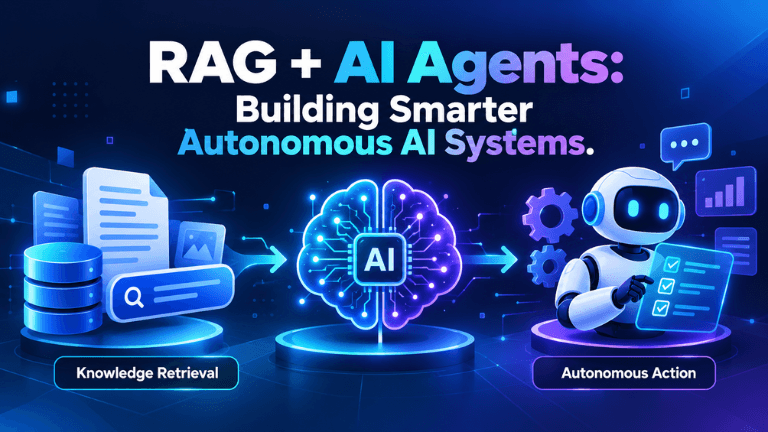
What Exactly Are RAG and AI Agents?
If you've been exploring AI lately, you've probably come across two terms that keep popping up everywhere — RAG and AI Agents. They sound technical, maybe even a little intimidating, but once you break them down, they're actually pretty intuitive.
Let's start with RAG, or Retrieval-Augmented Generation. Think about how a regular AI model like a chatbot works — it generates answers based on what it learned during training. The problem? That training data has a cutoff date, and the model can't look things up on its own. RAG fixes this by giving the AI a way to "search" through external documents, databases, or the internet before answering your question. So instead of guessing or relying on outdated memory, the AI actually fetches relevant, current information first, and then uses that to generate a more accurate response.
Now, AI Agents take things a step further. An agent isn't just answering questions — it's taking actions. Imagine an AI that doesn't just tell you "here's how to book a flight" but actually goes and books it for you, checking prices, comparing options, and making decisions along the way. That's the core idea behind agents: they can plan, use tools, make decisions, and complete multi-step tasks with minimal human hand-holding.
So where does the magic happen? When you combine RAG with AI Agents, you get something genuinely powerful. The agent can pull in fresh, accurate information using RAG, and then use that information to reason, plan, and act — whether that's answering a complex customer query, automating research, or managing a workflow. For students in Jalandhar stepping into the AI and tech space, understanding this combination isn't just theoretical knowledge — it's quickly becoming one of the most in-demand skills in the industry, especially as companies look to build smarter, more autonomous systems.
Why This Combination Matters for Beginners
A lot of students ask us, "Is this something I can actually learn if I'm just starting out?" And honestly, the answer is yes — but with the right approach. You don't need to be a machine learning PhD to understand RAG and AI agents. What you do need is a solid grip on the fundamentals: how language models work, basic Python, and some familiarity with how data gets stored and retrieved (think vector databases like Pinecone or FAISS).
Here's a mistake a lot of beginners make — they jump straight into building an "agent" without understanding why RAG matters in the first place. If your agent doesn't have access to accurate, up-to-date information, it's going to make decisions based on incomplete or outdated knowledge. That's like asking someone to plan a road trip using a ten-year-old map. The retrieval piece isn't optional — it's what keeps the whole system grounded in reality.
Another common doubt: "What can I actually build with this?" More than you'd think. Customer support systems that pull answers from a company's actual documentation instead of giving generic replies. Research assistants that scan hundreds of papers and summarize findings. Internal tools that help businesses query their own data instead of digging through spreadsheets manually. Even personal projects — like an agent that tracks your study material and quizzes you based on what you've actually covered.
The real shift happening right now is that AI isn't just answering questions anymore — it's starting to do things. And that's exactly why RAG and agents are being talked about together so often. One brings the knowledge, the other brings the action. For anyone in Jalandhar looking to build a career in AI development, this is the direction the industry is heading, and getting comfortable with these concepts early gives you a real head start over people who are still catching up.
Getting Started: A Practical Path Forward
So how do you actually begin? Start small. Before touching any agent frameworks, get comfortable with the basics of how retrieval works — understand embeddings (how text gets converted into numbers that capture meaning), and play around with a simple vector database. Build a tiny RAG pipeline that just answers questions from a PDF or a set of notes. It sounds basic, but this foundation is what everything else builds on.
Once that clicks, move into agent frameworks like LangChain, LlamaIndex, or CrewAI. These tools handle a lot of the heavy lifting, letting you focus on designing how your agent thinks and acts rather than building everything from scratch. Try creating an agent that can answer a question, decide if it needs more information, retrieve that information, and then respond — that loop is the heart of how these systems operate.
A question we hear often: "How difficult is this compared to regular coding?" It's less about difficulty and more about a different way of thinking. You're not just writing instructions step-by-step — you're designing a system that makes decisions on its own. That shift takes practice, but it's absolutely learnable with consistent effort and the right guidance.
One more thing worth mentioning — don't get discouraged if your first agent doesn't work perfectly. These systems involve multiple moving parts: retrieval accuracy, prompt design, tool integration, and decision logic. Debugging an agent is a skill in itself, and every student who's good at this today started out with agents that gave weird, wrong, or confusing answers.
If you're serious about building a career around this, structured, hands-on learning makes a real difference. Working through actual projects, under guidance, rather than just watching tutorials, is what separates people who understand RAG and agents conceptually from those who can actually build and deploy working systems. That practical, project-based approach is exactly what helps students in Jalandhar move from curious beginners to confident AI builders.
For students who want to develop these skills through structured, practical training, techcadd's RAG Certificate Course in Jalandhar can be a valuable learning path. The course focuses on practical understanding and project-based learning, helping students explore RAG, AI agents, and real-world AI application development.
Filed under
Keep reading
- What Is RAG? A Beginner's Guide to Retrieval-Augmented Generation New to AI? Learn what RAG (Retrieval-Augmented Generation) means, how it works, and why it matters for students in Jalandhar starting their AI and data science journey with techcadd.
- Deep Learning Explained: How It Works, Real-World Applications & What's NextConfused about deep learning? This complete guide breaks down how it actually works, where it's used, and why it's a smart skill to learn in Jalandhar right now.
- From Confusion to Confidence: One Boy's Journey Into Generative AI at techcadd, Jalandhar A relatable story of a confused beginner who found clarity in Generative AI through techcadd's Jalandhar training — real struggles, real breakthroughs, and a path any student can follow.
Comments
Loading…