On this page
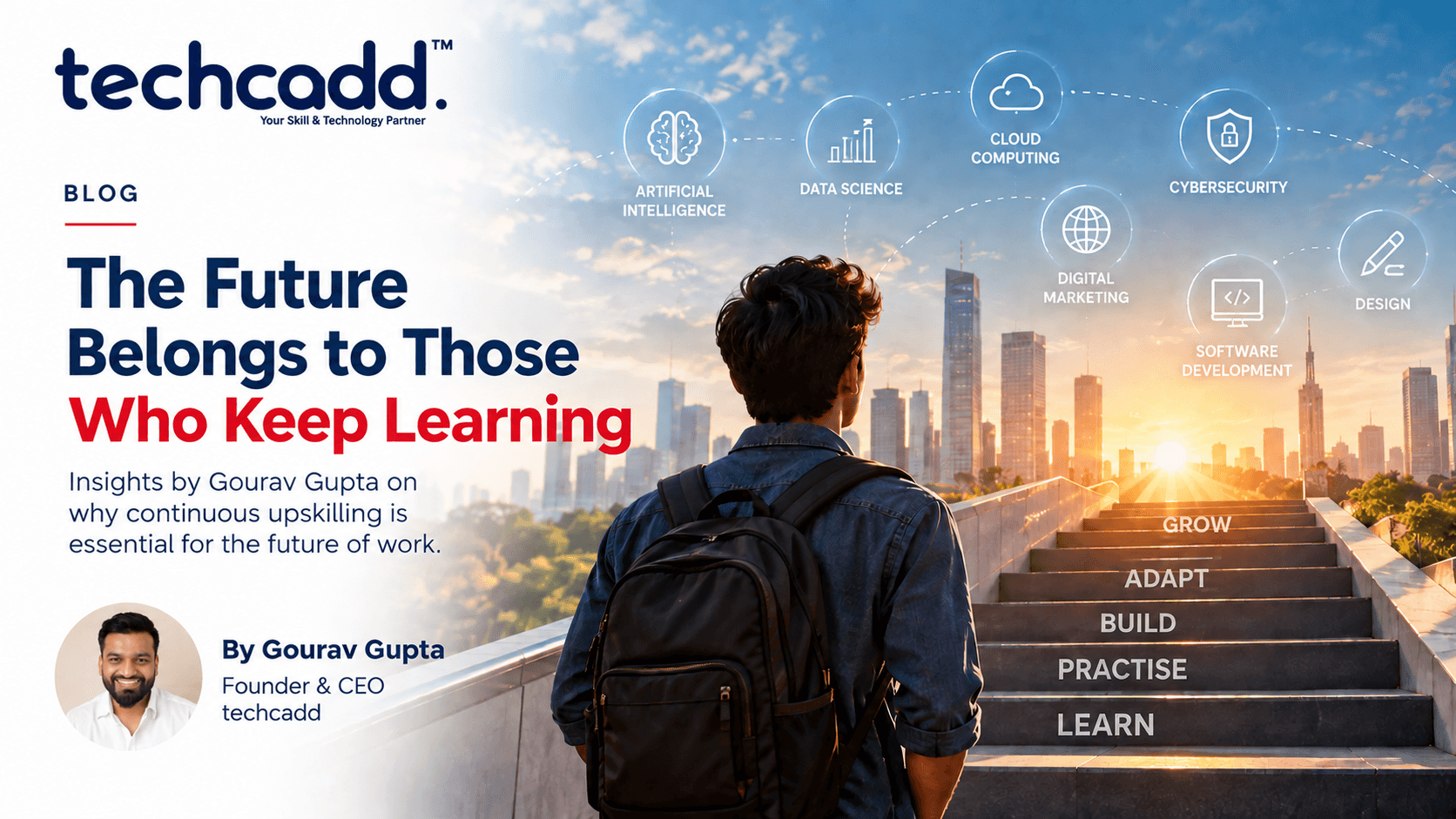
Technology has never evolved at the pace at which it is evolving today.
Artificial Intelligence is changing how we work. Cloud computing has transformed how businesses build and deliver digital services. Cybersecurity has become a business necessity rather than simply an IT function. Data is influencing decisions across industries, while automation is changing the way tasks and processes are performed.
But there is another transformation happening alongside the technological one—and, in my view, it is equally important:
The definition of being “skilled” is changing.
A degree, a certificate or even knowledge of a particular technology can be a starting point. But in a rapidly changing technology landscape, the ability to learn, apply, adapt and continuously upgrade has become increasingly important.
The World Economic Forum’s Future of Jobs Report 2025 estimates that 39% of workers’ existing skill sets are expected to be transformed or become outdated between 2025 and 2030. It also identifies AI and big data, networks and cybersecurity, and technological literacy among the fastest-growing skill areas.
This tells us something important: learning cannot have an expiry date.
From Learning Technology to Using Technology
When techcadd was founded in 2016, one of the fundamental problems we wanted to address was the gap between what students learned academically and what they were expected to demonstrate in the workplace.
Over the years, that gap has taken different forms.
A student may understand programming concepts but struggle to build an application. Someone may know the terminology of digital marketing but have never worked on an actual campaign. Another learner may study cybersecurity concepts without understanding how those concepts translate into real-world security practices.
This is why I have always believed that learning becomes meaningful when it is put into practice.
At techcadd, our approach has therefore evolved around practical exposure, project-based learning, emerging technologies, and industry-oriented training. Our objective is not simply to help a learner complete a course; it is to help them develop the confidence to use what they have learned.
AI Is Not Just Another Course
Artificial Intelligence deserves particular attention.
AI is no longer limited to specialised research laboratories or technology companies. It is increasingly becoming part of everyday professional workflows: from software development and marketing to analytics, design, customer service and business operations.
But learning AI should not mean simply learning how to use a collection of AI tools.
The deeper opportunity lies in understanding how AI works, where it can create value, where its limitations lie, and how humans can work effectively alongside it.
This is why the conversation around AI education must move beyond tools and trends towards AI literacy, problem-solving, critical thinking, responsible use and practical application.
The same principle applies to cybersecurity, cloud computing, data science, software development and every other technology discipline.
Technology changes.
The ability to learn technology is the skill that remains.
The Skills Gap Is Also an Application Gap
There is considerable discussion today about the “skills gap.” But I believe we should also look at what I would call the application gap.
Knowing what something is and knowing how to use it are two different things.
A learner may know what a database is. A developer needs to know how to design and use one.
A learner may understand what cybersecurity means. A cybersecurity professional needs to understand how systems can be protected.
A student may know the principles of graphic design. A designer needs to communicate a real message for a real audience.
This distinction is central to how we think about skill development at techcadd.
Learn the concept. Practise the skill. Build something. Receive feedback. Improve. Repeat.
That cycle is far more valuable than learning something once and assuming the learning is complete.
Education and Industry Must Work Together
Educational institutions have an important role in building strong foundations. Industry has an equally important role in showing learners how those foundations are applied.
That is why industry-academia collaboration matters.
Through collaborations with universities and colleges, technology workshops, seminars, internship initiatives, placement drives and industry interactions, techcadd works to create more opportunities for students to experience technology beyond conventional classroom learning.
An MOU should never be viewed simply as a document signed between two organisations.
Its real value begins after the signatures.
It should create opportunities for students to learn from practitioners, experience emerging technologies, work on practical problems, understand industry expectations and explore possible career pathways.
That is when a partnership becomes meaningful.
Upskilling Is No Longer Optional
One of the biggest changes I see today is that upskilling is no longer something people should consider only when they are looking for a new job.
It is becoming part of professional life itself.
A software professional may need to understand AI-assisted development. A marketer may need to understand analytics and automation. A designer may need to understand AI-enabled creative workflows. A business professional may need greater technological literacy.
The question is therefore not:
“What course should I complete?”
The better question is:
“What capability do I need to build next?”
The World Economic Forum reports that employers increasingly expect both technological skills and human capabilities, including creative thinking, analytical thinking, resilience, flexibility and lifelong learning, to remain important as work evolves.
This combination is critical.
Technology can provide tools.
People provide judgement, creativity, context and responsibility.
What Should Young Professionals Focus On?
If I were to offer one piece of advice to someone beginning their technology career today, it would be this:
Do not chase every trend. Build the ability to understand and adapt to trends.
Start with strong fundamentals.
Then choose a domain that genuinely interests you, whether that is software development, AI, data science, cybersecurity, cloud computing, digital marketing, design, or another technology-driven field.
Then build.
Create projects. Solve problems. Make mistakes. Ask questions. Seek feedback. Work with others. Understand how technology is used in actual businesses.
And perhaps most importantly, keep learning after the course ends.
A course can provide direction.
A project can provide evidence.
Experience can provide perspective.
But continuous learning is what keeps all three relevant.
The Role of techcadd
At techcadd, our journey has always been closely connected to this idea.
We began with a focus on making young people more capable and confident with technology and on bridging the gap between academics and industry through practical, future-ready skills.
As technology has evolved, so has our learning ecosystem: from conventional computer education towards areas such as Artificial Intelligence, Data Science, Cybersecurity, Cloud Computing, Full Stack Development, Digital Marketing, Graphic Designing, CAD/CAM and other emerging technologies.
Our responsibility, however, remains unchanged:
To help people become capable of learning, applying, and adapting to technology.
Because the objective of skill development should never be to prepare someone only for today's job market.
It should be to give them the confidence and capability to participate in tomorrow's.
Looking Ahead
The future of work will undoubtedly bring uncertainty.
Some technologies will become mainstream. Others will disappear. New professions will emerge. Existing roles will change. Businesses will adopt new tools, and professionals will have to learn new ways of working.
We cannot predict every technology that will matter five or ten years from now.
But we can prepare people to navigate that uncertainty.
We can build stronger fundamentals.
We can encourage curiosity.
We can make practical learning a priority.
We can create stronger connections between academia and industry.
And we can make continuous upskilling part of the culture.
That is the future of education I believe in.
Not education that ends with a certificate, but education that continues through every project, every challenge, every new technology, and every stage of a person's career.
Because ultimately, the future will not belong to those who know the most today.
It will belong to those who are willing to keep learning tomorrow.
— Mr. Gourav Gupta
Founder & CEO, techcadd
Filed under
Keep reading
- Artificial Intelligence vs Data Science: Which Should You Learn First in 2026?Artificial Intelligence and Data Science share tools like Python and machine learning, but they aim at different goals. Here's how to tell them apart before choosing.
- Excel + AI: The New Trend Reshaping Office Work — How techcadd Is Preparing StudentsExcerpt Discover how combining traditional Excel skills with AI tools is transforming modern office productivity. Learn how techcadd is equipping students with advanced, AI-powered spreadsheet techniques to succeed in today's evolving job market.
- How techcadd Jalandhar Is Helping Students Turn Digital Marketing Skills into Career OpportunitiesDiscover how techcadd Jalandhar is helping students turn digital marketing skills into real career opportunities through practical training, mentorship and hands-on projects.
Comments
Loading…