On this page
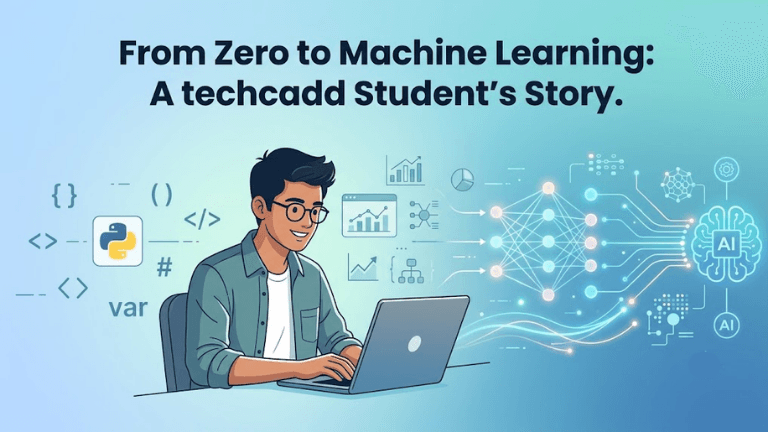
"I Can't Even Write a Line of Code" — Sound Familiar?
A few months ago, Simran walked into techcadd's Jalandhar center with a laptop she barely used for anything beyond YouTube and college assignments. She had a commerce background, zero programming experience, and a genuine fear that Machine Learning was "only for engineering toppers." Sound like someone you know? Maybe it's you.
Here's the thing nobody tells beginners: almost every ML developer you admire today started exactly where Simran did — confused by terms like "algorithm," intimidated by Python, and unsure if they were even capable of understanding this stuff.
The truth is, Machine Learning isn't reserved for people who've been coding since childhood. It's reserved for people willing to learn one concept at a time, without rushing.
Why "Zero Experience" Isn't a Problem
When students hear "Machine Learning," they picture complex math, endless code, and years of preparation. In reality, the starting point is much simpler than that. Basic logical thinking, curiosity, and consistency matter far more than prior coding exposure.
At techcadd, the approach for absolute beginners looks something like this:
Start with why ML matters, using everyday examples — like how Netflix recommends shows or how Google Maps predicts traffic
Build basic programming comfort in Python before touching any ML concept
Introduce math (statistics, probability) only as needed, in bite-sized, practical doses
Move from theory to hands-on practice almost immediately
Simran's first two weeks weren't about Machine Learning at all — they were about getting comfortable typing code without panicking every time an error popped up. That's a completely normal part of the process, and honestly, a part most tutorials skip talking about.
By week three, something shifted. She wasn't just following instructions anymore — she was starting to predict what the code would do before running it.
The Turning Point: From Confusion to "Wait, I Actually Get This"
Every student hits a wall at some point — usually right around the time loops, functions, or data structures show up. Simran hit hers in week four. She almost considered quitting, convinced she "wasn't the technical type."
This is a common doubt, and it's worth addressing directly: struggling with a concept doesn't mean you're bad at this. It means you're learning something genuinely new. The students who push through this exact phase are the ones who go on to build real projects.
What helped Simran wasn't more theory — it was smaller, practical wins. Instead of jumping straight into complex ML models, her mentors at techcadd broke things down into manageable pieces:
Cleaning and organizing a simple dataset (like student marks or sales numbers)
Visualizing that data so patterns actually became visible
Training a basic prediction model on something relatable, like predicting exam scores based on study hours
That last one was her breakthrough moment. Seeing her own code predict an outcome — even something simple — changed how she saw herself. She wasn't "a commerce student trying to learn tech" anymore. She was someone building things.
What Beginners Usually Get Wrong
A common mistake is trying to learn everything at once — jumping between YouTube videos, random courses, and advanced topics before the basics are solid. This creates confusion, not confidence.
Another mistake is comparing your Day 10 to someone else's Day 100. Every student's pace is different, and ML rewards patience far more than speed.
By the two-month mark, Simran wasn't just completing exercises. She was asking better questions — the kind that come from genuine understanding, not memorization.
Where Simran Is Now — And What This Means for You
Simran's Journey Into Machine Learning
Today, Simran is working on a real project: a model that predicts customer churn for a small local business, using actual data instead of textbook examples. She still has plenty to learn, but the fear is gone. It's been replaced by curiosity — the same curiosity that drives every good developer forward.
So, does learning Machine Learning actually help your career? For students in Jalandhar looking at fields like data analysis, AI development, automation, or even enhancing an existing tech role, Machine Learning can open up new opportunities. Companies today aren't just looking for people who understand ML theory — they increasingly value people who can apply those concepts to real-world problems. That's why practical, project-based learning matters.
At Techcadd's Machine Learning course n Jalandhar, students get the opportunity to learn concepts step by step while working towards practical applications rather than simply watching tutorials or memorising theory.
If you're wondering whether this path is realistic for you too, here's what actually matters:
You don't need a computer science degree to start. A willingness to learn and a basic understanding of computers can be a starting point.
You do need consistency. Showing up and practising regularly beats occasional bursts of intense study.
Real progress comes from projects. Writing code, working with datasets, fixing errors, and building models teaches you things that passive tutorial-watching can't.
Having accessible mentors can make a difference. Being able to ask questions, get feedback, and understand where you're going wrong can make the learning process less overwhelming for beginners.
That's an important part of the learning approach at Techcadd — structured training, mentor guidance, practical exercises, and a learning environment where beginners can ask questions instead of getting stuck alone.
Simran's story isn't unique because she's exceptionally gifted. It's meaningful because it shows what consistent learning can look like. With the right guidance, regular practice, and a willingness to start small, students can move from having little or no coding experience to building a genuine understanding of Machine Learning.
If there's one thing to take away from her journey, it's this: the hardest part isn't the coding. It's deciding to start — and then staying consistent long enough to see what you're capable of building.
Filed under
Keep reading
- How a Jalandhar Graduate Landed a Cloud Job Just Months After Learning AWS A Jalandhar graduate went from zero cloud knowledge to a cloud computing job in just a few months. Here's the real story of how learning AWS at techcadd changed his career path.
- How Ethical Hacking Training Turned a Curious Mind Into a Cyber Professional in JalandharFrom curious beginner to confident cyber professional — discover how ethical hacking training in Jalandhar helped one student build real skills, land opportunities, and start a career in cybersecurity.
- The Jalandhar Teenager Who Found a Security Flaw in a Local Business WebsiteA Jalandhar teen spotted a security flaw in a local business website — a real story showing why ethical hacking and cybersecurity skills matter for students today.
Comments
Loading…