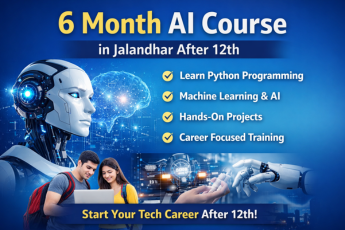
6 Month AI Course in Jalandhar after 12th – TechCadd
Your Complete Guide to Building a Career in Artificial Intelligence
Looking for a 6 Month AI Course in Jalandhar after 12th? TechCadd, a premier IT and AI training institute, is becoming the top choice for students who want practical, job-ready artificial intelligence skills. With businesses increasingly adopting AI technologies across every industry sector, learning how to develop, implement, and optimize AI solutions has become an essential skill for 2026 and beyond. The demand for skilled AI professionals is growing exponentially, and there has never been a better time to invest in this future-proof career path.
Why Artificial Intelligence is the Career of the Future
Artificial Intelligence is no longer just a concept from science fiction movies. It is actively transforming how businesses operate, how healthcare is delivered, how financial decisions are made, and how we interact with technology on a daily basis. From personalized recommendations on Netflix and Amazon to voice assistants like Siri and Alexa, from facial recognition on our smartphones to autonomous vehicles being tested on roads—AI is everywhere around us.
By 2026, it is estimated that over 85% of companies will have integrated AI into their operations in some form. This widespread adoption is creating millions of job opportunities for trained professionals who understand how to build, deploy, and maintain AI systems. The 6 Month AI Course in Jalandhar after 12th at TechCadd is designed specifically for young learners who want to get a head start in this exciting and rapidly growing field.
Unlike traditional degree programs that take three or four years to complete, our intensive 6-month program gives you industry-relevant skills that employers are actively seeking right now. You don't have to wait years to start your career—you can begin your journey today and be job-ready in just six months.
About TechCadd: Your Trusted Partner in AI Education
At TechCadd, the AI training in Jalandhar combines modern AI methodologies with hands-on practice. We have established ourselves as a leading IT and AI training institute in the region, known for our practical approach to teaching and our unwavering commitment to student success. Our state-of-the-art facilities, experienced trainers, and strong industry connections make us the preferred choice for students who want quality education that translates into real career opportunities.
While our comprehensive course covers core areas like machine learning, Python programming, data science, neural networks, and natural language processing, it also emphasizes practical project execution, live industry projects, and real-time use of industry-standard AI tools. The program is suitable for 12th pass students with little or no prior programming experience, as well as graduates who want to enhance their AI expertise. We firmly believe that anyone with curiosity, dedication, and a willingness to learn can master AI concepts with the right guidance and support.
What Makes Our 6-Month AI Course Special?
Students enrolled in the 6 Month AI Course in Jalandhar after 12th can expect personalized mentorship, live project sessions, and practical exposure to platforms like Python, TensorFlow, Keras, Scikit-learn, data visualization tools, and cloud AI services. TechCadd's training methodology focuses on building not just theoretical knowledge but measurable, results-driven AI skills that allow learners to develop intelligent applications effectively and generate real impact in the industry.
Our small batch sizes ensure that every student receives individual attention. You won't be just another face in a crowded classroom—you'll be part of a close-knit learning community where your questions are answered promptly, your progress is monitored closely, and your success is celebrated wholeheartedly. We believe in nurturing talent and helping each student discover their unique strengths in the vast and varied field of artificial intelligence.
Your Future with TechCadd
Whether you are aiming for a career as an AI engineer, machine learning specialist, data analyst, data scientist, or planning to start your own AI-powered venture, TechCadd's program equips you with industry-relevant knowledge, practical skills, and comprehensive placement support. By investing in this course, learners gain the ability to create data-driven AI solutions, optimize models for performance, and achieve tangible results in the world of artificial intelligence.
In today's fast-evolving technological ecosystem, the 6 Month AI Course in Jalandhar after 12th by TechCadd has established itself as a leading program for students seeking practical AI skills. Situated in the heart of Jalandhar, TechCadd has designed a comprehensive and interactive training program that demystifies artificial intelligence and prepares learners to thrive in a competitive tech environment. Our central location makes it convenient for students from all parts of the city and surrounding areas to access quality education.
What is Artificial Intelligence? Understanding the Core Concept
Before exploring the course specifics in detail, it is essential to understand what artificial intelligence truly means and why it matters. AI involves creating intelligent systems that can perform tasks requiring human intelligence, such as visual perception, speech recognition, decision-making, problem-solving, and language translation. Unlike traditional programming where every single step must be explicitly coded by a programmer, AI allows machines to learn from data, improve over time through experience, and make predictions or decisions based on patterns they discover in the data.
The 6 Month AI Course in Jalandhar after 12th starts by establishing these foundational principles in a way that is easy to understand for beginners. Students learn how AI differs from conventional programming, including the advantages of machine learning, deep learning, and neural networks. The course also highlights real-world AI applications that students encounter in their daily lives, such as recommendation systems used by Amazon and Netflix, chatbots that handle customer service queries on websites, autonomous vehicles being developed by Tesla and other companies, and healthcare diagnostics that help doctors detect diseases earlier and more accurately.
This contextual understanding prepares learners for realistic AI development scenarios they will encounter in their careers. By connecting abstract concepts to concrete examples, we ensure that students not only understand the theory but also appreciate the practical relevance of what they are learning.
Detailed Course Curriculum and Structure
The course is meticulously structured to take learners from foundational knowledge to practical AI development in a logical, step-by-step manner. Our curriculum is updated regularly to reflect the latest industry trends and technological advancements. Here is the complete breakdown of what you will learn during your six months with us:
Term 1: Foundations (2 Months)
Module 1: Programming with Python
Python has become the undisputed language of choice for AI and machine learning due to its simplicity, readability, and powerful libraries. In this module, you will master:
-
Python basics and syntax – Understanding variables, data types, operators, and control structures like loops and conditionals
-
Data structures and algorithms – Working with lists, tuples, dictionaries, sets, and implementing efficient algorithms for problem-solving
-
Object-oriented programming – Creating classes, objects, inheritance, and polymorphism to write reusable, organized code
-
Libraries: NumPy, Pandas, Matplotlib – Using NumPy for numerical computations, Pandas for data manipulation and analysis, and Matplotlib for creating visualizations
-
File handling and exception handling – Reading from and writing to files, managing errors gracefully to create robust programs
-
Functions and modules – Creating reusable code blocks and organizing code into modules for better maintainability
-
Working with APIs – Fetching data from web services and integrating external data sources into your applications
By the end of this module, you will be comfortable writing Python programs independently and ready to dive into AI-specific concepts with confidence.
Module 2: Mathematics for AI
AI is built on strong mathematical foundations. This module ensures you have the mathematical knowledge required to understand how AI algorithms actually work under the hood:
-
Linear algebra fundamentals – Vectors, matrices, eigenvalues, and eigenvectors that form the basis of neural networks and deep learning
-
Calculus for machine learning – Derivatives, gradients, and optimization techniques used in training machine learning models
-
Probability and statistics – Probability distributions, Bayes' theorem, hypothesis testing, and statistical inference for making decisions under uncertainty
-
Data visualization techniques – Creating meaningful charts and graphs to understand data patterns and communicate insights effectively
-
Statistical analysis for data science – Descriptive statistics, correlation, and regression analysis for understanding relationships in data
We teach mathematics in a practical, applied way—you'll see exactly how each mathematical concept is used in real AI applications, making the learning process engaging and relevant.
Module 3: Introduction to AI & Machine Learning
This module provides a broad overview of the AI landscape and sets the stage for deeper learning in subsequent modules:
-
AI concepts and applications – Understanding different types of AI (narrow AI, general AI, superintelligence) and their real-world uses
-
Types of machine learning – Supervised learning, unsupervised learning, semi-supervised learning, and reinforcement learning explained with examples
-
Supervised vs unsupervised learning – When to use each approach and their respective algorithms with practical use cases
-
AI project lifecycle – From problem definition to data collection, model building, deployment, and ongoing monitoring
-
Ethics in artificial intelligence – Understanding bias, fairness, transparency, accountability, and responsible AI development
-
History and evolution of AI – How we got from early expert systems in the 1950s to modern deep learning and large language models
-
Current trends and future directions – What's happening in AI research today and where the field is heading in the next decade
Term 2: Core AI & Machine Learning (2 Months)
Module 4: Machine Learning Algorithms
This is where you start building actual machine learning models that can make predictions and decisions. You'll learn both the theory behind algorithms and how to implement them:
-
Regression algorithms – Linear regression, polynomial regression, ridge regression, and lasso regression for predicting continuous values like prices or temperatures
-
Classification techniques – Logistic regression, k-nearest neighbors (KNN), support vector machines (SVM), and naive Bayes for categorizing data into classes
-
Clustering algorithms – K-means clustering, hierarchical clustering, and DBSCAN for finding natural groupings in unlabeled data
-
Decision trees and random forests – Building interpretable tree-based models and using ensemble methods for better performance
-
Model evaluation and validation – Cross-validation techniques, confusion matrices, precision, recall, F1-score, ROC curves, and AUC for assessing model performance
-
Gradient boosting algorithms – XGBoost, LightGBM, and CatBoost for achieving state-of-the-art performance on structured data
-
Dimensionality reduction – Principal Component Analysis (PCA) and t-SNE for visualizing and processing high-dimensional data
Module 5: Data Preprocessing & Feature Engineering
Real-world data is almost always messy and requires significant cleaning before it can be used for machine learning. This module teaches you how to prepare data effectively:
-
Data cleaning techniques – Handling duplicates, inconsistencies, formatting issues, and structural problems in datasets
-
Handling missing values – Various imputation strategies and when to drop vs. fill missing data based on the context
-
Feature selection methods – Identifying which features are most important for your model using statistical tests and domain knowledge
-
Data transformation – Scaling, normalization, standardization, and converting data types for optimal model performance
-
Dimensionality reduction – Reducing the number of features while preserving important information to avoid the curse of dimensionality
-
Outlier detection and treatment – Identifying anomalous data points and deciding whether to remove or transform them
-
Feature engineering – Creating new features from existing data to improve model performance and capture complex patterns
-
Encoding categorical variables – One-hot encoding, label encoding, and target encoding for converting categories to numbers
Module 6: Deep Learning & Neural Networks
Deep learning has revolutionized artificial intelligence and enabled breakthroughs in computer vision, natural language processing, and many other fields. This module introduces you to neural networks and their various architectures:
-
Neural network architecture – Understanding layers, neurons, weights, biases, and how information flows through networks via forward propagation
-
Activation functions – Sigmoid, tanh, ReLU, Leaky ReLU, and their variants for introducing non-linearity into networks
-
Backpropagation – How neural networks learn from errors by propagating gradients backward and updating weights using gradient descent
-
Convolutional Neural Networks (CNN) – Specialized networks for image data, used extensively in computer vision applications
-
Recurrent Neural Networks (RNN) – Networks for sequential data like time series, text, and speech that can remember past information
-
Long Short-Term Memory (LSTM) – Advanced RNNs that can learn long-term dependencies and overcome the vanishing gradient problem
-
Transfer learning – Using pre-trained models like VGG, ResNet, or BERT for your own tasks with minimal data and training time
-
Regularization techniques – Dropout, batch normalization, and early stopping to prevent overfitting and improve generalization
Term 3: Advanced AI & Projects (2 Months)
Module 7: Natural Language Processing (NLP)
NLP enables machines to understand, interpret, and generate human language. This module covers both fundamentals and state-of-the-art techniques:
-
Text preprocessing – Tokenization, stemming, lemmatization, removing stop words, and handling punctuation and special characters
-
Sentiment analysis – Determining whether text expresses positive, negative, or neutral sentiment for applications like social media monitoring
-
Language models – Understanding how modern language models like GPT, BERT, and T5 work under the hood
-
Chatbot development – Building conversational AI systems that can understand user queries and provide appropriate responses
-
NLP applications – Text classification, named entity recognition (NER), machine translation, question answering, and text summarization
-
Word embeddings – Word2Vec, GloVe, and FastText for representing words as dense vectors that capture semantic meaning
-
Transformer architecture – Understanding the revolutionary attention mechanism and transformer architecture behind modern NLP
-
Building practical chatbots – Creating conversational agents using frameworks like Rasa or Dialogflow
Module 8: Computer Vision
Computer vision teaches machines to interpret and understand visual information from the world. You'll learn:
-
Image processing – Filtering, edge detection, image enhancement, and morphological operations for preparing images
-
Object detection – Identifying and locating multiple objects within images using algorithms like YOLO (You Only Look Once) and SSD
-
Face recognition – Building systems that can detect faces and identify individuals from images or video streams
-
Image classification – Categorizing images into predefined classes using convolutional neural networks
-
OpenCV implementation – Using the popular OpenCV library for real-world computer vision applications
-
Image segmentation – Dividing images into meaningful regions for applications like medical imaging and autonomous driving
-
Video analysis – Processing video streams, tracking objects over time, and analyzing motion patterns
Module 9: AI Model Deployment
Building accurate models is only half the battle. This module teaches you how to put models into production where they can create real value:
-
Model saving and loading – Saving trained models to disk and loading them for inference using formats like pickle, joblib, and HDF5
-
Flask API development – Creating REST APIs to serve your models and make them accessible to web and mobile applications
-
Cloud deployment (AWS/Azure/GCP) – Deploying models on cloud platforms for scalability, reliability, and global accessibility
-
Model monitoring – Tracking model performance in production, detecting drift, and knowing when to retrain
-
Performance optimization – Making models faster and more efficient through techniques like quantization and pruning
-
Docker containerization – Packaging models and dependencies into containers for consistent deployment across environments
-
CI/CD for machine learning – Automating the deployment pipeline for continuous integration and delivery of ML models
Module 10: Capstone Projects
The final module brings everything together through hands-on projects that simulate real-world scenarios:
-
Real-world AI project – Working on a complete project from problem definition to deployment, following industry best practices
-
Industry case studies – Analyzing how leading companies have successfully implemented AI to solve business problems
-
Portfolio development – Building a comprehensive portfolio that showcases your skills and projects to potential employers
-
Project presentation – Presenting your work, explaining your approach, and defending your technical decisions
-
Interview preparation – Technical and behavioral interview practice with mock interviews and feedback sessions
-
Collaborative team projects – Working in teams to simulate real work environments and develop collaboration skills
Pedagogical Approach: How We Teach
At TechCadd, we believe that the best way to learn AI is by doing AI. Our teaching methodology is designed to maximize practical learning while ensuring you understand the underlying concepts thoroughly:
-
Live coding sessions – Watch instructors write code in real-time and explain their thought process, debugging strategies, and best practices
-
Weekly assignments – Regular practice exercises that reinforce learning and help you apply concepts independently
-
Monthly assessments – Track your progress, identify areas for improvement, and ensure you're keeping up with the pace
-
Group projects – Collaborate with peers on complex problems that require teamwork and communication skills
-
One-on-one mentorship – Personalized guidance from experienced instructors who are invested in your success
-
Industry guest lectures – Learn from professionals working in the field about real-world applications and career insights
-
Code review workshops – Get constructive feedback on your code and learn industry best practices for writing clean, efficient code
-
Debugging practice sessions – Develop systematic skills to troubleshoot issues and fix problems independently
Tools and Technologies You'll Master
Students gain hands-on experience with industry-standard tools that are actually used by companies every day:
Programming Languages:
-
Python – The primary language for AI development, used by 90% of AI professionals
-
SQL – For working with databases and extracting data for analysis
Libraries & Frameworks:
-
TensorFlow – Google's powerful deep learning framework for building and deploying models
-
Keras – High-level API for building neural networks quickly and easily
-
Scikit-learn – Classic machine learning algorithms for traditional ML tasks
-
PyTorch – Facebook's deep learning framework, popular in research and increasingly in industry
-
OpenCV – Computer vision library with hundreds of algorithms for image and video analysis
-
NLTK – Natural Language Toolkit for traditional NLP tasks
-
Transformers – State-of-the-art NLP models from Hugging Face
-
Hugging Face – Platform for accessing, sharing, and deploying pre-trained models
-
FastAI – Library making deep learning more accessible with high-level components
Development Tools:
-
Jupyter Notebook – Interactive coding environment perfect for data exploration and prototyping
-
Google Colab – Cloud-based notebooks with free GPU access for training models faster
-
VS Code – Popular code editor with excellent Python and AI extensions
-
GitHub – Version control and collaboration platform for managing code and working in teams
-
Flask – Lightweight web framework for creating APIs to serve models
-
Docker – Containerization platform for consistent deployment across environments
Cloud Platforms:
-
Google Cloud AI – AI and machine learning services on Google Cloud Platform
-
AWS Machine Learning – Amazon's comprehensive AI and ML offerings
-
Azure AI Services – Microsoft's AI platform with pre-built and custom model options
Data Visualization:
-
Matplotlib – Basic plotting library for creating static visualizations
-
Seaborn – Statistical data visualization with beautiful default styles
-
Plotly – Interactive visualizations for web and dashboard applications
-
Tableau – Business intelligence and visualization platform for professional dashboards
Long-Term Benefits of the Course
Enrolling in the 6 Month AI Course in Jalandhar after 12th provides significant long-term advantages that extend far beyond the classroom and well into your career:
-
Develop AI-powered applications and solutions – Create intelligent systems that solve real business problems and improve people's lives
-
Work as AI engineers or machine learning specialists – Step into high-demand, well-paying roles with excellent growth prospects
-
Build intelligent chatbots and recommendation systems – Create applications that engage users and drive business value
-
Analyze complex data and extract meaningful insights – Help organizations make data-driven decisions that improve outcomes
-
Create computer vision applications – Build systems that can see, interpret, and understand the visual world
-
Pursue higher education in AI and data science – A strong foundation for advanced degrees like M.Tech, MS, or PhD programs
-
Start your own AI-focused venture – Turn your innovative ideas into successful businesses
-
Build a professional portfolio – Showcase your projects to potential employers and stand out from other candidates
-
Advance your career with practical, industry-recognized expertise – Move up the career ladder faster with in-demand skills
-
Work remotely for international companies – Access global opportunities without leaving your home country
-
Contribute to open-source AI projects – Give back to the community, build your reputation, and learn from others
-
Stay relevant as technology evolves – AI skills will only become more valuable over time, ensuring long-term career security
Career Opportunities After Completing the Course
Completing this 6 Month AI Course in Jalandhar after 12th opens doors to numerous career paths. The AI job market is booming, and companies across industries are struggling to find enough qualified professionals:
Job Roles You Can Pursue:
-
AI Engineer – Design, implement, and maintain AI systems and applications
-
Machine Learning Engineer – Build, deploy, and scale machine learning models in production
-
Data Scientist – Extract insights from complex data and build predictive models
-
AI Developer – Develop AI-powered applications for various domains and platforms
-
NLP Engineer – Specialize in natural language processing for text and speech applications
-
Computer Vision Engineer – Work on image and video analysis for applications like surveillance, healthcare, and automotive
-
AI Consultant – Help businesses identify opportunities and implement AI solutions
-
Research Assistant – Work in academic or industrial research labs on cutting-edge AI problems
-
Junior AI Developer – Entry-level role with excellent growth potential and learning opportunities
-
AI Intern – Gain valuable experience while learning from industry professionals
-
Prompt Engineer – Design effective prompts for large language models like GPT
-
ML Ops Engineer – Manage the machine learning lifecycle including deployment, monitoring, and maintenance
-
Data Analyst (AI focus) – Analyze data using AI techniques and build simple predictive models
Industries Actively Hiring AI Professionals:
-
IT Services – Technology companies, consulting firms, and service providers
-
Healthcare – Medical imaging, drug discovery, patient monitoring, personalized medicine
-
Finance & Banking – Fraud detection, algorithmic trading, credit scoring, risk assessment
-
E-commerce – Recommendation systems, customer analytics, demand forecasting
-
Education Technology – Personalized learning, automated grading, intelligent tutoring systems
-
Manufacturing – Predictive maintenance, quality control, supply chain optimization
-
Automotive – Autonomous vehicles, driver assistance systems, traffic prediction
-
Robotics – Intelligent robots for manufacturing, healthcare, logistics, and service applications
-
Gaming – Intelligent NPCs, procedural content generation, player behavior analysis
-
Startups – Innovative companies building AI-powered products and services
-
Government Sector – Smart cities, public services, defense, and security applications
-
Research Organizations – Pushing the boundaries of AI through fundamental and applied research
-
Media & Entertainment – Content recommendation, personalization, and creation
-
Agriculture – Crop monitoring, yield prediction, precision agriculture
-
Telecommunications – Network optimization, customer churn prediction, service personalization
Average Salary Range in India:
-
Fresher: ₹3-6 LPA (Lakhs Per Annum) depending on company and location
-
Experienced (2-3 years): ₹8-15 LPA with strong growth trajectory
-
Senior AI Engineer: ₹18-30 LPA+ for professionals with proven expertise
-
AI Architect: ₹35-50 LPA+ for those who design large-scale AI systems
-
Freelance AI Developer: ₹50,000-2,00,000 per project depending on complexity and client
Who Should Enroll in This Course?
This course is designed for a wide range of learners with different backgrounds and goals. You are an ideal candidate if you fall into any of these categories:
✅ 12th Pass Students – Wanting to start their career in AI immediately after school instead of waiting for a traditional degree
✅ College Students – Looking to add valuable AI skills alongside their degree for better job prospects upon graduation
✅ Graduates – Seeking to upskill for better job opportunities in the rapidly growing tech industry
✅ Working Professionals – Wanting to switch to an AI career from another field like traditional software development or non-technical roles
✅ Entrepreneurs – Planning to build AI-powered businesses or add AI capabilities to existing ventures
✅ Tech Enthusiasts – Passionate about learning artificial intelligence and staying ahead of the technological curve
✅ Teachers & Educators – Wanting to teach AI to students and stay relevant in the changing education landscape
✅ Freelancers – Looking to add high-value AI services to their portfolio and increase earning potential
✅ Job Seekers – Wanting high-paying AI roles with excellent growth prospects and long-term career security
✅ Researchers – Interested in AI and machine learning for academic or industrial research applications
✅ Hobbyists – Exploring AI for personal projects and intellectual curiosity
No prior programming experience is required to join this course—just curiosity, dedication, and a genuine willingness to learn. Our course starts from the absolute basics and gradually builds up to advanced concepts, ensuring that every student can succeed regardless of their starting point.
Why Choose TechCadd for Your AI Course in Jalandhar?
When you choose TechCadd, you're not just signing up for a course—you're investing in your future with a partner committed to your success. Here's why students consistently choose us over other options:
1. Industry-Relevant Curriculum
-
Updated as per 2026 industry requirements, not outdated textbooks from years ago
-
Covers latest AI trends and technologies including generative AI and large language models
-
Focus on practical implementation rather than just theoretical concepts
-
Developed in consultation with industry experts who know what employers need
2. Experienced Trainers
-
Industry professionals with 5+ years of real-world experience building AI systems
-
Personalized mentorship for each student, not just one-size-fits-all teaching
-
Real-world project guidance from people who have actually built and deployed AI solutions
-
Passionate about teaching and genuinely invested in student success
3. Hands-on Training
-
70% practical + 30% theory for optimal learning and skill development
-
10+ live projects that simulate real work environments and challenges
-
Industry tools exposure so you're comfortable with the tools used by professionals
-
Portfolio-building exercises that give you something concrete to show employers
4. Comprehensive Placement Support
-
Resume building workshops to showcase your skills and projects effectively
-
Mock interviews to build confidence and improve your interview performance
-
Job placement assistance with our extensive network of hiring partners
-
Industry connections through our active alumni network working at top companies
5. Recognized Certification
-
Govt. recognized certificate valued by employers across the industry
-
Industry valid certification that demonstrates your competence to hiring managers
-
Project completion certificate for each major project you complete
-
Letter of recommendation for outstanding students who excel in the program
6. Affordable Fees with Flexible Options
-
Competitive pricing compared to other institutes offering similar quality
-
Flexible payment options to suit your budget and financial situation
-
EMI facility available with no hidden costs or interest charges
-
Scholarships for meritorious students based on academic performance
7. Modern Infrastructure
-
Fully equipped computer labs with latest hardware and software
-
High-speed internet for seamless learning and project work
-
Smart classrooms with modern teaching aids and presentation technology
-
Library with latest resources, reference materials, and research papers
-
24/7 lab access for practice and project work at your convenience
8. Prime Location Advantage
-
Situated in the heart of Jalandhar, easily accessible from all parts of the city
-
Well-connected by public transport including buses and auto-rickshaws
-
Safe and secure environment with proper facilities for all students
-
Nearby amenities including food courts, banks, and other essential services
Course Highlights at a Glance
Admission Process
Getting started with your AI journey at TechCadd is simple and straightforward:
Step 1: Fill the online application form on our website or visit our campus to fill the offline form with your basic details
Step 2: Attend a personal counseling session where we understand your goals, assess your interests, and explain the course in complete detail
Step 3: Take an optional aptitude test to assess your strengths (not mandatory for admission but helpful for placement)
Step 4: Enroll by paying the registration fee and secure your seat in the upcoming batch
Step 5: Start your AI journey with our expert trainers on the scheduled start date!
Why Choose TechCadd for 6 Month AI Course in Jalandhar After 12th
Your Complete Guide to Building a Successful Career in Artificial Intelligence
In the heart of Punjab, Jalandhar is no longer known only for sports goods and traditional industries. It is rapidly emerging as a growing hub for technology, innovation, and skill-based education. As businesses across the globe adopt automation, data analytics, and intelligent systems, Artificial Intelligence (AI) has become one of the most in-demand career fields in India and worldwide. The transformation is happening right before our eyes, and those who prepare themselves today will lead tomorrow.
If you have just completed your 12th and are wondering what career path can give you strong growth, high salary potential, and long-term future security, Artificial Intelligence is the answer. But here comes the most important question that every student and parent asks:
Where should you learn AI properly?
Many institutes claim to offer AI courses. Some promise quick certifications that hold little value in the job market. Others advertise "no coding required" shortcuts that simply don't exist in the real world of AI. A few focus only on theory, leaving students completely unprepared for actual industry work. But AI is not a shortcut-based career. It requires proper fundamentals, hands-on training, and genuine industry guidance from experienced professionals.
This is exactly where TechCadd Computer Education stands apart from every other institute in Jalandhar and Punjab.
Our 6 Month AI Course in Jalandhar after 12th is carefully designed to transform complete beginners into confident, industry-ready AI professionals. We don't just teach you concepts—we build your entire career foundation from the ground up.
Why Artificial Intelligence is the Career of the Future
Before choosing any course, it is important to understand why AI matters so much in today's world and why it will dominate the future job market.
Think about your daily life for a moment:
When Netflix recommends movies you might enjoy, AI is working behind the scenes analyzing your viewing history. When Instagram shows you personalized content that keeps you scrolling, AI algorithms are deciding what appears on your feed. When Google suggests search results almost instantly, AI is ranking billions of pages to find exactly what you need. When online shopping apps recommend products you didn't even know you wanted, AI is predicting your preferences based on complex patterns.
All of this is powered by Artificial Intelligence and Machine Learning.
But AI is not limited to big tech companies and entertainment platforms. It has penetrated every industry you can imagine:
In Healthcare, AI helps doctors predict diseases before symptoms appear, analyzes medical scans with superhuman accuracy, and discovers new drugs that can save millions of lives. Hospitals across India are actively hiring AI professionals who can implement these life-saving technologies.
In Banking and Finance, AI systems detect fraudulent transactions in real-time, assess credit risk for loan applicants, and automate trading decisions that move millions of rupees. Every major bank now has dedicated AI teams working on these challenges.
In E-commerce, AI powers recommendation engines that increase sales, optimizes pricing strategies based on demand, and manages inventory across massive warehouses. Companies like Amazon, Flipkart, and Myntra constantly need AI talent.
In Marketing, AI analyzes customer behavior to target advertisements more effectively, predicts which campaigns will succeed, and personalizes communication at scale. Digital marketing agencies are increasingly relying on AI professionals.
In Manufacturing, AI enables predictive maintenance that prevents costly equipment failures, optimizes production schedules, and controls robots that assemble products with precision. Punjab's manufacturing sector is beginning to adopt these technologies.
In Agriculture, AI helps farmers monitor crop health, predict weather impacts, and optimize water usage. This is particularly relevant for Punjab's agricultural economy.
The demand for AI professionals is incredibly high across all these sectors. But here's the most important thing to understand: the supply of skilled professionals is still very limited.
That gap between demand and supply is your opportunity.
Companies are struggling to find qualified AI talent. They are willing to pay premium salaries to those who have the right skills. By starting your AI education now, immediately after 12th, you position yourself to capture this opportunity before the market becomes saturated.
Why Choose a 6 Month AI Course After 12th?
Many students wait until graduation to choose a specialization. They spend three or four years in college, and only then start thinking about career skills. But starting AI right after 12th gives you a powerful advantage that these students will never have.
Here's why beginning early makes such a difference:
You start building technical skills years before your peers. While others are still learning basic theory in college, you'll already be building real AI applications. By the time they graduate, you'll have years of practical experience.
You gain clarity about your career direction early. Instead of wandering through college without purpose, you'll know exactly what you want to do. This focus helps you make better decisions about further education and job opportunities.
You build a strong portfolio before graduation. Our course includes multiple live projects that become part of your professional portfolio. When you eventually apply for jobs, you'll have concrete work to show employers—not just grades and certificates.
You increase your earning potential dramatically. Starting early means you can begin earning sooner. Many of our students start freelancing or taking internships even while continuing their education.
You develop a technical mindset early. AI training develops logical thinking, problem-solving ability, and analytical skills that help in every area of life and study.
Whether you are from Science, Commerce, or Arts stream, AI can be learned with proper guidance. You don't need to be a math genius or a programming prodigy. You just need curiosity, dedication, and the right teachers.
At TechCadd, we start from the absolute basics and gradually move toward advanced AI concepts. No prior coding experience? That's perfectly fine. We've taught thousands of beginners who went on to build successful careers.
What Makes TechCadd's 6 Month AI Course Different?
1. Beginner-Friendly Yet Industry-Focused Curriculum
At TechCadd, we don't believe in teaching outdated theory that has no relevance in today's job market. Our curriculum is designed according to current industry needs and is regularly updated to reflect the latest developments in AI technology.
The 6 Month AI Course covers everything you need to become job-ready:
Introduction to Artificial Intelligence – We start by building a strong conceptual foundation. You'll understand what AI really means, how it differs from traditional programming, and where it's applied in the real world. This module sets the context for everything that follows.
Python Programming from Scratch – Python is the language of AI. We teach it in a way that absolute beginners can understand. You'll start with simple concepts and gradually build up to writing complex programs. By the end of this module, coding will feel natural and enjoyable.
Data Handling & Data Visualization – AI runs on data. You'll learn how to collect, clean, and prepare data for analysis. You'll master libraries like NumPy and Pandas that are essential for any AI professional. You'll also learn to create visualizations that reveal insights hidden in data.
Statistics for Machine Learning – AI requires understanding of statistical concepts. We teach these in practical, applied ways—not abstract mathematical theory. You'll understand probability, distributions, hypothesis testing, and how they apply to machine learning.
Supervised & Unsupervised Learning – These are the core paradigms of machine learning. You'll learn how algorithms learn from labeled data and how they discover patterns in unlabeled data. You'll implement both types and understand when to use each.
Real-world Machine Learning Models – This is where theory meets practice. You'll build regression models for prediction, classification models for categorization, and clustering models for pattern discovery. You'll learn to evaluate model performance and improve results.
AI Tools & Automation – You'll become familiar with the tools that AI professionals actually use: TensorFlow, Scikit-learn, Jupyter Notebooks, and more. You'll learn to automate tasks and build efficient workflows.
Project Development – Throughout the course, you'll work on projects that simulate real-world challenges. By the end, you'll have a portfolio of work that demonstrates your capabilities.
You don't just learn definitions and theories—you build real applications that actually work.
We ensure that every concept connects with practical usage. When you learn something new, you immediately see how it applies to real problems. This approach makes learning faster, deeper, and more enjoyable.
2. Learn Python from Zero Level
Python is the backbone of Artificial Intelligence and Machine Learning. Every framework, every library, every tool in AI builds on Python. Mastering Python is not optional—it's essential.
Many students feel scared of coding, especially right after 12th when they have no programming experience. This fear is completely normal, but it's also completely unnecessary. At TechCadd, we teach Python in a simple, structured, and patient way:
Week 1-2: We start with variables, data types, and simple operations. You'll write your first programs and see immediate results. The feeling of making the computer do what you want is incredibly empowering.
Week 3-4: We move to loops and conditions. You'll learn to make decisions in code and repeat actions efficiently. This is where programming starts to feel powerful.
Week 5-6: Functions become your focus. You'll learn to organize code into reusable blocks, making complex programs manageable and elegant.
Week 7-8: Libraries like NumPy and Pandas transform how you work with data. You'll manipulate datasets that would be impossible to handle manually.
Week 9-10: Data visualization tools like Matplotlib and Seaborn let you create charts and graphs that reveal patterns and communicate insights.
By the end of the first phase of our course, you won't just understand coding—you'll genuinely enjoy it. Many of our students who were terrified of programming on day one become passionate coders who spend extra hours exploring on their own.
3. Practical Training with Live Projects
Artificial Intelligence cannot be learned only through notes, lectures, or textbooks. You must work on real datasets, face real challenges, and solve real problems. This is non-negotiable.
That's why our training focuses heavily on practical implementation from day one. Every concept you learn is immediately applied to hands-on exercises. As you progress, the exercises become more complex and more realistic.
During the course, you may work on projects like:
Predicting house prices based on features like location, size, and amenities. This regression project teaches you how to predict continuous values and evaluate model accuracy.
Student performance analysis that identifies factors affecting academic success. This project combines data analysis with practical insights that could help real educational institutions.
Sales forecasting models that help businesses predict future demand. Companies use these models to manage inventory and plan production.
Customer behavior prediction that identifies which customers are likely to make purchases. This is exactly what e-commerce companies do to target their marketing.
Basic chatbot development that can answer simple customer questions. You'll learn the fundamentals of natural language processing and conversational AI.
These projects become part of your professional portfolio. When you go for job interviews, you won't just say "I completed an AI course." You'll show real work that demonstrates your capabilities. Employers love this because it proves you can actually do the job, not just talk about it.
4. Industry-Experienced Trainers
At TechCadd Computer Education, our trainers are not just teachers who have only read about AI in books. They are industry professionals who have worked on real AI systems and understand the practical challenges of implementing AI in business environments.
They bring to the classroom:
Real-world examples from their own experience working on AI projects. They share stories of what worked, what failed, and why—lessons you can't learn from any textbook.
Industry case studies that show how companies actually use AI to solve problems. You'll understand the business context that makes AI valuable.
Interview preparation that focuses on what employers actually ask. Our trainers know what companies are looking for because they've been on both sides of the interview table.
Career mentorship that goes beyond technical skills. They help you navigate the job market, make smart career decisions, and avoid common mistakes.
You learn not just concepts and techniques, but also industry expectations and professional standards. This insider knowledge is invaluable when you start your career.
5. Strong Foundation for Future Studies
If you plan to pursue higher education, this course gives you a tremendous advantage. Whether you're aiming for:
B.Tech in Computer Science – You'll enter college already understanding machine learning basics, coding logic, and data analysis. While other students struggle with their first programming course, you'll be helping them understand.
BCA (Bachelor of Computer Applications) – Your practical AI skills will set you apart from classmates who only have theoretical knowledge. Projects and internships become much easier to secure.
Data Science degree – You'll have already covered much of the foundational material, making your college studies feel like review rather than struggle.
Advanced AI certifications – You'll be well-prepared for specialized certifications that can boost your career even further.
This 6 Month AI Course gives you a head start that compounds over time. While others are just beginning to learn, you'll already be applying and building. The early advantage becomes a permanent lead.
6. Certification That Adds Real Value
After successful completion of the course, students receive a professional certification from TechCadd Computer Education. This certificate is recognized by employers across India and demonstrates that you have completed rigorous training in Artificial Intelligence.
But here's the honest truth: more important than the certificate is the skillset you develop. Employers don't hire certificates—they hire capability. They want to know what you can actually do.
Our certification matters because it represents proven skills, not just attendance. When an employer sees a TechCadd certificate, they know that the holder has completed practical projects, understands real tools, and can contribute from day one.
That's the reputation we've built over more than a decade of IT training in Punjab. Our certificates carry weight because our graduates consistently perform well in the workplace.
7. The TechCadd Learning Environment
When you join TechCadd, you don't just join a classroom. You become part of a learning community that supports and motivates you throughout your journey.
Our students come from diverse backgrounds:
Science stream students who want to apply their analytical skills to AI
Commerce stream students who see the business applications of AI
Arts stream students who bring creative perspectives to problem-solving
Diploma holders looking to upgrade their technical skills
Everyone learns together, collaborates on projects, and grows together. This diversity enriches the learning experience because you see problems from multiple perspectives.
Our lab facilities provide hands-on practice with the latest hardware and software. You're not limited to theoretical demonstrations—you actually get to work with the tools yourself.
Our trainers encourage questions and create an environment where no query is too small or too basic. We believe that the only stupid question is the one you don't ask.
Our sessions focus on deep understanding, not memorization. We want you to truly grasp concepts, not just repeat definitions.
8. Why Jalandhar is Becoming a Tech Learning Hub
Jalandhar is gradually evolving into a skill-based education center that attracts students from across Punjab and neighboring states. Students prefer local training because:
It is affordable. You don't have to bear the high costs of moving to a metro city for education. Quality training is available right here.
It saves relocation costs. Living at home or nearby means you can focus on learning without the distractions and expenses of managing life in a new city.
It provides personalized attention. Unlike crowded institutes in big cities where you're just a number, TechCadd offers small batch sizes where every student receives individual attention.
TechCadd has played a major role in shaping technical education in Punjab for over a decade. Thousands of students have built successful careers through our IT programs. Our reputation is built on results, not just marketing.
The 6 Month AI Course is an extension of that excellence. We've taken everything we've learned from training thousands of students and applied it to create the best possible AI program.
Course Curriculum: What You'll Learn
Term 1: Foundations (2 Months)
Module 1: Programming with Python
-
Python syntax and basic concepts
-
Variables, data types, and operators
-
Control flow: loops and conditional statements
-
Functions and modular programming
-
Object-oriented programming fundamentals
-
File handling and exception management
-
NumPy for numerical computing
-
Pandas for data manipulation and analysis
-
Matplotlib for creating visualizations
Module 2: Mathematics for AI
-
Linear algebra fundamentals: vectors and matrices
-
Calculus essentials: derivatives and gradients
-
Probability concepts and distributions
-
Statistical analysis and hypothesis testing
-
Practical applications in AI contexts
Module 3: Introduction to AI & Machine Learning
-
What is AI? History and evolution
-
Types of machine learning explained
-
The complete AI project lifecycle
-
Ethics and responsible AI development
-
Current trends and future directions
Term 2: Core AI & Machine Learning (2 Months)
Module 4: Machine Learning Algorithms
-
Regression algorithms for prediction tasks
-
Classification techniques for categorization
-
Clustering for discovering patterns
-
Decision trees and random forests
-
Model evaluation and validation methods
-
Gradient boosting for improved performance
Module 5: Data Preprocessing & Feature Engineering
-
Data cleaning techniques and strategies
-
Handling missing values appropriately
-
Feature selection and importance
-
Data transformation and scaling
-
Dimensionality reduction techniques
-
Creating effective new features
Module 6: Deep Learning & Neural Networks
-
Neural network architecture explained
-
Activation functions and their roles
-
Backpropagation: how learning happens
-
Convolutional Neural Networks for images
-
Recurrent Neural Networks for sequences
-
Transfer learning applications
Term 3: Advanced AI & Projects (2 Months)
Module 7: Natural Language Processing
-
Text preprocessing techniques
-
Sentiment analysis implementation
-
Language models and transformers
-
Building practical chatbots
-
Named entity recognition
-
Text summarization methods
Module 8: Computer Vision
-
Image processing fundamentals
-
Object detection algorithms
-
Face recognition systems
-
Image classification models
-
OpenCV practical implementation
-
Video analysis techniques
Module 9: AI Model Deployment
-
Model saving and loading methods
-
Building APIs with Flask
-
Cloud deployment options
-
Model monitoring strategies
-
Performance optimization techniques
-
Containerization with Docker
Module 10: Capstone Projects
-
Complete real-world AI project
-
Industry case study analysis
-
Professional portfolio building
-
Project presentation skills
-
Job interview preparation
Career Opportunities After 6 Month AI Course
Many students ask, "Can I really get a job after this course?"
The honest answer is yes—with realistic expectations about where you start.
After completing this course, you can apply for:
AI Intern – Work under experienced professionals while continuing to learn. Internships often lead to full-time offers.
Machine Learning Intern – Focus specifically on building and training models. This role builds specialized expertise.
Data Analyst (Entry-Level) – Analyze data and create reports that help businesses make decisions. Many AI professionals start here.
Junior Python Developer – Use your Python skills to build applications. This role builds your coding abilities further.
AI Project Assistant – Support AI teams with data preparation, model testing, and documentation.
With experience and continuous learning, you can grow into:
Machine Learning Engineer – Design and implement ML systems independently
Data Scientist – Extract insights and build predictive models
AI Developer – Create intelligent applications
Automation Specialist – Implement AI solutions for business automation
Starting salary typically ranges between ₹15,000 to ₹35,000 per month depending on your skill level, the company, and your location. This might not seem huge, but remember two things:
First, you're starting right after 12th while others are still studying. You're earning and learning simultaneously.
Second, AI has long-term growth potential that far exceeds most other fields. With a few years of experience, six-figure monthly salaries become realistic.
What You Will Gain Beyond Technical Skills
AI education is not just about learning to code. The process of studying AI develops capabilities that serve you in any career:
Logical thinking – You learn to break complex problems into manageable steps and solve them systematically.
Problem-solving ability – You develop the confidence to tackle challenges you've never seen before.
Analytical mindset – You learn to examine situations critically and base decisions on evidence.
Data interpretation skills – You become comfortable with numbers and what they mean.
Confidence in technology – You lose fear of technical systems and gain the ability to learn new tools quickly.
These skills are valuable in every field, from business to research to education. Even if you eventually choose a different path, your AI training will serve you well.
Placement & Career Support
At TechCadd, we don't just train you and send you out. We provide comprehensive career support that continues after the course ends:
Resume building assistance – We help you create a professional resume that highlights your skills and projects effectively. Your resume is often the first impression employers have of you—we make sure it's a strong one.
Interview preparation sessions – We conduct mock interviews that simulate real interview conditions. You'll practice answering common questions and get feedback on your performance.
Career guidance – We help you understand the job market, identify opportunities that match your skills, and make informed decisions about your career path.
Internship guidance – We provide information about internship opportunities and help you apply.
Our aim is not just course completion—it's genuine career development. We measure our success by your success.
Who Should Join This Course?
This course is ideal for:
Students who have just completed 12th and want a tech career – You don't have to wait for graduation to start building your future. Begin now and get ahead.
Students planning to pursue B.Tech or BCA – Get a massive head start on your college peers. You'll enter your degree program already understanding concepts that others will struggle with.
Those interested in data science – This course builds the foundation you need for advanced data science work.
Students who want early career advantage – Starting early means you'll have years of experience when others are just beginning.
Beginners curious about AI – No prior knowledge required. We start from zero and build up.
Even if you are unsure about your exact career direction, this course can help you discover your interest in technology. Many students join without clear plans and leave with passion and purpose.
Making the Right Decision After 12th
Choosing a course after 12th is one of the most important decisions of your life. The path you choose now will influence your career, your earnings, and your opportunities for decades.
Instead of following the crowd blindly—doing what everyone else is doing just because it's familiar—choose a field that:
Has long-term demand – AI is not a passing trend. It's the foundation of the future economy. The skills you learn today will be valuable for your entire career.
Offers strong salary growth – AI professionals are among the highest-paid in the technology industry. As you gain experience, your earning potential grows dramatically.
Provides global opportunities – AI skills are in demand everywhere. You can work in India or abroad, for companies large or small, as an employee or as a freelancer.
Develops future-ready skills – AI training prepares you for a world that doesn't exist yet. You'll have the adaptability to learn whatever comes next.
Artificial Intelligence fulfills all these conditions perfectly.
And with proper guidance from TechCadd Computer Education in Jalandhar, you can build that future confidently.
Final Words: Your AI Journey Starts Today
The 6 Month AI Course in Jalandhar after 12th is more than just a training program. It is a foundation for a technology-driven career that can take you anywhere you want to go.
At TechCadd, we combine:
Updated curriculum that reflects current industry needs, not outdated textbooks
Practical training that builds real skills through hands-on projects
Industry mentorship from professionals who have actually built AI systems
Career support that helps you translate skills into jobs
Professional certification that employers recognize and respect
If you are ready to step into the world of Artificial Intelligence, now is the right time.
The AI revolution is happening right now. Companies are hiring. Opportunities are growing. And the supply of skilled professionals is still limited.
Your future in AI does not start after graduation. It doesn't start after you finish some other course. It doesn't start when you feel "ready."
Your future in AI starts the day you decide to learn.
And that day can be today.
The question isn't whether AI will transform the world—it already is. The question is whether you'll be part of that transformation or just watch it happen from the sidelines.
Join TechCadd's 6 Month AI Course in Jalandhar after 12th and become part of the future.
Future Scope and Career Opportunities After 6 Month AI Course in Jalandhar After 12th
You've completed your 6 Month AI Course in Jalandhar after 12th—or you're seriously considering enrolling in one. Now comes the question that matters most: what happens next?
This is the moment where excitement meets uncertainty. You've invested time, energy, and resources into learning cutting-edge artificial intelligence skills. You've mastered Python programming, understood machine learning algorithms, built neural networks, and learned how to deploy AI models. But where will these skills take you? What does the road ahead actually look like for a young AI professional?
Let me paint you a clear picture. Not some vague promise of "bright future" or "endless opportunities," but a real, grounded view of what awaits you after completing your AI training at TechCadd.
The Big Picture: Why AI Careers Are Booming Right Now
Before we dive into specific roles and salaries, let's understand why AI professionals are more valuable today than ever before.
India's technological landscape has transformed dramatically. From healthcare to finance, from education to manufacturing, every industry is racing to adopt artificial intelligence. The businesses that put Jalandhar on the global map—sports goods manufacturing, leather products, engineering works—are all looking at AI to improve efficiency, reduce costs, and compete globally.
Here's something that might surprise you: the global AI market is projected to reach nearly $2 trillion by 2030, and India is positioned to capture a significant share of this growth. According to industry reports, AI could add nearly $1 trillion to India's economy by 2035. This massive expansion is creating millions of new jobs for trained AI professionals.
And here's the best part—unlike traditional careers where your college degree and family connections often determine your fate, AI rewards skill and results above everything else. Your background doesn't matter. Your ability to build working AI systems does.
Companies are actively looking for trained AI professionals right now. A recent job posting for a Junior AI Engineer specifically mentioned they want candidates who have completed training or certification in artificial intelligence from a recognized platform. That's exactly what TechCadd prepares you for.
The demand far exceeds the supply. According to industry estimates, India alone will need over 1 million AI professionals by 2026, but the current trained workforce is less than half of that. This gap between demand and supply is your opportunity. Companies are desperate for talent and willing to pay premium salaries to those who have the right skills.
Your Career Options: The Complete Landscape
Artificial intelligence isn't one career—it's an entire universe of possibilities. Let me walk you through each path so you can see where you might fit.
1. AI Engineer: The Architect of Intelligent Systems
What You'll Do:
AI engineers are the people who design, build, and deploy intelligent systems. You'll work with machine learning models, neural networks, and large datasets to create applications that can see, hear, speak, and make decisions.
Typical Responsibilities:
-
Design and implement machine learning models for specific business problems
-
Preprocess and analyze large datasets to extract meaningful patterns
-
Optimize algorithms for performance and accuracy
-
Deploy models to production environments where they create real value
-
Stay updated with the latest research and techniques in AI
Salary Expectations:
In Punjab, AI Engineers earn around ₹25,000 to ₹35,000 per month at entry level, with experienced professionals commanding significantly more. All-India figures show AI Engineers starting at ₹4.5 to ₹7 lakhs per annum as beginners, growing to ₹15 to ₹25 lakhs per annum with experience. Senior AI Engineers and architects can earn ₹30 to ₹50 lakhs per annum or more.
Who Should Choose This:
If you enjoy building things from scratch, solving complex problems, and seeing your creations come to life, AI engineering will feel like play. You'll spend your days designing systems that can do things humans never imagined possible.
Real Opportunity in Your City:
Local businesses in Jalandhar's manufacturing sector are beginning to explore AI for quality control, predictive maintenance, and supply chain optimization. An AI engineer who can help them implement these solutions is worth their weight in gold. Imagine building a system that detects defects in sports goods automatically—that's the kind of work waiting for you.
2. Machine Learning Engineer: The Algorithm Specialist
What You'll Do:
Machine learning engineers specialize specifically in building and training machine learning models. While AI engineers have a broader focus, ML engineers dive deep into algorithms, model architecture, and performance optimization.
Typical Responsibilities:
-
Research and select appropriate machine learning algorithms for specific problems
-
Train models on large datasets and fine-tune hyperparameters
-
Evaluate model performance using appropriate metrics
-
Implement feature engineering and selection techniques
-
Scale models to handle large volumes of data
Salary Expectations:
Machine Learning Engineers earn ₹4 to ₹8 lakhs per annum at entry level nationally, with experienced professionals earning ₹12 to ₹20 lakhs per annum or more. In Punjab, starting salaries typically range from ₹22,000 to ₹30,000 per month.
Who Should Choose This:
If you love mathematics, enjoy diving deep into how algorithms actually work, and get excited about optimizing performance, machine learning engineering offers endless intellectual challenge.
Real Opportunity:
Every company building AI products needs ML engineers. From startups in Chandigarh's tech hub to established companies across Punjab, skilled ML engineers are in high demand right now.
3. Data Scientist: The Insight Extractor
What You'll Do:
Data scientists combine statistical analysis with machine learning to extract insights from complex data. They help organizations make data-driven decisions by finding patterns, predicting trends, and quantifying uncertainty.
Typical Responsibilities:
-
Collect, clean, and preprocess data from multiple sources
-
Perform exploratory data analysis to understand patterns and relationships
-
Build predictive models to forecast future outcomes
-
Communicate findings to stakeholders through visualizations and reports
-
Design experiments to test hypotheses and measure results
Salary Expectations:
Data Scientists earn ₹5 to ₹9 lakhs per annum at entry level, with experienced professionals earning ₹15 to ₹25 lakhs per annum or more. In Punjab, starting salaries typically range from ₹25,000 to ₹35,000 per month.
Who Should Choose This:
If you're naturally curious, love asking questions and finding answers in data, and enjoy communicating insights to others, data science offers a perfect blend of technical and soft skills.
Real Opportunity:
Think about all the businesses around you that collect data—retail stores tracking sales, hospitals maintaining patient records, schools monitoring student performance. They all need data scientists who can turn that data into actionable insights.
4. NLP Engineer: The Language Specialist
What You'll Do:
Natural Language Processing engineers specialize in teaching machines to understand and generate human language. They build chatbots, sentiment analyzers, language translators, and text summarization systems.
Typical Responsibilities:
-
Preprocess text data for analysis and modeling
-
Implement NLP techniques like tokenization, named entity recognition, and sentiment analysis
-
Build and train language models using transformer architectures
-
Develop conversational AI systems and chatbots
-
Optimize models for specific languages and domains
Salary Expectations:
NLP Engineers are highly specialized and command premium salaries: ₹6 to ₹10 lakhs per annum at entry level, with experienced professionals earning ₹18 to ₹30 lakhs per annum or more.
Who Should Choose This:
If you love language, enjoy working with text, and find fascination in teaching computers to understand human communication, NLP offers a unique and rewarding career path.
Real Opportunity:
With India's linguistic diversity and the growing need for multilingual AI systems, NLP engineers who can work with Hindi, Punjabi, and other regional languages are especially valuable. Companies building voice assistants, translation tools, and customer service chatbots need your skills.
5. Computer Vision Engineer: The Visual Perception Expert
What You'll Do:
Computer vision engineers teach machines to interpret and understand visual information. They work with images and videos, building systems that can detect objects, recognize faces, and understand scenes.
Typical Responsibilities:
-
Implement image processing techniques for data preparation
-
Build and train convolutional neural networks for visual tasks
-
Develop object detection and recognition systems
-
Work with video streams for real-time analysis
-
Optimize models for deployment on edge devices
Salary Expectations:
Computer Vision Engineers earn ₹5.5 to ₹9 lakhs per annum at entry level, with experienced professionals earning ₹15 to ₹28 lakhs per annum or more.
Who Should Choose This:
If you're visually oriented, enjoy working with images and videos, and find excitement in teaching computers to see, computer vision offers a fascinating career at the intersection of AI and perception.
Real Opportunity:
From security systems in factories to quality inspection in manufacturing, from medical image analysis to autonomous vehicles, computer vision is transforming industries across Punjab. Your skills will be in high demand.
6. AI Consultant: The Strategic Advisor
What You'll Do:
AI consultants help businesses identify opportunities to implement AI and guide them through the process. They bridge the gap between technical possibilities and business needs, advising organizations on strategy, implementation, and ROI.
Typical Responsibilities:
-
Assess client needs and identify AI opportunities
-
Develop AI strategy aligned with business goals
-
Guide technology selection and implementation
-
Train client teams on AI capabilities and limitations
-
Measure and communicate business impact
Salary Expectations:
AI Consultants earn ₹7 to ₹12 lakhs per annum at entry level, with experienced consultants earning ₹20 to ₹40 lakhs per annum or more. This role typically requires several years of experience.
Who Should Choose This:
If you have both technical understanding and business acumen, enjoy working with people, and like seeing the big picture while managing details, consulting offers tremendous growth potential.
Real Opportunity:
As more businesses in Punjab wake up to AI's potential, they'll need guidance on where to start and how to proceed. AI consultants who understand both technology and local business context will be invaluable.
7. AI Research Assistant: The Innovation Driver
What You'll Do:
Research assistants work in academic or industrial research labs, helping push the boundaries of what AI can do. They read research papers, implement new algorithms, and contribute to scientific discoveries.
Typical Responsibilities:
-
Review and understand cutting-edge research literature
-
Implement and experiment with new algorithms
-
Collect and prepare datasets for research
-
Document findings and contribute to research papers
-
Collaborate with senior researchers on projects
Salary Expectations:
Research Assistants earn ₹4 to ₹7 lakhs per annum, with opportunities to pursue higher education and move into research scientist roles earning significantly more.
Who Should Choose This:
If you're intellectually curious, enjoy pushing boundaries, and dream of contributing to AI's future rather than just applying current techniques, research offers that path.
Real Opportunity:
Research positions are often found in universities, research institutes, and corporate R&D labs. For students who want to pursue M.Tech or PhD later, research assistant experience is invaluable.
8. ML Ops Engineer: The Production Specialist
What You'll Do:
ML Ops engineers manage the machine learning lifecycle, ensuring that models work reliably in production environments. They handle deployment, monitoring, and maintenance of AI systems.
Typical Responsibilities:
-
Set up infrastructure for model training and deployment
-
Implement CI/CD pipelines for machine learning
-
Monitor model performance in production and detect drift
-
Automate retraining and redeployment processes
-
Ensure security and compliance of AI systems
Salary Expectations:
ML Ops Engineers earn ₹6 to ₹10 lakhs per annum at entry level, with experienced professionals earning ₹18 to ₹30 lakhs per annum or more.
Who Should Choose This:
If you enjoy systems thinking, love making things work reliably, and have interests spanning software engineering and AI, ML Ops offers a challenging and growing field.
Real Opportunity:
As companies move from experimenting with AI to actually deploying it, they need professionals who can make those deployments reliable and scalable. ML Ops is one of the fastest-growing areas in AI.
9. AI Product Manager: The Vision Keeper
What You'll Do:
AI product managers define what AI products should do and guide teams to build them. They understand both technology and user needs, translating between technical possibilities and market requirements.
Typical Responsibilities:
-
Research market needs and competitive landscape
-
Define product requirements and roadmap
-
Work with engineering teams to guide development
-
Coordinate with sales and marketing for launch
-
Measure product success and plan iterations
Salary Expectations:
AI Product Managers earn ₹8 to ₹15 lakhs per annum at entry level, with experienced professionals earning ₹25 to ₹50 lakhs per annum or more. This role typically requires several years of experience.
Who Should Choose This:
If you have strategic thinking ability, enjoy understanding user needs, and can bridge technical and business worlds, product management offers a path to leadership.
Real Opportunity:
As more AI products emerge, the need for product managers who understand AI's capabilities and limitations grows. This role combines technical knowledge with business acumen.
10. Junior AI Developer / AI Intern: Your Starting Point
What You'll Do:
These entry-level roles give you your first professional experience in AI. You'll work under experienced mentors, contribute to real projects, and learn how AI works in actual business environments.
Typical Responsibilities:
-
Assist senior team members with data preparation and model development
-
Write code for specific components of AI systems
-
Test and debug AI applications
-
Document processes and results
-
Learn continuously from experienced professionals
Salary Expectations:
Interns typically earn ₹10,000 to ₹20,000 per month as stipends, while Junior Developers earn ₹15,000 to ₹25,000 per month in Punjab. These roles are stepping stones to higher-paying positions.
Who Should Choose This:
Everyone starts somewhere. If you've just completed your AI course, these roles give you the experience you need to grow. With 1-2 years of experience, you'll be ready for more advanced positions.
Your Career Roadmap: From Course Completion to Success
If you're ready to build your AI career after completing your 6 Month AI Course in Jalandhar after 12th, here's your step-by-step plan:
Phase 1: Foundation (0-3 Months After Course)
-
Build your portfolio: Document all projects from your course. Create a GitHub repository showcasing your work. Write clear README files explaining what each project does and what you learned.
-
Start a personal project: Pick something you're passionate about and build an AI solution. Maybe a sentiment analyzer for Punjabi tweets, or an image classifier for sports equipment. This project becomes your signature work.
-
Create your online presence: Build a LinkedIn profile highlighting your skills and projects. Connect with AI professionals. Share your learnings and projects publicly.
-
Join AI communities: Participate in online forums, attend local meetups, join Discord servers. Learning from and connecting with others accelerates your growth.
Phase 2: Experience Building (3-12 Months)
-
Pursue internships: Apply for AI internships at companies in Jalandhar, Chandigarh, Mohali, and beyond. Even unpaid internships can be valuable for experience and portfolio building.
-
Take freelance projects: Platforms like Upwork, Fiverr, and Freelancer have AI projects. Start small, deliver excellence, and build your reputation.
-
Contribute to open source: Find open-source AI projects on GitHub and contribute. This builds your skills, portfolio, and network simultaneously.
-
Continue learning: AI evolves fast. Keep learning new techniques, frameworks, and approaches. Consider specialized certifications in areas that interest you.
Phase 3: Career Launch (12-24 Months)
-
Apply for full-time roles: With portfolio, internship experience, and freelance work behind you, you're ready for full-time positions. Target companies in your preferred industry and role.
-
Consider higher education: If you're interested in research or advanced roles, consider B.Tech, BCA, or specialized AI programs. Your practical experience will make you a stronger candidate.
-
Build your personal brand: Start a blog, create YouTube tutorials, speak at local events. Establishing yourself as knowledgeable opens doors to opportunities.
Phase 4: Growth (2-5 Years)
-
Specialize deeper: Choose your focus area—NLP, computer vision, ML Ops, etc.—and become an expert.
-
Move into leadership: As you gain experience, move toward team lead, manager, or architect roles.
-
Consider entrepreneurship: With deep expertise, you might start your own AI venture or consultancy.
-
Mentor others: Give back by mentoring newcomers. Teaching deepens your own understanding.
Industries Actively Hiring AI Professionals in India
1. Information Technology (IT)
-
Software development companies building AI products
-
IT services firms implementing AI for clients
-
Cloud service providers offering AI platforms
2. Healthcare
-
Hospitals using AI for diagnosis and patient monitoring
-
Pharmaceutical companies for drug discovery
-
Health tech startups building innovative solutions
3. Finance and Banking
-
Banks for fraud detection and risk assessment
-
Investment firms for algorithmic trading
-
Insurance companies for claims processing
4. E-commerce and Retail
-
Online stores for recommendation systems
-
Retail chains for inventory optimization
-
Marketing agencies for customer analytics
5. Manufacturing and Automotive
-
Factories for predictive maintenance
-
Automotive companies for autonomous features
-
Supply chain optimization
6. Education Technology
-
Personalized learning platforms
-
Automated grading systems
-
Student performance analytics
7. Agriculture
-
Crop monitoring and yield prediction
-
Precision agriculture systems
-
Supply chain optimization
8. Media and Entertainment
Government Initiatives Creating AI Opportunities
The Indian government has launched several initiatives that are creating AI jobs:
-
National AI Strategy – Aiming to make India a global AI leader
-
AI for All – Promoting AI literacy and skill development
-
Research centers – Establishing AI research institutes across India
-
Digital India – Driving technology adoption in government and public services
These initiatives mean government jobs and public sector opportunities for AI professionals are growing.
Why AI Professionals Earn More
You might wonder why AI salaries are so competitive compared to other fields. Several factors drive this:
High demand, low supply: Companies need AI talent, but trained professionals are still scarce.
Direct business impact: AI solutions directly improve revenue, reduce costs, and create competitive advantage.
Continuous learning requirement: AI evolves fast, and professionals who keep current are valuable.
Specialized knowledge: Deep expertise in AI techniques takes time to develop and is highly valued.
Global competition: Indian AI professionals can work for international companies remotely, earning global salaries while living in India.
Your Future Earnings Potential
Here's what your career earnings might look like with an AI qualification:
Years 0-2 (Entry Level): ₹3-7 LPA
-
Junior AI Developer
-
AI Intern
-
Machine Learning Trainee
Years 2-5 (Mid Level): ₹8-18 LPA
Years 5-8 (Senior Level): ₹18-30 LPA
-
Senior AI Engineer
-
Lead Data Scientist
-
AI Architect
Years 8+ (Expert/Leadership): ₹30-60 LPA+
-
AI Research Scientist
-
Director of AI
-
Chief AI Officer
These figures are realistic for talented professionals who continue learning and growing. The top performers earn even more.
Beyond Money: Other Rewards of an AI Career
While salaries are important, AI careers offer other valuable rewards:
Intellectual challenge: Every day brings new problems to solve and new things to learn.
Creative satisfaction: Building intelligent systems that actually work is deeply satisfying.
Social impact: AI solutions can improve healthcare, education, agriculture, and many other areas that matter.
Global opportunities: AI skills are valued everywhere. You can work from anywhere for companies anywhere.
Future security: As AI becomes more central to the economy, your skills become more valuable.
Entrepreneurial potential: AI expertise positions you to build your own products and companies.
Start Small While Learning: The Internship Advantage
One of the best ways to launch your AI career is through internships. Here's why:
Real experience: Internships expose you to how AI actually works in business environments.
Portfolio building: Projects you complete during internships become powerful portfolio pieces.
Network development: You meet professionals who can guide and refer you.
Career clarity: You learn what you enjoy and what you don't before committing to a full-time role.
Potential conversion: Many internships lead to full-time job offers.
While you're still training or immediately after, start applying for internships. Even short-term or part-time internships build your experience and confidence.
Ready to Start Your AI Career?
If you're serious about building your future in artificial intelligence, proper training makes all the difference. TechCadd Computer Education offers a comprehensive 6 Month AI Course in Jalandhar after 12th designed to transform beginners into industry-ready professionals with practical skills, live projects, and placement assistance.
Our course covers everything you need:
-
Python programming from scratch
-
Mathematics foundations for AI
-
Machine learning algorithms
-
Deep learning and neural networks
-
Natural language processing
-
Computer vision
-
Model deployment
-
Multiple live projects
-
Portfolio development
-
Career guidance
Your future in artificial intelligence is waiting. Take that first step today.