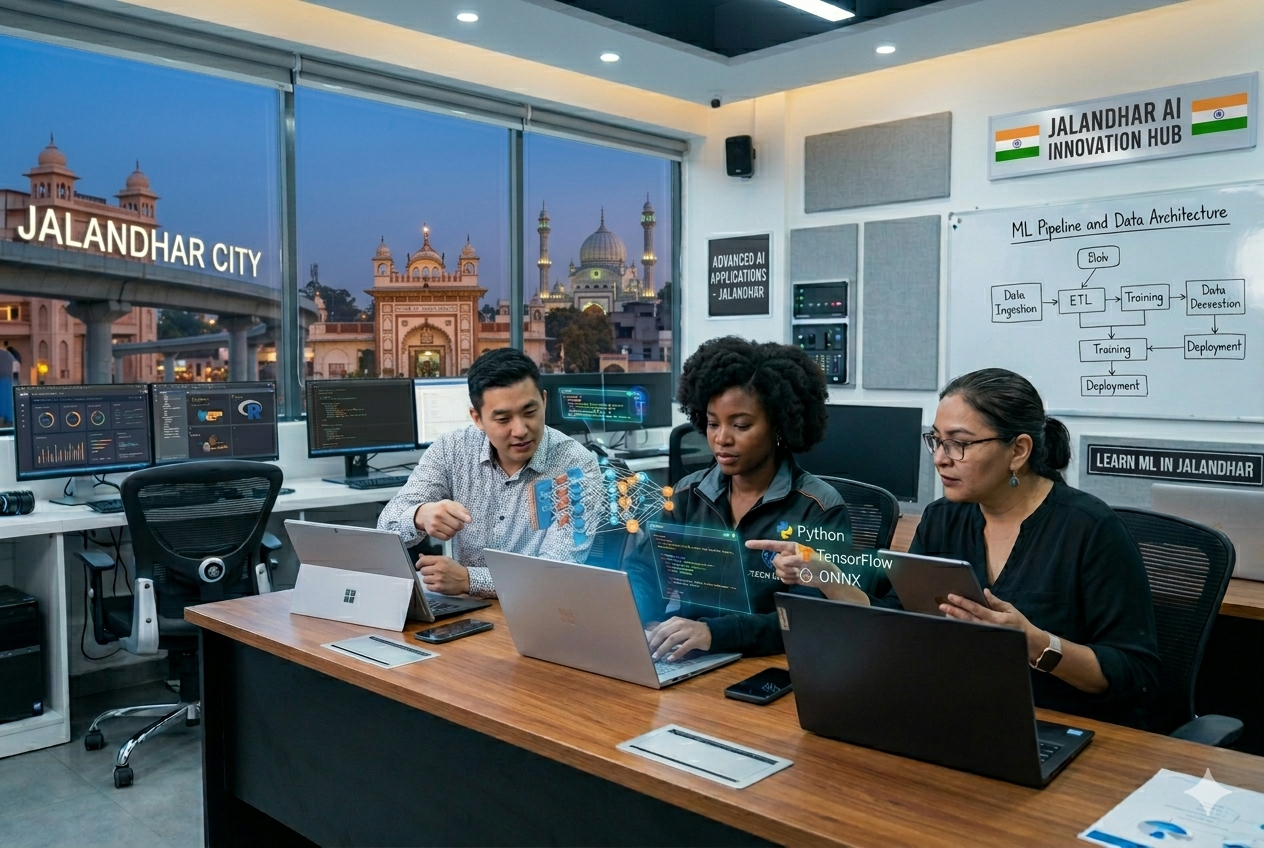
AI and Machine Learning Courses in Jalandhar: A Comprehensive 3000-Word Overview
The field of Artificial Intelligence (AI) and Machine Learning (ML) is reshaping industries across the globe, and Jalandhar has emerged as a significant educational hub for these cutting-edge technologies. Whether you are a fresh graduate, a working professional looking to upskill, or someone planning a career transition, the city offers diverse learning pathways ranging from short-term certifications to full-fledged university degrees. This comprehensive guide explores all available AI and ML courses in Jalandhar, helping you make an informed decision for your educational journey.
📊 The AI and ML Education Landscape in Jalandhar
Jalandhar's educational ecosystem for Artificial Intelligence and Machine Learning spans multiple tiers, catering to different budgets, time commitments, and career goals:
🎓 Category 1: Short-Term Certificate Programs (Budget-Friendly Options)
National Institute of Technology (NIT) Jalandhar
NIT Jalandhar, one of India's premier engineering institutions, offers short-term certification courses in AI and Machine Learning that are highly affordable and provide certification from a prestigious institute.
Program Details:
Recent Course Offerings:
-
"AI-Powered Innovation: Integrating Future-Ready Technologies" - This course covers fundamentals of AI, ML, and deep learning, exploring applications in healthcare, finance, education, and manufacturing. Advanced topics include intelligent automation, data-driven decision-making, quantum computing, and predictive analytics.
-
"Machine Learning for Data Analytics using Python: A Hands-on Approach" - This program focuses on practical implementation of ML algorithms using Python, covering algorithms, predictive modeling, and statistical analysis.
Key Features:
-
Certificate from an NIT institution
-
Taught by experienced faculty members from the Computer Science and Engineering department
-
Ideal for understanding core concepts before committing to larger programs
-
Covers both theoretical foundations and practical applications
Limitations:
-
Short duration limits depth of coverage
-
Offered periodically (not available year-round)
-
Competitive admission due to limited seats
How to Apply:
Monitor NIT Jalandhar's official website and department pages for announcements about upcoming short-term courses. These are typically announced at the beginning of each semester.
🏢 Category 2: Professional Diploma Programs (Practical, Job-Oriented Training)
For those seeking job-ready skills without committing to multi-year degrees, professional training institutes in Jalandhar offer comprehensive programs focused on hands-on learning.
TechCADD Computer Education
TechCADD has established itself as a leading institute for AI and ML training in Jalandhar, offering a structured Professional Certificate Program in Machine Learning & AI.
Program Overview:
-
Duration: 4-6 months (Regular/Weekend batches)
-
Mode: Online and Classroom (Jalandhar campus)
-
Certification: TechCADD Certified "Professional in Machine Learning & AI"
Detailed Curriculum Structure:
Learning Environment:
TechCADD emphasizes collaborative, hands-on learning. Classes are conducted in spacious, well-equipped rooms where instructors demonstrate coding and analysis live on projectors while students follow along. The setup includes:
-
Desks arranged for teamwork and peer learning
-
Real-time problem-solving exercises
-
Personalized attention from instructors
-
Practical exercises immediately after demonstrations
-
Small group collaborations to solve exercises and share solutions
Career Opportunities After Completion:
Student Reviews:
"I have been studying here from past few months and I would say that this institute is really very good as it provides a friendly environment for students and also the facilities are amazing." — Karan Sharma
"I am doing full stack course there and I feel very glad to join this institute. Staff is very cooperated and all classes are well maintained and teacher are so cooperative and provide appropriate knowledge regarding course." — Sandeep Chahal
Webdox Computer Institute
Webdox is an ISO 9001-2015 certified and MSME-registered computer institute established in 2018 near HMV College, Jalandhar.
Institute Highlights:
-
Established: 2018
-
Certifications: ISO 9001-2015, MSME Registered, Trademark Registered with Govt. of India
-
Google Rating: 100+ five-star ratings
-
Faculty: Experienced instructors with industry experience
Machine Learning Course Curriculum:
Course Features:
-
Duration: 45 days (for intensive programs)
-
Mode: Online and offline classes available
-
Flexibility: Flexible timings for working professionals and students
-
Support: Doubt clearance sessions even after course completion
-
Assignment Assistance: Available for students studying abroad for IT/Computer courses
Data Science Course Offering:
Webdox also offers a comprehensive Data Science course covering Python, Statistics, Machine Learning, Deep Learning, and Big Data with a duration of 3-6 months.
Student Testimonials:
"My experience over Webdox was amazing. The balance of theoretical knowledge and hands-on practice makes it a valuable investment. I would highly recommend it to anyone looking to gain in-demand skills in today's competitive job market. The instructors were knowledgeable and approachable." - Gurnamit Khaira
"Had an amazing experience there! Teachers are very knowledgeable, patient, and made complex concepts easy to understand. I appreciate the relaxed atmosphere to learn at my own pace." - Vanshika Rana
🎓 Category 3: Undergraduate Degree Programs (B.Tech)
For students seeking comprehensive, long-term education in AI and Machine Learning, full-time undergraduate degrees offer the most structured pathway.
Lovely Professional University (LPU), Phagwara
LPU is one of India's largest private universities, offering specialized B.Tech programs in AI and Machine Learning with industry collaborations.
B.Tech Computer Science and Engineering (Artificial Intelligence & Machine Learning)
Key Features:
-
NAAC A++ Grade accreditation
-
QS World University Rankings recognition
-
Industry-driven curriculum with project-based learning
-
AI-powered learning environment with experiential, gamified, and competency-based education
-
Partnership with Quantiphi for AI and Data Analytics course
Placement Highlights:
-
100% placement record across programs
-
1000+ companies participating in recruitment
-
Top recruiters: Microsoft, Amazon, Google Cloud, Cognizant, Capgemini, Infosys, Deloitte
-
Two Robotics and Automation students recently received record-breaking offers of ₹2.5 crore and ₹1.03 crore
Recent Placement Success:
Sri Vishnu and Betireddy Naga Vamsi Reddy, students of Robotics and Automation at LPU, received job offers of ₹2.5 crore and ₹1.03 crore respectively from a top AI robotics firm, demonstrating the quality and industry relevance of LPU's technical programs.
Chandigarh Group of Colleges (CGC), Landran
CGC Landran offers a four-year B.Tech in Artificial Intelligence & Machine Learning degree affiliated with I.K. Gujral Punjab Technical University, Jalandhar.
Program Overview:
-
Duration: 4 years (8 semesters)
-
Affiliation: I.K. Gujral Punjab Technical University, Jalandhar
-
Recognition: AICTE approved
Curriculum Highlights:
The program encompasses cognate subjects including:
-
Artificial Intelligence
-
Image Processing
-
Machine Learning
-
Advanced Search Technique
-
Soft Computing
-
Artificial Neural Networks
-
Data Analytics
-
Deep Learning
-
Human-Computer Interaction
-
Speech and Natural Language Processing
Eligibility Criteria:
-
Passed 10+2 examination with at least 45% marks (40% for reserved category)
-
Subjects: Physics/Mathematics/Chemistry/Computer Science/Electronics/Information Technology/Biology/Information Practices/Biotechnology/Technical Vocational subject
Alternative Entry Paths:
Placement Statistics:
Top Recruiters:
TaskUs, Amazl Digital solution, Knotsync, Stellen infotech, along with numerous web development and IT solution companies.
Industry Partnerships:
-
Member of Red Hat and Oracle Academy
-
Ingenious labs including IBM, FRESCO & AICTE AQIS MODROB
-
Partnerships with AWS and NVIDIA
-
Active ACM student chapter
🎓 Category 4: Postgraduate Degree Programs (M.Tech)
NIT Jalandhar - M.Tech Programs
NIT Jalandhar offers specialized M.Tech programs with AI and Machine Learning focus, both requiring GATE qualification.
M.Tech in Machine Learning
M.Tech in Signal Processing & Machine Learning
Placement Statistics (2024-2025):
Lovely Professional University - M.Tech in AI & ML
LPU offers a comprehensive M.Tech program in Artificial Intelligence and Machine Learning.
Program Overview:
-
Duration: 2 Years (Full Time)
-
Total Fees: ₹4.2 Lakhs (Tuition: ₹4 Lakhs)
-
Eligibility: Graduation with 55% + GATE/LPUNEST
-
Median Package: ₹8.4 Lakhs (2024)
Admission Process:
-
LPUNEST entrance exam required
-
Scholarships available based on LPUNEST scores
-
Counseling based on exam performance
Rankings:
🎓 Category 5: Diploma Programs
Lovely Professional University - Diploma in AI & ML
LPU offers a three-year Diploma program for students who have completed 10th standard.
Program Overview:
Eligibility Criteria:
-
Pass with 50% aggregate marks in 10th
-
Subjects required: Mathematics, Science, and English
-
5% relaxation for North-East states, Sikkim candidates, Defence Personnel, and Wards of Kashmiri Migrants
💼 Career Opportunities After AI and ML Courses
AI and ML skills open doors to high-paying roles across industries. Here are the primary career paths:
📈 Future Scope and Industry Demand
India's AI Talent Gap
According to recent industry reports:
-
India's AI sector is poised to surpass 2.3 million job openings by 2027
-
Available AI talent pool is expected to grow to only around 1.2 million professionals
-
This creates a supply-demand mismatch of 1.5-2x
-
Professionals with AI, cloud, and data capabilities are seeing 18-22% annual salary growth
Global Opportunities
The global AI talent shortage creates opportunities for Indian professionals:
-
In the US, one in two AI jobs could be left unfilled by 2027
-
Germany could see around 70% of AI jobs unfilled by 2027
-
Indian professionals can access international roles through remote work, global capability centres, and overseas opportunities
Emerging Technologies
The AI field is rapidly evolving with new specializations:
-
Agentic AI — AI focused on autonomous decision-making and action
-
Generative AI — Creating new content, images, and solutions
-
Edge AI — Deploying AI on local devices rather than cloud
-
Responsible AI — Ensuring ethical, fair, and transparent AI systems
💡 How to Choose the Right Course: Decision Guide
If Your Budget is Strictly Under ₹5,000:
-
Best Option: Short-term certificates from NIT Jalandhar
-
What to Expect: Introduction to concepts, basic Python implementation, certification from prestigious institute
-
Limitation: Limited depth; not sufficient for job readiness without additional training
If You Can Invest ₹20,000 - ₹50,000:
-
Best Option: Professional Diploma Programs (TechCADD, Webdox)
-
What to Expect: Comprehensive curriculum, hands-on projects, placement assistance, recognized certification
-
Time Commitment: 45 days to 6 months
-
Outcome: Job-ready skills, portfolio development, industry network
If You're Planning for Long-term Career (₹2 Lakhs - ₹16 Lakhs):
-
For 10th-pass students: Diploma in AI & ML at LPU (3 years, ₹2.11 Lakhs)
-
For 12th-pass students: B.Tech in CSE (AI/ML) at LPU or CGC Landran
-
For Graduates: M.Tech at NIT Jalandhar or LPU
-
What to Expect: Deep theoretical understanding, recognized degree, strong placement networks
-
Time Commitment: 2-4 years
Key Factors to Consider:
-
Your Educational Background: 10th-pass students can pursue diplomas; 12th-pass students can pursue B.Tech; graduates can pursue M.Tech/MCA
-
Time Availability: Working professionals may prefer weekend batches at private institutes
-
Career Goals: Quick job switch vs. long-term corporate career vs. research-oriented roles
-
Entrance Exams: NIT requires GATE; LPU requires LPUNEST
-
Mode of Learning: Classroom vs. online; collaborative vs. self-paced
📝 Important Admission Dates (2026)
LPU Admissions:
NIT Jalandhar M.Tech:
✅ Conclusion
Jalandhar offers a complete spectrum of AI and Machine Learning education, catering to diverse budgets, time commitments, and career goals. The city's educational landscape includes:
-
Budget-friendly entry points through NIT Jalandhar's short-term certificates
-
Job-oriented practical training through institutes like TechCADD and Webdox
-
Comprehensive degree programs through LPU and CGC Landran
-
Specialized postgraduate education through NIT Jalandhar and LPU's M.Tech programs
Your choice should align with your current qualifications, available time, budget, and long-term career aspirations. For those seeking immediate job readiness with practical skills, professional diploma programs offer the best balance of time investment and hands-on training. For long-term career growth with recognized credentials, university degrees provide stronger foundations and better placement networks.
Regardless of your chosen path, the growing demand for AI and ML professionals ensures that investing in these skills will yield significant career returns. With India facing a talent gap of 1.5-2x demand versus supply, qualified professionals will continue to command premium compensation and abundant career opportunities.
The technology education market in Jalandhar is crowded with numerous institutes making grand promises. From small coaching centers to established computer training schools, the options seem endless. Yet, when students and professionals consistently gravitate toward TechCADD, it raises an important question: What makes this institute different?
The answer lies not in any single factor but in a carefully orchestrated ecosystem of excellence that touches every aspect of the learning journey. TechCADD has positioned itself not merely as a training center but as a career launchpad that transforms beginners into industry-ready professionals .
This analysis will dissect the seven pillars that constitute TechCADD's unique value proposition, supported by authentic student experiences, detailed curriculum insights, and verifiable institutional strengths.
🏛️ Pillar 1: An Industry-Forged Curriculum, Not a Textbook Relic
The Problem with Traditional Institutes
Many computer institutes in Jalandhar operate on outdated syllabi that bear little resemblance to what modern companies actually need. Students emerge with theoretical knowledge of programming concepts but lack familiarity with the tools, frameworks, and workflows that dominate today's tech industry .
TechCADD's Curriculum Philosophy
TechCADD's curriculum development follows a fundamentally different approach. Rather than relying on static textbooks, their course content is described as "a living, breathing document, constantly evolving through direct feedback from our industry partners." This ensures that what students learn today aligns directly with what employers are seeking tomorrow .
Beyond the Basics Approach:
Instead of simply teaching Python programming, TechCADD integrates Python with comprehensive data science libraries for real-world application. Rather than covering machine learning in isolation, they immerse students in the complete AI pipeline encompassing everything from data preprocessing to model deployment .
The AI & Machine Learning Curriculum Deep Dive
TechCADD's Professional Certificate Program in Machine Learning & AI exemplifies this comprehensive approach. The course is structured across ten carefully sequenced modules :
The curriculum is regularly updated to reflect the newest AI trends, ensuring graduates possess relevant, employable, and cutting-edge skills .
The Data Science with AI Modules Program
For students specifically focused on data science, TechCADD offers a specialized Data Science Course with AI Modules covering :
-
Python for Data Science — Libraries, data structures, and fundamentals
-
Statistics and Probability — Statistical methods, hypothesis testing
-
Data Cleaning and Visualization — Power BI, Tableau techniques
-
Machine Learning Algorithms — Supervised and unsupervised learning
-
AI-Driven Modules — Neural networks, deep learning fundamentals
-
Natural Language Processing — Text processing, sentiment analysis
-
Computer Vision Basics — Image processing, object detection
-
Generative AI — Generative models, chatbot development
-
Big Data and Cloud Platforms — Hadoop, AWS, cloud data processing
This curriculum structure demonstrates a deliberate progression from fundamental concepts to advanced, industry-relevant applications .
The Ethical Hacking & Cybersecurity Program
TechCADD's cybersecurity curriculum is equally comprehensive, designed to create skilled defenders capable of protecting critical digital infrastructure :
This comprehensive coverage ensures students are prepared for the most demanding cybersecurity roles .
👨🏫 Pillar 2: Mentors Who Have Been in the Trenches
The Trainer Quality Gap
One of the most significant differentiators between average institutes and exceptional ones is the quality of instruction. Many institutes employ trainers who are academically qualified but lack real-world industry experience. They can teach theory but cannot prepare students for the practical realities of professional tech environments .
TechCADD's Industry-Professional Faculty
TechCADD addresses this gap directly by bringing in "seasoned developers, active cybersecurity experts, and lead data scientists" as trainers . These are professionals who don't just understand technology conceptually but have applied it in real business contexts, solved actual client problems, and navigated the complexities of production environments.
What This Means for Students:
When a cybersecurity trainer at TechCADD teaches penetration testing, they're not just explaining concepts from a textbook. They're sharing "war stories" about actual security assessments they've conducted, explaining how they discovered vulnerabilities that automated scanners missed, and providing insights into how professional ethical hackers think .
Similarly, when a data science mentor guides students through machine learning projects, they bring firsthand experience with challenges like data quality issues, model deployment complexities, and the critical skill of translating technical findings into business recommendations .
Evidence of Mentorship Excellence
The professional journey of Joshua Akoto Tamakloe, a former student who became a Teaching Assistant at TechCADD, demonstrates the quality of mentorship. His profile shows he :
-
Completed a Diploma in Full Stack Web Development at TechCADD (2023-2024)
-
Served as a Teaching Assistant (2024), where he "assisted the main instructor in delivering lessons, clarifying complex concepts, and demonstrating coding techniques"
-
Guided students through projects and "showed students real-world applications of development practices, including version control (Git), deployment, and debugging techniques"
This progression from student to teaching assistant validates the effectiveness of TechCADD's training and mentorship model .
💻 Pillar 3: An Unmatched "Learn by Doing" Philosophy
The Limitations of Theory-Heavy Education
Traditional computer education often emphasizes theoretical concepts over practical application. Students may understand algorithms on paper but struggle to implement them in code. They may know database theory but cannot design efficient schemas for real applications. This theory-practice gap creates significant challenges when graduates enter the workforce .
TechCADD's Project-Based Learning Framework
TechCADD's pedagogy is built around what they call a "robust project-based learning model" . From the very first month of their programs, students work on real projects rather than waiting until the end of the course for a single capstone experience.
The Classroom Environment:
The learning environment itself reinforces this hands-on philosophy. In TechCADD's data science classes, "the instructor demonstrates coding and analysis live on a projector while students follow along in the classroom." This setup allows students to see the practical application of concepts in real-time and immediately practice what they've learned .
The classroom is described as "a spacious, well-equipped room designed for collaborative learning," with "desks and workstations arranged to encourage teamwork." Students work "in small groups to solve exercises, discuss strategies, and share solutions," fostering "peer-to-peer interaction [that] enhances problem-solving abilities and fosters a sense of teamwork, which is essential in real-world data science projects" .
Hands-On Activities Across Programs:
In the AI and ML program, students work on:
-
Practical AI and ML projects applying algorithms to real datasets
-
Real-time model deployment using cloud platforms
-
Capstone projects like recommender systems, fraud detection, and chatbot development
In the cybersecurity program, students practice in "a specialized lab setting mimicking enterprise networks, cloud infrastructure and IoT devices" with "real-time hacking, defense simulations, and capture-the-flag exercises" .
Tools Students Master:
TechCADD students gain hands-on experience with industry-standard tools including :
-
AI/ML Tools: Python, TensorFlow, PyTorch, Keras, NumPy, Pandas
-
Visualization Tools: Power BI, Tableau, Matplotlib, Seaborn
-
Cybersecurity Tools: Nmap, Metasploit, Burp Suite, Wireshark, Aircrack-ng, John the Ripper
-
Cloud Platforms: AWS, Google AI, TensorFlow Serving
🎯 Pillar 4: A Proven Track Record of Placements and Career Transformation
The Ultimate Measure of Institute Quality
For most students, the ultimate goal of technical education is career advancement. An institute's true value is measured not by its facilities or marketing claims but by the success of its graduates in securing meaningful employment .
TechCADD's Placement Ecosystem
TechCADD maintains a "proactive corporate resource team that continuously engages with a network of hiring partners across Chandigarh, Mohali, Delhi, and beyond" . This network provides students with access to opportunities that might otherwise be inaccessible.
Comprehensive Career Support:
TechCADD's placement assistance includes multiple components :
-
Resume-building workshops that help students effectively showcase their skills and projects
-
Mock interviews with real-time feedback that prepare students for the actual interview experience
-
Soft-skills training covering communication, presentation, and professional etiquette
-
Portfolio guidance ensuring students can demonstrate their capabilities to employers
-
Internship opportunities through strong industry connections
Verified Success Story: Angelina's Transformation
Perhaps the most compelling evidence of TechCADD's effectiveness is the success story of Angelina, a BCA graduate who transformed into a cybersecurity professional through TechCADD's training .
Before TechCADD:
Angelina was a BCA graduate who felt her degree had "only scratched the surface of real-world IT skills." She was intrigued by cybersecurity but found the field daunting, with terms like "penetration testing," "network security," and "CEH" seeming like "a foreign language." She needed "a clear, guided path, not just a list of topics" .
The TechCADD Experience:
At TechCADD, she found the structured approach she needed. The Ethical Hacking and Cyber Security course provided :
-
Foundation building in networking and Linux
-
Hands-on practice with reconnaissance and scanning tools like Nmap
-
Vulnerability assessment and penetration testing using Metasploit
-
Web application security training covering OWASP Top 10 vulnerabilities
-
Professional report writing for client communication
The Result:
Angelina "received an offer from an IT risk consulting firm as a junior penetration tester." In her first week, she identified "a critical SQL injection flaw that their own developers had missed"—demonstrating the immediate value of her TechCADD training .
Student Testimonials
Beyond formal success stories, TechCADD's website features numerous student reviews consistently rating the institute 5 stars :
"I have been studying here from past few months and I would say that this institute is really very good as it provides a friendly environment for students and also the facilities are amazing." — Karan Sharma
"I am doing full stack course there and I feel very glad to join this institute. Staff is very cooperated and all classes are well maintained and teacher are so cooperative and provide appropriate knowledge regarding course." — Sandeep Chahal
"A great place to learn and enhance your technical skills. Nice place to upgrade your skills and upgrade your career in IT sector. So you must enroll yourself in this institute." — Manmeet Kaur
"I’m so glad I enrolled in the AI course in Jalandhar! The curriculum is well-structured, covering essential topics like natural language processing (NLP), data science, and neural networks. The instructors are knowledgeable and supportive, and the projects helped me apply what I learned in real-life scenarios." — Komal
"I joined the best AI training course in Jalandhar, and it’s been an incredible experience! The instructors break down complex AI concepts, making them easy to grasp. From machine learning basics to advanced algorithms, the course is comprehensive and practical." — Simran
🏢 Pillar 5: Strategic Location and State-of-the-Art Infrastructure
Learning Environment Matters
The physical environment where learning takes place significantly impacts educational outcomes. A conducive, well-equipped space enhances focus, enables effective practice, and signals institutional commitment to quality .
TechCADD's Facilities
TechCADD's Jalandhar center is "centrally located" and "easily accessible from all major areas of the city" .
The computer labs are "equipped with high-end systems, licensed software, and high-speed internet, providing a seamless and professional learning experience." This ensures students practice on the same tools and platforms they'll encounter in professional settings .
Classroom Design:
TechCADD's classrooms are "spacious, well-equipped room[s] designed for collaborative learning," with "desks and workstations arranged to encourage teamwork." This layout facilitates the peer interaction and group problem-solving that characterize effective technical education .
The use of "a projector to showcase coding examples, data visualization techniques, and machine learning workflows" ensures that "every student can follow along clearly" regardless of their seating position .
🔮 Pillar 6: Focus on Future-Proof and Niche Careers
Beyond Generic IT Training
Many institutes offer generic computer courses that produce graduates with undifferentiated skills. In a competitive job market, these graduates struggle to stand out to employers .
TechCADD's Specialized Offerings
TechCADD distinguishes itself by offering "deep, specialized training in high-growth areas" :
-
Data Science and Machine Learning — Preparing students for the AI-driven economy
-
Artificial Intelligence — Comprehensive AI training covering TensorFlow, Keras, and PyTorch
-
Cyber Security and Ethical Hacking — Addressing the critical shortage of security professionals
-
Full-Stack Web Development — Creating versatile developers ready for modern web projects
-
Digital Marketing — Equipping students for the digital business landscape
Career Opportunities Across Programs
AI and ML Career Paths :
-
Machine Learning Engineer — Designs and trains ML models for real-world problems
-
Data Scientist — Analyzes complex datasets and builds predictive models
-
AI Researcher/Scientist — Innovates and develops advanced AI techniques
-
NLP Engineer — Builds intelligent systems for text processing and chatbots
-
Deep Learning Specialist — Develops neural networks for image, speech, and pattern recognition
-
AI Product Developer — Creates AI-driven products and integrates ML solutions
-
AI Consultant — Advises organizations on AI adoption and implementation
-
Business Intelligence Analyst — Uses AI tools to visualize data trends
Cybersecurity Career Paths :
-
Penetration Tester — Conducts authorized security assessments
-
Security Operations Center (SOC) Analyst — Monitors and defends organizational systems
-
Vulnerability Assessor — Identifies weaknesses in systems and networks
-
Security Consultant — Advises organizations on security strategies
-
Red Team Specialist — Simulates attacks to test organizational defenses
Recruitment Sectors :
-
IT & Software Companies — Giants and start-ups seeking data and AI professionals
-
Banking and Finance — Risk modeling, fraud identification, investment forecasting
-
E-commerce — Recommendation systems, customer segmentation
-
Healthcare — Diagnostics, patient care optimization, medical research
-
Marketing and Consulting Agencies — Data-driven campaigns, predictive modeling
🎓 Pillar 7: Credible Certification and Professional Recognition
The Value of Recognized Credentials
In the job market, certifications and credentials matter. They provide employers with third-party validation of skills and demonstrate commitment to professional development .
TechCADD's Certification Framework
TechCADD's courses lead to "recognized certification[s], which can enhance your resume and validate your skills to potential employers" . These certifications are offered with the TechCADD brand, which has built recognition in the Jalandhar region and beyond.
For their Data Science with AI course, students receive a "Professional Certificate in Data Science & AI approved by TechCADD" . For cybersecurity, the program prepares students for globally recognized credentials like the Certified Ethical Hacker (CEH) certification .
📊 Comprehensive Comparison: TechCADD vs. Typical Jalandhar Institutes
💡 Practical Guidance for Your TechCADD Journey
Flexible Learning Options
TechCADD understands that students have different schedules and commitments. They offer :
-
Regular batches for full-time students
-
Weekend batches for working professionals
-
Online classes for remote learners
-
Classroom training for hands-on experience
Who Can Join?
TechCADD's programs are accessible to a wide range of learners :
-
Students with basic computer knowledge
-
Working professionals seeking upskilling
-
BCA/B.Sc graduates looking for specialized training
-
IT professionals wanting to transition to AI/ML or cybersecurity
-
Beginners with no prior programming experience (courses start from basics)
Demo Sessions
TechCADD offers "free counselling session and a demo class" for prospective students to experience the learning environment firsthand .
✅ Conclusion: The TechCADD Difference
As this comprehensive analysis demonstrates, TechCADD's position as a leading IT training institute in Jalandhar is built on a foundation of deliberate, student-centered excellence. Their approach addresses the fundamental limitations of traditional computer education by emphasizing :
-
Practical skills over theoretical knowledge
-
Industry experience over academic credentials alone
-
Career outcomes over course completion
-
Hands-on projects over textbook learning
-
Mentorship over lecturing
The success stories of students like Angelina—transforming from uncertain BCA graduates to confident cybersecurity professionals—provide compelling evidence of TechCADD's effectiveness . Student testimonials consistently praising the learning environment, instructor quality, and career support reinforce this picture .
The professional journey of Joshua Akoto Tamakloe, who progressed from student to Teaching Assistant at TechCADD while pursuing his Master's at LPU, demonstrates the caliber of individuals who choose TechCADD for their training .
For aspiring technology professionals in Jalandhar and beyond, TechCADD represents more than a training center—it represents a career launchpad with the potential to transform technical curiosity into professional success. Whether the goal is data science, artificial intelligence, cybersecurity, or web development, TechCADD offers the structured, supportive, and industry-aligned education necessary to achieve it .
The decision of where to invest in technical education is among the most consequential career choices a student can make. For those seeking not just a certificate but a genuine career transformation in the technology sector, the evidence strongly supports TechCADD as the premier choice in Jalandhar
Future Scope in AI and Machine Learning: A Comprehensive 3000-Word Analysis
The landscape of technology careers is undergoing a seismic shift. Artificial Intelligence and Machine Learning are no longer futuristic concepts confined to research labs—they are the engines powering today's economy and the architects of tomorrow's world. For anyone considering an AI and Machine Learning course in Jalandhar, understanding the future scope isn't just about knowing what jobs exist today; it's about positioning yourself for a career trajectory that will define the next decade of technological innovation.
This comprehensive analysis explores the vast opportunities awaiting AI and ML professionals, drawing from the latest industry reports, market projections, and real-world success stories. Whether you're a fresh graduate, a working professional seeking career advancement, or someone contemplating a complete career transformation, the future scope in this field offers unprecedented potential for growth, impact, and financial reward.
📊 The Macro Picture: India's AI Revolution
Unprecedented Demand Meets Supply Gap
The numbers driving India's AI sector tell a compelling story of opportunity. According to the India Decoding Jobs 2026 Report by CII and Taggd, hiring in India's IT sector is projected to rise by 7% year-on-year in fiscal 2026–27, driven by strong domestic macroeconomic factors and global IT firms establishing capability centres in India . The demand for AI professionals in India is expected to surpass 1 million by end-2026 .
Even more striking is the talent gap. According to a TeamLease Digital report, for every 10 open GenAI roles, only one qualified engineer is available . By 2026, the AI talent gap is expected to reach 53%, while cloud computing is projected to face a 55-60% demand-supply mismatch .
This scarcity is driving extraordinary salary growth. Professionals with AI, cloud, and data capabilities are seeing 18–22% annual salary growth . Senior GenAI and MLOps specialists are now commanding packages of ₹58–60 lakh per annum .
AI's Economic Impact: Beyond Job Creation
The narrative around AI often comes with the misconception that the rise of AI means the loss of jobs. The reality is more complex . According to a BW Businessworld report, AI could reshape 38 million jobs and contribute an estimated 2.61% productivity boost to the Indian economy . Agentic AI alone could reshape 10.35 million jobs in India by 2030 .
What makes this transformation particularly significant is its structural nature. More than 40% of India's workforce already uses AI tools in some capacity, and at the enterprise level, experimentation with Agentic AI systems is moving rapidly from pilots to structured deployment . AI is now embedded across risk assessment, fraud detection, clinical workflows, supply chain planning, predictive maintenance, and core operational processes .
🚀 Emerging Technologies Shaping the Future
Agentic AI: The Next Frontier
The most significant development in the AI landscape is the emergence of Agentic AI—advanced artificial intelligence focused on autonomous decision-making and action. According to a Quess Corp report, Agentic AI and specialised GenAI roles are projected to grow 35-40% annually, while the demand-supply gap remains above 50% .
India's Agentic AI market, valued at approximately USD 276 million in 2024, is projected to reach nearly USD 3.5 billion by 2030, supported by automation modernisation and enterprise adoption . This explosive growth is creating entirely new job categories that didn't exist three years ago.
The report identifies emerging roles including:
-
AI Orchestration Engineers — professionals who design and manage complex AI workflows
-
Agent Behaviour Analysts — specialists who understand and optimize autonomous AI decision-making
-
Agent Safety and Governance Specialists — experts ensuring responsible AI deployment
-
Vector Database Architects — professionals building the infrastructure for AI memory systems
-
Agent Lifecycle Managers — individuals overseeing the complete lifecycle of AI agents
-
Agentic AI Product Managers — leaders guiding AI product development
The IEEE Global Survey further confirms this trend, with 96% of technologists globally agreeing that agentic AI innovation, exploration, and adoption will continue to accelerate in 2026 . The survey also notes that 91% agree that the use of agentic AI to analyze larger volumes of data will increase, spurring a data analyst hiring boom to assess the accuracy of results, transparency, and associated vulnerabilities .
Generative AI: Beyond Hype to Production
Generative AI has moved from experimental pilots to production-grade deployments. AI and GenAI spending is expected to touch USD 6 billion by 2027 at a CAGR of 33.7% (IDC), with large-scale deployments creating strong demand for AI and machine learning engineers, data scientists, cloud architects, and cybersecurity specialists .
Tool-calling and orchestration appear in 72% of job descriptions, and Retrieval-Augmented Generation (RAG + Tool) capabilities are required in 63% of roles . Framework exposure to LangGraph, AutoGen, and CrewAI has reached 43%, showing a shift from prompt writing to workflow-based agent development .
AI Integration Across Sectors
AI is no longer confined to technology firms. According to MIT Sloan Management Review India, "BFSI, healthcare, retail, manufacturing—every sector is building AI capability" . The top industries expected to experience the most significant AI-driven transformation include:
This cross-sector penetration means that AI professionals have career options far beyond traditional IT companies, with opportunities in virtually every industry.
💼 Career Pathways: From Entry-Level to Executive
High-Demand Roles for 2026 and Beyond
According to MIT Sloan Management Review India, the roles that defined 2025 and will shape 2026 include :
Salary Benchmarks by Experience
According to Scaler's comprehensive salary guide for 2026 :
For specialized roles, the premiums are even higher :
-
Senior GenAI Engineers — ₹58–60 lakh per annum
-
MLOps Specialists — Up to ₹35 lakh per annum
-
Computer Vision Engineers — ₹10–22 lakh per annum, with experienced professionals in specialized industries earning up to ₹45 lakh
-
NLP Engineers — ₹21.4–25.9 lakh per annum
Skills That Command Premium Compensation
The most valuable technical skills for 2026 include :
Emerging Skills for 2026
The Quess Corp report highlights that the most in-demand capabilities are increasingly specialized :
-
Specified prompt engineering
-
LLM safety and tuning
-
AI orchestration
-
Agent design and simulation governance
-
AI compliance and risk operations
According to the IEEE Global Survey, the top skills technologists will seek in candidates for AI-related roles in 2026 are :
-
AI ethical practices skills — 44% (+9% from prior year)
-
Data analysis skills — 38% (+4% from prior year)
-
Machine learning skills — 34% (+6% from prior year)
-
Data modeling skills — 32% (no change)
-
Software development skills — 32% (-8% from prior year)
🏢 The Changing Employment Landscape
Global Capability Centres (GCCs) as Engines of Growth
GCCs are emerging as major drivers of AI employment in India. According to TeamLease Digital, GCCs will contribute over 22–25% of net new white-collar tech jobs in 2025, led by demand in AI and cloud computing . Of the 4.7 million new tech jobs projected by 2027, a sizable chunk (over 1.2 million) will be generated by GCCs, particularly in GenAI and engineering research and development .
GCCs account for 54% of total Agentic AI hiring demand, reflecting the concentration of agent platform engineering, orchestration, safety, and governance within GCC ecosystems .
Bengaluru and Hyderabad together account for nearly 62% of Agentic AI hiring, while NCR, Pune, and Chennai continue to expand as centres for governance, deployment, and workflow management .
The Rise of Tier-2 Cities
One of the most significant trends for students in Jalandhar is the emergence of tier-2 cities as talent hubs. The India Decoding Jobs 2026 Report points to "a surge in hiring across tier-2 and tier-3 cities, reflecting India's expanding talent ecosystem beyond metros" . By 2026, nearly 32% of new job roles are expected to originate from tier-2 cities, signalling a shift towards distributed growth and regional inclusion .
Tier II cities such as Kochi, Coimbatore, Jaipur, and Ahmedabad now contribute close to 10% of total Agentic AI hiring . For Jalandhar students, this means that high-paying opportunities are becoming more accessible without requiring relocation to metropolitan areas. Many GCCs and IT companies now offer hybrid or remote work options, further expanding opportunities for professionals based in tier-2 cities.
Startup Ecosystem and Product Companies
The startup ecosystem offers another promising career path. Well-funded startups often offer competitive base salaries ranging from ₹12 to 20 lakhs per annum along with equity stock options . While startups may present higher risk, they provide opportunities to work on cutting-edge technologies and gain rapid career growth.
Product-based companies typically pay 20 to 30% more than service-based IT firms . Indian unicorns and high-growth startups like Flipkart, Razorpay, and Swiggy offer competitive packages:
Multinational Corporations
MNCs continue to offer some of the highest salaries in India:
-
Google India — AI engineers average ₹46.5 lakh per annum
-
Qualcomm — Approximately ₹28.5 lakh per annum
-
Microsoft — ₹10–12 lakh per annum for entry-level
🎓 The Education-Career Connection
How TechCADD Training Aligns with Future Opportunities
For students considering an AI and Machine Learning course in Jalandhar, TechCADD's comprehensive curriculum is designed to prepare graduates for these emerging opportunities. The success story of Salvi, a B.Com graduate who transformed into a Python developer through TechCADD's training, illustrates what's possible with the right preparation .
Salvi's journey demonstrates several key principles:
-
A foundation-first approach — "The course started from absolute zero—what is a variable, what is a loop. The instructors were patient and ensured no one was left behind"
-
Project-based learning — "We didn't just learn theory. We built things. From simple calculators to complex, database-driven web applications using the Django framework, every module ended with a hands-on project"
-
Industry-relevant tools — "Learning Python for web development with Django was a game-changer. Django handles a lot of the complex stuff for you, allowing you to build robust, secure, and scalable applications quickly"
-
Comprehensive career support — "The team helped me build a compelling GitHub profile with my projects. We had mock interviews, resume-building workshops, and sessions on how to articulate my career change story positively"
The result? "Within two months of completing the course, I had three job offers!" Salvi's starting salary was double what she was making in her previous job .
The Value of Specialized Certifications
Industry-recognized certifications can significantly boost employability and earning potential. According to Scaler's salary guide:
-
AWS Machine Learning Specialty
-
Google Cloud Professional Machine Learning Engineer
-
Microsoft Azure AI Engineer
These certifications can add ₹10,000–20,000 to monthly salaries . Structured programs from platforms like Scaler, Coursera, or IIT certification courses demonstrate commitment to continuous learning and attract better job offers.
Educational Background and Career Trajectory
Graduates from IITs or top-tier engineering colleges typically receive 25–30% higher initial offers compared to candidates from other institutions . Advanced degrees like M.Tech or MS in AI and Machine Learning can add significant premiums to compensation packages. However, as the story of Salvi demonstrates, with the right training and skills, candidates from non-IT backgrounds can successfully transition into technology careers .
📈 The Next Five Years: What to Expect
Job Creation Projections
The scale of AI job creation over the next five years is staggering:
-
10.35 million jobs will be reshaped by Agentic AI in India by 2030
-
1.25 million+ AI roles expected by 2027, up from 600,000–650,000 currently
-
2,100+ GCCs expected to operate in India by 2027, employing three million professionals
Salary Trajectories
The salary projections for AI and ML professionals reflect their strategic importance:
-
AI skills are growing at 18–22% annually
-
Senior GenAI and MLOps salaries touched ₹58–60 lakh in 2025
-
By 2026, senior AI architects and principal engineers at top companies could earn well beyond ₹1 crore annually
Skills That Will Matter Most
Based on industry reports, the most valuable skills for the next five years include :
The Shift to Hybrid Roles
According to MIT Sloan Management Review India, "by 2026, India's AI job market is expected to look markedly different from the experimental years of the past. Hybrid roles, blending technical depth with product thinking, risk management, and governance, will become the norm rather than the exception" .
The next phase of growth will be defined by hybrid roles that combine technical expertise with strategic and risk management skills, signalling a more mature and sustainable AI talent market .
🎯 Practical Guidance for Your AI Career Journey
If You're Starting from Scratch
For beginners with no programming experience, the path forward is clear:
-
Start with Python — It's the universal language for AI and ML, with simple syntax and powerful libraries
-
Build a strong foundation — Understand variables, loops, functions, and data structures before moving to advanced topics
-
Learn by doing — Work on projects, not just theory. Build calculators, web scrapers, and simple ML models
-
Choose the right institute — Look for programs that offer hands-on projects, industry mentors, and placement support
If You're a Graduate from a Non-IT Background
Salvi's success story from B.Com to Python developer demonstrates that non-IT backgrounds are not barriers . Key steps:
-
Focus on portfolio development — Your GitHub profile speaks louder than your degree
-
Master one technology deeply — Python with Django or Python with data science libraries
-
Leverage career support — Resume building, mock interviews, and networking
If You're a Working Professional Seeking Upskilling
For professionals already in the workforce:
-
Weekend batches at institutes like TechCADD offer flexible schedules
-
Focus on emerging skills like GenAI, MLOps, and AI governance
-
Consider certifications from AWS, Google, or Microsoft to validate your skills
If You're Planning Long-term Academic Growth
For those considering long-term academic paths:
-
B.Tech in CSE (AI/ML) at institutions like LPU offers comprehensive 4-year programs
-
M.Tech at NIT Jalandhar requires GATE qualification but offers strong placement records with median packages of ₹16–20 lakhs
-
Online degrees and certifications from platforms like Scaler or Coursera offer flexible alternatives
✅ Conclusion: The Future Is Bright, But Preparation Matters
The future scope in AI and Machine Learning is not just promising—it's transformative. With projected demand exceeding supply by 50-100%, salary growth of 18-22% annually, and the emergence of entirely new job categories, the opportunities for skilled professionals have never been greater.
For students in Jalandhar, the combination of quality training options like TechCADD, the rise of tier-2 cities as talent hubs, and the global nature of AI work creates unprecedented opportunities. Whether you aspire to become a Machine Learning Engineer, Data Scientist, AI Specialist, GenAI Engineer, or MLOps Professional, the path forward is clearer than ever.
However, success in this field requires more than just enrollment in a course. It demands commitment to continuous learning, dedication to building practical skills, and strategic career planning. As the TeamLease Digital report notes, "without scaled-upskilling initiatives, enterprise ambitions risk being constrained" —and this applies equally to individual career ambitions.
The story of Salvi, who transformed from a B.Com graduate stuck in a dead-end job to a confident Python developer with three job offers, illustrates what's possible with the right training and mindset . Her journey from uncertainty to career success is a blueprint for anyone considering entering this field.
The question is not whether there will be opportunities in AI and Machine Learning—the evidence overwhelmingly shows that there will be. The question is whether you will be prepared to seize those opportunities when they arise. With the right training, dedication, and career planning, the future scope in this field offers not just a job, but a career of continuous growth, meaningful impact, and substantial reward.
As the World Economic Forum's Davos 2026 discussions emphasize, "the promise of AI can only be realized if people have the right skills" . For aspiring technology professionals in Jalandhar, now is the time to invest in those skills and position yourself for the AI-driven future that is already here.