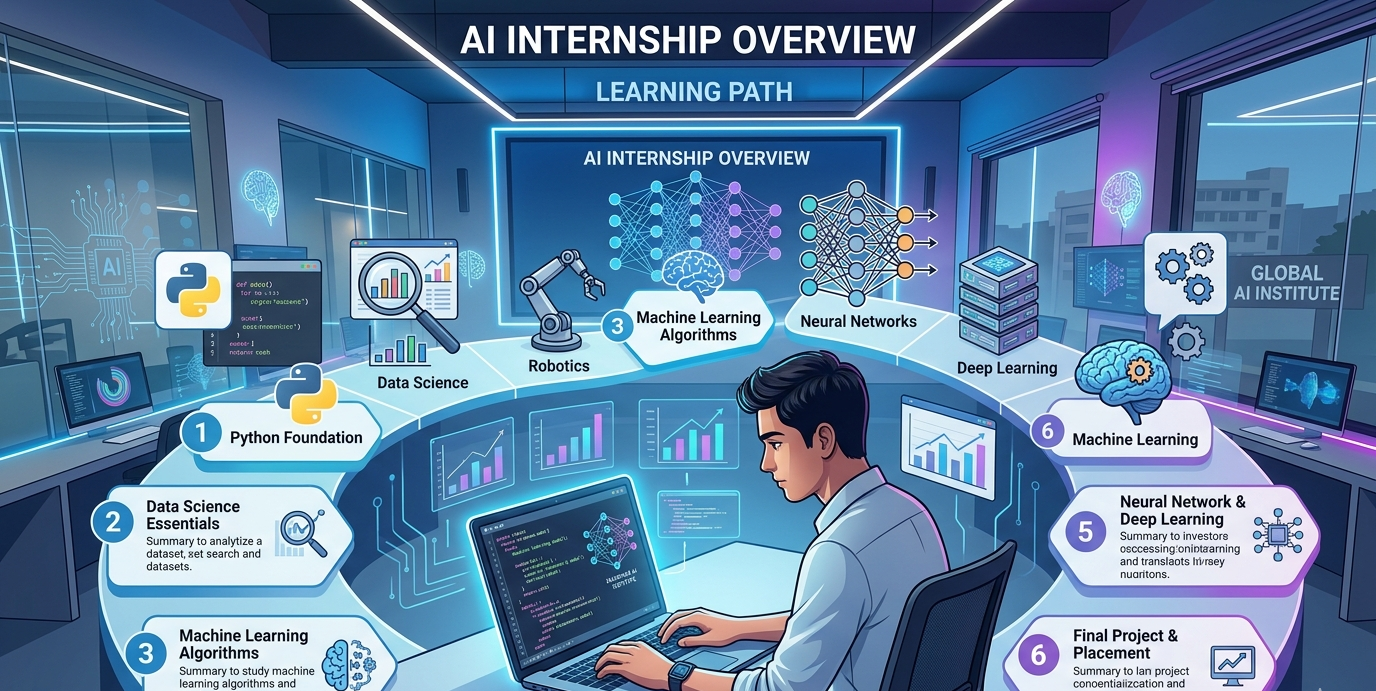
AI Internship Course Overview – Best AI Internship Institute in Jalandhar
Artificial Intelligence (AI) is revolutionizing the way industries operate, making it one of the most in-demand fields in today’s digital world. From automation and predictive analytics to intelligent decision-making systems, AI has become a critical component of modern technology. An AI internship course is designed to equip students with the knowledge, practical skills, and real-world experience required to excel in this rapidly growing domain.
This course overview provides a comprehensive understanding of what students can expect from an AI internship program offered by a leading institute in Jalandhar. It covers the curriculum structure, learning approach, tools and technologies, project work, and career opportunities associated with the course.
Introduction to the AI Internship Program
The AI internship program is a structured training course that combines theoretical learning with practical implementation. It is designed for students, graduates, and professionals who want to build a career in Artificial Intelligence, Machine Learning, and Data Science.
The course begins with foundational concepts and gradually progresses to advanced topics. By the end of the program, students gain the ability to design, develop, and deploy AI-based solutions for real-world problems.
Objectives of the Course
The primary objectives of the AI internship course are:
- To provide a strong foundation in Artificial Intelligence and Machine Learning
- To develop programming and analytical skills
- To enable students to work on real-world AI projects
- To prepare students for industry-level job roles
- To build confidence in handling complex datasets and algorithms
Course Structure and Learning Path
The AI internship course follows a step-by-step learning approach to ensure clarity and depth in understanding. Each module is designed to build upon the previous one.
Module 1: Fundamentals of Artificial Intelligence
This module introduces students to the basics of AI, including:
- Definition and history of AI
- Types of AI (Narrow AI, General AI)
- Applications of AI in various industries
- Overview of Machine Learning, Deep Learning, and Data Science
Students gain a clear understanding of how AI works and its importance in the modern world.
Module 2: Programming with Python
Python is the most widely used programming language in AI. This module covers:
- Python basics (variables, loops, functions)
- Data structures (lists, tuples, dictionaries)
- File handling
- Object-oriented programming
Students also learn how to use Python libraries essential for AI development.
Module 3: Mathematics for AI
Mathematics plays a crucial role in AI. This module includes:
- Linear algebra (vectors, matrices)
- Probability and statistics
- Calculus basics
Understanding these concepts helps students grasp how algorithms function.
Module 4: Data Handling and Preprocessing
Before building AI models, data must be cleaned and prepared. This module focuses on:
- Data collection techniques
- Data cleaning and transformation
- Handling missing values
- Feature engineering
Students learn how to prepare datasets for machine learning models.
Module 5: Machine Learning Fundamentals
This is one of the core modules of the course. Topics include:
- Types of machine learning (supervised, unsupervised, reinforcement learning)
- Regression algorithms
- Classification algorithms
- Clustering techniques
Students implement these algorithms using real datasets.
Module 6: Advanced Machine Learning
This module builds on the basics and includes:
- Decision trees and random forests
- Support vector machines
- Ensemble learning techniques
- Model evaluation and optimization
Students learn how to improve model accuracy and performance.
Module 7: Deep Learning
Deep learning is a subset of AI that focuses on neural networks. Topics include:
- Artificial neural networks (ANN)
- Convolutional neural networks (CNN)
- Recurrent neural networks (RNN)
- Model training and optimization
Students work on advanced projects such as image recognition and speech processing.
Module 8: Natural Language Processing (NLP)
NLP enables machines to understand and process human language. This module includes:
- Text preprocessing techniques
- Sentiment analysis
- Text classification
- Chatbot development
Students learn how AI is used in applications like virtual assistants and customer support systems.
Module 9: Computer Vision
Computer vision focuses on enabling machines to interpret visual data. Topics include:
- Image processing
- Object detection
- Face recognition
- Video analysis
This module is highly practical and involves working with image datasets.
Module 10: AI Tools and Frameworks
Students gain hands-on experience with industry-standard tools such as:
- TensorFlow
- Keras
- Scikit-learn
- Pandas and NumPy
- Matplotlib and Seaborn
Learning these tools is essential for implementing AI solutions effectively.
Module 11: Model Deployment
Building a model is only part of the process; deploying it is equally important. This module covers:
- Model deployment techniques
- Introduction to APIs
- Cloud platforms basics
- Real-world implementation
Students learn how to make their models accessible for practical use.
Internship and Practical Training
The internship component is a key feature of the course. Students get the opportunity to:
- Work on live projects
- Collaborate with teams
- Solve real-world problems
- Apply their knowledge in practical scenarios
This hands-on experience is essential for building confidence and industry readiness.
Live Projects and Case Studies
Students work on various real-world projects such as:
- Predictive analytics systems
- Recommendation engines
- Chatbots
- Image classification models
Case studies help students understand how AI is applied in different industries.
Certification
Upon successful completion of the course, students receive a certification that validates their skills in Artificial Intelligence. This certification enhances their resume and increases their chances of securing a job.
Placement Support
The institute provides comprehensive placement assistance, including:
- Resume building
- Interview preparation
- Mock interviews
- Job referrals
Students are guided throughout the placement process to ensure success.
Learning Methodology
The course follows a practical and interactive learning approach:
- Classroom training
- Hands-on practice
- Assignments and projects
- Doubt-clearing sessions
This ensures a complete understanding of concepts.
Skills Developed
By the end of the course, students develop:
- Programming skills
- Analytical thinking
- Problem-solving abilities
- Data handling skills
- AI model development expertise
Career Opportunities
After completing the course, students can pursue roles such as:
- AI Engineer
- Machine Learning Engineer
- Data Scientist
- NLP Engineer
- Computer Vision Engineer
The course also opens opportunities for freelancing and entrepreneurship.
Who Can Enroll?
The course is suitable for:
- Students and graduates
- Working professionals
- Beginners with basic computer knowledge
- Individuals interested in AI and technology
Benefits of the Course
- Industry-relevant curriculum
- Practical training and internship
- Experienced trainers
- Placement assistance
- Certification
Future Scope of AI
AI is one of the fastest-growing fields globally. It is expected to play a major role in:
- Automation
- Healthcare
- Finance
- Robotics
- Smart technologies
The demand for AI professionals will continue to rise, making it a highly promising career option.
Industry Integration and Real-World Application
One of the most valuable aspects of an AI internship course is its strong connection to real-world industry applications. The course is designed not just to teach concepts but to demonstrate how those concepts are applied in practical business scenarios. Students are exposed to industry-based case studies that help them understand how companies leverage Artificial Intelligence to solve complex problems.
For example, learners may analyze how AI is used in e-commerce platforms for recommendation systems, in healthcare for disease prediction, or in finance for fraud detection. This exposure helps students understand the practical significance of their learning and prepares them to contribute effectively in professional environments.
Capstone Projects and Final Assessment
Towards the end of the course, students are typically required to complete a capstone project. This project serves as a culmination of all the skills and knowledge gained during the training. Students are encouraged to choose real-world problems and develop AI-based solutions using the tools and techniques they have learned.
Capstone projects may include:
- Building a predictive model for sales forecasting
- Developing a chatbot for customer support
- Creating an image recognition system
- Designing a recommendation engine
These projects are evaluated by trainers and sometimes industry experts, providing valuable feedback and insights. Successfully completing a capstone project not only boosts confidence but also strengthens a student’s portfolio.
Exposure to Emerging Trends in AI
The field of Artificial Intelligence is constantly evolving, and staying updated with the latest trends is essential. A quality AI internship course ensures that students are introduced to emerging technologies and advancements such as:
- Generative AI and large language models
- AI in cybersecurity
- Edge AI and IoT integration
- Automation using AI tools
- Ethical AI and responsible AI practices
Understanding these trends helps students stay ahead in the competitive job market and prepares them for future innovations.
Collaboration and Team-Based Learning
In real-world workplaces, AI professionals often work in teams. To simulate this environment, the course includes collaborative projects and group activities. Students work together to solve problems, share ideas, and develop solutions.
This approach helps in developing important soft skills such as communication, teamwork, and project management. It also allows students to learn from each other and gain different perspectives on problem-solving.
Continuous Evaluation and Feedback
The learning process in the AI internship course is supported by continuous evaluation methods. Instead of relying solely on final exams, students are assessed through:
- Assignments
- Quizzes
- Project work
- Practical implementations
Regular feedback from trainers helps students identify their strengths and areas for improvement. This ensures consistent progress and better learning outcomes.
Career Guidance and Professional Development
In addition to technical training, the course also focuses on preparing students for professional careers. Career guidance sessions are conducted to help students understand job roles, industry expectations, and career paths in AI.
Students are trained in:
- Resume building tailored to AI roles
- Interview preparation and mock interviews
- Communication and presentation skills
- Building a professional online presence
These elements play a crucial role in helping students transition from training to employment successfully.
Why Choose Techcadd for AI Internship in Jalandhar
Introduction
In today’s rapidly evolving digital landscape, Artificial Intelligence (AI) has emerged as one of the most powerful and transformative technologies. From automation and data analysis to robotics and machine learning, AI is reshaping industries and creating countless career opportunities. As a result, the demand for skilled AI professionals is growing exponentially.
Choosing the right institute for AI training and internship is a critical step toward building a successful career. Among the various training institutes in Jalandhar, Techcadd has established itself as a trusted name in providing high-quality education and practical training in Artificial Intelligence.
Techcadd is known for its industry-oriented approach, expert trainers, hands-on learning methodology, and strong focus on internships and placement support. This comprehensive guide explains in detail why Techcadd is considered one of the best choices for pursuing an AI internship in Jalandhar.
About Techcadd
Techcadd is a leading training institute dedicated to providing professional courses in emerging technologies such as Artificial Intelligence, Data Science, Machine Learning, Web Development, and Digital Marketing. The institute focuses on bridging the gap between academic knowledge and industry requirements.
With a commitment to quality education and skill development, Techcadd has helped thousands of students build successful careers in the IT and digital sectors.
Why Techcadd Stands Out
1. Industry-Oriented Curriculum
One of the main reasons to choose Techcadd is its well-structured and industry-focused curriculum. The AI internship program is designed to cover both fundamental and advanced concepts, ensuring that students gain a complete understanding of the subject.
The curriculum includes:
- Introduction to Artificial Intelligence
- Machine Learning algorithms
- Deep Learning concepts
- Python programming
- Data analysis and visualization
- Real-world AI applications
The course is regularly updated to keep pace with the latest industry trends and technologies.
2. Strong Focus on Practical Learning
Techcadd emphasizes hands-on training rather than just theoretical knowledge. Students get the opportunity to work on:
- Live AI projects
- Real datasets
- Case studies
- Industry-level assignments
This practical approach helps students develop problem-solving skills and gain confidence in applying their knowledge.
3. Internship with Real-World Experience
The AI internship program at Techcadd is designed to provide real industry exposure. During the internship, students:
- Work on real-time projects
- Collaborate with teams
- Solve practical problems
- Build a strong portfolio
This experience is crucial for understanding how AI is used in real business scenarios.
4. Experienced and Professional Trainers
Techcadd has a team of highly experienced trainers who are industry professionals. They bring real-world knowledge into the classroom and guide students through practical applications of AI.
Trainers provide:
- Personalized attention
- Doubt-clearing sessions
- Mentorship and guidance
5. Advanced Tools and Technologies
Students at Techcadd get hands-on experience with industry-standard tools and technologies such as:
- Python
- TensorFlow
- Scikit-learn
- Pandas
- NumPy
Learning these tools ensures that students are job-ready.
6. Small Batch Size for Better Learning
Techcadd maintains small batch sizes to ensure that each student receives individual attention. This helps in better understanding and faster learning.
7. Certification and Recognition
After completing the course and internship, students receive:
- Course completion certificate
- Internship certificate
These certifications enhance the student’s resume and improve job prospects.
8. Placement Assistance
Techcadd provides strong placement support, including:
- Resume building
- Interview preparation
- Mock interviews
- Job referrals
The institute has connections with various companies, helping students secure job opportunities.
9. Affordable Fee Structure
Compared to other institutes, Techcadd offers high-quality training at an affordable cost, making it accessible to students from different backgrounds.
10. Flexible Learning Options
Techcadd provides flexible learning modes:
- Online classes
- Offline classes
- Weekend batches
This flexibility allows students and working professionals to learn at their convenience.
AI Internship Program at Techcadd
The AI internship program is designed to provide complete exposure to the field of Artificial Intelligence.
Key Features:
- Real-time project work
- Industry exposure
- Hands-on training
- Portfolio development
Students gain practical experience that helps them stand out in the job market.
Skills You Will Gain
By joining Techcadd, students develop:
- Programming skills (Python)
- Data analysis skills
- Machine learning techniques
- Problem-solving abilities
- Analytical thinking
These skills are essential for building a successful career in AI.
Career Opportunities After Training
After completing the AI internship at Techcadd, students can pursue roles such as:
- AI Engineer
- Data Scientist
- Machine Learning Engineer
- Data Analyst
- AI Researcher
Focus on Real-World Applications
Techcadd ensures that students understand how AI is used in real industries such as:
- Healthcare
- Finance
- E-commerce
- Education
This practical knowledge makes students industry-ready.
Supportive Learning Environment
The institute provides a positive and motivating environment where students can learn and grow. Trainers and staff are always available to help students with their queries.
Continuous Learning and Updates
Techcadd keeps its curriculum updated with the latest advancements in AI, ensuring that students learn the most relevant skills.
Student Success Stories
Many students from Techcadd have successfully secured jobs in reputed companies or started their own freelancing careers.
Why Techcadd is the Best Choice in Jalandhar
- Industry-focused training
- Practical learning approach
- Internship opportunities
- Placement support
- Affordable fees
Advanced Project-Based Learning Approach
One of the standout features of Techcadd is its strong emphasis on project-based learning. Instead of limiting students to theoretical concepts, the institute ensures that learners actively work on real-world AI projects throughout their training and internship.
Students get the opportunity to build projects such as:
- Predictive models using machine learning
- Chatbots for customer interaction
- Image recognition systems
- Data analysis dashboards
- Recommendation systems
These projects not only enhance technical knowledge but also help students understand how AI solutions are developed and deployed in real industries. By the end of the course, students have a solid portfolio that showcases their practical expertise, which is highly valuable during job interviews.
Personalized Mentorship and Career Guidance
Techcadd believes in guiding students beyond classroom learning. Each student receives personalized mentorship to help them identify their strengths and career goals.
Mentors assist students with:
- Choosing the right career path in AI
- Improving technical and analytical skills
- Preparing for job interviews
- Building confidence and communication skills
This one-on-one guidance ensures that every student gets the attention they need to succeed, making the learning experience more effective and result-oriented.
Exposure to Real Industry Challenges
During the internship, students are exposed to real-world challenges faced by businesses. This includes working with large datasets, solving complex problems, and optimizing AI models for better performance.
Such exposure helps students:
- Understand industry expectations
- Learn how to handle real-time issues
- Develop critical thinking skills
- Gain confidence in their abilities
This practical experience gives Techcadd students a competitive edge over others in the job market.
Focus on Building Job-Ready Professionals
Techcadd’s training approach is centered around making students job-ready from day one. The institute focuses not only on technical skills but also on preparing students for the professional world.
Key areas of focus include:
- Resume and portfolio building
- Mock interviews with real-world scenarios
- Technical test preparation
- Communication and presentation skills
This holistic development ensures that students are fully prepared to face job interviews and workplace challenges.
Strong Alumni Network and Industry Connections
Techcadd has built a strong network of alumni who are working in various reputed companies. This network helps current students by:
- Providing career guidance
- Sharing job opportunities
- Offering industry insights
The institute’s connections with companies also increase the chances of placements and internships for students.
Continuous Support Even After Course Completion
One of the key advantages of choosing Techcadd is the ongoing support provided even after course completion. Students can reach out to trainers for guidance, doubts, or career advice even after finishing their training.
This long-term support ensures that students continue to grow and succeed in their careers.
Hands-On Coding Practice and Lab Sessions
A strong emphasis is placed on hands-on coding practice throughout the AI internship course. Students spend a significant amount of time in lab sessions where they implement algorithms, write code, and test models in real-time. This practical exposure ensures that learners are not just understanding concepts theoretically but are also capable of applying them effectively.
Lab sessions are designed to simulate real development environments where students work with datasets, debug errors, and optimize their models. Trainers guide students step-by-step, ensuring that even beginners can gradually build confidence in coding and model development. This continuous practice plays a crucial role in strengthening programming skills and preparing students for real-world challenges.
Data-Driven Decision Making
One of the core aspects of Artificial Intelligence is the ability to make data-driven decisions. The course trains students to analyze data, extract meaningful insights, and use those insights to make informed decisions. Students learn how to:
- Interpret complex datasets
- Identify patterns and trends
- Build predictive models
- Evaluate model performance
This skill is highly valuable across industries, as organizations rely heavily on data to drive business strategies. By mastering data analysis and interpretation, students gain a competitive advantage in the job market.
Exposure to Real Business Problems
The AI internship program goes beyond academic learning by exposing students to real business challenges. Students are given problem statements based on actual industry scenarios and are required to develop AI-based solutions.
For instance, they may work on:
- Predicting customer behavior for marketing strategies
- Detecting anomalies in financial transactions
- Optimizing supply chain operations
- Automating repetitive business processes
This practical exposure helps students understand how AI contributes to business growth and efficiency. It also enhances their ability to think critically and develop innovative solutions.
Version Control and Collaboration Tools
In modern AI development, collaboration and version control are essential. The course introduces students to tools such as Git and GitHub, which are widely used in the industry for managing code and collaborating with teams.
Students learn how to:
- Track changes in code
- Work on collaborative projects
- Manage different versions of models
- Share and deploy their work
Understanding these tools prepares students for professional environments where teamwork and code management are crucial.
Building a Professional Portfolio
A key outcome of the AI internship course is the development of a strong professional portfolio. Throughout the course, students work on multiple projects that showcase their skills and expertise.
A well-developed portfolio may include:
- Machine learning models
- Data analysis reports
- AI-based applications
- Research-based projects
This portfolio becomes a powerful tool during job applications, as it demonstrates practical knowledge and hands-on experience to potential employers.
Freelancing and Entrepreneurial Opportunities
In addition to job placements, the course also opens doors to freelancing and entrepreneurship. With the skills gained during the training, students can work on independent projects, offer AI-based services, or even start their own ventures.
Freelancing opportunities may include:
- Developing AI models for clients
- Data analysis and consulting
- Building automation tools
- Creating AI-based applications
Entrepreneurial-minded students can leverage AI to create innovative solutions and launch startups in areas such as healthcare, education, and e-commerce.
Lifelong Learning and Skill Enhancement
Artificial Intelligence is a rapidly evolving field, and continuous learning is essential for long-term success. The course instills a habit of self-learning by encouraging students to explore new tools, technologies, and research developments.
Students are guided on how to:
- Follow industry trends
- Learn from online resources and research papers
- Participate in AI communities and forums
- Upgrade their skills regularly
This mindset of continuous improvement ensures that students remain relevant and competitive in the ever-changing technology landscape.
Future Scope of AI Internship – Career Opportunities and Growth
Artificial Intelligence (AI) is no longer a futuristic concept; it has become a core part of modern technology and business operations. From smartphones and virtual assistants to self-driving cars and advanced healthcare systems, AI is transforming every aspect of our lives. As industries continue to adopt AI-driven solutions, the demand for skilled professionals in this field is growing rapidly. Pursuing an AI internship is one of the most effective ways to enter this dynamic and high-growth industry.
This section provides an in-depth understanding of the future scope of Artificial Intelligence, the career opportunities it offers, and how an AI internship can help individuals build a successful and sustainable career.
Introduction to the Growth of Artificial Intelligence
Artificial Intelligence has experienced exponential growth over the past decade. With advancements in computing power, availability of large datasets, and improvements in machine learning algorithms, AI has become more accessible and efficient than ever before.
Organizations across industries are investing heavily in AI to improve efficiency, reduce costs, and enhance customer experiences. This widespread adoption has created a strong demand for AI professionals, making it one of the most promising career fields today.
Increasing Demand for AI Professionals
The demand for AI professionals is increasing globally, and India is no exception. Companies are actively looking for skilled individuals who can develop, implement, and manage AI-based systems.
Some key reasons for the growing demand include:
- Automation of business processes
- Need for data-driven decision making
- Growth of digital platforms and services
- Expansion of industries like e-commerce, fintech, and healthcare
An AI internship equips students with the skills required to meet these industry demands, making them valuable assets for organizations.
Career Opportunities in Artificial Intelligence
AI offers a wide range of career opportunities across various domains. Some of the most popular job roles include:
AI Engineer
AI Engineers are responsible for developing intelligent systems and applications. They work on machine learning models, deep learning algorithms, and automation tools.
Machine Learning Engineer
These professionals focus on designing and implementing machine learning models. They work with large datasets and develop predictive models.
Data Scientist
Data Scientists analyze complex data to extract meaningful insights. They use statistical methods, machine learning techniques, and data visualization tools.
Natural Language Processing (NLP) Engineer
NLP Engineers work on systems that understand and process human language, such as chatbots and virtual assistants.
Computer Vision Engineer
These professionals develop systems that can interpret and analyze visual data, such as images and videos.
AI Researcher
AI Researchers focus on advancing the field by developing new algorithms and technologies.
Industry Applications of AI
The future scope of AI is vast because it is used in almost every industry. Some key sectors include:
Healthcare
AI is used for disease diagnosis, medical imaging, drug discovery, and personalized treatment plans. It helps doctors make accurate and faster decisions.
Finance
In the financial sector, AI is used for fraud detection, risk analysis, algorithmic trading, and customer service automation.
E-commerce
AI powers recommendation systems, customer behavior analysis, inventory management, and personalized marketing.
Education
AI is transforming education through personalized learning, automated grading, and intelligent tutoring systems.
Manufacturing
AI enables predictive maintenance, quality control, and automation of production processes.
Transportation
Self-driving cars and smart traffic management systems are examples of AI in transportation.
Role of AI Internship in Career Development
An AI internship plays a crucial role in shaping a student’s career. It provides:
- Practical exposure to real-world projects
- Hands-on experience with AI tools and technologies
- Understanding of industry workflows
- Opportunity to build a strong portfolio
This experience helps students transition smoothly from learning to professional work environments.
Freelancing Opportunities in AI
The future scope of AI is not limited to traditional jobs. Freelancing has become a popular option for AI professionals. With the right skills, individuals can work independently and take on projects from clients worldwide.
Freelancing opportunities include:
- Developing machine learning models
- Data analysis and visualization
- Building AI-based applications
- Consulting services
This flexibility allows professionals to work on diverse projects and earn competitive income.
Entrepreneurship and Startups
AI also opens doors for entrepreneurship. Many startups are built around AI technologies, offering innovative solutions to real-world problems.
Entrepreneurs can use AI to develop products such as:
- Chatbots and virtual assistants
- AI-powered mobile applications
- Automation tools
- Data analytics platforms
With the right skills and ideas, individuals can create successful businesses in the AI domain.
Global Career Opportunities
AI is a global field, and skilled professionals have opportunities to work internationally. Many companies offer remote work options, allowing individuals to collaborate with teams across the world.
Countries like the United States, Canada, Germany, and Australia have a high demand for AI professionals. An AI internship helps build the skills required to compete in the global job market.
Salary and Growth Potential
AI professionals are among the highest-paid in the technology industry. Salaries vary based on experience, skills, and location, but even entry-level positions offer attractive packages.
With experience, professionals can move into senior roles such as:
- AI Architect
- Lead Data Scientist
- AI Consultant
- Chief Technology Officer (CTO)
The growth potential in AI is significant, making it a financially rewarding career.
Continuous Advancements in AI Technology
AI is constantly evolving, with new technologies and innovations emerging regularly. Some key trends shaping the future include:
- Generative AI and language models
- AI in cybersecurity
- Edge computing and AI integration
- Robotics and automation
- Ethical AI and responsible AI practices
Staying updated with these advancements is essential for long-term success.
Importance of Skill Development
To succeed in AI, continuous skill development is necessary. Key skills include:
- Programming (Python, R)
- Data analysis and visualization
- Machine learning and deep learning
- Problem-solving and critical thinking
An AI internship provides a strong foundation for developing these skills.
Impact of AI on Society
AI is not only transforming industries but also impacting society as a whole. It is improving:
- Healthcare services
- Education systems
- Transportation efficiency
- Business operations
At the same time, it raises important ethical considerations, such as data privacy and job displacement, which professionals must address responsibly.
Challenges and Opportunities
While AI offers immense opportunities, it also comes with challenges such as:
- Rapid technological changes
- Need for continuous learning
- Ethical and regulatory issues
However, these challenges also create opportunities for innovation and growth.
Future Job Market Trends
The job market for AI professionals is expected to grow significantly in the coming years. Organizations will continue to adopt AI technologies, creating new job roles and opportunities.
Some emerging roles include:
- AI Ethics Specialist
- AI Product Manager
- Automation Specialist
- AI Solutions Architect
Role of Institutes in Career Growth
Training institutes play a crucial role in preparing students for AI careers. A good institute provides:
- Industry-relevant curriculum
- Practical training and internship
- Placement support
- Career guidance
Choosing the right institute ensures a strong start in the AI field.
Long-Term Career Stability
AI offers long-term career stability due to its growing demand and wide range of applications. Professionals with strong skills and experience can enjoy job security and continuous growth.
Role of Artificial Intelligence in Emerging Technologies
Artificial Intelligence is not evolving in isolation; it is actively integrating with other emerging technologies, creating powerful combinations that are shaping the future. One of the most significant integrations is between AI and the Internet of Things (IoT). AI-powered IoT systems can collect, analyze, and respond to real-time data, enabling smart homes, smart cities, and intelligent industrial systems.
Similarly, AI is playing a crucial role in the development of blockchain technology by enhancing security, detecting fraudulent activities, and optimizing processes. In the field of augmented reality (AR) and virtual reality (VR), AI is used to create more immersive and personalized experiences. These integrations highlight how AI is becoming a central component of the broader technological ecosystem.
AI in Government and Public Sector
The adoption of AI is also increasing in the government and public sector. Governments are using AI for:
- Smart governance and policy planning
- Traffic management and urban planning
- Public safety and surveillance
- Disaster management and prediction
AI helps in improving efficiency, transparency, and decision-making in public services. This opens up new career opportunities for AI professionals in government projects and public sector organizations.
Remote Work and Global Collaboration
One of the major advantages of a career in AI is the flexibility it offers. With the rise of digital platforms and remote work culture, AI professionals can work with companies across the globe without being physically present in a specific location.
This has expanded the scope of employment, allowing individuals to:
- Work with international clients
- Participate in global projects
- Gain exposure to diverse industries and technologies
An AI internship helps students develop the skills required to work in remote and collaborative environments, making them adaptable to modern work trends.
AI in Small and Medium Businesses
Earlier, AI was primarily used by large corporations due to high costs and complexity. However, with advancements in technology and the availability of affordable tools, small and medium businesses are now adopting AI solutions.
These businesses use AI for:
- Customer support automation
- Marketing and sales optimization
- Inventory management
- Data analysis and forecasting
This trend is creating new opportunities for AI professionals to work with startups and growing businesses, where they can play a significant role in implementing AI solutions.
Ethical Considerations and Responsible AI
As AI continues to grow, ethical considerations are becoming increasingly important. Professionals in this field must ensure that AI systems are designed and used responsibly. Key ethical aspects include:
- Data privacy and security
- Avoiding bias in AI models
- Transparency in decision-making
- Accountability for AI-driven outcomes
Understanding these principles is essential for building trustworthy AI systems. Many organizations are now focusing on ethical AI practices, creating new roles and responsibilities in this area.
Contribution to Innovation and Research
Artificial Intelligence offers vast opportunities for innovation and research. Students who pursue an AI internship can explore advanced topics and contribute to the development of new technologies. Research areas include:
- Advanced neural networks
- Autonomous systems
- Human-AI interaction
- AI for social good
By engaging in research and innovation, individuals can contribute to solving global challenges and advancing the field of AI.