Complete Artificial Intelligence (AI) & Machine Learning Program: Your Gateway to the Future at TechCadd, Jalandhar
Artificial Intelligence is no longer a concept confined to science fiction or research labs. It has become the driving force behind the most significant technological and business transformations of our time. From the way we shop online with personalized recommendations to how banks detect fraudulent transactions, from autonomous vehicles navigating city streets to medical imaging systems diagnosing diseases with superhuman accuracy – AI is everywhere. This pervasive presence is only set to deepen, making AI literacy one of the most valuable skill sets anyone can possess in the 21st century.
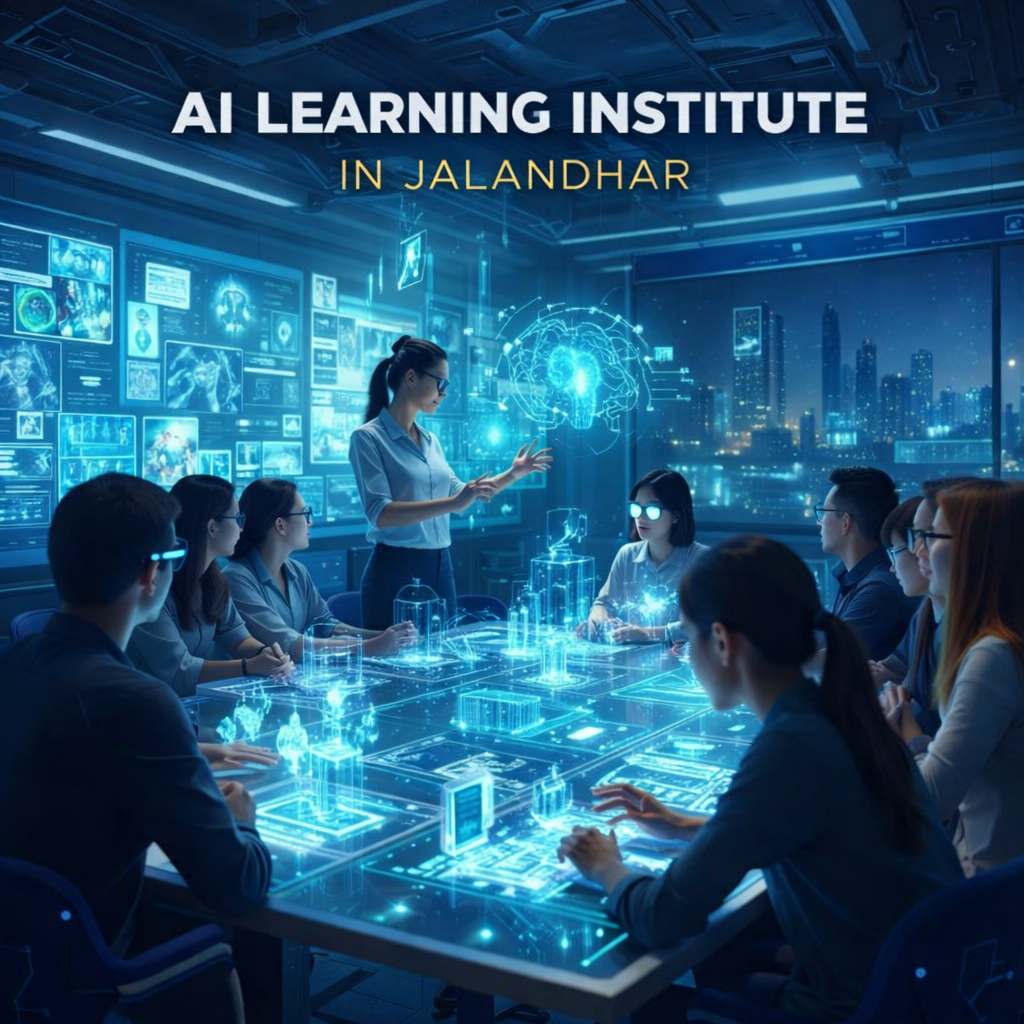
At TechCadd, the premier AI learning institute in Jalandhar, we have designed a comprehensive program that doesn't just teach you the theory of AI but equips you with the practical skills to build, deploy, and manage AI-powered solutions. Our curriculum is crafted by industry veterans and academic experts who understand the demands of the global AI job market. Whether you are a student starting your journey, a professional seeking to pivot into a high-growth field, or an entrepreneur looking to leverage AI for your business, this program is your launchpad.
The global AI market is projected to reach nearly $2 trillion by 2030. This explosive growth is creating a massive demand for skilled AI professionals. However, the supply of talent remains critically low. This gap represents an unparalleled opportunity for those who are prepared. Our program is designed to help you seize this opportunity by providing a structured, mentor-led, project-based learning experience that builds competence, confidence, and a standout portfolio.
Module 1: Foundations of Artificial Intelligence and Mathematics for AI
Every successful AI professional has a solid foundation. This module is designed to build that from the ground up. We start by demystifying AI, exploring its history, its core principles, and its various subfields including Machine Learning (ML), Deep Learning (DL), Natural Language Processing (NLP), Computer Vision, and Robotics. You'll understand the ethical implications of AI and the importance of responsible AI development.
1.1 Mathematics for Machine Learning: The Language of Algorithms
AI is built on a foundation of mathematics. We ensure you are not intimidated by it. Our instructors break down complex mathematical concepts into intuitive, understandable parts. We cover:
- Linear Algebra: The cornerstone of data representation. You'll master vectors, matrices, matrix operations, eigenvalues, and eigenvectors. This knowledge is crucial for understanding how data is structured and manipulated in neural networks.
- Calculus: The engine of learning. We explore derivatives, gradients, and the chain rule, which are essential for understanding how models learn through optimization algorithms like gradient descent.
- Probability and Statistics: The language of uncertainty and data. You'll learn about probability distributions, Bayes' theorem, hypothesis testing, and statistical significance. These concepts form the basis for making predictions and inferences from data.
- Optimization Techniques: Understanding how to find the 'best' solution from a set of possibilities is key. We'll cover convex optimization, gradient descent variations (SGD, Adam), and loss functions that guide model training.
Our approach is to teach you not just the formulas, but the intuition behind them, enabling you to understand, customize, and debug algorithms effectively.
1.2 Python Programming for AI and Data Science
Python is the undisputed language of AI. This module transforms you from a beginner to a proficient Python programmer, ready to tackle AI projects. We start with the fundamentals: data types, control flow, functions, and object-oriented programming. You will then dive into the essential libraries that power the AI ecosystem:
- NumPy: For efficient numerical computations. You'll learn to work with multi-dimensional arrays and perform complex mathematical operations with ease.
- Pandas: The data manipulation powerhouse. You'll master data loading, cleaning, transformation, and analysis using DataFrames, making you capable of handling real-world, messy datasets.
- Matplotlib and Seaborn: For data visualization. You'll learn to create insightful plots and charts to explore data, communicate findings, and evaluate model performance.
- Scikit-learn: The go-to library for classical machine learning. You'll implement algorithms for classification, regression, clustering, and dimensionality reduction.
Throughout this module, you'll work on hands-on coding exercises and mini-projects that reinforce your learning and build your programming muscle.
Module 2: Machine Learning – Building Predictive Models from Data
Machine Learning is the core of modern AI. This module takes you on a deep dive into the world of algorithms that learn from data. You will understand the complete machine learning pipeline: from data acquisition and preprocessing to model selection, training, evaluation, and deployment.
2.1 Supervised Learning: Learning from Labeled Data
Supervised learning is about predicting an output based on input features. We cover both regression (predicting continuous values) and classification (predicting categories) in exhaustive detail.
- Linear Regression: The simplest yet most fundamental algorithm. You'll understand its assumptions, implementation, and use cases.
- Logistic Regression: The go-to for binary classification problems, from spam detection to credit risk assessment.
- Decision Trees and Random Forests: Powerful, interpretable models for both classification and regression. You'll learn how to build, visualize, and optimize these tree-based models.
- Support Vector Machines (SVM): A robust algorithm for classification, especially effective in high-dimensional spaces. You'll master kernels that allow SVMs to handle non-linear data.
- Naive Bayes: A probabilistic classifier based on Bayes' theorem, widely used in text classification and spam filtering.
- k-Nearest Neighbors (k-NN): A simple, instance-based learning algorithm for both classification and regression.
We emphasize the trade-offs between different algorithms, helping you develop the intuition to choose the right tool for the right problem. You'll also learn critical model evaluation techniques like cross-validation, precision-recall curves, and ROC analysis.
2.2 Unsupervised Learning: Discovering Hidden Patterns
Unsupervised learning finds structure in unlabeled data. This module covers techniques that are crucial for customer segmentation, anomaly detection, and data compression.
- Clustering Algorithms (K-Means, Hierarchical, DBSCAN): You'll learn how to group similar data points together, a technique used in market segmentation, social network analysis, and image compression.
- Dimensionality Reduction (PCA, t-SNE): Techniques to reduce the number of variables in a dataset while preserving its essential structure. This is vital for visualization, noise reduction, and improving model efficiency.
- Association Rule Learning (Apriori, Eclat): Used for market basket analysis to discover items frequently purchased together.
Module 3: Deep Learning – Building Artificial Neural Networks
Deep Learning, powered by artificial neural networks, is the engine behind the most spectacular AI breakthroughs in computer vision, natural language processing, and game playing. This module takes you from the fundamentals to advanced architectures.
3.1 Artificial Neural Networks (ANN): The Building Blocks
We start with the biological inspiration behind neural networks and move to their mathematical formulation. You'll learn about:
- Perceptron and Activation Functions: Understanding the basic unit of a neural network and functions like sigmoid, tanh, ReLU, and their role in introducing non-linearity.
- Forward Propagation and Backpropagation: The core algorithms for how neural networks learn. You'll understand the mathematics behind calculating errors and adjusting weights to minimize loss.
- Optimizers and Regularization: Techniques to train networks faster and prevent overfitting, including SGD, Adam, dropout, and batch normalization.
3.2 Convolutional Neural Networks (CNN): Mastering Computer Vision
CNNs are the state-of-the-art for image and video analysis. You'll build and train models for tasks like:
- Image Classification: Identifying objects in images, from cat vs. dog to complex medical diagnoses.
- Object Detection: Locating and classifying multiple objects within an image (YOLO, SSD).
- Image Segmentation: Classifying every pixel in an image, used in autonomous driving and medical imaging.
- Transfer Learning: Leveraging pre-trained models like VGG16, ResNet, and Inception to build powerful vision systems with limited data.
3.3 Recurrent Neural Networks (RNN) and Transformers: Unlocking Language and Sequences
For sequential data like text, time series, and speech, specialized networks are needed.
- RNNs, LSTMs, and GRUs: You'll learn about networks with memory, capable of processing sequences of varying lengths. Applications include sentiment analysis, time series forecasting, and machine translation.
- The Transformer Architecture: The revolutionary architecture behind modern Large Language Models (LLMs) like GPT, BERT, and Llama. We'll cover attention mechanisms, positional encoding, and how to fine-tune these models for specific tasks.
- Natural Language Processing (NLP): A deep dive into text processing, tokenization, word embeddings (Word2Vec, GloVe), and building models for text classification, named entity recognition, and question answering.
Module 4: Data Engineering and MLOps – From Models to Production
Building a model is only half the battle. This module prepares you for the real world where AI models must be deployed, scaled, and maintained.
4.1 Data Engineering Fundamentals
Real-world data is messy and lives in various systems. You'll learn to:
- Work with databases using SQL and NoSQL.
- Build data pipelines using tools like Apache Airflow.
- Handle big data concepts with frameworks like Spark.
- Ensure data quality, governance, and security.
4.2 Model Deployment and MLOps
We cover the full lifecycle of AI projects:
- Model Serving: Deploying models as APIs using frameworks like Flask, FastAPI, and TensorFlow Serving.
- Containerization (Docker): Packaging your applications for consistent deployment across environments.
- Cloud Platforms (AWS, Google Cloud, Azure): Utilizing cloud services for scalable compute, storage, and managed AI services.
- Monitoring and Maintenance: Tracking model performance in production, detecting drift, and setting up retraining pipelines.
- CI/CD for ML: Applying software engineering best practices to machine learning projects.
Module 5: Specialized Tracks – Choose Your Path
To help you tailor your learning to your career goals, we offer specialized tracks:
- AI for Healthcare: Medical image analysis, genomics, and clinical NLP.
- AI for Finance: Algorithmic trading, fraud detection, and risk modeling.
- AI for E-commerce & Marketing: Recommendation systems, customer churn prediction, and dynamic pricing.
- Generative AI & Creative AI: Using models like GPT, DALL-E, and Stable Diffusion for content creation, code generation, and design.
- Autonomous Systems (Robotics): Integrating AI with robotics for perception, planning, and control.
Conclusion: Your AI Journey Begins Here at TechCadd, Jalandhar
The field of Artificial Intelligence is not just a career choice; it is an opportunity to be at the forefront of human innovation. The skills you will gain at TechCadd, the leading AI learning institute in Jalandhar, will empower you to solve complex problems, create groundbreaking products, and build a future that is not only technologically advanced but also ethically responsible. Our comprehensive curriculum, experienced mentors, and project-based approach ensure you are not just learning about AI, but becoming an AI practitioner. Join us and start building the future today.
Why TechCadd is the Premier AI Learning Institute in Jalandhar
In the rapidly evolving field of Artificial Intelligence, the quality of your education can make the difference between being a spectator and a pioneer. At TechCadd, we have built our reputation on delivering an unparalleled learning experience. We are not just an institute; we are a launchpad for the next generation of AI leaders. Our mission is to democratize AI education and provide every student with the skills, knowledge, and confidence to thrive in the AI-driven world.
1. Mentorship from Industry Practitioners, Not Just Academicians
The difference between a good AI course and a great one lies in the mentors. Our faculty comprises not just educators but active practitioners and researchers in the field of AI. They bring with them years of experience from leading tech companies, research labs, and successful AI startups. They don't just teach you from a textbook; they share real-world insights, war stories from the trenches, and best practices that you simply cannot learn in a purely academic setting.
Our mentors have built and deployed AI systems that are used by millions. They have solved complex data challenges, navigated the ethical dilemmas of AI, and seen firsthand what works and what doesn't. When you learn from them, you benefit from their experience, their network, and their deep understanding of the industry landscape. They are invested in your success, providing guidance on projects, career advice, and mentorship that extends beyond the classroom. You become part of their professional network, a valuable asset as you start your career.
2. An Industry-Aligned, Future-Proof Curriculum
The field of AI is moving at breakneck speed. A curriculum that was cutting-edge two years ago might be obsolete today. At TechCadd, we pride ourselves on our dynamic, constantly evolving curriculum. We have a dedicated curriculum committee that includes industry experts from top AI companies and research institutions. This committee meets regularly to review and update our course content, ensuring it reflects the latest advancements, tools, and industry demands.
Our curriculum goes far beyond basic Python and introductory machine learning. We delve into the most in-demand areas:
- Deep Learning Architectures: We don't just teach you to use pre-built models; we teach you to understand, customize, and innovate with architectures like Transformers, GANs (Generative Adversarial Networks), and Graph Neural Networks.
- Large Language Models (LLMs): You'll learn to work with state-of-the-art models like GPT-4, Llama 3, and BERT. We cover prompt engineering, fine-tuning, Retrieval-Augmented Generation (RAG), and deploying these models responsibly.
- MLOps (Machine Learning Operations): Recognizing that real-world AI is about more than just building models, we provide extensive training in deploying, scaling, and maintaining AI systems in production using tools like Docker, Kubernetes, MLflow, and cloud platforms.
- Responsible AI and Ethics: As AI becomes more powerful, the ethical implications become more critical. We ensure our students are not just technically proficient but also ethically aware, covering topics like bias, fairness, explainability, and privacy.
This approach ensures that you are not just learning for your first job but are prepared for the challenges and opportunities of the next decade.
3. 100% Project-Based Learning with Real-World Applications
You learn AI by doing AI. Our entire program is built around a project-based learning methodology. Each concept you learn is immediately applied to a hands-on project, solidifying your understanding and building your portfolio from day one. You don't just work on toy datasets or theoretical problems. You work on projects that mirror the challenges faced by AI professionals in the industry.
Your projects will include:
- Building a Recommendation System: Develop a personalized recommendation engine similar to those used by Netflix or Amazon.
- Creating a Computer Vision Application: Build a model that can detect diseases from medical images or identify objects in real-time video streams.
- Fine-Tuning a Large Language Model: Take a pre-trained model like Llama and fine-tune it for a specific domain, such as legal document analysis or customer support.
- Deploying an AI Model as a Scalable API: Take your trained model and deploy it to the cloud, building a full end-to-end application with a front-end interface.
- Solving a Business Problem with Data: Work with a local business or a provided dataset to extract insights and build a predictive model that solves a real business challenge.
By the end of the program, you will have a portfolio of 5-7 significant projects that you can showcase to potential employers. This portfolio is a powerful testament to your skills and practical experience, often carrying more weight than a certificate alone.
4. Small Batch Sizes for Unmatched Personalized Attention
AI is a complex subject. It requires deep understanding, critical thinking, and the ability to ask questions and receive feedback. In large, impersonal classes, students can get left behind. We intentionally maintain small batch sizes (typically 10-15 students per batch). This allows our mentors to know every student individually – their strengths, their weaknesses, their learning style, and their career aspirations.
This personalized approach ensures:
- Deeper Learning: Instructors can take the time to ensure every student understands a concept before moving on. No one is left behind.
- Tailored Feedback: When you work on projects, you receive detailed, personalized feedback that helps you improve and grow.
- Enhanced Interaction: Small classes foster a collaborative environment where students learn from each other, ask questions freely, and build lasting professional relationships.
- Flexible Pacing: While we have a structured curriculum, we can adapt the pace to the needs of the batch, ensuring optimal learning for everyone.
5. State-of-the-Art Infrastructure and Premium Tools Access
AI development requires significant computational resources. To ensure our students have the best possible learning environment, we have invested heavily in our infrastructure. Our labs are equipped with high-performance workstations featuring powerful GPUs (Graphics Processing Units) essential for training deep learning models.
We also provide access to:
- Cloud Computing Credits: Each student receives credits for major cloud platforms like AWS, Google Cloud, or Azure, allowing you to practice building and deploying models in the cloud.
- Premium Software and Tools: Access to the latest versions of Python libraries, data visualization tools, and MLOps platforms used by the industry.
- Dedicated Project Servers: A sandbox environment where you can experiment, collaborate on projects, and store your work safely.
- 24/7 Lab Access: Our labs are accessible beyond class hours, giving you the flexibility to work on projects and practice at your own pace.
6. Comprehensive Career Support and Placement Assistance
Our ultimate goal is your career success. Our dedicated placement cell is committed to connecting you with the best opportunities in the AI job market. Our support includes:
- Resume and Portfolio Development: We help you craft a compelling resume and a professional portfolio that effectively showcases your skills and projects.
- Interview Preparation: Conduct mock technical and HR interviews to prepare you for the rigors of the hiring process. You'll receive constructive feedback on your technical knowledge, problem-solving approach, and communication skills.
- Technical Assessments: We train you for the kind of coding and problem-solving challenges commonly used in AI interviews.
- Strong Corporate Network: We have established relationships with leading AI companies, startups, and corporate R&D labs across India and globally. We leverage this network to connect our graduates with open positions.
- Hiring Drives and Job Fairs: We regularly host hiring events and job fairs where our students can meet and interview with potential employers directly.
- Entrepreneurship Support: For those with entrepreneurial aspirations, we provide guidance on validating AI startup ideas, building a business plan, and connecting with investors.
7. Flexible Learning Options to Suit Your Lifestyle
We understand that our students come from diverse backgrounds. Some are college students with daytime commitments. Others are working professionals looking to upskill. We offer flexible learning options to accommodate your schedule:
- Weekday Batches (Morning, Afternoon, Evening): For those who can dedicate time during the week.
- Weekend Batches: Perfect for working professionals and students with weekday constraints.
- Fast-Track Batches: An intensive program for those who want to complete their training in a shorter timeframe.
- Online Live Learning: Interactive, live online sessions with the same curriculum and access to mentors, allowing you to learn from anywhere.
8. A Vibrant AI Community and Alumni Network
When you join TechCadd, you become part of a thriving community of AI enthusiasts, learners, and professionals. This community is one of your most valuable assets. We facilitate:
- AI Meetups and Guest Lectures: Regular events featuring talks by industry leaders, researchers, and successful alumni.
- Hackathons and Competitions: Opportunities to collaborate with peers, solve challenging problems, and showcase your skills.
- Alumni Network: Connect with TechCadd alumni working in top AI roles across the globe. This network provides mentorship, job referrals, and a sense of belonging.
- Research and Publication Opportunities: For those interested in research, we provide guidance and support for writing papers and presenting at conferences.
9. Proven Track Record of Success
The true measure of an institute is the success of its students. Our alumni have gone on to achieve remarkable things, from securing positions at top tech companies to founding successful AI startups. Their stories are a testament to the quality of education and support we provide. They are now AI engineers at Google, data scientists at major banks, researchers at universities, and entrepreneurs building AI solutions for real-world problems. This track record of success is what makes TechCadd the trusted choice for AI education in Jalandhar.
Conclusion: Your Future in AI Starts Now
Choosing the right institute for your AI education is one of the most important decisions you will make. At TechCadd, we are dedicated to providing you with the highest quality education, mentorship, and support to ensure your success. We invite you to join the leading AI learning institute in Jalandhar and take the first step towards a future where you are not just using technology, but building it. Contact us today to start your journey.
The Future Scope of Artificial Intelligence: A World of Limitless Opportunities
We are currently living through the most significant technological revolution since the advent of the internet. Artificial Intelligence is not a fleeting trend or a niche technology. It is a foundational technology, much like electricity or the internal combustion engine, that is poised to transform every sector of the economy and every aspect of our lives. For those with the skills to harness its power, the opportunities are not just abundant – they are unprecedented. This is not just about getting a job; it's about being a part of the movement that will define the 21st century.
1. Unprecedented Demand for AI Talent Across Every Industry
The demand for AI professionals is exploding. According to reports from the World Economic Forum, LinkedIn, and major recruitment agencies, AI and Machine Learning specialists are consistently ranked among the fastest-growing and highest-paying job roles globally. This demand is not limited to traditional tech companies. Every industry is racing to integrate AI:
- Healthcare: From drug discovery and personalized medicine to diagnostic imaging and robotic surgery, AI is revolutionizing patient care and medical research. Hospitals, biotech firms, and pharmaceutical companies are aggressively hiring AI talent.
- Finance: Algorithmic trading, fraud detection, risk assessment, personalized banking, and customer service chatbots are all driven by AI. Banks, investment firms, and fintech startups are in constant need of skilled professionals.
- Automotive & Manufacturing: The development of autonomous vehicles is one of the most ambitious AI projects ever. Beyond self-driving cars, AI is used for predictive maintenance, quality control, and supply chain optimization in factories.
- Retail & E-commerce: Recommendation systems, demand forecasting, dynamic pricing, and inventory management are all powered by AI, creating a massive demand for talent in this sector.
- Agriculture: AI is being used for precision farming, crop monitoring, yield prediction, and automated harvesting, addressing the global challenge of food security.
- Media & Entertainment: Personalized content recommendations, automated content creation (writing, music, video), and advanced special effects are all AI-driven.
- Government & Public Sector: From smart city initiatives and public safety to efficient service delivery and policy analysis, governments are also investing heavily in AI.
This cross-industry demand creates a career landscape where you have the freedom to choose a domain that aligns with your passion, be it healthcare, finance, art, or environmental science. The common thread is the need for AI expertise.
2. High-Paying, Globally Recognized Career Paths
AI careers are not only in high demand but are also among the most financially rewarding. The specialized skills required command premium compensation. The career paths are diverse and offer clear progression:
- Machine Learning Engineer: Builds and deploys ML models at scale. Responsible for the entire lifecycle from data collection to model serving. Often considered the core engineering role in AI. Average salaries in India range from ₹8-25 lakhs for experienced professionals, with top global companies paying significantly more.
- Data Scientist: Extracts insights from data and builds predictive models. Combines skills in statistics, machine learning, and business acumen. A highly sought-after role across industries.
- AI Research Scientist: Pushes the boundaries of AI by developing new algorithms and architectures. Typically requires advanced education (Master's/PhD) and a passion for theoretical exploration. These roles exist in academia, corporate R&D labs (Google Brain, DeepMind, Microsoft Research), and cutting-edge startups.
- Computer Vision Engineer: Specializes in enabling machines to "see" and interpret the visual world. Works on applications like facial recognition, autonomous driving, and medical imaging.
- NLP Engineer: Focuses on enabling machines to understand, interpret, and generate human language. Works on chatbots, machine translation, sentiment analysis, and the latest LLM-based applications.
- MLOps Engineer: Bridges the gap between data science and IT operations. Specializes in deploying, monitoring, and maintaining ML models in production. A relatively new but rapidly growing and critical role.
- AI Product Manager: Guides the development of AI-powered products. Requires a blend of technical understanding, business strategy, and user empathy.
- AI Consultant: Advises organizations on how to leverage AI to solve business problems, often working with multiple clients across different industries.
The salary potential is not the only draw. AI professionals often enjoy roles that offer intellectual challenge, creative problem-solving, and the opportunity to work on projects that have a tangible impact on the world.
3. The Rise of Generative AI and New Frontiers
While the demand for traditional AI roles remains strong, the recent explosion of Generative AI has opened up entirely new frontiers. Technologies like Large Language Models (GPT), image generators (DALL-E, Midjourney), and code generators (GitHub Copilot) are creating new industries and transforming existing ones. This has led to a surge in demand for:
- Prompt Engineers: Professionals skilled in crafting effective prompts to get the best results from LLMs.
- LLM Fine-Tuners: Experts who can adapt pre-trained models for specific tasks and domains.
- Generative AI Application Developers: Building applications that leverage these new models for content creation, design, coding, and more.
- AI Ethics and Governance Specialists: As Generative AI raises new ethical questions about deepfakes, bias, and copyright, there is a growing need for professionals who can ensure responsible development and deployment.
These roles did not exist five years ago, highlighting the dynamic nature of the field. By getting trained now, you are positioning yourself at the very beginning of a massive new wave of innovation.
4. The Entrepreneurial Opportunity: Building the Next AI Unicorn
For those with an entrepreneurial spirit, AI offers a playground of opportunity. The cost of building and deploying AI applications has dropped dramatically thanks to open-source models, cloud computing, and powerful APIs. This has lowered the barriers to entry for AI startups. The next big tech companies are likely to be AI-first. Some of the most exciting areas for AI startups include:
- AI for Specialized Vertical Markets: Building AI solutions for specific industries like legal tech, education tech, or construction tech.
- AI-Powered SaaS (Software as a Service): Creating tools that use AI to enhance productivity, creativity, or decision-making for businesses and individuals.
- AI for Social Good: Tackling global challenges in climate change, healthcare access, education, and disaster response with innovative AI solutions.
- AI Infrastructure and Tools: Building the next generation of tools and platforms that will help other developers build AI applications.
Your AI education at TechCadd can be the foundation for your own venture, giving you the technical credibility and network to turn your ideas into reality.
5. The Role of AI in India's Digital Future
India is poised to become a global AI powerhouse. The government's "AI for All" initiative and the establishment of a national AI portal demonstrate a strong commitment to fostering AI innovation. With a massive pool of engineering talent and a burgeoning startup ecosystem, India is rapidly becoming a hub for AI research, development, and implementation. This creates a particularly favorable environment for AI professionals trained in India. Cities like Bangalore, Hyderabad, Pune, and even in Punjab, Jalandhar are seeing a growth in AI-focused companies and opportunities. The future of AI in India is bright, and skilled professionals will be at the forefront of this growth.
6. Lifelong Learning and Continuous Evolution
One of the most exciting aspects of a career in AI is that it is a field of constant learning and discovery. You will never be bored. There will always be new research papers to read, new models to experiment with, and new problems to solve. The field attracts curious, passionate individuals who are driven by a desire to push the boundaries of what's possible. This makes it a deeply fulfilling career for those who love to learn and innovate. Your training at TechCadd is not the end of your learning journey, but the beginning of a lifetime of intellectual growth.
7. Jalandhar: An Emerging Hub for AI Talent
While metropolitan cities have traditionally been the center of tech jobs, the landscape is changing. With the rise of remote work and the growth of tech ecosystems in smaller cities, Jalandhar is well-positioned to become a hub for AI talent. By training at TechCadd in Jalandhar, you can build a career that is not tied to a specific location. You can work for companies in Bangalore or San Francisco from the comfort of your home city, enjoying a lower cost of living while earning competitive salaries. This location advantage is a significant factor for many of our students.
Conclusion: The Time to Invest in Your AI Future is Now
The future is not something that just happens; it is built by the people with the vision and skills to create it. Artificial Intelligence is the tool that will build the future. By choosing to invest in an AI education at TechCadd, the leading AI learning institute in Jalandhar, you are not just preparing for a job; you are positioning yourself to be a builder of tomorrow. The opportunities are vast, the rewards are significant, and the time to start is now. Join us and become a part of the AI revolution.