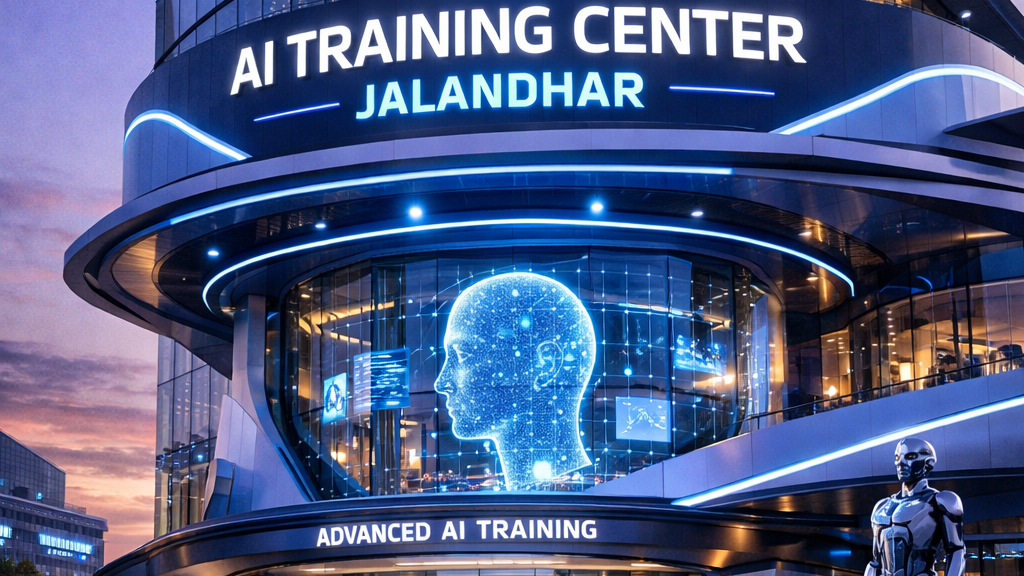
Complete AI Training Program in Jalandhar: Master Artificial Intelligence from Fundamentals to Advanced Applications
Artificial Intelligence is no longer a futuristic concept—it is the driving force behind the fourth industrial revolution. From self-driving cars and voice assistants to personalized healthcare and financial forecasting, AI is transforming every industry. The global AI market is projected to reach $1.8 trillion by 2030, creating an unprecedented demand for skilled AI professionals. According to the World Economic Forum, AI and machine learning specialists are among the fastest-growing job roles globally. This is precisely why TechCadd has designed its comprehensive AI training center in Jalandhar—to equip you with the skills needed to thrive in this AI-driven world.
Whether you are a student aiming for a career in tech, a professional looking to upskill, or an entrepreneur wanting to leverage AI for your business, our training program is your gateway to success. We don't just teach you AI concepts; we train you to become an AI problem solver who can build intelligent systems, analyze complex data, and drive innovation. Our curriculum is meticulously crafted to take you from complete beginner to job-ready AI specialist, with a strong emphasis on practical, hands-on learning.
What makes our AI training unique is the personalized coaching approach. You'll work with experienced AI practitioners who guide you through every step of your learning journey. Our small batch sizes ensure you get individual attention, and our state-of-the-art labs provide the computational resources you need to train complex models. Join us at TechCadd, the leading AI training center in Jalandhar, and transform your career.
Module 1: Foundations of Artificial Intelligence and Python Programming
Every AI journey begins with a strong foundation. This module ensures you master the essential building blocks before diving into advanced topics.
1.1 Introduction to Artificial Intelligence: History, Concepts, and Applications
We start by exploring the fascinating history of AI, from the Dartmouth Conference in 1956 to today's deep learning revolution. You'll learn about the different types of AI: Narrow AI (systems designed for specific tasks), General AI (hypothetical systems with human-like intelligence), and Superintelligence. You'll explore the ethical implications of AI, including bias in algorithms, privacy concerns, and the future of work. Real-world case studies across healthcare, finance, retail, and manufacturing will illustrate how AI is solving complex problems. This foundational knowledge provides context for everything you'll learn later.
1.2 Python for AI: Mastering the Essential Programming Language
Python is the lingua franca of AI. This comprehensive module transforms you into a proficient Python programmer, ready to tackle AI projects. Starting from the basics, you'll learn variables, data types, loops, functions, and object-oriented programming. We then move to libraries essential for AI: NumPy for numerical computing, Pandas for data manipulation and analysis, Matplotlib and Seaborn for data visualization. You'll work with real datasets, learning to clean, transform, and explore data—skills that are fundamental for any AI project. Your coach will guide you through coding exercises, ensuring you develop strong programming habits and problem-solving skills. By the end of this module, you'll be comfortable writing Python code to handle complex data operations.
Module 2: Mathematics for Machine Learning
Mathematics is the language of AI. This module demystifies the mathematical concepts behind machine learning algorithms, making them accessible and practical.
2.1 Linear Algebra: The Foundation of Data Representation
Linear algebra is crucial for understanding how data is represented and transformed in AI models. You'll learn about vectors, matrices, and tensors—the building blocks of neural networks. Topics include matrix operations, eigenvalues and eigenvectors, singular value decomposition (SVD), and principal component analysis (PCA). Your coach will explain these concepts using intuitive examples and Python implementations, showing how they are used in dimensionality reduction, feature extraction, and deep learning architectures. You'll build a solid intuitive understanding that will make advanced AI topics much easier to grasp.
2.2 Calculus: Understanding How Models Learn
Calculus is essential for understanding optimization—how AI models learn from data. You'll learn about derivatives, partial derivatives, gradients, and the chain rule. The concept of gradient descent, the algorithm that drives learning in neural networks, is explained in depth. Your coach will guide you through implementing gradient descent from scratch, so you truly understand how models minimize error and improve over time. You'll also learn about backpropagation, the algorithm that makes deep learning possible, and how it uses calculus to adjust millions of parameters in a neural network.
2.3 Probability and Statistics: Making Sense of Uncertainty
AI models must handle uncertainty. This module covers probability theory, probability distributions (normal, binomial, Poisson), Bayesian thinking, and statistical inference. You'll learn about hypothesis testing, confidence intervals, and how to evaluate model performance using metrics like accuracy, precision, recall, and F1-score. Understanding these concepts is critical for building reliable AI systems and for interpreting model outputs. Your coach will use real-world examples to make these concepts practical and relevant.
Module 3: Machine Learning Fundamentals
Machine Learning is the core of AI. This module provides comprehensive coverage of classical machine learning algorithms and their practical applications.
3.1 Supervised Learning: Predicting from Labeled Data
Supervised learning is used when you have labeled data. You'll learn both regression and classification algorithms. For regression (predicting continuous values), we cover linear regression, polynomial regression, and regularization techniques (Ridge, Lasso). For classification (predicting categories), we cover logistic regression, decision trees, random forests, and support vector machines (SVM). Your coach will guide you through implementing these algorithms using scikit-learn, the leading machine learning library. You'll work on real-world projects like predicting house prices (regression) and classifying customer churn (classification), learning to preprocess data, train models, and evaluate performance.
3.2 Unsupervised Learning: Finding Hidden Patterns
Unsupervised learning is used when data lacks labels. You'll learn about clustering algorithms like K-means, hierarchical clustering, and DBSCAN for segmenting customers or grouping similar items. Dimensionality reduction techniques like PCA and t-SNE are covered for visualizing high-dimensional data and reducing computational complexity. Anomaly detection algorithms for identifying fraud or unusual patterns are also explored. These techniques are essential for exploratory data analysis and for building AI systems that can discover insights without human guidance.
3.3 Model Evaluation and Validation
Building models is only half the story—you must also evaluate them effectively. You'll learn about train-test splits, cross-validation, and bias-variance tradeoff. Metrics like confusion matrix, ROC curves, and AUC-ROC are covered for classification problems. For regression, you'll learn about R-squared, mean squared error, and mean absolute error. You'll also learn about hyperparameter tuning using grid search and random search to optimize model performance. Your coach will show you how to avoid common pitfalls like overfitting and data leakage, ensuring your models generalize well to new data.
Module 4: Deep Learning and Neural Networks
Deep Learning has revolutionized AI, enabling breakthroughs in computer vision, natural language processing, and more. This module takes you deep into neural networks.
4.1 Artificial Neural Networks (ANNs)
You'll start by understanding the perceptron—the simplest neural network—and then build up to multi-layer perceptrons (MLPs). Topics include activation functions (sigmoid, tanh, ReLU), forward propagation, and backpropagation. You'll learn how to build and train neural networks using TensorFlow and Keras, the most popular deep learning frameworks. Your coach will guide you through building neural networks for regression and classification tasks, and you'll learn techniques like dropout and batch normalization to improve performance and prevent overfitting.
4.2 Convolutional Neural Networks (CNNs) for Computer Vision
CNNs are the backbone of modern computer vision. You'll learn about convolutional layers, pooling layers, and how CNNs learn hierarchical features from images. You'll build architectures like LeNet, AlexNet, and ResNet, and apply them to tasks like image classification, object detection, and image segmentation. Using transfer learning, you'll learn how to leverage pre-trained models like VGG16, Inception, and YOLO to build powerful vision systems with limited data. You'll work on projects like building a face recognition system, detecting diseases from medical images, and creating a self-driving car simulation.
4.3 Recurrent Neural Networks (RNNs) and Transformers for Sequence Data
For tasks involving sequences—like text, speech, or time series—RNNs and Transformers are essential. You'll learn about simple RNNs, LSTMs (Long Short-Term Memory networks), and GRUs (Gated Recurrent Units) for handling long-range dependencies. The Transformer architecture, which powers models like GPT and BERT, is covered in depth. You'll understand self-attention mechanisms and how they revolutionized natural language processing. You'll build models for text generation, sentiment analysis, machine translation, and time series forecasting. By the end of this module, you'll be able to build AI systems that understand and generate human language.
Module 5: Natural Language Processing (NLP)
NLP enables machines to understand and generate human language. This module covers the full spectrum of NLP techniques.
5.1 Text Preprocessing and Feature Extraction
Before building NLP models, you need to preprocess text data. You'll learn techniques like tokenization, stemming, lemmatization, stop word removal, and handling of special characters. You'll explore different ways to represent text: bag-of-words, TF-IDF, word embeddings (Word2Vec, GloVe), and contextual embeddings (BERT, GPT). Your coach will guide you through implementing these techniques and understanding their trade-offs.
5.2 Advanced NLP Tasks and Applications
You'll build real-world NLP applications including sentiment analysis for understanding customer opinions, named entity recognition (NER) for extracting information from documents, text summarization for condensing long articles, and question answering systems. You'll work with large language models (LLMs) like GPT, learning how to fine-tune them for specific tasks and how to use prompt engineering effectively. You'll also learn about building chatbots and conversational AI systems that can interact naturally with users.
Module 6: Computer Vision and Image Processing
Computer Vision allows machines to interpret and understand visual information. This module covers both classical and deep learning approaches to vision.
6.1 Image Processing Fundamentals
You'll start with the basics of digital images: pixels, color spaces, and image transformations. You'll learn techniques for image filtering, edge detection, feature extraction (SIFT, SURF), and image segmentation. Using OpenCV, the leading computer vision library, you'll implement these techniques and understand their applications in real-world systems.
6.2 Advanced Vision Applications
Building on CNNs, you'll create sophisticated vision applications including face recognition and emotion detection, object detection and tracking using YOLO and SSD, semantic and instance segmentation using Mask R-CNN, and image generation using GANs (Generative Adversarial Networks). You'll work on projects like building a surveillance system, creating artistic style transfer, and developing augmented reality applications. Your coach will help you understand the nuances of deploying vision models in production environments.
Module 7: Model Deployment and MLOps
Building AI models is only part of the job—you also need to deploy them to production. This module covers the entire lifecycle of AI projects.
7.1 Model Deployment Strategies
You'll learn how to take your trained models and make them available for use. Topics include creating REST APIs for models using Flask or FastAPI, containerization with Docker for consistent deployment, and cloud deployment on AWS, Google Cloud, or Azure. You'll learn about edge deployment for mobile and IoT devices using TensorFlow Lite. Your coach will guide you through deploying a real model to the cloud, making it accessible via a web interface.
7.2 MLOps: Managing the AI Lifecycle
MLOps combines machine learning with DevOps to manage the entire AI lifecycle. You'll learn about model versioning, experiment tracking using tools like MLflow, automated retraining pipelines, and model monitoring for detecting drift. These practices ensure your models remain accurate and reliable over time. You'll learn to use tools like Docker, Kubernetes, and CI/CD pipelines to automate and scale AI operations.
Module 8: Practical Projects and Portfolio Development
Throughout the training, you'll work on real-world projects that build your portfolio. Projects include:
- Predictive Analytics Project: Build a model to forecast sales or customer churn for a real business.
- Computer Vision System: Create a face recognition attendance system or an object detection app.
- NLP Application: Develop a sentiment analysis tool for social media monitoring or a chatbot for customer service.
- Generative AI Project: Build a text generation model or an image generation system using GANs.
- End-to-End AI Product: Take a project from problem definition to deployed solution, showcasing your full stack of skills.
Your coach will guide you through each project, providing feedback and helping you present your work professionally. By the end of the course, you'll have a portfolio of projects that demonstrates your capabilities to employers.
Conclusion: Your AI Journey Starts Here
Artificial Intelligence is reshaping the world, and the demand for skilled AI professionals has never been higher. At TechCadd, the premier AI training center in Jalandhar, we provide the knowledge, skills, and support you need to excel in this exciting field. Our comprehensive curriculum, experienced mentors, practical projects, and placement assistance ensure you're not just learning—you're preparing for a successful career. Whether you aspire to work at top tech companies, lead AI initiatives, or start your own AI venture, we are here to guide you every step of the way. Join TechCadd today and become part of the AI revolution.
Why TechCadd is the Leading AI Training Center in Jalandhar
In the rapidly evolving landscape of artificial intelligence, choosing the right training center is a critical decision that will shape your career trajectory. With countless institutes claiming to offer AI education, what makes one truly exceptional? At TechCadd, we believe that our unwavering commitment to student success, industry-aligned curriculum, practical approach, and comprehensive support system make us the premier AI training center in Jalandhar. Our students don't just learn AI—they become innovators who are ready to tackle real-world challenges.
This isn't just about teaching algorithms and models. It's about transforming you into a confident AI professional who can conceptualize, build, and deploy intelligent systems. With a track record of successful alumni working in top companies and research institutions, TechCadd has established itself as the trusted name for AI education in the region. Here's why students from Jalandhar, Punjab, and beyond choose us for their AI journey.
1. Industry-Experienced AI Mentors Who Guide You at Every Step
The quality of training is only as good as the quality of mentors. At TechCadd, we have assembled a team of AI practitioners with deep industry experience. Our mentors have worked on cutting-edge AI projects in domains like healthcare, finance, e-commerce, and autonomous systems. They don't just know the theory—they have faced the challenges of building AI systems in production environments, dealing with data scarcity, model drift, and deployment constraints.
Your mentor will be your guide throughout the program. They will help you understand complex concepts, debug your code, and think critically about AI problems. They will share insights from their own careers—what worked, what didn't, and how to navigate the AI job market. Because our batch sizes are small, you get personalized attention. Your mentor knows your strengths and weaknesses and adapts their guidance accordingly. This is the difference between being just another student and having a dedicated coach invested in your success.
Our mentors also stay current with the latest developments in AI. They bring knowledge of recent research papers, new frameworks, and emerging best practices into the classroom. You'll learn from people who are active in the AI community, ensuring you're always learning what's relevant now, not what was relevant years ago.
2. Comprehensive Curriculum That Covers the Full AI Spectrum
AI is a vast field. Our curriculum ensures you get a comprehensive understanding while also allowing you to specialize in areas that interest you. We cover everything from foundational mathematics to advanced deep learning, from classical machine learning to cutting-edge generative AI. The curriculum is continuously updated to reflect the latest developments in the field.
Python for AI: You'll master Python programming with a focus on libraries like NumPy, Pandas, Matplotlib, and Scikit-learn. These skills are essential for any AI professional and form the foundation of your work.
Mathematics for AI: Linear algebra, calculus, probability, and statistics are taught in the context of AI, with intuitive explanations and practical implementations. You'll understand not just how algorithms work, but why they work.
Machine Learning: We cover both supervised and unsupervised learning in depth. You'll learn about regression, classification, clustering, and dimensionality reduction. You'll implement algorithms from scratch and use modern libraries, understanding the trade-offs and best practices for each.
Deep Learning: You'll build neural networks, convolutional networks (CNNs) for vision, recurrent networks (RNNs) and Transformers for sequence data. You'll work with TensorFlow and PyTorch, the two leading deep learning frameworks, and learn to build state-of-the-art models.
Specialized Domains: You'll dive deep into Natural Language Processing (NLP), learning about word embeddings, transformers, and large language models (LLMs) like GPT and BERT. In Computer Vision, you'll master image processing, object detection, and image generation. You'll also learn about generative AI, reinforcement learning, and AI ethics.
Deployment and MLOps: You'll learn to take your models from notebooks to production. We cover model serving, API development, containerization with Docker, cloud deployment, and the practices of MLOps for managing the AI lifecycle.
This comprehensive approach ensures you have the breadth to understand the AI landscape and the depth to build real applications. You'll graduate not just with knowledge, but with the ability to apply that knowledge to solve problems.
3. 100% Hands-On Learning with Real-World Projects
The best way to learn AI is by doing AI. At TechCadd, theory is always paired with practical application. From day one, you'll be writing code, analyzing data, and building models. Our project-based approach ensures you develop not just knowledge but also the skills and confidence to tackle real challenges.
Real Datasets, Real Problems: You'll work with datasets from Kaggle, industry partners, and research repositories. You'll tackle problems like predicting customer churn for a telecom company, detecting fraudulent transactions, building a recommendation system, and analyzing medical images. These aren't toy problems—they're the kind of challenges you'll face in your career.
End-to-End Project Experience: For each major module, you'll complete a project that takes you from problem definition to solution. You'll learn to formulate the problem, acquire and preprocess data, select appropriate models, train and evaluate them, and present your results. Your mentor provides feedback and helps you refine your approach.
Capstone Project: The culmination of your training is a comprehensive capstone project. You'll choose a problem that interests you and build a complete AI solution. This could be anything from a face recognition system to a chatbot to a predictive maintenance model. You'll document your work and present it, creating a portfolio piece that demonstrates your skills to employers.
By the time you complete the program, you'll have a portfolio of projects that showcase your abilities. When you go for job interviews, you won't just talk about what you know—you'll show what you've built. This practical experience is what employers value most.
4. Small Batch Sizes for Personalized Attention
AI is complex. Learning it effectively requires individual attention. That's why we keep our batch sizes small—typically 10-15 students per batch. In this environment, you get the personalized attention you need to truly master the material.
In a small batch, your mentor knows you as an individual. They understand your learning style, your strengths, and the areas where you need extra help. You can ask questions freely without feeling lost in a crowd. When you're stuck on a concept, you get immediate help rather than waiting for the next class. Your mentor can adapt the pace to ensure you understand before moving on.
This personalized approach is particularly important in AI, where concepts build on each other. If you don't fully understand gradient descent, you'll struggle with deep learning. If you're shaky on linear algebra, you'll find neural networks confusing. Our mentors ensure you build a solid foundation at each stage, so you're always prepared for what comes next.
You also benefit from interaction with your peers. Small batches foster a collaborative environment where you can learn from each other, work together on projects, and build professional relationships that last beyond the course.
5. State-of-the-Art Infrastructure and Tools Access
AI development requires significant computational resources. Training deep learning models on standard laptops can be frustratingly slow. At TechCadd, we provide you with the infrastructure you need to work efficiently.
High-Performance Computing: Our labs are equipped with powerful workstations featuring high-end GPUs (Graphics Processing Units) that dramatically accelerate model training. You'll work with NVIDIA GPUs using CUDA, the standard for deep learning computation.
Cloud Access: In addition to on-site resources, we provide access to cloud platforms like Google Colab Pro, AWS, and Azure. You'll learn to leverage cloud computing for even larger projects, gaining skills that are highly valued in the industry.
Professional Tools: You'll have access to all the tools used by AI professionals: Jupyter Notebooks for development, TensorFlow and PyTorch for deep learning, Scikit-learn for machine learning, OpenCV for computer vision, and Hugging Face for NLP. You'll also use tools for experiment tracking (MLflow), containerization (Docker), and deployment.
By working with these tools in a professional environment, you'll be ready to step into any AI role and be productive from day one.
6. Comprehensive Placement and Career Support
Your ultimate goal is to build a successful career. Our placement cell works tirelessly to help you achieve that goal. We provide comprehensive support that goes beyond just teaching you AI skills.
Resume and Portfolio Development: We help you craft a professional resume that highlights your AI skills and projects. Your portfolio of projects is your most powerful asset, and we help you present it in the most compelling way. You'll learn to write effective project descriptions that demonstrate your impact.
Mock Interviews and Technical Preparation: AI interviews often include technical questions on algorithms, mathematics, and coding. We conduct mock interviews that simulate real interview conditions. You'll practice solving problems, explaining your projects, and answering behavioral questions. You'll receive constructive feedback that helps you improve.
Industry Network: We have built strong relationships with AI companies, startups, and research labs across India. Our placement cell actively connects qualified students with these opportunities. Many of our alumni have been placed through our network, often receiving multiple offers.
Freelance and Entrepreneurship Support: For those who want to work independently, we provide guidance on starting a freelance career or launching an AI startup. You'll learn about finding clients, setting rates, managing projects, and building a business around AI.
Our alumni work in a variety of roles including AI Engineer, Machine Learning Engineer, Data Scientist, NLP Specialist, Computer Vision Engineer, and AI Researcher. They work at companies like TCS, Infosys, Wipro, startups, and international firms. Many have also pursued higher education in AI at top universities abroad.
7. Globally Recognized Certifications and Research Opportunities
Upon completing the program, you receive a TechCadd certificate that is recognized by employers. But we also help you earn additional credentials that boost your profile.
Cloud Certifications: We prepare you for AWS Certified Machine Learning, Google Professional ML Engineer, and Azure AI Engineer certifications. These are highly valued by employers and can significantly increase your earning potential.
Research Opportunities: For students interested in research, we provide guidance and support. You can work on projects that may lead to publications in conferences or journals. We help you connect with researchers and build the skills needed for graduate studies in AI.
Having these certifications and research experiences on your resume sets you apart from other candidates and demonstrates your commitment to excellence.
8. Flexible Learning Options to Fit Your Schedule
We understand that our students have different commitments. Some are college students with daytime classes. Others are working professionals who need to study in the evenings or weekends. That's why we offer flexible learning options:
- Weekday Batches: For students who can attend classes during weekdays. Morning, afternoon, and evening slots are available.
- Weekend Batches: For working professionals and college students. Saturday and Sunday sessions allow you to learn without disrupting your work or studies.
- Fast-Track Batches: For those who want to complete the program quickly and start their careers sooner.
- Online Classes: Live online sessions with the same mentors, recorded sessions for revision, and online support ensure you never miss out.
You can choose the option that best fits your schedule and learning style. We'll work with you to ensure your training fits seamlessly into your life.
9. Vibrant Community and Networking Opportunities
When you join TechCadd, you become part of a community of AI enthusiasts, learners, and professionals. This community is an asset that will support you throughout your career.
Guest Lectures: Industry experts and researchers share their experiences and insights. You'll learn from people who are pushing the boundaries of AI.
Hackathons and Competitions: We organize AI hackathons where you can work in teams to solve challenging problems. These events build your skills, your portfolio, and your network.
Alumni Network: Our alumni work in companies across India and around the world. They often refer opportunities back to current students and are happy to share advice.
Study Groups: You'll form study groups with peers, working together on projects and learning from each other. These relationships often last beyond the course and become valuable professional connections.
10. Proven Success: Stories of Our Alumni
The true measure of an institute is the success of its students. Here are some examples of what TechCadd alumni have achieved:
Rohan Mehta came to us with a background in mechanical engineering. After completing our AI training, he secured a role as a Machine Learning Engineer at a leading e-commerce company. He now builds recommendation systems that serve millions of users daily.
Anjali Sharma was working as a software developer when she decided to upskill. After our program, she transitioned to an AI role at a fintech startup, where she builds fraud detection models. She credits the practical project experience for her successful transition.
Karanveer Singh completed our training and started his own AI consulting business. He now works with local businesses in Jalandhar to implement AI solutions, helping them optimize operations and gain competitive advantages.
Neha Gupta used her AI skills to pursue a Master's degree in Computer Science at a top university in Canada. Her portfolio of projects from TechCadd was a key factor in her admission.
These are just a few examples of how TechCadd alumni are making their mark in the world of AI. Your story could be next.
Conclusion: Your AI Future Begins Here
Choosing the right AI training center is one of the most important decisions you'll make for your career. At TechCadd, we are committed to providing you with the highest quality education, the most experienced mentors, and the most comprehensive support. We don't just teach AI—we build AI professionals who are ready to lead in the age of artificial intelligence.
Join TechCadd, the premier AI training center in Jalandhar, and take the first step toward a future filled with opportunity. Contact us today to schedule a free counseling session and discover how we can help you achieve your AI dreams.
The Future Scope of Artificial Intelligence: Endless Opportunities for Skilled Professionals
Artificial Intelligence is not just another technology—it is a foundational shift that is reshaping every aspect of human life and business. From the way we work and communicate to the way we diagnose diseases and combat climate change, AI is at the heart of the most significant innovations of our era. For anyone considering a career in AI, the future is not just promising—it is boundless. At TechCadd, the leading AI training center in Jalandhar, we prepare you not only for today's opportunities but for the opportunities of tomorrow. Let's explore in detail why AI offers one of the most exciting and rewarding career paths available.
1. Explosive Growth in the AI Job Market
The numbers speak for themselves. According to the World Economic Forum, AI and machine learning specialists are among the fastest-growing job categories globally, with demand expected to grow by over 30% annually. LinkedIn's Emerging Jobs Report consistently ranks AI roles among the top emerging jobs. In India, the AI market is projected to reach $7.8 billion by 2025, growing at a CAGR of over 20%. This growth translates into hundreds of thousands of new AI jobs each year.
Every industry is adopting AI. Technology companies like Google, Microsoft, and Amazon are at the forefront, but AI is also transforming traditional industries. Healthcare organizations use AI for diagnostics and drug discovery. Financial institutions use AI for fraud detection and algorithmic trading. Manufacturing companies use AI for predictive maintenance and quality control. Retailers use AI for personalization and supply chain optimization. Agriculture uses AI for crop monitoring and yield prediction. This cross-industry adoption means that AI professionals are needed everywhere, not just in tech companies.
The demand for AI talent far exceeds the supply, creating a talent gap that translates into abundant opportunities for trained professionals. Employers are often willing to pay premium salaries to candidates who can demonstrate practical AI skills. This talent gap is expected to persist for the foreseeable future as AI adoption continues to accelerate.
2. Diverse Career Paths and Specializations
AI offers a wide range of career paths that cater to different interests, skills, and aspirations. You can choose to specialize in areas that align with your strengths:
Machine Learning Engineer: Design, build, and deploy machine learning models at scale. This role requires strong programming skills, understanding of algorithms, and experience with deployment tools. Machine learning engineers are in high demand across industries and often command the highest salaries in the AI field.
Data Scientist: Extract insights from data using statistical analysis, machine learning, and visualization. Data scientists combine technical skills with business acumen to solve complex problems. This role is central to data-driven decision making in organizations.
AI Research Scientist: Push the boundaries of AI through research and development. This role typically requires advanced degrees and involves working on novel algorithms, publishing papers, and advancing the state of the art. Research scientists work in academia, corporate research labs, and AI startups.
Computer Vision Engineer: Build systems that understand and interpret visual information. Applications include autonomous vehicles, facial recognition, medical imaging, and augmented reality. Computer vision is one of the most dynamic areas of AI with rapid advancements.
Natural Language Processing (NLP) Engineer: Develop systems that understand and generate human language. NLP powers chatbots, virtual assistants, translation services, and sentiment analysis tools. With the rise of large language models (LLMs), NLP expertise is more valuable than ever.
AI Product Manager: Lead the development of AI products from concept to launch. This role combines technical understanding with business strategy, user experience, and project management. AI product managers are essential for bringing AI innovations to market.
MLOps Engineer: Manage the lifecycle of machine learning models in production. MLOps combines machine learning with DevOps to ensure models are reliable, scalable, and maintainable. As AI systems become more critical, MLOps expertise is increasingly in demand.
AI Ethics Specialist: Address the ethical challenges of AI, including bias, fairness, transparency, and accountability. As AI systems impact more aspects of life, organizations need specialists who can ensure responsible AI development and deployment.
These roles offer excellent career growth, competitive compensation, and the opportunity to work on cutting-edge technology. As you gain experience, you can move into leadership roles, become a consultant, or start your own AI venture.
3. High Earning Potential and Financial Rewards
AI professionals are among the highest-paid in the technology sector. The specialized skills required, combined with high demand, translate into exceptional earning potential.
Entry-Level Salaries: Freshers with AI training can expect starting salaries between ₹6-10 lakhs per annum in India. Those with strong portfolios and project experience often command even higher offers.
Mid-Level Professionals: With 2-4 years of experience, AI professionals typically earn between ₹12-25 lakhs per annum. Specialization in high-demand areas like deep learning or NLP can push salaries to the upper end of this range.
Senior Roles: Senior AI engineers, research scientists, and AI managers earn ₹25-50 lakhs or more. Top performers at leading companies and in international roles can earn significantly higher, often exceeding ₹1 crore for executive positions.
Freelancing and Consulting: AI freelancers can command premium rates. Experienced consultants often charge between ₹5,000-15,000 per hour for specialized work. Many AI professionals choose freelancing for flexibility and higher earnings.
Startup Opportunities: AI expertise provides a foundation for entrepreneurship. AI startups are among the most funded in the venture capital ecosystem. Founders with strong AI skills and vision can build companies that achieve significant valuations.
The combination of high salaries, freelancing opportunities, and startup potential makes AI one of the most financially rewarding career paths available today.
4. Emerging Technologies and Future Frontiers
AI is evolving rapidly, with new technologies and applications emerging constantly. The professionals who stay ahead of these trends will shape the future of the field.
4.1 Generative AI and Large Language Models (LLMs)
Generative AI—models that can create text, images, code, and more—has exploded in recent years. Tools like ChatGPT, DALL-E, and Midjourney have captured the public imagination and are transforming industries. The market for generative AI is projected to reach $1.3 trillion by 2032. Professionals who understand how to build, fine-tune, and deploy these models will be in extraordinary demand.
Large Language Models (LLMs) like GPT-4, Claude, and LLaMA are enabling new applications in content creation, customer service, software development, and education. The ability to work with these models—through techniques like fine-tuning, prompt engineering, and retrieval-augmented generation (RAG)—is becoming a core skill for AI professionals.
4.2 Autonomous Systems and Robotics
Autonomous systems—from self-driving cars to warehouse robots—represent one of the most challenging and exciting frontiers of AI. Companies like Tesla, Waymo, and Amazon are investing billions in autonomous technology. As these systems mature, the demand for professionals with expertise in computer vision, reinforcement learning, and control systems will grow exponentially.
Robotics combined with AI (AI robotics) is transforming manufacturing, logistics, healthcare, and service industries. Surgical robots, automated warehouses, and domestic robots are just the beginning. AI professionals who understand the intersection of software and hardware will find abundant opportunities.
4.3 AI in Healthcare and Life Sciences
AI is revolutionizing healthcare. From drug discovery and diagnostics to personalized treatment and patient monitoring, AI applications in healthcare are saving lives and reducing costs. The AI healthcare market is projected to reach $188 billion by 2030. Specialists in medical imaging analysis, genomic data analysis, and clinical decision support systems are in high demand.
The recent success of AI in protein folding (AlphaFold) has opened new frontiers in biology and drug development. AI professionals with domain knowledge in life sciences are uniquely positioned to make significant contributions in this area.
4.4 Edge AI and TinyML
As AI models become more efficient, they are moving from the cloud to the edge—running on devices like smartphones, IoT sensors, and embedded systems. Edge AI enables real-time processing, reduces latency, and enhances privacy. TinyML, the practice of running machine learning on microcontrollers, is enabling AI in billions of low-power devices. Professionals who can optimize models for edge deployment will be essential as the Internet of Things (IoT) continues to grow.
4.5 Quantum Machine Learning
Quantum computing, while still in its early stages, promises to revolutionize AI. Quantum machine learning could solve problems that are intractable for classical computers. As quantum hardware improves, professionals who understand both quantum computing and machine learning will be at the forefront of this emerging field.
5. Global Opportunities and Remote Work
AI skills are globally transferable. The principles of machine learning, deep learning, and data science are universal, meaning your skills are valuable anywhere in the world. This opens up international career opportunities that were previously inaccessible.
International Jobs: Many TechCadd alumni have gone on to work for global tech companies in the US, Canada, Europe, and Singapore. Others work remotely for international firms while living in Jalandhar, earning salaries that far exceed local standards.
Remote Work: The shift toward remote work has been particularly beneficial for AI professionals. Many companies now hire AI talent globally, allowing you to work for top firms without relocating. Remote work also offers flexibility and work-life balance.
Global AI Community: AI is a global field with conferences, research communities, and open-source projects that transcend borders. By building your skills and participating in this community, you become part of a worldwide network of innovators.
6. Entrepreneurship and Innovation
AI provides unprecedented opportunities for entrepreneurship. The barriers to starting an AI company have never been lower, thanks to cloud computing, open-source tools, and the availability of pre-trained models. AI entrepreneurs are building companies that solve real problems—from climate change to education to healthcare.
AI-First Startups: Some of the most successful startups of the past decade have been AI-first companies. The trend continues, with venture capitalists actively seeking AI startups. AI expertise gives you a significant advantage if you want to start your own venture.
Building Solutions for Local Markets: There are countless opportunities to apply AI to local challenges in Jalandhar and Punjab. From optimizing agricultural yields to improving healthcare delivery, AI can solve problems that matter in your community. Many TechCadd alumni have started businesses that bring AI to local industries.
Consulting and Services: Even without building a product company, you can start an AI consulting practice. Many organizations need help understanding and implementing AI but lack internal expertise. AI consultants help them navigate this journey, providing high-value services.
7. Research and Academia
For those drawn to discovery, AI offers rich opportunities in research and academia. The field is advancing rapidly, with new breakthroughs happening constantly. Researchers in AI have the opportunity to push the boundaries of knowledge and create technologies that change the world.
Graduate Studies: AI expertise provides a strong foundation for pursuing Master's and PhD programs. Top universities around the world actively recruit students with strong AI backgrounds. Many TechCadd alumni have gone on to graduate studies at prestigious institutions.
Corporate Research: Major tech companies maintain research labs (Google AI, Microsoft Research, DeepMind, FAIR) where scientists work on fundamental AI problems. These roles offer the opportunity to conduct cutting-edge research with significant resources.
Academic Careers: For those who want to teach and mentor the next generation of AI professionals, academic careers offer the chance to shape the future of the field. AI faculty are in high demand at universities worldwide.
8. Why Jalandhar is the Perfect Launchpad for Your AI Career
Jalandhar is emerging as a hub for technology and innovation in Punjab. The city has a growing ecosystem of IT companies, startups, and educational institutions. By training at TechCadd in Jalandhar, you position yourself at the center of this emerging ecosystem.
Local businesses in Jalandhar—in sectors like sports goods, textiles, manufacturing, and healthcare—are increasingly looking to AI for competitive advantage. They need professionals who understand both global AI trends and local market dynamics. As a TechCadd graduate, you'll be well-positioned to meet this demand.
The cost of living in Jalandhar is lower than in major tech hubs, allowing you to build savings faster. The city offers a supportive environment with a strong sense of community. Being trained at TechCadd gives you access to a network of alumni and professionals in the region who can support your career growth.
9. Real Stories: TechCadd Alumni Thriving in AI
The future scope of AI is best illustrated through the success stories of those who have already walked this path:
Vikram Singh came to TechCadd with a background in electronics. After completing our AI training, he landed a role as a Computer Vision Engineer at a startup working on autonomous vehicles. He now leads a team building perception systems for self-driving cars.
Priya Verma was working as a data analyst when she decided to upskill. After our program, she transitioned to a Data Scientist role at a major e-commerce company, where she builds recommendation systems that drive millions in revenue.
Harpreet Kaur completed our training and started her own AI consultancy. She now works with businesses across Punjab to implement AI solutions, from predictive maintenance in manufacturing to customer analytics in retail.
Rahul Sharma used his AI skills to pursue a Master's degree in Computer Science at a top university in the US. He is now researching AI for healthcare and has published multiple papers at top conferences.
These stories represent the possibilities that AI offers. With the right training and dedication, you can achieve similar success.
Conclusion: Your AI Future Starts Now
Artificial Intelligence is the defining technology of our time. The opportunities it creates—for career growth, financial success, entrepreneurship, and making a positive impact—are unprecedented. The demand for skilled AI professionals will only grow as AI continues to transform industries and societies.
At TechCadd, the premier AI training center in Jalandhar, we provide the knowledge, skills, and support you need to succeed in this exciting field. Our comprehensive curriculum, experienced mentors, practical projects, and placement assistance ensure you're ready to seize the opportunities ahead. Don't wait for the future—build it. Join TechCadd today and become part of the AI revolution.