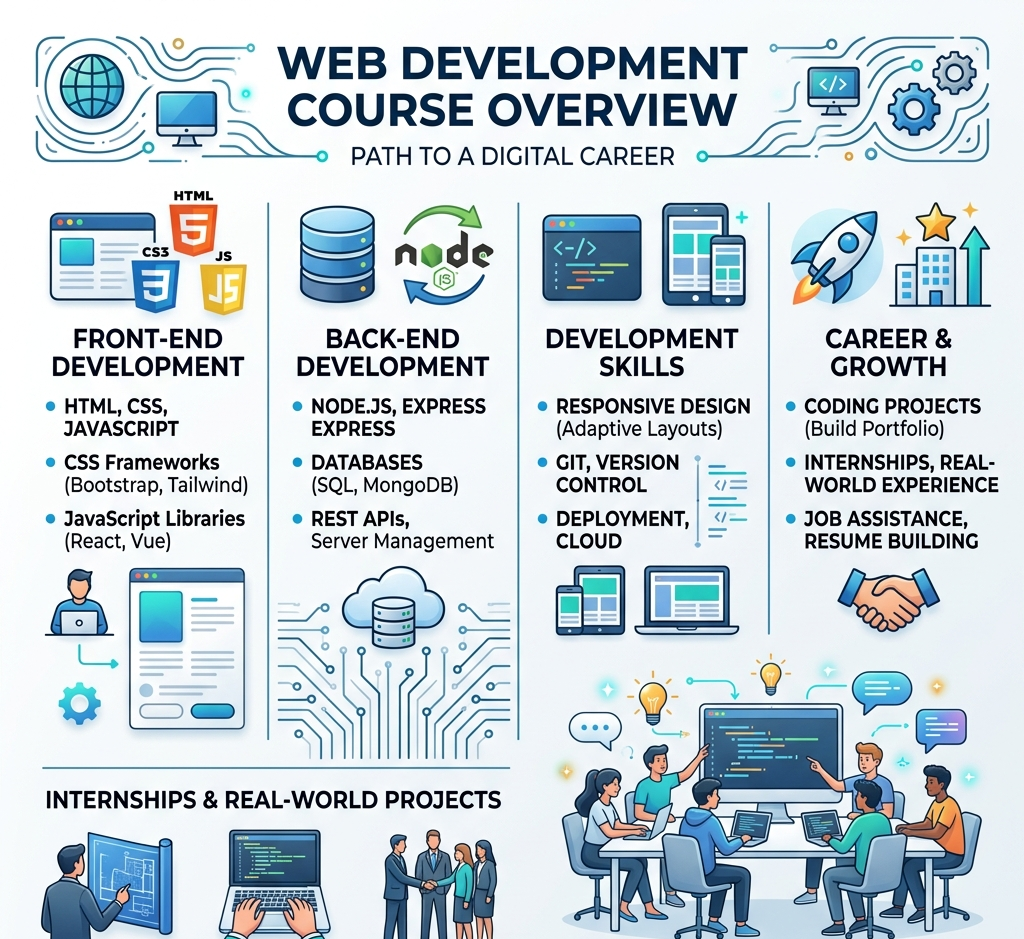
Web Development Internship Course in Jalandhar – Complete Course Overview
Web development is one of the fastest-growing and most in-demand career fields in today’s digital economy. Every business, from small startups to global enterprises, relies heavily on websites and web applications to reach their audience, deliver services, and generate revenue. As a result, the demand for skilled web developers continues to rise year after year.
A Web Development Internship Course in Jalandhar is designed to equip students, graduates, and working professionals with the technical knowledge, practical skills, and industry exposure required to succeed in this competitive field. This course is not just about learning programming languages—it is about understanding how real-world web applications are built, deployed, and maintained.
This comprehensive course overview will walk you through everything you need to know about web development internship training, including course structure, modules, tools, technologies, practical exposure, career benefits, and much more.
1. Introduction to Web Development
Web development refers to the process of creating, building, and maintaining websites and web applications. It includes everything from designing a simple static webpage to developing complex dynamic platforms like e-commerce websites, social media platforms, and enterprise applications.
The web development field is broadly divided into three main areas:
1. Front-End Development
This is the visual part of a website that users interact with. It includes layout, design, buttons, forms, and user interface elements.
2. Back-End Development
This is the server-side part of web development that handles logic, databases, and application functionality.
3. Full Stack Development
A combination of both front-end and back-end development, allowing developers to build complete web applications.
The internship course in Jalandhar focuses on all these aspects to make students job-ready.
2. Objective of the Course
The primary objective of the Web Development Internship Course is to:
- Provide in-depth knowledge of web technologies
- Build strong programming fundamentals
- Offer hands-on training with live projects
- Prepare students for real-world challenges
- Develop problem-solving and analytical skills
- Enhance employability and career opportunities
The course ensures that students gain both theoretical understanding and practical expertise.
3. Course Duration and Training Methodology
Duration:
The course typically ranges from:
- 3 months (basic)
- 6 months (advanced)
- 6–12 months (full stack with internship)
Training Methodology:
The teaching approach is designed to maximize learning efficiency:
- Instructor-led classroom training
- Practical lab sessions
- Live project development
- Internship-based learning
- Assignments and assessments
- Doubt-clearing sessions
Students are encouraged to work on real-time projects to gain industry-level experience.
4. Detailed Course Curriculum
The Web Development Internship Course is divided into multiple modules, each focusing on a specific aspect of development.
Module 1: Basics of Web Development
This module introduces students to the fundamentals of web development.
Topics Covered:
- Introduction to the Internet and Web
- How websites work
- Client-server architecture
- Web browsers and servers
- Domain names and hosting
Students gain a foundational understanding of how web technologies function.
Module 2: HTML (HyperText Markup Language)
HTML is the backbone of any website.
Topics Covered:
- HTML structure and syntax
- Tags and elements
- Forms and input fields
- Tables and lists
- Multimedia integration
Students learn how to create the basic structure of web pages.
Module 3: CSS (Cascading Style Sheets)
CSS is used to style and design websites.
Topics Covered:
- CSS syntax and selectors
- Colors, fonts, and layouts
- Flexbox and Grid
- Responsive design
- Media queries
This module helps students design visually appealing and responsive websites.
Module 4: JavaScript
JavaScript adds interactivity to websites.
Topics Covered:
- Variables and data types
- Functions and events
- DOM manipulation
- Loops and conditions
- ES6 features
Students learn how to make websites dynamic and interactive.
Module 5: Front-End Frameworks
Modern web development relies heavily on frameworks.
Topics Covered:
- Introduction to Bootstrap
- Responsive UI development
- React.js basics
- Component-based architecture
Students learn to build professional and scalable front-end applications.
Module 6: Back-End Development
Back-end development handles server-side logic.
Topics Covered:
- Introduction to server-side programming
- PHP / Node.js fundamentals
- Handling forms and data
- Authentication and authorization
Students understand how data is processed and managed.
Module 7: Database Management
Databases store and manage application data.
Topics Covered:
- Introduction to databases
- MySQL / MongoDB
- CRUD operations
- Database design
Students learn how to connect applications with databases.
Module 8: Version Control (Git & GitHub)
Version control is essential for modern development.
Topics Covered:
- Git basics
- Repositories and commits
- Branching and merging
- Collaboration using GitHub
Students learn how to manage code efficiently.
Module 9: APIs and Integration
APIs allow communication between systems.
Topics Covered:
- REST APIs
- JSON data
- API integration
- Third-party services
Students learn how to integrate external services into applications.
Module 10: Deployment and Hosting
This module focuses on making websites live.
Topics Covered:
- Web hosting
- Domain setup
- Deployment using GitHub Pages / hosting platforms
- Performance optimization
Students learn how to publish websites online.
5. Internship Program
The internship is the most important part of the course.
Key Features:
- Live client projects
- Real-world problem solving
- Team collaboration
- Industry exposure
- Mentorship from experts
Students work on actual projects such as:
- Business websites
- E-commerce platforms
- Portfolio websites
- Web applications
This experience helps students build confidence and practical skills.
6. Tools and Technologies Covered
Students are trained on the latest tools used in the industry:
- HTML5, CSS3, JavaScript
- Bootstrap, React.js
- Node.js / PHP
- MySQL / MongoDB
- Git & GitHub
- VS Code
These tools ensure students are aligned with industry standards.
7. Skills Developed During the Course
By the end of the course, students develop:
- Strong coding skills
- Problem-solving ability
- Logical thinking
- UI/UX understanding
- Project management skills
- Communication and teamwork
These skills are essential for career growth.
8. Real-World Project Work
Students work on multiple projects such as:
- Personal portfolio website
- Blogging platform
- E-commerce website
- Business website
Projects help students showcase their skills to employers.
9. Certification
After completing the course, students receive:
- Course completion certificate
- Internship certificate
- Project experience certificate
These certifications add value to resumes.
10. Placement Assistance
Most institutes provide placement support, including:
- Resume building
- Interview preparation
- Mock interviews
- Job referrals
Students get opportunities to work in IT companies or startups.
11. Career Opportunities
After completing the course, students can pursue roles like:
- Front-End Developer
- Back-End Developer
- Full Stack Developer
- Web Designer
- Freelancer
The demand for web developers is continuously increasing.
12. Freelancing Opportunities
Students can also work independently as freelancers by:
- Creating websites for clients
- Working on platforms like Fiverr and Upwork
- Building their own startup
Freelancing offers flexibility and high earning potential.
13. Advantages of Choosing Internship-Based Training
- Practical learning approach
- Real industry exposure
- Better job opportunities
- Strong portfolio development
- Hands-on experience
14. Who Should Enroll in This Course?
This course is suitable for:
- Students and graduates
- Working professionals
- Beginners with no coding background
- Entrepreneurs
15. Future Scope of Web Development
Web development continues to evolve with technologies like:
- Artificial Intelligence
- Cloud computing
- Progressive Web Apps
- Blockchain
This ensures long-term career growth.
17. Industry-Oriented Learning Approach
One of the most important aspects of a Web Development Internship Course in Jalandhar is its industry-oriented learning approach. Unlike traditional education systems that focus mainly on theory, this course emphasizes practical implementation and real-world application. Students are trained according to current industry standards so that they can easily transition into professional roles after completing the course.
The curriculum is regularly updated to match the latest trends and technologies in web development. This ensures that students are not learning outdated concepts but are instead gaining knowledge that is relevant in today’s job market. Trainers often include case studies, real-life examples, and industry scenarios to make the learning process more engaging and effective.
18. Soft Skills and Personality Development
Apart from technical skills, this course also focuses on developing essential soft skills that are crucial for career success. Employers today look for candidates who are not only technically sound but also possess strong communication and interpersonal skills.
Key Areas Covered:
- Communication skills
- Presentation skills
- Interview techniques
- Time management
- Team collaboration
Students are trained to confidently present their ideas, explain their projects, and perform well in job interviews. These skills play a significant role in career growth and professional success.
19. Continuous Assessment and Feedback
To ensure effective learning, students are regularly assessed throughout the course. Continuous evaluation helps in identifying strengths and areas that need improvement.
Assessment Methods:
- Weekly assignments
- Coding challenges
- Mini projects
- Quizzes and tests
- Final project evaluation
Trainers provide detailed feedback after each assessment, helping students improve their performance. This continuous feedback loop ensures that students stay on track and achieve their learning goals.
20. Exposure to Real Development Environment
During the internship phase, students are introduced to a professional development environment. They learn how real IT companies operate and how projects are managed.
Key Learnings:
- Working in teams
- Using project management tools
- Meeting deadlines
- Handling client requirements
- Debugging real-world issues
This exposure prepares students for the challenges they will face in their careers and gives them a competitive edge in the job market.
21. Networking Opportunities
Another significant advantage of enrolling in a web development internship course is the opportunity to build a professional network. Students get a chance to interact with trainers, industry experts, and fellow learners.
Networking helps in:
- Learning from others’ experiences
- Discovering job opportunities
- Collaborating on projects
- Staying updated with industry trends
A strong professional network can open doors to new opportunities and career growth.
22. Lifetime Learning and Support
Many institutes in Jalandhar offer lifetime learning support to their students. This means that even after completing the course, students can revisit concepts, attend doubt sessions, or seek guidance from trainers.
This continuous support system ensures that students are never stuck in their learning journey. As web development is an ever-evolving field, having access to ongoing support helps students stay updated with new technologies and advancements.
Why Choose TechCadd for Web Development Internship in Jalandhar
In today’s fast-paced digital world, choosing the right institute for skill development is one of the most important decisions a student or aspiring professional can make. With the increasing demand for web developers across industries, enrolling in a high-quality training and internship program has become essential. TechCadd stands out as one of the leading training institutes in Jalandhar, offering industry-focused web development internships that are designed to bridge the gap between academic learning and real-world application.
Industry-Oriented Training Approach
One of the biggest reasons to choose TechCadd is its industry-oriented training methodology. Unlike traditional institutes that focus only on theoretical concepts, TechCadd emphasizes practical learning. The curriculum is carefully designed to align with current industry standards, ensuring that students learn technologies that are actually in demand.
Students are trained in core web development technologies such as HTML, CSS, JavaScript, Bootstrap, React, Node.js, and databases. The focus is not just on learning syntax but on understanding how to build complete, functional, and scalable web applications.
Experienced Trainers and Mentors
TechCadd boasts a team of highly experienced trainers who have real-world industry experience. These professionals bring practical insights into the classroom, helping students understand how concepts are applied in real projects.
Mentors at TechCadd guide students step-by-step, from basics to advanced topics. They also provide personalized attention, ensuring that every student gets the support they need. Whether it’s debugging code, understanding complex logic, or preparing for interviews, the trainers are always available to help.
Hands-On Projects and Real-Time Exposure
A key highlight of TechCadd’s web development internship is its strong focus on hands-on projects. Students work on live projects that simulate real industry scenarios. This practical exposure helps them build confidence and develop problem-solving skills.
By the end of the course, students have a strong portfolio of projects that they can showcase to potential employers. These projects demonstrate their ability to build websites and web applications from scratch, making them job-ready.
Internship with Real Work Experience
TechCadd goes beyond traditional training by offering internship opportunities that provide real work experience. During the internship, students work on actual assignments, collaborate with teams, and learn how the software development lifecycle works.
This experience is invaluable as it prepares students for real job environments. It also gives them an edge over others in the competitive job market.
Updated Curriculum with Latest Technologies
The tech industry evolves rapidly, and TechCadd ensures that its curriculum stays up to date. Students are trained in the latest tools and technologies used in web development.
From front-end frameworks like React to back-end technologies like Node.js and database management systems, the course covers everything needed to become a full-stack developer. This ensures that students are not learning outdated concepts but are equipped with skills that are relevant in today’s job market.
Personalized Learning Environment
Every student has a different learning pace, and TechCadd understands this well. The institute provides a supportive and personalized learning environment where students can learn comfortably.
Small batch sizes ensure that trainers can focus on each student individually. Doubt sessions, revision classes, and one-on-one mentoring help students grasp concepts more effectively.
Career Support and Placement Assistance
One of the most important aspects of any training institute is its placement support, and TechCadd excels in this area. The institute provides comprehensive career support, including:
- Resume building
- Interview preparation
- Mock interviews
- Job referrals
Students are guided on how to present themselves professionally and how to crack technical interviews. This increases their chances of getting placed in reputed companies.
Affordable Fees with High Value
TechCadd offers high-quality training at affordable fees, making it accessible to a wide range of students. The institute believes in providing value for money by offering comprehensive courses, practical training, and career support.
Flexible payment options and occasional discounts make it easier for students to enroll without financial stress.
Modern Infrastructure and Learning Resources
The institute is equipped with modern infrastructure, including well-equipped labs, high-speed internet, and the latest software tools. Students get access to a professional learning environment that enhances their overall experience.
In addition to classroom training, students are provided with study materials, recorded sessions, and practice assignments to reinforce their learning.
Focus on Skill Development and Confidence Building
TechCadd not only focuses on technical skills but also on overall personality development. Communication skills, teamwork, and problem-solving abilities are emphasized throughout the course.
Students are encouraged to participate in group discussions, presentations, and coding challenges. This helps them build confidence and prepares them for professional environments.
Strong Student Community and Networking
Being part of TechCadd means becoming a part of a growing community of learners and professionals. Students get opportunities to network with peers, alumni, and industry experts.
This networking can be extremely beneficial for career growth, as it opens doors to job opportunities, collaborations, and knowledge sharing.
Flexible Learning Options
TechCadd offers flexible learning options to cater to different needs. Students can choose from classroom training, online classes, or hybrid modes depending on their convenience.
This flexibility ensures that even working professionals or students with busy schedules can enroll and upgrade their skills.
Certification and Recognition
Upon successful completion of the course and internship, students receive a certification from TechCadd. This certificate adds value to their resume and serves as proof of their skills and training.
Employers often prefer candidates with practical training and certifications, giving TechCadd students an advantage in the job market.
Proven Track Record of Success
TechCadd has trained thousands of students who are now working in reputed companies or running their own businesses. The institute’s success stories speak volumes about its quality of education and training.
Positive student reviews and testimonials highlight the effectiveness of the programs and the dedication of the trainers.
Real-Time Problem Solving and Debugging Skills
One of the key skills required for a web developer is the ability to solve problems and debug code. TechCadd places strong emphasis on this aspect.
Students are given real-world challenges and are encouraged to find solutions independently with guidance from mentors. This approach helps them develop critical thinking and analytical skills.
Exposure to Freelancing and Entrepreneurship
In addition to job opportunities, TechCadd also prepares students for freelancing and entrepreneurship. Students learn how to:
- Build and manage client projects
- Create portfolios
- Use freelancing platforms
- Handle project deadlines
This opens up multiple career paths, allowing students to work independently or start their own ventures.
Continuous Learning and Support
Learning doesn’t stop after course completion. TechCadd provides continuous support to its students even after they finish their training.
Alumni can reach out to trainers for guidance, attend workshops, and stay updated with new technologies. This lifelong learning approach ensures long-term career growth.
Advanced Learning Methodology and Practical Exposure
TechCadd takes a modern and structured approach to teaching web development, ensuring that students not only understand concepts but also apply them effectively. The institute follows a step-by-step learning model where students start with foundational concepts and gradually move towards advanced topics. This progressive learning strategy helps students build strong fundamentals before tackling complex projects.
The emphasis on practical exposure is what truly sets TechCadd apart. Instead of relying solely on lectures, students spend a significant amount of time coding, building applications, and solving real-world problems. Regular assignments, mini-projects, and coding challenges are integrated into the curriculum to ensure continuous practice. This hands-on approach reinforces learning and helps students retain concepts for a longer time.
Real-World Project Development Experience
At TechCadd, students are encouraged to work on real-world projects that mimic industry requirements. These projects include developing responsive websites, e-commerce platforms, portfolio sites, and dynamic web applications. By working on such projects, students gain a clear understanding of how different technologies come together to create fully functional solutions.
Project-based learning also enhances creativity and innovation. Students are given the freedom to experiment with their ideas, implement unique features, and improve user experience. This not only strengthens their technical skills but also helps them think like professional developers.
Strong Focus on Latest Industry Trends
The web development industry is constantly evolving, with new frameworks, tools, and best practices emerging regularly. TechCadd ensures that students stay ahead of the curve by incorporating the latest industry trends into their training programs.
Students are introduced to modern development practices such as responsive design, version control systems like Git, API integration, and deployment strategies. This ensures that they are well-prepared to handle real-world development environments and can adapt quickly to new technologies.
Soft Skills and Professional Development
In addition to technical expertise, TechCadd places strong emphasis on soft skills and professional development. Communication skills, time management, teamwork, and problem-solving abilities are essential for success in any career, especially in the tech industry.
Students participate in presentations, group discussions, and collaborative projects, which help them develop confidence and improve their interpersonal skills. These qualities are highly valued by employers and play a crucial role in career growth.
Dedicated Support System for Students
TechCadd provides a strong support system to ensure that students have a smooth and productive learning experience. From the moment they enroll, students receive guidance and assistance at every step of their journey.
Dedicated doubt-clearing sessions, revision classes, and extra practice materials help students overcome challenges and stay on track. Trainers are approachable and always ready to assist, creating a positive and encouraging learning environment.
Building a Job-Ready Portfolio
One of the biggest advantages of joining TechCadd is the opportunity to build a professional portfolio. Throughout the course, students work on multiple projects that they can showcase to potential employers.
A well-structured portfolio demonstrates a student’s skills, creativity, and practical experience. It serves as a powerful tool during job applications and interviews, significantly increasing the chances of getting hired.
Long-Term Career Growth Opportunities
TechCadd not only focuses on immediate job placement but also on long-term career growth. The skills and knowledge gained during the training enable students to explore various career paths, including full-stack development, UI/UX design, freelancing, and entrepreneurship.
The institute’s comprehensive training approach ensures that students are equipped to adapt to future technological advancements and continue growing in their careers.
Future Scope of Web Development – Complete Detailed Guide
Web development has transformed from a basic website-building activity into a highly advanced and dynamic field that powers the digital world. Today, every business, organization, and individual relies on web technologies to establish an online presence, connect with audiences, and deliver services efficiently. As technology continues to evolve, the future scope of web development is expanding rapidly, offering endless career opportunities and growth potential.
This comprehensive guide explores the future scope of web development, emerging trends, career opportunities, industry demand, technological advancements, and why it remains one of the best career choices in the modern era.
1. Introduction to the Future of Web Development
The internet has become an integral part of everyday life. From shopping and banking to education and entertainment, everything is now accessible online. This digital transformation has created a massive demand for web developers who can build efficient, secure, and user-friendly web applications.
The future of web development is driven by:
- Rapid digitalization
- Increasing internet users
- Growth of e-commerce
- Expansion of startups
- Technological innovation
As businesses continue to shift online, the need for skilled web developers will only increase.
2. Increasing Demand for Web Developers
One of the strongest indicators of future scope is demand. Web development is among the most in-demand skills globally.
Reasons for High Demand:
- Every business needs a website
- Growth of online services
- Digital marketing dependency
- Mobile-first approach
- Cloud-based applications
From small local businesses to multinational corporations, everyone requires web solutions. This ensures a stable and growing demand for web developers in the coming years.
3. Growth of E-Commerce Industry
The e-commerce industry is booming and is expected to grow exponentially in the future.
Key Factors Driving Growth:
- Online shopping convenience
- Digital payment systems
- Mobile commerce
- Global market reach
Popular platforms like Amazon, Flipkart, and Shopify rely heavily on web development technologies. As more businesses enter the e-commerce space, the demand for developers who can build secure and scalable platforms will continue to rise.
4. Rise of Full Stack Development
Full stack development is becoming increasingly popular because companies prefer professionals who can handle both front-end and back-end development.
Advantages:
- Higher salary packages
- More job opportunities
- Flexibility in roles
- Better understanding of projects
The future belongs to developers who can manage complete web applications, making full stack development a highly valuable skill.
5. Emergence of Advanced Technologies
Web development is evolving with the integration of advanced technologies.
Key Technologies Shaping the Future:
1. Artificial Intelligence (AI)
AI-powered websites can personalize user experiences, automate tasks, and improve decision-making.
2. Machine Learning (ML)
ML helps websites analyze user behavior and provide recommendations.
3. Blockchain
Used for secure transactions and decentralized applications.
4. Cloud Computing
Cloud platforms enable scalable and efficient web applications.
5. Internet of Things (IoT)
Web applications are now connected with smart devices.
These technologies are expanding the scope of web development beyond traditional boundaries.
6. Progressive Web Apps (PWAs)
Progressive Web Apps are the future of web applications.
Features:
- Fast loading speed
- Offline functionality
- App-like experience
- Cross-platform compatibility
PWAs combine the best features of websites and mobile apps, making them highly popular among businesses and developers.
7. Mobile-First Development
With the increasing use of smartphones, mobile-first development has become essential.
Key Trends:
- Responsive design
- Mobile optimization
- Faster loading times
Developers must focus on creating websites that perform well on mobile devices, as most users access the internet through smartphones.
8. Remote Work and Freelancing Opportunities
Web development offers unmatched flexibility in terms of work environment.
Opportunities:
- Remote jobs
- Freelancing platforms
- Global clients
- Work-from-home options
Developers can work from anywhere in the world, making it an ideal career choice for those seeking flexibility and independence.
9. High Salary Potential
Web development is a high-paying career due to its demand and importance.
Factors Affecting Salary:
- Skills and experience
- Technology expertise
- Location
- Company size
Experienced developers and full stack professionals can earn lucrative salaries both in India and internationally.
10. Startup and Entrepreneurship Opportunities
Web development empowers individuals to start their own businesses.
Opportunities:
- Launching startups
- Building SaaS products
- Creating online platforms
- Developing apps
Entrepreneurs with web development skills can bring their ideas to life without relying heavily on external resources.
11. Continuous Learning and Growth
Web development is a dynamic field that constantly evolves.
Learning Opportunities:
- New frameworks and tools
- Updated technologies
- Industry trends
Developers must keep learning to stay relevant, which ensures continuous career growth.
12. Role of Web Development in Digital Transformation
Digital transformation is reshaping industries worldwide.
Impact Areas:
- Education (e-learning platforms)
- Healthcare (online consultations)
- Finance (digital banking)
- Entertainment (streaming services)
Web development plays a crucial role in enabling these transformations.
13. Security and Cybersecurity Demand
With increasing online activities, cybersecurity has become a priority.
Key Aspects:
- Data protection
- Secure transactions
- User privacy
Developers with knowledge of security practices will have a significant advantage in the future.
14. API and Microservices Architecture
Modern applications rely on APIs and microservices.
Benefits:
- Scalability
- Flexibility
- Faster development
This architecture is becoming the standard for web applications, increasing demand for skilled developers.
15. Global Career Opportunities
Web development skills are globally recognized.
Opportunities:
- Work in multinational companies
- Remote international jobs
- Freelance projects worldwide
Developers are not limited by geography, making it a truly global career.
16. Integration with Other Fields
Web development is not limited to IT—it integrates with multiple industries.
Examples:
- Digital marketing
- Data science
- AI and automation
- Gaming
This cross-industry integration increases career opportunities.
17. Role of Frameworks and Libraries
Modern frameworks simplify development.
Popular Tools:
- React.js
- Angular
- Vue.js
- Node.js
Learning these tools ensures better career prospects.
18. Importance of UI/UX Design
User experience is critical for success.
Focus Areas:
- User-friendly design
- Fast performance
- Accessibility
Developers with UI/UX skills are highly valued.
19. Green and Sustainable Web Development
Future trends include eco-friendly web development.
Focus:
- Energy-efficient websites
- Optimized performance
- Reduced carbon footprint
This emerging field will create new opportunities.
21. Impact of Automation on Web Development
Automation is becoming a significant part of modern web development. With the introduction of advanced tools and platforms, many repetitive tasks such as code generation, testing, and deployment are now automated. However, instead of reducing opportunities, automation is actually increasing the demand for skilled developers who can design, manage, and optimize these automated systems.
Key Benefits of Automation:
- Faster development cycles
- Reduced human error
- Improved efficiency
- Better scalability
Developers who understand automation tools and workflows, such as CI/CD pipelines, will have a strong advantage in the future job market.
22. Role of Low-Code and No-Code Platforms
Low-code and no-code platforms are gaining popularity as they allow non-technical users to build websites and applications with minimal coding knowledge. While some believe this could reduce the demand for developers, the reality is quite the opposite.
Why Developers Are Still Needed:
- Complex applications require custom coding
- Advanced features cannot be handled by no-code tools
- Integration with external systems requires expertise
- Performance optimization needs professional skills
In fact, developers who can work alongside these platforms and enhance their capabilities will be in high demand.
23. Expansion of Web3 and Decentralized Applications
Web3 is the next evolution of the internet, focusing on decentralization, transparency, and user control. It is built on blockchain technology and is expected to revolutionize how web applications operate.
Key Features:
- Decentralized platforms
- Smart contracts
- Cryptocurrency integration
- Enhanced security
Web developers who learn blockchain and Web3 technologies will have access to cutting-edge career opportunities in the coming years.
24. Importance of Performance Optimization
As users expect faster and smoother experiences, performance optimization is becoming a critical aspect of web development.
Key Focus Areas:
- Page load speed
- Efficient coding practices
- Image and asset optimization
- Server performance
Websites that load quickly and perform well have higher user engagement and better search engine rankings. Developers with expertise in optimization techniques will be highly valued.
25. Growth of Content-Driven Platforms
Content-driven platforms such as blogs, news portals, and streaming websites are growing rapidly. These platforms require robust web development to handle large volumes of traffic and data.
Opportunities in This Area:
- CMS development (WordPress, headless CMS)
- Content optimization
- SEO-friendly website development
- Scalable architecture
This creates a steady demand for developers who can build and manage content-rich websites.
26. Increasing Importance of Accessibility
Web accessibility ensures that websites can be used by people with disabilities. Governments and organizations worldwide are emphasizing accessibility standards.
Key Aspects:
- Screen reader compatibility
- Keyboard navigation
- Color contrast and readability
- Inclusive design
Developers who understand accessibility guidelines will have a competitive edge and contribute to a more inclusive digital world.