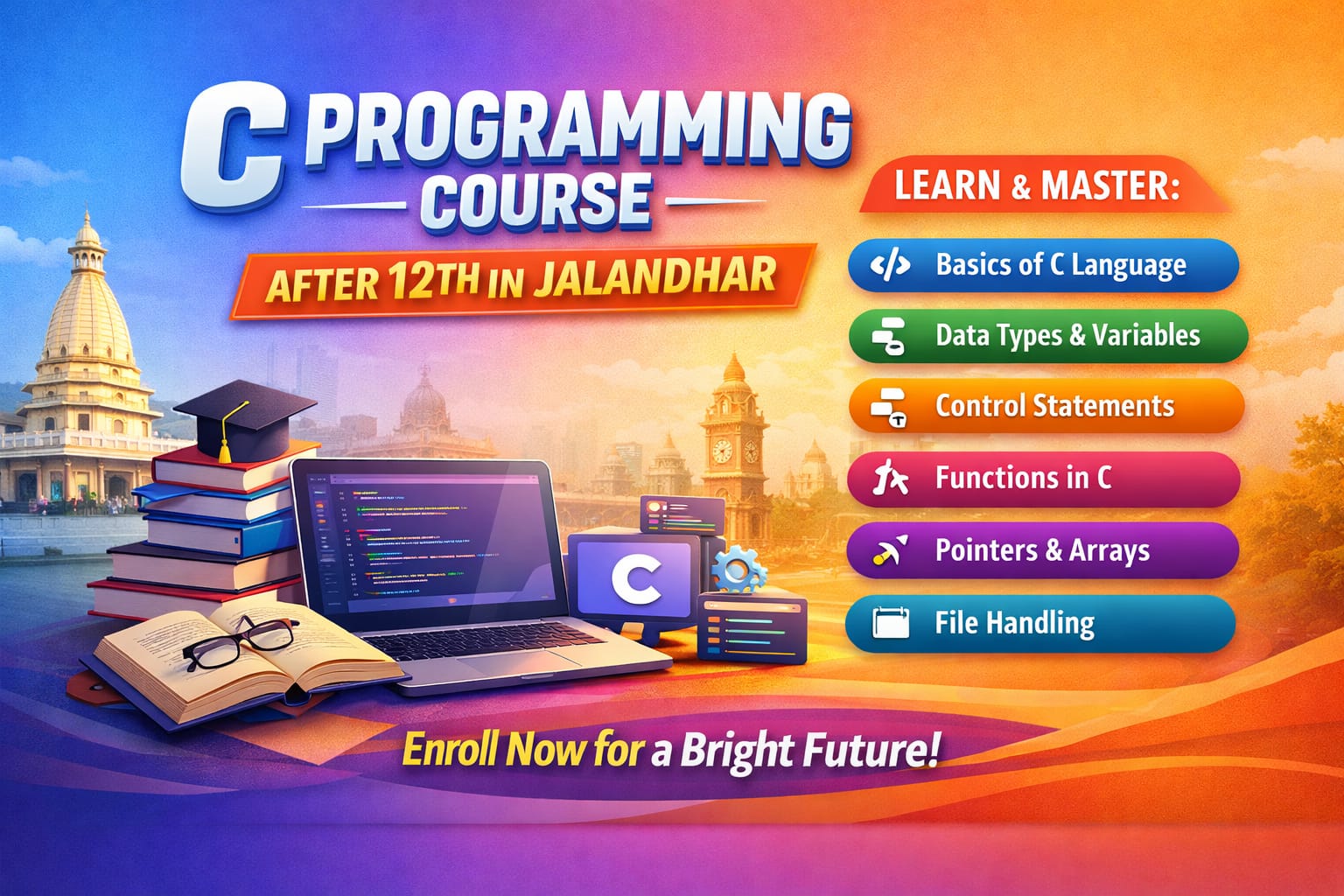
Section 1: Introduction to C Programming Course After 12th
1.1 Why C Programming is the Foundation of All Programming Languages
C programming is often called the "mother of all programming languages." It is the foundation upon which many modern languages like C++, Java, Python, and JavaScript are built. Understanding C gives you a deep insight into how computers work at a fundamental level – memory management, pointers, and system-level programming.
For students who have just completed their 12th standard, choosing a C programming course after 12th in Jalandhar is one of the most strategic career decisions they can make. C is not just a language; it's a gateway to understanding programming at its core.
-
Foundation Language: C is the basis for learning other languages like C++, Java, and Python
-
System Programming: Operating systems, embedded systems, and device drivers are written in C
-
Performance: C programs are fast and efficient, ideal for performance-critical applications
-
Placement Perspective: Many IT companies test C programming skills in interviews
-
Competitive Programming: C is widely used in coding competitions for its speed
-
Embedded Systems: IoT devices, microcontrollers, and robotics use C
1.2 What Makes C Special?
C was developed by Dennis Ritchie at Bell Labs in the early 1970s. Despite its age, it remains one of the most widely used programming languages due to its efficiency, flexibility, and low-level access to memory.
Key Features of C:
1.3 Why Choose a C Programming Course After 12th?
1.4 Who Should Enroll?
A C programming course after 12th in Jalandhar is ideal for:
-
Students who have passed 12th (any stream – Science, Commerce, Arts)
-
Those interested in programming, software development, and technology
-
Students who want to build a strong foundation in programming
-
Those who enjoy logical thinking and problem-solving
-
Students aiming for careers in embedded systems, system programming, or competitive coding
-
College students wanting to add C programming skills alongside their degree
-
Career changers looking for a solid programming foundation
No prior coding experience is required to enroll — the trainers lead you through step-by-step from the basics to advanced level .
1.5 Why Jalandhar is Emerging as a Programming Education Hub
Jalandhar has emerged as a significant hub for technical education in Punjab. With growing IT companies and the increasing need for skilled programmers, the demand for C programming skills remains strong as the foundation for all other languages. Techcadd's C programming course after 12th in Jalandhar prepares students to take advantage of this growing ecosystem.
1.6 Techcadd: Your Partner in C Programming Education
Techcadd Computer Education in Jalandhar has been providing quality technical training for over 15 years . Our C programming course after 12th is designed with one goal: to make you job-ready. We combine industry-aligned curriculum, expert faculty, hands-on projects, and strong placement support to ensure that every student who completes our program is ready for the programming job market .
-
15+ years of excellence: Trusted name in Jalandhar education since 2008
-
5000+ successful alumni: Proof that our approach works
-
100+ employer network: Strong industry connections
-
Industry-experienced faculty: Learn from professional programmers
-
Placement-first approach: Everything designed for employability
-
90%+ placement rate: Consistent results year after year
Section 2: Complete Curriculum Overview
2.1 Course Structure
Our C programming course after 12th in Jalandhar is designed to take you from beginner to job-ready professional in 3-6 months. The curriculum is divided into carefully sequenced modules that build upon each other .
Duration: 3-6 Months
Eligibility: 12th Pass (Any Stream)
Certification: Techcadd Professional Certificate in C Programming
2.2 Module 1: Fundamentals of Programming
This foundational module introduces core programming concepts.
2.3 Module 2: C Language Basics
Learn the fundamentals of C programming language.
2.4 Module 3: Input/Output and Operators
Learn to take input, produce output, and perform operations.
2.5 Module 5: Control Flow Statements
Control the flow of program execution.
2.6 Module 6: Loops in C
Execute blocks of code repeatedly.
2.7 Module 7: Arrays
Store and manipulate collections of data.
2.8 Module 8: Strings
Work with text data in C.
2.9 Module 9: Functions
Organize code into reusable blocks.
2.10 Module 10: Pointers
Master C's most powerful feature – direct memory access.
2.11 Module 11: Structures and Unions
Create custom data types.
2.12 Module 12: File Handling
Read from and write to files for persistent data storage.
2.13 Module 13: Dynamic Memory Allocation
Manage memory at runtime.
2.14 Module 14: Data Structures Using C
Apply C to implement fundamental data structures.
2.15 Module 15: Preprocessor Directives
Use C's preprocessing capabilities.
2.16 Module 16: Capstone Projects
Apply all your learning to build real-world C applications.
Section 3: Course Duration and Flexibility
3.1 Batch Options
3.2 Learning Modes
-
Classroom training: In-person learning with hands-on coding
-
Live online classes: For students unable to attend in person
-
Blended learning: Combination of classroom and online sessions
-
Recorded sessions: Access to all lectures for review
Section 1: Why Techcadd is Jalandhar's Most Trusted Institute for C Programming Training
1.1 Our Legacy of Excellence
Techcadd Computer Education has been a trusted name in technical education in Jalandhar and across Punjab for over 15 years . Throughout this journey, we have consistently delivered on our promise: transforming students into industry-ready professionals through quality training programs that lead to jobs.
When students search for the best C programming course after 12th in Jalandhar, they're looking for more than just a certificate – they want a guaranteed path to employment and a strong foundation for their programming career. Techcadd has built its reputation on delivering exactly that. Our programs are designed with one singular focus: making you employable .
Located in the heart of Jalandhar, we have become the go-to destination for students from across the city and surrounding areas who want to build strong programming foundations and launch successful careers in IT.
-
15+ years of excellence: Trusted name in Jalandhar education since 2008
-
5000+ successful alumni: Proof that our approach works
-
100+ employer network: Strong industry connections
-
Industry-experienced faculty: Learn from professional programmers
-
Placement-first approach: Everything designed for employability
-
90%+ placement rate: Consistent results year after year
-
Trusted by parents: Strong relationships built on results
1.2 What Sets Techcadd Apart
1.3 Our Placement-First Philosophy
At Techcadd, placement isn't an add-on – it's built into everything we do:
From Day One: From the very first class, we emphasize the skills and projects that will matter in programming job interviews. Students understand how each concept connects to real job requirements. There are no wasted weeks – every moment is focused on making you employable .
Curriculum Design: Every module is chosen based on its relevance to actual programming job roles. We regularly survey employers to understand exactly what they're looking for in entry-level programmers . This ensures our curriculum stays current and relevant.
Project Selection: Projects are carefully selected to showcase the skills employers value most. Students build a portfolio that demonstrates their capabilities.
Assessment Methods: We assess students not just on theoretical knowledge but on their ability to solve real coding problems – the same way they'll be assessed in job interviews.
Interview Preparation: Placement preparation is integrated throughout the course, not just tacked on at the end. Students practice coding challenges and technical interviews from early on, building confidence gradually.
1.4 Our C Programming Teaching Philosophy
Learning by Doing: We follow the 70-20-10 learning model – 70% hands-on coding, 20% peer learning, and 10% conceptual instruction. You learn by actually writing code, not just listening to lectures .
Industry Alignment: Our curriculum is continuously updated based on feedback from employers. You learn exactly what companies are looking for .
Individual Attention: With small batch sizes of 15-20 students, every student receives personalized guidance and support. Instructors know your name, understand your learning style, and provide customized help .
Continuous Assessment: Regular coding assignments, quizzes, and project reviews ensure you're always progressing. We identify struggling students early and provide extra support.
Placement First: Everything we do is designed with one goal: your employability. Curriculum, projects, assessments, and support are all chosen based on what employers actually want .
Section 2: Our Expert C Programming Faculty
2.1 Industry Practitioners as Instructors
The quality of any training program is determined by its faculty. At Techcadd, we have assembled a team of instructors who are not just teachers but professional programmers with years of real-world experience .
2.2 What Our Faculty Bring
-
Real-World Stories: Actual projects and how they were built
-
Common Mistakes: Learn from others' errors, avoid them yourself
-
Best Practices: Industry-standard approaches from day one
-
Industry Connections: Networks that lead to job opportunities
-
Current Trends: Up-to-date knowledge of evolving technologies
-
Interview Insights: Know what employers ask and how to prepare
-
Career Guidance: Advice based on years of experience
Section 3: Our Infrastructure for C Programming Training
3.1 State-of-the-Art Learning Environment
3.2 Learning Resources
-
Detailed course notes
-
Video recordings of all sessions
-
Code samples and templates
-
Reference materials and documentation
-
Online portal with 24/7 access
-
Practice coding challenges
3.3 Location Advantages
Our Jalandhar campus is strategically located and easily accessible from all parts of the city, well-connected by public transport, with ample parking and nearby amenities .
Section 4: Our C Programming Placement Process
4.1 Dedicated Placement Team
4.2 Comprehensive Placement Preparation
-
Resume building tailored for programmer roles
-
LinkedIn optimization for tech recruiters
-
GitHub portfolio development
-
Coding challenge practice (LeetCode, HackerRank)
-
Mock technical interviews
-
Soft skills training
-
Company referrals
4.3 Placement Drives
We organize regular placement drives at our Jalandhar campus with 15-20 events annually, 10-15 companies per drive, and offers made on the spot.
4.4 Our Placement Track Record
Section 5: Why Companies Prefer Techcadd C Programming Graduates
-
Strong programming foundation: Deep understanding of core concepts
-
Problem-solving ability: Trained to tackle complex challenges
-
Data structure expertise: Essential for technical interviews
-
Pointer mastery: Deep understanding of memory management
-
Project experience: Real applications in portfolio
-
Logical thinking: Developed through rigorous practice
-
Professional attitude: Communication and teamwork skills
-
Industry connections: Referrals from alumni
Section 6: Why Choose Techcadd Over Other Institutes
Section 7: Industry Recognition
-
Awards: Best IT Training Institute in Jalandhar (2022, 2023)
-
Recognition: Trusted by 100+ employers
-
Partnerships: Tie-ups with IT companies and startups
-
Certification Alignment: Industry-recognized curriculum
Section 8: Student Support and Mentorship
8.1 Comprehensive Student Support System
Academic Support:
Technical Support:
8.2 Mentorship Program
Every student is assigned a personal mentor who provides :
-
Academic mentoring
-
Project guidance
-
Career counseling
-
Interview preparation
-
Industry insights
-
Networking support
8.3 Peer Learning Community
-
Collaborative projects
-
Study circles
-
Alumni interactions
-
Hackathons
-
Coding competitions
8.4 Parent Engagement
Section 9: Corporate Partnerships
-
Direct Recruitment Partnerships: 100+ companies
-
Memorandum of Understanding (MoU) : Formal tie-ups
-
Industry Advisory Board: Guiding curriculum
-
Internship Opportunities: Real work experience
Section 10: Flexible Learning Options
Section 11: Affordability and Financial Assistance
-
Transparent Fee Structure: No hidden costs
-
Flexible Payment Options: EMI, monthly payments
-
Scholarships: Merit-based, need-based
-
Early Bird Discount: 10% off
-
Group Discount: 10-15% for 3+ students
-
Pay After Placement: For eligible students
Section 12: Alumni Success Stories
12.1 Alumni Placement Highlights
Techcadd's 5000+ successful alumni are a testament to our commitment to quality education and placement support. Our C programming graduates have built strong foundations and moved into diverse roles across various industries.
Placement Sectors:
-
IT Services and Consulting (TCS, Infosys, Wipro, Accenture)
-
Embedded Systems Companies
-
Electronics and Hardware Firms
-
Automotive Software
-
Aerospace and Defense
-
Startups and Entrepreneurship
Section 13: Conclusion – Your Programming Foundation Starts Here
13.1 The Techcadd Promise
When you choose Techcadd for the best C programming course after 12th in Jalandhar, you're not just enrolling in a training program – you're building the foundation for your entire programming career. With 15+ years of proven excellence, 5000+ successful alumni, 100+ employer connections, and a 90%+ placement rate, we provide everything you need to build a successful programming career .
13.2 Your Journey Starts Now
C programming is the foundation of all modern programming languages. Mastering C gives you a deep understanding of how computers work and prepares you for learning any other language. With Techcadd's comprehensive training, expert faculty, hands-on projects, and strong placement support, you can start your programming journey in just 3-6 months.
Take the First Step Today:
-
Visit our Jalandhar campus for a free counseling session
-
Attend a free demo class
-
See our facilities and meet our expert faculty
-
Enroll and begin building your programming foundation
Section 1: The Enduring Demand for C Programmers
1.1 National Context
Despite being over 50 years old, C remains one of the most important programming languages in the world. It is the language of operating systems, embedded systems, device drivers, and performance-critical applications. According to the TIOBE Index, C consistently ranks among the top programming languages year after year.
-
Timeless Language: C has remained relevant for over 5 decades
-
System Programming: Operating systems (Linux, Windows) are written in C
-
Embedded Systems: IoT devices, microcontrollers, and robotics use C
-
Performance Critical: Games, databases, and high-frequency trading use C
-
Foundation Language: Understanding C makes learning other languages easier
1.2 Why C Programmers Are Valued
C programmers are valued for their deep understanding of how computers work at a fundamental level. They can optimize code for performance, work with hardware directly, and build systems that other languages cannot.
1.3 Punjab's Growing Embedded Systems Ecosystem
Punjab has a growing electronics and manufacturing sector, creating demand for embedded systems programmers who know C. Techcadd's C programming course after 12th in Jalandhar prepares students to take advantage of this growing ecosystem .
Section 2: Future Scope of C Programming Careers
2.1 Industry Growth
-
Embedded systems market growing at 8-10% annually
-
IoT devices projected to reach 75 billion by 2025
-
Operating systems always need C programmers
-
Game development engines use C for performance
-
Database systems (MySQL, PostgreSQL) written in C
2.2 Career Progression in C Programming
Section 3: Job Opportunities After C Programming Course
After completing a C programming course after 12th in Jalandhar, you'll unlock a range of exciting career opportunities .
3.1 C Programmer
C Programmers write, test, and maintain code in C language.
-
Responsibilities: Coding, debugging, testing, documentation
-
Skills needed: C fundamentals, pointers, memory management, data structures
-
Average salary: ₹3-5 LPA (entry-level)
3.2 Embedded Systems Developer
Embedded Systems Developers write software for hardware devices.
-
Responsibilities: Firmware development, hardware interaction, real-time systems
-
Skills needed: C, microcontroller knowledge, electronics basics
-
Average salary: ₹4-7 LPA (entry-level)
3.3 Firmware Engineer
Firmware Engineers write low-level software for devices.
-
Responsibilities: Device drivers, bootloaders, hardware abstraction
-
Skills needed: C, assembly language, hardware knowledge
-
Average salary: ₹4-7 LPA (entry-level)
3.4 Systems Programmer
Systems Programmers work on operating systems and system utilities.
-
Responsibilities: OS components, file systems, system calls
-
Skills needed: C, operating system concepts, data structures
-
Average salary: ₹4-7 LPA (entry-level)
3.5 Device Driver Developer
Device Driver Developers write software that allows OS to communicate with hardware.
-
Responsibilities: Kernel modules, hardware drivers, interrupt handling
-
Skills needed: C, OS internals, hardware knowledge
-
Average salary: ₹5-8 LPA (entry-level)
3.6 Game Programmer
Game Programmers use C for game engines and performance-critical components.
-
Responsibilities: Game logic, graphics programming, optimization
-
Skills needed: C, data structures, algorithms, graphics basics
-
Average salary: ₹4-7 LPA (entry-level)
3.7 Database Developer
Database Developers work on database management systems.
-
Responsibilities: Query optimization, storage engines, indexing
-
Skills needed: C, data structures, algorithms, SQL basics
-
Average salary: ₹4-6 LPA (entry-level)
3.8 Compiler Developer
Compiler Developers work on language compilers and tools.
-
Responsibilities: Lexical analysis, parsing, code generation
-
Skills needed: C, compiler theory, data structures
-
Average salary: ₹5-8 LPA (entry-level)
3.9 Network Programmer
Network Programmers develop networking protocols and applications.
-
Responsibilities: Socket programming, protocol implementation, network tools
-
Skills needed: C, networking concepts, TCP/IP
-
Average salary: ₹4-6 LPA (entry-level)
3.10 Competitive Programmer
Competitive Programmers participate in coding competitions using C for speed.
-
Responsibilities: Solving algorithmic problems, optimizing code
-
Skills needed: C, algorithms, data structures, problem-solving
-
Earning potential: Prize money, job offers from top companies
Section 4: Industry-Wide C Programming Applications
4.1 Operating Systems
Linux, Windows, macOS kernels are written in C.
4.2 Embedded Systems
IoT devices, microcontrollers, automotive systems use C.
4.3 Database Systems
MySQL, PostgreSQL, SQLite are written in C.
4.4 Gaming
Game engines like Unreal use C++ (derived from C) for performance.
4.5 Compilers and Interpreters
GCC, Clang, Python interpreter are written in C.
4.6 Networking
Network protocols, routers, switches use C.
4.7 Aerospace and Defense
Mission-critical systems in aerospace use C.
4.8 Automotive
Engine control units, infotainment systems use C.
4.9 Medical Devices
Life-critical medical equipment uses C.
4.10 Financial Systems
High-frequency trading systems use C for speed.
Section 5: Top Recruiters for C Programmers
Section 6: Salary Trends for C Programmers
6.1 Salary by Experience
6.2 Salary by Specialization
6.3 Freelance Potential
Section 7: Why Now is the Best Time
7.1 Market Momentum
-
IoT explosion creating demand for embedded C programmers
-
Automotive software becoming critical
-
Legacy systems need maintenance in C
-
Performance-critical applications always need C
-
Foundation for learning modern languages
7.2 Talent Gap
Companies are struggling to find programmers with deep understanding of C, pointers, and memory management. There is consistent demand for quality C programmers in India and worldwide.
7.3 Return on Investment
7.4 Comparison with Traditional Education
Section 8: How Techcadd Prepares You for the C Programming Future
-
Future-ready curriculum: Strong foundation that prepares for any programming language
-
Lifelong learning support: Free course audits for alumni
-
Professional network: 5000+ alumni community
-
Career guidance: Ongoing support throughout your career
-
Industry connections: 100+ employers actively hiring
Section 9: Emerging Trends in C Programming
9.1 Internet of Things (IoT)
IoT devices run on embedded systems programmed in C.
9.2 Automotive Software
Modern cars have millions of lines of C code.
9.3 Artificial Intelligence at the Edge
AI on edge devices requires efficient C code.
9.4 Real-Time Systems
Critical systems need C's predictability and speed.
9.5 Legacy System Maintenance
Billions of lines of existing C code need maintenance.
9.6 Game Development
Game engines continue to use C++ (C's successor).
Section 10: Skills You Need to Succeed
10.1 Technical Skills
-
C Fundamentals: Syntax, data types, operators
-
Control Structures: if-else, loops, switch
-
Functions: Modular programming
-
Arrays and Strings: Data handling
-
Pointers: Memory management
-
Structures and Unions: Custom data types
-
File Handling: Persistent data
-
Data Structures: Linked lists, stacks, queues, trees
-
Algorithms: Sorting, searching
-
Dynamic Memory Allocation: malloc, calloc, free
10.2 Soft Skills
-
Problem-Solving: Approaching challenges systematically
-
Logical Thinking: Reasoning step by step
-
Attention to Detail: C requires precision
-
Debugging Mindset: Finding and fixing errors
-
Continuous Learning: Staying updated
Section 11: Industry Certifications and Advanced Learning
11.1 Global Certifications You Can Pursue After Techcadd
11.2 Advanced Learning Pathways
Many Techcadd graduates continue their education through:
-
C++ programming for object-oriented development
-
Embedded systems and IoT development
-
Operating systems and kernel development
-
Game development with C/C++
-
Robotics and automation
Section 12: The Techcadd Alumni Advantage
12.1 Lifelong Learning Support
Your relationship with Techcadd doesn't end when you complete your course :
-
Free course audits: Update your skills anytime
-
Alumni networking events: Connect with fellow programmers
-
Job referrals: Alumni helping alumni find opportunities
-
Career guidance: Ongoing support throughout your career
-
Industry updates: Regular information about tech trends
12.2 Alumni Success Metrics
Section 13: Conclusion – Your Programming Foundation Starts Here
13.1 The Opportunity
C programming is the foundation of all modern software development. Mastering C gives you a deep understanding of how computers work and prepares you for any programming language or domain you choose to pursue .
13.2 The Techcadd Advantage
When you choose Techcadd for the best C programming course after 12th in Jalandhar, you're choosing:
-
15+ years of proven excellence
-
5000+ successful alumni
-
100+ employer connections
-
90%+ placement rate
-
Industry-experienced faculty
-
Practical, hands-on training
-
Comprehensive C coverage
-
Data structures and algorithms
-
Small batch sizes
-
Affordable fees with EMI
-
Lifetime alumni support
13.3 Your Journey Starts Now
The best time to start was yesterday. The second best time is today. Don't wait years to begin your career. With Techcadd, you can start your programming journey in just 3-6 months .
Take the First Step: