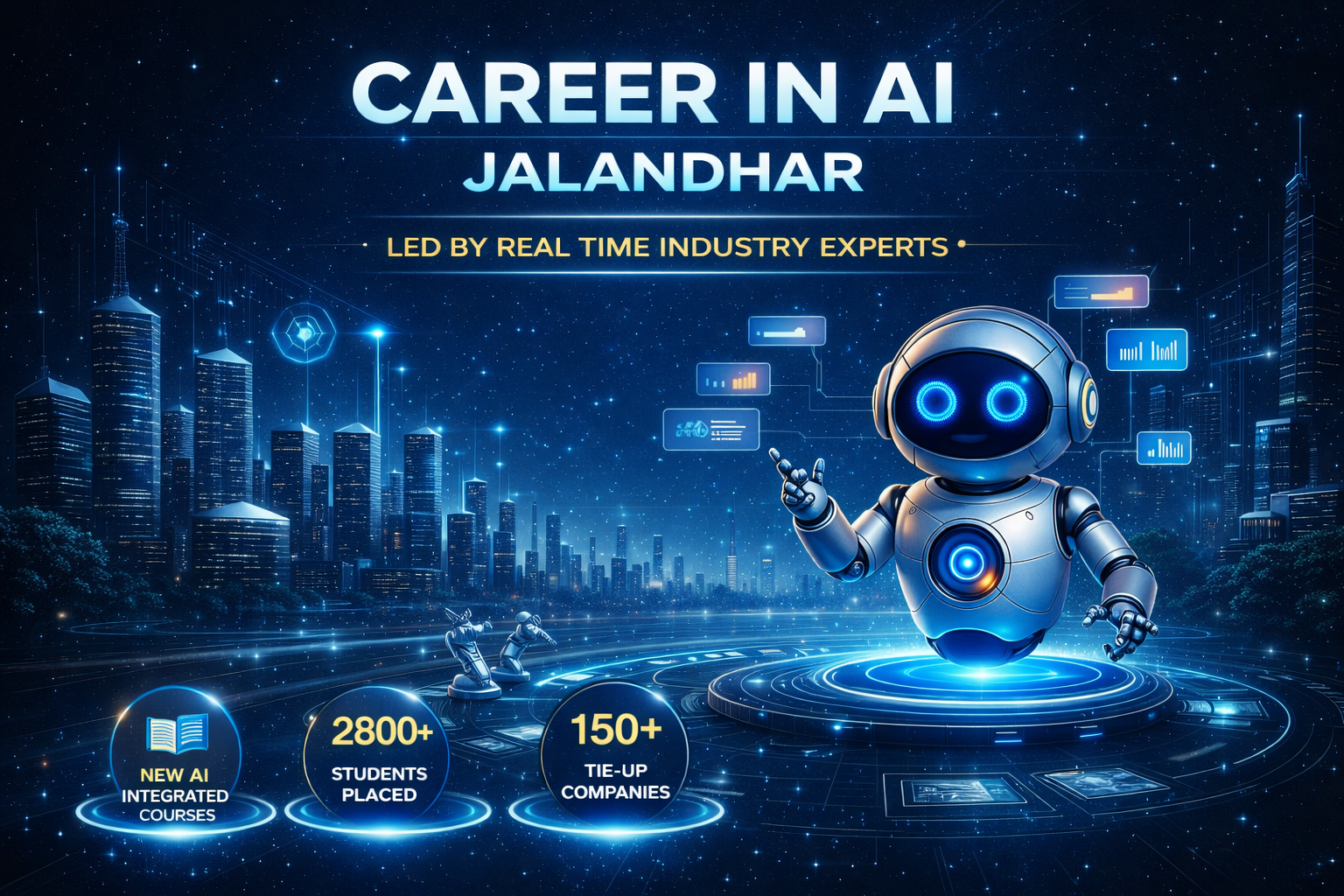
Career in AI Course in Jalandhar: Your Comprehensive Guide to Mastering Artificial Intelligence
The world is standing at the precipice of the Fourth Industrial Revolution, and Artificial Intelligence is its driving engine. From the recommendation systems on your favorite streaming service to the voice assistant in your pocket, AI is no longer a futuristic concept—it is an integral part of our daily lives. For businesses, AI represents unprecedented opportunities for efficiency, personalization, and innovation. This seismic shift has created an insatiable demand for skilled AI professionals who can build, manage, and deploy intelligent systems. At TechCadd, we have meticulously crafted our Career in AI Course in Jalandhar to meet this demand, equipping you with the knowledge, practical skills, and industry perspective needed to not just participate in, but to lead this AI-driven future.
This course is more than just an introduction to algorithms; it is a transformative journey. You will go from understanding the core concepts of data science to building sophisticated machine learning models, and finally, to exploring the cutting-edge frontiers of deep learning and generative AI. Our approach is intensely practical. We believe that true mastery comes from doing, which is why our curriculum is saturated with real-world projects, case studies, and mentorship from professionals who are actively shaping the AI landscape. Whether you are a fresh graduate, a software developer looking to specialize, or a professional from a non-technical background seeking a career pivot, this course provides the structured, supportive, and rigorous path to your new career.
Module 1: Foundations of Artificial Intelligence and Data Science
Every AI expert's journey begins with a solid foundation. This module is designed to build your understanding from the ground up, ensuring you have the mathematical, statistical, and programming bedrock necessary for success in more advanced topics.
1.1 Understanding AI, ML, and DL: The Big Picture
We start by demystifying the buzzwords. You will develop a clear understanding of the hierarchical relationship between Artificial Intelligence, Machine Learning, and Deep Learning. Through engaging lectures and discussions, we explore the history of AI, its various subfields like computer vision, natural language processing, and robotics, and the ethical considerations that come with building intelligent systems. You will learn about different types of AI: Narrow AI (which excels at specific tasks), General AI (the holy grail), and Super AI (a theoretical concept). Understanding this landscape is crucial for identifying your area of interest and where you can best apply your skills. We'll analyze case studies of successful AI implementations across industries—from healthcare diagnostics to financial fraud detection—to give you a real-world perspective on the impact of AI.
1.2 Python Programming for AI and Data Science
Python is the undisputed language of AI. In this sub-module, you will gain a thorough, practical understanding of Python and the libraries that make AI possible. We don't just teach syntax; we teach you how to think programmatically. Starting with core concepts like data types, loops, functions, and object-oriented programming, we will quickly move to essential data science libraries. You will become proficient with NumPy for numerical computing, mastering multi-dimensional arrays and mathematical operations. You will learn Pandas for data manipulation and analysis, becoming adept at loading, cleaning, transforming, and exploring datasets. Matplotlib and Seaborn will be your tools for creating insightful visualizations, from simple line charts to complex, publication-quality graphs. Throughout this module, you'll work on small projects that reinforce your learning, building a strong coding habit that will serve you throughout the course and your career.
1.3 Mathematics for Machine Learning
A common misconception is that you need to be a math genius to work in AI. While a strong foundation is necessary, we make the core concepts accessible and practical. This sub-module focuses on the three pillars of AI mathematics: Linear Algebra, Calculus, and Statistics. You will understand vectors, matrices, and their operations—the language in which machine learning models think. You'll grasp the concept of derivatives and gradients, which are at the heart of how models learn (optimization). Finally, you'll master key statistical concepts like probability distributions, descriptive statistics, hypothesis testing, and Bayes' Theorem. Our approach is to teach these concepts through code. Instead of just memorizing formulas, you'll see them in action, using Python to perform matrix multiplications, compute gradients, and run statistical tests on real datasets, demystifying the math and making it a powerful tool in your arsenal.
Module 2: Core Machine Learning: From Algorithms to Predictive Models
This is the heart of the course. You will learn the most important machine learning algorithms, understand when and how to use them, and apply them to solve complex prediction problems.
2.1 Data Preprocessing and Feature Engineering
Real-world data is messy. Before any model can be trained, it must be prepared. This is often the most time-consuming but crucial step. You will master the art of data preprocessing, learning how to handle missing values, encode categorical variables, and scale or normalize features. More importantly, you'll dive into Feature Engineering—the process of creating new, more informative features from existing data to improve model performance. You'll learn techniques like polynomial features, feature binning, and extracting features from text or dates. This module teaches you that a well-engineered feature set can often be more impactful than the choice of algorithm itself. You'll work with messy datasets from sources like Kaggle, learning the intuition and best practices that separate a novice from an expert data scientist.
2.2 Supervised Learning: Regression and Classification
Supervised learning is about predicting a target variable based on labeled data. You will explore both regression (predicting continuous values) and classification (predicting categories). For regression, you'll master Linear Regression, Polynomial Regression, and Regularization techniques like Ridge and Lasso to prevent overfitting. For classification, you'll delve into Logistic Regression, Support Vector Machines (SVM), k-Nearest Neighbors (k-NN), and Naive Bayes. For each algorithm, we don't just treat it as a black box. You'll understand the underlying mathematics, the assumptions it makes, its strengths and weaknesses, and most importantly, how to tune its hyperparameters for optimal performance. Through hands-on projects, you'll predict housing prices, diagnose diseases, and build customer churn models, experiencing the full lifecycle of a supervised learning project.
2.3 Tree-Based Models and Ensemble Learning
Tree-based models are some of the most powerful and widely used algorithms in industry. You will master Decision Trees, understanding how they split data based on features. From there, you'll learn about ensemble methods that combine multiple models to create a superior predictor. You'll become proficient in Random Forests, which build a 'forest' of diverse trees to improve accuracy and control overfitting. You'll then master Gradient Boosting Machines (GBM) and its powerful variants: XGBoost, LightGBM, and CatBoost. These are the go-to algorithms for winning competitions on Kaggle and are heavily used in industry for problems ranging from credit scoring to search ranking. You will not only learn to implement these models but also understand how to interpret their results, visualize feature importance, and deploy them effectively.
2.4 Unsupervised Learning: Finding Hidden Structures
Not all data comes with labels. Unsupervised learning helps you discover hidden patterns and structures. You will learn Clustering techniques like K-Means and Hierarchical Clustering to segment customers into groups for targeted marketing. You'll explore Dimensionality Reduction using Principal Component Analysis (PCA) to simplify complex datasets, visualize high-dimensional data, and speed up other machine learning models. You'll also be introduced to Association Rule Learning (like the Apriori algorithm) for market basket analysis, understanding which products are frequently bought together. Projects in this module will involve customer segmentation for an e-commerce company and building a recommendation system based on user behavior patterns.
Module 3: Deep Learning and Neural Networks
Deep Learning is the technology behind recent AI breakthroughs like self-driving cars and advanced language models. This module will take you into the world of neural networks.
3.1 Artificial Neural Networks (ANNs)
We begin with the fundamental building block of deep learning: the artificial neuron. You will understand the architecture of a neural network: input, hidden, and output layers. You'll learn about activation functions (ReLU, Sigmoid, Tanh), the backpropagation algorithm for training, and the concept of forward and backward passes. You'll build your first neural network from scratch using TensorFlow or PyTorch, understanding the core concepts of epochs, batches, and loss functions. You'll then apply ANNs to solve complex regression and classification problems, learning how to tune hyperparameters like the number of layers, number of neurons, and learning rate to achieve state-of-the-art results.
3.2 Convolutional Neural Networks (CNNs) for Computer Vision
CNNs revolutionized how machines see. You will dive deep into the architecture of a CNN, understanding the roles of convolutional layers (for feature detection), pooling layers (for dimensionality reduction), and fully connected layers (for classification). You'll learn about filters, stride, padding, and how these networks learn hierarchical features—from edges in the first layer to complex objects in the final layer. You'll get hands-on experience with popular architectures like VGG16, ResNet, and Inception. Using transfer learning (a powerful technique of using pre-trained models), you'll build applications like image classifiers for medical diagnosis, object detection systems, and image segmentation tools. This module equips you to tackle any problem involving visual data.
3.3 Recurrent Neural Networks (RNNs) and Transformers for Sequence Data
When data comes in sequences—like text, audio, or time series—RNNs and their advanced variants are the tools of choice. You'll learn about the architecture of RNNs, the challenges of vanishing gradients, and the solutions provided by Long Short-Term Memory (LSTM) and Gated Recurrent Units (GRU). You'll apply these to tasks like sentiment analysis, stock price prediction, and text generation. This sub-module also introduces you to the revolutionary Transformer Architecture, which underpins modern large language models (LLMs) like GPT and BERT. You'll understand attention mechanisms and how they have enabled massive advances in natural language processing (NLP). Projects will include building a chatbot and implementing a text summarization tool.
Module 4: Generative AI and Large Language Models (LLMs)
This module focuses on the most exciting and rapidly evolving area of AI: Generative AI. You'll learn how to not just analyze data, but create entirely new content.
4.1 Introduction to Generative AI
We'll explore the landscape of generative AI, understanding the difference between discriminative and generative models. You'll learn about Generative Adversarial Networks (GANs), a fascinating architecture where two neural networks (a generator and a discriminator) compete to create realistic data. You'll use GANs to generate realistic images of faces, artwork, and other complex datasets. You'll also be introduced to Variational Autoencoders (VAEs) and understand how they enable controlled generation.
4.2 Working with Large Language Models (LLMs)
LLMs are transforming the world. You'll learn how to work with state-of-the-art models from OpenAI, Google, and the open-source community. We'll cover Prompt Engineering in depth, teaching you how to craft effective prompts to get the best results from models like GPT-4. You'll learn about Retrieval-Augmented Generation (RAG), a technique to ground LLMs in your own data, enabling you to build intelligent chatbots and Q&A systems that are accurate and context-aware. You'll get hands-on experience with the OpenAI API, building applications that can write code, analyze documents, and create marketing copy. We'll also discuss fine-tuning models on your own datasets to create specialized AI assistants.
Module 5: Model Deployment and MLOps
A model is only valuable if it can be used. This module teaches you the skills to take your models from Jupyter notebooks to production environments.
5.1 Deploying Models as APIs
You'll learn how to use frameworks like Flask and FastAPI to wrap your trained models into RESTful APIs. This allows other applications to interact with your AI model over the internet. You'll understand the concepts of model serialization, creating endpoints for prediction, and handling API requests. This skill is essential for integrating AI features into web and mobile apps.
5.2 Introduction to MLOps and Cloud Platforms
Machine Learning Operations (MLOps) is the practice of streamlining the entire machine learning lifecycle. You'll be introduced to core MLOps concepts like version control for data and models (using DVC and Git), experiment tracking (using tools like MLflow), and CI/CD pipelines for models. You'll also get hands-on with major cloud platforms (AWS, Google Cloud Platform, Azure), learning how to use their AI services (like AWS SageMaker or Google AI Platform) to train, deploy, and scale your models. This module ensures you have the operational skills required for a career in a modern AI team.
Module 6: Capstone Project and Career Preparation
Your journey culminates in a major capstone project that will be the centerpiece of your portfolio. You will choose a real-world problem, design a solution, collect and preprocess data, build and evaluate models, and deploy your solution. Your mentor will guide you through every step. This project is not just an assignment; it's your opportunity to showcase your skills to potential employers. Alongside the project, we provide comprehensive career support: resume building tailored to AI roles, creating an impressive GitHub portfolio, mock technical interviews, and guidance on navigating the AI job market. You'll learn how to present your projects effectively and communicate your value to hiring managers.
Conclusion: Your AI Journey Begins Today at TechCadd
The field of Artificial Intelligence is vast, dynamic, and filled with opportunities for those with the right skills and guidance. At TechCadd, we are committed to being that guide. Our Career in AI Course in Jalandhar is more than a training program; it is a launchpad for your future. You will not only learn the most in-demand skills but also build the confidence and network to succeed. Join us and become part of the next generation of AI innovators. The future is intelligent, and it's being built by people like you.
Why TechCadd is the Premier Destination for Your AI Career Journey in Jalandhar
In the rapidly expanding universe of Artificial Intelligence, the difference between a good education and a transformative one lies in the details. It's in the depth of the curriculum, the caliber of the mentors, the quality of the projects, and the strength of the community. At TechCadd, we have meticulously designed our Career in AI Course in Jalandhar to be the gold standard. We are not just teaching you to code; we are sculpting you into a thought leader, a problem solver, and a professional ready to take on the most challenging roles in the AI industry. Here's why TechCadd stands as the unequivocal leader for AI education in the region.
1. Mentorship from Industry Practitioners, Not Just Academicians
The most valuable lessons in AI come from those who have walked the path. Our faculty is composed of experienced data scientists, machine learning engineers, and AI researchers who are currently working at the forefront of the industry. They bring with them not just textbook knowledge, but the hard-won wisdom of solving real-world problems. They have built recommendation engines for e-commerce giants, deployed computer vision systems for manufacturing, and fine-tuned LLMs for financial applications. This means that when you learn from them, you learn what works, what doesn't, and why. You'll hear stories of projects that failed and the critical lessons learned, and you'll gain insights into the unspoken rules of the industry. This practical perspective is invaluable and something no online tutorial can provide. Our mentors are passionate about teaching and committed to your success, offering guidance that goes beyond the classroom to include career advice and professional networking.
2. A Curriculum That Breathes with the Industry's Pulse
The AI field evolves at breakneck speed. A curriculum that was cutting-edge a year ago can feel dated today. At TechCadd, we ensure our curriculum is never static. We have a dedicated curriculum council that monitors industry trends, emerging technologies, and hiring patterns. This means our course content is updated in real-time. When a new framework like LangChain gains traction for LLM applications, we integrate it. When the focus shifts from simple neural networks to transformer-based architectures, we adapt. This commitment to staying current ensures that what you learn is not just relevant but ahead of the curve. You won't be learning legacy techniques; you'll be learning the tools and methodologies that companies are hiring for right now. Our curriculum covers the full spectrum, from the foundational Python and statistics to the latest in generative AI and MLOps, creating a well-rounded and future-proof skillset.
3. A Project-Based Pedagogy That Builds an Impressive Portfolio
In the AI world, your portfolio is your resume. Employers don't just want to know what you studied; they want to see what you can build. That's why our pedagogy is built on projects—and not just any projects, but real-world, portfolio-grade projects. Throughout the course, you'll work on a series of carefully designed projects that mirror industry challenges. You'll build a sentiment analysis model for product reviews, a customer churn predictor for a subscription service, an image classifier for a medical dataset, and a question-answering system powered by an LLM and RAG. Your capstone project is the culmination of your learning—a complex, end-to-end solution to a problem you are passionate about. By the end of the course, you will have a GitHub portfolio filled with 5-7 substantial projects that demonstrate your ability to code, design models, and solve problems. This portfolio becomes your most powerful tool when applying for jobs, giving you a tangible advantage over candidates with only theoretical knowledge.
4. Intimate Batch Sizes for Personalized Mentorship
We believe that learning, especially a complex subject like AI, is best done in a supportive, interactive environment. That's why we strictly limit our batch sizes. You won't be a face in a crowd of 50 or 100. In our small batches of 10-15 students, you receive the personalized attention you deserve. Your mentor will know your strengths, identify your weaknesses, and provide tailored guidance to help you overcome challenges. You can ask questions freely, engage in deep discussions, and receive detailed feedback on your code and projects. This intimate setting fosters a strong learning community where students collaborate, learn from each other's mistakes, and build lasting professional relationships. It ensures that no one gets left behind and that everyone can progress at a pace that suits their understanding.
5. Access to Cutting-Edge Tools and Infrastructure
Building AI models requires serious computational power. We provide you with access to a state-of-the-art lab environment equipped with high-performance workstations. More importantly, we give you hands-on experience with the professional tools used in the industry. You will learn to write and experiment with code using Jupyter Notebooks, VS Code, and Google Colab Pro. You'll work with the big three deep learning frameworks: TensorFlow, PyTorch, and Keras. You'll be introduced to Docker for containerization, Git and GitHub for version control, and MLflow for experiment tracking. For cloud computing, you'll get practical experience on AWS SageMaker and Google AI Platform using sponsored credits. This exposure ensures you are not just proficient in theory but comfortable with the entire ecosystem of tools you'll encounter in a professional setting.
6. A Dedicated Placement Cell with an AI-Focused Network
Your ultimate goal is a successful career, and our placement cell is structured to help you achieve that. It's not a one-size-fits-all service; it's a strategic partner in your job search. We have a dedicated AI placement team that focuses exclusively on roles in data science, machine learning, and AI engineering. We maintain strong relationships with hiring managers at leading tech companies, innovative startups, and corporate R&D centers. Our placement process includes personalized resume and LinkedIn profile optimization to highlight your AI projects and skills. We conduct rigorous mock technical interviews that simulate the coding, statistics, and machine learning design rounds you'll face. We help you build your personal brand and guide you on how to effectively communicate your project work. We don't just send out your resume; we actively refer candidates and invite recruiters for on-campus drives and networking sessions. Our alumni have secured positions at top companies, and our network continues to grow, providing a constant stream of opportunities.
7. Flexible Learning Pathways to Fit Your Life
We understand that our students have diverse backgrounds and commitments. That's why we offer flexible learning options without compromising on quality. You can choose from weekday batches (morning or evening), weekend batches ideal for working professionals, or a fast-track intensive program for those looking to complete the course quickly. For students not based in Jalandhar, we offer a highly interactive live online classroom experience. Our online sessions are not pre-recorded videos; they are live, instructor-led sessions with the same small batch sizes, interactive Q&A, and access to all lab infrastructure. This flexibility ensures that anyone with the passion and dedication can access our world-class training.
8. A Thriving Community and Alumni Network
When you join TechCadd, you join a community. You'll have access to our private alumni network on platforms like Slack and LinkedIn, a valuable resource for career advice, job referrals, and collaborative projects. We regularly organize guest lectures from AI leaders at companies like Google, Microsoft, and Flipkart. We host AI hackathons and coding challenges that push you to apply your skills in a competitive environment. We also facilitate mentorship circles where you can connect with experienced alumni who can provide guidance on your career path. This community becomes an integral part of your support system, long after you've completed the course. It's a network of peers, mentors, and professionals who share your passion for AI and are invested in each other's success.
9. Continuous Support and Lifelong Learning
Your journey with TechCadd doesn't end on graduation day. We believe in lifelong learning. As an alumnus, you will have lifetime access to our course materials, which are constantly updated. You are welcome to attend select sessions of future batches to refresh your knowledge or learn about new additions to the curriculum. You'll have access to our dedicated alumni portal, where we share the latest job openings, industry trends, and learning resources. You become part of the TechCadd family for life, with continuous support to help you stay at the forefront of this ever-evolving field.
10. Proven Success Stories That Inspire
Ultimately, our success is measured by the success of our students. We are proud to share stories of alumni who have transformed their careers through our AI program. From fresh graduates who landed roles as junior data scientists at top analytics firms, to software engineers who upskilled to become machine learning engineers, to non-technical professionals who pivoted into product management for AI products. These stories are not anomalies; they are the expected outcomes for students who engage with our program. They demonstrate the power of the right curriculum, expert mentorship, and unwavering support. They are a testament to the fact that with the right guidance, a career in AI is not just a dream, but an achievable reality.
Conclusion: Choose TechCadd, Choose Your AI Future
The path to a career in Artificial Intelligence is both exciting and demanding. It requires a guide who can provide the right tools, the right environment, and the right support. TechCadd offers all of this and more. We are dedicated to your success, from the moment you write your first line of Python code to the day you ace your first technical interview. Join us in Jalandhar, and let's build your AI future together. The world needs your intelligence. Let's train it.
The Future Scope of AI: Unlocking a Universe of Career Opportunities
We are living through a technological inflection point. The rapid advancements in Artificial Intelligence are not merely changing industries; they are redefining the very nature of work, innovation, and society. For the ambitious professional, this represents an unprecedented opportunity. The demand for AI talent is not a short-term trend; it is a fundamental, long-term shift in the global economy. As AI becomes further embedded in every sector—from agriculture and manufacturing to healthcare and finance—the need for skilled professionals who can develop, implement, and manage these intelligent systems will only intensify. This comprehensive guide explores the vast and expanding landscape of AI careers, detailing the roles, the industries, and the future trends that make pursuing a Career in AI Course in Jalandhar at TechCadd one of the most strategic decisions you can make today.
1. The Explosive Growth of the AI Job Market
The numbers are staggering. According to reports from the World Economic Forum, LinkedIn, and industry analysts, AI and machine learning roles are consistently ranked among the fastest-growing job categories globally. This isn't limited to the traditional tech hubs of Bangalore, Hyderabad, or Pune; the demand is percolating down to Tier-2 and Tier-3 cities as businesses across India digitalize and seek competitive advantages through data and intelligence. Companies are no longer asking if they should adopt AI, but how fast they can do it. This creates a massive talent supply-demand gap. For every qualified AI professional, there are multiple job opportunities waiting. This gap means that salaries for AI roles are highly competitive, often significantly higher than comparable roles in traditional IT, and they continue to rise as the talent war intensifies. The market is hungry for professionals who possess not just theoretical knowledge, but demonstrable, practical skills.
2. A Diverse Universe of Job Roles and Specializations
One of the most exciting aspects of an AI career is its diversity. The field offers a plethora of roles catering to different interests and strengths. Here's a look at some of the most prominent career paths you can pursue:
2.1 Machine Learning Engineer
This is the quintessential AI role. Machine Learning Engineers are the architects who design, build, and deploy machine learning models. They work at the intersection of software engineering and data science. Their responsibilities include taking models created by data scientists, scaling them to handle massive datasets, and integrating them into production systems. They possess strong coding skills (Python, Java, Scala), deep knowledge of ML frameworks (TensorFlow, PyTorch), and expertise in MLOps and cloud platforms. It's a high-impact role central to any AI initiative.
2.2 Data Scientist
Often called the "detectives of data," Data Scientists are responsible for extracting insights and building predictive models from complex datasets. They combine statistical analysis, machine learning, and business acumen to solve real-world problems. A day in the life might involve formulating a business question, collecting and cleaning data, building a model, and then communicating the findings to stakeholders. This role requires a strong blend of technical expertise and communication skills.
2.3 AI Research Scientist
For those driven by a desire to push the boundaries of what's possible, the role of an AI Research Scientist is a perfect fit. These individuals work on advancing the fundamental algorithms and architectures of AI. They publish papers, explore new deep learning techniques, and work on foundational problems in areas like reinforcement learning, generative modeling, and AI safety. This role typically requires a strong academic background (Master's or Ph.D.) and a deep passion for theoretical advancement.
2.4 Computer Vision Engineer
As the world becomes more visual, the demand for computer vision engineers is soaring. These specialists build systems that enable machines to interpret and understand the visual world. Their work powers applications like facial recognition, autonomous vehicle navigation, medical image analysis, and augmented reality. They are masters of Convolutional Neural Networks (CNNs) and frameworks like OpenCV and TensorFlow.
2.5 NLP (Natural Language Processing) Engineer
With the explosion of Large Language Models (LLMs), NLP engineers are in incredibly high demand. They build systems that enable machines to understand, interpret, and generate human language. This includes creating chatbots, sentiment analysis tools, text summarizers, and language translation models. They are experts in transformer architectures, tokenizers, and the latest models like GPT, BERT, and their open-source counterparts.
2.6 AI Product Manager
Not all AI careers are deeply technical. AI Product Managers play a crucial role in bridging the gap between complex AI capabilities and market needs. They define the product vision, gather requirements from stakeholders, work closely with engineering teams, and manage the product lifecycle for AI-powered features. This role requires a strong understanding of AI's potential and limitations, combined with excellent business and leadership skills.
2.7 Data Engineer
AI models are only as good as the data they're trained on, and data engineers are the ones who build the pipelines that provide this data. They design, build, and maintain the infrastructure that allows for the collection, storage, and processing of massive datasets. Their work is fundamental to any data-driven organization and requires expertise in big data technologies like Spark, Hadoop, and cloud data warehouses.
2.8 MLOps Engineer
MLOps is the practice of operationalizing machine learning. MLOps engineers focus on the deployment, monitoring, and management of ML models in production. They build CI/CD pipelines for models, manage model versioning, and ensure the reliability and scalability of AI systems. This role is becoming increasingly critical as companies move beyond prototyping models to deploying them at scale.
3. AI Across Industries: Beyond Technology
AI's impact is no longer confined to the technology sector. It is becoming a horizontal technology, transforming every industry it touches. This means your AI skills will be valuable in a wide range of domains:
- Healthcare: AI is used for disease diagnosis (from medical images), drug discovery, personalized treatment plans, and streamlining hospital operations.
- Finance: AI powers algorithmic trading, fraud detection, credit scoring, risk management, and personalized banking chatbots.
- Manufacturing: AI enables predictive maintenance (anticipating equipment failure), quality control through computer vision, and supply chain optimization.
- Retail & E-commerce: AI drives product recommendation systems, demand forecasting, dynamic pricing, and personalized marketing campaigns.
- Agriculture: AI is used for crop yield prediction, soil monitoring, precision farming using drones, and pest detection.
- Automotive: This is the domain of autonomous vehicles, advanced driver-assistance systems (ADAS), and intelligent traffic management.
- Education: AI creates personalized learning platforms, automated grading systems, and intelligent tutoring systems.
- Media & Entertainment: AI curates content feeds, generates music and art, and creates personalized user experiences.
This cross-industry applicability provides immense job security and the freedom to choose a domain that aligns with your personal passions.
4. High Earning Potential and Financial Freedom
A career in AI is one of the most financially rewarding paths available. The specialized skill set and the high demand translate into excellent compensation, even at the entry level. In India, entry-level Machine Learning Engineers and Data Scientists can expect starting salaries ranging from ₹6-10 lakhs per annum, with top performers and those with strong portfolios commanding even more. With 3-5 years of experience, compensation packages easily range from ₹15-30 lakhs per annum. At the senior and leadership levels (AI Lead, Principal Data Scientist, AI Architect), total compensation (including stock options and bonuses) can exceed ₹50 lakhs to ₹1 crore or more, especially in product companies and well-funded startups.
Moreover, AI skills open the door to global opportunities. The remote work revolution has enabled skilled Indian AI professionals to work for international companies, earning salaries that are competitive with global standards while enjoying the lower cost of living in India. This combination of high earnings and location flexibility is a powerful driver of financial freedom and wealth creation.
5. Entrepreneurship and the AI Startup Ecosystem
For those with an entrepreneurial spirit, AI skills provide the foundation to build the next generation of companies. The barriers to entry for AI startups are lower than ever, thanks to cloud platforms and open-source models. AI entrepreneurs are solving problems across healthcare, finance, education, and logistics. The Indian startup ecosystem is booming, with significant venture capital flowing into AI-driven ventures. Having the technical expertise to build the core product gives you a massive advantage as a founder. Alternatively, you can leverage your AI skills to launch a successful freelance consulting practice, helping businesses across sectors implement AI solutions, creating a high-income, independent career.
6. Future-Proofing Your Career in the Age of AI
There's a natural question: will AI automate jobs? The answer is yes, but it will primarily automate tasks, not entire roles, and it will create more new jobs than it displaces. The key to thriving is to be the one who builds, manages, and directs the AI. By mastering AI, you are positioning yourself on the right side of the technological shift. You are not a worker who might be replaced by a machine; you are the person who creates and controls that machine. Your skills will be in demand as long as companies look to leverage data and automation for a competitive advantage. This makes a career in AI one of the most future-proof investments you can make in your professional life.
7. The Jalandhar Advantage: Building Your Career Locally for a Global Impact
Jalandhar is emerging as a hub for skill development and technological education in Northern India. By choosing TechCadd for your Career in AI Course in Jalandhar, you benefit from a high-quality, cost-effective education in a city with a supportive infrastructure and a lower cost of living. You can build a strong foundation without the financial pressure of a metropolitan city. Our placement network ensures that your geographical location is not a barrier to opportunity. We connect our students to jobs in national and international tech hubs, leveraging the power of remote work and our strong corporate relationships. Jalandhar provides the ideal launchpad—a supportive community, expert mentorship, and a focus on building real-world skills—for a career with a truly global reach.
8. The Road Ahead: Emerging Frontiers in AI
The field of AI is still in its infancy, and the next decade promises even more groundbreaking developments. Being trained now positions you to ride these waves as they emerge:
- Generative AI for Enterprise: Beyond simple chatbots, we will see the deep integration of LLMs into all business software, creating AI agents that can automate complex workflows.
- Multimodal AI: Models that can understand and generate content across text, image, video, and audio seamlessly, leading to more powerful and versatile applications.
- AI in Edge Computing: Running AI models on devices like smartphones and IoT sensors, enabling real-time intelligence without relying on the cloud.
- Responsible AI and AI Governance: As AI becomes more powerful, the need for professionals who can ensure its fairness, transparency, and ethical use will grow exponentially.
- Quantum Machine Learning: A nascent but incredibly promising field that combines quantum computing with machine learning, which could solve problems currently intractable for classical computers.
By learning the fundamentals and building a strong foundation today, you'll be ready to adapt and excel in these future frontiers.
Conclusion: Seize Your Future in AI with TechCadd
The future scope of a career in Artificial Intelligence is not just bright; it's boundless. It's a field where you can solve the world's most complex problems, drive massive business value, and achieve unparalleled professional and financial growth. But this future belongs to those who prepare for it. At TechCadd, we provide the most comprehensive, practical, and supportive AI training in Jalandhar. We are dedicated to ensuring that you don't just learn about AI, but that you master it and launch a successful career. The era of AI is here. Don't watch it from the sidelines. Join us and become an active participant in building the intelligent future.