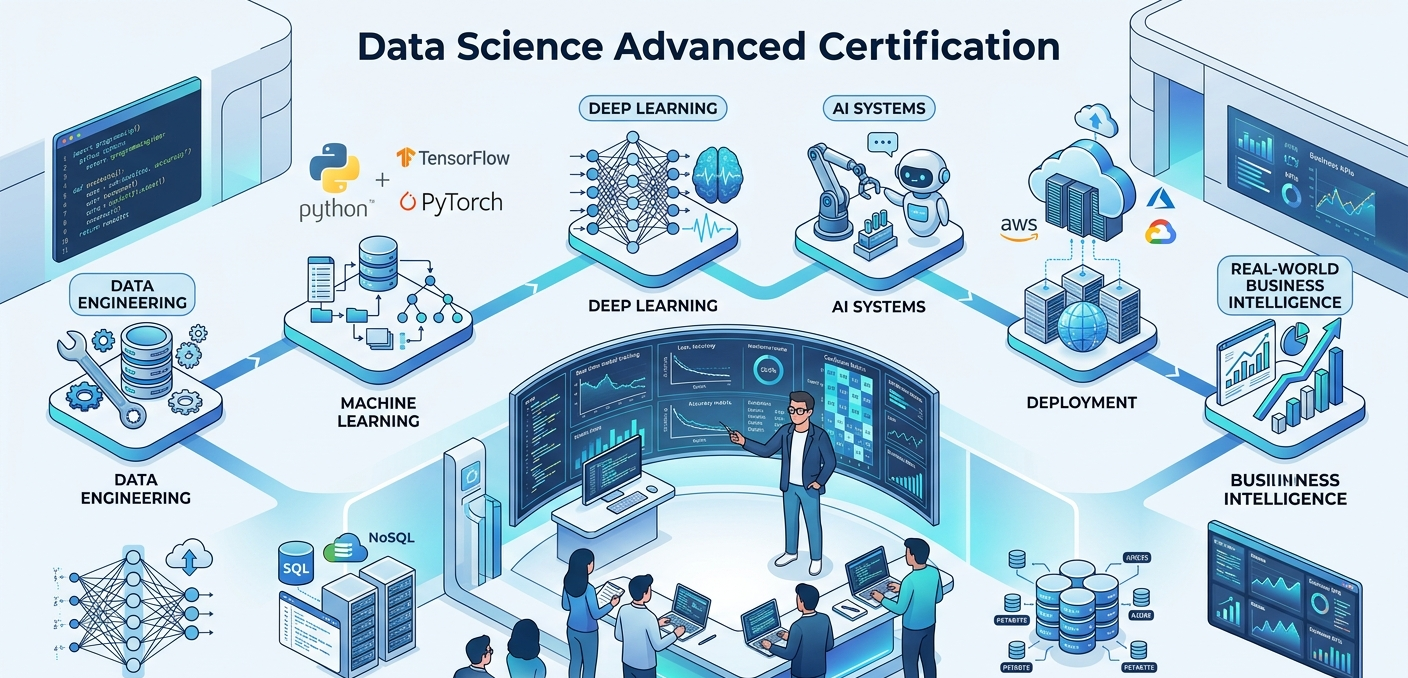
Course Overview: Data Science Advanced Certification – Jalandhar
1. Introduction to Data Science Advanced Certification
The Data Science Advanced Certification in Jalandhar is a professional-level training program designed for learners who want to gain deep expertise in data science, machine learning, artificial intelligence, and advanced analytics systems. This course goes far beyond basic or intermediate training and focuses on building industry-ready professionals capable of working on complex, real-world data problems.
In today’s digital era, data has become the most valuable asset for organizations. Every business decision is influenced by data insights, predictive models, and intelligent automation systems. This certification program is designed to help learners understand not only how data science works but also how it is applied at an advanced level in industries such as finance, healthcare, IT, e-commerce, manufacturing, and government sectors.
The course is structured to provide a strong balance between theoretical understanding, technical mastery, and real-world implementation.
2. Objective of the Advanced Certification Program
The main objective of this advanced certification is to develop highly skilled data science professionals who can confidently handle complex datasets and build scalable AI-driven solutions.
The key objectives include:
- Mastering advanced machine learning and deep learning techniques
- Understanding big data processing and cloud-based analytics
- Developing end-to-end data science solutions
- Building real-time predictive and intelligent systems
- Enhancing problem-solving and analytical thinking at an advanced level
- Preparing learners for senior-level data science roles
This program is not just about learning tools—it is about developing expert-level thinking in data-driven decision-making and AI strategy.
3. Why Advanced Certification in Data Science is Important
Basic data science knowledge is no longer enough in the competitive job market. Companies now demand professionals who can handle advanced-level challenges such as large-scale data processing, deep learning models, and real-time analytics systems.
Advanced certification becomes important because it:
- Enhances technical depth and specialization
- Improves career opportunities in top companies
- Builds expertise in AI and machine learning systems
- Prepares learners for senior roles in analytics
- Increases salary potential and global job opportunities
This course ensures that learners move beyond entry-level skills and become advanced practitioners in data science and AI.
4. Course Structure Overview
The course is divided into advanced-level modules that cover every important aspect of modern data science.
Module 1: Advanced Python for Data Science
- Advanced Python programming concepts
- Object-oriented programming for data science
- Working with large datasets efficiently
- Optimization techniques
- Advanced libraries usage
Module 2: Advanced Statistics and Mathematics
- Probability theory for machine learning
- Statistical inference and hypothesis testing
- Linear algebra for AI models
- Optimization techniques
- Data distribution and probability models
Module 3: Machine Learning (Advanced Level)
- Supervised and unsupervised learning
- Ensemble learning techniques
- Random Forest, Gradient Boosting, XGBoost
- Model tuning and optimization
- Cross-validation techniques
Module 4: Deep Learning Fundamentals
- Neural networks architecture
- Activation functions and optimization
- Convolutional Neural Networks (CNN)
- Recurrent Neural Networks (RNN)
- TensorFlow and Keras implementation
Module 5: Big Data Analytics
- Introduction to big data systems
- Hadoop ecosystem
- Apache Spark processing
- Distributed computing concepts
- Handling large-scale datasets
Module 6: Data Engineering Basics
- Data pipelines and workflows
- ETL processes
- Data warehousing concepts
- SQL and NoSQL databases
- Data architecture design
Module 7: Cloud Computing for Data Science
- AWS / Azure / Google Cloud basics
- Cloud-based machine learning deployment
- Scalable data storage solutions
- Real-time data processing systems
Module 8: Capstone Advanced Project
- End-to-end AI solution development
- Real industry problem-solving
- Model deployment and reporting
- Final presentation and evaluation
5. Hands-On Practical Learning Approach
This advanced certification strongly focuses on practical implementation rather than theoretical learning alone. Students will work on:
- Real industry datasets
- Live machine learning projects
- Deep learning model training
- Big data processing tasks
- Cloud deployment exercises
Every module includes hands-on assignments that simulate real-world industry problems, ensuring learners develop strong practical expertise.
6. Advanced Tools and Technologies Covered
Students will gain hands-on experience with industry-leading tools such as:
- Python (Advanced libraries like NumPy, Pandas, Scikit-learn)
- TensorFlow and Keras (Deep Learning frameworks)
- PySpark (Big Data processing)
- SQL and NoSQL databases
- AWS / Azure / Google Cloud platforms
- Power BI / Tableau (Advanced visualization)
- Jupyter Notebook and development environments
These tools are widely used in global companies and research organizations.
7. Real-World Industry Applications
Advanced data science is used in almost every major industry. This course prepares learners for practical applications such as:
7.1 Finance
- Fraud detection systems
- Risk modeling
- Algorithmic trading
- Credit scoring systems
7.2 Healthcare
- Disease prediction models
- Medical image analysis
- Patient risk assessment
- Drug discovery analytics
7.3 E-commerce
- Recommendation systems
- Customer behavior prediction
- Dynamic pricing models
- Sales forecasting
7.4 Manufacturing
- Predictive maintenance
- Supply chain optimization
- Quality control automation
7.5 Technology Companies
- AI product development
- Search engine optimization
- Intelligent automation systems
8. Skill Development Focus
This advanced certification helps learners develop:
- Advanced analytical thinking
- Deep understanding of machine learning models
- Problem-solving skills for complex datasets
- Cloud computing expertise
- Big data handling skills
- AI system design capability
- Business intelligence understanding
These skills are essential for senior-level data science roles.
9. Importance of Advanced Projects
Projects are the backbone of this certification. Students work on highly advanced projects such as:
- Fraud detection using machine learning
- AI-based recommendation systems
- Deep learning image classification
- Customer segmentation at scale
- Predictive analytics for business forecasting
These projects help learners build a strong professional portfolio that demonstrates real expertise.
10. Industry Relevance and Job Readiness
This course is designed to meet current industry standards. Companies expect advanced professionals who can:
- Build scalable machine learning models
- Handle large datasets efficiently
- Deploy AI systems in production
- Solve real business problems
- Work with cloud-based infrastructures
This certification ensures learners are fully prepared for high-level data science roles in IT companies, startups, and global organizations.
11. Career Opportunities After Advanced Certification
After completing this program, learners can pursue advanced roles such as:
- Senior Data Scientist
- Machine Learning Engineer
- AI Engineer
- Big Data Engineer
- Data Architect
- AI Research Analyst
- Business Intelligence Lead
These roles offer strong career growth, global opportunities, and high salary packages.
12. Learning Outcome Summary
After completing the Data Science Advanced Certification in Jalandhar, learners will be able to:
- Build advanced machine learning and deep learning models
- Work with big data systems and cloud platforms
- Develop end-to-end AI solutions
- Solve complex business problems using data
- Deploy real-world data science applications
- Work confidently in senior-level data science roles
14. Importance of Advanced-Level Problem Solving in Data Science
At an advanced stage of data science, the focus shifts from basic model building to complex problem-solving and system-level thinking. In real industries, problems are rarely straightforward. They involve multiple variables, large datasets, uncertain outcomes, and dynamic business environments.
This certification trains learners to handle such complexity by teaching them how to:
- Decompose complex business problems into structured data problems
- Identify hidden patterns in multi-dimensional datasets
- Choose the most effective algorithms based on context
- Balance accuracy, efficiency, and scalability in model design
- Evaluate trade-offs between different machine learning approaches
For example, in a financial fraud detection system, a simple classification model is not enough. Learners must design systems that can continuously learn from new data, adapt to evolving fraud patterns, and work in real-time environments.
This level of thinking prepares students for senior data science roles where strategic decisions matter as much as technical execution.
15. Advanced Data Visualization and Storytelling
In modern data science, visualization is not just about creating charts—it is about communicating insights effectively to business leaders and stakeholders. Advanced professionals must be able to transform complex analytical results into simple, actionable narratives.
This course emphasizes advanced data storytelling skills such as:
- Building interactive dashboards using Power BI and Tableau
- Designing executive-level reports for decision-makers
- Creating dynamic visualizations for real-time monitoring systems
- Using storytelling techniques to explain AI model outcomes
- Translating technical results into business impact language
For example, instead of showing raw accuracy scores of a model, learners are trained to explain how those results improve customer retention, reduce costs, or increase revenue.
This ability to connect data science with business impact is a key requirement in senior-level roles.
16. Exposure to Production-Level Data Science Systems
One of the most important aspects of this advanced certification is exposure to production-level systems, where data science models are deployed and used in real-time environments.
Students will understand:
- How models move from development to production
- How APIs are used to integrate machine learning models into applications
- How cloud platforms handle large-scale AI deployments
- How monitoring systems track model performance over time
- How updates and retraining processes are managed
This knowledge is critical because real-world data science is not limited to building models—it involves maintaining, scaling, and improving them continuously in live environments.
17. Role of Collaboration in Advanced Data Science Projects
Advanced data science projects are rarely completed by individuals alone. They require collaboration between multiple teams including data engineers, analysts, software developers, and business stakeholders.
This course prepares learners for collaborative environments by introducing:
- Team-based project development
- Version control using Git and GitHub
- Communication with non-technical stakeholders
- Agile project workflows
- Documentation and reporting standards
Students learn how to work in structured teams, similar to real corporate environments, which significantly improves their employability.
18. Evolution of Data Science Careers in the Future
The career landscape of data science is continuously evolving. In the future, professionals will not just be “data scientists” but will specialize into highly focused roles such as:
- AI Solution Architect
- Machine Learning Operations Engineer (MLOps)
- Deep Learning Specialist
- Data Strategy Consultant
- Cognitive Computing Engineer
These roles combine advanced technical expertise with strategic thinking and system design capabilities.
The Data Science Advanced Certification in Jalandhar ensures learners are prepared for this evolution by building both technical depth and strategic understanding.
19. Long-Term Value of Advanced Certification
Unlike short-term technical courses, an advanced certification provides long-term professional value. It helps learners build a strong foundation that remains relevant even as technologies evolve.
The long-term benefits include:
- Strong career stability in the IT and AI industry
- Continuous growth opportunities in global companies
- Ability to transition into leadership and managerial roles
- Flexibility to work across multiple industries and domains
- Higher earning potential and global job mobility
This certification acts as a career investment that pays off throughout a professional lifetime.
Why TECHCADD – Complete Institutional Overview
1. Introduction to TECHCADD
In today’s fast-paced digital world, technology is evolving at an unprecedented speed. Industries across the globe are undergoing rapid transformation due to advancements in artificial intelligence, data science, automation, cloud computing, and digital technologies. In such a scenario, the demand for skilled professionals has increased significantly.
However, there exists a major gap between traditional education and industry requirements. Most academic institutions still focus heavily on theoretical knowledge, while industries require practical skills, hands-on experience, and job-ready professionals.
This gap is exactly where TECHCADD plays a transformative role.
TECHCADD is a professional training institute dedicated to providing industry-oriented, practical, and career-focused education. It offers training programs in cutting-edge fields such as Data Science, Artificial Intelligence, Machine Learning, Software Development, Web Technologies, CAD/CAM, Digital Marketing, and many more emerging domains.
Unlike traditional learning systems, TECHCADD focuses on skill development, live projects, and real-world application of knowledge, ensuring that students are fully prepared for industry challenges.
The core philosophy of TECHCADD is simple yet powerful:
“Learn. Practice. Implement. Succeed.”
2. Vision and Mission of TECHCADD
Vision
The vision of TECHCADD is to become a globally recognized skill development institute that empowers students with advanced technical knowledge, practical expertise, and industry-relevant capabilities.
Mission
The mission of TECHCADD is to:
- Provide high-quality technical education
- Bridge the gap between academics and industry
- Enhance employability of students
- Promote practical and experiential learning
- Support innovation and entrepreneurship
- Build a future-ready workforce
TECHCADD aims to create professionals who can contribute effectively to industries, startups, and global organizations.
3. Why TECHCADD is Different from Traditional Institutes
One of the biggest reasons TECHCADD stands out is its practical learning approach. While most institutes focus only on theoretical concepts, TECHCADD emphasizes real-world application.
Key differences include:
- Industry-based curriculum design
- Hands-on project training
- Real-time problem solving
- Use of professional tools and technologies
- Exposure to industry workflows
- Personalized mentorship
Instead of rote learning, students at TECHCADD are encouraged to think, analyze, and apply knowledge practically.
This makes TECHCADD not just an educational institute, but a career transformation platform.
4. Importance of Practical Learning at TECHCADD
In today’s job market, practical skills are more important than theoretical knowledge. Employers prefer candidates who can directly contribute to projects without requiring extensive training.
TECHCADD ensures practical learning through:
Hands-on Training
Students actively work on coding, designing, analytics, and development tasks.
Live Projects
Real-world projects are assigned to simulate industry scenarios.
Case Studies
Students analyze real business problems and propose solutions.
Simulation Learning
Work environments are simulated to reflect real corporate settings.
For example:
- Data Science students work with real datasets
- Web developers create live websites and applications
- CAD students design industrial-level models
This ensures students gain real industry exposure during training itself.
5. Courses Offered at TECHCADD
TECHCADD provides a wide range of professional and industry-relevant courses:
5.1 Data Science & Artificial Intelligence
- Python programming
- Machine learning
- Deep learning
- Data analytics
- AI applications
5.2 Software Development
- Programming fundamentals
- Application development
- Software engineering concepts
5.3 Web Development
- HTML, CSS, JavaScript
- Frontend frameworks
- Backend development
- Full-stack development
5.4 CAD/CAM & Engineering Design
- AutoCAD
- 2D/3D modeling
- Mechanical design tools
5.5 Digital Marketing
- SEO
- Social media marketing
- Google Ads
- Content marketing
Each course is carefully designed according to current industry requirements and job trends.
6. Skill Development Approach
TECHCADD focuses on holistic skill development including:
Technical Skills:
- Programming
- Data analysis
- Machine learning
- Software tools
- Design technologies
Soft Skills:
- Communication skills
- Problem-solving ability
- Team collaboration
- Time management
- Presentation skills
This ensures students are not only technically strong but also professionally competent.
7. Importance of Live Projects
Live projects are one of the most important aspects of TECHCADD training.
Students work on:
- Real business problems
- Industry datasets
- Software development projects
- Design and automation systems
Benefits:
- Real-world experience
- Portfolio development
- Job readiness
- Confidence building
This helps students understand how industries actually operate.
8. Internship and Placement Support
TECHCADD provides strong placement assistance including:
- Resume preparation
- Interview training
- Mock interviews
- Internship opportunities
- Job referrals
Internships help students gain real industry exposure before full-time employment.
This significantly improves their chances of getting hired.
9. Industry-Relevant Curriculum
TECHCADD continuously updates its curriculum to match industry trends.
Students learn:
- Latest technologies
- Modern tools
- Industry workflows
- Real-world applications
This ensures that learners stay competitive in the job market.
10. Role in Personality Development
TECHCADD also focuses on personality development:
- Communication skills
- Confidence building
- Interview preparation
- Professional behavior
- Presentation skills
This prepares students for corporate environments.
11. Modern Infrastructure and Learning Environment
TECHCADD provides:
- Advanced computer labs
- High-speed internet
- Updated software tools
- Smart classrooms
- Project-based learning setups
This creates a productive and engaging learning atmosphere.
12. Focus on Emerging Technologies
TECHCADD trains students in future technologies such as:
- Artificial Intelligence
- Machine Learning
- Data Science
- Cloud Computing
- Automation
- IoT
This ensures students are ready for future job markets.
13. Career Opportunities After TECHCADD
Students can pursue careers such as:
- Data Scientist
- Software Developer
- Web Developer
- CAD Engineer
- AI Engineer
- Digital Marketing Specialist
These roles are highly demanded globally.
14. Why Students Prefer TECHCADD
Students choose TECHCADD because of:
- Practical training approach
- Industry exposure
- Expert trainers
- Career-oriented learning
- Affordable programs
- Placement support
It acts as a complete career development ecosystem.
15. Future Scope of TECHCADD Training
The future of technology is evolving rapidly. TECHCADD prepares students for:
- AI-driven industries
- Data-based decision systems
- Automation technologies
- Digital transformation
Students trained here become future-ready professionals.
17. TECHCADD Learning Model: Structured Path to Career Success
TECHCADD follows a highly structured and systematic learning model designed to take students from basic understanding to advanced professional competence. This model ensures that learning is not random or theoretical, but goal-oriented and outcome-driven.
The learning journey is divided into clearly defined phases:
Phase 1: Foundation Building
In the initial stage, students are introduced to fundamental concepts of their selected domain. Whether it is programming, data science, CAD design, or digital marketing, the focus is on building a strong conceptual base.
Trainers use simplified explanations, real-life examples, and interactive sessions to ensure that even beginners with no technical background can understand the subject easily. This stage eliminates fear of technology and builds confidence.
Phase 2: Skill Development
Once the foundation is clear, students move into skill-building exercises. Here, they start working on tools, software, and programming environments used in the industry.
This includes:
- Writing real code
- Working with datasets
- Designing models
- Using professional software tools
This phase is crucial because it transforms theoretical knowledge into practical ability.
Phase 3: Applied Learning
In this stage, students begin solving real-world problems. Instead of simple exercises, they are given industry-based scenarios.
For example:
- Analyzing business data for decision-making
- Creating websites for real use cases
- Designing mechanical components for industry applications
- Building dashboards for business insights
This stage helps students understand how their skills are applied in actual industries.
Phase 4: Industry Simulation
TECHCADD replicates a real corporate environment inside the classroom. Students work in teams, follow deadlines, and handle project-based tasks similar to professional companies.
This simulation prepares students for workplace behavior, collaboration, and productivity expectations.
Phase 5: Career Integration
The final phase focuses on preparing students for employment. This includes:
- Resume building
- Portfolio development
- Mock interviews
- Communication training
- Internship placement support
By the end of this phase, students are fully prepared to enter the job market confidently.
18. Real-World Industry Alignment
One of TECHCADD’s strongest advantages is its alignment with real industry needs. The curriculum is not static; it is continuously updated based on market trends and company requirements.
Industries today demand professionals who can:
- Solve real business problems
- Work with modern tools
- Adapt quickly to new technologies
- Deliver results efficiently
TECHCADD ensures that students are trained exactly for these expectations.
For example:
- Data science students work on predictive models used in companies
- Web developers learn frameworks used in startups and IT firms
- CAD students learn industrial design standards used in manufacturing
This alignment ensures that TECHCADD students are never outdated in their skills.
19. Transformation from Student to Professional
TECHCADD focuses heavily on transformation rather than just education. Many students join with limited technical exposure, but through structured training, they evolve into confident professionals.
This transformation includes:
- Improved technical skills
- Strong analytical thinking
- Better communication abilities
- Professional attitude development
- Increased confidence in problem-solving
Students not only learn what to do, but also how to think like industry professionals.
This mindset shift is one of the most valuable outcomes of TECHCADD training.
20. Role of TECHCADD in Career Building
TECHCADD plays a crucial role in shaping successful careers by offering a complete ecosystem of learning and growth.
It supports students in:
- Choosing the right career path
- Gaining relevant skills
- Building industry-ready projects
- Preparing for interviews
- Connecting with job opportunities
Instead of just offering a course, TECHCADD provides a complete career roadmap.
This makes it highly beneficial for:
- Fresh graduates
- Job seekers
- Working professionals looking for upskilling
- Students switching career domains
21. Importance of Industry Exposure
Industry exposure is a key factor that determines job success. TECHCADD ensures that students gain exposure through:
- Live projects
- Case studies
- Internship opportunities
- Industry interactions
This exposure helps students understand:
- How companies operate
- What challenges industries face
- How solutions are developed in real time
Such exposure significantly increases employability and confidence.
22. Long-Term Career Impact of TECHCADD Training
The impact of TECHCADD training is long-lasting. It does not just help students get their first job but supports their entire career growth.
After completing training, students are able to:
- Secure jobs in reputed companies
- Adapt to new technologies easily
- Grow into senior-level positions
- Work on global projects
- Start freelance or entrepreneurial ventures
This long-term growth is possible because TECHCADD builds strong foundational + practical + strategic skills.
23. Why TECHCADD Stands Out
TECHCADD stands out because it focuses on what truly matters in today’s world—skills, not just certificates.
Its uniqueness comes from:
- Practical learning methodology
- Industry-driven curriculum
- Real-world projects
- Personalized mentorship
- Career-focused training approach
It ensures that every student who joins is not just educated but empowered for success.
Future Scope of Data Science Advanced Certification – Jalandhar
1. Introduction: Data Science as the Foundation of Future Technology
The future of global industries is being reshaped by one powerful force—data. Every modern system, whether it is a business platform, mobile application, healthcare system, financial network, or government infrastructure, now depends on data-driven intelligence.
The Data Science Advanced Certification in Jalandhar prepares learners for this rapidly evolving future by equipping them with advanced analytical, machine learning, deep learning, and AI-based skills.
In the coming decade, data science will not just be a technical skill. It will become a core requirement for decision-making, innovation, and digital transformation across all industries.
2. Explosive Global Growth of Data Science
The global demand for data science professionals is increasing at an exponential rate. Organizations across the world are generating massive amounts of structured and unstructured data every second from:
- Social media platforms
- E-commerce transactions
- Banking systems
- Healthcare devices
- IoT sensors
- Mobile applications
- Cloud-based systems
This massive data explosion has created a strong need for professionals who can:
- Analyze complex datasets
- Build predictive systems
- Automate decision-making
- Improve business performance using AI
In the future, companies will not survive without data science integration. This makes data science one of the most stable, high-growth, and future-proof career fields globally.
3. Future Career Opportunities in Data Science
The future scope of this certification includes a wide range of advanced and high-paying career opportunities.
3.1 Data Scientist (Advanced Level)
Data Scientists will work on complex models, AI systems, and predictive analytics that influence business strategy and product development.
3.2 Machine Learning Engineer
ML Engineers will design scalable machine learning systems that continuously learn and improve using real-time data.
3.3 AI Engineer
AI Engineers will build intelligent systems such as chatbots, recommendation engines, and automation platforms.
3.4 Data Architect
Data Architects will design large-scale data systems, pipelines, and storage frameworks.
3.5 Big Data Engineer
These professionals will handle large-scale distributed systems using technologies like Spark and Hadoop.
3.6 AI Research Scientist
They will focus on developing new algorithms, neural network architectures, and advanced AI models.
These roles are expected to grow rapidly as companies move toward fully AI-driven ecosystems.
4. Artificial Intelligence: The Core of Future Data Science
Artificial Intelligence is the biggest driving force behind the future of data science. AI is transforming industries by enabling machines to learn, predict, and make decisions.
Future AI trends include:
- Self-learning systems
- Autonomous decision-making models
- AI-powered automation in industries
- Intelligent virtual assistants
- Predictive intelligence systems
Data science professionals will play a key role in building, training, and optimizing these AI systems.
In the future, the boundary between data science and AI will blur, creating a unified field focused on intelligent system design and automation.
5. Growth of Cloud Computing and Scalable AI Systems
Cloud computing will dominate the future of data science infrastructure. Companies are rapidly moving from traditional systems to cloud-based platforms such as AWS, Azure, and Google Cloud.
Future data science systems will be:
- Fully cloud-based
- Highly scalable
- Real-time data processing enabled
- Globally accessible
- Integrated with AI services
This means professionals will need to understand not only data science but also cloud architecture and deployment systems.
6. Rise of Big Data and Real-Time Analytics
In the future, organizations will rely heavily on real-time data processing systems instead of static reports.
Examples include:
- Real-time fraud detection in banking
- Live recommendation systems in e-commerce
- Instant traffic prediction in transportation systems
- Real-time health monitoring in healthcare
Big Data technologies such as Spark, Hadoop, and distributed computing systems will become standard tools in the industry.
Data scientists will be responsible for designing systems that can handle millions of data points per second efficiently.
7. Future of Automation in Data Science
Automation is rapidly transforming how data science tasks are performed. Many repetitive tasks are now being handled by AI-powered tools.
Future automation includes:
- AutoML (Automated Machine Learning)
- AI-based data cleaning systems
- Automated feature engineering
- Self-optimizing models
- Intelligent data pipelines
However, automation does not replace data scientists. Instead, it allows professionals to focus on higher-level strategy, interpretation, and decision-making.
8. Expansion of Data Science Across All Industries
In the future, data science will no longer be limited to IT companies. It will be integrated into every industry.
Healthcare
- Disease prediction systems
- Medical imaging analysis
- Patient risk assessment
Finance
- Fraud detection
- Algorithmic trading
- Risk modeling
Retail & E-commerce
- Personalized recommendations
- Demand forecasting
- Customer segmentation
Education
- Personalized learning systems
- Student performance analytics
Agriculture
- Crop yield prediction
- Weather-based farming insights
This widespread adoption ensures massive job opportunities across multiple sectors.
9. Future of Data Science in Business Strategy
Data science will become a core part of business leadership. Companies will rely on data scientists not just for analysis, but for strategic decision-making.
Future business applications include:
- Predictive business planning
- AI-driven marketing strategies
- Dynamic pricing models
- Customer behavior forecasting
- Risk analysis systems
Data scientists will increasingly work alongside executives, influencing high-level business decisions.
10. Evolution of Data Science Skills
Future professionals will require a combination of technical, analytical, and strategic skills.
Technical Skills
- Python, R, SQL
- Machine learning & deep learning
- Big data tools
- Cloud platforms
Analytical Skills
- Statistical modeling
- Predictive analytics
- Data visualization
- Problem-solving
Strategic Skills
- Business understanding
- Decision-making
- Data storytelling
- AI ethics
This combination will define future-ready professionals.
11. Rise of Remote Work and Global Opportunities
Data science is one of the most remote-friendly careers in the world. In the future, professionals will have opportunities to work globally without relocation.
Future work models include:
- Remote jobs for international companies
- Freelance AI and analytics projects
- Hybrid global teams
- Cloud-based collaboration systems
This opens opportunities for learners in Jalandhar to work with companies worldwide.
12. Growth of Startups and Innovation Ecosystem
Startups will continue to be major drivers of data science demand. Every startup depends on data to grow quickly and make smart decisions.
Data science will be used for:
- User growth analysis
- Product optimization
- Market prediction
- Customer retention
Startups offer faster career growth, innovation exposure, and real-world experience.
13. Future of Ethical AI and Responsible Data Science
As AI becomes more powerful, ethical considerations will become extremely important.
Future requirements include:
- Data privacy protection
- Bias-free algorithms
- Transparent AI systems
- Responsible data usage
New roles like AI Ethics Specialist and Data Governance Expert will emerge.
14. Long-Term Career Growth and Stability
Data science offers one of the strongest long-term career paths in the world.
Career progression:
Junior Analyst → Data Scientist → Senior Data Scientist → AI Lead → Data Strategist → Chief Data Officer
This ensures continuous growth and leadership opportunities.
16. Emergence of Intelligent Decision Systems
One of the most significant future developments in data science is the rise of intelligent decision systems. These systems will go beyond traditional analytics and dashboards by actively suggesting, predicting, and even executing decisions in real time.
Instead of simply showing “what happened,” future systems will answer:
- What will happen next?
- Why will it happen?
- What should we do about it?
This shift is transforming data science into a field known as decision intelligence, where AI models are directly connected to business actions. For example, in retail, systems will automatically adjust pricing based on demand patterns. In banking, fraud systems will not only detect suspicious activity but also block transactions instantly.
Data scientists trained at an advanced level will play a crucial role in designing and governing these systems, ensuring they remain accurate, ethical, and business-aligned.
17. Hyper-Personalization as the Future Standard
Another powerful trend shaping the future scope of data science is hyper-personalization. Businesses are moving away from generic services and toward deeply personalized user experiences powered by AI and machine learning.
In the future:
- Every user will receive personalized product recommendations
- Healthcare treatments will be customized for individuals
- Learning platforms will adapt content to each student’s behavior
- Marketing campaigns will be tailored in real time
This level of personalization is only possible through advanced data science models that analyze user behavior, preferences, and interactions continuously.
Professionals who complete this certification will be capable of building systems that drive next-generation customer engagement and experience design.
18. Growth of Autonomous Systems and AI Agents
The future will also see rapid growth in autonomous systems and AI agents. These are intelligent systems capable of performing tasks without human intervention.
Examples include:
- Self-driving vehicles
- AI customer support agents
- Automated trading systems
- Smart manufacturing robots
- Intelligent supply chain systems
Data scientists will be responsible for training and refining the models that power these autonomous systems. This will require deep understanding of machine learning, reinforcement learning, and real-time data processing.
As industries adopt more automation, the demand for advanced data science professionals will increase significantly.
19. Expansion of Data Science into Smart Cities and Public Systems
Governments around the world are investing heavily in smart city projects, where data science plays a central role.
Future applications include:
- Traffic flow optimization using real-time data
- Smart energy distribution systems
- Public safety and crime prediction models
- Waste management optimization
- Environmental monitoring and climate prediction
In such systems, millions of data points are processed continuously to improve urban living conditions.
Data scientists will increasingly contribute to public infrastructure planning and national-level decision-making systems, making this field highly impactful beyond private industries.
20. Continuous Evolution and Lifelong Learning in Data Science
One of the defining characteristics of data science is that it is constantly evolving. New algorithms, tools, frameworks, and methodologies are introduced regularly.
This means that future professionals must adopt a mindset of:
- Continuous learning
- Skill upgrading
- Technology adaptation
- Research-driven improvement
The Data Science Advanced Certification in Jalandhar prepares learners not just for current industry needs but also builds a foundation for lifelong learning. Professionals who stay updated will always remain in demand, regardless of technological changes.