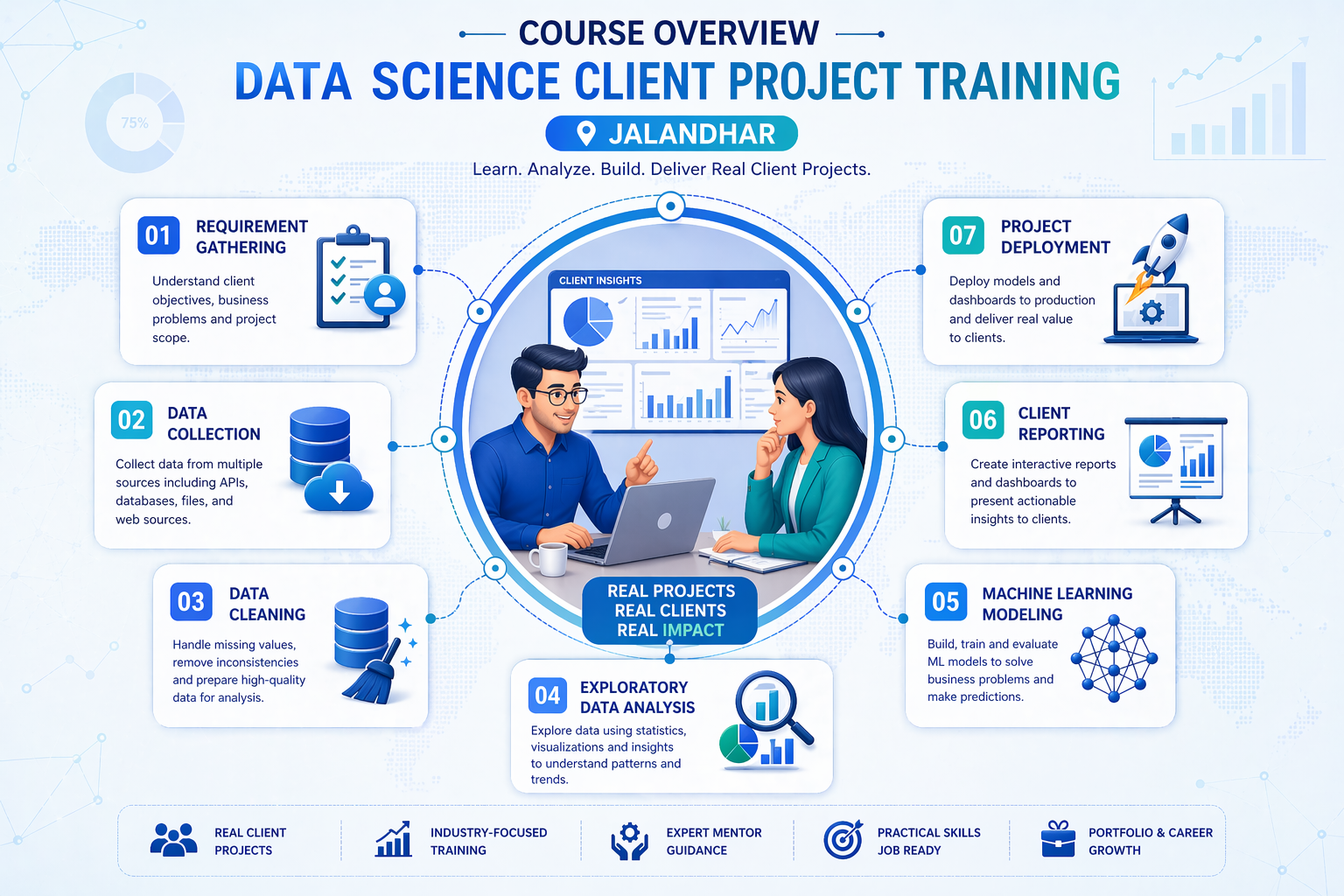
Data Science Client Project Training Jalandhar – Course Overview
Introduction to the Course
The Data Science Client Project Training in Jalandhar is a comprehensive, industry-focused program designed to bridge the gap between theoretical knowledge and real-world application. In today’s competitive job market, employers are no longer satisfied with candidates who only understand concepts—they are actively looking for individuals who can apply their knowledge to solve real business problems. This course is specifically designed to meet that demand.
The program emphasizes hands-on learning through live client projects, enabling students to gain practical experience in working with real datasets, understanding business requirements, and delivering actionable insights. It provides a structured pathway for learners to master data science tools and techniques while simultaneously developing professional skills required in real work environments.
This course is ideal for students, fresh graduates, and working professionals who want to build a strong career in data science by gaining real-world project experience.
Course Objectives
The primary objective of this course is to make learners industry-ready by equipping them with both technical expertise and practical exposure.
Key objectives include:
- Building a strong foundation in data science concepts
- Developing programming and analytical skills
- Providing hands-on experience through client projects
- Teaching data cleaning, analysis, and visualization techniques
- Enabling learners to build machine learning models
- Training students in project management and client interaction
- Helping learners build a professional portfolio
- Preparing students for job interviews and real-world roles
By the end of the course, students will be capable of independently handling data science projects from start to finish.
Course Structure and Learning Path
The course follows a well-structured learning path that progresses from basic concepts to advanced applications, with a strong emphasis on practical implementation.
1. Foundation Module – Introduction to Data Science
This module introduces students to the fundamentals of data science.
Topics covered include:
- What is data science and its importance
- Applications across industries
- Types of data and data sources
- Understanding business problems
- Role of data professionals
This module helps students understand the relevance of data science in the modern world.
2. Python Programming for Data Science
Python is the core programming language used in data science.
Topics include:
- Variables and data types
- Lists, tuples, and dictionaries
- Conditional statements and loops
- Functions and modules
- File handling
Students also learn key libraries such as:
- NumPy for numerical operations
- Pandas for data manipulation
- Matplotlib and Seaborn for visualization
This module ensures students gain strong programming skills required for data analysis.
3. Data Collection and Preprocessing
Real-world data is often messy and requires cleaning before analysis.
Topics include:
- Data collection techniques
- Importing data from various sources
- Handling missing values
- Removing duplicates
- Data transformation and normalization
Students learn how to prepare datasets for accurate and reliable analysis.
4. Exploratory Data Analysis (EDA)
EDA is a crucial step in understanding data patterns and relationships.
Topics include:
- Data summarization
- Statistical analysis
- Identifying trends and outliers
- Correlation analysis
- Visualization techniques
Students gain insights into how data behaves and how to extract meaningful information.
5. Data Visualization and Reporting
Data visualization is essential for communicating insights effectively.
Topics include:
- Creating charts and graphs
- Dashboard creation
- Data storytelling techniques
- Tools like Tableau and Power BI
Students learn how to present complex data in a simple and understandable format.
6. Database Management and SQL
This module introduces students to database concepts and SQL.
Topics include:
- Database fundamentals
- Writing SQL queries
- Data extraction and manipulation
- Joins, filters, and aggregations
Students learn how to work with structured data efficiently.
7. Statistics for Data Science
Statistics forms the backbone of data analysis.
Topics include:
- Descriptive statistics
- Probability concepts
- Hypothesis testing
- Regression analysis
- Statistical inference
This module strengthens analytical and problem-solving skills.
8. Machine Learning Fundamentals
Machine learning enables predictive analysis.
Topics include:
- Supervised learning
- Unsupervised learning
- Regression and classification
- Clustering techniques
Students learn how to build predictive models using real datasets.
9. Advanced Machine Learning Techniques
This module covers advanced concepts required for complex projects.
Topics include:
- Model evaluation and optimization
- Feature engineering
- Ensemble methods
- Real-world case studies
Students gain hands-on experience in improving model performance.
10. Client Project Training Module
This is the core highlight of the course.
Students work on:
- Real or simulated client projects
- Business problem-solving
- Data analysis and modeling
- Project documentation and reporting
They learn how to deliver solutions professionally, just like in real industry environments.
Real-World Project Experience
Students work on various real-world projects such as:
- Sales prediction
- Customer segmentation
- Market trend analysis
- Fraud detection
- Business dashboards
These projects simulate real industry challenges and provide valuable experience.
Project Workflow and Methodology
Students follow a structured workflow similar to industry practices:
- Requirement analysis
- Data collection and cleaning
- Data exploration
- Model building
- Evaluation and optimization
- Reporting and presentation
This approach ensures that students understand the complete lifecycle of a data science project.
Tools and Technologies Covered
Students gain hands-on experience with industry-standard tools such as:
- Python
- Pandas and NumPy
- SQL
- Excel
- Tableau
- Power BI
- Machine learning libraries
These tools are widely used in real-world data science projects.
Portfolio Development
A strong portfolio is essential for career success.
Students build:
- Multiple client-based projects
- Case studies
- Dashboards and reports
- GitHub repositories
This helps showcase their skills to employers and clients.
Learning Methodology
The course follows a practical and interactive learning approach:
- Instructor-led sessions
- Hands-on practice
- Live projects
- Assignments and quizzes
- Doubt-solving sessions
This ensures effective learning and skill development.
Soft Skills and Professional Development
In addition to technical skills, students develop:
- Communication skills
- Client interaction skills
- Presentation skills
- Time management
These skills are essential for professional success.
Career Opportunities
After completing the course, students can pursue roles such as:
- Data Analyst
- Data Scientist
- Business Analyst
- Machine Learning Engineer
They can also explore freelancing and remote work opportunities.
Who Can Enroll?
This course is suitable for:
- Students and fresh graduates
- Working professionals
- IT professionals
- Beginners with no coding experience
The course starts from basics and gradually advances.
Course Duration and Flexibility
The course duration typically ranges from 3 to 6 months.
Flexible learning options include:
- Classroom training
- Online live sessions
- Weekend batches
Benefits of the Course
- Hands-on learning
- Real client project exposure
- Strong portfolio development
- Industry-ready skills
- High career growth opportunities
Career Support and Placement Assistance
The course provides:
- Resume building sessions
- Mock interviews
- Portfolio guidance
- Job placement assistance
Students are prepared for real-world job opportunities.
Industry-Oriented Mentorship and Expert Guidance
A key strength of the Data Science Client Project Training program is the availability of experienced mentors who guide students throughout their learning journey. These mentors are often industry professionals with real-world experience in handling complex data science projects. Their insights help students understand not just how to perform tasks, but why certain approaches are used in real scenarios.
Mentors provide continuous support during project development, helping learners overcome challenges, debug errors, and refine their solutions. They also share best practices, industry standards, and practical tips that are rarely found in textbooks. This mentorship ensures that students gain a deeper understanding of data science concepts and their real-world applications.
Exposure to Agile Project Management Practices
Modern organizations follow structured project management methodologies such as Agile to ensure efficient and timely project delivery. This course introduces students to basic Agile concepts and workflows used in real data science teams.
Students learn:
- Breaking projects into smaller tasks (sprints)
- Setting milestones and deadlines
- Collaborating with team members
- Iterative development and feedback cycles
Understanding Agile practices prepares students to work effectively in professional environments and improves their ability to manage projects independently.
Documentation and Reporting Skills
In real-world projects, proper documentation is as important as technical execution. This course trains students to create clear and professional documentation for their work.
Students learn how to:
- Document project objectives and requirements
- Explain methodologies and processes
- Present findings in structured reports
- Create presentations for stakeholders
Strong documentation skills help students communicate their work effectively and add significant value to their professional profile.
Version Control and Collaboration Tools
To prepare students for real-world workflows, the course also introduces version control systems and collaboration tools. These tools are widely used in the industry to manage code, track changes, and collaborate with team members.
Students are introduced to:
- Git and GitHub for version control
- Sharing and managing project repositories
- Tracking changes and updates
- Collaborating on team projects
This exposure ensures that students are familiar with modern development practices and can work efficiently in team environments.
Handling Complex and Large Datasets
As students progress through the course, they are exposed to increasingly complex datasets that simulate real-world challenges. These datasets may include large volumes of data, missing values, inconsistencies, and multiple variables.
Students learn how to:
- Handle large datasets efficiently
- Optimize data processing techniques
- Use advanced tools for data handling
- Ensure data accuracy and reliability
This experience prepares them for real industry scenarios where data complexity is a common challenge.
Building Confidence Through Presentations
An essential part of client project training is the ability to present results confidently. Students are encouraged to present their projects to mentors and peers, simulating real client presentations.
They learn how to:
- Explain their approach clearly
- Highlight key insights
- Answer questions confidently
- Justify their decisions
These presentation skills are crucial for both job interviews and professional roles.
Networking Opportunities and Peer Learning
The course environment encourages collaboration and networking among students. Learners interact with peers from different backgrounds, share ideas, and work together on projects.
Benefits of peer learning include:
- Exposure to diverse perspectives
- Improved problem-solving skills
- Better understanding through collaboration
- Building professional connections
Networking also helps students stay connected with industry trends and opportunities.
Preparing for Real Industry Challenges
The ultimate goal of this course is to prepare students for real-world challenges. By working on client projects, learners experience the complexities and uncertainties of real business problems.
They develop:
- Critical thinking abilities
- Adaptability to changing requirements
- Problem-solving skills
- Professional work ethics
This comprehensive preparation ensures that students are not only technically skilled but also ready to thrive in professional environment
Why Choose TechCadd for Data Science Client Project Training in Jalandhar
In today’s competitive digital landscape, theoretical knowledge alone is not enough to build a successful career in data science. Employers and clients are looking for professionals who can work on real-world problems, handle live data, and deliver business-driven solutions. This is where TechCadd stands out as a leading training institute in Jalandhar.
TechCadd’s Data Science Client Project Training program is specifically designed to provide hands-on experience with real client projects, helping students bridge the gap between learning and industry expectations. The institute focuses on practical implementation, industry exposure, and job readiness, making it an ideal choice for aspiring data professionals.
Real Client Project Experience
One of the biggest advantages of choosing TechCadd is the opportunity to work on real client-based projects. Unlike traditional courses that rely on theoretical assignments, TechCadd provides practical exposure to real business problems.
Students get experience in:
- Understanding client requirements
- Working with real datasets
- Solving business challenges
- Delivering professional solutions
This real-world experience makes students industry-ready and highly valuable to employers.
Industry-Oriented Training Approach
TechCadd follows an industry-focused teaching methodology that aligns with current market demands. The curriculum is designed to reflect real-world workflows used in companies.
The training covers:
- Requirement gathering and problem understanding
- Data collection and preprocessing
- Exploratory data analysis
- Machine learning model development
- Reporting and visualization
- Project deployment
This structured approach ensures that students understand the complete lifecycle of a data science project.
Hands-On Learning with Practical Implementation
At TechCadd, learning is not limited to theory. Every concept is taught through practical implementation.
Students benefit from:
- Live coding sessions
- Real-time project work
- Case studies based on industry scenarios
- Assignments and practical exercises
This hands-on approach builds confidence and strengthens problem-solving skills.
Strong Focus on Portfolio Development
A professional portfolio is essential for showcasing skills in data science. TechCadd emphasizes building a strong portfolio through real client projects.
Students create:
- End-to-end project case studies
- Data analysis reports
- Machine learning solutions
- Interactive dashboards
This portfolio helps students stand out in job interviews and freelance opportunities.
Expert Trainers with Real Industry Experience
TechCadd provides training from experienced professionals who have worked on real data science projects.
Students gain:
- Insights into industry practices
- Guidance on solving complex problems
- Mentorship for career growth
- Exposure to real business use cases
Learning from industry experts ensures that students understand practical applications beyond textbooks.
Exposure to Real Business Scenarios
Understanding business context is crucial in data science. TechCadd trains students to think beyond technical implementation and focus on business impact.
Students learn:
- How to translate business problems into data solutions
- How to interpret data insights for decision-making
- How to present results to clients effectively
This makes them valuable assets in any organization.
Placement Assistance and Career Support
TechCadd provides strong career support to help students achieve their goals.
Support includes:
- Resume building
- Interview preparation
- Mock interviews
- Job referrals
- Career guidance
This ensures that students are fully prepared for job opportunities after completing the course.
Beginner to Advanced Learning Path
The course is designed to cater to all levels of learners.
- Beginners start with basic concepts like Python and data handling
- Intermediate learners focus on analysis and modeling
- Advanced learners work on real client projects and deployment
This structured progression makes learning smooth and effective.
Modern Tools and Technologies
TechCadd ensures that students are trained on the latest tools used in the data science industry.
Technologies include:
- Python (NumPy, Pandas, Matplotlib)
- Machine Learning (Scikit-learn)
- Data Visualization tools
- SQL and database systems
This ensures students are aligned with industry standards.
Communication and Client Handling Skills
Working on client projects requires strong communication skills. TechCadd trains students in professional communication and client interaction.
Students learn:
- How to present insights clearly
- How to communicate with clients
- How to handle feedback and revisions
These skills are essential for both jobs and freelancing.
Real-Time Project Workflow Training
TechCadd teaches the complete workflow followed in real companies.
Students understand:
- Project planning and execution
- Data processing pipelines
- Model evaluation and improvement
- Final delivery and reporting
This prepares them for real workplace environments.
Flexible Learning Options
TechCadd offers flexible learning modes to suit different needs:
- Classroom training
- Online live sessions
- Weekend batches
- Fast-track programs
This flexibility helps students and working professionals learn conveniently.
Affordable and High-Value Training
TechCadd provides high-quality training at a cost-effective price. The combination of real project exposure, mentorship, and career support makes it a valuable investment.
Confidence Building Through Real Experience
Confidence comes from doing real work, not just learning theory. TechCadd ensures that students gain real experience, which builds their confidence.
By the end of the course, students:
- Have worked on real client projects
- Built a strong portfolio
- Developed problem-solving skills
- Are ready for job roles or freelancing
Long-Term Career Growth
TechCadd focuses on building a strong foundation for long-term success.
Students are prepared for roles such as:
- Data Analyst
- Data Scientist
- Machine Learning Engineer
- Business Analyst
The skills learned help in continuous career growth.
Continuous Support and Learning
Even after course completion, TechCadd provides ongoing support.
Students get:
- Access to updated content
- Alumni network support
- Career guidance
- Networking opportunities
This ensures continuous learning and growth.
Deep Understanding of Data Lifecycle Management
One of the most important aspects of working on client projects is understanding how data flows from raw input to actionable insights. TechCadd places strong emphasis on teaching the complete data lifecycle, ensuring students gain clarity on each stage involved in handling real-world data.
Students are trained in:
- Collecting structured and unstructured data from multiple sources
- Cleaning and transforming raw data into usable formats
- Managing missing values and inconsistencies
- Structuring datasets for analysis and modeling
This in-depth understanding helps students work efficiently on complex datasets, which is a critical requirement in real client projects.
Emphasis on Problem-Solving and Analytical Thinking
Data science is not just about tools and coding—it’s about solving problems. TechCadd focuses on developing analytical thinking skills that enable students to approach challenges logically and creatively.
Students learn how to:
- Break down complex problems into manageable steps
- Identify patterns and trends in data
- Choose the right algorithms for specific use cases
- Evaluate model performance and improve results
This problem-solving mindset is what differentiates an average learner from a skilled data professional.
Exposure to Project Documentation and Reporting Standards
In real-world environments, documenting your work is just as important as completing it. TechCadd trains students in creating professional documentation and reports that meet industry standards.
Students gain experience in:
- Writing clear and structured project documentation
- Creating detailed analysis reports
- Designing dashboards for client presentations
- Explaining technical results in simple business terms
These skills are highly valued by employers and clients, as they ensure clarity and professionalism in project delivery.
Collaboration and Team-Based Learning
Many data science projects are completed in teams, especially in corporate environments. TechCadd introduces students to collaborative learning, where they work in groups to solve problems and complete projects.
Benefits include:
- Learning teamwork and coordination
- Understanding different roles in a project
- Sharing knowledge and ideas
- Improving communication and collaboration skills
This prepares students for real workplace dynamics and team-based projects.
Real-Time Feedback and Continuous Improvement
At TechCadd, learning is a continuous process supported by regular feedback. Trainers closely monitor student progress and provide constructive suggestions for improvement.
Students benefit from:
- Personalized feedback on projects
- Suggestions for improving code and models
- Guidance on best practices
- Continuous performance tracking
This helps students refine their skills and achieve better results over time.
Exposure to Deployment and Production Concepts
Building a model is only part of a data science project—deploying it is equally important. TechCadd introduces students to basic deployment concepts to help them understand how solutions are implemented in real environments.
Students learn:
- How models are integrated into applications
- Basics of deployment workflows
- Understanding APIs and data pipelines
- Delivering usable solutions to clients
This knowledge gives students an added advantage in the job market.
Developing a Professional Work Approach
TechCadd focuses on shaping students into professionals who can work efficiently in real environments. This includes training on work ethics, discipline, and responsibility.
Students are guided on:
- Meeting deadlines consistently
- Maintaining quality standards
- Communicating progress effectively
- Handling project challenges professionally
These qualities are essential for long-term success in any career.
Increased Employability and Career Confidence
By combining technical skills with real project experience, TechCadd significantly enhances employability. Students are not only skilled but also confident in their abilities.
By the end of the training, students:
- Have practical experience with real projects
- Understand industry workflows
- Can confidently attend interviews
- Are ready to take on professional roles
Strong Foundation for Advanced Learning
The training at TechCadd also prepares students for future growth. With a solid foundation in data science and real project experience, students can easily move into advanced domains such as:
- Artificial Intelligence
- Deep Learning
- Big Data Analytics
- Advanced Machine Learning
Transforming Learners into Industry Professionals
Ultimately, TechCadd’s goal is to transform learners into industry-ready professionals. The focus is not just on completing a course, but on ensuring that every student is capable of delivering real value in the professional world.
With practical exposure, expert mentorship, and continuous support, students gain the skills, confidence, and mindset needed to succeed in data science careers.
Future Scope of Data Science Client Project Training Jalandhar
Introduction
In today’s fast-evolving digital landscape, data has become the backbone of modern businesses. Organizations across industries are increasingly relying on data to drive decisions, optimize operations, and create innovative solutions. As a result, data science has emerged as one of the most in-demand and future-proof career fields globally.
However, employers are no longer satisfied with candidates who possess only theoretical knowledge. They are actively seeking professionals who have hands-on experience and can handle real-world challenges effectively. This is where Data Science Client Project Training in Jalandhar plays a crucial role. By focusing on practical exposure through live or simulated client projects, this training prepares learners for real industry environments.
The future scope of such training programs is immense, as they align perfectly with the evolving demands of the job market. This section explores the long-term opportunities, career growth, industry demand, and technological advancements that make client project-based data science training a valuable investment.
Growing Demand for Practical Skills
The job market is shifting towards skill-based hiring rather than degree-based hiring. Employers prioritize candidates who can demonstrate their abilities through practical experience.
Why Practical Skills Matter
- Companies want job-ready professionals
- Reduced training time for employers
- Immediate contribution to projects
- Better problem-solving capabilities
Client project training provides hands-on experience, making candidates more attractive to employers. In the future, practical experience will become even more important than theoretical knowledge.
Increasing Demand for Data Science Professionals
The demand for data science professionals continues to grow rapidly across the globe. Organizations generate massive amounts of data and require skilled individuals to analyze and interpret it.
Key Drivers of Demand
- Digital transformation
- Growth of e-commerce
- Expansion of artificial intelligence
- Need for data-driven decision-making
Professionals with real project experience have a significant advantage in this competitive market.
Importance of Client Project Experience
Client project experience is one of the most valuable assets for a data science professional.
Benefits
- Real-world exposure
- Understanding business requirements
- Hands-on problem-solving
- Professional project delivery
In the future, candidates with client project experience will be preferred over those with only academic knowledge.
Diverse Career Opportunities
Data science client project training opens doors to various career paths.
Popular Roles
- Data Analyst
- Data Scientist
- Business Analyst
- Machine Learning Engineer
- Data Consultant
These roles offer excellent growth opportunities and competitive salaries.
Industry-Wide Applications
Data science is used across multiple industries, ensuring long-term demand.
Healthcare
Disease prediction, patient data analysis
Finance
Fraud detection, risk management
E-commerce
Customer segmentation, recommendation systems
Marketing
Campaign analysis, customer insights
Manufacturing
Process optimization, quality control
This wide applicability ensures a stable and growing career path.
Technological Advancements
The future of data science is closely linked with technological advancements.
Artificial Intelligence
AI is enhancing data analysis capabilities
Machine Learning
ML models are widely used for predictions
Big Data
Handling large datasets is becoming essential
Cloud Computing
Cloud platforms enable scalable solutions
Professionals trained in client projects gain exposure to these technologies.
Global Career Opportunities
Data science is a globally recognized field. Professionals can work with international companies and remote teams.
Benefits
- Higher salaries
- Diverse work experience
- Exposure to global projects
Remote work trends further increase these opportunities.
High Salary Potential
Data science professionals are among the highest-paid in the tech industry.
Salary Growth
- Entry-level roles offer competitive salaries
- Mid-level roles provide significant growth
- Senior roles offer high earning potential
Client project experience enhances earning potential.
Role of Portfolio in Career Growth
A strong portfolio is essential for showcasing skills.
Portfolio Benefits
- Demonstrates practical experience
- Builds credibility
- Attracts employers and clients
Client project training helps build a powerful portfolio.
Continuous Learning and Adaptability
Data science is a constantly evolving field.
Professionals must:
- Learn new tools and technologies
- Stay updated with trends
- Work on new projects
Client project training encourages continuous learning.
Entrepreneurship Opportunities
Data science skills enable professionals to start their own ventures.
Opportunities
- Consulting services
- Freelancing
- Data-driven startups
This provides financial independence and growth.
Remote Work and Freelancing
The rise of remote work has increased opportunities for data professionals.
Benefits
- Work from anywhere
- Flexible schedules
- Global clients
Client project experience helps in securing freelance work.
Future Trends in Data Science
Key trends shaping the future include:
- AI integration
- Real-time analytics
- Automation
- Data-driven decision-making
Professionals must stay updated with these trends.
Challenges and Opportunities
While the field offers great opportunities, it also has challenges:
Challenges
- Rapid technological changes
- High competition
- Complex data handling
Opportunities
- Continuous growth
- Innovation
- High demand
Proper training helps overcome challenges.
Impact of Client Project Training
Client project training significantly enhances career prospects.
Key Advantages
- Practical experience
- Industry exposure
- Confidence building
- Better job opportunities
It prepares students for real-world roles.
Long-Term Career Growth
Data science offers long-term career stability.
Professionals can:
- Advance to senior roles
- Specialize in specific domains
- Transition into leadership positions
This ensures sustained growth.
The future scope of Data Science Client Project Training in Jalandhar is extremely promising. With the increasing demand for skilled professionals and the importance of practical experience, such training programs provide a strong foundation for a successful career.
Data science is one of the most dynamic and rewarding career fields. By gaining real-world experience through client project training, learners can position themselves for long-term success.
With dedication, continuous learning, and practical exposure, the future in data science is limitless.
Increasing Importance of Business Understanding
In the future, data science professionals will not only be expected to work with data but also to understand the business context behind it. Companies are looking for individuals who can translate data insights into actionable business strategies. This means that having technical knowledge alone will not be sufficient—professionals must also develop a strong understanding of business operations, industry trends, and customer behavior.
Client project training plays a vital role in developing this skill. By working on real or simulated business problems, students learn how to align their data analysis with business goals. This ability to connect technical work with business impact will be highly valuable in the future job market.
Growth of Real-Time Decision Making
The future of business is moving toward real-time decision-making, where companies rely on instant data insights to respond quickly to market changes. This has increased the demand for professionals who can analyze data in real time and provide immediate recommendations.
Data science professionals trained through client projects are well-equipped to handle such requirements. They learn how to work with dynamic datasets, build real-time dashboards, and deliver insights quickly. As this trend continues to grow, the demand for such skills will increase significantly.
Expansion of Data-Driven Culture in Organizations
Organizations are increasingly adopting a data-driven culture, where decisions are based on data rather than intuition. This shift is creating a continuous demand for data professionals who can provide accurate and reliable insights.
In the future, almost every department within an organization—such as marketing, finance, operations, and human resources—will rely on data analysis. This widespread adoption ensures that data science professionals will remain essential across all business functions.
Demand for End-to-End Project Expertise
Employers are increasingly looking for professionals who can handle the entire lifecycle of a data science project. This includes understanding requirements, collecting data, analyzing it, building models, and presenting results.
Client project training prepares students for this end-to-end responsibility. They gain experience in managing complete projects, making them more valuable to employers. In the future, such comprehensive skill sets will be a key differentiator in the job market.
Rise of Hybrid Roles
The future job market is seeing the emergence of hybrid roles that combine data science with other domains. For example:
- Data Analyst + Business Strategist
- Data Scientist + Software Developer
- Data Engineer + Cloud Specialist
Professionals with interdisciplinary skills will have a competitive advantage. Client project training exposes students to various aspects of data science, helping them adapt to these hybrid roles.
Increasing Use of Cloud-Based Data Solutions
Cloud computing is becoming an integral part of data science. Organizations are moving their data storage and processing to cloud platforms for scalability and efficiency.
Future data professionals will need to:
- Work with cloud-based tools
- Manage data pipelines
- Deploy models on cloud platforms
Client project training often introduces students to real-world environments where such tools are used, preparing them for future industry demands.
Importance of Ethical Data Practices
As data usage increases, concerns about data privacy and ethics are also growing. Organizations are expected to handle data responsibly and comply with regulations.
Data professionals must understand:
- Data privacy laws
- Ethical use of data
- Responsible AI practices
In the future, ethical considerations will play a significant role in data science careers.
Continuous Innovation and Career Evolution
Data science is a field driven by innovation. New tools, techniques, and technologies are constantly being developed, creating new opportunities for professionals.
Client project training encourages a mindset of continuous improvement and adaptability. Students learn how to approach problems creatively and stay updated with industry trends.
This ability to evolve with the industry ensures long-term career success and growth.
Strong Demand in Emerging Markets
Emerging cities and regions, including areas around Jalandhar, are witnessing increased adoption of digital technologies. Local businesses are beginning to use data analytics to improve operations and compete in the market.
This creates new opportunities for trained professionals to work with local companies, startups, and enterprises. In addition to global opportunities, there is strong potential for growth in regional markets.