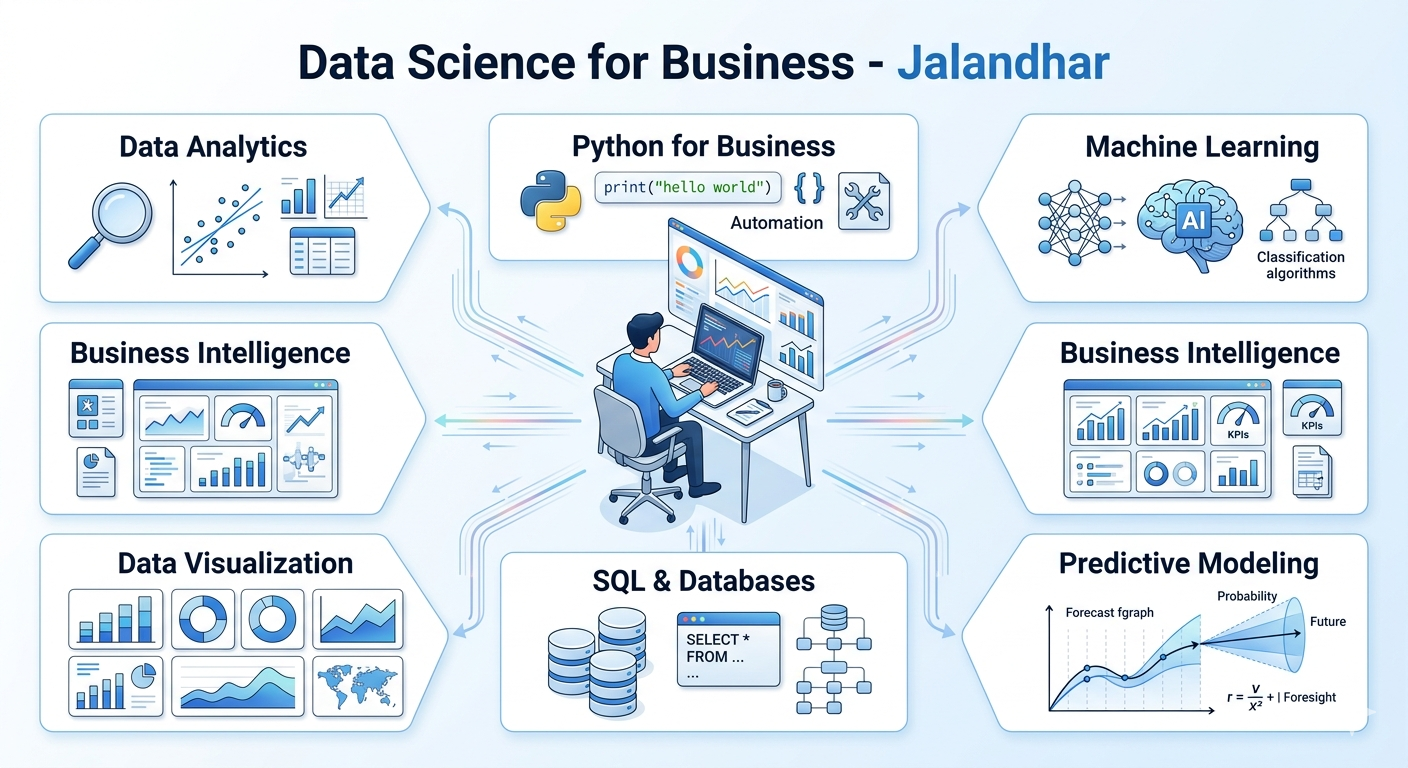
DATA SCIENCE FOR BUSINESS – JALANDHAR
COURSE OVERVIEW
1. Introduction to Data Science for Business
In today’s digital economy, businesses no longer rely only on intuition or traditional decision-making methods. Instead, they depend on data-driven strategies to understand customers, optimize operations, increase profits, and stay ahead of competitors. This transformation has made Data Science for Business one of the most powerful and in-demand domains across industries.
The Data Science for Business course in Jalandhar is designed to bridge the gap between raw data and meaningful business decisions. It equips learners with analytical, statistical, and machine learning skills, along with practical business understanding to solve real-world problems.
Data science is not just about coding or algorithms. It is about understanding business problems, collecting the right data, analyzing it effectively, and converting it into actionable insights. In modern organizations, data scientists act as decision enablers who help businesses grow using evidence-based strategies.
This course is structured to help students, professionals, and entrepreneurs understand how data science can be applied in marketing, finance, operations, human resources, and strategic planning.
2. Why Data Science is Important for Business
Businesses generate massive amounts of data every second. This includes customer transactions, website activity, social media interactions, supply chain data, and financial records. Without proper analysis, this data remains useless.
Data science helps businesses in multiple ways:
- Understanding customer behavior
- Predicting future trends
- Improving marketing strategies
- Reducing operational costs
- Increasing revenue and efficiency
- Making data-driven decisions
- Identifying risks and opportunities
For example, e-commerce companies use data science to recommend products. Banks use it for fraud detection. Hospitals use it for patient diagnosis prediction. Even small businesses in cities like Jalandhar can benefit from data science to improve sales and customer engagement.
3. Course Objectives
The primary objectives of the Data Science for Business course include:
- To provide strong foundational knowledge of data science concepts
- To teach practical business applications of data analytics
- To develop skills in Python programming and data tools
- To train students in machine learning and predictive modeling
- To enhance decision-making abilities using data insights
- To prepare learners for real industry projects and job roles
By the end of this course, learners will be able to analyze complex datasets, build predictive models, and apply insights to solve real business problems.
4. Target Audience
This course is designed for a wide range of learners:
- Students from commerce, science, and engineering backgrounds
- Business owners and entrepreneurs
- Working professionals seeking career growth
- Marketing and finance professionals
- IT and software developers
- Fresh graduates looking for data science careers
No advanced technical background is required initially, as the course starts from basics and gradually moves to advanced concepts.
5. Course Structure Overview
The course is divided into multiple modules that combine theory and practical implementation.
Module 1: Introduction to Data Science
- What is Data Science
- Data Science lifecycle
- Role of data in business
- Types of data (structured and unstructured)
- Real-world applications
Module 2: Python Programming for Data Science
- Python basics
- Data types and structures
- Functions and libraries
- Pandas, NumPy, Matplotlib
- Data manipulation techniques
Module 3: Statistics for Data Science
- Descriptive statistics
- Probability concepts
- Correlation and regression
- Data distributions
- Hypothesis testing
Module 4: Data Collection and Cleaning
- Data sourcing techniques
- Web scraping basics
- Handling missing data
- Data preprocessing
- Feature engineering
Module 5: Data Visualization
- Importance of visualization in business
- Charts and graphs
- Power BI / Tableau basics
- Dashboard creation
- Storytelling with data
Module 6: Machine Learning Basics
- Introduction to ML
- Supervised learning
- Unsupervised learning
- Regression models
- Classification models
Module 7: Advanced Machine Learning
- Decision trees
- Random forest
- K-means clustering
- Support vector machines
- Model evaluation techniques
Module 8: Business Intelligence Applications
- KPI tracking
- Sales forecasting
- Customer segmentation
- Market analysis
- Business dashboards
Module 9: Real-Time Projects
- E-commerce analytics project
- Customer churn prediction
- Sales prediction model
- Fraud detection system
- Business dashboard creation
Module 10: Capstone Project
- End-to-end data science project
- Problem statement selection
- Data collection and analysis
- Model building
- Final presentation
6. Tools and Technologies Covered
Students will gain hands-on experience with industry-standard tools:
- Python programming language
- Jupyter Notebook
- Excel for analytics
- SQL for database management
- Power BI / Tableau for visualization
- Scikit-learn for machine learning
- Pandas and NumPy libraries
These tools are widely used in companies, making students job-ready.
7. Real-World Business Applications
Data science is widely used across industries:
Marketing
- Customer segmentation
- Ad targeting
- Campaign optimization
Finance
- Risk analysis
- Fraud detection
- Credit scoring
Retail & E-commerce
- Product recommendations
- Demand forecasting
- Inventory optimization
Healthcare
- Disease prediction
- Patient monitoring systems
- Medical data analysis
Manufacturing
- Predictive maintenance
- Quality control
- Supply chain optimization
8. Why Choose Data Science for Business in Jalandhar
Jalandhar is growing rapidly as an educational and business hub. With increasing digital transformation in small and medium businesses, the demand for data-driven decision-making is rising.
Key reasons:
- Growing IT and startup ecosystem
- Increasing demand for skilled professionals
- Opportunities in local and global companies
- Affordable and practical learning environment
- Strong career growth potential
This course helps local students become globally competitive professionals.
9. Practical Learning Approach
This course focuses heavily on practical learning:
- Live coding sessions
- Industry-based case studies
- Real datasets
- Project-based learning
- Interactive business scenarios
Instead of just theory, students work on real problems faced by companies.
10. Career Opportunities
After completing this course, learners can pursue roles such as:
- Data Analyst
- Business Analyst
- Data Scientist
- Machine Learning Engineer
- Business Intelligence Analyst
- Data Consultant
Salary packages vary depending on skills and experience, but data science roles are among the highest-paying in the IT industry.
11. Skills You Will Gain
Students will develop:
- Analytical thinking
- Problem-solving skills
- Programming knowledge
- Statistical understanding
- Business decision-making ability
- Data visualization expertise
- Machine learning implementation skills
12. Industry Project Experience
One of the strongest parts of this course is industry-level project training.
Students work on:
- Real business datasets
- Live project simulations
- Client-based case studies
- End-to-end analytics solutions
This experience helps in interviews and job placements.
13. Future Scope of Data Science
Data science is one of the fastest-growing fields globally. In the future:
- AI-driven decision-making will dominate industries
- Automation will increase demand for data professionals
- Businesses will become fully data-centric
- Machine learning will be used in every sector
In India and globally, the demand for data scientists will continue to grow significantly.
15. Advanced Business Decision-Making Using Data Science
In modern organizations, decision-making is no longer based on assumptions or experience alone. Instead, it is powered by structured data analysis and predictive insights. One of the key strengths of Data Science for Business is its ability to transform complex datasets into clear, actionable decisions that directly impact profitability and growth.
Businesses today operate in highly competitive environments where even small improvements in efficiency, customer targeting, or pricing strategy can lead to significant advantages. Data science helps organizations identify these opportunities with precision.
For example, instead of launching a marketing campaign blindly, companies analyze customer segments, past purchase behavior, seasonal trends, and engagement metrics. Using this data, they can design highly targeted campaigns that increase conversion rates and reduce marketing costs.
Similarly, in pricing strategy, data science helps businesses determine the optimal price point for products or services. By analyzing competitor pricing, demand elasticity, and customer purchasing patterns, companies can maximize revenue while maintaining competitiveness.
In operational management, data science enables better resource allocation. Businesses can predict demand fluctuations and adjust inventory, workforce, and supply chain operations accordingly. This reduces waste, improves efficiency, and ensures smoother business processes.
16. Customer Behavior Analysis and Personalization
One of the most powerful applications of data science in business is understanding customer behavior. Every customer interaction—whether online or offline—generates valuable data. This includes browsing history, purchase patterns, feedback, and engagement with marketing campaigns.
Through data science techniques, businesses can identify patterns in this data and build detailed customer profiles. These profiles help companies understand what customers want, how they behave, and what influences their buying decisions.
Personalization is a major outcome of this analysis. Instead of offering the same product or message to every customer, businesses can tailor their offerings based on individual preferences. This leads to higher customer satisfaction and stronger brand loyalty.
For example:
- E-commerce platforms recommend products based on browsing history.
- Streaming platforms suggest content based on viewing behavior.
- Retail stores offer personalized discounts to frequent buyers.
This level of personalization was not possible in traditional business models, but data science has made it a standard practice today.
17. Predictive Analytics in Business Growth
Predictive analytics is one of the most valuable aspects of data science for business. It allows organizations to forecast future outcomes based on historical data.
Businesses use predictive models to answer questions like:
- What will be the sales next month?
- Which customers are likely to leave?
- What products will be in high demand?
- What risks might affect operations?
By answering these questions in advance, companies can take proactive actions instead of reactive decisions.
For example, if a business predicts a drop in sales during a particular season, it can adjust its marketing strategy beforehand. Similarly, if customer churn is predicted, companies can take steps to retain those customers through offers or improved services.
Predictive analytics reduces uncertainty and helps businesses plan more effectively.
18. Data-Driven Marketing Strategies
Marketing is one of the most transformed areas due to data science. Traditional marketing relied on broad audience targeting, but data science enables precise and efficient strategies.
With data-driven marketing, businesses can:
- Identify the right audience
- Choose the best communication channels
- Optimize advertising budgets
- Measure campaign performance in real time
Social media platforms, search engines, and digital advertising networks use data science extensively to show ads to the most relevant users.
For example, if a user searches for a product online, data algorithms analyze that behavior and display related advertisements across different platforms. This increases the chances of conversion significantly.
Businesses also use A/B testing, where two versions of a marketing campaign are tested to determine which performs better. Data science helps analyze results and improve future campaigns.
19. Importance of Data Ethics and Security in Business
As businesses collect and analyze large volumes of data, ethical responsibility becomes extremely important. Data privacy and security are critical concerns in today’s digital world.
Companies must ensure that customer data is protected from misuse, theft, or unauthorized access. Ethical data usage also means being transparent about how data is collected and used.
Data science professionals must follow guidelines such as:
- Protecting sensitive customer information
- Avoiding biased algorithms
- Ensuring fair decision-making
- Maintaining transparency in data usage
Ethical data practices not only build customer trust but also protect businesses from legal and reputational risks.
20. Integration of AI and Data Science in Business
Data science and artificial intelligence (AI) are closely connected. While data science focuses on analyzing and interpreting data, AI uses this data to automate decisions and processes.
In business, AI-powered systems can:
- Automate customer service using chatbots
- Detect fraud in real time
- Recommend products automatically
- Optimize logistics and delivery routes
When combined with data science, AI becomes even more powerful. It enables businesses to build intelligent systems that learn and improve over time.
This integration is shaping the future of industries, making operations faster, smarter, and more efficient.
21. Continuous Learning and Industry Relevance
The field of data science is constantly evolving. New tools, technologies, and techniques are introduced regularly. Therefore, continuous learning is essential for anyone pursuing a career in this field.
Professionals must stay updated with:
- New machine learning algorithms
- Advanced data visualization tools
- Cloud computing platforms
- Big data technologies
The Data Science for Business course encourages a mindset of lifelong learning, ensuring that learners remain relevant in the industry.
Why TECHCADD – Complete Institutional Overview
1. Introduction to TECHCADD
In today’s rapidly evolving technological landscape, education is no longer limited to theoretical learning. Industries demand professionals who are skilled, practical, and job-ready. In this context, TECHCADD has emerged as a modern professional training institute focused on bridging the gap between academic education and industry requirements.
TECHCADD is dedicated to providing high-quality training in various domains such as Data Science, Artificial Intelligence, Machine Learning, Software Development, Web Technologies, CAD/CAM, Digital Marketing, and other emerging technologies. The institute focuses on practical learning, live projects, and industry-oriented curriculum to ensure that students are fully prepared for real-world challenges.
Unlike traditional educational systems that rely heavily on theory, TECHCADD emphasizes skill-based learning. This approach ensures that students not only understand concepts but also know how to apply them in real business and industrial environments.
2. Vision and Mission of TECHCADD
Vision
The vision of TECHCADD is to become a leading global training institute that empowers students with advanced technical skills and transforms them into industry-ready professionals capable of contributing to innovation and development.
Mission
The mission of TECHCADD includes:
- Providing high-quality technical education
- Bridging the gap between education and industry
- Promoting practical and hands-on learning
- Enhancing employability of students
- Supporting startups and innovation-driven learning
- Building a skilled workforce for the future
TECHCADD aims to create a strong ecosystem where students, trainers, and industries collaborate to produce impactful learning outcomes.
3. Why TECHCADD is Different from Other Institutes
One of the key reasons TECHCADD stands out is its practical learning approach. Many institutes focus only on theoretical knowledge, but TECHCADD ensures that students gain real-world experience.
Key differentiators include:
- Industry-oriented curriculum
- Live project training
- Experienced trainers from industry background
- Personalized learning support
- Modern lab infrastructure
- Regular workshops and seminars
- Internship opportunities
This combination ensures that students are not just learners but skilled professionals ready for employment.
4. Importance of Practical Learning at TECHCADD
In today’s competitive job market, practical skills are more important than theoretical knowledge. Employers look for candidates who can solve real-world problems.
TECHCADD focuses on:
- Hands-on coding practice
- Real-time project development
- Case studies from industries
- Simulation-based learning
- Problem-solving exercises
For example, in Data Science training, students work on real datasets instead of just reading concepts. This helps them understand how data is used in industries like healthcare, finance, marketing, and manufacturing.
5. Industry-Relevant Courses Offered
TECHCADD offers a wide range of courses designed to meet current industry demands:
5.1 Data Science & Analytics
- Python programming
- Machine learning
- Data visualization
- Business analytics
- AI fundamentals
5.2 Web Development
- HTML, CSS, JavaScript
- Frontend frameworks
- Backend development
- Full-stack projects
5.3 Software Development
- Programming languages
- Application development
- Software engineering concepts
5.4 CAD/CAM & Engineering Design
- AutoCAD
- 3D modeling
- Mechanical design tools
5.5 Digital Marketing
- SEO
- Social media marketing
- Google ads
- Content strategy
Each course is carefully designed to match industry requirements and job roles.
6. Role of TECHCADD in Skill Development
Skill development is the core focus of TECHCADD. The institute aims to make students technically strong and professionally confident.
Key skills developed include:
- Technical coding skills
- Analytical thinking
- Problem-solving ability
- Communication skills
- Teamwork and collaboration
- Project management
These skills help students not only get jobs but also grow in their careers.
7. Importance of Live Projects
One of the strongest aspects of TECHCADD is its focus on live projects. Students are encouraged to work on real industry projects that simulate actual working environments.
Benefits of live projects:
- Practical exposure
- Industry experience
- Portfolio building
- Better job opportunities
- Confidence enhancement
For example, a Data Science student may work on predicting customer behavior for a retail company or analyzing sales data for a startup.
8. Career Opportunities After TECHCADD Training
After completing training at TECHCADD, students can explore various career paths:
- Data Analyst
- Software Developer
- Web Developer
- AI/ML Engineer
- CAD Designer
- Digital Marketing Specialist
- Business Analyst
These roles are in high demand across industries such as IT, manufacturing, healthcare, education, and finance.
9. TECHCADD and Industry Collaboration
TECHCADD maintains strong connections with industries to ensure students are aligned with market needs. Industry collaboration helps in:
- Curriculum updates based on industry trends
- Internship opportunities
- Guest lectures by professionals
- Placement assistance
This ensures that students are always learning relevant and updated skills.
10. Role in Student Personality Development
Apart from technical skills, TECHCADD also focuses on personality development. Students are trained to improve:
- Communication skills
- Presentation skills
- Interview preparation
- Confidence building
This holistic development approach ensures that students are ready for both technical and professional challenges.
11. Importance of Certification
Certification plays an important role in career growth. TECHCADD provides industry-recognized certifications that add value to student resumes.
Benefits include:
- Better job opportunities
- Industry recognition
- Skill validation
- Career advancement
12. Future Scope of Learning at TECHCADD
The future of technology is evolving rapidly with advancements in AI, machine learning, automation, and data science. TECHCADD prepares students for this future by continuously updating its curriculum.
Future opportunities include:
- AI-driven industries
- Data-driven decision-making roles
- Automation engineering
- Cloud computing careers
Students trained at TECHCADD are well-prepared for these emerging fields.
13. Why Students Prefer TECHCADD
Students choose TECHCADD because of:
- Practical learning environment
- Experienced trainers
- Affordable training programs
- Job-oriented courses
- Real-world exposure
- Strong placement support
It is not just an institute but a complete career development platform.
15. Teaching Methodology at TECHCADD
One of the strongest pillars of TECHCADD is its modern and structured teaching methodology, which is designed to make learning simple, practical, and industry-focused. Instead of relying on traditional lecture-based education, TECHCADD follows a concept-to-application approach, where every topic is taught with real-life use cases.
The teaching process is generally divided into four stages:
1. Concept Understanding
Students are first introduced to fundamental concepts in a simple and easy-to-understand manner. Trainers use real-world examples to explain complex ideas so that learners can connect theory with practical situations.
2. Demonstration
After understanding the concept, trainers demonstrate how it works in real applications. For example, in Data Science, students are shown how datasets are analyzed using Python libraries rather than just reading about them.
3. Hands-on Practice
Students then perform exercises themselves in lab environments. This step is crucial because it builds confidence and helps students develop problem-solving abilities.
4. Project Implementation
Finally, students apply everything they have learned to complete mini-projects and live industry projects. This ensures they are job-ready and capable of working independently.
This structured methodology ensures that no student is left behind, regardless of their academic background.
16. Modern Infrastructure and Learning Environment
TECHCADD provides a modern, technology-enabled learning environment that supports practical education. The institute is equipped with:
- Advanced computer labs
- High-speed internet connectivity
- Updated software tools and licenses
- Projector-based smart classrooms
- Dedicated project development spaces
The learning environment is designed to encourage collaboration and creativity. Students often work in teams, simulating real corporate environments where teamwork is essential.
In addition, TECHCADD ensures that students have access to the latest technologies used in the industry. This includes tools for programming, data analysis, design, and digital marketing.
A comfortable and professional environment helps students stay motivated and focused throughout their training journey.
17. Student Experience at TECHCADD
The student experience at TECHCADD goes beyond classroom learning. It is a complete career-building journey that includes academic growth, skill development, and personality enhancement.
Students benefit from:
Interactive Learning
Instead of passive listening, students actively participate in discussions, coding sessions, and group activities.
Mentorship Support
Experienced mentors guide students throughout their learning journey, helping them overcome challenges and improve continuously.
Peer Learning
Students work together on projects, which enhances teamwork and communication skills.
Continuous Feedback
Regular assessments and feedback sessions help students identify their strengths and weaknesses.
This holistic experience ensures that students not only gain knowledge but also grow professionally and personally.
18. Internship and Placement Support
One of the most important reasons students choose TECHCADD is its strong focus on career support and placements. The institute helps students transition from learning to employment through structured placement assistance.
Key placement support features include:
- Resume building sessions
- Interview preparation training
- Mock interviews with industry experts
- Internship opportunities with companies
- Job referral support
Internships play a crucial role in bridging the gap between training and employment. Students gain real industry exposure, which significantly increases their chances of getting hired.
TECHCADD also helps students develop professional profiles on platforms like LinkedIn, making them more visible to recruiters.
19. Focus on Emerging Technologies
TECHCADD continuously updates its curriculum to include emerging technologies that are shaping the future of industries. This ensures that students are always learning relevant and in-demand skills.
Some of the key emerging areas include:
- Artificial Intelligence (AI)
- Machine Learning (ML)
- Data Science & Big Data
- Cloud Computing
- Internet of Things (IoT)
- Automation and Robotics
By learning these advanced technologies, students become future-ready professionals capable of working in high-growth industries.
For example, AI and ML are now widely used in healthcare, finance, e-commerce, and manufacturing. Students trained in these areas have strong global career opportunities.
20. Real-World Impact of TECHCADD Training
The ultimate goal of TECHCADD is not just education, but real-world impact. Students who complete training at TECHCADD are able to:
- Secure better job opportunities
- Start their own businesses or startups
- Work on freelance projects
- Contribute to digital transformation in companies
Many students also go on to build successful careers in IT companies, startups, and multinational organizations.
In cities like Jalandhar, where industries are rapidly adopting digital technologies, TECHCADD-trained professionals are playing an important role in modernizing businesses through data-driven and technology-based solutions.
21. Why TECHCADD is a Career-Transforming Platform
TECHCADD is not just a training institute—it is a career transformation platform. It helps students shift from being learners to becoming professionals.
Key reasons include:
- Industry-relevant curriculum
- Practical exposure
- Personalized mentorship
- Strong career guidance
- Focus on employability skills
This transformation is what makes TECHCADD different from traditional coaching institutes. It focuses on long-term success rather than just short-term learning.
Future Scope of Data Science for Business (5000 Words Comprehensive Content)
1. Introduction to the Future of Data Science in Business
The future of business is deeply connected with data. In the modern digital era, organizations are no longer relying on traditional decision-making methods. Instead, they are shifting towards data-driven decision-making systems, where insights from data guide every strategic move.
Data Science for Business is becoming one of the most important fields because it helps organizations understand patterns, predict outcomes, and optimize operations. As industries continue to grow and digital transformation accelerates, the demand for data science professionals is expected to increase significantly.
In cities like Jalandhar and across India, businesses are rapidly adopting technologies such as artificial intelligence, machine learning, and big data analytics. This transformation is creating huge opportunities for students and professionals who are skilled in data science.
The future scope of data science in business is not limited to IT companies; it extends to every sector including healthcare, finance, retail, manufacturing, education, logistics, and even government organizations.
2. Why Data Science Will Dominate the Future of Business
The importance of data science is increasing because modern businesses depend heavily on data. Every interaction, transaction, and online activity generates data. However, raw data alone is not useful unless it is analyzed properly.
Data science helps businesses to:
- Understand customer behavior
- Predict future trends
- Improve decision-making
- Reduce operational costs
- Increase efficiency and productivity
- Identify risks before they occur
In the future, businesses that do not use data science will struggle to compete with those that do. This is because data-driven companies make faster and more accurate decisions.
For example, e-commerce platforms use data science to recommend products, while banks use it to detect fraud. This shows how deeply data science is already integrated into business systems.
3. Growth of Data Science Jobs in the Future
One of the most promising aspects of data science is its job market growth. According to global industry trends, data science is among the fastest-growing career fields.
Future job roles include:
- Data Scientist
- Data Analyst
- Business Analyst
- Machine Learning Engineer
- AI Engineer
- Data Engineer
- Business Intelligence Developer
The demand for these roles is expected to grow continuously over the next decade.
In India, especially in developing cities like Jalandhar, companies are increasingly hiring data professionals to improve business performance. Startups and SMEs are also adopting analytics to stay competitive.
4. Role of Artificial Intelligence in Future Business
Artificial Intelligence (AI) is closely linked with data science and will play a major role in shaping the future of business.
AI enables machines to learn from data and make decisions without human intervention. When combined with data science, it creates powerful systems capable of:
- Predicting customer needs
- Automating business processes
- Enhancing customer experience
- Detecting fraud and risks
- Optimizing supply chains
For example, AI-powered chatbots are already being used in customer service. In the future, AI systems will become even more advanced and capable of handling complex business operations.
Businesses that adopt AI and data science early will have a significant competitive advantage.
5. Future of Data Science in Different Industries
Data science will impact almost every industry in the future. Below are some key sectors:
5.1 Healthcare
- Disease prediction
- Patient monitoring systems
- Medical image analysis
- Drug discovery
5.2 Finance
- Fraud detection
- Credit risk analysis
- Stock market prediction
- Automated trading systems
5.3 Retail and E-commerce
- Personalized recommendations
- Customer segmentation
- Demand forecasting
- Inventory management
5.4 Manufacturing
- Predictive maintenance
- Quality control
- Production optimization
5.5 Education
- Student performance analysis
- Smart learning systems
- Admission prediction
This shows that data science is not limited to one field—it is a universal technology.
6. Impact of Big Data in Future Business Growth
Big data refers to extremely large datasets that cannot be processed using traditional methods. With the growth of digital platforms, the amount of data generated daily is increasing rapidly.
In the future, businesses will rely heavily on big data to:
- Understand market trends
- Improve customer satisfaction
- Enhance decision-making
- Optimize marketing strategies
Big data technologies will allow companies to analyze millions of data points in real time, making business operations faster and more accurate.
7. Future of Data Science in Small Cities like Jalandhar
The future scope of data science is not limited to metro cities. Even smaller cities like Jalandhar are becoming important centers for education and business growth.
In Jalandhar:
- Startups are emerging in technology and retail sectors
- Manufacturing industries are adopting digital tools
- Educational institutes are offering advanced technical courses
- Businesses are shifting towards online platforms
This creates huge opportunities for data science professionals in the region. Local businesses can use data science to improve sales, understand customers, and expand their markets.
8. Automation and Future Business Systems
Automation is one of the biggest outcomes of data science and AI. In the future, many business processes will become fully automated.
Examples include:
- Automated customer support systems
- Self-managing supply chains
- AI-based hiring systems
- Smart financial systems
Automation will reduce manual effort and increase efficiency. However, it will also increase the demand for skilled professionals who can design and manage these systems.
9. Role of Cloud Computing in Future Data Science
Cloud computing will play a major role in the future of data science. It allows businesses to store and process large amounts of data without expensive infrastructure.
Benefits include:
- Scalability
- Cost efficiency
- Remote accessibility
- Faster data processing
Most future data science applications will be cloud-based, enabling businesses to operate globally without physical limitations.
10. Future Skills Required in Data Science
To succeed in the future, professionals need to develop advanced skills such as:
- Programming (Python, R)
- Machine learning
- Artificial intelligence
- Data visualization
- Cloud computing
- Statistical analysis
- Problem-solving skills
In addition, soft skills such as communication, teamwork, and business understanding will also be important.
11. Entrepreneurship and Startup Opportunities
Data science is also opening doors for entrepreneurship. Many startups are using data to build innovative solutions.
Future startup opportunities include:
- AI-based apps
- Analytics platforms
- Smart business tools
- Predictive systems
Entrepreneurs with data science knowledge can create highly scalable businesses in the digital economy.
12. Salary and Career Growth in Future
Data science professionals are among the highest-paid in the tech industry. As demand increases, salaries are expected to grow further.
In the future:
- Entry-level professionals will earn competitive salaries
- Experienced data scientists will be highly valued
- Specialized AI and ML experts will earn premium packages
This makes data science a highly attractive career option.
13. Government and Policy Support
Governments are also supporting the growth of data science through digital initiatives, smart city projects, and AI policies.
In India, initiatives like Digital India are promoting data-driven governance and smart infrastructure development. This will further increase the demand for data science professionals.
14. Challenges in Future Data Science Growth
Despite its bright future, there are some challenges:
- Data privacy concerns
- Lack of skilled professionals
- High infrastructure costs
- Data security risks
- Ethical issues in AI
These challenges need to be addressed through proper regulations and education.
16. Future Trends Shaping Data Science in Business
The future of data science will be strongly influenced by several emerging trends that are already reshaping global industries. One of the most significant trends is the rise of predictive and prescriptive analytics. While traditional analytics focuses on understanding what has happened in the past, future systems will increasingly focus on what will happen and what actions should be taken.
Businesses will rely on predictive models to forecast customer demand, market fluctuations, and operational risks with high accuracy. Prescriptive analytics will go even further by recommending optimal business decisions automatically based on data insights.
Another major trend is the expansion of real-time analytics systems. In the future, businesses will not wait for weekly or monthly reports. Instead, they will analyze data instantly as it is generated. This will help companies respond immediately to changes in customer behavior, market conditions, or system performance.
For example, an online retail business will be able to adjust pricing, inventory, and promotions instantly based on live user activity. Similarly, financial institutions will be able to detect fraudulent transactions within seconds.
17. Integration of Data Science with Emerging Technologies
The future scope of data science becomes even more powerful when combined with other emerging technologies.
Internet of Things (IoT)
IoT devices generate massive amounts of real-time data from smart homes, factories, and cities. Data science will be essential to analyze this data and make intelligent decisions such as energy optimization, predictive maintenance, and smart automation.
Blockchain
Blockchain combined with data science will improve transparency and security in business transactions. It will also help in building trustworthy data systems for industries like finance, supply chain, and healthcare.
Edge Computing
With edge computing, data will be processed closer to where it is generated instead of centralized servers. This will reduce latency and improve real-time decision-making in applications like autonomous vehicles and smart devices.
Quantum Computing (Future Phase)
Although still developing, quantum computing has the potential to revolutionize data science by solving extremely complex problems much faster than traditional computers.
These integrations show that data science will not exist alone but will be a core part of a larger technological ecosystem.
18. Evolution of Decision-Making in Future Businesses
In the future, business decision-making will shift from human-driven intuition to data-driven intelligence systems. Instead of managers relying only on experience, decisions will be supported or even generated by intelligent algorithms.
Future business systems will be able to:
- Analyze millions of data points instantly
- Identify hidden patterns in customer behavior
- Suggest optimal strategies automatically
- Simulate business outcomes before implementation
This evolution will make businesses more efficient, accurate, and competitive. It will also reduce human errors and improve strategic planning.
However, human decision-makers will still play a crucial role in interpreting insights and ensuring ethical use of data.
19. Long-Term Global Impact of Data Science
On a global scale, data science will significantly impact economic development, innovation, and sustainability.
- Economies will become more data-driven and digital
- Governments will use data science for public welfare and smart governance
- Environmental monitoring systems will use data to address climate change
- Healthcare systems will become predictive and preventive rather than reactive
In the long term, data science will contribute to building a smart global society, where decisions at every level—from businesses to governments—are guided by data intelligence.