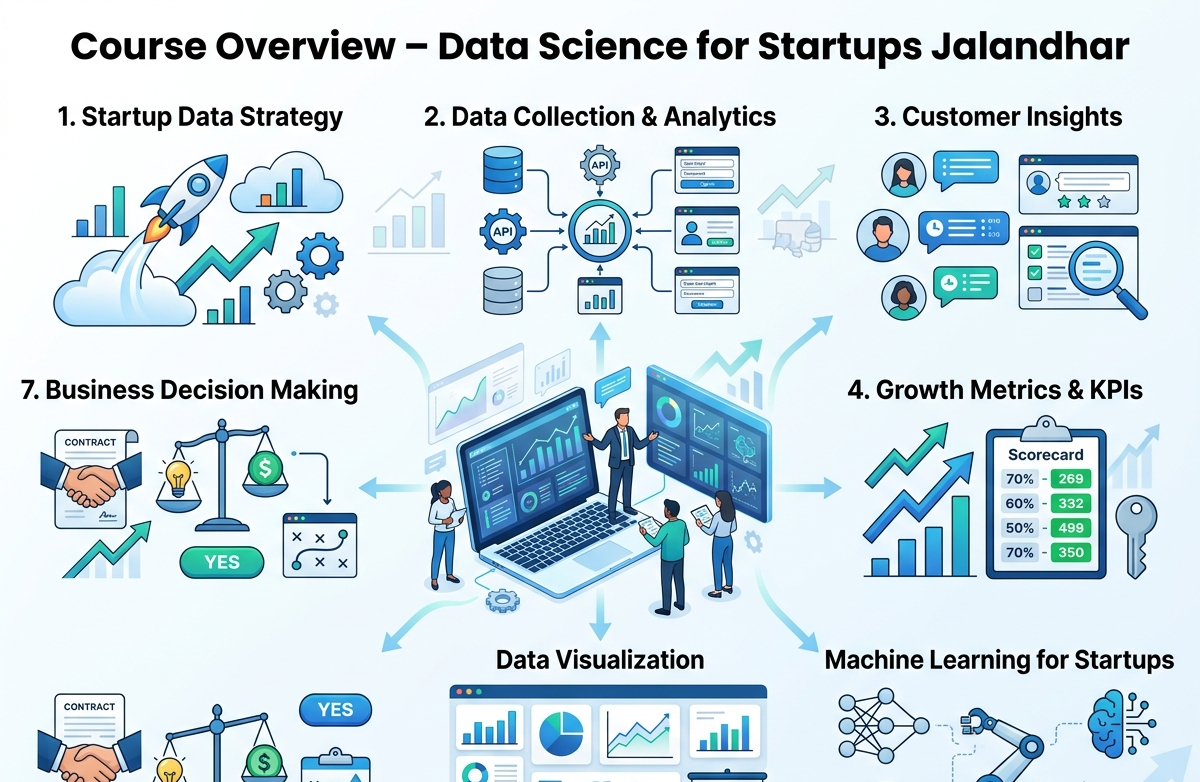
Data Science for Startups Jalandhar – Course Overview
Introduction to the Course
The Data Science for Startups course in Jalandhar is a comprehensive, business-focused training program designed to empower entrepreneurs, aspiring founders, and professionals with the ability to leverage data for smarter decision-making and sustainable growth. In today’s highly competitive startup ecosystem, success is no longer based solely on intuition or creativity. Instead, data-driven strategies have become essential for identifying opportunities, minimizing risks, and scaling operations efficiently.
This course bridges the gap between data science and business strategy by teaching learners how to apply analytical techniques, machine learning models, and visualization tools to real-world startup challenges. It focuses on practical implementation rather than just theoretical concepts, ensuring that participants gain hands-on experience in solving business problems using data.
The program is ideal for individuals who want to build, manage, or scale startups using modern data-driven approaches. Whether you are a beginner or a professional, this course provides a structured pathway to understand and implement data science in a startup environment.
Course Objectives
The primary objective of this course is to equip learners with both technical and strategic skills required to apply data science in startup businesses.
Key objectives include:
- Understanding the role of data science in startup growth
- Learning data analysis and visualization techniques
- Applying machine learning to business problems
- Developing data-driven strategies for decision-making
- Building real-world startup-focused projects
- Enhancing problem-solving and analytical thinking
- Enabling entrepreneurs to make informed decisions
By the end of the course, learners will be able to use data effectively to improve business performance and drive innovation.
Course Structure and Learning Path
The course follows a structured learning approach that combines technical training with business applications. It is divided into multiple modules, each focusing on a specific aspect of data science in startups.
1. Foundation Module – Understanding Startups and Data Science
This module introduces learners to the basics of startups and the importance of data science in business.
Topics covered include:
- Overview of startup ecosystems
- Challenges faced by startups
- Importance of data-driven decision-making
- Role of data science in business growth
- Case studies of successful startups
This module provides a strong foundation for understanding how data science can be applied in real-world business scenarios.
2. Python Programming for Business Analytics
Python is one of the most widely used programming languages in data science.
Topics include:
- Basics of Python programming
- Variables and data types
- Data structures (lists, tuples, dictionaries)
- Conditional statements and loops
- Functions and modules
Students also learn key libraries such as:
- Pandas for data manipulation
- NumPy for numerical operations
- Matplotlib and Seaborn for visualization
This module ensures that learners can handle and analyze data effectively.
3. Data Collection and Market Research
Data is the foundation of any data-driven strategy. This module focuses on collecting and analyzing relevant data.
Topics include:
- Data collection methods
- Market research techniques
- Customer data analysis
- Competitor analysis
- Data sourcing strategies
Students learn how to gather meaningful data for decision-making.
4. Data Cleaning and Preprocessing
Raw data is often incomplete and inconsistent. This module teaches students how to prepare data for analysis.
Topics include:
- Handling missing values
- Removing duplicates
- Data transformation
- Normalization techniques
This step ensures accuracy and reliability in analysis.
5. Exploratory Data Analysis (EDA)
EDA is used to understand data patterns and trends.
Topics include:
- Data summarization
- Statistical analysis
- Identifying trends and outliers
- Correlation analysis
- Visualization techniques
Students gain insights into how data behaves and how to extract meaningful information.
6. Data Visualization and Business Dashboards
Visualization helps communicate insights effectively.
Topics include:
- Creating charts and graphs
- Dashboard design
- Data storytelling
- Tools like Tableau and Power BI
Students learn how to present data in a clear and engaging manner.
7. Business Intelligence and Decision Making
This module focuses on using data for strategic decision-making.
Topics include:
- KPI analysis
- Performance tracking
- Data-driven strategies
- Business forecasting
Students learn how to use data to improve business performance.
8. Machine Learning for Startups
Machine learning helps startups automate processes and make predictions.
Topics include:
- Supervised learning
- Unsupervised learning
- Regression models
- Classification algorithms
- Customer segmentation
- Recommendation systems
Students apply machine learning techniques to real business problems.
9. Advanced Analytics and Growth Strategies
This module focuses on advanced techniques for business growth.
Topics include:
- Predictive analytics
- Customer lifetime value analysis
- Churn prediction
- Growth hacking strategies
Students learn how to scale startups using data.
10. Real-World Startup Projects
Students work on practical projects such as:
- Market analysis
- Sales forecasting
- Customer segmentation
- Product recommendation systems
These projects simulate real startup challenges and provide hands-on experience.
Tools and Technologies Covered
Students gain experience with industry-standard tools such as:
- Python
- Pandas and NumPy
- SQL
- Excel
- Tableau
- Power BI
These tools are essential for data analysis and business intelligence.
Learning Methodology
The course follows a practical and interactive approach:
- Instructor-led training
- Hands-on sessions
- Case studies
- Real-world projects
- Assignments and quizzes
This ensures effective learning and skill development.
Portfolio Development
A strong portfolio is essential for career success.
Students build:
- Startup-focused projects
- Business case studies
- Dashboards and reports
This helps showcase their skills to employers and investors.
Soft Skills and Business Skills Development
In addition to technical skills, students develop:
- Communication skills
- Problem-solving abilities
- Strategic thinking
- Presentation skills
These skills are essential for startup success.
Career Opportunities
After completing the course, learners can pursue roles such as:
- Data Analyst
- Business Analyst
- Product Analyst
- Startup Consultant
Entrepreneurs can apply these skills to their own ventures.
Who Can Enroll?
This course is suitable for:
- Entrepreneurs and startup founders
- Students and graduates
- Business professionals
- Beginners with no coding experience
The course starts from basics and progresses to advanced topics.
Course Duration and Flexibility
The course duration typically ranges from 3 to 6 months.
Flexible learning options include:
- Classroom training
- Online sessions
- Weekend batches
Benefits of the Course
- Practical business-focused learning
- Hands-on project experience
- Improved decision-making skills
- Competitive advantage for startups
- Career growth opportunities
Career Support and Guidance
The course provides:
- Resume building
- Portfolio guidance
- Interview preparation
- Business mentoring
This ensures learners are ready for real-world opportunities.
Startup-Focused Problem Solving Approach
One of the most important aspects of this course is its strong focus on startup-oriented problem solving. Unlike traditional data science programs that emphasize only algorithms and technical skills, this course trains learners to think like entrepreneurs and business problem solvers. Students are taught to analyze real startup challenges such as customer acquisition, product-market fit, revenue optimization, and operational efficiency.
Through guided exercises and case studies, learners understand how to break complex business problems into smaller, data-driven tasks. They learn how to identify key performance indicators (KPIs), define success metrics, and use data to support decision-making. This approach helps bridge the gap between technical analysis and business strategy, making learners more valuable in startup environments.
Exposure to Real Startup Case Studies
The course includes detailed analysis of successful and failed startups to help students understand the role of data in real business scenarios. These case studies provide practical insights into how startups use data science to grow or why some fail due to lack of proper data utilization.
Students study examples related to:
- Customer behavior analysis in e-commerce startups
- Growth strategies used by fintech companies
- Marketing optimization in digital startups
- Product recommendation systems in tech platforms
By analyzing these real-world examples, learners gain a deeper understanding of how data science directly impacts startup success.
Data-Driven Product Development
Another important aspect covered in the course is the role of data science in product development. Startups rely heavily on user feedback and data analytics to improve their products and services.
Students learn how to:
- Analyze user feedback and reviews
- Identify product improvement areas
- Track user engagement metrics
- Test new features using data
- Optimize product performance based on insights
This knowledge helps learners understand how startups continuously evolve their products using data-driven insights.
Growth Hacking Using Data Science
Growth hacking is a key strategy used by startups to achieve rapid growth with limited resources. This course introduces students to data-driven growth hacking techniques that help startups scale efficiently.
Topics include:
- Analyzing user acquisition channels
- Optimizing marketing campaigns
- Improving conversion rates
- Retention analysis
- A/B testing strategies
Students learn how data science can be used to identify growth opportunities and implement cost-effective strategies for scaling startups.
Decision Intelligence for Startups
Decision intelligence is the practice of using data, analytics, and AI to support business decision-making. This course introduces learners to this emerging concept and its importance in startup ecosystems.
Students learn how to:
- Use data dashboards for decision-making
- Automate business insights
- Predict future trends
- Support strategic planning with data
This skill is especially valuable for startup founders who need to make quick and accurate decisions under uncertainty.
Building a Startup Mindset with Data Science
Beyond technical knowledge, this course focuses on developing a startup mindset among learners. This includes creativity, innovation, risk-taking, and adaptability. Students are encouraged to think like entrepreneurs and use data as a tool for innovation.
They learn how to:
- Identify business opportunities using data
- Validate startup ideas with analytics
- Reduce risks through data insights
- Build scalable solutions
This mindset prepares learners not just for jobs, but for creating their own startups in the future.
Continuous Learning and Industry Adaptation
The startup ecosystem is highly dynamic, and technologies evolve rapidly. Therefore, continuous learning is a key part of this course philosophy. Students are encouraged to stay updated with the latest tools, trends, and technologies in data science and startups.
They are guided on how to:
- Follow industry trends
- Learn new tools and frameworks
- Participate in data science communities
- Work on continuous skill improvement
This ensures long-term career sustainability in both data science and entrepreneurship.
Why TechCADD – Complete Overview (Data Science Training Jalandhar)
Introduction
In today’s rapidly evolving digital world, choosing the right training institute plays a crucial role in shaping a successful career. Technology fields such as Data Science, Artificial Intelligence, Machine Learning, and Data Analytics are growing at an unprecedented pace. However, the quality of training varies significantly from one institute to another. This is where TechCADD stands out as a trusted and career-focused training institute in Jalandhar.
TechCADD is not just a training center; it is a professional learning ecosystem designed to bridge the gap between academic education and industry requirements. The institute focuses on practical learning, real-world project experience, and industry-oriented skill development to ensure students are fully prepared for the job market.
Strong Industry-Oriented Training Approach
One of the biggest reasons to choose TechCADD is its strong focus on industry-oriented training. Unlike traditional classroom learning, where emphasis is often placed on theory, TechCADD follows a practical-first approach.
Students are trained using:
- Real-world datasets
- Live project simulations
- Industry case studies
- Practical coding exercises
- Business-oriented problem solving
This ensures that learners gain hands-on experience, which is essential for careers in data science and IT fields.
Expert Faculty with Real Industry Experience
TechCADD provides training under the guidance of experienced professionals who have worked in real industry environments. These trainers bring practical insights into the classroom, helping students understand how concepts are applied in real-world scenarios.
Benefits of expert faculty:
- Practical knowledge sharing
- Industry best practices
- Real project experience guidance
- Career mentoring and support
- Updated knowledge of latest technologies
This mentorship helps students develop both technical and professional skills.
Focus on Real-Time Projects
One of the key highlights of TechCADD is its emphasis on real-time projects. Students are not limited to theoretical assignments; instead, they work on live and simulated industry projects.
These projects include:
- Data analysis projects
- Machine learning models
- Business dashboards
- Predictive analytics systems
- Client-based problem solving
Working on such projects helps students build a strong portfolio that is highly valued by employers.
Career-Oriented Curriculum
TechCADD offers a well-structured curriculum designed according to current industry demands. The curriculum is continuously updated to include the latest tools, technologies, and trends in the IT and data science industry.
Key features include:
- Beginner to advanced level training
- Step-by-step learning modules
- Practical assignments
- Industry-relevant topics
- Skill-based learning approach
This ensures students are not only learning concepts but also applying them effectively.
Strong Placement Assistance
Another major reason to choose TechCADD is its dedicated placement support system. The institute focuses on preparing students for job interviews and connecting them with potential employers.
Placement support includes:
- Resume building sessions
- Mock interviews
- Soft skills training
- Interview preparation
- Job referral support
This increases students’ chances of securing good job opportunities in reputed companies.
Hands-On Learning Environment
TechCADD believes in learning by doing. Students are encouraged to actively participate in coding sessions, project development, and problem-solving activities.
This environment helps in:
- Improving logical thinking
- Enhancing technical skills
- Building confidence
- Developing real-world problem-solving abilities
Such an approach ensures deep understanding of concepts.
Focus on Portfolio Development
In today’s competitive job market, having a strong portfolio is essential. TechCADD helps students build professional portfolios that showcase their skills and projects.
Portfolio includes:
- Real-world projects
- Data analysis reports
- Machine learning models
- Dashboard visualizations
- GitHub repositories
A strong portfolio increases employability and freelancing opportunities.
Updated Tools and Technologies
TechCADD ensures students learn the latest tools used in the industry.
These include:
- Python
- SQL
- Power BI
- Tableau
- Machine Learning libraries
- Excel for analytics
Learning these tools helps students stay competitive in the job market.
Personalized Attention and Small Batch Sizes
To ensure effective learning, TechCADD maintains small batch sizes. This allows trainers to give individual attention to each student.
Benefits include:
- Better doubt solving
- Personalized guidance
- Improved learning experience
- Stronger student-teacher interaction
Soft Skills and Personality Development
Along with technical training, TechCADD also focuses on personality development.
Students are trained in:
- Communication skills
- Interview skills
- Presentation skills
- Confidence building
- Professional behavior
These skills are essential for career success.
Affordable and Value-Based Training
TechCADD offers high-quality training at affordable fees, making it accessible for students from different backgrounds.
The focus is on:
- Value for money
- Skill-based education
- Career growth opportunities
Industry Connections and Exposure
TechCADD maintains strong connections with industry professionals and companies. This helps students gain exposure to real industry environments.
Benefits include:
- Guest lectures
- Industry workshops
- Networking opportunities
- Real-world insights
Flexible Learning Options
To accommodate different learners, TechCADD offers flexible training modes:
- Classroom training
- Online live sessions
- Weekend batches
- Fast-track courses
This makes it suitable for students and working professionals.
Student Support System
TechCADD provides continuous support throughout the learning journey.
Support includes:
- Doubt-solving sessions
- Project assistance
- Career guidance
- Learning resources
Building Future-Ready Professionals
The ultimate goal of TechCADD is to create future-ready professionals who can succeed in the IT industry.
Students are trained to:
- Think analytically
- Solve real problems
- Work on live projects
- Adapt to new technologies
Strong Focus on Practical Skill Development
One of the key strengths of TechCADD is its unwavering focus on practical skill development. In today’s competitive job market, employers are not only looking for candidates who understand theoretical concepts but also those who can apply those concepts in real-world scenarios. TechCADD addresses this need by integrating hands-on learning into every stage of its training programs.
Students are continuously engaged in practical exercises, coding challenges, and live project simulations. Instead of simply memorizing concepts, learners actively apply what they study in real-time. This approach helps students build deeper understanding and long-term retention of knowledge.
Practical learning at TechCADD includes:
- Real dataset analysis
- Project-based assignments
- Industry-level problem-solving tasks
- Simulation of business scenarios
- Interactive coding labs
This ensures that students are fully prepared to handle actual job responsibilities after course completion.
Bridging the Gap Between Education and Industry
One of the biggest challenges faced by students today is the gap between academic education and industry requirements. Many graduates possess theoretical knowledge but struggle when it comes to applying it in real jobs. TechCADD plays a crucial role in bridging this gap.
The training methodology is designed in such a way that it reflects real industry workflows. Students are taught how companies operate, how projects are executed, and how teams collaborate in professional environments.
This includes exposure to:
- Industry-standard tools and workflows
- Agile project management concepts
- Version control systems like Git
- Team-based project execution
- Client communication practices
By experiencing these elements during training, students become industry-ready even before entering the job market.
Real-Time Problem Solving Approach
TechCADD emphasizes developing problem-solving abilities among students. Instead of focusing only on pre-defined textbook problems, learners are encouraged to solve real-world challenges.
Students are trained to:
- Analyze complex datasets
- Identify patterns and insights
- Develop logical solutions
- Optimize processes using data
- Make data-driven decisions
This problem-solving mindset is extremely valuable in fields like Data Science, Artificial Intelligence, and Business Analytics, where real-world problems are often unpredictable and complex.
Continuous Evaluation and Performance Tracking
To ensure effective learning, TechCADD follows a continuous evaluation system. Students are regularly assessed through assignments, quizzes, projects, and practical tests.
This system helps in:
- Identifying strengths and weaknesses
- Tracking learning progress
- Improving weak areas through feedback
- Ensuring concept clarity
- Maintaining consistent performance
Regular feedback from trainers helps students improve continuously and stay on the right learning path.
Exposure to Industry Trends and Technologies
Technology is constantly evolving, and staying updated is essential for success in IT and data science careers. TechCADD ensures that students are always aware of the latest industry trends, tools, and technologies.
Students are introduced to:
- Emerging technologies in data science
- Latest AI and machine learning trends
- Cloud computing platforms
- Automation tools
- Business intelligence advancements
This exposure helps learners stay relevant in the fast-changing tech industry.
Entrepreneurial and Freelancing Opportunities
TechCADD not only prepares students for jobs but also encourages entrepreneurial thinking and freelancing opportunities. With strong technical skills and project experience, students can explore independent career paths as well.
They are guided on:
- Starting freelancing careers in data science
- Working on international freelance platforms
- Building independent consulting services
- Developing startup ideas using data
- Creating passive income through tech skills
This opens multiple career pathways beyond traditional employment.
Networking and Professional Growth
Another important advantage of studying at TechCADD is the opportunity to build a strong professional network. Students interact with trainers, industry experts, and fellow learners, creating valuable connections that can help in their careers.
Networking benefits include:
- Job referrals
- Internship opportunities
- Collaborative projects
- Industry exposure
- Long-term professional relationships
Such connections often play a crucial role in career growth and job placement.
Motivation and Career Guidance Support
TechCADD also focuses on keeping students motivated throughout their learning journey. Many students face challenges such as lack of confidence or confusion about career direction. To address this, the institute provides continuous career guidance and motivation sessions.
These include:
- One-on-one counseling
- Career roadmap planning
- Goal setting sessions
- Motivation workshops
- Success strategy discussions
This support system helps students stay focused and achieve their career goals effectively.
Building Confidence Through Real Experience
Confidence is a key factor in career success. TechCADD helps students build confidence by giving them real experience in handling projects, solving problems, and presenting their work.
As students progress through the course, they gradually transition from beginners to confident professionals capable of handling industry-level tasks. This transformation is one of the most important outcomes of the training program.
Future Scope of Data Science Training at TechCADD Jalandhar
Introduction
The future of technology is being shaped by data. Every click, transaction, interaction, and digital activity generates data, and this data is becoming the most valuable asset for modern businesses. Organizations are no longer relying on guesswork; instead, they depend on data-driven insights to make decisions, predict trends, and optimize performance.
In this evolving landscape, Data Science has emerged as one of the most powerful and high-demand career fields globally. The future scope of Data Science training at TechCADD Jalandhar is extremely promising because it equips learners with industry-relevant skills, practical exposure, and real-world project experience that align perfectly with current and future market demands.
This section explores the long-term career opportunities, industry growth, technological evolution, and global demand that make data science one of the most future-proof career choices.
1. Global Growth of Data Science Industry
The data science industry is experiencing exponential growth worldwide. Companies across all sectors are investing heavily in data analytics, machine learning, and artificial intelligence to improve decision-making.
Key Growth Factors:
- Explosion of digital data
- Increased use of AI and automation
- Growth of e-commerce platforms
- Expansion of cloud computing
- Rise of smart technologies
According to industry trends, the demand for data professionals is expected to continue rising for the next decade. This ensures long-term job security and career stability for trained professionals.
2. High Demand for Skilled Data Professionals
One of the strongest aspects of data science as a career is its high demand across industries. Companies are actively looking for professionals who can:
- Analyze complex datasets
- Build predictive models
- Create business insights
- Automate decision-making processes
TechCADD-trained students gain practical experience that makes them highly employable in this competitive job market.
3. Wide Range of Career Opportunities
Data science offers diverse career paths, making it one of the most flexible fields in IT.
Future Job Roles:
- Data Analyst
- Data Scientist
- Machine Learning Engineer
- Business Intelligence Analyst
- Data Engineer
- AI Specialist
- Research Analyst
Each role offers strong growth potential and high salary packages.
4. Increasing Salary Potential
One of the biggest reasons students choose data science is its high earning potential. As businesses become more data-driven, skilled professionals are rewarded with competitive salaries.
Salary Growth Trends:
- Entry-level roles offer attractive packages
- Mid-level professionals see rapid salary growth
- Senior experts earn premium compensation
With experience and project exposure from TechCADD, learners can significantly increase their earning potential.
5. Importance of Real-World Project Experience
The future of hiring is shifting toward skill-based recruitment. Employers now prefer candidates who have hands-on project experience rather than just theoretical knowledge.
TechCADD’s training approach focuses on:
- Live project simulations
- Real-world case studies
- Client-based problem solving
- Portfolio development
This practical exposure gives students a strong competitive advantage.
6. Rise of Artificial Intelligence and Automation
Artificial Intelligence (AI) and automation are transforming every industry. Data science plays a central role in powering these technologies.
Future Impact:
- Automated decision-making systems
- Smart recommendation engines
- Predictive analytics tools
- AI-powered business solutions
Professionals trained in data science will be essential in developing and managing these systems.
7. Expansion of Cloud Computing
Cloud computing is becoming the backbone of modern data storage and processing systems. Companies are shifting to cloud platforms for scalability and efficiency.
Key Cloud Platforms:
- AWS
- Microsoft Azure
- Google Cloud
Future data professionals will need to work with cloud-based tools, and TechCADD prepares students for this evolving requirement.
8. Data Science in Every Industry
Data science is not limited to IT companies. It is used across all major industries.
Industry Applications:
- Healthcare: Disease prediction and patient analysis
- Finance: Fraud detection and risk management
- E-commerce: Customer behavior analysis
- Education: Learning analytics
- Marketing: Campaign optimization
- Manufacturing: Process improvement
This widespread demand ensures long-term career opportunities.
9. Growth of Freelancing and Remote Work
The future of work is becoming more flexible. Freelancing and remote jobs are growing rapidly, especially in data science.
Benefits:
- Work from anywhere
- Global client opportunities
- Flexible working hours
- Higher earning potential
TechCADD training prepares students for freelancing platforms and remote job roles.
10. Startup Ecosystem Growth
Startups are increasingly relying on data science to grow and scale their businesses. Data-driven decision-making helps startups reduce risks and improve efficiency.
Future opportunities include:
- Startup analytics roles
- Business intelligence consulting
- Product optimization using data
- Growth strategy development
TechCADD-trained professionals can play a key role in startup ecosystems.
11. Evolution of Data-Driven Decision Making
In the future, almost every business decision will be driven by data. Organizations will depend on analytics to:
- Understand customers
- Improve products
- Reduce costs
- Increase revenue
This ensures continuous demand for data professionals.
12. Emerging Technologies in Data Science
Data science is evolving with new technologies.
Future Technologies:
- Deep Learning
- Natural Language Processing (NLP)
- Computer Vision
- Edge Computing
- Quantum Computing (future stage)
Professionals trained at TechCADD will be prepared for these advancements.
13. Importance of Portfolio in Future Careers
In the future job market, portfolios will be more important than degrees alone.
TechCADD helps students build:
- Real-world projects
- Data analysis dashboards
- Machine learning models
- GitHub repositories
A strong portfolio increases job chances significantly.
14. Continuous Learning and Skill Upgradation
Data science is a rapidly evolving field. Professionals must continuously upgrade their skills to stay relevant.
Future success depends on:
- Learning new tools
- Adapting to new technologies
- Working on advanced projects
- Staying industry updated
TechCADD encourages lifelong learning mindset.
15. Ethical and Responsible Data Usage
As data usage increases, ethical concerns are also growing.
Future professionals must understand:
- Data privacy laws
- Ethical AI practices
- Responsible data handling
- Security standards
This will become an important part of data science careers.
16. Long-Term Career Stability
Unlike many traditional jobs, data science offers long-term career stability due to:
- High demand
- Continuous industry growth
- Global relevance
- Technology dependency
This makes it a secure career choice for the future.
17. Role of TechCADD in Career Development
TechCADD plays a crucial role in shaping future-ready professionals by providing:
- Practical training
- Industry exposure
- Project experience
- Career guidance
- Placement support
This ensures students are fully prepared for future opportunities.
Increasing Role of Data in Business Strategy
In the coming years, data will play an even more central role in shaping business strategies. Companies will no longer rely on traditional intuition-based decision-making. Instead, every strategic move—whether related to marketing, operations, product development, or customer engagement—will be guided by data insights.
This shift means that data science professionals will be directly involved in core business decisions. Their ability to interpret complex datasets and convert them into actionable strategies will make them indispensable in organizations. TechCADD-trained students, who already gain exposure to real-world projects and business scenarios, will be well-positioned to take advantage of this transformation.
Businesses will increasingly depend on professionals who can:
- Identify market trends through data
- Predict customer behavior accurately
- Optimize pricing strategies
- Improve operational efficiency
- Reduce business risks using analytics
This growing dependency ensures long-term relevance and demand for data science expertise.
Rise of Intelligent Automation Systems
The future will see a rapid rise in intelligent automation systems powered by data science and artificial intelligence. These systems will not only perform repetitive tasks but also make decisions based on real-time data analysis.
Examples include:
- Automated customer service systems
- Smart recommendation engines in e-commerce
- Predictive maintenance in manufacturing
- Fraud detection systems in banking
Professionals trained in data science will be responsible for designing, training, and maintaining these intelligent systems. TechCADD’s practical training approach ensures that students understand how these systems work in real-world environments, giving them a strong advantage in the future job market.
Expansion of Data Science in Small and Medium Businesses
Earlier, data science was mainly used by large corporations. However, in the future, small and medium-sized businesses (SMEs) will also increasingly adopt data-driven strategies due to affordability and accessibility of tools.
This opens up new opportunities for data science professionals in:
- Local businesses
- Startups
- E-commerce sellers
- Service-based companies
TechCADD-trained professionals can work with these businesses to help them grow using data insights, creating a large number of job and freelancing opportunities at local and global levels.
Growth of Personalized Customer Experiences
One of the biggest trends shaping the future is personalization. Businesses are increasingly focusing on delivering personalized experiences to customers based on their preferences, behavior, and purchase history.
Data science plays a key role in this transformation by enabling:
- Personalized product recommendations
- Targeted marketing campaigns
- Customized user experiences
- Behavior-based content delivery
In the future, companies that fail to adopt personalization strategies will struggle to compete. This creates continuous demand for skilled data professionals who can build and manage personalization systems.
Integration of Data Science with Emerging Technologies
The future of data science is closely linked with other emerging technologies. It will not exist in isolation but will be integrated with multiple advanced fields.
Key Integrations:
- Data Science + Artificial Intelligence
- Data Science + Internet of Things (IoT)
- Data Science + Blockchain
- Data Science + Cloud Computing
- Data Science + Cybersecurity
This integration will create new job roles and career paths that do not even exist today. TechCADD prepares students with a strong foundation that allows them to adapt to these evolving technologies easily.
Long-Term Entrepreneurial Opportunities
Data science is not just a job-oriented skill—it is also a powerful tool for entrepreneurship. In the future, more professionals will use data science to build their own startups and businesses.
Possible entrepreneurial opportunities include:
- Data analytics consulting firms
- AI-based product startups
- Marketing analytics agencies
- Freelance data science services
TechCADD encourages students to think beyond employment and explore entrepreneurial possibilities using their technical skills.