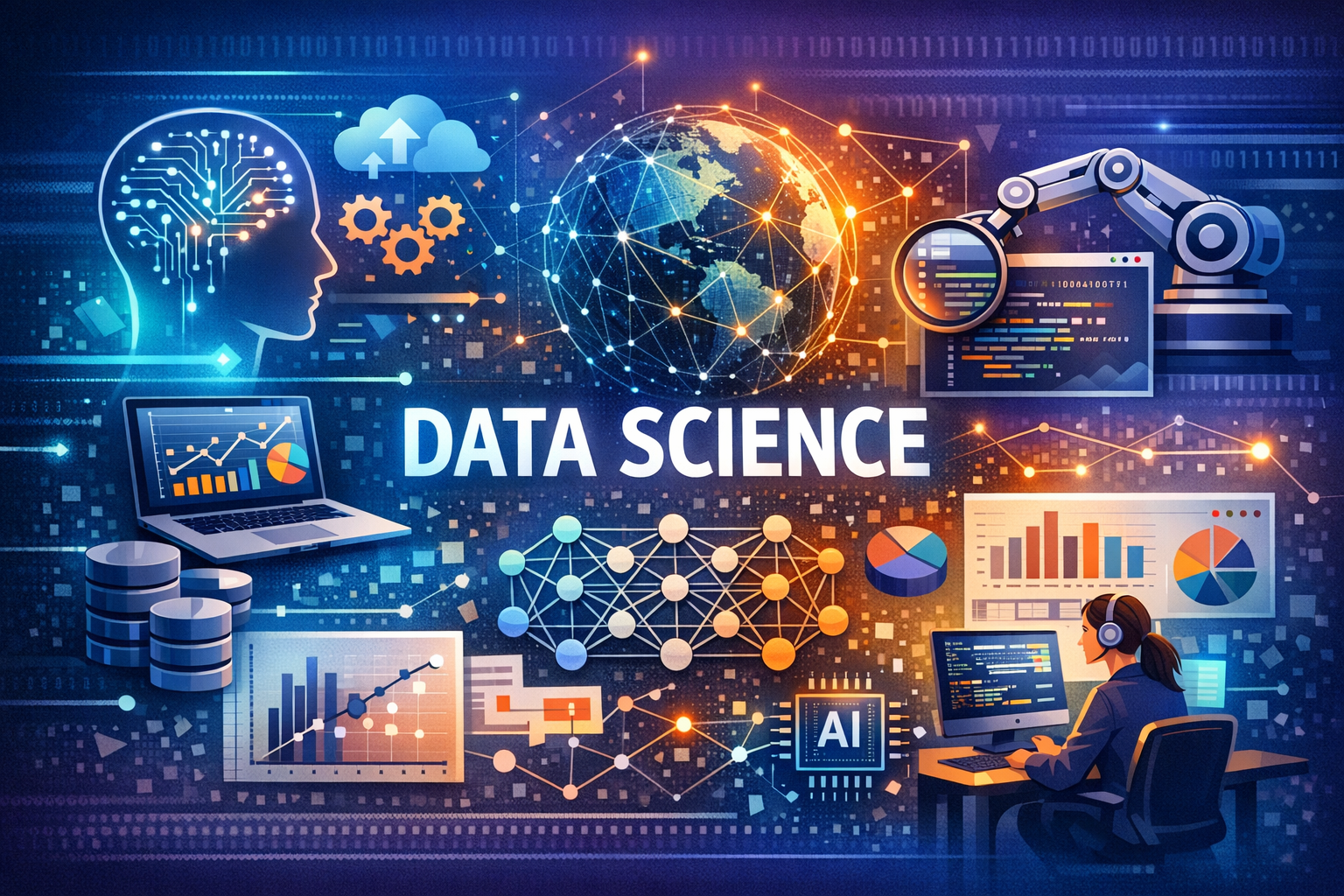



Data Science Course Overview – Techcadd Jalandhar
In today’s digital era, data has become one of the most valuable assets for organizations across the world. Every business, from small startups to large multinational corporations, generates massive amounts of data every day through websites, applications, customer transactions, social media platforms, and digital systems. However, raw data alone is not useful unless it is analyzed and converted into meaningful insights. This is where data science plays a crucial role. Data science helps organizations understand patterns, trends, and relationships within data so they can make smarter decisions and improve business strategies.
The Techcadd Data Science Course in Jalandhar is designed to provide students with the practical knowledge and technical skills required to become successful data science professionals. The course focuses on building a strong foundation in programming, statistics, data analysis, machine learning, and data visualization. It is suitable for beginners, graduates, working professionals, and anyone who wants to build a career in the rapidly growing field of data science.
Introduction to Data Science
Data science is a multidisciplinary field that combines programming, mathematics, statistics, and domain knowledge to analyze structured and unstructured data. It involves collecting data, cleaning it, analyzing patterns, building predictive models, and presenting insights through visualizations. Organizations use data science to improve decision-making, increase efficiency, predict future trends, and gain a competitive advantage in the market.
At Techcadd, the course begins with a clear introduction to the fundamentals of data science. Students learn how data science is used in different industries such as finance, healthcare, e-commerce, marketing, and technology. This foundation helps learners understand the importance of data-driven decision-making and how data science professionals solve real-world business problems.
Programming with Python
Python is one of the most widely used programming languages in data science because of its simplicity, flexibility, and powerful libraries. The Techcadd data science course includes comprehensive training in Python programming, which helps students develop the ability to work with data effectively.
During the Python module, students learn basic programming concepts such as variables, data types, operators, loops, and conditional statements. They also learn about functions, file handling, and object-oriented programming concepts. As the course progresses, students explore Python libraries that are commonly used in data science, including NumPy and Pandas.
NumPy is used for numerical computing and handling arrays, while Pandas is used for data manipulation and analysis. These libraries allow students to work with large datasets, perform calculations, filter data, and organize information efficiently. Learning Python provides the technical foundation needed to perform data analysis and build machine learning models.
Data Analysis and Data Manipulation
Data analysis is one of the most important steps in the data science process. Before building models or making predictions, it is necessary to understand the data, clean it, and prepare it for analysis. In this module, students learn how to work with real-world datasets and handle common data challenges.
At Techcadd, students are trained in data cleaning techniques such as handling missing values, removing duplicates, correcting inconsistent data, and transforming datasets into a usable format. They also learn how to perform exploratory data analysis (EDA), which involves summarizing the main characteristics of a dataset using statistical methods and visualization techniques.
Through practical exercises and projects, students gain experience in analyzing datasets, identifying patterns, and extracting meaningful insights. These skills are essential for any data scientist because they ensure that the data used for analysis and modeling is accurate and reliable.
Statistics and Mathematical Foundations
Statistics and mathematics form the backbone of data science. Without a solid understanding of statistical concepts, it becomes difficult to interpret data or build accurate predictive models. The Techcadd data science course includes a dedicated module on statistics to help students develop strong analytical thinking.
Students learn important statistical concepts such as mean, median, mode, variance, standard deviation, probability distributions, and hypothesis testing. These concepts help learners understand how data behaves and how to make data-driven conclusions.
In addition to statistics, students also explore basic mathematical concepts used in machine learning algorithms. These include linear algebra, probability theory, and optimization techniques. While the course simplifies these topics for beginners, it ensures that students understand the mathematical logic behind data science models.
Data Visualization
Data visualization is the process of presenting data in graphical formats such as charts, graphs, and dashboards. Visual representations make it easier to understand complex data and communicate insights effectively. Organizations rely heavily on data visualization to present findings to decision-makers and stakeholders.
In the Techcadd data science course, students learn how to create professional data visualizations using Python libraries such as Matplotlib and Seaborn. These tools allow students to create line charts, bar charts, scatter plots, histograms, heatmaps, and other types of visualizations.
Students also learn how to customize graphs by adding titles, labels, legends, and colors. This helps them create visually appealing and informative charts that clearly represent the underlying data. Through hands-on practice, learners gain the skills needed to transform raw data into meaningful visual stories.
Machine Learning Fundamentals
Machine learning is one of the most exciting and powerful areas of data science. It involves creating algorithms that allow computers to learn patterns from data and make predictions without being explicitly programmed. Machine learning is used in many modern technologies such as recommendation systems, fraud detection, speech recognition, and predictive analytics.
The Techcadd course introduces students to the fundamentals of machine learning and its real-world applications. Students learn about different types of machine learning techniques, including supervised learning and unsupervised learning.
Supervised learning involves training models using labeled data, where the correct output is already known. Examples include predicting house prices, classifying emails as spam or not spam, and identifying customer behavior patterns. Students learn algorithms such as linear regression, logistic regression, decision trees, and k-nearest neighbors.
Unsupervised learning involves analyzing data without predefined labels. These techniques help identify hidden patterns and group similar data points together. Students learn algorithms such as clustering and dimensionality reduction.
By working with machine learning models, students understand how predictive systems are built and how data can be used to forecast future outcomes.
Model Evaluation and Optimization
Building a machine learning model is only the first step. It is equally important to evaluate how well the model performs and improve its accuracy. In this part of the course, students learn how to test and validate machine learning models using different evaluation techniques.
Students explore performance metrics such as accuracy, precision, recall, and F1-score. These metrics help determine how reliable a model is when making predictions. They also learn techniques like cross-validation and train-test splitting to ensure models generalize well to new data.
Techcadd also teaches methods for improving model performance through feature selection, hyperparameter tuning, and optimization techniques. These skills help students build more accurate and efficient machine learning models.
Real-World Projects
One of the most important aspects of the Techcadd data science course is its focus on practical learning. Instead of only studying theoretical concepts, students work on real-world projects that simulate industry scenarios. These projects help learners apply their knowledge and develop problem-solving skills.
Students may work on projects such as analyzing sales data, predicting customer behavior, building recommendation systems, or identifying trends in large datasets. These hands-on projects provide valuable experience that can be showcased in portfolios and job interviews.
Working on projects also helps students understand the complete data science workflow, from collecting and cleaning data to building models and presenting results.
Industry-Relevant Tools and Technologies
The field of data science continues to evolve rapidly, and professionals need to stay updated with the latest tools and technologies. The Techcadd course introduces students to widely used data science tools that are commonly used in the industry.
Students learn how to work with Jupyter Notebook, which is a popular environment for writing and running Python code for data analysis. They also gain experience with libraries such as NumPy, Pandas, Matplotlib, and Scikit-learn.
By learning these tools, students become comfortable working with real datasets and performing advanced data analysis tasks. This practical experience prepares them for professional roles in data science and analytics.
Career Opportunities in Data Science
The demand for data science professionals is growing rapidly across the world. Organizations in industries such as finance, healthcare, retail, marketing, and technology are actively looking for skilled professionals who can analyze data and generate insights.
After completing the Techcadd data science course, students can explore various career opportunities such as Data Analyst, Data Scientist, Machine Learning Engineer, Business Analyst, and AI Specialist. These roles involve analyzing large datasets, building predictive models, and helping organizations make informed decisions.
The data science field also offers competitive salaries and strong career growth opportunities. As businesses continue to rely on data-driven strategies, the need for skilled data professionals will continue to increase in the coming years.
Hands-On Learning Approach
Techcadd follows a practical learning approach to ensure students gain real skills rather than just theoretical knowledge. The course includes live demonstrations, coding exercises, assignments, and project-based learning. This interactive training environment allows students to practice concepts and improve their problem-solving abilities.
Students also receive guidance from experienced trainers who provide industry insights and help learners understand complex concepts in a simplified manner. This mentorship plays a crucial role in helping students build confidence and technical expertise.
Certification and Career Support
Upon successful completion of the course, students receive a certification from Techcadd, which validates their knowledge and skills in data science. Certification can be beneficial when applying for jobs because it demonstrates that the student has received structured training in the field.
In addition to training, Techcadd also provides career support to help students transition into professional roles. This may include resume guidance, interview preparation, and career counseling. Such support helps students prepare for the job market and increase their chances of securing employment in the data science industry.
Conclusion
Data science has become one of the most in-demand career fields in the modern digital economy. As organizations continue to generate and rely on data, the need for skilled professionals who can analyze and interpret that data will continue to grow. Learning data science opens the door to exciting career opportunities in multiple industries.
The Techcadd Data Science Course in Jalandhar provides a comprehensive learning experience that covers programming, data analysis, statistics, machine learning, and visualization. Through practical projects, hands-on training, and expert guidance, students develop the skills needed to succeed in the data science industry.
For students and professionals who want to build a successful career in data science, the Techcadd training program offers the knowledge, tools, and support needed to achieve their goals and thrive in a data-driven world.