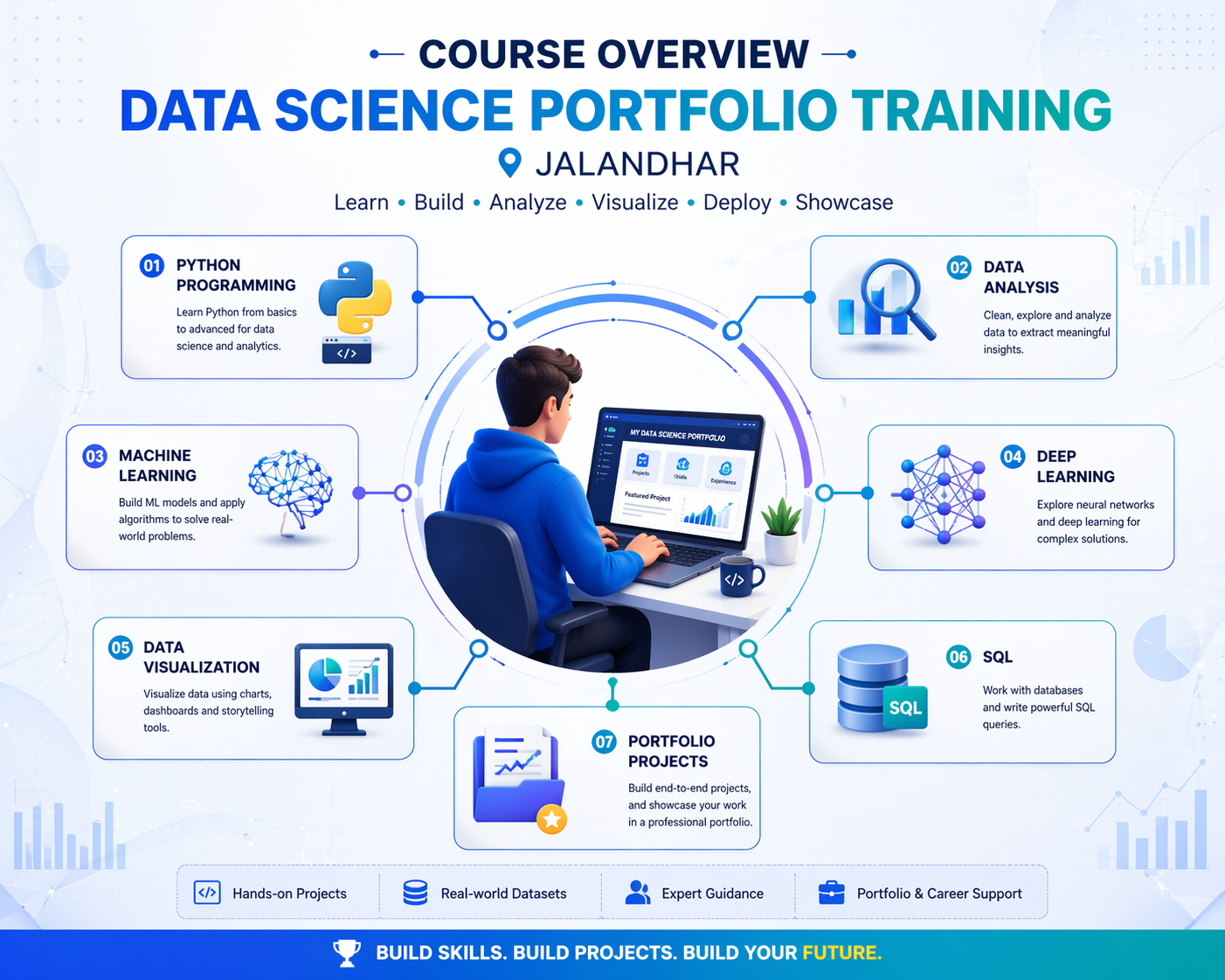
Data Science Portfolio Training Jalandhar – Course Overview
Introduction to the Course
The Data Science Portfolio Training in Jalandhar is a comprehensive, industry-oriented program designed to equip learners with the practical skills, tools, and real-world experience required to excel in the rapidly growing field of data science. Unlike traditional academic courses that focus heavily on theory, this training program emphasizes hands-on learning and portfolio development, ensuring that students are job-ready from day one.
In today’s digital era, organizations generate massive amounts of data every second. This data, when analyzed effectively, can provide valuable insights that drive business decisions, improve operational efficiency, and create competitive advantages. As a result, the demand for skilled data professionals has increased significantly across industries such as healthcare, finance, e-commerce, marketing, and technology.
This course is specifically structured to bridge the gap between theoretical knowledge and industry requirements. It enables students to learn essential data science concepts while simultaneously working on real-world projects that form a strong professional portfolio.
Course Objectives
The primary goal of this course is to transform beginners into confident data professionals by focusing on practical implementation and portfolio building. The course aims to:
- Provide a strong foundation in data science concepts
- Develop programming and analytical skills
- Teach data handling, cleaning, and preprocessing techniques
- Enable learners to build machine learning models
- Train students in data visualization and storytelling
- Help learners create a professional portfolio with real-world projects
- Prepare students for job interviews and career opportunities
By the end of the course, students will not only understand data science concepts but also be able to apply them effectively in real-world scenarios.
Course Structure and Learning Approach
The Data Science Portfolio Training program follows a structured learning path that progresses from basic to advanced concepts. The course is divided into multiple modules, each focusing on a specific aspect of data science.
1. Beginner Level – Foundations
At the initial stage, students are introduced to the fundamentals of data science and programming. This module is designed for beginners with little or no prior knowledge.
Topics covered include:
- Introduction to data science and its applications
- Understanding data types and data structures
- Basics of programming logic
- Introduction to Python programming
- Setting up development environments
Students learn how to write simple programs and understand the logic behind data manipulation.
2. Programming with Python
Python is the backbone of data science, and this module focuses on building strong programming skills.
Key topics include:
- Variables and data types
- Lists, tuples, and dictionaries
- Conditional statements and loops
- Functions and modules
- File handling
Students also work with important Python libraries such as:
- NumPy for numerical computing
- Pandas for data manipulation
- Matplotlib and Seaborn for visualization
This module ensures that learners are comfortable working with data using Python.
3. Data Collection and Data Cleaning
Real-world data is often messy and unstructured. This module teaches students how to collect, clean, and prepare data for analysis.
Topics include:
- Data collection methods
- Importing data from various sources
- Handling missing values
- Removing duplicates
- Data transformation and normalization
Students learn how to prepare datasets for accurate analysis and modeling.
4. Exploratory Data Analysis (EDA)
EDA is a critical step in data science, where analysts explore datasets to understand patterns and relationships.
This module covers:
- Statistical analysis
- Data summarization techniques
- Identifying trends and outliers
- Correlation analysis
- Data visualization techniques
Students gain insights into how data behaves and how to extract meaningful information.
5. Data Visualization and Storytelling
Data visualization is essential for communicating insights effectively. This module focuses on creating visual representations of data.
Topics include:
- Charts and graphs (bar, line, pie, scatter plots)
- Dashboard creation
- Data storytelling techniques
- Visualization tools like Tableau and Power BI
Students learn how to present complex data in a simple and understandable format.
6. Database Management and SQL
Handling structured data requires knowledge of databases. This module introduces students to SQL and database concepts.
Topics include:
- Database fundamentals
- Writing SQL queries
- Data extraction and manipulation
- Joins, filters, and aggregations
Students learn how to work with large datasets stored in databases.
7. Statistics for Data Science
Statistics plays a crucial role in data analysis and modeling.
Key concepts include:
- Descriptive statistics
- Probability distributions
- Hypothesis testing
- Regression analysis
- Statistical inference
This module helps students understand the mathematical foundation behind data science.
8. Machine Learning Fundamentals
Machine learning is one of the most important aspects of data science. This module introduces students to core ML concepts.
Topics include:
- Supervised learning
- Unsupervised learning
- Regression algorithms
- Classification algorithms
- Clustering techniques
Students learn how to build predictive models using real datasets.
9. Advanced Machine Learning
In this module, students dive deeper into advanced machine learning techniques.
Topics include:
- Model evaluation and optimization
- Feature engineering
- Ensemble methods
- Decision trees and random forests
Students gain hands-on experience in improving model performance.
10. Real-World Portfolio Projects
The highlight of this course is the portfolio development phase.
Students work on multiple real-world projects such as:
- Sales prediction models
- Customer segmentation analysis
- Fraud detection systems
- Recommendation systems
- Business dashboards
Each project is designed to simulate real industry problems and solutions.
11. Capstone Project
At the end of the course, students complete a capstone project that integrates all the skills they have learned.
This project serves as a showcase of their abilities and becomes a key part of their professional portfolio.
Portfolio Development
A strong portfolio is essential for securing a job in data science. This course focuses heavily on building a professional portfolio that includes:
- Multiple real-world projects
- Well-documented code
- Visual dashboards
- Case studies and reports
- GitHub repository
Students are guided step-by-step to create a portfolio that stands out to employers.
Tools and Technologies Covered
The course provides hands-on experience with industry-standard tools such as:
- Python
- NumPy and Pandas
- Matplotlib and Seaborn
- SQL
- Tableau
- Power BI
- Machine learning libraries
These tools are widely used in the industry and are essential for data science professionals.
Learning Methodology
The course follows a practical and interactive learning approach:
- Instructor-led training
- Hands-on practice sessions
- Real-world projects
- Assignments and quizzes
- Doubt-solving sessions
This ensures that students not only learn concepts but also apply them effectively.
Career Support and Placement Assistance
The training program also focuses on career development by providing:
- Resume building sessions
- Portfolio reviews
- Mock interviews
- Job placement assistance
Students are prepared for real-world job opportunities and interviews.
Who Can Enroll?
This course is suitable for:
- Students and fresh graduates
- Working professionals
- IT professionals
- Business analysts
- Beginners with no coding experience
The course starts from basics and gradually progresses to advanced topics.
Duration and Flexibility
The course duration typically ranges from 3 to 6 months, depending on the learning mode.
Flexible options include:
- Classroom training
- Online live sessions
- Weekend batches
This makes it convenient for students and working professionals.
Benefits of the Course
- Industry-relevant curriculum
- Hands-on project experience
- Strong portfolio development
- High job demand
- Career growth opportunities
Students gain practical skills that are directly applicable in the industry.
Future Scope
Data science continues to grow as one of the most in-demand fields globally. With advancements in artificial intelligence, big data, and automation, the need for skilled data professionals is increasing rapidly.
Career opportunities include:
- Data Scientist
- Data Analyst
- Machine Learning Engineer
- Business Analyst
This course prepares students for long-term career success.
Industry Exposure and Real-Time Learning Environment
One of the most valuable aspects of the Data Science Portfolio Training in Jalandhar is the strong focus on industry exposure and real-time learning. Unlike traditional classroom-based programs, this course is designed to simulate actual workplace scenarios where students work on datasets similar to those used in real companies. This approach helps learners understand how data science is applied in practical business environments.
Students are introduced to real-time workflows such as data collection, preprocessing, analysis, model building, and result presentation. They also learn how to collaborate on projects, manage timelines, and present findings to stakeholders—skills that are highly valued in the industry.
Guest lectures, workshops, and seminars conducted by industry experts further enhance the learning experience. These sessions provide insights into current trends, tools, and challenges in the field of data science, helping students stay updated with the latest developments.
Soft Skills and Professional Development
In addition to technical expertise, the course also emphasizes the development of essential soft skills required for career success. Data professionals often need to communicate complex insights in a simple and effective manner. Therefore, this training includes modules on:
- Communication and presentation skills
- Critical thinking and problem-solving
- Team collaboration and project management
- Interview preparation and confidence building
Students learn how to present their projects professionally, explain their methodologies, and justify their results—skills that are crucial during job interviews and in professional roles.
Continuous Assessment and Feedback
To ensure effective learning, the course incorporates continuous assessment methods. Instead of relying solely on final exams, students are evaluated through:
- Weekly assignments
- Mini-projects
- Quizzes and practical tests
- Project presentations
Regular feedback from trainers helps students identify their strengths and areas for improvement. This continuous evaluation process ensures that learners stay on track and achieve their learning goals.
Internship Opportunities and Live Projects
Many Data Science Portfolio Training programs in Jalandhar also offer internship opportunities, allowing students to gain real-world work experience. During internships, learners work on live projects under the guidance of industry professionals.
These projects provide exposure to real business challenges and help students apply their knowledge in practical scenarios. Internship experience adds significant value to a student’s resume and increases their chances of getting hired.
Building a Strong Professional Identity
In today’s competitive job market, having technical skills alone is not enough. This course helps students build a strong professional identity by guiding them in:
- Creating an impressive resume
- Building a professional LinkedIn profile
- Showcasing projects on GitHub
- Developing a personal brand
Students are trained to present themselves as skilled data professionals who are ready to contribute to organizations from day one.
Lifelong Learning and Career Growth
Data science is a continuously evolving field, and professionals must keep updating their skills to stay relevant. This course instills a mindset of lifelong learning by encouraging students to explore new tools, technologies, and techniques.
Even after course completion, students are guided on how to continue learning through online resources, communities, and advanced certifications. This ensures long-term career growth and adaptability in the ever-changing tech landscape.
Why Choose TechCadd for Data Science Training in Jalandhar
In today’s fast-evolving digital era, choosing the right training institute can define your entire career trajectory. When it comes to building a successful career in data science, selecting an institute that offers practical exposure, industry alignment, and strong mentorship is crucial. TechCadd stands out as a leading training institute in Jalandhar, offering a well-structured Data Science Portfolio Training program designed to bridge the gap between theoretical learning and real-world application.
Industry-Oriented Curriculum
One of the biggest reasons to choose TechCadd is its industry-relevant curriculum. Unlike traditional learning approaches that focus heavily on theory, TechCadd emphasizes practical knowledge and real-world implementation.
The course is carefully designed to include:
- Python programming for data science
- Data analysis and preprocessing
- Machine learning algorithms
- Deep learning fundamentals
- Data visualization tools
- SQL and database management
- Portfolio development with real projects
This ensures that students are not just learning concepts but also applying them in practical scenarios. The curriculum is regularly updated to match current industry trends, making students job-ready from day one.
Focus on Portfolio Development
What truly sets TechCadd apart is its strong focus on building a professional portfolio. In the data science field, having a portfolio is more important than just having a certificate.
At TechCadd, students:
- Work on real-world datasets
- Build end-to-end projects
- Create GitHub portfolios
- Develop dashboards and reports
- Showcase their work professionally
By the end of the course, students have a complete portfolio that they can present to employers, increasing their chances of getting hired significantly.
Experienced Trainers and Mentorship
TechCadd provides access to experienced trainers who have real industry exposure. Learning from professionals who have worked in the field gives students valuable insights into how data science works in real business environments.
Key benefits include:
- Personalized mentorship
- Doubt-solving sessions
- Career guidance
- Industry insights and best practices
This mentorship helps students understand not just “how” things work, but also “why” they are used in real-world scenarios.
Hands-On Learning Approach
TechCadd follows a “learn by doing” approach. Every concept taught in class is backed by practical implementation.
Students get:
- Live coding sessions
- Real-time project work
- Case studies
- Assignments and challenges
This hands-on methodology ensures that students gain confidence in applying their skills independently.
Real-World Projects and Case Studies
One of the strongest advantages of choosing TechCadd is the exposure to real-world projects. These projects simulate actual industry problems and help students understand how to solve them using data science techniques.
Examples include:
- Sales prediction models
- Customer segmentation analysis
- Recommendation systems
- Fraud detection systems
- Data dashboards and reporting
Working on such projects gives students a competitive edge in the job market.
Placement Assistance and Career Support
TechCadd doesn’t just train students—it supports them until they secure a job. The institute provides strong placement assistance and career guidance.
Support includes:
- Resume building
- Interview preparation
- Mock interviews
- Job referrals
- Soft skills training
This comprehensive support system ensures that students are well-prepared for job opportunities in the data science domain.
Beginner-Friendly Yet Advanced Training
Whether you are a beginner or someone with prior knowledge, TechCadd’s course is designed to cater to all levels.
- Beginners start with fundamentals like Python and basic statistics
- Intermediate learners dive into machine learning and data analysis
- Advanced learners work on deep learning and portfolio projects
This step-by-step approach makes learning smooth and effective.
Flexible Learning Options
TechCadd understands that students have different schedules and learning preferences. That’s why they offer flexible learning modes such as:
- Classroom training
- Online live sessions
- Weekend batches
- Fast-track programs
This flexibility allows students and working professionals to learn at their convenience.
Modern Infrastructure and Learning Environment
The institute provides a modern learning environment equipped with:
- High-performance systems
- Updated software tools
- Interactive classrooms
- Practical labs
A good learning environment plays a key role in improving focus and productivity, and TechCadd ensures students get the best facilities.
Affordable and Value for Money
Compared to other institutes offering similar courses, TechCadd provides high-quality training at an affordable cost. The combination of practical exposure, mentorship, and placement support makes it a great value-for-money investment.
Strong Local Presence in Jalandhar
Being located in Jalandhar, TechCadd has a strong understanding of the local job market and industry needs. This helps students:
- Connect with local opportunities
- Build networks
- Get region-specific career guidance
For students in and around Jalandhar, this is a huge advantage.
Continuous Learning and Support
Learning doesn’t stop after course completion at TechCadd. Students continue to receive:
- Access to updated content
- Alumni support
- Career guidance
- Networking opportunities
This ensures long-term growth and career development.
Skill-Based Learning Instead of Just Certification
Many institutes focus only on providing certificates, but TechCadd focuses on building real skills. The goal is to make students capable of solving real-world problems, not just passing exams.
By the end of the course, students:
- Understand core concepts deeply
- Can work on real projects independently
- Are confident in interviews
- Have a strong portfolio
High Demand Career Opportunities
Data science is one of the most in-demand career fields today. By training with TechCadd, students can explore roles such as:
- Data Analyst
- Data Scientist
- Machine Learning Engineer
- Business Analyst
- AI Specialist
The demand for these roles continues to grow across industries like IT, finance, healthcare, e-commerce, and more.
Practical Tools and Technologies Covered
TechCadd ensures students are trained on the latest tools and technologies used in the industry, such as:
- Python (NumPy, Pandas, Matplotlib)
- Machine Learning (Scikit-learn)
- Deep Learning (TensorFlow, Keras)
- Data Visualization (Power BI, Tableau basics)
- SQL databases
This technical exposure ensures students are aligned with industry standards.
Confidence Building and Career Transformation
One of the biggest outcomes of training at TechCadd is the transformation in confidence. Students not only gain technical skills but also develop:
- Problem-solving abilities
- Analytical thinking
- Communication skills
- Presentation skills
These qualities are essential for long-term success in any career.
Strong Emphasis on Real-Time Industry Exposure
Another compelling reason to choose TechCadd is its commitment to providing real-time industry exposure. Learning data science is not just about understanding algorithms—it’s about knowing how to apply them in real business environments. TechCadd integrates real-world scenarios into its teaching methodology so that students can experience how data-driven decisions are made in organizations.
Students are introduced to industry workflows such as:
- Data collection and cleaning from raw sources
- Exploratory data analysis (EDA) for business insights
- Model building and evaluation
- Deployment concepts and reporting
This end-to-end exposure ensures that learners understand the complete lifecycle of a data science project, making them more confident and job-ready.
Personalized Attention and Small Batch Sizes
Unlike large institutions where individual attention is often compromised, TechCadd focuses on maintaining small batch sizes. This allows trainers to give personalized attention to each student, ensuring better understanding and faster learning.
Benefits of this approach include:
- One-on-one interaction with trainers
- Quick doubt resolution
- Customized guidance based on learning pace
- Better engagement during sessions
This personalized learning environment plays a crucial role in helping students grasp complex concepts easily.
Regular Assessments and Performance Tracking
To ensure continuous improvement, TechCadd conducts regular assessments and tracks student performance throughout the course. These assessments are designed not just to test theoretical knowledge but also practical skills.
Students receive:
- Weekly assignments
- Project evaluations
- Practical tests
- Feedback sessions
This structured evaluation system helps students identify their strengths and areas of improvement, allowing them to work on their weaknesses effectively.
Exposure to Freelancing and Remote Opportunities
In today’s digital world, career opportunities are not limited to full-time jobs. TechCadd also introduces students to freelancing and remote work opportunities in the field of data science.
Students learn:
- How to create profiles on freelancing platforms
- How to bid for projects
- How to communicate with clients
- How to deliver professional data science solutions
This opens up multiple income streams and gives students the flexibility to work independently if they choose.
Soft Skills and Interview Readiness
Technical skills alone are not enough to secure a job. Employers also look for candidates who can communicate effectively and present their ideas clearly. TechCadd understands this and incorporates soft skills training as a part of the program.
This includes:
- Communication skills development
- Presentation techniques
- Interview question preparation
- HR and technical mock interviews
These sessions help students build confidence and perform well in real interview situations.
Networking Opportunities and Community Support
Being a part of TechCadd means becoming a part of a growing learning community. Students get opportunities to connect with peers, trainers, and industry professionals.
Networking benefits include:
- Knowledge sharing
- Collaboration on projects
- Career guidance from experienced professionals
- Access to job opportunities through connections
Such a community-driven approach enhances learning and opens doors to new opportunities.
Continuous Updates with Latest Industry Trends
The field of data science is constantly evolving, with new tools, technologies, and techniques emerging regularly. TechCadd ensures that its students stay updated with these changes by continuously upgrading the course content.
This includes:
- Introduction to new libraries and frameworks
- Updates on AI and machine learning trends
- Exposure to advanced tools and techniques
Staying updated with industry trends ensures that students remain competitive in the job market.
Building a Strong Career Foundation
Ultimately, TechCadd is not just about completing a course—it’s about building a strong foundation for a long-term career. The institute focuses on developing both technical expertise and practical experience, ensuring that students are prepared for real-world challenges.
By the end of the training, students are equipped with:
- In-demand technical skills
- Hands-on project experience
- A professional portfolio
- Confidence to face interviews and workplace challenges
Future Scope of Data Science Portfolio Training Jalandhar
Introduction
In the modern digital world, data has become one of the most valuable assets for organizations across all industries. Every business decision, from marketing strategies to financial planning, is increasingly driven by data insights. As a result, data science has emerged as one of the fastest-growing and most in-demand career fields globally. With the rapid expansion of digital technologies, the future scope of data science is not only promising but also continuously evolving.
The concept of Data Science Portfolio Training in Jalandhar is particularly important in this context. While many individuals learn theoretical concepts, employers today prioritize candidates who can demonstrate real-world skills through practical projects. Portfolio-based training bridges this gap by equipping learners with hands-on experience and industry-relevant expertise.
This section explores the future scope of data science in detail, highlighting career opportunities, industry demand, technological advancements, and long-term growth prospects for individuals who undergo portfolio-based training.
Growing Demand for Data Science Professionals
The demand for data science professionals has been growing exponentially over the past decade, and this trend is expected to continue in the coming years. Organizations generate massive amounts of structured and unstructured data daily, and they require skilled professionals to analyze and interpret this data effectively.
Key Drivers of Demand
- Digital transformation across industries
- Growth of e-commerce and online platforms
- Increasing reliance on data-driven decision-making
- Expansion of artificial intelligence and machine learning
- Rise of big data technologies
Companies are actively seeking professionals who can extract insights from data and help them stay competitive in the market.
Role of Portfolio Training in Future Careers
Traditional degrees alone are no longer sufficient to secure high-paying jobs in data science. Employers prefer candidates who can showcase their abilities through real-world projects. This is where portfolio training plays a crucial role.
A well-developed portfolio demonstrates:
- Practical problem-solving skills
- Experience with real datasets
- Ability to build and deploy models
- Strong understanding of tools and technologies
In the future, portfolio-based hiring will become even more common, making such training programs highly valuable.
Emerging Career Opportunities
The field of data science offers a wide range of career paths. With the right skills and a strong portfolio, individuals can explore various roles, including:
1. Data Scientist
Data scientists analyze complex datasets to extract meaningful insights and build predictive models.
2. Data Analyst
Data analysts focus on interpreting data and creating reports to support business decisions.
3. Machine Learning Engineer
These professionals design and implement machine learning models and algorithms.
4. Business Intelligence Analyst
They use data visualization tools to create dashboards and provide business insights.
5. Data Engineer
Data engineers build and manage data pipelines and infrastructure.
6. AI Specialist
AI specialists work on advanced technologies like natural language processing and computer vision.
The diversity of roles ensures that learners can choose a career path based on their interests and strengths.
Industry-Wide Applications
Data science is not limited to a single industry. Its applications span across multiple sectors, making it a versatile career option.
Healthcare
Data science is used for disease prediction, medical research, and patient data analysis.
Finance
Banks and financial institutions use data science for fraud detection, risk management, and investment analysis.
E-commerce
Online platforms use data science for recommendation systems, customer segmentation, and sales forecasting.
Marketing
Companies analyze customer behavior to create targeted marketing campaigns.
Manufacturing
Data science helps optimize production processes and improve quality control.
Education
Educational institutions use data analytics to improve learning outcomes and student performance.
This wide range of applications ensures long-term demand for data science professionals.
Technological Advancements Shaping the Future
The future of data science is closely linked with advancements in technology. Several emerging technologies are shaping the field:
Artificial Intelligence (AI)
AI is becoming an integral part of data science, enabling machines to learn and make decisions.
Machine Learning (ML)
ML algorithms are used to build predictive models and automate processes.
Big Data
The rise of big data technologies allows organizations to handle massive datasets efficiently.
Cloud Computing
Cloud platforms provide scalable resources for data storage and processing.
Automation
Automation tools are simplifying repetitive tasks, allowing professionals to focus on complex problems.
Students trained in portfolio-based programs gain exposure to these technologies, making them future-ready.
Global Career Opportunities
Data science is a globally recognized field, offering opportunities not only in India but also internationally. Skilled professionals can work with multinational companies, remote teams, and freelance platforms.
With the rise of remote work, geographical boundaries are no longer a limitation. Professionals from Jalandhar can work for companies based in the United States, Europe, or other parts of the world.
Salary Growth and Financial Benefits
One of the most attractive aspects of a career in data science is the potential for high salaries. Due to the high demand and skill requirements, data science professionals are among the highest-paid in the tech industry.
Entry-Level Salaries
Freshers with a strong portfolio can secure competitive starting salaries.
Mid-Level Growth
With experience, professionals can move into higher-paying roles.
Senior Positions
Senior data scientists and AI specialists earn significantly higher salaries.
Freelancing and consulting opportunities further enhance earning potential.
Importance of Continuous Learning
The field of data science is constantly evolving, and professionals must continuously update their skills to stay relevant. New tools, technologies, and techniques are introduced regularly, making lifelong learning essential.
Portfolio training instills a habit of continuous learning by encouraging students to:
- Work on new projects
- Explore advanced topics
- Participate in online communities
- Pursue certifications
This mindset ensures long-term career growth and adaptability.
Entrepreneurship and Freelancing Opportunities
Data science skills also open doors to entrepreneurship and freelancing. Professionals can:
- Start their own analytics consultancy
- Offer freelance services
- Develop data-driven products
- Work as independent consultants
With a strong portfolio, individuals can attract clients and build successful careers independently.
Role of Data Science in Future Technologies
Data science will play a crucial role in shaping future technologies such as:
- Smart cities
- Autonomous vehicles
- Personalized healthcare
- Advanced robotics
- Internet of Things (IoT)
These technologies rely heavily on data analysis and predictive modeling, ensuring sustained demand for data professionals.
Job Security and Stability
As data becomes central to business operations, the need for data science professionals will continue to grow. This provides a high level of job security and stability compared to many other career fields.
Organizations will always require experts who can interpret data and provide actionable insights.
Challenges and Opportunities
While the future of data science is promising, it also comes with challenges:
- Rapid technological changes
- High competition
- Need for continuous skill development
However, these challenges also create opportunities for growth and innovation.
Portfolio training helps learners overcome these challenges by providing practical experience and industry exposure.
Impact of Portfolio-Based Training on Future Careers
Portfolio-based training significantly enhances career prospects by:
- Demonstrating practical skills
- Building confidence
- Improving employability
- Providing real-world experience
Employers prefer candidates who can showcase their work, making portfolio training a key factor in career success.
Future Trends in Data Science
Some of the key trends that will shape the future of data science include:
- Increased use of AI and automation
- Growth of real-time analytics
- Expansion of data-driven decision-making
- Integration of data science with business strategies
Staying updated with these trends is essential for long-term success.
Role of Data Science in Digital Transformation
As businesses across the globe continue to adopt digital technologies, data science plays a central role in driving digital transformation. Organizations are increasingly relying on data to optimize operations, enhance customer experiences, and make strategic decisions. This transformation is not limited to large corporations; small and medium-sized enterprises are also embracing data-driven approaches to stay competitive.
Data science enables companies to analyze customer behavior, predict market trends, and automate processes. For example, businesses can use predictive analytics to forecast demand, reduce operational costs, and improve supply chain efficiency. As digital transformation accelerates, the demand for skilled data professionals will continue to rise, making data science a future-proof career option.
Increasing Importance of Data Literacy
In the coming years, data literacy will become a fundamental skill across all professions. Even non-technical roles will require a basic understanding of data analysis and interpretation. This shift highlights the importance of data science training programs that not only teach technical skills but also focus on making learners comfortable with data.
Portfolio-based training helps individuals develop this data literacy by providing hands-on experience with real datasets. Students learn how to interpret data, draw conclusions, and communicate insights effectively. This ability will be highly valued in the future job market.
Integration with Other Emerging Fields
Data science is increasingly being integrated with other advanced fields, creating new opportunities for professionals. Some of these fields include:
- Cybersecurity: Data science is used to detect threats and prevent cyber attacks.
- Blockchain: Data analytics helps improve transparency and efficiency in blockchain systems.
- Augmented Reality (AR) and Virtual Reality (VR): Data is used to enhance user experiences.
- Digital Marketing: Advanced analytics drives personalized marketing strategies.
This interdisciplinary nature of data science expands its scope and creates diverse career opportunities.
Demand for Domain-Specific Data Experts
In the future, there will be a growing demand for data professionals who have expertise in specific domains such as healthcare, finance, retail, or logistics. Companies prefer candidates who not only understand data science but also have knowledge of the industry they are working in.
Portfolio training programs help learners specialize by allowing them to work on domain-specific projects. For example, a student interested in finance can build projects related to stock market prediction, while someone interested in healthcare can work on medical data analysis.
Contribution to Smart Decision-Making
One of the biggest advantages of data science is its ability to support smart decision-making. Organizations are moving away from intuition-based decisions and adopting data-driven strategies. Data science provides accurate insights that help businesses minimize risks and maximize profits.
In the future, decision-making processes in almost every industry will be powered by data analytics. This will further increase the demand for skilled data professionals who can interpret data and provide actionable recommendations.
Expansion of Remote Work Opportunities
The rise of remote work has significantly expanded opportunities for data science professionals. Companies are now open to hiring talent from different parts of the world, allowing individuals to work for global organizations without relocating.
This trend is especially beneficial for learners in cities like Jalandhar, as they can access international job opportunities while staying in their local environment. A strong portfolio plays a crucial role in securing remote jobs, as it showcases skills and experience to potential employers.
Long-Term Career Sustainability
Data science offers long-term career sustainability due to its relevance across industries and continuous evolution. As new technologies emerge, the role of data science will expand further, creating new job roles and opportunities.
Professionals who invest in portfolio-based training and continuous learning will be well-positioned to adapt to changes and achieve long-term success. This makes data science not just a short-term career option but a sustainable and rewarding profession for the future.