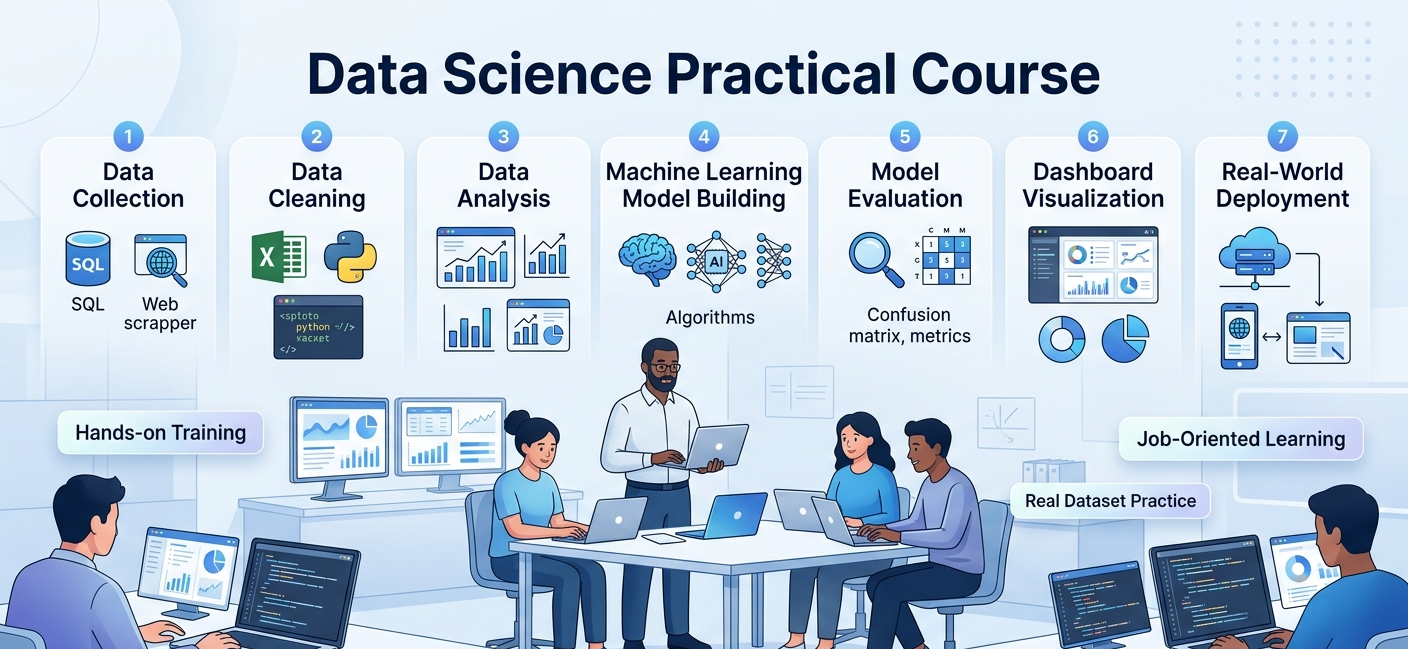
Course Overview: Data Science Practical Course – Jalandhar
1. Introduction to Data Science Practical Course
The Data Science Practical Course in Jalandhar is designed to provide learners with complete hands-on experience in the field of data science, analytics, and machine learning. Unlike theoretical programs that focus only on concepts, this course emphasizes real-world implementation, live projects, and industry-based problem solving.
In today’s digital economy, organizations depend heavily on data to make decisions. Every click, transaction, and interaction generates valuable information. However, this data is meaningless unless it is processed, analyzed, and converted into actionable insights. This course teaches exactly that transformation process in a practical, structured, and industry-oriented manner.
The program is built to ensure that students not only understand data science concepts but also gain the ability to apply them in real business scenarios using professional tools and technologies.
2. Objective of the Practical Data Science Training
The main objective of this course is to develop job-ready data science professionals who can confidently work on real datasets and solve business problems.
The key goals include:
- Providing hands-on experience with real datasets
- Teaching end-to-end data science workflows
- Developing practical skills in Python, SQL, and machine learning
- Building confidence through live projects
- Preparing learners for industry roles like Data Analyst and Data Scientist
- Enhancing problem-solving and analytical thinking
This course focuses on learning by doing, ensuring that every student works on practical assignments instead of only theoretical exercises.
3. Why Practical Training is Important in Data Science
Data science is not a subject that can be mastered through theory alone. It requires constant practice, experimentation, and real-world exposure.
In a practical course, students learn:
- How to clean messy real-world data
- How to handle missing values and errors
- How to build and test machine learning models
- How to interpret results for business decisions
- How to deploy data science solutions
Real datasets are often complex and unstructured. Practical training prepares students to handle such challenges effectively, just like professionals in the industry.
4. Course Structure Overview
The course is divided into structured modules that gradually take students from basics to advanced level practical implementation.
Module 1: Introduction to Data Science Environment
- Understanding data science lifecycle
- Installation of tools and setup
- Introduction to Jupyter Notebook
- Basics of Python for data science
Module 2: Data Handling and Preprocessing
- Importing datasets
- Data cleaning techniques
- Handling missing values
- Data transformation and formatting
- Feature engineering basics
Module 3: Exploratory Data Analysis (EDA)
- Data visualization using charts and graphs
- Statistical summaries
- Identifying patterns and trends
- Using libraries like Pandas and Matplotlib
- Business insight extraction from data
Module 4: SQL for Data Science
- Database concepts
- Writing SQL queries
- Data extraction from databases
- Joining multiple tables
- Practical database exercises
Module 5: Machine Learning Fundamentals
- Introduction to ML workflow
- Supervised learning algorithms
- Unsupervised learning techniques
- Model training and testing
- Accuracy and performance evaluation
Module 6: Practical Machine Learning Projects
- Real dataset-based classification projects
- Regression problem-solving
- Clustering analysis
- Model optimization techniques
Module 7: Data Visualization & Dashboards
- Creating dashboards using Power BI / Tableau
- Interactive reporting
- Business intelligence visualization
- Storytelling with data
Module 8: Final Live Project
- End-to-end project development
- Problem statement selection
- Data collection and preprocessing
- Model building and evaluation
- Final presentation and reporting
5. Hands-On Learning Approach
This course is completely focused on practical exposure. Every concept is immediately applied through exercises and projects.
Students will work on:
- Real business datasets
- Industry case studies
- Live coding sessions
- Problem-solving tasks
- Group and individual projects
This ensures that learners gain real industry experience even before entering the job market.
6. Tools and Technologies Used
Students will gain hands-on experience with industry-standard tools:
- Python (Pandas, NumPy, Scikit-learn)
- Jupyter Notebook
- SQL databases
- Excel for data analysis
- Power BI for dashboards
- Tableau for visualization
- Machine learning libraries
These tools are widely used in top IT companies and startups, making students industry-ready.
7. Real-Time Project Experience
One of the strongest aspects of this course is live project training. Students will not only learn concepts but also apply them in real-world scenarios.
Example projects include:
- Customer churn prediction
- Sales forecasting system
- Fraud detection system
- Movie recommendation system
- Employee performance analysis
- E-commerce data analysis
These projects help students build a professional portfolio that can be showcased during interviews.
8. Skills Developed During the Course
By the end of this training, students will develop:
- Strong analytical thinking
- Data cleaning and preprocessing skills
- Machine learning model development skills
- Data visualization expertise
- SQL database handling skills
- Business problem-solving ability
- Project development experience
These skills are essential for modern data science roles.
9. Industry Relevance of Practical Training
The IT industry demands professionals who can work on real problems, not just theoretical knowledge. This course is designed to match current industry expectations.
Companies expect candidates to:
- Work with large datasets
- Build predictive models
- Understand business requirements
- Create dashboards and reports
- Deliver actionable insights
This course prepares students exactly for these expectations, making them highly employable.
10. Career Opportunities After This Course
After completing the Data Science Practical Course, students can pursue careers such as:
- Data Analyst
- Data Scientist
- Business Analyst
- Machine Learning Engineer
- BI Developer
- AI Assistant Developer
These roles offer strong salary packages and long-term career growth opportunities.
11. Importance of Practical Experience for Jobs
In interviews, companies prefer candidates who have:
- Project experience
- Hands-on coding skills
- Real dataset exposure
- Problem-solving ability
This course ensures that students are not just learners but experienced practitioners by the time they complete training.
12. Learning Outcome Summary
After completing this practical course, learners will be able to:
- Analyze real-world datasets confidently
- Build and evaluate machine learning models
- Create professional dashboards and reports
- Solve business problems using data
- Work independently on data science projects
- Enter the job market with strong practical skills
14. Practical Problem-Solving Approach in Real Industry Scenarios
One of the most valuable aspects of this training is the emphasis on real-world problem-solving. In the actual data science industry, professionals rarely work with clean or pre-structured datasets. Instead, they deal with messy, incomplete, and complex data collected from multiple sources.
This course trains learners to approach such problems step by step:
- Understanding the business problem before touching the data
- Identifying relevant data sources
- Cleaning and preparing datasets for analysis
- Selecting appropriate algorithms based on problem type
- Evaluating model performance in a meaningful way
- Converting insights into business recommendations
For example, in a retail scenario, students may analyze customer purchase history to identify buying patterns. In a healthcare scenario, they may work on patient data to predict disease risks. In banking, they may detect fraudulent transactions using classification models.
This structured problem-solving approach helps learners develop a professional mindset similar to industry data scientists.
15. Importance of Hands-On Coding Practice
Coding is a core skill in data science, but it becomes powerful only when applied practically. This course ensures that students spend a significant amount of time writing, debugging, and optimizing code.
Learners will gain hands-on experience in:
- Writing Python scripts for data analysis
- Implementing machine learning algorithms from scratch and using libraries
- Handling errors and optimizing code performance
- Working with real datasets instead of sample examples
- Building reusable functions and workflows
Regular coding practice helps students develop confidence and fluency, which is essential for technical interviews and job roles.
16. Development of Analytical and Logical Thinking
Data science is not just about tools—it is about thinking logically and analytically. This course focuses heavily on developing a structured thinking process.
Students are trained to:
- Break down complex datasets into smaller components
- Identify hidden patterns and correlations
- Ask the right analytical questions
- Validate assumptions using data
- Support conclusions with evidence
This mindset is critical in real-world data science roles where decisions directly impact business outcomes.
Over time, learners start thinking like analysts and strategists rather than just coders, which significantly enhances their professional value.
17. Exposure to Industry-Level Workflow
Another important feature of this training is exposure to end-to-end industry workflow simulation. Students experience how data science projects are executed in real companies.
A typical workflow includes:
- Understanding business requirements
- Data collection from multiple sources
- Data cleaning and preprocessing
- Exploratory data analysis (EDA)
- Model building and training
- Performance evaluation
- Deployment and reporting
By following this complete cycle, students gain a realistic understanding of how data science projects move from concept to execution in corporate environments.
18. Building Confidence for Technical Interviews
This practical course also focuses on preparing students for job interviews and technical assessments. Many candidates struggle in interviews due to lack of practical exposure, even if they understand theory.
To solve this, the course helps learners:
- Explain their projects clearly
- Demonstrate coding skills confidently
- Solve real-time data problems
- Answer scenario-based interview questions
- Present dashboards and insights effectively
By the end of the course, students have enough practical experience to confidently face interviews in IT companies, startups, and analytics firms.
19. Transition from Learner to Professional
The ultimate goal of this training is transformation. Students are not just learning concepts—they are transitioning into industry-ready professionals.
This transformation includes:
- Moving from theoretical understanding to applied skills
- Gaining confidence in handling real datasets
- Developing project portfolios for job applications
- Building communication skills for business environments
- Understanding how data science impacts decision-making
This shift is what makes the course highly valuable for career growth in the data science field.
Why TECHCADD – Complete Institutional Overview
1. Introduction to TECHCADD
In the rapidly evolving world of technology and digital transformation, education has shifted far beyond traditional classroom learning. Today’s industries demand professionals who are not only theoretically strong but also practically skilled, innovative, and industry-ready. This shift has created a strong need for institutes that focus on skill-based, practical, and career-oriented training.
TECHCADD stands as one such leading professional training institute dedicated to bridging the gap between academic education and industry requirements. It provides high-quality training in domains such as Data Science, Artificial Intelligence, Machine Learning, Software Development, Web Development, CAD/CAM, Digital Marketing, and emerging technologies.
Unlike traditional education systems that emphasize memorization and theoretical exams, TECHCADD focuses on real-world application, hands-on training, live projects, and industry exposure. Its mission is to transform students into skilled professionals who can confidently work in the competitive job market.
2. Vision and Mission of TECHCADD
Vision
The vision of TECHCADD is to become a globally recognized skill development and technical training institute that empowers learners with advanced knowledge, practical expertise, and industry-relevant skills.
Mission
The mission of TECHCADD includes:
- Providing quality technical education aligned with industry needs
- Bridging the gap between academic learning and professional requirements
- Enhancing employability of students
- Promoting innovation and practical learning
- Supporting startups and entrepreneurship development
- Creating a skilled workforce for future technologies
TECHCADD aims to produce professionals who are capable of contributing effectively to industries, startups, and global organizations.
3. Why TECHCADD is Different from Other Institutes
TECHCADD is not just another training center; it is a career transformation platform. What makes it different is its strong focus on practical learning and industry integration.
Most traditional institutes focus only on theoretical knowledge, but TECHCADD focuses on:
- Real-time project training
- Industry-oriented curriculum
- Hands-on coding and design practice
- Professional tool usage
- Job-ready skill development
Key differentiators include:
- Industry-expert trainers
- Live project-based learning
- Internship opportunities
- Modern labs and infrastructure
- Personalized mentorship
- Placement assistance support
This ensures that students are not just learners but professionally skilled individuals ready for employment.
4. Importance of Practical Learning at TECHCADD
In today’s competitive job market, theoretical knowledge alone is not sufficient. Employers prefer candidates who can apply knowledge in real-world situations.
TECHCADD emphasizes practical learning through:
- Hands-on exercises
- Live industry projects
- Case study analysis
- Simulation-based learning
- Problem-solving tasks
For example:
- Data Science students work on real datasets
- Web development students build functional websites
- CAD students design industrial models
This approach ensures that students develop real industry experience during training itself.
5. Courses Offered at TECHCADD
TECHCADD offers a wide range of professional courses:
5.1 Data Science & Artificial Intelligence
- Python programming
- Machine learning
- Deep learning
- Data visualization
- AI applications
5.2 Software Development
- Programming fundamentals
- Application development
- Software engineering
5.3 Web Development
- HTML, CSS, JavaScript
- Frontend frameworks
- Backend development
- Full-stack development
5.4 CAD/CAM & Engineering Design
- AutoCAD
- 2D & 3D modeling
- Mechanical design tools
5.5 Digital Marketing
- SEO
- Social media marketing
- Google Ads
- Content marketing
Each course is designed according to current industry demands and job trends.
6. Skill Development at TECHCADD
TECHCADD focuses on building both technical and soft skills.
Technical Skills:
- Programming
- Data analysis
- Software tools
- Machine learning
- Design technologies
Soft Skills:
- Communication skills
- Problem-solving ability
- Team collaboration
- Presentation skills
- Time management
This combination ensures holistic student development.
7. Importance of Live Projects
Live projects are a core part of TECHCADD training.
Students work on:
- Real business problems
- Industry datasets
- Software development tasks
- Design and automation projects
Benefits:
- Real-world exposure
- Practical understanding
- Portfolio building
- Job readiness
This makes students confident and industry-ready.
8. Internship and Placement Support
TECHCADD provides strong placement support including:
- Resume preparation
- Interview training
- Mock interviews
- Internship opportunities
- Job referrals
Internships help students gain professional experience before entering full-time employment.
9. Industry-Relevant Curriculum
TECHCADD continuously updates its curriculum to match industry standards.
This ensures students learn:
- Latest technologies
- Modern tools
- Real-world applications
- Industry workflows
This makes TECHCADD graduates more competitive in the job market.
10. Role in Personality Development
TECHCADD also focuses on personality development:
- Confidence building
- Communication skills
- Interview preparation
- Professional behavior
- Presentation skills
This prepares students for corporate environments.
11. Modern Infrastructure and Learning Environment
TECHCADD provides a modern learning environment with:
- Advanced computer labs
- Updated software tools
- High-speed internet
- Smart classrooms
- Project-based learning setups
This environment enhances creativity and productivity.
12. Focus on Emerging Technologies
TECHCADD trains students in future technologies like:
- Artificial Intelligence
- Machine Learning
- Data Science
- Cloud Computing
- Automation
- IoT
This ensures students are future-ready professionals.
13. Career Opportunities After TECHCADD
Students can pursue careers such as:
- Data Scientist
- Software Developer
- Web Developer
- CAD Engineer
- AI Engineer
- Digital Marketing Specialist
These roles are highly demanded globally.
14. Why Students Prefer TECHCADD
Students choose TECHCADD because:
- Practical learning approach
- Industry exposure
- Experienced trainers
- Affordable courses
- Career-oriented training
- Strong placement support
It is a complete career development ecosystem.
15. Future Scope of TECHCADD Training
The future of technology is rapidly evolving. TECHCADD aligns with future needs such as:
- AI-driven industries
- Data-based decision systems
- Automation technologies
- Digital transformation
Students trained here are prepared for future challenges.
17. TECHCADD Learning Ecosystem: From Learning to Earning
TECHCADD is designed as a complete learning-to-career ecosystem, not just a classroom training center. The entire structure is built to ensure that a student moves step-by-step from basic understanding to professional employment readiness.
The learning ecosystem follows a progressive model:
1. Concept Clarity Stage
In this stage, students are introduced to fundamental concepts in a simple and structured way. Trainers focus on making complex topics easy to understand using real-life examples and visual explanations. This ensures that even beginners without technical backgrounds can start confidently.
2. Skill Building Stage
Once the basics are clear, students begin hands-on practice. They start working with tools like Python, AutoCAD, web frameworks, or data visualization platforms depending on their course. This stage is focused on building technical confidence through repetition and guided practice.
3. Project Development Stage
At this level, students apply their skills to build real-world projects. These projects simulate actual industry problems such as data analysis reports, websites, automation systems, or engineering designs. This stage is critical because it helps students understand how theoretical knowledge is applied in real business scenarios.
4. Industry Integration Stage
The final stage focuses on preparing students for employment. This includes resume building, mock interviews, communication training, and internship exposure. Students learn how to present themselves professionally and handle real interview situations confidently.
This structured ecosystem ensures that every student graduating from TECHCADD is not just educated but industry-ready and job-prepared.
18. Transformation of Students into Professionals
One of the biggest strengths of TECHCADD is its ability to transform beginners into professionals. Many students join with limited technical knowledge, but through structured training, they develop strong industry-level skills.
The transformation includes:
- From theoretical learner → practical problem solver
- From passive student → active developer
- From beginner → industry-ready professional
- From job seeker → job performer
This transformation happens through continuous practice, mentorship, and exposure to real-world challenges.
Students not only learn how to use tools but also develop the mindset of thinking like engineers, analysts, or developers depending on their field.
19. Role of TECHCADD in Bridging the Industry Gap
One of the major challenges in today’s education system is the gap between academic learning and industry requirements. Many graduates struggle to get jobs because they lack practical experience.
TECHCADD plays a crucial role in bridging this gap by:
- Teaching industry-relevant skills
- Providing real-world project exposure
- Training students on current tools and technologies
- Aligning curriculum with company expectations
This ensures that students are not only academically qualified but also professionally competent.
As a result, TECHCADD-trained students are more confident and better prepared for interviews and job roles compared to traditional learners.
20. Long-Term Career Impact of TECHCADD Training
The impact of TECHCADD training is not limited to getting a job; it extends to long-term career growth.
Students who complete training at TECHCADD are able to:
- Build strong professional careers in IT and engineering
- Adapt quickly to new technologies
- Grow into senior-level roles faster
- Start freelancing or entrepreneurial ventures
- Contribute to innovative projects in industries
This long-term growth is possible because TECHCADD focuses on foundation + skills + industry exposure, which together create a strong career base.
TECHCADD stands as a powerful platform for modern technical education that goes far beyond traditional teaching methods. It is built on the principle of “Learn, Practice, Apply, and Grow”, ensuring that students are fully prepared for real-world challenges.
With its strong focus on practical learning, live projects, mentorship, and career development, TECHCADD has established itself as a trusted institute for students who want to build successful careers in technology and design fields.
In a world where industries are rapidly evolving, TECHCADD ensures that students are not left behind. Instead, they are equipped with the right skills, mindset, and confidence to succeed in the competitive global job market.
Future Scope of Data Science Practical Course – Jalandhar
1. Introduction: The Future Belongs to Data
The future of technology, business, and innovation is fundamentally driven by data. In every industry across the world, decision-making is shifting from intuition-based approaches to data-driven intelligence systems. This transformation is creating massive opportunities for skilled data professionals who can collect, analyze, and interpret data effectively.
The Data Science Practical Course in Jalandhar prepares learners for this future by equipping them with hands-on technical skills, real-world project experience, and analytical thinking abilities required in modern industries.
In the coming years, data will not just support decision-making—it will define decision-making itself.
2. Explosive Growth of the Data Science Industry
The global data science industry is growing at an unprecedented rate. Every day, businesses generate massive volumes of structured and unstructured data from digital platforms, mobile apps, sensors, transactions, and social media.
This growth is creating strong demand for professionals who can:
- Process large-scale datasets
- Extract meaningful insights
- Build predictive models
- Support strategic business decisions
In the future, almost every company—regardless of size or industry—will require data science professionals. This includes startups, multinational corporations, government organizations, and research institutions.
The demand for data scientists is expected to remain strong for the next decade and beyond, making it one of the most stable and high-growth career fields.
3. Expansion of Career Opportunities in Data Science
The future scope of this course includes a wide range of career opportunities. Data science is no longer limited to a single job role. Instead, it has evolved into multiple specialized career paths.
3.1 Data Scientist
Data Scientists will continue to be in high demand. They will design advanced machine learning models, analyze complex datasets, and solve critical business problems.
3.2 Data Analyst
Data Analysts will focus on interpreting data, generating reports, and supporting business decisions with insights.
3.3 Machine Learning Engineer
ML Engineers will build intelligent systems that learn from data and improve automatically over time.
3.4 Business Intelligence Developer
BI professionals will create dashboards and visualization systems for business reporting.
3.5 Data Engineer
Data Engineers will design data pipelines and manage large-scale data infrastructure.
3.6 AI Specialist
AI specialists will focus on building automation systems, intelligent assistants, and predictive applications.
These roles are expected to grow significantly as organizations become more data-centric.
4. Rise of Artificial Intelligence and Automation
Artificial Intelligence (AI) is one of the biggest driving forces behind the future of data science. AI systems are becoming capable of performing complex tasks such as prediction, classification, automation, and decision-making.
In the future, AI will:
- Automate repetitive analytical tasks
- Enhance decision-making accuracy
- Power recommendation engines
- Enable predictive business systems
- Improve customer experience through personalization
However, this does not reduce the importance of data science professionals. Instead, it shifts their role toward strategic thinking, model interpretation, and AI system design.
Professionals trained in practical data science will play a key role in building and managing these AI systems.
5. Future of Data Science in Business Strategy
Businesses are rapidly shifting toward data-driven strategy models. In the future, data science will not just be a technical function but a core part of business leadership.
Companies will use data science for:
- Predicting market trends
- Understanding customer behavior
- Optimizing operations
- Reducing business risks
- Improving product development
Data scientists will increasingly work alongside CEOs, managers, and strategists to guide business direction.
This means professionals trained in data science will have opportunities to work in decision-making and leadership roles, not just technical positions.
6. Growth of Data Science in India and Emerging Cities
India is becoming a global hub for data science talent. With rapid digital transformation, industries in India are adopting analytics and AI at a fast pace.
Cities like Jalandhar are also emerging as important centers for skill development and IT training. This creates strong local opportunities for students who want to build careers in data science without moving to major metro cities.
Future trends in India include:
- Growth of IT and analytics companies
- Expansion of AI startups
- Government digital initiatives
- Smart city development projects
- Increased demand for skilled professionals in Tier-2 cities
This makes data science one of the most promising career options in India’s growing digital economy.
7. Future Skills Required in Data Science
The future of data science will require a combination of technical, analytical, and strategic skills.
Technical Skills:
- Python programming
- Machine learning and deep learning
- SQL and database management
- Cloud computing (AWS, Azure, GCP)
- Big data technologies
Analytical Skills:
- Statistical analysis
- Data visualization
- Pattern recognition
- Predictive modeling
Soft Skills:
- Problem-solving ability
- Communication and storytelling
- Business understanding
- Critical thinking
Professionals who master this combination will have strong career stability and growth.
8. Integration with Emerging Technologies
Data science will continue to merge with other advanced technologies, creating new opportunities and career paths.
8.1 Internet of Things (IoT)
Millions of connected devices will generate continuous data streams, requiring real-time analysis.
8.2 Cloud Computing
All major data science workflows will move to cloud platforms for scalability and efficiency.
8.3 Blockchain
Data science will be used for analyzing secure transactions and decentralized systems.
8.4 Edge Computing
Data processing will shift closer to devices, requiring lightweight AI models.
8.5 Cybersecurity Analytics
Data science will play a key role in detecting cyber threats and protecting digital systems.
These integrations will expand the scope of data science far beyond traditional analytics.
9. Future of Real-Time Decision Systems
In the coming years, businesses will move from traditional reporting systems to real-time decision-making systems.
This means:
- Instant fraud detection in banking
- Real-time pricing in e-commerce
- Live recommendation systems
- Dynamic supply chain optimization
Data scientists will be responsible for building systems that process and analyze data instantly, enabling faster and smarter decisions.
10. Long-Term Career Growth and Stability
One of the strongest advantages of data science is long-term career stability. Unlike many traditional IT roles, data science continues to evolve and expand.
Career growth path:
Data Analyst → Junior Data Scientist → Data Scientist → Senior Data Scientist → Data Strategist → AI Lead → Chief Data Officer
This structured career path ensures continuous learning and professional advancement.
11. Future of Data Science in Everyday Life
Data science is not limited to businesses—it will increasingly impact daily life.
Examples include:
- Personalized healthcare systems
- Smart education platforms
- Autonomous vehicles
- Intelligent virtual assistants
- Predictive weather systems
This means data science professionals will directly contribute to innovations that improve human life.
13. Future of Data Science in Remote Work and Freelancing
One of the most important changes shaping the future of data science is the rise of remote work and freelancing opportunities. Unlike many traditional careers that require physical presence in offices, data science is highly digital in nature, making it perfectly suited for remote and global work environments.
In the future, companies will increasingly hire data professionals who can work from anywhere in the world. Platforms such as freelance marketplaces, remote job boards, and global tech communities will create endless opportunities for skilled data scientists.
Future opportunities include:
- Freelance data analysis projects for global clients
- Remote machine learning model development
- Online dashboard and reporting solutions
- Short-term consulting projects for startups
- Part-time AI and analytics contracts
This shift allows professionals to build independent careers without geographical limitations, increasing flexibility and income potential.
For students completing the Data Science Practical Course in Jalandhar, this means they are not limited to local job markets. They can work with companies across India and even international clients while staying in their hometown.
14. Growth of Data Science in Startups and Innovation Ecosystems
Startups are one of the biggest drivers of future data science demand. In the coming years, almost every startup—regardless of industry—will rely heavily on data to survive and grow.
Startups use data science for:
- Understanding customer needs and behavior
- Identifying market opportunities
- Improving product performance
- Reducing operational costs
- Scaling business efficiently
Unlike large corporations, startups rely on fast decision-making. This creates a huge demand for data-driven insights in real time.
Data science professionals will have opportunities to work as:
- Growth analysts in startup teams
- Product data scientists
- AI-driven marketing specialists
- Business intelligence advisors
Since startups operate in fast-paced environments, professionals gain rapid skill development and exposure to real business challenges, making this a highly valuable career path for future data scientists.
15. Evolution of Data Science Tools and Technologies
The future of data science will also be shaped by continuous evolution in tools and technologies. While current tools like Python, SQL, and Power BI are widely used, future systems will become more automated, intelligent, and cloud-based.
Key future developments include:
- AutoML (Automated Machine Learning): Tools that automatically build and optimize models
- AI-powered analytics platforms: Systems that generate insights without manual intervention
- Low-code/no-code data platforms: Allowing faster model development without heavy coding
- Cloud-native data ecosystems: Fully integrated cloud environments for data processing
- AI-assisted coding tools: Helping data scientists write and optimize code faster
However, even as tools become more advanced, the need for human intelligence will remain essential. Data scientists will focus more on interpretation, strategy, and decision-making, while machines handle repetitive tasks.
16. Future Demand in Non-IT Industries
A major trend in the future is that data science will no longer be limited to IT companies. Almost every industry will adopt data-driven decision-making.
Future demand will increase in:
Healthcare
- Predicting diseases early
- Patient data analysis
- Hospital resource optimization
Education
- Personalized learning systems
- Student performance prediction
- Adaptive learning platforms
Agriculture
- Crop yield prediction
- Weather-based farming decisions
- Soil health analytics
Manufacturing
- Predictive maintenance of machines
- Supply chain optimization
- Quality control automation
Government & Public Sector
- Smart city planning
- Crime prediction systems
- Public resource management
This expansion means data science professionals will have diverse career options beyond traditional IT roles.
17. Increasing Importance of Decision Intelligence
In the future, data science will evolve into a broader concept called Decision Intelligence. This involves combining data science, AI, and business strategy to support better decision-making systems.
Instead of just providing insights, data scientists will help organizations:
- Simulate business scenarios
- Predict outcomes of decisions
- Optimize strategies automatically
- Reduce risks before actions are taken
This will make data professionals key contributors to executive-level decisions, increasing their importance in organizations.
18. Long-Term Stability and Career Security
Unlike many traditional career fields that are affected by automation, data science continues to grow with technology advancement. The more digital the world becomes, the higher the demand for data professionals.
Reasons for long-term stability include:
- Continuous growth of data generation
- Expansion of AI and automation systems
- Increasing reliance on predictive analytics
- Global digital transformation across industries
This ensures that data science remains a future-proof career option with strong job security and growth potential.