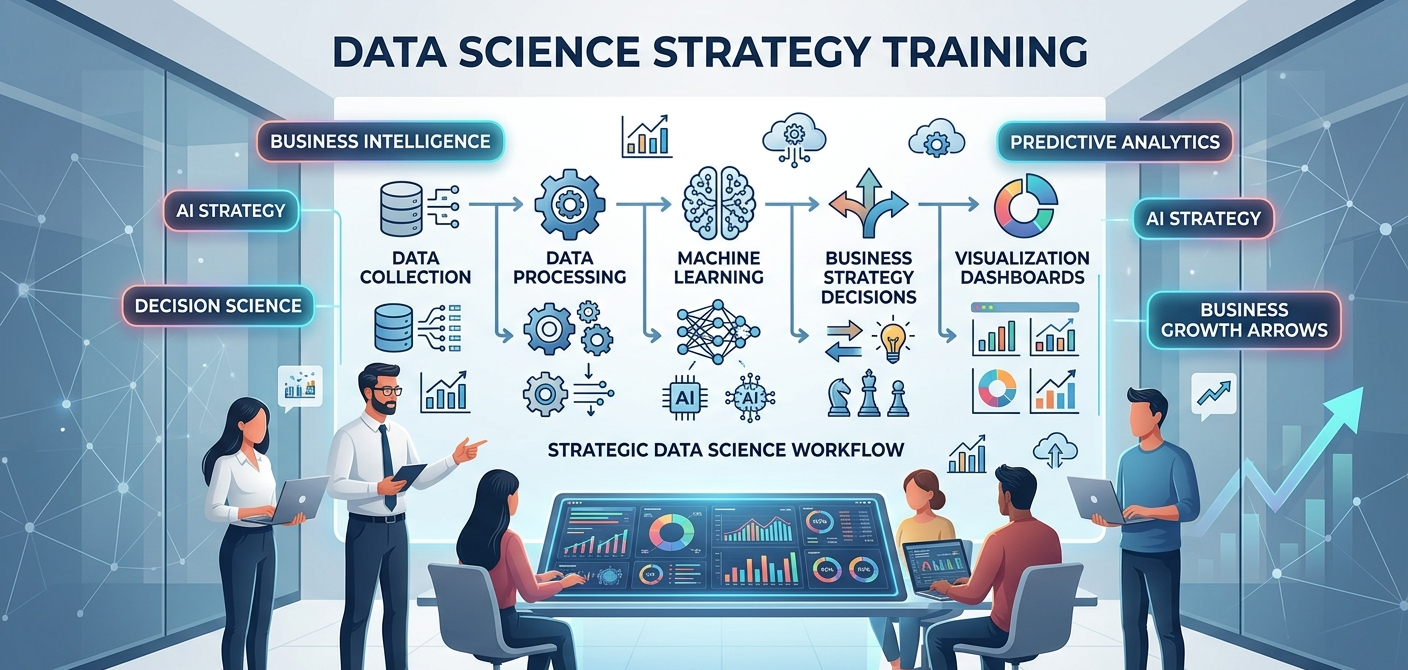
Course Overview: Data Science Strategy Training – Jalandhar
1. Introduction to Data Science Strategy Training
In today’s rapidly evolving digital world, data has become the backbone of every successful business. Organizations are no longer relying on intuition alone; instead, they are adopting data-driven strategies to make smarter, faster, and more accurate decisions. The Data Science Strategy Training in Jalandhar is designed to bridge the gap between raw data and strategic business decision-making.
This course goes beyond traditional data science education. It focuses not only on technical skills but also on how data science can be aligned with business strategy, organizational goals, and real-world decision systems. Learners will gain the ability to transform data into actionable insights that drive growth, efficiency, and innovation.
Whether you are a student, working professional, entrepreneur, or aspiring data scientist, this program equips you with both analytical and strategic thinking skills required in today’s competitive job market.
2. Purpose of the Course
The primary purpose of this training program is to develop professionals who can:
- Understand complex datasets and business environments
- Apply statistical and machine learning techniques effectively
- Translate analytical results into business strategies
- Support decision-making with data-driven insights
- Build predictive and prescriptive models for real-world problems
Unlike traditional courses that focus only on coding or tools, this training emphasizes how to think like a data strategist.
3. Why Data Science Strategy Matters
Modern businesses generate massive volumes of data every second—from customer interactions, social media, transactions, sensors, and digital platforms. However, data alone has no value unless it is interpreted correctly.
Data Science Strategy helps organizations to:
- Identify market trends and customer behavior patterns
- Optimize business operations and reduce costs
- Improve customer experience and personalization
- Predict future outcomes using machine learning models
- Gain competitive advantage in their industry
In simple terms, this course teaches you how to turn data into business power.
4. Who Should Enroll in This Course
This course is ideal for:
- Students interested in data science, AI, or analytics
- Business analysts who want to upgrade their skills
- IT professionals transitioning into data roles
- Entrepreneurs who want to make data-driven decisions
- Marketing professionals working with customer data
- Fresh graduates seeking high-demand tech careers
No matter your background, the course is structured to guide you from foundational concepts to advanced strategic applications.
5. Course Objectives
The key objectives of this program include:
5.1 Building Analytical Thinking
Students will learn how to break down complex problems into data-driven solutions.
5.2 Strengthening Technical Skills
Training in tools like Python, SQL, Power BI, and machine learning frameworks.
5.3 Developing Business Understanding
Understanding how companies use data science for growth and strategy.
5.4 Enhancing Decision-Making Ability
Using predictive models to support business decisions.
5.5 Industry Readiness
Preparing learners for real-world job roles in analytics and data science.
6. Key Features of the Training Program
This course stands out due to its unique combination of strategy and technical learning:
- Industry-oriented curriculum
- Hands-on live projects
- Real business case studies
- Interactive sessions with experts
- Practical assignments and assessments
- Portfolio development for job readiness
- Career guidance and interview preparation
The training is designed to simulate real corporate environments where data science is used for decision-making.
7. Course Curriculum Overview
The curriculum is divided into structured modules:
Module 1: Introduction to Data Science & Strategy
- Basics of data science
- Role of data in business strategy
- Data lifecycle and pipeline
- Introduction to analytics types
Module 2: Data Analysis Foundations
- Data collection and cleaning
- Exploratory Data Analysis (EDA)
- Data visualization techniques
- Statistical fundamentals
Module 3: Programming for Data Science
- Python programming basics
- Libraries: NumPy, Pandas, Matplotlib, Seaborn
- Working with datasets
- Data manipulation techniques
Module 4: Machine Learning Essentials
- Supervised learning
- Unsupervised learning
- Regression and classification models
- Model evaluation techniques
Module 5: Business Intelligence & Strategy
- KPI development
- Dashboard creation
- Power BI / Tableau basics
- Strategic decision-making models
Module 6: Predictive Analytics
- Forecasting techniques
- Time series analysis
- Customer behavior prediction
- Risk analysis models
Module 7: Advanced Data Science Applications
- AI integration in business
- Recommendation systems
- NLP basics
- Automation in analytics
Module 8: Real-Time Project Work
- End-to-end project development
- Industry-based case studies
- Data strategy implementation
- Final presentation and evaluation
8. Practical Learning Approach
The training emphasizes learning by doing. Instead of focusing only on theory, students will work on:
- Real datasets from industries
- Business problem-solving exercises
- Group projects and presentations
- Live simulations of decision-making scenarios
This ensures that learners develop confidence in applying concepts in real environments.
9. Tools and Technologies Covered
Students will gain hands-on experience with industry-standard tools such as:
- Python (Core programming language)
- SQL (Database management)
- Excel (Data handling and analysis)
- Power BI (Data visualization)
- Tableau (Business intelligence dashboards)
- Scikit-learn (Machine learning)
- Jupyter Notebook (Development environment)
These tools are widely used in top companies worldwide.
10. Real-World Applications of Data Science Strategy
Data Science Strategy is used across industries:
10.1 Healthcare
- Disease prediction
- Patient data analysis
- Medical imaging insights
10.2 Finance
- Fraud detection
- Risk assessment
- Investment forecasting
10.3 Retail & E-commerce
- Customer segmentation
- Recommendation systems
- Sales forecasting
10.4 Marketing
- Campaign performance analysis
- Customer behavior tracking
- Target audience prediction
10.5 Manufacturing
- Supply chain optimization
- Predictive maintenance
- Quality control analytics
11. Learning Outcomes
After completing this course, learners will be able to:
- Analyze and interpret complex datasets
- Build machine learning models
- Create data-driven business strategies
- Design dashboards and reports
- Solve real-world business problems
- Work confidently in data science roles
This makes students job-ready for roles such as Data Analyst, Business Analyst, Data Scientist, and AI Strategist.
12. Industry Demand and Career Growth
The demand for data science professionals is increasing rapidly across the globe. Companies are actively hiring individuals who can not only analyze data but also contribute to strategic decision-making.
Career opportunities include:
- Data Scientist
- Business Analyst
- Data Analyst
- Machine Learning Engineer
- AI Consultant
- Business Intelligence Developer
With the rise of AI and automation, data science has become one of the most future-proof career paths.
13. Why Choose This Training in Jalandhar
Jalandhar is emerging as a growing hub for education and skill development in North India. This training program provides:
- Local access to global-level training
- Affordable and industry-oriented learning
- Expert mentorship and guidance
- Practical exposure without needing to relocate
- Strong career support system
It is designed to empower students in the region with world-class skills.
14. Future Scope of Data Science Strategy
The future of data science is extremely promising. With the rise of AI, automation, and digital transformation, businesses will increasingly depend on data-driven strategies.
Future trends include:
- AI-powered business decision systems
- Automated analytics platforms
- Smart predictive ecosystems
- Real-time decision intelligence
- Deep learning-based strategy models
Professionals skilled in data science strategy will be highly valuable in the coming decade.
16. Role of Strategic Thinking in Data Science
One of the most important aspects of this training is the integration of strategic thinking with data science techniques. In traditional data science learning, students often focus heavily on algorithms, coding, and model building. However, in the real business world, success depends not just on building models but on understanding why a model is needed and how it impacts business decisions.
Strategic thinking allows data professionals to align analytics with organizational goals. For example, instead of simply predicting customer churn, a data strategist asks deeper questions such as:
- Why are customers leaving?
- Which customer segments are most valuable?
- What business actions can reduce churn effectively?
This shift from technical execution to strategic interpretation is what makes this course unique. Students are trained to think like consultants who can translate raw data insights into actionable business strategies.
17. Importance of Problem-Solving Mindset
A strong focus of this program is developing a problem-solving mindset. Data science is not just about tools; it is about solving real-world challenges using structured thinking.
Students are trained to:
- Define business problems clearly before analysis
- Break down complex issues into smaller analytical parts
- Choose the right data science approach for each problem
- Validate solutions using logical reasoning and evidence
For example, in retail analytics, instead of directly applying machine learning models, learners first understand the business problem such as declining sales, then identify patterns in customer behavior, and finally propose strategic improvements supported by data.
This structured mindset ensures that learners become effective decision-makers rather than just technical operators.
18. Industry-Oriented Project Experience
A key highlight of the training is hands-on industry project exposure. Students work on real-life datasets that reflect actual business scenarios. These projects are designed to simulate corporate environments where data scientists collaborate with business teams.
Some example project areas include:
- Customer segmentation for marketing campaigns
- Sales forecasting for retail businesses
- Fraud detection in financial transactions
- Employee performance analytics
- Product recommendation systems for e-commerce
Through these projects, learners gain experience in the complete data science lifecycle—from data collection to strategy implementation. This practical exposure builds confidence and prepares students for real job roles.
19. Development of Analytical Communication Skills
Another important focus of this training is communication of data insights. In the professional world, even the most advanced analysis is useless if it cannot be explained clearly to non-technical stakeholders.
Students learn how to:
- Present insights through dashboards and reports
- Communicate findings in simple business language
- Create visual storytelling using graphs and charts
- Deliver presentations to management teams
This skill is especially important for roles in business intelligence and data strategy, where professionals must bridge the gap between technical teams and business leaders.
20. Integration of AI in Business Strategy
Modern businesses are increasingly integrating Artificial Intelligence into their decision-making systems. This course introduces learners to how AI enhances business strategy through automation and prediction.
Key applications include:
- AI-driven customer personalization
- Automated decision-making systems
- Intelligent recommendation engines
- Predictive maintenance in industries
- Smart marketing automation
Students understand how AI is not just a technical tool but a strategic asset that transforms business operations. This knowledge helps learners stay future-ready in a rapidly evolving job market.
21. Building a Professional Data Science Portfolio
At the end of the training, students will have a complete portfolio of projects and case studies. This portfolio is extremely important for job interviews and career growth.
It includes:
- Real-world business projects
- Machine learning models
- Data visualization dashboards
- Strategic analysis reports
- End-to-end case studies
Employers value candidates who can demonstrate practical experience rather than just theoretical knowledge. This portfolio becomes a strong proof of skill and expertise.
22. Career Transformation Through This Program
This training is designed not just as a learning program but as a career transformation journey. Many students enter with basic knowledge, but by the end of the course, they are prepared for professional roles in top companies.
The transformation includes:
- From student to data professional
- From theory-based learning to practical execution
- From coding-focused mindset to strategy-focused thinking
- From beginner level to industry-ready expert
This shift is what makes the program highly valuable for long-term career success.
Why TECHCADD – Complete Institutional
1. Introduction to TECHCADD
In today’s rapidly evolving technological world, education is no longer limited to theoretical knowledge. Industries demand professionals who are skilled, practical, and capable of solving real-world problems. Traditional education systems often focus on theory, but modern industries require hands-on experience, technical expertise, and industry exposure.
This is where TECHCADD plays a transformative role.
TECHCADD is a professional training institute dedicated to providing industry-oriented technical education in fields such as Data Science, Artificial Intelligence, Machine Learning, Software Development, CAD/CAM, Web Development, Digital Marketing, and other emerging technologies.
The primary goal of TECHCADD is to bridge the gap between academic learning and industry requirements by offering practical, skill-based training programs that prepare students for real-world careers.
Unlike traditional institutes, TECHCADD focuses on career transformation, not just education.
2. Vision and Mission of TECHCADD
Vision
The vision of TECHCADD is to become a leading global skill development and technical training institute that empowers students with advanced knowledge, practical expertise, and industry readiness.
Mission
The mission of TECHCADD includes:
- Delivering high-quality technical education
- Bridging the gap between academics and industry
- Enhancing employability of students
- Promoting innovation and practical learning
- Supporting startups and digital transformation
- Creating a skilled workforce for future industries
TECHCADD aims to build professionals who can contribute effectively to industries and global technological advancement.
3. Why TECHCADD is Different from Other Institutes
TECHCADD stands out because of its practical learning approach and industry integration.
While many institutes focus on theoretical knowledge, TECHCADD ensures that students:
- Work on live projects
- Gain real industry experience
- Learn tools used in companies
- Build professional portfolios
- Develop problem-solving skills
Key differentiators:
- Industry-based curriculum
- Real-time project training
- Experienced trainers from industry backgrounds
- Personalized mentoring
- Modern lab infrastructure
- Internship opportunities
- Placement assistance
This makes TECHCADD a career-focused training platform rather than just an educational institute.
4. Importance of Practical Learning at TECHCADD
In today’s competitive job market, companies prefer candidates who can apply knowledge practically rather than just memorizing concepts.
TECHCADD emphasizes:
Hands-on Training
Students actively work on coding, designing, and analytical tasks.
Real-Time Projects
Students build projects similar to real industry applications.
Problem-Solving Approach
Training focuses on solving real business and technical problems.
Industry Simulation
Learning environments simulate actual workplace scenarios.
For example:
- Data Science students work on real datasets
- Web developers build live websites
- CAD students design real engineering models
This ensures students become job-ready professionals.
5. Courses Offered at TECHCADD
TECHCADD offers a wide range of industry-oriented courses:
5.1 Data Science & AI
- Python programming
- Machine learning
- Deep learning
- Data visualization
- AI applications
5.2 Web Development
- HTML, CSS, JavaScript
- Frontend frameworks
- Backend development
- Full-stack development
5.3 Software Development
- Programming fundamentals
- Application development
- Software engineering concepts
5.4 CAD/CAM & Engineering Design
- AutoCAD
- 2D/3D modeling
- Mechanical design
5.5 Digital Marketing
- SEO
- Social media marketing
- Google Ads
- Content marketing
Each course is designed according to current industry requirements and job trends.
6. Role of TECHCADD in Skill Development
Skill development is the core focus of TECHCADD.
Students are trained in:
- Technical skills
- Analytical thinking
- Logical reasoning
- Communication skills
- Teamwork
- Project management
This combination of skills ensures students are not only technically strong but also professionally competent.
7. Importance of Live Projects
Live projects are one of the strongest features of TECHCADD training.
Benefits include:
- Real industry exposure
- Portfolio development
- Practical experience
- Increased job opportunities
- Confidence building
For example:
- A data science student may analyze real business data
- A web developer may build a real e-commerce website
- A CAD student may design industrial components
This practical exposure makes students industry-ready from day one.
8. Internship and Placement Support
TECHCADD provides strong placement assistance to students.
Placement support includes:
- Resume building
- Interview preparation
- Mock interviews
- Internship opportunities
- Job referrals
Internships help students gain real-world experience before entering full-time jobs.
This significantly increases employability and career success.
9. Importance of Industry-Relevant Curriculum
TECHCADD continuously updates its curriculum based on industry trends.
This ensures students learn:
- Latest technologies
- Modern tools
- Current industry practices
- Real-world applications
This makes TECHCADD graduates more competitive in the job market.
10. Role in Personality Development
TECHCADD also focuses on personality development, including:
- Communication skills
- Confidence building
- Presentation skills
- Interview preparation
- Professional behavior
This ensures students are ready for corporate environments.
11. Modern Infrastructure and Learning Environment
TECHCADD provides a modern learning environment with:
- Advanced computer labs
- High-speed internet
- Updated software tools
- Smart classrooms
- Project-based learning setups
This environment encourages creativity and collaboration.
12. Focus on Emerging Technologies
TECHCADD trains students in future technologies such as:
- Artificial Intelligence
- Machine Learning
- Data Science
- Cloud Computing
- Automation
- IoT
This ensures students are prepared for future job markets.
13. Career Opportunities After TECHCADD
Students trained at TECHCADD can pursue careers such as:
- Data Scientist
- Software Developer
- Web Developer
- CAD Engineer
- AI Engineer
- Digital Marketing Specialist
- Business Analyst
These roles are in high demand globally.
14. Why Students Prefer TECHCADD
Students choose TECHCADD because of:
- Practical training approach
- Industry exposure
- Experienced trainers
- Affordable courses
- Job-oriented learning
- Strong career support
It is a complete career development ecosystem.
15. Future Scope of TECHCADD Training
The future of technical education is shifting toward skill-based learning.
TECHCADD is aligned with future needs such as:
- AI-driven industries
- Data-driven decision making
- Automation systems
- Digital transformation
Students trained here will be future-ready professionals.
7. TECHCADD Training Ecosystem: A Complete Learning Journey
TECHCADD is designed as a complete learning ecosystem, not just a classroom-based institute. The training journey is structured to take a student from beginner level to industry-ready professional step by step.
The ecosystem is built around four major pillars:
1. Foundation Building
Every student begins with strong foundational knowledge. This includes understanding basic concepts, tools, and terminologies related to their chosen domain. Whether it is programming, design, or data science, the focus is on building clarity and confidence from the ground up.
2. Skill Development
Once the foundation is clear, students move toward skill enhancement. Here, they start working on real tools such as Python, AutoCAD, Power BI, or web development frameworks. This stage ensures that students are not only learning concepts but also applying them practically.
3. Industry Simulation
In this stage, TECHCADD creates a real-world working environment inside the classroom. Students are given tasks similar to what professionals handle in companies. They work in teams, follow deadlines, and solve complex problems, just like in the corporate world.
4. Career Integration
The final stage focuses on career readiness. Students prepare resumes, attend mock interviews, build portfolios, and participate in internship programs. This ensures a smooth transition from learning to employment.
This structured ecosystem makes TECHCADD different from traditional institutes.
18. Outcome-Based Learning Approach
One of the strongest aspects of TECHCADD is its outcome-based education model. Instead of simply completing a syllabus, students are evaluated based on what they can actually do.
The expected outcomes include:
- Ability to build real projects
- Strong problem-solving skills
- Understanding of industry workflows
- Confidence in using professional tools
- Ability to work independently or in teams
For example, in a Data Science course, the outcome is not just learning Python or machine learning concepts, but being able to analyze real datasets and make business decisions using data.
This ensures that every student who completes training at TECHCADD is practically skilled and job-ready.
19. Industry Alignment and Curriculum Design
TECHCADD continuously updates its curriculum to match current industry requirements. Technology is changing rapidly, and outdated skills are no longer useful in the job market.
To stay relevant, TECHCADD:
- Studies industry trends
- Collaborates with professionals
- Updates course modules regularly
- Adds new technologies like AI, cloud computing, and automation
This ensures that students are always learning what companies actually need.
For example:
- Web development courses include modern frameworks used in startups
- Data science courses include real-world machine learning applications
- CAD courses include industrial design standards
This industry alignment significantly increases job opportunities for students.
20. Student Transformation Through TECHCADD
One of the most important goals of TECHCADD is student transformation. The institute focuses not just on teaching, but on changing the way students think, learn, and perform.
Before joining TECHCADD, many students:
- Lack practical exposure
- Have limited technical confidence
- Struggle with real-world problem-solving
After training at TECHCADD, students:
- Gain strong technical expertise
- Develop industry-level confidence
- Become capable of working on live projects
- Improve communication and presentation skills
- Become job-ready professionals
This transformation is what makes TECHCADD truly valuable.
21. Role of Mentorship in Learning
Mentorship plays a key role in TECHCADD’s success model. Experienced mentors guide students throughout their learning journey.
Mentors help students with:
- Concept clarification
- Project guidance
- Career advice
- Skill improvement strategies
- Interview preparation
This personalized support ensures that no student is left behind. It also helps students stay motivated and focused on their career goals.
22. Building a Strong Professional Portfolio
In today’s competitive job market, a degree alone is not enough. Employers look for practical proof of skills.
TECHCADD helps students build strong portfolios that include:
- Live projects
- Case studies
- GitHub repositories (for technical students)
- Design portfolios (for CAD/web students)
- Data analysis reports
A strong portfolio increases the chances of getting hired by top companies because it shows real capability instead of just theoretical knowledge.
23. TECHCADD and Digital Transformation in Education
TECHCADD is also contributing to the digital transformation of education. It replaces outdated teaching methods with modern, interactive, and technology-driven learning systems.
Key digital learning elements include:
- Online learning resources
- Interactive coding sessions
- Virtual labs
- Project-based assignments
- Digital assessment systems
This makes learning more engaging, flexible, and effective for students.
24. Real-World Impact on Students’ Careers
The real success of TECHCADD can be seen in its students’ career growth.
After completing training, students are able to:
- Get placed in IT companies
- Work in startups and product-based companies
- Start freelancing careers
- Build their own tech ventures
Many students also move into higher studies or specialized certifications after gaining strong foundational skills at TECHCADD.
This shows that TECHCADD is not just an institute, but a career launching platform.
7. TECHCADD Training Ecosystem: A Complete Learning Journey
TECHCADD is designed as a complete learning ecosystem, not just a classroom-based institute. The training journey is structured to take a student from beginner level to industry-ready professional step by step.
The ecosystem is built around four major pillars:
1. Foundation Building
Every student begins with strong foundational knowledge. This includes understanding basic concepts, tools, and terminologies related to their chosen domain. Whether it is programming, design, or data science, the focus is on building clarity and confidence from the ground up.
2. Skill Development
Once the foundation is clear, students move toward skill enhancement. Here, they start working on real tools such as Python, AutoCAD, Power BI, or web development frameworks. This stage ensures that students are not only learning concepts but also applying them practically.
3. Industry Simulation
In this stage, TECHCADD creates a real-world working environment inside the classroom. Students are given tasks similar to what professionals handle in companies. They work in teams, follow deadlines, and solve complex problems, just like in the corporate world.
4. Career Integration
The final stage focuses on career readiness. Students prepare resumes, attend mock interviews, build portfolios, and participate in internship programs. This ensures a smooth transition from learning to employment.
This structured ecosystem makes TECHCADD different from traditional institutes.
18. Outcome-Based Learning Approach
One of the strongest aspects of TECHCADD is its outcome-based education model. Instead of simply completing a syllabus, students are evaluated based on what they can actually do.
The expected outcomes include:
- Ability to build real projects
- Strong problem-solving skills
- Understanding of industry workflows
- Confidence in using professional tools
- Ability to work independently or in teams
For example, in a Data Science course, the outcome is not just learning Python or machine learning concepts, but being able to analyze real datasets and make business decisions using data.
This ensures that every student who completes training at TECHCADD is practically skilled and job-ready.
19. Industry Alignment and Curriculum Design
TECHCADD continuously updates its curriculum to match current industry requirements. Technology is changing rapidly, and outdated skills are no longer useful in the job market.
To stay relevant, TECHCADD:
- Studies industry trends
- Collaborates with professionals
- Updates course modules regularly
- Adds new technologies like AI, cloud computing, and automation
This ensures that students are always learning what companies actually need.
For example:
- Web development courses include modern frameworks used in startups
- Data science courses include real-world machine learning applications
- CAD courses include industrial design standards
This industry alignment significantly increases job opportunities for students.
20. Student Transformation Through TECHCADD
One of the most important goals of TECHCADD is student transformation. The institute focuses not just on teaching, but on changing the way students think, learn, and perform.
Before joining TECHCADD, many students:
- Lack practical exposure
- Have limited technical confidence
- Struggle with real-world problem-solving
After training at TECHCADD, students:
- Gain strong technical expertise
- Develop industry-level confidence
- Become capable of working on live projects
- Improve communication and presentation skills
- Become job-ready professionals
This transformation is what makes TECHCADD truly valuable.
21. Role of Mentorship in Learning
Mentorship plays a key role in TECHCADD’s success model. Experienced mentors guide students throughout their learning journey.
Mentors help students with:
- Concept clarification
- Project guidance
- Career advice
- Skill improvement strategies
- Interview preparation
This personalized support ensures that no student is left behind. It also helps students stay motivated and focused on their career goals.
22. Building a Strong Professional Portfolio
In today’s competitive job market, a degree alone is not enough. Employers look for practical proof of skills.
TECHCADD helps students build strong portfolios that include:
- Live projects
- Case studies
- GitHub repositories (for technical students)
- Design portfolios (for CAD/web students)
- Data analysis reports
A strong portfolio increases the chances of getting hired by top companies because it shows real capability instead of just theoretical knowledge.
23. TECHCADD and Digital Transformation in Education
TECHCADD is also contributing to the digital transformation of education. It replaces outdated teaching methods with modern, interactive, and technology-driven learning systems.
Key digital learning elements include:
- Online learning resources
- Interactive coding sessions
- Virtual labs
- Project-based assignments
- Digital assessment systems
This makes learning more engaging, flexible, and effective for students.
24. Real-World Impact on Students’ Careers
The real success of TECHCADD can be seen in its students’ career growth.
After completing training, students are able to:
- Get placed in IT companies
- Work in startups and product-based companies
- Start freelancing careers
- Build their own tech ventures
Many students also move into higher studies or specialized certifications after gaining strong foundational skills at TECHCADD.
This shows that TECHCADD is not just an institute, but a career launching platform.
15. Future of Data Science with Cloud Computing and Big Data
One of the most significant transformations shaping the future of data science is the integration of cloud computing and big data technologies. As data volumes continue to grow exponentially, traditional storage and processing systems are no longer sufficient. Organizations are rapidly shifting toward scalable cloud platforms such as AWS, Azure, and Google Cloud.
In the future, data science professionals will be expected to work seamlessly with cloud-based ecosystems where:
- Data is stored in distributed systems
- Processing happens in real-time pipelines
- Machine learning models are deployed directly on cloud platforms
- Data accessibility is global and instant
Big data technologies such as Hadoop, Spark, and distributed databases will become standard tools in every data science workflow. Professionals who understand how to manage and analyze massive datasets in cloud environments will be in extremely high demand.
This shift means that future data scientists will not only be analysts but also cloud-enabled data engineers and system architects capable of designing scalable data solutions.
16. Rise of Real-Time Analytics and Decision Systems
Another major future trend is the shift from batch processing to real-time analytics. Businesses are no longer satisfied with historical reports; they want instant insights to make immediate decisions.
For example:
- E-commerce platforms adjust pricing dynamically based on demand
- Banking systems detect fraud in real time
- Ride-sharing apps optimize routes instantly
- Social media platforms personalize feeds continuously
This evolution will create demand for professionals who can build and manage real-time data pipelines and streaming analytics systems.
In the future, decision-making will happen within seconds, powered by live data streams. Data science strategists will play a critical role in designing these intelligent systems that support instant business actions.
17. Ethical AI and Responsible Data Science
As data science becomes more powerful, ethical concerns are also growing. The future of this field will strongly depend on ethical AI and responsible data usage.
Organizations will be required to ensure that:
- Data privacy is protected
- Algorithms are free from bias
- AI decisions are transparent
- User consent is respected
- Data usage complies with global regulations
Future data scientists will need to understand not just how to build models, but also how to ensure those models are fair, ethical, and socially responsible.
This will lead to the emergence of new roles such as:
- AI Ethics Specialist
- Responsible AI Engineer
- Data Governance Analyst
This course prepares learners to think beyond technical outcomes and understand the social impact of data-driven systems.
18. Integration of Data Science with Emerging Technologies
The future scope of data science expands further when combined with other emerging technologies. These integrations will redefine industries completely.
18.1 Internet of Things (IoT)
Billions of connected devices will generate continuous data streams. Data scientists will analyze this data to improve smart homes, smart cities, and industrial automation.
18.2 Blockchain Technology
Data science will be used to analyze blockchain networks, detect fraud, and improve transparency in financial and supply chain systems.
18.3 Augmented Reality (AR) and Virtual Reality (VR)
User behavior data from AR/VR environments will be analyzed to enhance gaming, education, and virtual collaboration experiences.
18.4 Edge Computing
Data processing will move closer to the source (devices), requiring data scientists to optimize lightweight and efficient models for edge systems.
These integrations show that the future of data science is not isolated—it is deeply interconnected with every technological advancement.
19. Personalization Economy: The Future of Customer Experience
In the future, businesses will shift from mass marketing to hyper-personalized customer experiences. Every user will receive tailored recommendations, offers, and content based on their behavior and preferences.
Data science will power this personalization economy by:
- Tracking user behavior in real time
- Predicting customer needs before they are expressed
- Creating individualized marketing strategies
- Enhancing customer satisfaction and loyalty
Industries like e-commerce, entertainment, healthcare, and education will heavily depend on personalization systems.
Data science professionals will become key architects of these systems, ensuring that every customer interaction is optimized using data-driven intelligence.
20. Future of Automation in Data Science Workflows
Automation will significantly transform how data science work is performed. Many repetitive tasks such as data cleaning, feature engineering, and model selection will be automated using advanced AI systems.
Future workflows will include:
- AutoML (Automated Machine Learning) systems
- AI-powered data preprocessing tools
- Intelligent feature selection algorithms
- Self-optimizing predictive models
However, this does not reduce the importance of data scientists. Instead, it shifts their role toward higher-level strategic thinking, interpretation, and decision-making.
Professionals will focus more on:
- Business problem definition
- Model validation and interpretation
- Strategic implementation of insights
- Ethical and responsible use of AI
This evolution ensures that human intelligence remains central to data science despite automation.
21. Increasing Demand for Data Storytelling
In the future, data science will not only be about analysis but also about storytelling with data. Organizations will require professionals who can convert complex datasets into meaningful narratives that influence decision-makers.
Data storytelling involves:
- Creating visually compelling dashboards
- Simplifying complex insights
- Communicating findings clearly to non-technical audiences
- Supporting decisions with evidence-based narratives
This skill will become extremely important in leadership roles where influencing business decisions is key.
Data scientists who can combine analytical depth with communication skills will have a strong competitive advantage in the future job market.
22. Evolution of Data Science Roles in the Next Decade
The structure of data science careers will evolve significantly in the coming years. Instead of traditional job roles, we will see more specialized and hybrid roles emerging.
Future roles may include:
- AI Business Strategist
- Data Product Manager
- Machine Learning Operations Engineer (MLOps)
- Cognitive Systems Designer
- Predictive Intelligence Consultant
These roles combine technical expertise with business understanding and strategic thinking.
The Data Science Strategy Training in Jalandhar prepares learners specifically for this shift by focusing on both analytical and strategic dimensions of the field.
23. Long-Term Vision: Data as the Core of Every Industry
In the long-term future, data will become the foundation of every industry. Whether it is healthcare, agriculture, education, transportation, or entertainment—every sector will rely on data science to operate efficiently.
We will see:
- Fully data-driven governments
- AI-powered healthcare diagnostics
- Smart agriculture using predictive analytics
- Autonomous transportation systems
- Intelligent education platforms
In this future ecosystem, data scientists will be among the most influential professionals shaping global development.