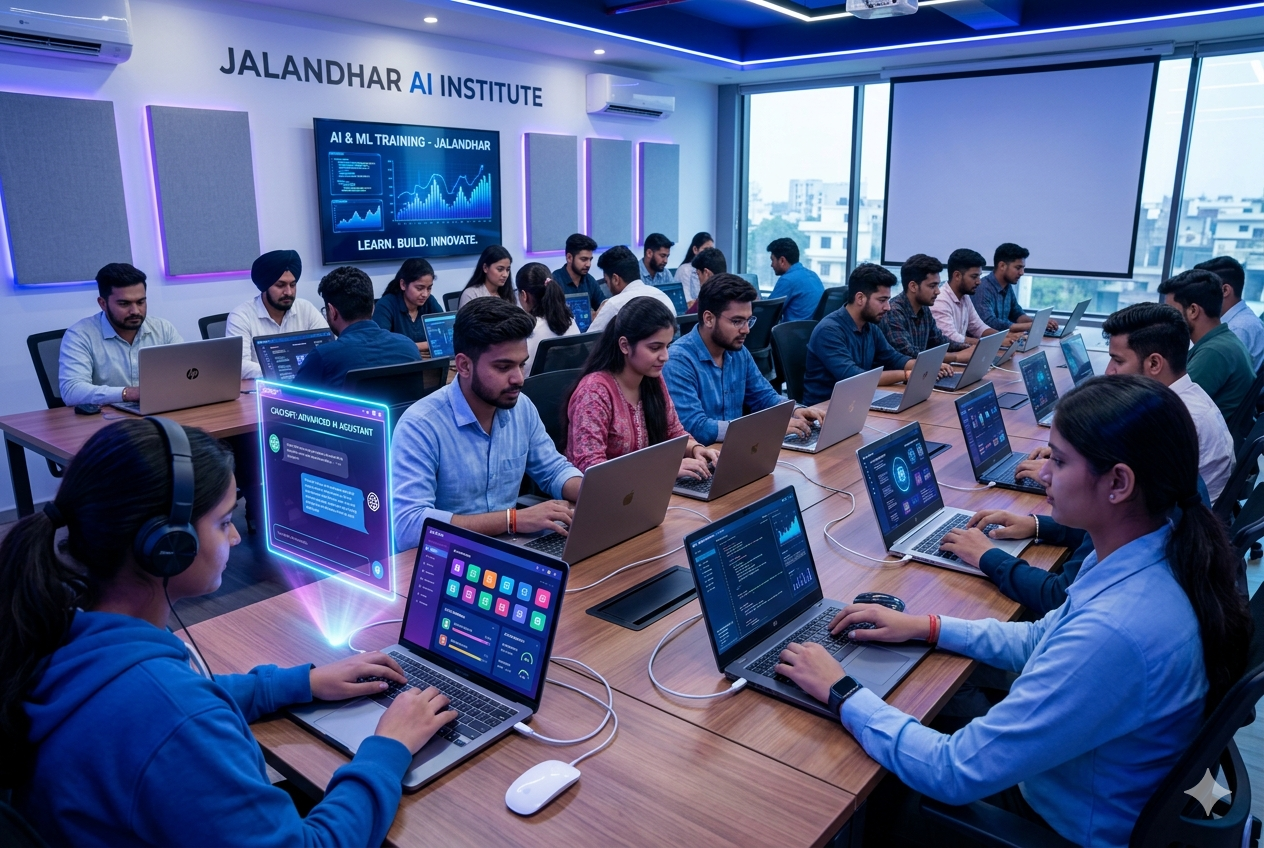
Deep Learning Courses in Jalandhar: Your Complete Guide to AI Education in Punjab

Jalandhar has emerged as a significant hub for artificial intelligence and deep learning education in Punjab, with numerous institutes offering specialized programs designed to prepare students for careers in this rapidly growing field. This comprehensive guide explores the deep learning education landscape in Jalandhar, covering course options, curriculum details, career opportunities, and everything you need to know before enrolling.


Why Deep Learning Education Matters in Today's World

Deep learning, a subset of artificial intelligence and machine learning, has revolutionized how we interact with technology. From the voice assistants on our smartphones to the recommendation algorithms on streaming platforms, deep learning powers many of the intelligent systems we use daily. The technology uses neural networks with multiple layers to process information, mimicking the way the human brain works.

For students and professionals in Jalandhar, investing in deep learning education opens doors to high-demand career opportunities. Companies across industries—healthcare, finance, e-commerce, manufacturing, and automotive—are actively seeking professionals who can develop and deploy deep learning models. The demand for AI and machine learning skills has reached unprecedented levels, making this one of the most lucrative career paths in technology today.


Major Institutes Offering Deep Learning Courses in Jalandhar

TechCADD Computer Education

TechCADD stands out as one of the most comprehensive training centers for AI and deep learning in Jalandhar. Their Professional Certificate Program in Machine Learning & AI offers a structured curriculum spanning 4-6 months, available in both regular and weekend batches.

The program emphasizes practical, hands-on learning with real-world projects. Students gain exposure to industry-standard tools including TensorFlow, PyTorch, Keras, and Google Colab. The curriculum covers everything from Python fundamentals to advanced neural network architectures, ensuring students build a strong foundation before moving to complex concepts.

What makes TechCADD particularly appealing is its placement assistance program. The institute provides resume guidance, interview preparation, and connections to potential employers. Student reviews consistently highlight the supportive learning environment and the practical orientation of the courses.

Proskills AI Academy

Proskills AI Academy offers a specialized Machine Learning Course in Jalandhar designed for students, graduates, and working professionals. The course costs ₹49,999 with flexible installment options, making quality AI education accessible to a broader audience.

The academy emphasizes 100% practical training, with students working on tool-based assignments, model-building exercises, and real use-case projects. Their curriculum covers supervised and unsupervised learning, deep learning and neural networks, model evaluation, and hyperparameter tuning. The academy also provides certification assistance and job placement support.

GTB Computer Education

GTB Institute offers a comprehensive Artificial Intelligence Course with a duration of 4-5 months. Their program covers both theoretical concepts and practical applications, including supervised and unsupervised learning, natural language processing, deep learning, and reinforcement learning.

Students receive hands-on experience with industry-standard tools like Python, TensorFlow, and Keras. The course curriculum is regularly updated to reflect the latest advancements in AI technologies, ensuring students learn current, relevant skills.

AlgoSchool AI

Positioning itself as "the first and only AI-dedicated institute in Jalandhar," AlgoSchool AI focuses exclusively on artificial intelligence education. Their mission extends beyond training—they aim to build a community where engineering students, management students, business owners, and alumni can collaborate and grow together.

Students learn through hands-on projects in machine learning, data science, generative AI, and AI agent development. The institute's community-oriented approach provides unique networking opportunities and mentorship from alumni and innovators who help shape student ideas into startups or impactful careers.

Apeejay Institute of Management and Engineering Technical Campus

For those seeking a formal degree program, Apeejay Institute offers a B.Tech in Artificial Intelligence and Machine Learning. This four-year full-time undergraduate program is recognized by AICTE and affiliated with IK Gujral Punjab Technical University.

The program has an intake of 30 seats, with admission based on JEE Main scores and merit in qualifying examinations. Eligibility requires 10+2 with Physics and Mathematics as compulsory subjects, along with one additional subject from Chemistry, Biotechnology, Biology, or Computer Science.


What You'll Learn: Deep Learning Curriculum Overview

Foundations of Neural Networks

Every deep learning course begins with the fundamentals of neural networks. Students learn about perceptrons—the building blocks of neural networks—activation functions that introduce non-linearity, and backpropagation, the algorithm that enables networks to learn from errors. Understanding these concepts is essential before moving to more advanced architectures.

Model Training and Optimization

A significant portion of any deep learning course focuses on training techniques. Students learn about loss functions that measure model performance, optimization algorithms like Stochastic Gradient Descent (SGD) and Adam that help models converge to optimal solutions, and regularization techniques that prevent overfitting.

Advanced Architectures

Modern deep learning relies on sophisticated architectures. Courses in Jalandhar typically cover:

  • Convolutional Neural Networks (CNNs) for image and video analysis

  • Recurrent Neural Networks (RNNs) for sequential data like text and time series

  • Long Short-Term Memory Networks (LSTMs) and Gated Recurrent Units (GRUs) for handling long-range dependencies

  • Transformers and Attention Mechanisms that power modern language models like ChatGPT

Specialized Domains

Most comprehensive programs include specialized modules covering:

Computer Vision: Image classification, object detection, image segmentation, and real-world applications in autonomous vehicles and medical imaging.

Natural Language Processing (NLP): Text preprocessing, word embeddings, sentiment analysis, and chatbot development. Students learn to build systems that understand and generate human language.

Generative AI: Transformer models, prompt engineering techniques, and applications like content generation and creative AI systems.


Tools and Technologies You'll Master

Deep learning courses in Jalandhar typically provide hands-on experience with industry-standard tools:


Tool Purpose
TensorFlow Google's open-source framework for building and training deep learning models
PyTorch Facebook's framework known for its dynamic computation graphs and research-friendly approach
Keras High-level API that simplifies neural network development, often used with TensorFlow
OpenCV Library for computer vision tasks used alongside CNNs
Google Colab Free cloud-based platform with GPU support for running deep learning notebooks
Jupyter Notebooks Interactive environment for writing and testing code with visualizations
Power BI/Tableau Data visualization tools for predictive analytics and AI-powered dashboards

Career Opportunities After Deep Learning Training

Completing a deep learning course in Jalandhar opens doors to numerous high-paying career paths:

Machine Learning Engineer

Machine Learning Engineers design, develop, and deploy ML models to solve real-world problems. They work with algorithms, data pipelines, and production environments, making this one of the most in-demand roles in technology.

Data Scientist

Data Scientists analyze complex datasets to extract insights and build predictive models for business decisions. They combine statistical analysis with machine learning to drive organizational strategy.

Deep Learning Specialist

These professionals develop neural networks for specialized applications like image recognition, speech processing, and pattern recognition. The role requires deep expertise in architectures like CNNs and RNNs.

NLP Engineer

NLP Engineers build intelligent systems for text processing, chatbots, and language understanding. With the rise of conversational AI, this specialization has seen tremendous growth.

AI Researcher

AI Researchers innovate and develop advanced AI techniques and models for future applications. They work in research labs, tech companies, and academic institutions, pushing the boundaries of what AI can achieve.

Computer Vision Engineer

Focusing on image and video analysis, these professionals work on applications like facial recognition, autonomous vehicles, and medical image analysis.

AI Product Manager

AI Product Managers oversee the development of AI-powered products, ensuring alignment with business objectives and user needs. They bridge technical and business domains.

AI Consultant

AI Consultants help organizations identify opportunities to integrate AI, assess business needs, and suggest solutions that improve processes and decision-making.


Short-Term Courses and Workshops

For those seeking shorter learning opportunities, Jalandhar offers several options:

NIT Jalandhar Short-Term Course

The Department of Computer Science & Engineering at Dr. B R Ambedkar National Institute of Technology Jalandhar organizes self-sponsored online short-term courses. One recent offering was "AI-Powered Innovation: Integrating Future-Ready Technologies in Real-World Applications," a 5-day program covering AI fundamentals, machine learning, deep learning, and applications across healthcare, finance, education, and manufacturing. The course also explored advanced topics like quantum computing and AI's role in 5G/6G networks.

University Workshops

DAV University, Jalandhar, regularly hosts AI and ML workshops conducted by industry partners like Ansh Infotech. These one-day sessions provide valuable insights into AI and ML basics, real-life applications, and hands-on demonstrations of how data is processed and used to build intelligent models.


Community and Networking Opportunities

TFUG Jalandhar

The TensorFlow User Group (TFUG) Jalandhar is a nonprofit official developer community under Google for Developers India. Jalandhar is one of only 27 cities in India with a TFUG chapter, providing an exclusive space to learn, share, and collaborate on the latest in AI and machine learning.

Organized by LPU alumni, TFUG Jalandhar offers workshops, talks, and discussions led by industry experts on TensorFlow and AI advancements. The community welcomes members of all skill levels and provides opportunities to network with like-minded enthusiasts, stay updated on emerging technologies, and engage in impactful projects.


Comparison of Major Deep Learning Course Providers


Institute Course Duration Key Features Price Range
TechCADD 4-6 months Industry curriculum, capstone projects, placement assistance Contact for pricing
Proskills AI Academy 4-5 months 100% practical training, installments available ₹49,999
GTB Institute 4-5 months Hands-on experience, industry-standard tools Contact for pricing
Apeejay Institute 48 months (B.Tech) AICTE-recognized degree, JEE Main admission University fee structure

How to Choose the Right Deep Learning Course

When selecting a deep learning course in Jalandhar, consider these factors:

Your Background and Goals

Beginners should look for courses that start with Python fundamentals and gradually progress to advanced concepts. Working professionals may prefer flexible schedules with weekend batches. Those seeking formal academic credentials should consider degree programs like the B.Tech at Apeejay.

Curriculum Depth

Ensure the course covers both foundational concepts and advanced topics. Look for programs that include neural network fundamentals, CNNs, RNNs, Transformers, and practical applications like computer vision and NLP.

Hands-On Experience

The best deep learning courses emphasize practical learning. Look for programs offering real-world projects, capstone assignments, and exposure to industry-standard tools like TensorFlow, PyTorch, and Google Colab.

Placement Support

If career transition is your goal, prioritize institutes offering placement assistance, resume guidance, and interview preparation. TechCADD and Proskills AI Academy both emphasize job support.

Faculty Expertise

Research the instructors' backgrounds. Courses led by industry professionals with real-world AI experience often provide more practical insights than purely academic programs.


Prerequisites and Preparation

Most deep learning courses in Jalandhar are designed to accommodate beginners, though some preparation can enhance your learning experience:

Basic Programming Knowledge

While many institutes teach Python from scratch, having basic programming familiarity helps. Python is the primary language for deep learning, so focus on fundamentals like data types, loops, functions, and libraries.

Mathematics Fundamentals

Deep learning relies on linear algebra (matrices, vectors), calculus (derivatives, gradients), and statistics. Some courses include refresher modules, but basic comfort with these concepts is beneficial.

Dedication and Consistency

Deep learning requires consistent practice. Plan to dedicate several hours weekly to coding exercises and project work, especially for comprehensive 4-6 month programs.


The Future of Deep Learning Education in Jalandhar

Jalandhar's deep learning education ecosystem continues to evolve. The presence of specialized institutes like AlgoSchool AI, professional training centers like TechCADD and Proskills, academic programs at Apeejay, and community groups like TFUG Jalandhar creates a comprehensive learning environment.

The city's educational infrastructure is complemented by industry connections. Many institutes maintain relationships with tech companies, facilitating internships and placements for students. The emphasis on practical, project-based learning ensures graduates are job-ready.

As AI continues to transform industries, the demand for skilled deep learning professionals will only grow. For students and professionals in Jalandhar, investing in deep learning education represents a strategic career move—one that opens doors to opportunities in one of the most exciting and rapidly advancing fields in technology.


Conclusion

Deep learning courses in Jalandhar offer comprehensive pathways into the world of artificial intelligence. Whether you choose a short-term certification, a professional diploma, or a full-degree program, the city's educational institutions provide quality training with strong practical components.

The combination of structured curricula, hands-on projects, industry-standard tools, and placement support makes Jalandhar a viable destination for AI education. With institutes like TechCADD, Proskills AI Academy, GTB, and Apeejay offering diverse options, learners can find programs aligned with their goals, schedules, and budgets.

As you embark on your deep learning journey, remember that success requires consistent effort and practice. The field evolves rapidly, so continuous learning beyond the course—through communities like TFUG Jalandhar and self-study—will serve you well. With dedication and the right training, you can build the skills needed to thrive in the AI-driven future.

Why TechCADD is Jalandhar's Premier Destination for Deep Learning and AI Education

In the rapidly evolving landscape of artificial intelligence and deep learning education, choosing the right training institute can make the difference between a mediocre learning experience and a transformative career launch. TechCADD Computer Education has emerged as a standout institution in Jalandhar, offering specialized programs that combine industry-relevant curriculum, expert mentorship, and proven placement support. This comprehensive analysis explores why TechCADD has become the preferred choice for aspiring AI and deep learning professionals in Punjab.

The Growing Importance of Deep Learning Education

Before diving into what makes TechCADD exceptional, it's worth understanding why deep learning education matters. Deep learning, a sophisticated subset of machine learning, uses artificial neural networks to process information in ways that mimic the human brain. This technology powers everything from voice assistants and recommendation systems to autonomous vehicles and medical diagnostics.

The demand for AI and deep learning professionals has reached unprecedented levels. According to industry reports, companies across healthcare, finance, e-commerce, manufacturing, and automotive sectors are actively seeking professionals who can develop, train, and deploy deep learning models. For students and professionals in Jalandhar, investing in quality deep learning education opens doors to some of the most lucrative and future-proof career paths available today.

TechCADD's Specialized Deep Learning and AI Programs

TechCADD offers a comprehensive Professional Certificate Program in Machine Learning & AI that serves as the cornerstone of their deep learning education offerings. This program, lasting 4-6 months with flexible regular and weekend batch options, is designed to transform beginners into job-ready AI professionals.

Comprehensive Curriculum Structure

What sets TechCADD apart is the depth and currency of their curriculum. Rather than teaching outdated concepts, TechCADD maintains a "living, breathing curriculum" that evolves through direct feedback from industry partners. The program covers:

Module 1: Introduction to Artificial Intelligence and Machine Learning
Students begin with foundational concepts, understanding the history, evolution, and real-world applications of AI. This module establishes why deep learning matters and where it fits within the broader AI landscape.

Module 2: Python for Data Science and AI
Python serves as the primary programming language for deep learning. TechCADD's instruction goes beyond basic syntax to cover data manipulation with NumPy and Pandas, along with visualization using Matplotlib. Students learn to work with real datasets from day one.

Module 3: Supervised and Unsupervised Learning
Before diving into deep learning, students master classical machine learning algorithms including linear regression, decision trees, support vector machines (SVM), and K-means clustering. This foundation ensures understanding of when and why deep learning approaches are appropriate.

Module 4: Deep Learning and Neural Networks
This is where TechCADD's deep learning specialization truly shines. Students explore neural network architecture, activation functions, backpropagation algorithms, and optimization techniques. The curriculum covers both theoretical understanding and practical implementation.

Module 5: Advanced Deep Learning Architectures
Students master Convolutional Neural Networks (CNNs) for computer vision applications and Recurrent Neural Networks (RNNs) for sequential data like text and time series. These architectures form the backbone of modern AI applications.

Module 6: Natural Language Processing (NLP)
The NLP module covers text preprocessing, word embeddings, sequence modeling, and sentiment analysis. Students learn to build chatbots and language understanding systems, skills that are in extremely high demand.

Module 7: Generative AI and Advanced Models
This cutting-edge module covers transformer models, ChatGPT architecture, and prompt engineering techniques. TechCADD ensures students understand the latest developments in generative AI, preparing them for the current job market.

Module 8: Computer Vision
Students gain hands-on experience with image classification, object detection, and image segmentation using real-world datasets. This module has applications in healthcare, autonomous vehicles, security, and retail.

Module 9: AI Tools and Libraries
Practical training with industry-standard tools including TensorFlow, Keras, PyTorch, and Google Colab ensures students can work in any AI development environment.

Module 10: Data Visualization and Predictive Analytics
Using Power BI and Tableau, students learn to create AI-powered interactive dashboards that communicate insights effectively to business stakeholders.

Module 11: Model Deployment and Optimization
The curriculum covers deploying models using AWS, Google AI Platform, and TensorFlow Serving. Students learn to optimize models for production environments, a critical skill often overlooked in other programs.

Module 12: AI Ethics and Responsible AI
TechCADD recognizes the importance of ethical considerations in AI development. This module covers data privacy, bias detection, fairness, transparency, and responsible AI practices.

Module 13: Capstone Projects
The program culminates with hands-on projects where students build real-world applications like recommender systems, fraud detection models, and chatbots. These projects become portfolio pieces that demonstrate competence to employers.

What Makes TechCADD Different: The Distinctive Advantages

1. Industry-Formed Curriculum, Not Textbook Education

Perhaps the most significant differentiator for TechCADD is their commitment to curriculum relevance. Many institutes in Jalandhar teach outdated syllabi that bear little relation to what companies actually need. TechCADD takes a different approach.

Their curriculum is constantly updated through direct feedback from industry partners. When students learn Python, they don't just learn syntax—they learn Python with Django for web applications and Python for data science with real datasets. When they study data analytics, they work with the complete data pipeline using SQL, Power BI, and Tableau.

The focus on tool-based learning means students become proficient with the actual tools used in professional environments: Kali Linux for cybersecurity concepts relevant to AI security, TensorFlow for deep learning, and deployment tools like Docker. This practical orientation ensures graduates can contribute from their first day on the job.

2. Mentors Who Have Been in the Trenches

TechCADD's faculty represents another critical advantage. Unlike institutes where instructors are academically qualified but lack real-world experience, TechCADD's trainers are seasoned industry professionals.

The instructors include active data scientists, AI engineers, and cybersecurity experts who bring current industry challenges, best practices, and workflows directly into the classroom. This mentorship model goes beyond traditional teaching—students receive guidance from professionals who have solved real problems and can share insights that no textbook can provide.

Angelina, a student who completed TechCADD's cybersecurity program, described how this mentorship transformed her understanding: "The instructor demystified the entire field. He explained that ethical hacking isn't about random guessing; it's a methodological process. The course was mapped out like a journey, starting with fundamentals and moving to advanced techniques. It was exactly the structured approach I needed".

3. Unmatched "Learn by Doing" Philosophy

TechCADD's pedagogical approach centers on project-based learning. Theory without practice is forgettable, and TechCADD ensures students build tangible skills through hands-on work.

From the first month, students work on real projects. Web design students build and deploy live websites. AI students complete capstone projects analyzing real-world datasets. Cybersecurity students practice penetration testing in dedicated lab environments.

The classroom environment itself reflects this practical orientation. In TechCADD's data science classes, instructors demonstrate coding live on a projector while students follow along on their own computers. This setup allows immediate practice and reinforcement of concepts.

Students work together in small groups, discussing ideas, solving problems collaboratively, and supporting each other during exercises. The instructor moves around the room providing personalized guidance, ensuring no student falls behind.

4. Proven Placement Success and Career Transformation

TechCADD's placement record speaks volumes about the quality of their training. The institute maintains a dedicated placement cell that actively engages with hiring partners across Chandigarh, Mohali, Delhi, and beyond.

But TechCADD's career support goes far beyond forwarding resumes. The institute provides:

  • Resume-building workshops that highlight practical skills and project experience

  • Mock interviews with real-time feedback on technical and soft skills

  • Portfolio guidance to help students showcase their best work

  • Soft-skills training for professional communication

  • Career counseling to align interests with the right career paths

The results speak for themselves. Consider Salvi's story—a B.Com graduate stuck in a monotonous back-office job who transformed into a confident Python developer. "Within two months of completing the course, I had three job offers!" Salvi exclaims. "The starting salary was double what I was making in my previous job".

Or Angelina's journey from a curious beginner to a professional ethical hacker: "I received an offer from an IT risk consulting firm as a junior penetration tester. In my first week, I identified a critical SQL injection flaw that their own developers had missed. The feeling of protecting a business from a potential breach was immensely satisfying".

5. State-of-the-Art Infrastructure

TechCADD's physical infrastructure supports their educational philosophy. Located centrally in Jalandhar, the institute is easily accessible from all major areas of the city.

The computer labs feature high-end systems with licensed software and high-speed internet. Students learn on the same tools they'll encounter in professional environments, ensuring no transition shock when they enter the workforce.

The classroom environment is designed for collaborative learning, with desks and workstations arranged to encourage teamwork and peer learning.

6. Focus on Future-Proof and Niche Careers

While many institutes offer generic computer courses, TechCADD provides specialized pathways to the most promising careers in technology. Their deep learning and AI program is just one example of this niche specialization.

Other specialized programs include:

  • Data Science and Machine Learning with focus on real-world applications

  • Cyber Security and Ethical Hacking with dedicated lab environments

  • Full-Stack Web Development covering both front-end and back-end technologies

  • UI/UX Design for creating user-centered digital experiences

  • Digital Marketing with practical campaign experience

This specialization ensures students develop deep expertise rather than shallow familiarity with multiple topics.

7. Recognized Certification and Credibility

Completing TechCADD's Professional Certificate Program in Machine Learning & AI results in a recognized certification that adds credibility to graduates' profiles. This certification signals to employers that the holder has demonstrated competence through rigorous training and project work.

The institute maintains a 5.00 average rating based on student reviews, reflecting consistent satisfaction with their programs. Student testimonials consistently highlight the quality of instruction, supportive environment, and practical orientation:

Karan Sharma, an AI program student, notes: "I have been studying here from the past few months and I would say that this institute is really very good as it provides a friendly environment for students and also the facilities are amazing".

Sandeep Chahal adds: "I am doing full stack course there and I feel very glad to join this institute. Staff is very cooperative and all classes are well maintained and teacher are so cooperative and provide appropriate knowledge regarding course".

8. Industry Recognition and Academic Partnerships

TechCADD's reputation extends beyond individual student success. The institute has earned recognition from academic institutions, with Innocent Hearts Group of Institutions, Loharan, organizing an industrial visit to TechCADD for their IT department students.

During this visit, students explored IT services, digital marketing, graphic design, skill development, and animation. They learned about software development, web development, e-commerce solutions, content creation, and modern frameworks. This academic partnership demonstrates TechCADD's standing as a respected training institution in the region.

9. Flexible Learning Options

Understanding that students have diverse needs and schedules, TechCADD offers flexible learning options. Their AI and deep learning programs are available in both online and classroom modes, with regular and weekend batches.

This flexibility makes quality AI education accessible to working professionals who need to balance learning with existing commitments, as well as students who prefer intensive full-time study.

10. Affordable Investment with High Returns

TechCADD positions their programs as value-based education with strong return on investment. The AI course is structured to be affordable while delivering industry-relevant skills that command competitive salaries in the job market.

For students who complete the Professional Certificate Program in Machine Learning & AI, the career outcomes justify the investment. AI professionals in India can expect salaries ranging from entry-level positions to highly competitive packages for experienced specialists.

Career Opportunities After TechCADD's Deep Learning Program

TechCADD's comprehensive training prepares graduates for multiple high-demand career paths:

Machine Learning Engineer

Machine Learning Engineers design and train ML models to solve real-world problems using data-driven algorithms. This role involves selecting appropriate algorithms, training models, and optimizing performance.

AI Researcher

AI Researchers innovate and develop advanced AI techniques and models for future applications. They work in research labs, tech companies, and academic institutions, pushing the boundaries of what AI can achieve.

Data Scientist

Data Scientists analyze complex datasets to extract insights and build predictive models for business decisions. They combine statistical analysis with machine learning to drive organizational strategy.

NLP Engineer

NLP Engineers build intelligent systems for text processing, chatbots, and language understanding. With the rise of conversational AI, this specialization has seen tremendous growth.

Deep Learning Specialist

These professionals develop neural networks for specialized applications like image recognition, speech processing, and pattern recognition. The role requires deep expertise in architectures like CNNs and RNNs.

Computer Vision Engineer

Focusing on image and video analysis, these professionals work on applications like facial recognition, autonomous vehicles, and medical image analysis.

AI Consultant

AI Consultants advise organizations on AI adoption, implementation, and process optimization. They help businesses identify opportunities where AI can drive value.

AI Product Manager

AI Product Managers oversee development of AI-powered products, ensuring alignment with business objectives and user needs.

Business Intelligence Analyst

These professionals use AI tools to visualize data trends and support strategic decision-making across organizations.

AI Trainer

AI Trainers educate others about AI concepts, tools, and technologies. They conduct workshops and coaching sessions for professionals seeking to understand AI applications.

How TechCADD Compares to Other Institutes in Jalandhar

While Jalandhar has several institutes offering AI and ML training—including ThinkNEXT Technologies, TCIL-IT Jalandhar, and WebTech Learning—TechCADD distinguishes itself in several critical ways:


Criteria TechCADD Typical Competitors
Curriculum Currency Industry-forged, updated through partner feedback Often textbook-based, slow to update
Faculty Industry professionals with active experience Academically qualified but limited practical experience
Learning Approach Project-based with real-world applications Theory-heavy with minimal hands-on work
Placement Support Dedicated cell with mock interviews, portfolio guidance Resume forwarding only
Infrastructure Modern labs with licensed software Basic computer facilities
Specialization Deep specialization in high-demand fields Generic computer courses
Certification Industry-recognized with strong credibility Basic course completion certificates

Student Success Stories: The Proof Is in the Outcomes

Salvi: From B.Com Graduate to Python Developer

Salvi's transformation represents what's possible with TechCADD's training. Coming from a non-IT background with a B.Com degree, she felt trapped in a dead-end job with no growth prospects.

"What stood out for me was the reviews from other career-switchers," Salvi recalls. "They weren't just from engineering students; there were people from commerce and arts backgrounds who had successfully transitioned into IT. That gave me hope".

The TechCADD counsellor didn't promise quick fixes but outlined a realistic path. Salvi learned Python with Django framework, building projects from simple calculators to complex database-driven web applications. The project-based approach was transformative.

"Within two months of completing the course, I had three job offers! The starting salary was double what I was making in my previous job," she shares.

Angelina: From Curious Beginner to Ethical Hacker

Angelina's journey from a BCA graduate with general computer knowledge to a skilled ethical hacker demonstrates TechCADD's effectiveness in specialized fields.

"I was always the person my family would call when their phone behaved strangely. I enjoyed solving these puzzles," Angelina explains. Her curiosity led her to cybersecurity, but terms like "penetration testing" and "network security" seemed like foreign languages.

At TechCADD, she found the structured approach she needed. Starting with networking fundamentals and Linux, she progressed to vulnerability assessment and penetration testing. The hands-on labs allowed safe practice of offensive security techniques.

Today, Angelina works as a junior penetration tester. "Using the skills I learnt at TechCADD, I identified a critical SQL injection flaw that their own developers had missed. The feeling of protecting a business from a potential breach was immensely satisfying".

Manmeet Kaur: Enhancing Technical Skills

Manmeet's experience reflects the broader value of TechCADD's approach: "A great place to learn and enhance your technical skills. Nice place to upgrade your skills and upgrade your career in IT sector. So you must enroll yourself in this institute".

Making the Right Choice: A Checklist for Prospective Students

Before enrolling in any deep learning program, TechCADD suggests asking these critical questions:

  • Is the curriculum updated for the current year and aligned with job descriptions?

  • Who are the trainers, and what industry experience do they have?

  • What does "placement assistance" actually include? Can I see verified placement records?

  • Will I build a tangible portfolio of projects during the course?

  • Does the institute offer specialized courses for high-demand fields, or just generic ones?

When evaluated against this checklist, TechCADD emerges as a clear leader among Jalandhar's computer education institutes.

Conclusion: Why TechCADD Should Be Your Choice for Deep Learning Education

Deep learning and artificial intelligence represent the most exciting career opportunities in technology today. For students and professionals in Jalandhar seeking to enter this field, TechCADD offers a compelling combination of industry-relevant curriculum, expert mentorship, hands-on learning, and proven placement support.

The institute's Professional Certificate Program in Machine Learning & AI provides comprehensive coverage of everything from Python fundamentals to advanced generative AI models. Students emerge not just with theoretical knowledge but with practical skills demonstrated through portfolio projects and real-world applications.

The success stories of Salvi, Angelina, and countless others demonstrate that TechCADD delivers on its promises. Whether you're a student with a non-IT background, a working professional seeking career advancement, or an entrepreneur wanting to leverage AI for business growth, TechCADD provides the education, support, and guidance needed to achieve your goals.

As Manmeet Kaur noted, TechCADD is indeed "a great place to learn and enhance your technical skills". In the rapidly evolving field of deep learning, choosing the right educational partner matters enormously. TechCADD has established itself as Jalandhar's premier destination for AI and deep learning education—a choice that can transform your career trajectory and open doors to opportunities in one of the most dynamic fields in technology.

The AI revolution is not coming; it's already here. With TechCADD's training, you can be part of shaping that revolution rather than merely observing it. Visit TechCADD's Jalandhar centre for a free career counselling session and demo class to experience the difference yourself. Your journey from aspirant to AI professional can begin today.




However, the field is still in its early stages. The global AI market, valued at approximately $200 billion in 2024, is projected to grow at a compound annual growth rate (CAGR) of over 35% through 2030, with deep learning technologies accounting for a significant share. India, with its vast pool of technical talent and growing digital infrastructure, is positioned to become a global AI hub. The National AI Strategy (NITI Aayog) and initiatives like "AI for All" are already creating an ecosystem that will drive demand for skilled deep learning professionals for years to come.


2. Emerging Trends That Will Define the Future of Deep Learning

2.1 Generative AI and Foundation Models

Generative AI—models that can create text, images, code, and even scientific discoveries—has captured the world's imagination. The rise of large language models (LLMs) like GPT‑4, Claude, and Gemini, and image generators like DALL·E and Midjourney, represents a paradigm shift. The future will see:

  • Multimodal models that seamlessly combine text, image, audio, and video, enabling applications like AI assistants that can "see" and "hear."

  • Smaller, efficient models optimized for specific domains and capable of running on edge devices.

  • Customized foundation models tailored for industries like healthcare, legal, and finance.

For deep learning professionals, expertise in transformer architectures, fine-tuning techniques, and prompt engineering will become increasingly valuable. The demand for professionals who can adapt foundation models to specific business problems will far exceed supply.

2.2 Edge AI and TinyML

Today, most deep learning models run in the cloud, but the future is at the edge. Edge AI involves running models directly on devices—smartphones, cameras, IoT sensors, medical devices—reducing latency, enhancing privacy, and enabling real‑time decision‑making. TinyML, a subset of edge AI, focuses on running models on microcontrollers with minimal power consumption.

Applications range from predictive maintenance in factories to smart agriculture and wearable health monitors. The edge AI market is expected to exceed $100 billion by 2030, creating demand for engineers skilled in model compression, quantization, and deployment on embedded platforms.

2.3 Self‑Supervised and Few‑Shot Learning

Traditional deep learning requires massive labeled datasets, a major bottleneck. Self‑supervised learning (SSL)—where models learn from unlabeled data by solving pretext tasks—is changing this. SSL enables models to understand structure from raw data, drastically reducing the need for human annotation. Few‑shot and zero‑shot learning allow models to generalize to new tasks with minimal examples.

These techniques will make deep learning accessible to industries where labeled data is scarce, such as healthcare (rare diseases), manufacturing (fault detection), and agriculture (pest identification). Professionals who understand SSL, contrastive learning, and meta‑learning will be at the forefront.

2.4 AI for Science and Engineering

Deep learning is accelerating scientific discovery. From protein folding (AlphaFold) to climate modeling, materials science, and drug discovery, AI is becoming an indispensable tool for researchers. Future breakthroughs will include:

  • AI‑driven drug development, cutting time and costs.

  • Fusion energy research, where deep learning helps control plasma.

  • Personalized medicine, using genomic data to tailor treatments.

These applications require interdisciplinary expertise: deep learning combined with domain knowledge in biology, chemistry, physics, or engineering. For those willing to bridge these fields, the opportunities are immense.

2.5 Responsible AI and AI Governance

As AI systems become more powerful, concerns about bias, fairness, transparency, and security grow. The future will see increased regulation and the emergence of "responsible AI" as a core discipline. Professionals who can build explainable models, audit AI systems for bias, and implement AI safety protocols will be in high demand.

Governments and enterprises are already establishing AI ethics boards and compliance frameworks. By 2030, every major organization deploying AI will have dedicated roles for AI governance, risk management, and ethical oversight.

2.6 AI in Cybersecurity

Cyber threats are evolving in complexity and scale. Deep learning is being used to detect anomalies, predict attacks, and automate incident response. The future will see:

  • AI‑powered security operations centers (SOCs) that reduce response time.

  • Adversarial machine learning—both attacking and defending AI systems.

  • Deepfake detection and digital forensics.

Cybersecurity professionals with deep learning expertise will be among the most sought‑after in the industry.


3. Industry‑Wise Future Scope of Deep Learning

3.1 Healthcare

Healthcare is poised for a deep learning revolution. The market for AI in healthcare is projected to exceed $180 billion by 2030. Key applications include:

  • Medical imaging: AI for detecting tumors, fractures, and retinal diseases with accuracy surpassing human radiologists.

  • Drug discovery: Reducing time from lab to patient from years to months.

  • Personalized treatment: Using patient data to recommend optimal therapies.

  • Remote patient monitoring: Wearables and AI for early warning of health deterioration.

For deep learning practitioners, opportunities exist in hospitals, diagnostic chains, pharmaceutical companies, and health‑tech startups.

3.2 Finance and Banking

Financial institutions are heavy adopters of AI. Future applications include:

  • Algorithmic trading with AI that adapts to market conditions.

  • Fraud detection using graph neural networks and anomaly detection.

  • Risk management with deep learning models that simulate economic scenarios.

  • Customer service through conversational AI.

The demand for deep learning specialists in fintech, investment banks, and insurance companies will continue to grow.

3.3 Automotive and Autonomous Systems

Self‑driving cars are the most visible deep learning application, but the impact extends to autonomous drones, robotics, and smart logistics. The global autonomous vehicle market is expected to surpass $2 trillion by 2030. Deep learning powers perception (object detection), planning, and control. Professionals with expertise in computer vision, sensor fusion, and reinforcement learning will find abundant opportunities.

3.4 Manufacturing and Industry 4.0

Smart factories use deep learning for predictive maintenance, quality inspection, and supply chain optimization. Computer vision systems detect defects in real time, reducing waste. Generative design uses AI to create optimized parts. As India pushes "Make in India" with a focus on Industry 4.0, the need for AI talent in manufacturing will surge.

3.5 Agriculture

Precision agriculture uses deep learning to monitor crop health, predict yields, detect pests, and optimize irrigation. Drones equipped with computer vision can survey vast fields. With agriculture being a mainstay of the Punjab economy, deep learning applications tailored to local crops and conditions present a unique opportunity for Jalandhar‑based professionals.

3.6 Retail and E‑commerce

From personalized recommendations to inventory management and cashier‑less stores, deep learning is reshaping retail. The future will bring hyper‑personalization, visual search, and AI‑driven supply chains. Leading companies like Amazon, Flipkart, and Reliance are investing heavily in AI.

3.7 Education

AI in education (EdTech) will personalize learning, automate grading, and provide tutoring. With the rise of online education, deep learning can adapt content to each student's pace and style. India's EdTech market, already worth billions, will continue to expand, creating roles for AI engineers who understand pedagogy and learning analytics.


4. Career Opportunities and Emerging Job Roles

The future scope of deep learning is reflected in the evolving job market. While traditional roles like Machine Learning Engineer and Data Scientist will remain strong, new specialized roles are emerging:

4.1 Prompt Engineer / LLM Specialist

With the proliferation of large language models, organizations need experts who can design effective prompts, fine‑tune models, and integrate LLMs into applications. This role combines deep learning knowledge with creativity and domain understanding.

4.2 AI Model Architect

Designing and scaling foundation models requires deep expertise in transformer architectures, distributed training, and hardware acceleration. These roles are currently among the highest‑paid in AI.

4.3 MLOps Engineer

As AI moves to production, MLOps (Machine Learning Operations) has become critical. MLOps engineers manage model deployment, monitoring, and continuous improvement. They bridge data science and DevOps.

4.4 Edge AI Engineer

Specialists in deploying models on mobile devices, IoT, and embedded systems. They understand model optimization, quantization, and hardware constraints.

4.5 AI Product Manager

Product managers with deep learning literacy are essential for translating technical capabilities into viable products. They define roadmaps, prioritize features, and coordinate between business and engineering teams.

4.6 Responsible AI Specialist

Roles focused on fairness, explainability, and compliance. They work with development teams to audit models and ensure adherence to emerging regulations.

4.7 AI Research Scientist

Research scientists push the boundaries of deep learning, publishing papers and developing novel algorithms. Positions exist in corporate R&D labs (Google, Microsoft, etc.), universities, and startups.

4.8 AI Consultant

Consultants help organizations identify AI opportunities, develop strategies, and implement solutions. With AI adoption spreading across traditional industries, consultants are in high demand.

Salary Outlook

Salaries for deep learning professionals in India vary by role and experience. Entry‑level positions (0‑2 years) typically range from ₹6‑12 LPA, mid‑level (3‑5 years) from ₹15‑30 LPA, and senior roles (6+ years) can exceed ₹50 LPA, with top‑tier product companies offering ₹1 crore+ compensation packages. Globally, deep learning specialists command even higher salaries, with remote work opportunities expanding access to international markets.


5. Future Scope for Graduates from Jalandhar

Jalandhar, with its growing educational infrastructure and proximity to the Chandigarh‑Mohali IT corridor, offers unique advantages for aspiring deep learning professionals.

5.1 Local Industry Presence

The region is home to a growing number of IT companies, BPOs, and startups that are increasingly adopting AI. Companies like Infosys, Tech Mahindra, and numerous SMEs have presence in Mohali and Chandigarh, just a few hours away. Many TechCADD alumni have secured placements in these firms.

5.2 Remote Work Opportunities

The post‑pandemic world has normalized remote work. Deep learning professionals in Jalandhar can work for companies based in Bengaluru, Mumbai, or even Silicon Valley without relocating. This opens up high‑salary opportunities while allowing professionals to stay in their home city.

5.3 Entrepreneurial Ecosystem

There is growing support for tech startups in Punjab. With domain‑specific knowledge (e.g., agriculture, manufacturing), Jalandhar‑based professionals can build AI solutions for local industries. Government initiatives like Startup Punjab and incubators at institutions like NIT Jalandhar provide a nurturing environment.

5.4 Freelancing and Consulting

Deep learning expertise can be monetized through freelance platforms like Upwork and Toptal, or by offering consulting services to local businesses. Many professionals in Jalandhar have built successful independent careers after training at institutes like TechCADD.

5.5 Academic and Research Pathways

For those inclined toward academia, there are opportunities to pursue higher studies (M.Tech, PhD) at institutions like NIT Jalandhar, IITs, or abroad. The future scope includes becoming educators and researchers who shape the next generation of AI talent.


6. Skills Required to Stay Future‑Ready

To capitalize on the future scope of deep learning, aspiring professionals should focus on building a robust skill set:

  • Programming: Advanced Python, with proficiency in libraries like TensorFlow, PyTorch, and JAX.

  • Mathematics: Linear algebra, calculus, probability, and optimization.

  • Deep Learning Architectures: CNNs, RNNs, Transformers, GANs, VAEs, and emerging architectures like diffusion models.

  • MLOps and Deployment: Docker, Kubernetes, cloud platforms (AWS, GCP, Azure), and monitoring tools.

  • Data Engineering: SQL, data pipelines, and big data technologies (Spark, etc.).

  • Domain Specialization: Acquiring expertise in a specific industry (healthcare, finance, etc.) can significantly enhance career prospects.

  • Soft Skills: Communication, problem‑solving, and business acumen—essential for translating AI capabilities into business value.


7. The Role of Institutes Like TechCADD in Shaping the Future

As deep learning continues to evolve, the importance of quality education cannot be overstated. Institutes like TechCADD in Jalandhar play a crucial role by:

  • Delivering industry‑relevant curricula that evolve with the field.

  • Providing hands‑on experience through projects that simulate real‑world challenges.

  • Building foundational skills that enable lifelong learning—essential in a fast‑changing field.

  • Connecting students with employers through placement support and networking.

For students in Jalandhar, enrolling in a comprehensive deep learning program is the first step toward a future‑proof career. TechCADD’s focus on practical training, mentorship by industry professionals, and commitment to placement aligns perfectly with the demands of the future job market.


8. Challenges and How to Overcome Them

While the future is bright, there are challenges:

  • Rapid pace of change: Technologies become outdated quickly. Continuous learning is non‑negotiable.

  • Ethical concerns: AI can perpetuate bias; practitioners must be vigilant.

  • Data availability: Real‑world projects often face data scarcity. Learning to work with synthetic data and transfer learning is essential.

  • Competition: The field is becoming crowded; specialization and strong portfolios are key differentiators.

Students can overcome these by cultivating a growth mindset, participating in communities like TFUG Jalandhar, contributing to open source, and building a visible presence on platforms like GitHub and LinkedIn.


9. Conclusion: A Decade of Opportunity

Deep learning is not just a technology trend—it is a foundational shift that will underpin the next generation of innovation. From healthcare to agriculture, from finance to manufacturing, deep learning will create new industries, transform existing ones, and generate millions of jobs worldwide.

For students and professionals in Jalandhar, this represents an unprecedented opportunity. The city’s educational ecosystem, with institutes like TechCADD providing cutting‑edge training, positions learners to enter this field with confidence. The future scope of deep learning is vast, and those who invest in building strong skills today will be the architects of tomorrow’s intelligent world.

Whether you aspire to be a machine learning engineer at a global tech giant, an AI entrepreneur solving local problems, or a researcher pushing the boundaries of AI, the path begins with quality education and a commitment to lifelong learning. The future is intelligent—and it’s waiting for you.