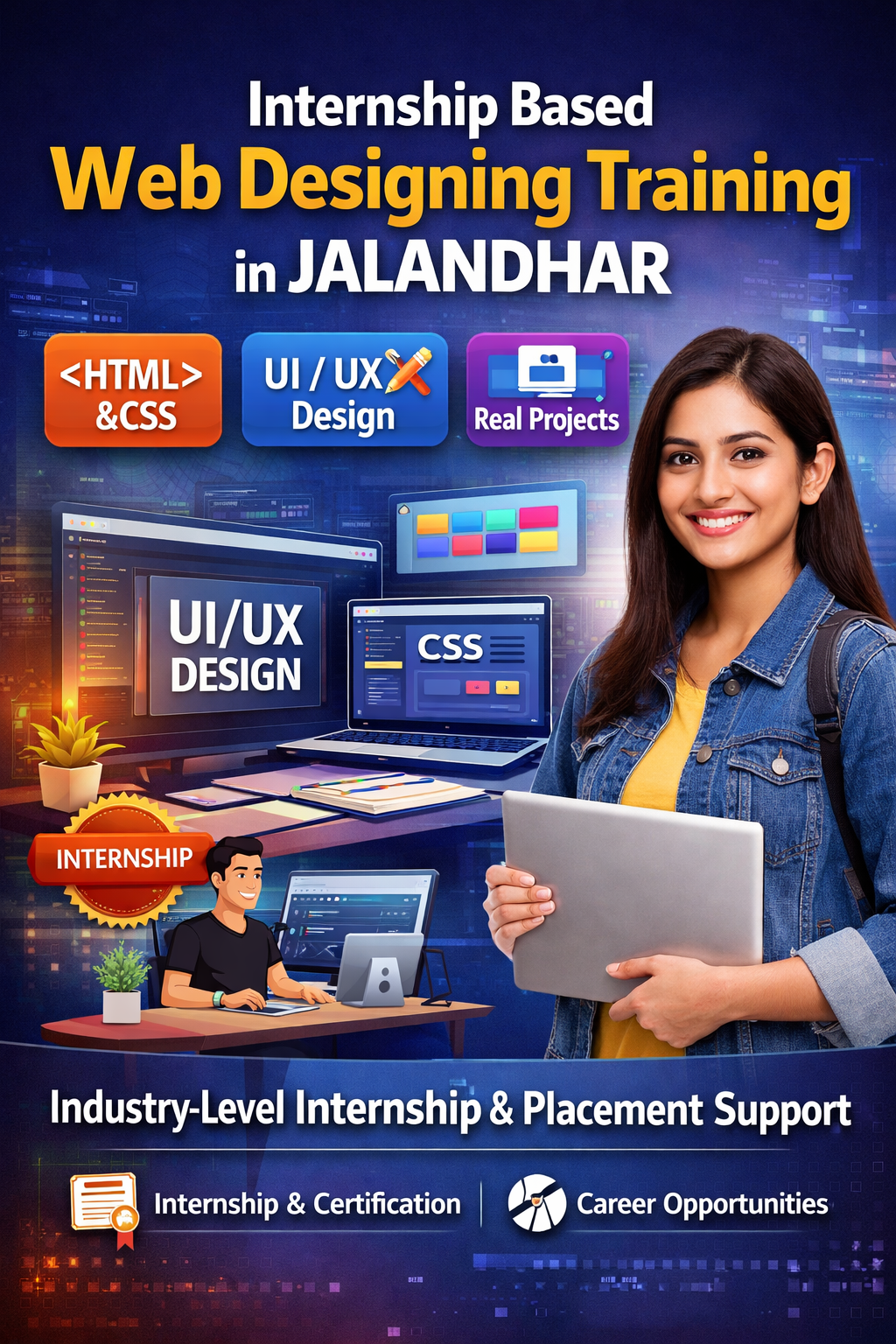
Internship Based Web Designing Training in Jalandhar — Complete Course Overview
Introduction: Where Learning Meets Real Experience
There is a significant difference between knowing how to design a website and actually being able to do it under real-world conditions — with real clients, real deadlines, real feedback, and real expectations. Most traditional training programs focus exclusively on classroom-based learning, leaving students underprepared for the actual demands of a professional work environment. This is precisely the gap that TechCADD's Internship Based Web Designing Training in Jalandhar is designed to bridge.
Our internship-integrated web designing program is a bold and forward-thinking approach to professional training that combines structured classroom instruction with genuine, hands-on internship experience. Students do not simply learn theory and then search for experience afterward — they build skills and gain professional experience simultaneously, emerging from the program as confident, workplace-ready web designers who have already proven themselves in a real professional setting.
This is not just a course. It is a complete career launching experience designed to give every student the knowledge, the portfolio, the professional exposure, and the confidence they need to succeed from day one of their professional journey. If you are serious about building a thriving career in web designing, this program is designed specifically for you.
What Makes Internship Based Training Different?
Before exploring the details of the curriculum, it is important to understand why internship-based training is fundamentally superior to conventional classroom-only programs. In a standard web designing course, students learn skills in a controlled, low-pressure environment where mistakes carry no real consequences. While this is useful for initial learning, it does not prepare students for the realities of working with actual clients, managing project timelines, incorporating client feedback, collaborating with team members, and delivering polished work under pressure.
Internship-based training changes all of this by embedding real work experience into the training program itself. Students apply what they learn in the classroom to actual projects with real stakes. They experience the full lifecycle of a web design project — from the initial client brief and concept development to design execution, revision rounds, and final delivery. This exposure transforms students not just into technically skilled designers but into genuine professionals who understand how the industry works from the inside out. Employers recognize and value this distinction enormously, which is why internship-trained graduates consistently receive faster placements, better job offers, and stronger career trajectories than their conventionally trained peers.
Program Structure and Duration
The Internship Based Web Designing Training at TechCADD is structured as a comprehensive program spanning 4 to 6 months, divided into two seamlessly integrated phases. The first phase focuses on intensive classroom training where students build a strong technical and creative foundation. The second phase transitions into a structured internship where students apply their skills to real projects in a professional environment, guided and mentored by experienced industry professionals.
Both phases overlap strategically, meaning students begin getting exposure to real project work before their classroom training is even complete. This progressive integration ensures a smooth, natural transition from learning to doing, with continuous support and mentorship throughout the entire journey.
Phase One: Comprehensive Classroom Training
Module 1: Digital Foundations and the World of Web Design
Every great web designer begins with a thorough understanding of the digital ecosystem in which they operate. This foundational module introduces students to how the internet functions, the relationship between domain names and web hosting, the role of browsers and servers, and the different categories of websites that exist in the digital world. Students develop a clear mental map of where web design fits within the broader technology industry and what career paths are available to them. This big-picture understanding gives every subsequent module a meaningful context and helps students make more informed decisions throughout their learning journey.
Module 2: HTML5 — Structuring the Digital World
HTML5 is the fundamental language used to structure every piece of content on the internet. In this module, students receive thorough, practical training in writing clean, semantic, and well-organized HTML code. They learn to work with all essential HTML elements including headings, paragraphs, links, images, lists, tables, forms, and multimedia. Particular emphasis is placed on semantic HTML practices — using the right tags for the right content — which is critical for both accessibility standards and search engine visibility. By the end of this module, students can confidently build a complete, well-structured web page entirely from scratch, forming the bedrock upon which all subsequent design skills are built.
Module 3: CSS3 — The Art of Visual Design
If HTML gives a website its structure, CSS3 gives it its soul. This module dives deep into the world of visual styling, teaching students how to control every aspect of a website's appearance — colors, typography, spacing, backgrounds, borders, shadows, and layout. Advanced CSS3 topics include the powerful Flexbox and Grid systems for creating sophisticated, flexible page layouts, smooth animations and transitions that enhance user engagement, and the use of custom properties and variables for maintaining consistent design systems. Students also explore the art of choosing and combining typefaces, building color palettes, and applying visual hierarchy principles — skills that distinguish a truly skilled designer from someone who merely writes code.
Module 4: Responsive and Mobile-First Web Design
The majority of internet traffic today comes from mobile devices, and Google's search algorithm now prioritizes mobile-friendly websites above all others. Responsive design is therefore not a specialization — it is a non-negotiable fundamental that every web designer must master. This module provides comprehensive training in creating websites that respond intelligently to any screen size, from the smallest smartphone to the largest desktop monitor. Students learn media queries, fluid grid systems, flexible images and media, and the mobile-first design philosophy that has become the industry gold standard. Real-device testing exercises ensure that students understand how their designs actually behave across different phones, tablets, and browsers.
Module 5: Bootstrap 5 — Professional Design at Speed
Bootstrap 5 is the world's most widely used front-end framework, and for good reason — it enables designers and developers to build fully responsive, professionally polished websites with remarkable speed and consistency. In this module, students gain comprehensive proficiency in Bootstrap's powerful grid system, its extensive library of pre-built UI components including navigation bars, hero sections, cards, modals, accordions, carousels, and forms, along with the utility class system that dramatically accelerates the design workflow. Students learn both how to use Bootstrap effectively and how to customize it to avoid the generic look that comes from using default styles, ensuring their designs always feel unique and tailored to each client's brand identity.
Module 6: JavaScript for Interactive Design
A web designer who understands JavaScript is infinitely more valuable than one who does not. This module introduces students to the core concepts of JavaScript programming — variables, data types, functions, conditional logic, loops, and DOM manipulation — specifically through the lens of web design rather than software development. Students learn to add meaningful interactivity to their websites, including dynamic navigation menus, image sliders, animated scroll effects, interactive forms with real-time validation, and responsive pop-up elements. This practical JavaScript knowledge not only enhances the quality of the websites students design but also gives them a powerful advantage during job interviews, where basic JavaScript proficiency is increasingly expected even of designers.
Module 7: Adobe Creative Suite — Photoshop and Illustrator
Professional-quality visual assets are what separate average websites from truly stunning ones. In this module, students develop strong proficiency in Adobe Photoshop and Adobe Illustrator — the two most widely used design tools in the industry. Photoshop training covers image editing and retouching, creating web banners and promotional graphics, working with layers and masks, and optimizing images for web performance. Illustrator training covers vector graphic creation, logo and icon design, and the creation of scalable design assets. Students learn how to build a consistent visual language for a brand using these tools, a skill that is in enormous demand among design agencies and corporate clients alike.
Module 8: Figma and Professional UI/UX Design
Figma has revolutionized the way modern web designers work, and it has become the single most important tool in a UI/UX designer's toolkit. This module provides thorough, professional-level training in Figma, covering wireframing and low-fidelity prototyping, high-fidelity UI design with pixel-perfect precision, component libraries and design systems, interactive prototyping for client presentations, and collaborative design workflows. Alongside the tool training, students receive in-depth instruction in core UX principles including user research methods, user persona development, information architecture, user journey mapping, usability heuristics, and accessibility standards. This combination of tool proficiency and design thinking equips students to create digital experiences that are not only beautiful but genuinely intuitive and user-centered.
Module 9: WordPress and CMS Development
WordPress is the platform that powers over 40 percent of all websites on the internet, and proficiency in WordPress is one of the most directly marketable skills a web designer can possess. This module covers WordPress from installation and configuration through to advanced theme customization, plugin management, page building with Elementor, performance optimization, and basic security practices. Students build complete, fully functional WordPress websites as part of their coursework, gaining the ability to confidently handle the kind of projects that make up a large proportion of the freelance and agency web design market. WooCommerce basics for e-commerce website setup are also covered, opening up even more client and employment opportunities.
Module 10: SEO Fundamentals and Web Performance
A website that cannot be found online is a website that fails its purpose. This module equips students with the essential knowledge of Search Engine Optimization that every web designer needs to deliver truly complete, effective websites to clients. Topics include on-page SEO best practices, meta tags, heading structure optimization, image alt text, internal linking strategy, page speed optimization techniques, Core Web Vitals, and how to use Google Analytics and Google Search Console to measure and improve website performance. This knowledge adds tremendous value to a web designer's professional profile and is consistently highlighted by our graduates as something that gave them a decisive advantage during client meetings and job interviews.
Phase Two: Structured Internship Experience
The internship phase is where everything comes together. Under the supervision and mentorship of experienced professionals, students work on real web design projects for actual clients. They participate in client briefing sessions, develop design concepts and present them for approval, execute full website designs, respond to client feedback, and deliver completed projects on schedule.
Students experience the full professional workflow of a web design project from start to finish — multiple times. They learn how to manage client expectations, communicate professionally in a workplace setting, collaborate with team members, and handle the pressure of real deadlines. This experience is documented in their portfolio and reflected in an internship completion certificate that carries significant weight with employers.
Portfolio Development and Career Preparation
Throughout both phases of the program, students build a rich, professionally curated portfolio that showcases their strongest work. Resume building, LinkedIn optimization, mock interviews, and placement support are integrated into the final stage of the program, ensuring every graduate steps into the job market fully prepared and confidently presented.
Conclusion
Internship Based Web Designing Training at TechCADD in Jalandhar is not just a course — it is a complete transformation from aspiring learner to working professional. By combining rigorous classroom training with genuine industry exposure, we give our students something that no conventional course can offer — real experience, real confidence, and a real head start in one of the most exciting and rewarding careers of the digital age.
Begin your internship-based web designing journey at TechCADD, Jalandhar — and graduate not just with a certificate, but with a career already in motion.
Why TechCADD Is the Best Choice for Internship Based Web Designing Training in Jalandhar
Introduction: The Decision That Defines Your Career
Every career begins with a single, defining decision — the decision of where to learn, who to learn from, and how to prepare yourself for the professional world that awaits. In the field of web designing, this decision carries enormous weight because the quality of your training directly determines the quality of opportunities that will come your way. In Jalandhar, where multiple institutes compete for the attention of aspiring web designers, TechCADD has established itself as the undisputed leader — not through marketing claims, but through a consistent, proven track record of producing skilled, confident, and successfully placed web design professionals.
What makes TechCADD truly exceptional is not any single feature or facility — it is the complete, holistic ecosystem of learning, mentorship, real-world experience, and career support that we have built and refined over years of dedication to our students. When you choose TechCADD for your internship based web designing training, you are not simply enrolling in a course. You are stepping into a professionally structured environment designed from the ground up to transform you into a genuinely capable, industry-ready web designer. Here is a detailed and honest look at exactly why TechCADD is the right choice for you.
1. The Only Institute Offering True Internship Integration
Many institutes in Jalandhar claim to offer practical training, but very few actually deliver genuine internship experience as an integrated part of their program. At TechCADD, internship-based training is not an afterthought or an optional add-on — it is a foundational pillar of our entire training model. From the very beginning, our program is designed so that classroom learning and real-world project work happen simultaneously and in perfect sync with each other.
Students at TechCADD do not finish their course and then go looking for internship opportunities. They are already gaining professional experience while they are still in training. They work on real projects, interact with real client requirements, and navigate real professional challenges under the guidance of experienced mentors. This integrated approach produces graduates who are not just technically skilled but genuinely experienced — and that difference is immediately apparent to every employer who hires from TechCADD.
2. Curriculum Designed by Industry, Not Just Educators
One of the most common and damaging problems in professional training is the gap between what institutes teach and what the industry actually needs. Outdated curricula produce graduates who are unprepared for real job requirements, leading to frustration for both the students and the employers who hire them. TechCADD has completely eliminated this problem by developing its curriculum in direct consultation with working web designers, hiring managers, digital agency owners, and IT company professionals who understand exactly what skills the current job market demands.
Our curriculum is not static — it is a living document that evolves continuously to incorporate new tools, emerging design trends, updated industry standards, and shifting employer expectations. When Figma became the industry standard for UI/UX design, we integrated it fully. When Bootstrap 5 replaced earlier versions, we updated our training immediately. When mobile-first design became non-negotiable, we restructured our responsive design module to reflect that reality. At TechCADD, you will never learn yesterday's skills — you will always be trained for today's industry and tomorrow's opportunities.
3. Mentors Who Are Active Industry Professionals
The quality of any training program is ultimately determined by the people who deliver it. At TechCADD, our instructors are not career academics who have spent their entire professional lives in a classroom. They are active, working professionals with substantial hands-on experience in web design, UI/UX, front-end development, and digital project management. They bring genuine industry insight into every session — sharing real stories, real challenges, and real solutions drawn from their own professional experience.
This distinction matters enormously. When a TechCADD mentor explains how to handle client feedback on a design, they are drawing from real client interactions. When they teach portfolio presentation strategies, they are sharing what actually works in real hiring situations. When they discuss the professional dynamics of working in a design agency, they know exactly what they are talking about because they have lived it. This quality of instruction creates a learning experience that is rich, relevant, practical, and deeply motivating.
4. Real Projects, Real Clients, Real Professional Growth
At the heart of TechCADD's internship-based program is the commitment to giving students genuine professional experience rather than simulated exercises. During the internship phase of the program, students work on actual web design projects for real clients — businesses, startups, local companies, and organizations that have specific design requirements, brand guidelines, and expectations.
Working on real projects is a transformative experience that no classroom exercise can replicate. Students learn how to interpret a client brief and translate it into a design concept. They discover how to present their work confidently and professionally. They experience the process of receiving critical feedback and revising their designs constructively. They learn to manage their time effectively, meet deadlines consistently, and communicate clearly in a professional setting. Every one of these experiences builds not just skills but the kind of professional maturity and workplace confidence that employers find immediately attractive.
5. Portfolio That Speaks Louder Than Any Certificate
In the web design industry, your portfolio is your most powerful career asset — far more influential than any degree or certificate. Employers and clients do not just want to know that you completed a course. They want to see what you can actually create. At TechCADD, portfolio development is treated as a core component of the training program rather than an afterthought.
Throughout the course and internship, students work on a carefully curated sequence of projects that showcase the full range of their skills — from responsive website designs and UI/UX prototypes to WordPress sites, e-commerce layouts, and brand identity work. By the time they complete the program, TechCADD graduates possess a rich, professional portfolio that demonstrates real capability, genuine creativity, and the kind of polished output that commands attention in job interviews and freelance proposals. This portfolio, built on real project experience, is one of the most valuable things TechCADD gives its students.
6. Placement Support That Goes Far Beyond Job Listings
TechCADD's placement support is comprehensive, proactive, and deeply personalized. We do not simply hand students a list of job openings and wish them luck. Our dedicated placement team begins preparing students for the job market well before their program ends, ensuring they are fully equipped and genuinely ready to compete for the best available opportunities.
Placement support at TechCADD includes professional resume crafting tailored to web design roles, LinkedIn profile optimization that attracts recruiter attention, thoroughly conducted mock interview sessions that simulate real hiring scenarios, portfolio review and presentation coaching, and direct referrals to our extensive network of hiring partners. Our placement partners include IT companies, digital marketing agencies, web development studios, e-commerce businesses, media organizations, and corporate in-house design teams spread across Jalandhar, Ludhiana, Chandigarh, Delhi, and other major cities. We also organize regular campus placement drives that bring employers directly to TechCADD to recruit from our graduating batches.
7. Infrastructure Built for Professional Learning
The environment in which you learn has a profound impact on the quality and depth of your learning experience. TechCADD's institute is equipped with modern, well-maintained computer labs featuring high-performance systems loaded with all the industry-standard software our students need — including the complete Adobe Creative Suite, Figma, Visual Studio Code, WordPress, and all associated design and development tools. Fast, reliable internet connectivity, comfortable and ergonomically designed workspaces, and a clean, professional atmosphere ensure that students can focus fully on their learning without any environmental distractions or technical limitations. Students have access to lab facilities beyond regular class hours, giving them the freedom to practice, experiment, and complete their internship project work whenever inspiration strikes.
8. A Learning Community That Empowers and Inspires
TechCADD is more than an institute — it is a community. Students who train here do not just gain skills and a certificate. They become part of a vibrant, supportive network of learners, mentors, and alumni who genuinely care about each other's success. Current students benefit from the guidance and encouragement of peers who are slightly ahead in the program, and from the mentorship of alumni who have already navigated the transition from training to professional life successfully.
Our alumni community spans companies and freelance businesses across India and internationally, providing current students with real-world insights, career advice, referrals, and inspiration. This sense of belonging to something larger than a single course is something that TechCADD students consistently cite as one of the most valuable and unexpected benefits of their training experience.
9. Affordable Investment with Extraordinary Returns
TechCADD offers a fee structure that reflects our deep commitment to making high-quality, internship-integrated web design training accessible to every motivated student regardless of their financial background. Our fees are transparently structured with no hidden costs and flexible installment options that make enrollment achievable for students from all economic situations. When measured against the career opportunities, salary potential, freelance income, and lifelong professional value that TechCADD's training unlocks, our program represents one of the most rewarding investments any aspiring web designer can make.
Conclusion: Your Career Deserves the Best Foundation
Choosing TechCADD for your internship based web designing training in Jalandhar means choosing an institute that is genuinely invested in your success — not just as a student but as a professional. With an industry-aligned curriculum, real internship experience, expert mentorship, powerful placement support, and a community that lifts you higher, TechCADD provides everything you need to launch a web design career that is confident, competitive, and built to last.
Your future in web design begins with one great decision. Make it count. Choose TechCADD.
Visit TechCADD in Jalandhar today and discover why hundreds of successful web designers credit their career beginnings to one exceptional institute.
Future Scope of Internship Based Web Designing Training — A Career Without Limits
Introduction: Designing the Future, One Pixel at a Time
The world we live in today is fundamentally and irreversibly digital. Every industry, every business, every organization, and every individual is connected to the internet in ways that were unimaginable just a decade ago. Behind every website, every app interface, every digital platform, and every online experience that billions of people interact with daily stands a skilled web designer — someone who took the time to learn, practice, and master the art and science of creating compelling digital experiences. If you are considering internship based web designing training in Jalandhar, you are not just choosing a course. You are positioning yourself at the center of one of the most dynamic, expansive, and future-proof career landscapes that exists in the modern world.
Understanding the future scope of web designing — particularly for candidates who have completed internship-integrated training — is essential for appreciating the full magnitude of the opportunity that lies ahead. The future is not just promising for web designers. It is extraordinary, and the advantages that come specifically from internship-based training make that future even more accessible, more immediate, and more rewarding than it would be for conventionally trained graduates.
1. An Industry That Never Stops Growing
The digital economy is the fastest-growing economy on the planet, and web design sits squarely at its foundation. Every single day, thousands of new websites are launched globally across every conceivable industry and niche. Small businesses establishing their first online presence, large corporations redesigning their digital platforms, startups building their brand identity from scratch, government organizations modernizing their public-facing portals, educational institutions creating e-learning environments — all of them require skilled web designers to bring their digital visions to life.
India is at the forefront of this digital explosion. With one of the world's largest and fastest-growing internet user bases, a booming startup ecosystem, aggressive government digitization initiatives, and an e-commerce market that is expanding at a breathtaking pace, the demand for web design professionals in India is growing at a rate that consistently outpaces the supply of qualified talent. For graduates of internship based web designing training programs, this supply-demand imbalance translates directly into abundant job opportunities, competitive salaries, and strong long-term career stability. The digital world needs more skilled web designers than it currently has — and that need is only going to deepen with each passing year.
2. Internship Experience as a Career Accelerator
One of the most significant future scope advantages specific to internship-trained web designers is the speed at which they advance in their careers compared to conventionally trained peers. Employers across the industry consistently report that candidates with real internship experience integrate into professional roles faster, require less on-the-job training, produce better quality work earlier, and demonstrate stronger professional maturity from the very beginning of their employment.
This accelerated integration means that internship-trained graduates are considered for promotions, salary increments, and expanded responsibilities sooner than their counterparts who learned only in a classroom. In a competitive job market where standing out matters enormously, the combination of solid technical skills and genuine professional experience that internship-based training provides is an advantage that compounds over the entire length of your career. The head start you get from internship-integrated training does not just help you land your first job faster — it sets the trajectory for a steeper, more rewarding career growth curve that benefits you for decades.
3. The UI/UX Revolution and Its Unlimited Opportunities
User Interface and User Experience design has undergone a dramatic transformation in recent years, evolving from a specialized niche into one of the most critical and highest-compensated disciplines across the entire technology industry. Companies of every size and type have come to understand that exceptional design is not a luxury — it is a direct and measurable driver of business performance. Websites and applications that are intuitive, visually engaging, and user-centered generate more traffic, retain users longer, convert visitors into customers more effectively, and build the kind of brand loyalty that sustains long-term business success.
As a result, skilled UI/UX designers are among the most sought-after professionals in the global tech industry today. The demand for these professionals is growing rapidly in India's major tech hubs as well as internationally, with remote work opportunities making geographic boundaries increasingly irrelevant. Web designers who develop strong UI/UX skills during their internship-based training — gaining practical experience applying UX research principles and creating polished, user-tested design prototypes in Figma — are uniquely positioned to step into some of the most exciting, creative, and financially rewarding roles the digital industry has to offer. The UI/UX revolution is still in its early stages, and the designers entering the field today will shape its most significant developments.
4. E-Commerce Boom and the Demand for Conversion-Focused Design
India's e-commerce sector is one of the most powerful engines of digital growth in the world, and it shows absolutely no signs of slowing down. With hundreds of millions of Indian consumers now shopping online regularly and countless new online businesses launching every month, the demand for skilled web designers who understand e-commerce design principles is at an all-time high and climbing steadily.
E-commerce web design is a specialized and highly valuable skill set that goes far beyond making websites look attractive. It involves understanding consumer psychology, designing for conversion optimization, creating seamless checkout experiences, building trust through strategic visual design, and ensuring flawless mobile performance for a customer base that predominantly shops on smartphones. Internship-trained web designers who have worked on real e-commerce projects during their program possess a practical understanding of these principles that classroom-only graduates simply do not have. This specialized experience is enormously valued in the job market and commands premium compensation across both employment and freelance contexts.
5. Artificial Intelligence: Collaboration, Not Competition
The rapid advancement of Artificial Intelligence is reshaping virtually every profession, and web design is no exception. AI-powered design tools are becoming increasingly sophisticated, capable of generating layout suggestions, automating repetitive styling tasks, producing image assets, and even writing basic code. This has led some aspiring designers to wonder whether AI represents a threat to the web design profession.
The reality is far more nuanced and ultimately encouraging for human designers. AI tools are extraordinarily powerful at executing defined, repetitive tasks quickly and efficiently — but they fundamentally lack the human qualities that are at the core of truly exceptional web design. Empathy for users, creative intuition, strategic thinking, cultural sensitivity, brand storytelling ability, and the capacity to translate complex human needs into elegant digital experiences are qualities that belong uniquely to human designers. Rather than replacing web designers, AI is empowering them to work faster, explore more creative possibilities, and focus their energy on the higher-level design thinking that creates real value.
Internship-trained web designers who learn to leverage AI tools effectively alongside their human creative abilities will become some of the most productive and valuable professionals in the industry. The future of web design belongs to human designers who embrace AI as a powerful collaborative tool — and that future is remarkably bright.
6. Freelancing and the Global Remote Economy
The global shift toward remote work and freelance employment has created a golden era of opportunity for web designers with strong skills and professional portfolios. Platforms like Upwork, Fiverr, Toptal, Freelancer, and 99designs connect skilled Indian web designers with clients from the United States, United Kingdom, Canada, Australia, Germany, and dozens of other high-income countries who are actively seeking quality design work at competitive rates.
For internship-trained web designers, the freelance market is particularly accessible because they enter it with something that most new freelancers lack — a proven portfolio of real project work. Rather than scrambling to find their first client without any completed projects to show, internship graduates already have documented, professional-quality work that immediately establishes their credibility on freelance platforms. This head start in portfolio development dramatically accelerates the process of building a successful freelance business. Many TechCADD internship program graduates are already earning significant income from international freelance clients by the time they complete their training, creating a financial foundation that grows steadily as their experience and reputation develop.
7. Entrepreneurship and the Digital Agency Opportunity
For web designers with entrepreneurial ambitions, the future scope extends far beyond employment into the exciting territory of business ownership. The skills acquired through internship-based web design training provide a comprehensive and practical foundation for launching a freelance studio, a full-service digital agency, a specialized UI/UX consultancy, or a web design productized service business.
India's startup ecosystem is thriving, and digital agencies serving local businesses, national brands, and international clients are among the most viable and scalable business models available to skilled web designers. The internship experience gained during training is particularly valuable for aspiring entrepreneurs because it provides direct exposure to client relationship management, project scoping, workflow organization, and quality delivery under real-world conditions — the exact competencies needed to run a successful design business.
8. Government Digital Initiatives Fueling Domestic Demand
India's Digital India mission continues to drive massive investment in digital infrastructure, online government services, and digital literacy programs across the country. This government commitment to digitization is creating substantial and sustained demand for web design professionals at every level — from large national projects to local government website development and maintenance contracts. Cities like Jalandhar are direct beneficiaries of this initiative, with growing numbers of businesses, institutions, and public organizations investing in professional web presence as part of the broader digitization movement.
9. Continuous Learning and Specialization Pathways
The future scope of a web designing career is not a single linear path — it is a rich, branching landscape of specialization and advancement opportunities that expand as your experience and skills grow. Web designers can deepen their expertise in UI/UX strategy, transition into product design roles at technology companies, specialize in motion design and interactive web experiences, develop expertise in accessibility and inclusive design, move into creative direction and design leadership, or combine design skills with front-end development for maximum market value and compensation.
The web design field rewards continuous learning generously, with each new skill acquired opening new doors to more exciting, more specialized, and more highly compensated opportunities. The foundation built through internship-based training gives you the professional credibility, practical portfolio, and industry awareness needed to pursue these advanced pathways with confidence and clarity.
Conclusion: Your Future Is Already Being Built
The future scope of internship based web designing training is not something that exists only in the distant future — it begins the moment your internship experience starts and continues to expand with every project completed, every skill mastered, and every professional relationship built. The digital world is growing, evolving, and creating new opportunities every single day, and web designers with real-world experience are the professionals best positioned to seize those opportunities decisively.
By completing internship-based web designing training at TechCADD in Jalandhar, you are not simply preparing for a job. You are building the foundation of a career that is creative, financially rewarding, globally relevant, and endlessly evolving. The demand is real, the opportunities are vast, and the future belongs to designers who combine genuine skills with genuine experience.
That future starts with TechCADD. It starts with you. And it starts today.
Enroll in TechCADD's Internship Based Web Designing Training in Jalandhar and step confidently into a future without professional limits.