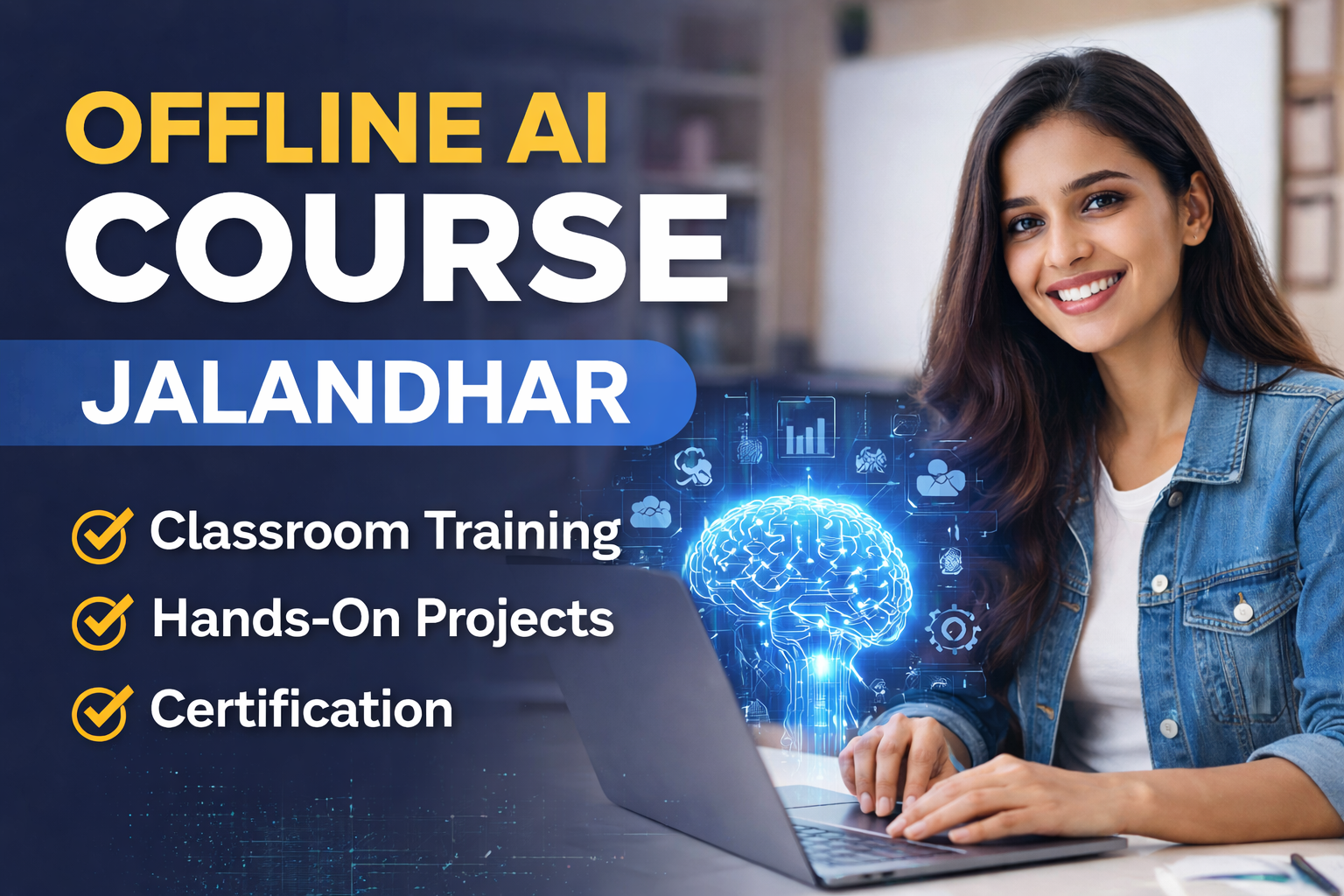
Offline AI Course in Jalandhar – Complete Overview

Introduction to Artificial Intelligence

Artificial Intelligence (AI) is one of the fastest-growing technologies in today’s digital world. It focuses on building smart machines capable of performing tasks that usually require human intelligence, such as problem-solving, decision-making, speech recognition, and visual perception. With industries rapidly adopting AI, the demand for skilled professionals has increased significantly.

In Jalandhar, offline AI courses are becoming popular among students, graduates, and working professionals who want structured learning and face-to-face guidance. These classroom-based programs provide a strong foundation in AI concepts along with practical exposure.


What is an Offline AI Course?

An offline AI course is a classroom-based training program where students attend physical classes at an institute. Unlike online courses, offline learning allows direct interaction with trainers, real-time doubt-solving, and collaborative learning with peers.

These courses are designed to help learners understand AI from basic to advanced levels. Students get hands-on experience through projects, assignments, and live case studies, which prepares them for real-world challenges.


Why Choose an Offline AI Course in Jalandhar?

1. Face-to-Face Learning

One of the biggest advantages of offline training is personal interaction with instructors. Students can ask questions instantly and receive immediate feedback, which improves understanding.

2. Structured Curriculum

Offline courses follow a well-organized syllabus, ensuring step-by-step learning. Beginners can easily grasp complex topics without feeling overwhelmed.

3. Practical Exposure

Institutes in Jalandhar focus on practical training through live projects and case studies. This helps students gain industry-level experience.

4. Better Discipline and Focus

Classroom learning reduces distractions and helps students stay consistent with their studies.

5. Networking Opportunities

Students get a chance to connect with trainers, classmates, and industry experts, which can be helpful for career growth.


Course Curriculum

Offline AI courses in Jalandhar usually cover a wide range of topics, including:

1. Introduction to AI

  • Basics of Artificial Intelligence
  • Types of AI
  • Applications of AI in industries

2. Programming with Python

  • Python fundamentals
  • Data structures
  • Libraries like NumPy, Pandas, Matplotlib

3. Mathematics for AI

  • Linear algebra
  • Probability and statistics
  • Calculus basics

4. Machine Learning

  • Supervised learning
  • Unsupervised learning
  • Regression and classification
  • Model evaluation

5. Deep Learning

  • Neural networks
  • CNN (Convolutional Neural Networks)
  • RNN (Recurrent Neural Networks)

6. Natural Language Processing (NLP)

  • Text processing
  • Sentiment analysis
  • Chatbots

7. Computer Vision

  • Image processing
  • Object detection
  • Face recognition

8. AI Tools and Frameworks

  • TensorFlow
  • Keras
  • Scikit-learn

Duration of the Course

Offline AI courses in Jalandhar typically range from 3 months to 12 months, depending on the level and depth of the program. Short-term courses focus on basics, while long-term programs cover advanced concepts and projects.


Eligibility Criteria

Most institutes have flexible eligibility requirements:

  • Students (12th pass or graduates)
  • Engineering or IT background (preferred but not mandatory)
  • Basic computer knowledge
  • Interest in programming and technology

Hands-On Projects

Practical learning is a key part of offline AI courses. Students work on projects such as:

  • Chatbot development
  • Recommendation systems
  • Image classification
  • Fraud detection systems
  • Predictive analytics

These projects help build a strong portfolio, which is essential for job applications.


Tools and Technologies Covered

Students get hands-on experience with various tools, including:

  • Python
  • Jupyter Notebook
  • TensorFlow & Keras
  • Scikit-learn
  • Power BI / Tableau (in some institutes)

Placement Assistance

Many training institutes in Jalandhar offer placement support, including:

  • Resume building
  • Interview preparation
  • Mock interviews
  • Internship opportunities

Some institutes also have tie-ups with companies, helping students secure jobs after course completion.


Career Opportunities After AI Course

After completing an offline AI course, students can explore various career options:

  • AI Engineer
  • Machine Learning Engineer
  • Data Scientist
  • Data Analyst
  • NLP Engineer
  • Computer Vision Engineer

AI professionals are in high demand across industries such as healthcare, finance, retail, and IT.


Salary Expectations

The salary of AI professionals depends on skills, experience, and job role:

  • Freshers: ₹3 LPA – ₹6 LPA
  • Mid-level: ₹6 LPA – ₹12 LPA
  • Experienced: ₹12 LPA+

With experience and expertise, salaries can grow significantly.


Top Institutes Offering Offline AI Courses in Jalandhar

Several institutes provide quality AI training, offering experienced trainers, practical exposure, and placement assistance. Students should choose institutes based on course content, faculty experience, and reviews.


Advantages of Offline AI Training

  • Personalized attention
  • Immediate doubt resolution
  • Real-time feedback
  • Group learning environment
  • Better practical understanding

Challenges of Offline Learning

  • Fixed schedule
  • Travel time
  • Limited flexibility compared to online learning

However, for many students, the benefits outweigh the challenges.


Future Scope of AI

Artificial Intelligence is shaping the future of technology. From self-driving cars to virtual assistants, AI is transforming every industry. The demand for AI professionals is expected to grow rapidly in the coming years.

In India, cities like Jalandhar are also witnessing growth in tech education, making AI courses more accessible to students.


Who Should Join This Course?

Offline AI courses are suitable for:

  • Students looking to build a career in AI
  • IT professionals upgrading their skills
  • Entrepreneurs wanting to integrate AI into business
  • Anyone interested in technology and innovation

Tips for Choosing the Right Institute

  • Check course curriculum
  • Verify trainer experience
  • Look for practical training opportunities
  • Read student reviews
  • Confirm placement support

Conclusion

Offline AI courses in Jalandhar provide a strong foundation for building a successful career in Artificial Intelligence. With classroom-based learning, hands-on projects, and expert guidance, students can gain the skills needed to excel in this fast-growing field.

Whether you are a beginner or a professional, enrolling in an offline AI course can open doors to exciting career opportunities in the tech industry.

Learning Environment and Classroom Experience

One of the key highlights of an offline AI course in Jalandhar is the structured and interactive classroom environment. Students benefit from a distraction-free setting where they can focus entirely on learning. Trainers often use smart boards, live demonstrations, and real-time coding sessions to explain complex AI concepts in a simple and practical way.

Classroom learning also encourages group discussions, brainstorming sessions, and peer-to-peer interaction. This collaborative approach helps students understand different perspectives and improves problem-solving skills. Regular assessments, quizzes, and doubt-clearing sessions further enhance the overall learning experience.


Importance of Mentorship in Offline Training

Mentorship plays a crucial role in offline AI training. Experienced instructors guide students at every step, from understanding basic concepts to working on advanced projects. Unlike online courses where learners often feel isolated, offline programs provide constant support and motivation.

Mentors also help students identify their strengths and weaknesses, suggest improvements, and provide career guidance. This personalized attention is especially beneficial for beginners who may find AI concepts challenging at the start.


Industry-Oriented Training Approach

Offline AI courses in Jalandhar are designed to meet industry requirements. Institutes focus on practical skills that are in demand in the job market. Students are trained using real-world datasets and scenarios, which helps them understand how AI is applied in industries like healthcare, finance, e-commerce, and manufacturing.

Many institutes also organize workshops, seminars, and guest lectures by industry experts. These sessions provide insights into current trends, tools, and technologies used in the AI domain.


Certification and Its Value

After completing an offline AI course, students receive a certification from the institute. This certificate adds value to their resume and increases their chances of getting hired. While skills are the most important factor, having a recognized certification helps demonstrate your knowledge and commitment to learning AI.

Some institutes also prepare students for global certifications, which can further boost career opportunities.


Internship Opportunities

Many offline AI training programs in Jalandhar offer internship opportunities as part of their curriculum. Internships allow students to work on real company projects, gain practical experience, and understand workplace dynamics.

This hands-on exposure is extremely valuable, as it helps bridge the gap between theoretical knowledge and real-world application. Students who perform well during internships may also receive job offers from the same company.


Soft Skills Development

Apart from technical knowledge, offline AI courses also focus on developing essential soft skills. These include:

  • Communication skills
  • Teamwork
  • Problem-solving ability
  • Presentation skills

These skills are important for career growth, as AI professionals often need to work in teams and present their ideas effectively.


Flexible Batches and Timings

To accommodate different learners, many institutes in Jalandhar offer flexible batch timings. Students can choose from:

  • Morning batches
  • Evening batches
  • Weekend batches

This flexibility is especially helpful for working professionals and college students who want to learn AI alongside their regular commitments.


Cost of Offline AI Courses in Jalandhar

The fees for offline AI courses vary depending on the institute, course duration, and level of training. On average:

  • Basic courses: ₹15,000 – ₹30,000
  • Advanced courses: ₹30,000 – ₹80,000

Some institutes also offer installment options or discounts, making it easier for students to afford quality education.


Comparison: Offline vs Online AI Courses

While both offline and online courses have their advantages, offline training stands out in several ways:

Offline Courses:

  • Direct interaction with trainers
  • Better practical understanding
  • Structured learning environment
  • Immediate doubt resolution

Online Courses:

  • Flexible schedule
  • Learn from anywhere
  • Self-paced learning

For students who prefer guided learning and classroom experience, offline AI courses are often the better choice.


Real-World Applications of AI Learned in Training

During the course, students learn how AI is used in real life. Some examples include:

  • Voice assistants like Alexa and Siri
  • Recommendation systems used by e-commerce platforms
  • Fraud detection in banking
  • Medical diagnosis systems
  • Self-driving technology

Understanding these applications helps students connect theoretical concepts with practical use cases.


Building a Strong Portfolio

A strong portfolio is essential for getting a job in AI. Offline courses help students build portfolios by working on multiple projects. These projects can be showcased during interviews to demonstrate practical skills.

Students are also guided on how to upload projects on platforms like GitHub and create professional profiles.


Continuous Learning and Career Growth

AI is a rapidly evolving field, and continuous learning is necessary to stay updated. Offline training provides a solid foundation, but students should keep upgrading their skills by learning new tools, technologies, and frameworks.

Attending workshops, participating in hackathons, and joining AI communities can further enhance knowledge and career growth.


Conclusion (Extended)

Offline AI courses in Jalandhar are an excellent choice for anyone looking to build a strong career in Artificial Intelligence. With expert guidance, practical training, and a supportive learning environment, students can gain the confidence and skills needed to succeed in this competitive field.

The combination of classroom learning, real-world projects, mentorship, and placement support makes offline training highly effective. As AI continues to grow in importance, investing in such a course can open doors to numerous career opportunities and long-term success.


Why Choose TechCadd for Offline AI Course in Jalandhar

Introduction

In today’s fast-paced digital era, Artificial Intelligence (AI) has become one of the most in-demand skills across industries. From automation to data analysis, AI is transforming the way businesses operate. As a result, many students and professionals are looking for the best training institutes to learn AI and build a successful career.

Among the various institutes available in Jalandhar, TechCadd has emerged as a preferred choice for offline AI training. Known for its practical approach, experienced trainers, and student-focused learning environment, TechCadd offers a comprehensive AI course designed to meet industry standards.


1. Industry-Focused Curriculum

One of the biggest reasons to choose TechCadd is its industry-oriented curriculum. The course is designed to cover all essential topics required to become an AI professional.

The syllabus includes:

  • Python programming
  • Machine Learning algorithms
  • Deep Learning concepts
  • Data Science fundamentals
  • Natural Language Processing (NLP)
  • Computer Vision

The curriculum is regularly updated to match the latest industry trends, ensuring students learn relevant and in-demand skills.


2. Experienced and Certified Trainers

At TechCadd, students learn from experienced trainers who have real-world industry knowledge. Trainers not only teach theoretical concepts but also share practical insights based on their professional experience.

Their teaching approach is simple, interactive, and easy to understand, making it suitable for both beginners and advanced learners.


3. Classroom-Based Learning Advantage

TechCadd provides offline, classroom-based training in Jalandhar, which allows students to interact directly with instructors. This helps in:

  • Instant doubt clearing
  • Better understanding of concepts
  • Personalized attention
  • Improved focus and discipline

Face-to-face learning ensures that no student is left behind.


4. Hands-On Practical Training

TechCadd strongly emphasizes practical learning. Students work on real-time projects and case studies, which helps them gain industry-level experience.

Some project examples include:

  • Chatbot development
  • Image recognition systems
  • Recommendation engines
  • Predictive analytics models

This hands-on experience makes students job-ready.


5. Live Projects and Case Studies

Unlike many institutes that focus only on theory, TechCadd integrates live projects into its curriculum. Students get the opportunity to work on real-world problems and datasets.

This exposure helps them understand how AI is implemented in industries like healthcare, finance, retail, and IT.


6. Placement Assistance

One of the key benefits of choosing TechCadd is its placement support. The institute helps students prepare for job opportunities through:

  • Resume building sessions
  • Interview preparation
  • Mock interviews
  • Job referrals

TechCadd’s placement assistance increases the chances of students getting hired in reputed companies.


7. Small Batch Sizes

TechCadd maintains small batch sizes to ensure personalized attention for each student. This allows trainers to focus on individual learning needs and provide better guidance.

Students can easily interact with trainers and get their doubts resolved without hesitation.


8. Flexible Batch Timings

TechCadd offers flexible batch options to suit different schedules. Students can choose from:

  • Morning batches
  • Evening batches
  • Weekend batches

This flexibility makes it convenient for college students and working professionals.


9. Affordable Course Fees

Compared to other institutes, TechCadd offers AI courses at affordable fees without compromising on quality. The institute also provides installment options, making it accessible for students from different financial backgrounds.


10. Certification

After completing the course, students receive a certification from TechCadd. This certificate adds value to their resume and helps them stand out in job applications.


11. Strong Learning Environment

TechCadd provides a positive and motivating learning environment. Classrooms are well-equipped with modern infrastructure, and students are encouraged to participate actively in discussions and activities.


12. Focus on Career Development

TechCadd not only focuses on technical skills but also helps students develop essential soft skills such as:

  • Communication skills
  • Teamwork
  • Problem-solving
  • Presentation skills

These skills are important for career growth in the AI industry.


13. Updated Tools and Technologies

Students at TechCadd get hands-on experience with the latest tools and technologies, including:

  • Python
  • TensorFlow
  • Keras
  • Scikit-learn
  • Jupyter Notebook

Learning these tools prepares students for real-world job roles.


14. Internship Opportunities

TechCadd provides internship opportunities to students, allowing them to gain practical experience in a professional environment. Internships help students apply their knowledge and build confidence.


15. Positive Student Reviews

TechCadd has received positive feedback from students for its quality training, supportive faculty, and practical approach. Many students have successfully built careers in AI after completing their course from TechCadd.


16. Local Advantage in Jalandhar

Being located in Jalandhar, TechCadd is easily accessible for students in and around the city. It provides a great opportunity for local students to learn AI without relocating to bigger cities.


17. Beginner-Friendly Approach

TechCadd’s AI course is designed for beginners as well as advanced learners. Even students with no prior programming knowledge can start learning AI from scratch.


18. Continuous Support

Students at TechCadd receive continuous support even after completing the course. Trainers are available to guide them in projects, job preparation, and career decisions.


19. Real Career Opportunities

TechCadd prepares students for real job roles such as:

  • AI Engineer
  • Machine Learning Engineer
  • Data Scientist
  • Data Analyst

The training ensures students are industry-ready.


20. Future Growth with AI Skills

AI is the future of technology, and learning it from a reputed institute like TechCadd can open doors to numerous opportunities. With the right skills and training, students can achieve long-term career growth.


Conclusion

Choosing the right institute is crucial for building a successful career in Artificial Intelligence. TechCadd stands out as a reliable and trusted training institute in Jalandhar due to its industry-focused curriculum, experienced trainers, practical learning approach, and placement support.

Its offline classroom training ensures better understanding, hands-on experience, and personalized guidance. Whether you are a beginner or a professional looking to upgrade your skills, TechCadd provides the right platform to achieve your career goals in Ai

21. Personalized Learning Approach

One of the standout features of TechCadd is its personalized learning approach. Every student has a different pace and style of learning, and TechCadd ensures that individual needs are addressed effectively. Trainers pay close attention to each student’s progress and provide extra support wherever required.

This customized guidance helps students build a strong understanding of AI concepts without feeling overwhelmed, especially for beginners who are new to programming and data science.


22. Real-Time Problem Solving

At TechCadd, students are encouraged to solve real-time problems during classroom sessions. Instead of just following theoretical lessons, learners actively participate in coding exercises, debugging, and model-building tasks.

This approach enhances critical thinking and helps students develop practical problem-solving skills, which are highly valued in the AI industry.


23. Regular Assignments and Assessments

To ensure consistent learning, TechCadd conducts regular assignments, quizzes, and assessments. These evaluations help students track their progress and identify areas where improvement is needed.

Frequent practice not only strengthens technical knowledge but also builds confidence for exams and job interviews.


24. Exposure to Real Industry Tools

TechCadd goes beyond basic learning by providing exposure to tools and platforms used by professionals in the industry. Students learn how to work with real datasets, build models, and interpret results effectively.

This practical exposure ensures that students are not just theoretically strong but also capable of handling real-world AI tasks.


25. Doubt Clearing Sessions

Understanding AI concepts can sometimes be challenging, especially for beginners. TechCadd organizes dedicated doubt-clearing sessions where students can ask questions freely and get detailed explanations.

This open communication between students and trainers ensures that no concept remains unclear.


26. Supportive Faculty and Staff

The faculty and staff at TechCadd are known for being approachable and supportive. Students can easily reach out to trainers for help, whether it’s related to coursework, projects, or career advice.

This supportive environment creates a positive learning experience and motivates students to perform better.


27. Focus on Practical Implementation

TechCadd emphasizes “learning by doing.” Students spend a significant amount of time working on practical tasks rather than just studying theory. This helps them understand how AI models are built, trained, and deployed.

By the end of the course, students are confident in implementing AI solutions independently.


28. Career Guidance and Counseling

Apart from technical training, TechCadd also provides career guidance and counseling sessions. Experts guide students on choosing the right career path based on their skills and interests.

Students receive valuable tips on job roles, industry expectations, and career growth opportunities in AI.


29. Strong Alumni Network

TechCadd has a growing network of successful alumni who are working in various tech companies. This network can be beneficial for current students in terms of mentorship, job referrals, and industry insights.

Being part of such a community helps students stay connected and updated with industry trends.


30. Confidence Building and Personality Development

TechCadd understands that technical skills alone are not enough for success. The institute also focuses on building confidence and improving personality traits.

Students are encouraged to present their projects, participate in discussions, and engage in interactive sessions. This helps them become more confident and job-ready.


Extended Conclusion

TechCadd continues to prove itself as a top choice for offline AI training in Jalandhar by offering a perfect blend of theoretical knowledge, practical exposure, and career support. Its student-centric approach, experienced trainers, and industry-relevant curriculum make it a reliable institute for anyone looking to build a career in Artificial Intelligence.

With continuous mentorship, hands-on projects, and placement assistance, TechCadd ensures that students are fully prepared to enter the competitive AI job market. Choosing TechCadd is not just about learning AI—it’s about building a strong foundation for a successful and future-ready career.





Future Scope of Artificial Intelligence (AI)

Introduction

Artificial Intelligence (AI) is rapidly transforming the world, becoming one of the most powerful and influential technologies of the 21st century. From smartphones to self-driving cars, AI is reshaping industries, improving efficiency, and creating new opportunities. As businesses continue to adopt automation and data-driven decision-making, the demand for AI professionals is growing at an unprecedented rate.

The future scope of AI is vast and promising, offering countless possibilities for innovation, career growth, and technological advancement. In this article, we will explore how AI will impact various industries, career opportunities, future trends, and its overall global influence.


What is Artificial Intelligence?

Artificial Intelligence refers to the simulation of human intelligence in machines that are programmed to think, learn, and make decisions. AI systems can analyze large amounts of data, recognize patterns, and perform tasks with minimal human intervention.

Key branches of AI include:

  • Machine Learning (ML)
  • Deep Learning
  • Natural Language Processing (NLP)
  • Computer Vision
  • Robotics

These technologies are the foundation of modern AI applications.


Growing Demand for AI Professionals

The demand for AI professionals is increasing globally. Companies are investing heavily in AI to gain a competitive edge. As a result, job roles such as AI Engineer, Data Scientist, Machine Learning Engineer, and AI Researcher are in high demand.

In India, the growth of AI is accelerating, with cities like Bangalore, Hyderabad, and even emerging cities like Jalandhar offering opportunities in tech education and careers.


AI in Different Industries

1. Healthcare

AI is revolutionizing healthcare by improving diagnosis, treatment, and patient care.

  • Early disease detection
  • Medical imaging analysis
  • Personalized treatment plans
  • Virtual health assistants

AI-powered tools can analyze patient data faster and more accurately than traditional methods.


2. Education

AI is transforming the education sector by making learning more personalized and efficient.

  • Smart tutoring systems
  • Automated grading
  • Adaptive learning platforms
  • Virtual classrooms

Students can learn at their own pace with AI-driven tools.


3. Finance

AI is widely used in the financial sector for:

  • Fraud detection
  • Risk assessment
  • Algorithmic trading
  • Customer service chatbots

Banks and financial institutions rely on AI for secure and efficient operations.


4. Retail and E-commerce

AI enhances customer experience and business operations in retail.

  • Product recommendations
  • Inventory management
  • Customer behavior analysis
  • Chatbots for support

Companies like Amazon use AI extensively to improve sales and user experience.


5. Manufacturing

AI is improving production efficiency and reducing costs.

  • Predictive maintenance
  • Quality control
  • Automation of repetitive tasks
  • Supply chain optimization

Smart factories powered by AI are the future of manufacturing.


6. Transportation

AI is playing a key role in the development of autonomous vehicles and smart transportation systems.

  • Self-driving cars
  • Traffic management systems
  • Route optimization
  • Ride-sharing platforms

AI helps reduce accidents and improve transportation efficiency.


Career Opportunities in AI

The future scope of AI includes a wide range of career options:

  • AI Engineer
  • Machine Learning Engineer
  • Data Scientist
  • Data Analyst
  • NLP Engineer
  • Robotics Engineer

These roles offer high salaries and strong career growth.


Salary Trends in AI

AI professionals are among the highest-paid in the tech industry.

  • Entry-level: ₹4 LPA – ₹8 LPA
  • Mid-level: ₹8 LPA – ₹20 LPA
  • Senior-level: ₹20 LPA+

With experience and expertise, salaries can increase significantly.


Emerging Trends in AI

1. Generative AI

Generative AI is creating new content such as text, images, and videos. Tools like ChatGPT and DALL·E are examples of this technology.


2. AI in Cybersecurity

AI is being used to detect and prevent cyber threats in real time.


3. Explainable AI

As AI systems become more complex, there is a growing need for transparency and understanding of how decisions are made.


4. AI and IoT Integration

The combination of AI and the Internet of Things (IoT) is creating smart devices and systems.


5. Edge AI

Edge AI allows data processing on devices rather than relying on cloud computing, improving speed and efficiency.


Advantages of AI in the Future

  • Increased efficiency and productivity
  • Reduction in human error
  • Faster decision-making
  • Automation of repetitive tasks
  • Improved customer experiences

Challenges of AI

Despite its benefits, AI also presents challenges:

  • Job displacement due to automation
  • Data privacy concerns
  • High implementation costs
  • Ethical issues

Addressing these challenges is essential for sustainable AI growth.


AI in India – Future Growth

India is becoming a major hub for AI development. The government and private sectors are investing in AI technologies.

Initiatives like Digital India and AI-focused education programs are promoting AI adoption.

Cities like Jalandhar are also seeing growth in AI training institutes, making education more accessible.


Role of AI in Startups

AI is driving innovation in startups. Many startups are using AI to develop unique solutions and disrupt traditional industries.


AI and Entrepreneurship

AI provides opportunities for entrepreneurs to create new products and services. Businesses can use AI to improve operations and customer engagement.


Skills Required for Future AI Careers

To succeed in AI, individuals need:

  • Programming skills (Python)
  • Knowledge of mathematics and statistics
  • Understanding of machine learning algorithms
  • Problem-solving skills
  • Analytical thinking

Continuous Learning in AI

AI is constantly evolving, and professionals need to keep learning new technologies and tools to stay relevant.


Global Impact of AI

AI is not limited to one country—it is a global technology that is shaping economies and societies worldwide.


Future of AI in Daily Life

AI will become an integral part of everyday life:

  • Smart homes
  • Virtual assistants
  • Personalized recommendations
  • Automated services
  • AI in Government and Public Services

    In the future, AI will play a major role in improving government services and public administration. Governments around the world are already adopting AI to enhance efficiency, transparency, and decision-making.

    AI can be used for:

    • Smart city development
    • Traffic and crowd management
    • Automated public service systems
    • Crime prediction and surveillance
    • Disaster management and response

    With AI-powered systems, governments can deliver faster and more accurate services to citizens, reducing delays and improving overall governance.


    AI in Agriculture

    Agriculture is another sector where AI is expected to bring significant transformation. Farmers can use AI technologies to increase productivity and reduce risks.

    Future applications include:

    • Smart irrigation systems
    • Crop health monitoring using drones
    • Weather prediction and analysis
    • Soil quality assessment
    • Automated harvesting

    In countries like India, where agriculture is a major part of the economy, AI can help farmers make better decisions and improve crop yields.


    AI in Human Resource Management

    AI is also transforming how companies manage their workforce. In the future, HR departments will rely more on AI tools for:

    • Resume screening and candidate selection
    • Employee performance analysis
    • Predictive analytics for workforce planning
    • Chatbots for employee support

    This will make hiring processes faster and more efficient while reducing human bias.


    AI in Entertainment and Media

    The entertainment industry is increasingly adopting AI to create personalized and engaging content.

    Future AI applications include:

    • Content recommendation systems
    • AI-generated music and videos
    • Virtual influencers and digital avatars
    • Automated video editing

    Streaming platforms and social media networks will continue to use AI to enhance user experience and engagement.


    AI in Space Exploration

    AI is playing an important role in space research and exploration. In the future, AI systems will help scientists analyze vast amounts of data collected from space missions.

    Applications include:

    • Autonomous spacecraft navigation
    • Planet exploration using AI-powered robots
    • Data analysis from satellites
    • Space mission simulations

    AI will enable faster discoveries and more efficient space missions.


    AI and Sustainability

    AI has the potential to address global challenges such as climate change and environmental sustainability.

    Future contributions of AI include:

    • Energy optimization in industries
    • Smart grids for efficient power distribution
    • Climate modeling and prediction
    • Waste management and recycling systems

    By using AI, organizations can reduce their environmental impact and promote sustainable practices.


    AI in Personalized Marketing

    Marketing strategies are becoming more data-driven, and AI is at the center of this transformation. In the future, businesses will use AI to deliver highly personalized experiences to customers.

    Key applications include:

    • Customer behavior analysis
    • Targeted advertising
    • Predictive analytics for sales
    • Chatbots for customer interaction

    This will help businesses increase customer satisfaction and improve conversion rates.


    Ethical AI and Responsible Development

    As AI continues to grow, there will be a strong focus on ethical AI development. Organizations and governments will work to ensure that AI systems are fair, transparent, and unbiased.

    Key areas of focus will include:

    • Data privacy and security
    • Bias reduction in AI models
    • Accountability in AI decisions
    • Responsible use of AI technologies

    Ethical AI will be essential for building trust and ensuring long-term success.


    AI and Remote Work

    The rise of remote work has increased the importance of AI-powered tools. In the future, AI will continue to enhance productivity and collaboration for remote teams.

    Examples include:

    • Virtual assistants for scheduling and task management
    • AI-driven project management tools
    • Automated communication systems
    • Performance tracking and analytics

    AI will make remote work more efficient and manageable.


    AI in Small Businesses

    AI is no longer limited to large corporations. In the future, small and medium-sized businesses (SMEs) will also benefit from AI technologies.

    Affordable AI tools will help small businesses:

    • Automate daily operations
    • Improve customer service
    • Analyze business data
    • Optimize marketing strategies

    This will level the playing field and allow smaller companies to compete with larger organizations.


    Long-Term Vision of AI

    Looking ahead, AI is expected to become more advanced and integrated into every aspect of life. Some long-term possibilities include:

    • Fully autonomous systems
    • Advanced human-AI collaboration
    • Smart cities powered entirely by AI
    • AI-driven scientific discoveries

    While these developments may take time, they highlight the immense potential of AI.


    Final Extended Conclusion

    The future scope of Artificial Intelligence is not just limited to technology—it extends to every industry and aspect of human life. From improving healthcare and education to transforming businesses and government systems, AI is set to become a driving force of global progress.

    As AI continues to evolve, it will create new opportunities, redefine job roles, and shape the future of work. For students, professionals, and entrepreneurs, this is the right time to invest in learning AI and building relevant skills.

    With continuous advancements and growing adoption, AI will remain one of the most promising and impactful technologies for years to come. Embracing AI today means preparing for a smarter, more efficient, and innovative future.