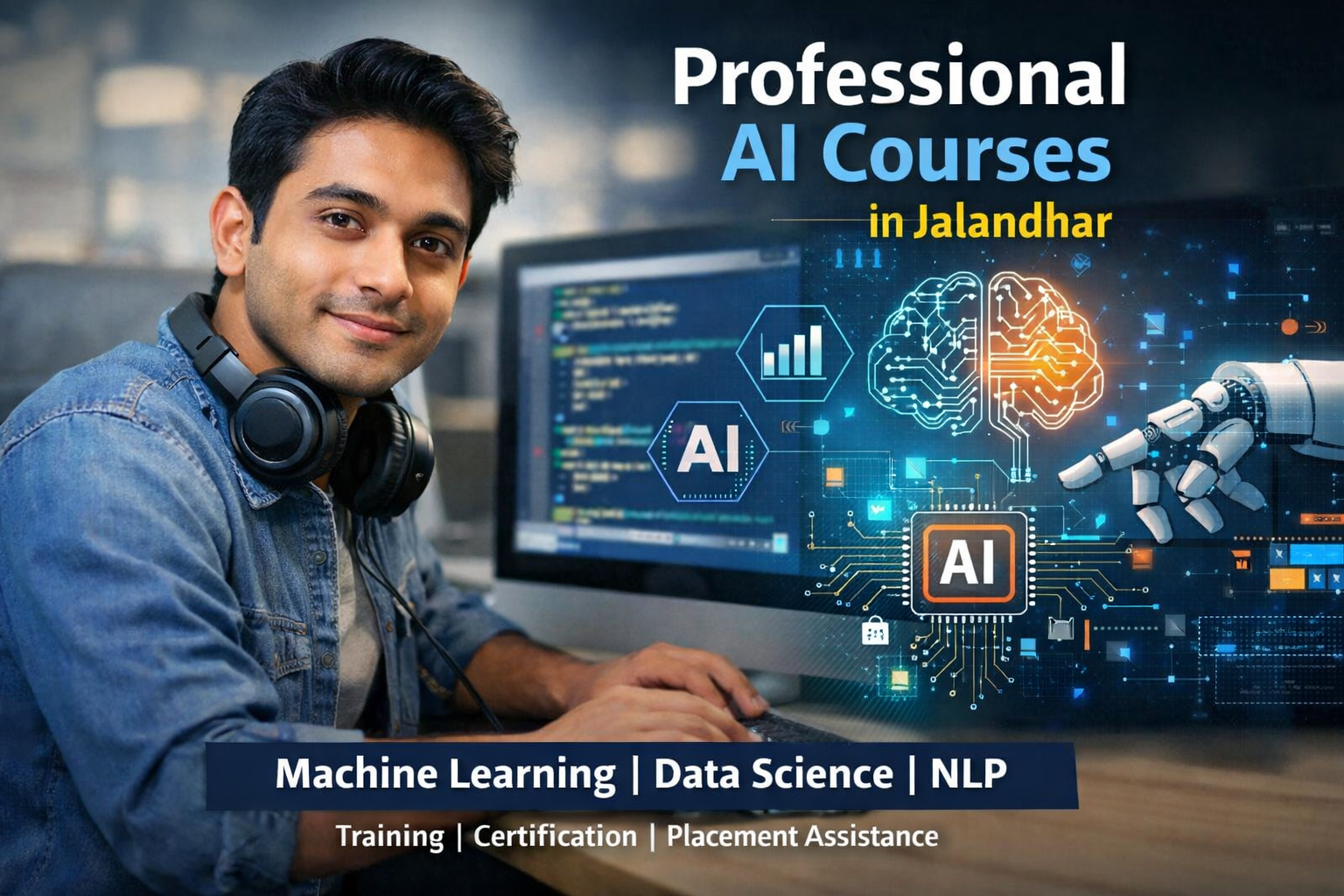
This overview provides a comprehensive look at the professional Artificial Intelligence (AI) course landscape in Jalandhar. Once primarily known for its traditional educational institutions, Jalandhar is rapidly evolving into a significant hub for technological education, with a particular focus on AI, Machine Learning (ML), and related future-ready fields.

The city offers a rich and diverse ecosystem for AI education, catering to a wide range of learners. From prestigious government institutes like the Dr. B.R. Ambedkar National Institute of Technology (NIT) to innovative private training centers and traditional universities offering specialized degrees, Jalandhar provides multiple pathways for anyone looking to build a career in this transformative field. This overview will explore these different avenues, detailing the programs, curricula, and opportunities available, and will provide a guide to help you choose the right path for your professional goals.

🏛️ The AI Education Landscape in Jalandhar

The AI education scene in Jalandhar is characterized by a healthy mix of formal degree programs and skill-specific professional certifications. This dual structure ensures that whether you are a student looking for a long-term academic foundation or a professional seeking to upskill quickly, you will find a suitable option.


Type of Institute Key Focus Examples Best Suited For
Public Universities & Colleges Long-term, formal degree programs (B.Tech, BCA) with a broad academic foundation. DAV University, Apeejay Institute of Management and Engineering Technical Campus, Lyallpur Khalsa College Technical Campus Students seeking a traditional university degree and a deep, theoretical understanding of AI/ML.
Government & Premier Institutes High-level workshops, short-term courses, and specialized certification programs, often with a focus on emerging tech and social inclusion. Dr. B.R. Ambedkar NIT Jalandhar Students and professionals looking for intensive, prestigious short courses and exposure to cutting-edge research.
Private Training Institutes Industry-focused, hands-on diploma and certification programs designed for quick employability. AlgoSchool AI, TechCADD Computer Education, ThinkNEXT Technologies, TCIL-IT Students, working professionals, and entrepreneurs who want practical, project-based training to enter the job market quickly.
Social & Skill Initiatives Short-term skill enhancement programs, often free or subsidized, aimed at empowering underprivileged or minority communities. Apeejay College of Fine Arts (with FICCI FLO), NIT Jalandhar (for minority students) Students from BPL families or minority communities seeking foundational digital and AI skills.

This variety means that Jalandhar's AI education ecosystem is not just for computer science elites but is becoming increasingly inclusive, aiming to equip a broad cross-section of the city's youth for the future of work.

📚 A Detailed Look at AI Courses in Jalandhar

To provide a clear picture, let's break down the key players and their offerings into three main categories: formal degree programs, specialized professional courses, and unique skill development initiatives.

1. Formal Degree Programs

For those seeking a comprehensive, long-term education, several institutions in and around Jalandhar offer AICTE-approved undergraduate programs.

  • B.Tech in Artificial Intelligence and Machine Learning: This is a flagship four-year program offered by multiple colleges affiliated with IK Gujral Punjab Technical University (PTU), Jalandhar.

    • Apeejay Institute of Management and Engineering Technical Campus: This course has an intake of 30 seats and admission is based on JEE Main scores.

    • Lyallpur Khalsa College Technical Campus (LKCTC): Similarly, this college offers a 4-year B.Tech program with an intake of 30 seats, with a total fee of approximately ₹3.25 Lakhs.

    • Eligibility: Both programs require a 10+2 pass with Physics and Mathematics as compulsory subjects, along with one of Chemistry, Biotechnology, or Computer Science, with a minimum of 45% marks (40% for reserved categories).

  • BCA in Artificial Intelligence and Machine Learning: For students interested in a computer applications degree with a specialization in AI, DAV University offers a four-year BCA (Hons) program.

2. Specialized Professional Certification Programs

This is the fastest-growing segment in Jalandhar, with private institutes offering intensive, practical training designed to make students job-ready in a matter of months.

  • AlgoSchool AI: This institute markets itself as "Jalandhar's first and only AI-dedicated training institute," focusing solely on AI education. They emphasize practical learning through projects, mentorship, and a community-driven approach. Their workshops and programs cover modern topics like Industrial AI Automation and AI Agent Development. In a recent hands-on workshop at CT College, students had the opportunity to build their own working AI agents, turning ideas into functioning systems in just a few hours. Their curriculum is built around real-world use cases, preparing students not just to learn AI, but to apply it.

  • TechCADD Computer Education: TechCADD offers a comprehensive "Professional Certificate Program in Machine Learning & AI," which is a 4-6 month course available in both online and classroom modes. This program is structured to take a student from beginner to advanced levels. A key highlight is its detailed and industry-relevant curriculum, which includes:

    • Foundation: Introduction to AI/ML and Python for Data Science (using NumPy, Pandas, Matplotlib).

    • Core ML: Supervised and Unsupervised Learning (Linear Regression, Decision Trees, K-Means Clustering).

    • Advanced AI: Deep Learning (CNNs, RNNs), Natural Language Processing (NLP), and Generative AI (with a focus on ChatGPT, Transformers, and Prompt Engineering).

    • Practical Application: Data Visualization (Power BI, Tableau), Model Deployment (AWS, TensorFlow Serving), and a Capstone Project on topics like fraud detection or recommendation systems.

    • Career Support: The program includes placement assistance, resume guidance, and interview preparation.

3. Prestigious Short-Term Courses and Workshops

Institutes like NIT Jalandhar add a layer of prestige and depth to the city's AI education offerings. They often host workshops and short-term courses led by experts from IITs and other premier institutions.

  • NIT Jalandhar's AI Initiatives: In a significant move, NIT Jalandhar organized a major "Awareness Workshop on Capacity Building and Skill Development in Artificial Intelligence (AI), 5G, and Emerging Technologies" under the aegis of the Ministry of Minority Affairs. This event, which saw participation from over 300 students, featured technical sessions, expert lectures, and live demonstrations. Following its success, NIT Jalandhar announced free certification programs in AI, 5G, and Cybersecurity for minority students, along with plans for mentorship programs and industry-aligned curricula.

  • Specialized Short-Term Courses (STC): The Department of Computer Science & Engineering at NIT Jalandhar also offers self-sponsored online short-term courses. One such course was on "AI-Powered Innovation: Integrating Future-Ready Technologies in Real-World Applications," a 5-day program covering advanced topics like intelligent automation, quantum computing, and the role of AI in 5G/6G networks. These courses provide a valuable opportunity to learn about the latest research trends and tools from a premier national institute at a low cost (e.g., ₹300 + GST for external candidates).

4. Social Impact and Skill Enhancement Programs

Beyond commercial and academic courses, Jalandhar also hosts programs with a strong social mission.

  • Apeejay College of Fine Arts Initiative: In collaboration with FICCI FLO Amritsar, Apeejay College conducted a one-month Skill Enhancement Programme for students from Below Poverty Line (BPL) families. The curriculum was unique as it integrated AI tools into three distinct fields: Video Editing & VFX, Graphic Design & Illustration, and Website Design & Digital Marketing. This program is an excellent example of how AI skills are being democratized and made accessible to all, empowering students to use AI for enhanced creativity and productivity.

🎓 Choosing the Right Program: A Comparison

To help you navigate these choices, here is a comparison of the key program types based on essential factors.


Comparison Factor B.Tech / BCA Degree Private Institute Certification (e.g., TechCADD, AlgoSchool) NIT Jalandhar Workshops/STC
Duration 3-4 years 4-6 months A few days to 1 week
Cost High (₹3 Lakhs+ for full course) Moderate (varies by institute) Low (often subsidized or free)
Curriculum Focus Broad theoretical foundation, university syllabus, AICTE-approved Practical, hands-on, industry-current tools and projects Advanced, niche topics, latest research trends
Mode of Learning Full-time, on-campus Flexible (classroom, online, weekend batches) Intensive, often online or in-person workshops
Admission Criteria 10+2 with PCM, JEE Main scores (for B.Tech) Open to all with basic programming knowledge; no strict entrance exams Open to students and professionals; minimal eligibility
Best For Long-term career, higher studies (M.Tech, MS), core R&D roles Quick upskilling, immediate job placement, career switch Gaining specialized knowledge, adding prestigious certification to resume

🚀 Career Outcomes and Industry Readiness

The ultimate goal of any professional course is to open doors to a successful career. The programs in Jalandhar are designed with this in mind, and they prepare students for a variety of in-demand roles.

Completing a comprehensive AI and ML course from a reputed institute in Jalandhar can lead to roles such as:

  • Machine Learning Engineer: Designing and training ML models to solve real-world problems.

  • Data Scientist: Analyzing complex datasets to extract insights and build predictive models.

  • AI/ML Researcher: Innovating and developing advanced AI techniques and models.

  • NLP Engineer: Building intelligent systems for text processing, chatbots, and language understanding.

  • AI Product Developer: Creating and integrating AI-driven solutions into products.

  • Deep Learning Specialist: Developing neural networks for image, speech, and pattern recognition.

  • AI Consultant: Advising organizations on AI adoption and implementation strategies.

The hands-on, project-based nature of courses offered by institutes like TechCADD and AlgoSchool AI is a significant advantage, as students build a portfolio of work that can be showcased to potential employers. Furthermore, the mentorship programs and industry-aligned curricula being developed by institutions like NIT Jalandhar are crucial for bridging the gap between academic learning and the practical needs of the tech industry.

💡 Conclusion: Your Path to an AI Career in Jalandhar

Jalandhar has firmly established itself as a fertile ground for AI education, offering a spectrum of opportunities that cater to diverse needs and aspirations. From the rigorous academic environment of a B.Tech program to the focused, job-centric training of a professional certification, and the prestige of a specialized workshop at NIT Jalandhar, the city provides a robust launchpad for your career.

Here is a simple guide to help you make your decision:

  1. If you are a recent 10+2 graduate with a strong interest in technology and a long-term career horizon, consider pursuing a formal degree like a B.Tech in AI & ML from a college like Apeejay or LKCTC. This path provides the deepest theoretical understanding and opens up the most opportunities for higher education and specialized R&D roles.

  2. If you are a student, graduate, or professional looking to quickly gain practical skills and enter the job market, a certification program from a private institute like TechCADD or AlgoSchool AI is likely your best bet. These programs are designed for speed and employability, focusing on the exact tools and technologies that companies are hiring for right now.

  3. If you want to enhance your resume with a specialized, prestigious certification or explore advanced topics like AI in 5G or Quantum Computing, keep an eye on the short-term courses and workshops offered by NIT Jalandhar. These are an excellent way to deepen your expertise in a specific area and learn from leading experts.

  4. If you are from an underprivileged background but have the passion to learn, be on the lookout for social impact initiatives like the one conducted by Apeejay College. These programs are designed to ensure that financial constraints do not become a barrier to acquiring future-ready digital skills.

The AI revolution is here, and Jalandhar is equipped with the institutions, courses, and community to help you be a part of it. By carefully evaluating your own goals and the options laid out in this overview, you can take the first confident step toward a rewarding career in one of the most exciting fields of our time.


The curriculum spans ten carefully designed modules, each building upon the knowledge gained in previous sections:

Module 1: Introduction to Artificial Intelligence and Machine Learning serves as the gateway, establishing core concepts, historical context, and real-world applications. Students explore how AI is transforming industries from healthcare to finance, setting the stage for deeper technical exploration.

Module 2: Python for Data Science and AI provides the programming foundation essential for any AI practitioner. Using libraries like NumPy, Pandas, and Matplotlib, students learn data manipulation and visualization techniques that form the backbone of practical AI work.

Module 3: Supervised and Unsupervised Learning dives into the core algorithms that power machine learning. Students work with Linear Regression, Decision Trees, K-Means Clustering, and Support Vector Machines (SVM), understanding not just how to implement these algorithms but when to apply them.

Module 4: Deep Learning and Neural Networks explores the architecture that drives modern AI breakthroughs. Convolutional Neural Networks (CNNs) for image processing and Recurrent Neural Networks (RNNs) for sequential data are covered in depth, along with backpropagation concepts.

Module 5: Natural Language Processing (NLP) addresses one of AI's most visible applications. Text analytics, sentiment analysis, and chatbot creation give students the skills to build systems that understand and generate human language.

Module 6: Generative AI and Advanced Models brings students to the cutting edge, covering ChatGPT, Transformer models, and prompt engineering techniques—skills that are in immediate high demand across industries.

Module 7: Data Visualization and Predictive Analytics focuses on communicating insights effectively using Power BI, Tableau, and AI-powered interactive dashboards.

Module 8: Deployment and Model Optimization bridges the gap between development and production, teaching students to deploy models using AWS, Google AI, and TensorFlow Serving.

Module 9: AI Ethics and Responsible AI addresses the critical considerations of data privacy, fairness, transparency, and ethical AI practices—topics increasingly demanded by employers and regulators.

Module 10: Capstone Projects culminates the learning experience with hands-on projects like recommender systems, fraud detection, and chatbot development that demonstrate comprehensive mastery.

AI Course Specializations

Beyond the comprehensive certificate program, TechCADD offers specialized AI training that allows students to focus on specific areas of interest. The "Best AI Course in Jalandhar" program covers similar foundational material but with additional emphasis on deep learning architectures, computer vision, and advanced AI techniques. This program is designed for students who want to position themselves at the forefront of AI innovation.

The curriculum in this specialized track includes detailed exploration of TensorFlow, Keras, and PyTorch, the three most widely used deep learning frameworks in industry. Students work with these tools to build and train neural networks for image classification, object detection, and image segmentation—skills directly applicable to roles in autonomous systems, medical imaging, and surveillance technology.

Practical, Hands-On Learning Methodology

Learning by Doing

What truly sets TechCADD apart is its unwavering commitment to practical, hands-on learning. The institute's philosophy is simple: theory without application is insufficient preparation for the demands of the AI industry. Every concept taught in the classroom is immediately applied through coding exercises, live demonstrations, and project work.

The classroom environment reflects this commitment. In TechCADD's data science and AI classes, multiple students gather in a single room, working together under the guidance of experienced instructors. The instructor demonstrates coding and analysis live on a projector while students follow along on their own workstations, creating an immersive learning experience that goes beyond traditional lecture-style teaching.

Interactive Classroom Setup

The physical learning environment at TechCADD is designed to maximize engagement and collaboration. Desks and workstations are arranged to encourage teamwork, allowing students to discuss ideas, solve problems together, and support each other during exercises. The instructor uses a projector to showcase coding examples, data visualization techniques, and machine learning workflows, ensuring every student can follow along clearly regardless of their seating position.

This setup ensures that all participants, regardless of prior experience, can actively engage in learning and apply concepts in real-time. The combination of live demonstrations and interactive exercises creates an environment where complex topics become approachable and easier to understand.

Project-Based Learning

TechCADD places significant emphasis on project-based learning, recognizing that employers value demonstrable skills over theoretical knowledge alone. Students work on real-world datasets and live case studies throughout their training, building a portfolio of work that can be showcased to potential employers.

The capstone projects at the end of the program are particularly significant. Students select from projects like fraud detection systems, recommendation engines, or chatbots—each requiring the integration of multiple skills learned throughout the course. These projects serve not only as learning experiences but as portfolio pieces that demonstrate comprehensive mastery to employers.

Expert Faculty and Mentorship

Industry-Experienced Instructors

The quality of any educational program ultimately depends on the quality of its instructors. TechCADD addresses this fundamental requirement by employing faculty members with extensive industry experience. These are not academic theoreticians but practitioners who have worked on real AI and machine learning projects, bringing insights that textbooks cannot provide.

In the AWS training program, for instance, instructors are certified AWS experts with hands-on knowledge of cloud computing environments. Similarly, AI instructors have practical experience with the tools and frameworks they teach, allowing them to share not just how to use these technologies but how they are actually applied in professional settings.

Personalized Mentorship

Beyond formal instruction, TechCADD emphasizes personalized mentorship. Instructors move around the classroom during exercises, providing guidance, answering questions, and helping students overcome challenges in real-time. This individual attention ensures that every participant can keep up with the lessons and gain practical experience in the subject.

The mentorship extends beyond technical instruction to career guidance. Faculty members help students understand industry expectations, prepare for interviews, and build the professional skills necessary to succeed in technology careers.

Multi-Course Ecosystem: Beyond AI

Comprehensive Technical Training

While TechCADD's AI programs are exceptional, the institute's value extends beyond artificial intelligence. The institute offers a comprehensive ecosystem of technical courses that allows students to build complementary skills or pursue alternative career paths.

The AWS Training and Certification Course prepares students for globally recognized cloud computing certifications. With cloud infrastructure becoming increasingly essential for AI deployment, this course complements AI training perfectly. Students learn to deploy, manage, and scale cloud applications using Amazon Web Services, including EC2, S3, IAM, RDS, and Lambda.

The Advanced Diploma in Website Designing offers creative students a path into web development and design. This program covers front-end development, UI/UX design principles, WordPress development, and even AI tools in web design—demonstrating TechCADD's commitment to integrating AI across domains.

The Data Science Course provides another complementary path, focusing on Python programming, machine learning algorithms, and data analysis techniques. Students learn to work with real datasets, developing skills in data manipulation, analysis, and visualization.

Success Story: Angelina's Journey from Beginner to Ethical Hacker

One of the most compelling demonstrations of TechCADD's effectiveness is the success story of Angelina, a BCA graduate who transformed from a curious beginner to a professional ethical hacker through TechCADD's cybersecurity program.

Angelina's journey began with a common frustration: her formal degree had only scratched the surface of real-world IT skills. She had a natural curiosity about how systems worked and a desire to understand cybersecurity, but the path seemed daunting.

The counselling session at TechCADD proved transformative. The instructor demystified the entire field, explaining that ethical hacking isn't about random guessing but a methodological process of vulnerability assessment and penetration testing. The course was mapped out as a journey from networking basics to advanced exploitation techniques—exactly the structured approach Angelina needed.

The training covered everything from building foundational knowledge in networking and Linux to advanced penetration testing with tools like Metasploit. Students learned web application security, wireless hacking, and the critical skill of professional report writing—what separates amateurs from professionals.

The result? Angelina secured a position as a junior penetration tester at an IT risk consulting firm. In her first week, using skills learned at TechCADD, she identified a critical SQL injection flaw that developers had missed—demonstrating immediate value to her employer.

This success story illustrates TechCADD's broader value proposition: structured learning, expert mentorship, and practical skills that translate directly to career success.

Student Reviews and Testimonials

The consistent theme across TechCADD student reviews is satisfaction with both the learning environment and outcomes. The institute maintains a perfect 5.00 average rating based on multiple reviews across different course pages.

Karan Sharma notes, "I have been studying here from past few months and I would say that this institute is really very good as it provides a friendly environment for students and also the facilities are amazing".

Sandeep Chahal emphasizes the supportive environment: "I am doing full stack course there and I feel very glad to join this institute. Staff is very cooperated and all classes are well maintained and teacher are so cooperative and provide appropriate knowledge regarding course".

Manmeet Kaur recommends the institute broadly: "A great place to learn and enhance your technical skills. Nice place to upgrade your skills and upgrade your career in IT sector. So you must enroll yourself in this institute".

For the AI course specifically, Komal shares, "I'm so glad I enrolled in the AI course in Jalandhar! The curriculum is well-structured, covering essential topics like natural language processing (NLP), data science, and neural networks. The instructors are knowledgeable and supportive, and the projects helped me apply what I learned in real-life scenarios. This course is ideal for both beginners and experienced learners".

Simran adds, "I joined the best AI training course in Jalandhar, and it's been an incredible experience! The instructors break down complex AI concepts, making them easy to grasp. From machine learning basics to advanced algorithms, the course is comprehensive and practical. The hands-on projects gave me real-world experience—I feel ready to apply my skills professionally!"

These reviews reflect a consistent pattern: students appreciate the practical focus, supportive faculty, comprehensive curriculum, and the confidence they gain to pursue professional careers.

Placement Support and Career Outcomes

Career-Focused Training

TechCADD distinguishes itself through serious commitment to placement support. The institute understands that the ultimate measure of educational success is career outcomes, and their programs are designed with this in mind.

The placement support includes resume building assistance, helping students effectively showcase their skills and projects to potential employers. Mock interview sessions prepare students for the technical and behavioral questions they'll face in job interviews. Career guidance helps students identify appropriate roles and companies aligned with their skills and interests.

Diverse Career Pathways

The career opportunities following TechCADD's AI programs are extensive and varied. Graduates can pursue roles including:

Machine Learning Engineers design and train ML models to solve real-world problems using data-driven algorithms—a role at the heart of modern AI implementation.

Data Scientists analyze complex datasets to extract insights and build predictive models for business decisions, combining technical skills with business acumen.

AI Researchers innovate and develop advanced AI techniques and models for future applications, working at the frontier of artificial intelligence.

NLP Engineers build intelligent systems for text processing, chatbots, and language understanding—skills in high demand as conversational AI expands.

Deep Learning Specialists develop neural networks for image, speech, and pattern recognition, working on cutting-edge applications in autonomous systems and medical imaging.

AI Consultants advise organizations on AI adoption, implementation strategies, and process optimization, combining technical expertise with business strategy.

Business Intelligence Analysts use AI tools to visualize data trends and support strategic decision-making.

The AWS training program similarly opens roles like Cloud Engineer, Solutions Architect, DevOps Engineer, and Cloud Security Specialist. The web design program leads to positions as Front-end Developers, UX Designers, WordPress Experts, and freelance opportunities.

Flexible Learning Options

Accessibility and Convenience

TechCADD recognizes that students have different schedules, commitments, and learning preferences. The institute addresses this through flexible learning options including regular courses, fast-track programs, weekend batches, and both online and classroom modes.

The AI and ML certification program is offered in both online and classroom formats at the Jalandhar campus, allowing students to choose the mode that best fits their circumstances. The AWS training similarly offers flexible scheduling with regular 2-3 month courses, fast-track 4-6 week options, and weekend batches for working professionals.

Affordability and Value

TechCADD positions its courses as providing high return on investment—low-cost certification with high career value. The institute emphasizes that students receive thorough practical training with industry-current tools at a fraction of the cost of formal degree programs, making career advancement accessible to a broader range of students.

Infrastructure and Learning Resources

State-of-the-Art Facilities

TechCADD provides students with access to advanced labs equipped with industry-standard tools and software. The facilities include the latest software and datasets, ensuring students work with the same tools used in professional environments.

The interactive classroom setup includes projection systems for live demonstrations, comfortable workstations for hands-on practice, and an environment designed to foster collaboration and engagement.

AI Tools and Libraries

Students gain hands-on experience with the most important AI tools and libraries in current use. The curriculum covers TensorFlow, Keras, PyTorch, Python with NumPy and Pandas, Power BI, Tableau, ChatGPT, and transformer models. This exposure ensures graduates are familiar with the tools employers actually use.

Why TechCADD Stands Among Competitors

Comparison with Other Institutes

Jalandhar has several institutes offering AI and ML training, including ThinkNEXT Technologies, TCIL-IT Jalandhar, and WebTech Learning. TechCADD distinguishes itself through several key differentiators.

The expert mentorship provided by industry-experienced instructors gives TechCADD students insights they cannot get from purely academic faculty. The hands-on projects using real datasets and live case studies ensure students build demonstrable skills, not just theoretical knowledge. The comprehensive curriculum covering everything from Python basics to generative AI provides a complete education path.

The placement support with resume guidance and interview preparation demonstrates commitment to career outcomes beyond just education. The flexible learning options accommodate students with varying schedules and commitments.

Recognition and Certification

Students completing TechCADD programs receive recognized certifications that validate their skills to employers. The AWS training prepares students for globally accepted certifications like AWS Certified Solutions Architect and AWS Cloud Practitioner. The AI programs provide TechCADD Certified "Professional in Machine Learning & AI" credentials that carry weight in the local job market.

The AI Revolution and TechCADD's Role

Addressing Industry Demand

The demand for AI professionals has never been higher. AI is transforming healthcare, finance, manufacturing, education, and virtually every other industry. Companies are seeking professionals who can implement AI solutions, analyze data intelligently, and drive business value through artificial intelligence.

TechCADD positions itself as a bridge between this growing demand and aspiring professionals in Jalandhar and Punjab. The institute's courses are designed to produce job-ready graduates who can immediately contribute to employer needs.

Future-Proofing Careers

TechCADD emphasizes that AI skills are not just about immediate employment but about future-proofing careers. As automation and AI continue to transform industries, professionals with AI skills will be better positioned to adapt and thrive. The institute's curriculum includes emerging areas like generative AI and transformer models, ensuring students are prepared for the technologies that will shape the next decade.

Ethical AI Education

Responsible AI Practices

TechCADD distinguishes itself through attention to ethical considerations in AI. The curriculum includes modules on AI Ethics and Responsible AI, covering data privacy, fairness, transparency, and ethical AI practices.

This focus is increasingly important as organizations recognize that AI systems must be not just powerful but also responsible and trustworthy. TechCADD students graduate understanding the importance of building AI systems that are fair, transparent, and respectful of privacy.

Conclusion: The TechCADD Value Proposition

TechCADD Computer Education has established itself as a premier destination for AI education in Jalandhar through a combination of factors that together create a compelling value proposition.

The comprehensive curriculum takes students from beginner to advanced across all key AI domains. The practical, hands-on approach ensures students build skills they can immediately apply. The expert faculty provide mentorship from industry practitioners. The flexible learning options accommodate diverse student needs. The placement support demonstrates commitment to career outcomes. The affordable pricing makes career advancement accessible.

Student reviews consistently reflect satisfaction with the learning experience and outcomes. Success stories like Angelina's demonstrate the transformative potential of TechCADD's approach.

For anyone in Jalandhar or Punjab seeking to build a career in artificial intelligence, TechCADD represents a proven pathway. The institute combines the structure of formal education with the practical focus of professional training, creating an environment where students can develop the skills, confidence, and portfolio necessary to succeed in one of the most exciting fields of our time.

The decision to pursue AI education is significant—it represents an investment in future career prospects. Choosing the right institute makes all the difference between learning concepts and building a career. TechCADD has demonstrated through its curriculum, faculty, facilities, and student outcomes that it is equipped to help students make that transition successfully.

For aspiring AI professionals in Jalandhar, TechCADD offers not just a course but a career transformation journey—from curious beginner to confident professional ready to contribute to the AI revolution.




The Future Scope of AI Professionals in India: A 3000-Word Comprehensive Analysis

The artificial intelligence revolution is no longer on the horizon—it has arrived, and India stands at the epicenter of this transformation. For students and professionals in Jalandhar considering a career in AI, the question isn't whether there will be opportunities, but rather how to position themselves to capture the immense value being created across industries. This comprehensive analysis explores the future scope of AI careers, examining market projections, emerging technologies, skill demands, and the strategic advantages available to those who prepare now.


Part I: The India AI Market – A Tsunami of Opportunity

Market Size and Growth Projections

India's AI market is experiencing unprecedented growth, driven by rapid digital adoption, government initiatives, and an insatiable demand for intelligent solutions across sectors. The numbers paint a picture of extraordinary opportunity:

Government estimates indicate that India's AI market could reach $17 billion by 2027, representing a compound annual growth rate that few industries can match. More striking still, industry projections suggest this figure could surge to $450 billion (approximately 7 trillion yen) by 2031, representing a six-fold increase in just five years. This positions India as the third-largest AI market globally, trailing only the United States and China in scale and growth potential.

The driving forces behind this expansion are multifaceted. According to a recent AWS and Nasscom study, nearly 90 percent of Indian organizations expect to adopt AI-driven solutions by 2028. This isn't merely about technology implementation—it represents a fundamental shift in how Indian businesses operate, compete, and create value.

The Talent Supply-Demand Gap

Perhaps the most critical metric for aspiring AI professionals is the talent gap. Despite India's reputation as an IT powerhouse, the country faces a shortage of over one million skilled AI professionals by the end of the decade. This deficit isn't theoretical—it's actively constraining business growth and innovation.

The supply-demand imbalance is particularly acute in specialized AI domains. A recent report by Quess Corp reveals that demand for Agentic AI and specialized Generative AI roles is projected to grow at 35-40 percent annually, while the demand-supply gap remains above 50 percent. For context, India's Agentic AI market, valued at approximately $276 million in 2024, is projected to reach nearly $3.5 billion by 2030.

This gap represents a generational opportunity. Professionals who acquire AI skills now will enter a market where demand dramatically exceeds supply, commanding premium compensation and career mobility that will only increase as the market matures.

The Workforce Transformation Imperative

Nasscom projections indicate that 60-65 percent of India's existing workforce will require reskilling or upskilling to remain relevant in the next five years. This isn't just about technology professionals—it extends across marketing, operations, human resources, and virtually every business function.

LinkedIn's Skills Report confirms that AI literacy is now among the fastest-growing skill requirements in India, even for non-technical roles. The message is clear: AI proficiency is transitioning from a specialized skill to a baseline competency across the economy.


Part II: Emerging Technologies Shaping Future AI Careers

Agentic AI: The Next Frontier

The evolution of AI is entering a new phase, and understanding this trajectory is essential for career planning. Traditional AI systems respond to prompts; Agentic AI represents a fundamental leap forward—systems capable of autonomous decision-making and action.

Agentic AI is characterized by:

  • Tool-calling and orchestration appearing in 72 percent of job descriptions

  • Retrieval-Augmented Generation (RAG) capabilities required in 63 percent of roles

  • Framework expertise in LangGraph, AutoGen, and CrewAI reaching 43 percent of positions

These aren't abstract concepts. They represent concrete skill requirements that employers are actively seeking. Roles that were virtually non-existent three years ago are now in high demand, including AI Orchestration Engineers, Agent Behaviour Analysts, Agent Safety and Governance Specialists, Vector Database Architects, Agent Lifecycle Managers, and Agentic AI Product Managers.

The Rise of Small Language Models

India's AI strategy has taken a distinctive turn that creates unique opportunities for professionals trained in the country. At the AI Impact Summit in February 2026, India's Minister of Electronics and Information Technology made a pivotal announcement: "95 percent of AI work only requires small models".

This strategic shift recognizes that large language models with trillion-plus parameters are resource-intensive and often unnecessary for practical applications. Instead, India is focusing on what the World Bank's president has termed "small AI"—models with 10 billion to 50 billion parameters that can run efficiently on modest hardware while delivering powerful results for specific use cases.

The implications for career planning are significant. Professionals who develop expertise in:

  • Model optimization and compression

  • Domain-specific fine-tuning

  • Efficient deployment on edge devices

  • Low-resource language processing

will find themselves at the forefront of India's AI evolution.

India's Indigenous AI Ecosystem

India is not merely adopting AI—it is building its own AI infrastructure tailored to the country's unique needs. The "IndiaAI" mission, launched in March 2024 with a budget exceeding $1 billion over five years, is nurturing a domestic AI ecosystem.

Indian startups are making remarkable strides:

  • Sarvam AI has developed vision models that outperform OpenAI and Google in accuracy across India's 22 official languages

  • ConveGenius uses AI chatbots to support over 150 million students across India

  • Eka Care provides AI services supporting 15-plus languages for electronic medical records in rural healthcare settings

  • Gnani.ai's Inya VoiceOS (50 billion parameters) can clone local dialects in seconds, enabling voice-based transactions in remote areas with poor connectivity

These aren't academic experiments—they are deployed solutions solving real problems for millions of Indians. The professionals building these systems are in high demand, and the ecosystem is only beginning to expand.

AI in Physical Domains: Beyond Software

The future scope of AI extends well beyond software applications. India's strategic focus includes applying AI to physical and industrial challenges:

  • Project Skanda (Shodh AI) focuses on energy sector applications, using AI algorithms to discover new sodium-ion battery formulations, potentially reducing India's dependence on lithium imports

  • Amul's Sarlaben App (colloquially called the "cowshed AI") uses 1.3 billion-parameter models to detect cattle illness through vocalization and visual analysis—a 34-day training project that demonstrates how quickly focused AI solutions can be deployed

  • BeePrecise, an agricultural technology startup, has developed IoT-enabled AI platforms for beekeeping, bringing precision agriculture to non-traditional farming sectors

These applications represent a fundamentally different career path from traditional software development—one that combines AI expertise with domain knowledge in agriculture, energy, healthcare, and manufacturing.


Part III: The Transformation of Work and Employment

The AI-Enabled Workforce

India's workforce is undergoing its most significant transition since the IT boom of the 1990s. Unlike previous technological shifts, AI is not merely changing how work is done—it is redefining what work is valuable.

EY's analysis suggests that generative AI alone could create 38 million jobs in India by 2030 while increasing overall productivity by more than 2.6 percent. This net positive job creation runs counter to fears of mass displacement, but it comes with a critical caveat: the jobs being created are different from those being transformed.

The skills that will command premium compensation are shifting toward:

  • AI system design and architecture rather than routine coding

  • Model governance and safety rather than basic implementation

  • Business strategy integration rather than isolated technical work

  • Cross-functional collaboration rather than siloed development

Geographic Distribution of AI Opportunities

While Bengaluru and Hyderabad remain India's AI hubs, accounting for nearly 62 percent of Agentic AI hiring, the geographic distribution of opportunities is expanding. The National Capital Region, Pune, and Chennai are growing as centers for governance, deployment, and workflow management.

Most significantly for Jalandhar-based professionals, Tier II cities including Kochi, Coimbatore, Jaipur, and Ahmedabad now contribute close to 10 percent of total AI hiring. This trend toward distributed employment reflects both remote work adoption and the growth of regional technology ecosystems. Punjab, with its strong educational infrastructure and proximity to the Chandigarh-Mohali IT corridor, is well-positioned to capture this decentralized growth.

Current job listings confirm active hiring across Punjab:

  • AI Developer/ML Engineer positions in Mohali requiring 4+ years experience

  • Python Developer roles in Mohali with Django/Flask expertise

  • MERN Stack Developer positions in Ludhiana

  • .NET Full Stack opportunities in Ludhiana

While many roles currently require experience, the market is evolving rapidly. Early-career hiring in advanced AI roles accounts for approximately 20 percent of total positions, with projections indicating this percentage will grow as the talent shortage intensifies.

Salary Trajectories and Compensation

Salary data for AI professionals in Punjab reflects the early stage of market development. The average reported salary for AI/ML engineers in Punjab is approximately ₹3,01,064 per year, with the caveat that this figure is based on limited reported salaries and likely underrepresents the premium available for specialized skills.

More revealing are the premium differentials. Senior architecture and safety positions command salary premiums ranging between 20 percent and 28 percent above standard technical roles. This gap reflects the market's recognition that governance, safety, and architectural expertise are becoming as valuable as pure technical skills.

For professionals who develop deep expertise in high-demand areas, compensation trajectories are considerably higher. The combination of AI skills with domain expertise—whether in finance, healthcare, agriculture, or manufacturing—creates value propositions that command significant premiums.


Part IV: Career Pathways and Skill Requirements

The New Career Architecture

The AI economy is creating career structures that didn't exist five years ago. Traditional career paths—from junior developer to senior developer to team lead—are being supplemented by new trajectories:

Technical Specialist Track:

  • Junior AI Developer → ML Engineer → AI Architect → Principal AI Engineer

Research Track:

  • AI Research Assistant → AI Research Scientist → Senior Research Lead → AI Research Director

Product Track:

  • AI Product Analyst → AI Product Manager → Director of AI Products → Chief AI Officer

Governance Track:

  • AI Compliance Specialist → AI Ethics Lead → AI Governance Director → Head of Responsible AI

Each track requires different skill combinations, and the availability of these roles is expanding rapidly. What makes the current moment unique is that professionals entering the field now have the opportunity to define these roles rather than simply filling pre-existing positions.

Technical Skill Requirements

Analysis of current job descriptions reveals the technical skills most in demand:

Programming Languages:

  • Python remains the foundational language for AI development

  • SQL proficiency for data manipulation and querying

  • JavaScript/Node.js for integration with web applications

Frameworks and Libraries:

  • TensorFlow and PyTorch for model development

  • Scikit-learn for traditional machine learning

  • LangGraph, AutoGen, CrewAI for Agentic AI development

  • Pandas, NumPy for data manipulation

Tools and Platforms:

  • AWS, Google Cloud for model deployment

  • Docker for containerization

  • Git for version control and collaboration

  • Power BI, Tableau for visualization

Specialized Skills:

  • Natural Language Processing (NLP) including transformer models

  • Computer Vision (CNNs, object detection)

  • RAG (Retrieval-Augmented Generation) implementation

  • Prompt engineering for generative AI

The Soft Skills Imperative

Technical proficiency alone is insufficient for career advancement in AI. The roles commanding premium compensation require:

System Thinking: The ability to understand how AI systems interact with broader business processes, user needs, and organizational constraints.

Communication: The capacity to explain complex AI concepts to non-technical stakeholders, bridging the gap between technical possibility and business reality.

Ethical Judgment: Understanding of bias, fairness, transparency, and the societal implications of AI deployment.

Adaptability: The willingness to continuously learn as technologies evolve, recognizing that specific tools will change even as fundamental concepts endure.


Part V: The Strategic Advantage of TechCADD Training

Industry-Aligned Curriculum

For professionals in Jalandhar seeking to position themselves for these opportunities, the quality of training is decisive. TechCADD's Professional Certificate Program in Machine Learning & AI is designed to address the specific skills gaps identified in industry demand.

The curriculum structure reflects an understanding that modern AI professionals need:

  • Foundational mastery in Python and data science

  • Algorithmic depth in supervised and unsupervised learning

  • Advanced capabilities in deep learning and NLP

  • Cutting-edge exposure to generative AI and transformer models

  • Practical deployment skills using cloud platforms

  • Ethical grounding in responsible AI practices

This comprehensive approach ensures that graduates are not merely familiar with AI concepts but are capable of building, deploying, and managing production AI systems.

Hands-on Project Experience

The gap between theoretical knowledge and practical capability is where many candidates falter. TechCADD's emphasis on project-based learning addresses this directly. Students work with real datasets, build functional models, and develop portfolios that demonstrate actual capability rather than merely listing course completions.

The capstone projects—recommendation systems, fraud detection, chatbot development—provide tangible evidence of skills that employers can evaluate directly. For early-career professionals, a strong project portfolio often matters more than years of experience.

Placement Support and Career Guidance

TechCADD's placement support includes resume building, interview preparation, and connections with hiring partners across Punjab and beyond. For professionals concerned about navigating the job market, this structured support reduces the uncertainty of career transitions.

The institute's focus on job-ready skills means that graduates are prepared not just to attend interviews but to perform effectively from their first day in a new role.


Part VI: The Future Outlook – What Lies Ahead

The Next Five Years (2026-2031)

The next half-decade will be decisive for India's AI trajectory. Several trends will shape opportunities:

Enterprise AI Integration: By 2028, nearly all Indian organizations will have integrated AI into core operations. This creates demand not only for AI builders but for professionals who can manage integration, governance, and change management.

Vertical AI Solutions: The most successful AI applications will be those tailored to specific industries and use cases. Professionals who combine AI expertise with domain knowledge—in agriculture, healthcare, education, or manufacturing—will command premium positions.

Global Capability Centers: Global Capability Centers (GCCs) account for 54 percent of Agentic AI hiring demand in India, concentrating roles in platform engineering, orchestration, safety, and governance. This suggests significant opportunities for professionals who can work within large enterprise environments.

Remote and Distributed Work: Remote AI roles are projected to account for 15-20 percent of advanced AI hiring. For Jalandhar-based professionals, this means opportunities are not limited to local employers but extend to companies across India and potentially globally.

The Export Opportunity

India's AI strategy includes not only domestic deployment but also export to other Global South nations. The "India model" of AI—focused on practical applications, resource efficiency, and deployment in challenging conditions—has relevance far beyond India's borders.

For AI professionals trained in India, this creates opportunities to work on solutions that will be deployed across Asia, Africa, and Latin America. The combination of technical skills with understanding of developing-world constraints is a competitive advantage that multinational organizations increasingly value.

Preparing for the AI-Driven Economy

The transformation ahead demands proactive preparation. For aspiring AI professionals, the path forward includes:

Immediate Action (0-12 months):

  • Enroll in comprehensive AI training with hands-on project components

  • Build a portfolio of 3-5 substantial projects demonstrating different AI capabilities

  • Develop proficiency in Python and at least one deep learning framework

Near-Term Development (12-24 months):

  • Pursue specialized expertise in one high-demand area (NLP, computer vision, agentic AI)

  • Gain exposure to deployment and MLOps practices

  • Build professional network through industry events and online communities

Long-Term Career Growth (2-5 years):

  • Develop domain expertise in an industry sector

  • Build governance and ethical AI competence

  • Consider leadership roles that combine technical and business acumen


Conclusion: Your Place in the AI Revolution

The future scope for AI professionals in India is not merely promising—it is transformative. The combination of rapid market growth, severe talent shortages, and India's distinctive strategic focus creates opportunities that are unprecedented in scale and potential.

For students and professionals in Jalandhar, the geographic advantages are real. Punjab's strong educational tradition, the growing IT corridor from Chandigarh to Mohali, and the emergence of Tier II cities as technology hubs all position local professionals to capture value from the AI revolution.

What distinguishes this moment is that the opportunity is not confined to an elite few. The democratization of AI education, the availability of practical training programs, and the market's willingness to reward demonstrated capability over credentials mean that motivated learners can build successful careers regardless of their starting point.

TechCADD's comprehensive AI programs represent one pathway to acquiring the skills that will define the coming decade. The curriculum, hands-on projects, and placement support are designed to bridge the gap between aspiration and achievement.

The AI revolution is here, and it is expanding. The question is not whether you will be affected—you will be. The question is whether you will be among those who shape this transformation or among those who are shaped by it.

For those ready to seize the opportunity, the future scope is limitless. India's AI journey is just beginning, and there is room for all who are prepared to contribute.