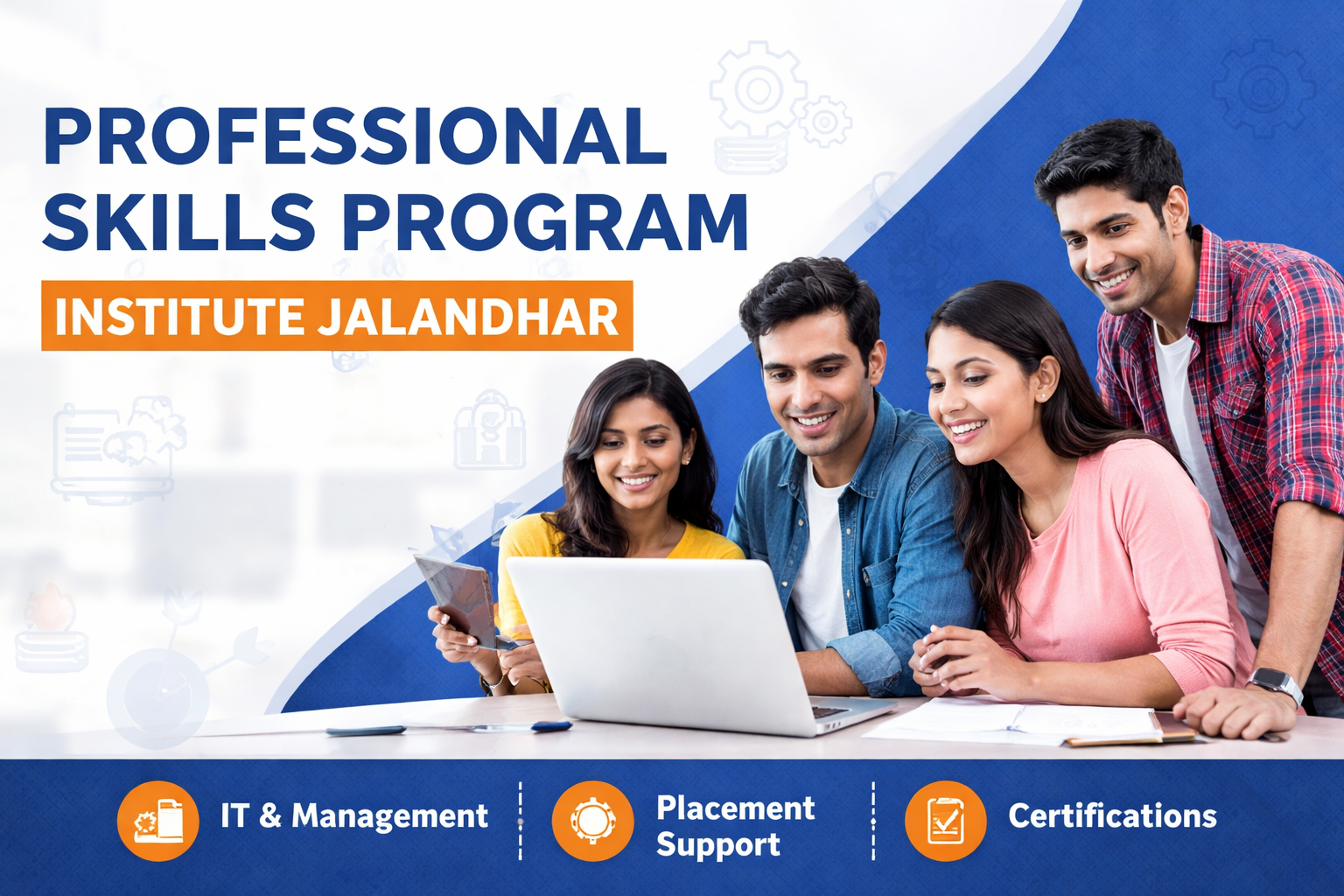
Professional Skills Program Institute, Jalandhar: A Complete Overview
Executive Summary
ProSkills Institute, established in Jalandhar, Punjab, has emerged as a significant player in the vocational and technical education landscape of the region. The institute operates through multiple specialized departments, offering a diverse portfolio of programs ranging from short-term certificates to advanced diplomas and three-year engineering diplomas. With a focus on industry-relevant skills, practical training, and career-oriented education, ProSkills Institute serves a broad student base including 10th and 12th pass candidates, working professionals, and aspiring entrepreneurs.
This comprehensive overview examines the institute's departmental structure, course offerings across various domains, pedagogical approach, infrastructure, faculty expertise, placement assistance mechanisms, and the overall value proposition for prospective students.
1. Introduction: Positioning in Jalandhar's Educational Landscape
Jalandhar, one of Punjab's most prominent educational hubs, has witnessed significant growth in vocational and technical education over the past decade. ProSkills Institute has strategically positioned itself within this ecosystem by offering programs that bridge the gap between conventional academic education and industry-demanded skills. The institute operates from its primary facility located within the PR World Trade Center complex near the bus stand in Jawahar Nagar, Jalandhar, making it accessible to students from across the city and surrounding regions .
The institute's educational philosophy centers on the principle that theoretical knowledge must be complemented by substantial hands-on experience. This approach aligns with the broader national emphasis on skill development under initiatives like Skill India and the National Skill Development Corporation's objectives. Unlike traditional polytechnic colleges that may focus heavily on theoretical engineering concepts, ProSkills Institute emphasizes practical competencies that enable immediate workforce integration.
The institute serves multiple student segments simultaneously. For recent school graduates (10th and 12th pass), it offers foundational vocational training that can lead to entry-level employment. For working professionals, it provides upskilling opportunities through flexible short-term programs. Additionally, aspiring entrepreneurs benefit from trade-specific training that enables them to establish independent ventures in fields such as electrical work, welding, carpentry, or computer hardware servicing .
2. Departmental Structure and Academic Organization
ProSkills Institute operates through four primary academic departments, each catering to distinct career pathways and industry sectors. This departmentalization allows the institute to maintain focused expertise, specialized faculty, and tailored infrastructure for each domain.
2.1 Department of Polytechnic Studies
The Department of Polytechnic Studies represents the institute's most academically intensive division, offering three-year diploma programs equivalent to those provided by government polytechnic colleges. These programs target 12th-pass students seeking comprehensive engineering education .
Engineering Diplomas (3 Years):
The polytechnic department offers diplomas in Computer Science Engineering, Civil Engineering, Mechanical Engineering, Electrical Engineering, Electronics and Telecommunication Engineering, Automobile Engineering, Chemical Engineering, Marine Engineering, Nautical Science, and Instrumentation and Control Engineering. Each program follows a semester-based curriculum structure integrating theoretical instruction with laboratory work and workshop practice.
Vocational Diplomas (3 Years):
Beyond traditional engineering disciplines, this department also offers three-year vocational diplomas in Fashion Designing, Hotel Management and Catering Technology, and Multipurpose Health Worker (Female). These programs cater to students interested in service-sector careers rather than conventional engineering pathways.
The three-year duration allows for comprehensive coverage of fundamental principles, specialized topics, and extended practical training, including mandatory industrial internships during the final year.
2.2 Department of Information Technology
The IT department addresses the growing demand for digital skills across the technology sector. This department offers programs spanning multiple proficiency levels, from basic computer literacy to advanced programming and networking certifications .
Advanced Diplomas (2 Years):
These programs target 12th-pass students seeking in-depth IT education. Offerings include Advanced Diplomas in Computer Application, Office Automation, Desktop Publishing, Computer Hardware and Networking, Information Technology, Computer Science, Computer Application and Programming, Web Designing, and Website Development. The two-year format enables comprehensive coverage of both foundational and advanced topics.
Diplomas (1 Year):
One-year diploma programs accommodate both 10th and 12th pass students across various specializations. These include Software Engineering, Computer Application, Office Automation and Publishing, Desktop Publishing, Computer Hardware and Networking, Information Technology, Computer Science, Digital Marketing, Software Testing, Auto CAD Designing, and Digital Animation.
Certificate Programs (3-6 Months):
Short-term certificates provide targeted skill development for rapid workforce entry or professional upskilling. Offerings include Computer Application, Office Automation, Desktop Publishing, Information Technology, AutoCAD, Hardware and Networking, Web Designing, Data Entry Operator, Programming Languages (C, C++, Java, .NET, PHP, J2EE), Database Management, Linux Administration, Data Structures, Visual Basic.NET, English Typing, Hindi Typing, and Solid Works.
This tiered structure enables students to enter at appropriate levels based on their prior education and career goals, with clear pathways for progression from certificates to diplomas.
2.3 Department of Vocational Education and Training
The vocational training department focuses on industrial trades and technical skills essential for manufacturing, construction, and service sectors. These programs emphasize hands-on skill development for immediate workplace application .
Industrial Trade Diplomas (2 Years):
These programs target 12th-pass students seeking specialized trade skills. Offerings include Diesel Mechanic, Electrician, Electronic Mechanic, Mechanic Fitter, Draughtsman (Mechanical), Draughtsman (Civil), and Vocational Diploma in Electrical.
Diplomas (1 Year):
One-year vocational diplomas accommodate 10th-pass students in trades including Diesel Mechanic, Painter General, Mason, Electrician, Architectural Assistant, Printing Technology, Motor Mechanic, and Motor Winding.
Certificate Programs (6 Months - 1 Year):
Short-term certificates provide foundational trade skills for rapid workforce entry. Offerings include Draughtsman (Mechanical), Draughtsman (Civil), CNC Mechanic, Welder, Carpentry, Mining Technology, AC and Refrigeration, Plumber, Surveyor, Electrician, Motor Winding, Mobile Phone Repairing, Marine Mechanical Fitter, and Wireman.
The vocational department's curriculum emphasizes practical workshop training, with theory instruction limited to safety protocols, material properties, and basic scientific principles relevant to each trade.
2.4 Department of Yoga and Sports
According to available information, ProSkills Institute also operates a Department of Yoga and Sports offering wellness-oriented programs. These include a one-year Diploma in Yoga and Naturopathy, a six-month Certificate in Yoga Therapy, and short-term Yoga and Meditation Workshops. These programs focus on the therapeutic applications of yoga for stress management, weight control, and chronic pain relief .
3. Course Portfolio: Comprehensive Program Analysis
3.1 Engineering and Technical Programs
The three-year engineering diplomas represent the institute's most academically rigorous offerings. The Computer Science Engineering program covers programming fundamentals, data structures, database management, web technologies, and software engineering principles. The Civil Engineering curriculum includes surveying, construction materials, structural analysis, and building drawing. Mechanical Engineering students study thermodynamics, manufacturing processes, machine design, and workshop technology.
Electrical Engineering covers circuit theory, electrical machines, power systems, and control systems. Electronics and Telecommunication Engineering includes analog and digital electronics, communication systems, and microprocessors. The Automobile Engineering program focuses on vehicle systems including engines, transmissions, suspension, and electrical systems.
The inclusion of Marine Engineering and Nautical Science is noteworthy, as these specialized programs prepare students for careers in the shipping industry, though such programs typically require additional certifications and approvals from maritime authorities.
3.2 Information Technology Programs
The IT department's curriculum emphasizes practical software skills. Programming courses cover multiple languages including C, C++, Java, .NET, PHP, and J2EE, enabling students to develop proficiency across different programming paradigms. Web design and development courses include HTML, CSS, JavaScript, and backend technologies. Database management training covers SQL, database design, and administration.
Digital marketing coursework includes search engine optimization, social media marketing, email marketing, and analytics. Hardware and networking programs cover computer assembly, troubleshooting, operating systems, network configuration, and basic server administration. AutoCAD and Solid Works training serves students interested in design and drafting careers.
The IT department's certificate programs in specific programming languages (3-6 months) are particularly valuable for professionals seeking targeted upskilling without committing to longer diploma programs.
3.3 Vocational and Industrial Trade Programs
The vocational programs emphasize practical trade skills essential for manufacturing and construction sectors. Diesel Mechanic training covers engine repair, fuel systems, and vehicle maintenance. Electrician programs include wiring, motor control, and basic electrical system troubleshooting. Welder training covers arc welding, gas welding, and basic metallurgy.
Carpentry and Mason programs teach construction trades skills including formwork, brick laying, plastering, and basic structural work. Plumbing and Refrigeration programs cover pipe fitting, pump installation, AC servicing, and refrigeration system maintenance.
Mobile Phone Repairing represents a modern addition to the vocational portfolio, addressing demand for consumer electronics servicing skills. Marine Mechanical Fitter training prepares students for shipboard mechanical maintenance roles.
3.4 Hospitality and Healthcare Programs
The three-year Hotel Management and Catering Technology diploma covers food production, food and beverage service, housekeeping, front office operations, and hospitality management principles. Fashion Designing includes garment construction, pattern making, textile science, and fashion illustration.
The Multipurpose Health Worker (Female) program trains students in basic healthcare delivery, first aid, patient care, and community health practices, potentially enabling employment in clinics, hospitals, or community health settings.
4. Pedagogical Approach and Training Methodology
4.1 Practical Training Emphasis
ProSkills Institute's pedagogical approach centers on hands-on training with modern tools and equipment . The institute operates dedicated laboratory facilities for different departments, including computer labs for IT programs, workshops for engineering and vocational trades, and specialized spaces for hospitality and fashion programs.
This practical emphasis means that instructional time is divided between classroom theory and laboratory/workshop practice. For vocational trades, the ratio typically favors hands-on practice, with students spending substantial time developing psychomotor skills under instructor supervision.
4.2 Industry-Aligned Curriculum
The institute states that its curriculum incorporates input from industry professionals and reflects current industry practices . This alignment manifests through several mechanisms: course content updated to reflect technological changes, projects based on real-world scenarios, and exposure to tools and software commonly used in industry settings.
For IT programs, this means teaching current programming languages, frameworks, and development methodologies rather than obsolete technologies. For engineering programs, it involves covering current codes, standards, and construction practices. For vocational trades, it means training on equipment types commonly encountered in actual work environments.
4.3 Flexible Program Durations
The institute's multi-duration program structure accommodates diverse student needs . Three-year programs suit students seeking comprehensive education comparable to polytechnic diplomas. Two-year advanced diplomas provide depth in specific domains without the full three-year commitment. One-year diplomas offer focused skill development for rapid workforce entry. Certificate programs of 3-6 months enable targeted upskilling or exploration of new career directions.
This flexibility allows students to choose programs aligned with their available time, financial resources, and career objectives. Working professionals can pursue short-term certificates without extended career interruption, while recent school graduates may opt for longer programs providing broader foundations.
5. Faculty Expertise and Instructional Quality
According to institute information, faculty members include professionals with real-world industry experience alongside academic credentials . This industry-experienced faculty is particularly valuable for vocational and IT programs where practical knowledge of workplace practices, common problems, and industry standards significantly enhances training quality.
The institute's faculty structure likely includes department heads responsible for curriculum oversight, full-time instructors for core courses, and potentially guest instructors or industry professionals for specialized topics. However, specific information regarding faculty qualifications, student-faculty ratios, or faculty development programs is not available in the search results.
For prospective students, the practical value of industry-experienced instructors cannot be overstated. Such instructors can share workplace realities, common challenges, troubleshooting approaches, and professional practices that purely academic instructors might not know. They can also provide authentic insights into industry expectations, career pathways, and professional development.
6. Infrastructure and Learning Resources
6.1 Physical Facilities
The institute's location within the PR World Trade Center in Jawahar Nagar suggests a commercial rather than campus-style facility . This location near the bus stand provides transportation accessibility for students commuting from various parts of Jalandhar and surrounding areas.
The institute maintains separate facilities for different departments, including workshops for vocational trades, computer laboratories for IT programs, and specialized spaces for engineering and hospitality programs. However, specific details regarding workshop equipment, computer specifications, laboratory instruments, library resources, or classroom facilities are not provided in the available information.
6.2 Equipment and Tools
For vocational trades, the institute states that training uses modern tools and equipment . Industrial trade programs likely include access to welding equipment, carpentry tools, electrical testing instruments, engine repair facilities, and refrigeration servicing equipment. The IT department presumably maintains computer systems with relevant software installations for programming, design, and networking courses.
Prospective students would benefit from visiting the facilities personally to assess equipment condition, availability, and relevance to their intended program of study before enrollment.
7. Placement Assistance and Career Support
7.1 Placement Services
The institute offers placement assistance and internship support across all departments . This support typically includes resume preparation assistance, interview skills training, job search guidance, and connections with potential employers. The institute states that it helps connect students with internship opportunities and job placements in relevant industries.
However, specific placement statistics such as placement percentages, average salary packages, recruiting companies, or industry partnerships are not available in the search results. Prospective students should request this information directly from the institute's placement office before enrollment.
7.2 Career Pathways by Program Type
Career opportunities vary significantly by program. Engineering diploma graduates may pursue positions as junior engineers, technicians, or supervisors in construction, manufacturing, or service companies. IT program graduates can work as software developers, web designers, network technicians, or digital marketing specialists. Vocational trade graduates may find employment as electricians, welders, mechanics, or refrigeration technicians, or may establish independent service businesses .
The institute's career opportunity listings suggest broad employment potential, though actual outcomes depend on individual student performance, local job market conditions, and the institute's employer network strength.
8. Admission Requirements and Eligibility
8.1 Educational Qualifications
Eligibility requirements vary by program level and department. For three-year engineering diplomas and advanced diplomas, 12th pass is the standard requirement . For one-year vocational diplomas and certificates, 10th pass is typically sufficient, though some one-year programs in the IT department require 12th pass .
The institute accommodates students from both 10th and 12th educational backgrounds, with program options available at each level. This inclusivity enables students who may not have completed higher secondary education to access vocational training and employment opportunities.
8.2 Target Student Segments
Beyond educational qualifications, the institute identifies three primary student segments: students (10th or 12th pass candidates seeking career preparation), working professionals (individuals seeking skill upgrades or career changes), and entrepreneurs (individuals planning to start technical or service businesses) .
This segmentation reflects the institute's understanding that vocational training serves diverse purposes beyond initial career preparation, including professional development, career transition, and business startup preparation.
9. Affordability and Financial Considerations
The institute claims to offer affordable fees with high-quality education . However, specific fee structures for different programs are not available in the search results. Fee amounts likely vary significantly based on program duration (3 months to 3 years), department (IT programs may cost differently than vocational trades), and included resources (such as workshop materials or software access).
Prospective students should contact the institute directly for current fee information, including any additional costs for materials, examination fees, certification charges, or other expenses beyond tuition.
10. Strengths and Potential Limitations
10.1 Identified Strengths
Program Diversity: The institute offers programs across engineering, IT, vocational trades, hospitality, healthcare, and yoga, providing options for diverse career interests and educational backgrounds.
Flexible Duration Options: With programs ranging from 3 months to 3 years, students can select durations matching their career goals and available time commitment.
Practical Training Emphasis: The focus on hands-on learning with modern tools addresses the skill gap that many traditional academic programs leave unaddressed.
Multiple Entry Points: Students with 10th or 12th qualifications can find appropriate programs, making vocational education accessible to broader populations.
Placement Assistance: The institute's stated commitment to placement support, while lacking specific metrics, indicates attention to employment outcomes.
10.2 Information Gaps and Potential Limitations
Based on available information, several areas require prospective student investigation:
Accreditation Status: The search results do not specify whether the institute's programs are approved by AICTE, UGC, state technical education boards, or other regulatory bodies. Prospective students should verify accreditation before enrollment, particularly for three-year engineering diplomas intended for government employment or further education.
Placement Data: No specific placement statistics, employer lists, or salary information is provided. Serious students should request this data directly.
Faculty Credentials: While the institute claims experienced faculty, specific faculty qualifications and industry experience details are unavailable.
Infrastructure Details: Specific information regarding workshop equipment, computer lab specifications, library resources, and facility conditions is not provided.
Alumni Network: No information about alumni outcomes, alumni associations, or graduate success stories is available.
11. How to Obtain Additional Information
Given the information gaps in publicly available materials, prospective students should take several steps before enrollment:
Direct Institute Contact: The institute can be reached through its website (www.proskillsinstitute.com) and by phone at 076529 33997 .
Facility Visit: Personal inspection of workshop facilities, computer labs, and training equipment is strongly recommended, particularly for vocational and engineering programs where equipment quality directly affects training outcomes.
Current Student Interaction: Speaking with current students about teaching quality, equipment access, placement support, and overall satisfaction provides valuable perspective not available in official materials.
Graduate Employment Verification: Requesting contact information for recent graduates or asking for placement records with employer names enables independent verification of placement claims.
Fee Structure Inquiry: Obtaining complete fee information including all associated costs prevents unexpected expenses after enrollment.
12. Comparative Positioning in Jalandhar's Vocational Education Market
ProSkills Institute competes in Jalandhar's vocational education market alongside government ITIs (Industrial Training Institutes), private polytechnic colleges, and specialized training centers. The institute's multi-department structure and diverse program portfolio differentiate it from single-focus competitors.
Government ITIs typically offer lower fees but may have longer waiting lists and less flexible scheduling. Private polytechnics may offer degree programs but often at higher price points. ProSkills Institute's positioning appears to target the mid-market segment seeking practical skills at accessible prices with flexible program options.
The inclusion of modern programs like Mobile Phone Repairing, Digital Marketing, and Yoga Therapy alongside traditional trades suggests an effort to address contemporary skill demands beyond conventional vocational education.
13. Conclusion and Recommendations
ProSkills Institute, Jalandhar, presents a comprehensive vocational and technical education option with significant program diversity across engineering, IT, industrial trades, hospitality, healthcare, and wellness domains. The institute's emphasis on practical training, flexible program durations, and multiple entry points for students with different educational backgrounds represents genuine strengths.
However, the absence of publicly available information regarding accreditation status, specific placement statistics, faculty credentials, and detailed infrastructure descriptions creates information gaps that prospective students must fill through direct inquiry and facility visits.
Recommendations for Prospective Students:
Students considering ProSkills Institute should prioritize programs where hands-on skill development directly translates to employment opportunities, particularly vocational trades and IT certificates. The three-year engineering diplomas require additional scrutiny regarding accreditation, as this affects eligibility for government jobs and further education.
Before enrollment, prospective students should verify the institute's regulatory approvals, inspect facilities personally, request placement records, speak with current students, and compare offerings with alternative local providers including government ITIs and other private institutes.
For students seeking rapid workforce entry with practical skills, particularly in trades or IT support roles, ProSkills Institute appears worth serious consideration contingent on satisfactory verification of the information gaps identified in this overview. For students seeking traditional academic degrees or assured government employment pathways, alternative institutions with clearer accreditation and placement track records may prove more suitable.
The institute's multi-department structure and program variety make it a viable option for students uncertain about their career direction, as they can potentially explore different domains through short certificates before committing to longer programs. However, as with any educational investment, thorough due diligence remains essential before enrollment.
Why TechCADD? A Comprehensive Analysis of Jalandhar's Premier Computer Education Institute
Executive Summary
In the competitive landscape of computer education in Jalandhar, TechCADD Computer Education Institute has emerged as a distinctive player, offering industry-aligned training across multiple technology domains including Data Science, Ethical Hacking, Web Designing, Digital Marketing, and Full-Stack Development. This comprehensive analysis explores why TechCADD has become a preferred choice for aspiring IT professionals, examining its pedagogical approach, curriculum design, faculty expertise, placement support, infrastructure, and overall value proposition.
The institute operates from a strategically located facility near the Bus Stand in Jalandhar, opposite the All India Radio Station, making it accessible to students across the city and surrounding regions. With a mission to create a comprehensive network of well-trained technical professionals who are directly employable in industries, TechCADD positions itself as more than just a training center—it aims to be a career launchpad for the digital economy.
This analysis draws from official institute information, course descriptions, student reviews, and comparative evaluations to present a balanced, evidence-based overview of what makes TechCADD distinctive in Jalandhar's crowded educational marketplace.
1. The Core Differentiator: Industry-Aligned Curriculum
1.1 Living Curriculum, Not Static Syllabi
Perhaps the most significant differentiator TechCADD offers is its commitment to maintaining a curriculum that evolves based on direct industry feedback. Unlike conventional institutes that may teach outdated programming languages or obsolete frameworks, TechCADD positions its course content as a "living, breathing document" constantly updated to reflect current market demands.
This approach addresses a fundamental problem in technical education: the gap between academic training and workplace requirements. Many students graduate from traditional programs only to discover that the technologies they mastered are no longer what employers seek. TechCADD's dynamic curriculum model attempts to bridge this gap by incorporating feedback from hiring partners and industry practitioners directly into course design.
1.2 Beyond Fundamentals: Specialization and Depth
TechCADD's educational philosophy emphasizes specialization over generalization. Rather than offering superficial coverage of multiple topics, the institute designs its courses to develop deep expertise in specific domains. For example:
-
Python Programming is taught with Django for full-stack web development, not just basic syntax
-
Data Analytics covers the complete data pipeline including SQL, Power BI, and Tableau
-
Web Development encompasses both front-end and back-end technologies, creating versatile full-stack developers
This approach recognizes that employers value specialists who can solve specific problems over generalists with surface-level knowledge across many areas.
1.3 Tool-Based Learning with Industry-Standard Platforms
TechCADD integrates the most in-demand tools and platforms into its training programs. Students gain hands-on experience with:
-
Kali Linux for ethical hacking and penetration testing
-
TensorFlow for artificial intelligence and machine learning
-
Docker for containerization and deployment
-
Metasploit, Burp Suite, Wireshark for cybersecurity training
-
Power BI and Tableau for data visualization
This tool-centric approach ensures that students are not learning theoretical concepts in isolation but are developing practical familiarity with the exact technologies they will encounter in professional environments.
2. Faculty Expertise: Learning from Practitioners, Not Just Teachers
2.1 Industry Veterans as Instructors
TechCADD emphasizes that its trainers are not academically qualified individuals with limited practical experience but seasoned developers, active cybersecurity experts, and lead data scientists who bring current industry challenges and workflows into the classroom. This distinction is crucial because the quality of instruction directly correlates with learning outcomes.
The institute claims its faculty members have 10-15 years of experience in their respective domains, including UI/UX design, front-end development, and digital design. These professionals share not just textbook knowledge but "war stories"—real challenges they have faced, solutions they have implemented, and lessons they have learned through years of practice.
2.2 Mentorship Model, Not Lecture-Only Delivery
Beyond standard classroom instruction, TechCADD implements a mentorship model where each student is assigned a mentor who guides them through their learning journey. This personalized approach includes:
-
One-to-one feedback on projects and assignments
-
Debugging assistance and code review
-
Career guidance and portfolio development
-
Regular progress monitoring and intervention when needed
This mentorship structure addresses a common criticism of vocational training institutes—that students can complete courses without truly mastering the material. The personalized attention ensures that struggling students receive support before falling behind.
2.3 Accessibility and Approachability
The institute promotes an environment where mentors are approachable and dedicated to student success. This contrasts with larger, "assembly-line" institutes where students may feel like numbers rather than individuals receiving personalized attention.
3. The "Learn by Doing" Philosophy: Project-Based Education
3.1 Portfolio-Building from Day One
TechCADD's pedagogical approach centers on project-based learning, where theoretical concepts are immediately applied to practical projects. From the first month of enrollment, students work on tangible projects that build their professional portfolios:
-
Web design students build and deploy live, responsive websites
-
Data science students complete capstone projects analyzing real-world datasets
-
Ethical hacking students practice in isolated lab environments simulating enterprise networks
This emphasis on portfolio development serves a dual purpose: it reinforces learning through application, and it provides graduates with demonstrable evidence of their capabilities when applying for jobs.
3.2 Simulated Work Environments
TechCADD creates learning environments that mimic actual IT company settings. Students learn to use:
-
Git for version control, simulating collaborative development workflows
-
Project management tools to track progress and meet deadlines
-
Team collaboration practices that reflect real workplace dynamics
These simulated environments prepare students not just for technical interviews but for the day-to-day realities of working in technology teams—skills that are often overlooked in traditional education but are critical for workplace success.
3.3 Safe Practice Environments for Security Training
For cybersecurity courses, TechCADD provides dedicated, isolated lab environments where students can safely practice penetration testing and vulnerability assessment without legal or ethical concerns. This is particularly important because ethical hacking skills cannot be developed through theory alone—they require hands-on practice with real attack scenarios in controlled settings.
4. Comprehensive Course Portfolio Across High-Demand Domains
TechCADD offers specialized training across multiple technology domains, each designed to prepare students for specific career pathways.
4.1 Cybersecurity and Ethical Hacking
The Advanced Certification in Ethical Hacking represents one of TechCADD's flagship programs. The course covers:
Students gain hands-on experience with tools including Nmap, Metasploit, Burp Suite, Wireshark, Aircrack-ng, and John the Ripper. The program prepares students for CEH certification and roles such as penetration tester, SOC analyst, and security consultant.
4.2 Web Designing and Development
TechCADD offers multiple web design programs, including an Advanced Diploma in Website Designing and an Advance Certification in Web Designing. The curriculum encompasses:
-
Front-End Development: HTML5, CSS3, Bootstrap, responsive design principles
-
JavaScript and ReactJS: Interactive features, dynamic applications, modern frameworks
-
UI/UX Design: User psychology, wireframing, intuitive interface design
-
Graphic Design Integration: Adobe Photoshop, Illustrator for visual elements
-
WordPress & CMS: Plugin customization, content management systems
-
SEO Fundamentals: Search engine optimization, performance optimization
-
AI in Web Design: ChatGPT integration, Figma AI, Adobe Sensei
A distinctive feature of the web design curriculum is its integration of AI tools in web design workflows, including layout automation, personalized user experiences, and AI-powered prototyping.
4.3 Data Science and Artificial Intelligence
The Advanced Data Science Course integrates data science, machine learning, and artificial intelligence into a comprehensive program. Key modules include:
-
Python programming with NumPy, Pandas, Matplotlib
-
Statistics and probability for data analysis
-
Machine Learning algorithms (supervised and unsupervised learning)
-
Deep Learning with TensorFlow and Keras
-
Natural Language Processing for text mining and sentiment analysis
-
Big Data concepts including Hadoop and Spark
-
Data visualization with Power BI and Tableau
-
Model deployment using Flask and Streamlit
The program emphasizes AI-powered predictive analytics, enabling students to build systems that can forecast outcomes, automate decisions, and learn from data.
4.4 Classroom Environment and Learning Experience
TechCADD's data science classroom environment is described as engaging and collaborative, with students working together under instructor guidance. The instructor demonstrates coding and analysis live on a projector while students follow along on their own computers, creating an immersive learning experience that combines visual demonstration with hands-on practice.
Key features of the learning environment include:
-
Collaborative setup: Workstations arranged to encourage teamwork and peer learning
-
Live demonstrations: Real-time coding examples and data visualization techniques
-
Immediate application: Students practice concepts immediately after demonstrations
-
Personalized attention: Instructors move around the room providing individual guidance
5. Placement Support and Career Transformation
5.1 Dedicated Placement Cell
TechCADD maintains a proactive placement cell that continuously engages with a network of hiring partners across Chandigarh, Mohali, Delhi, and beyond. This placement support extends beyond simple resume forwarding to include:
-
Resume-building workshops tailored to IT industry expectations
-
Mock interviews with real-time feedback from industry professionals
-
Soft-skills training for professional communication
-
Portfolio guidance to showcase project work effectively
-
Internship facilitation for practical experience
5.2 Placement Track Record
The institute claims a strong placement record, with graduates working as Python Developers, Data Analysts, Software Engineers, and Ethical Hackers in top companies. Student testimonials on the website reflect positive experiences:
-
Karan Sharma: "I have been studying here from the past few months and I would say that this institute is really very good as it provides a friendly environment for students and also the facilities are amazing"
-
Sandeep Chahal: "I am doing a full-stack course there and I feel very glad to join this institute. Staff is very cooperative and all classes are well maintained and teachers are so cooperative and provide appropriate knowledge regarding the course"
-
Manmeet Kaur: "A great place to learn and enhance your technical skills. Nice place to upgrade your skills and upgrade your career in the IT sector. So you must enroll yourself in this institute"
5.3 Career Pathway Clarity
TechCADD provides clear career pathway information for each course domain. For example, Data Science graduates can pursue roles as Data Scientists, Machine Learning Engineers, AI Research Analysts, Business Intelligence Analysts, Data Analysts, Big Data Engineers, Predictive Modelers, or Freelance Data Consultants. Web design graduates can work as Web Designers, Front-End Developers, UI/UX Designers, WordPress Developers, or freelance web developers.
6. Infrastructure and Learning Resources
6.1 Strategic Location
TechCADD is located opposite the All India Radio Station, near the Bus Stand in Jalandhar. This central location provides accessibility for students commuting from various parts of the city and surrounding areas, reducing travel time and making it convenient for working professionals pursuing upskilling programs.
6.2 Modern Laboratory Facilities
The institute maintains modern computer labs equipped with high-end systems, licensed software, and high-speed internet connectivity. For cybersecurity training, dedicated isolated lab environments simulate enterprise networks, cloud infrastructure, and IoT devices, allowing students to practice penetration testing safely.
For web design and data science programs, labs are equipped with industry-standard software including Adobe Creative Suite, development environments, and data analytics platforms.
6.3 Conducive Learning Environment
The classroom environment is designed to promote collaborative learning, with workstations arranged to facilitate teamwork and peer interaction. Spacious, well-equipped rooms provide comfortable spaces for extended learning sessions.
7. Mission, Vision, and Educational Philosophy
7.1 Mission Statement
TechCADD's mission is "to develop a comprehensive network at national and international levels through its well-managed franchise centers, where students can easily reach qualitative advanced technology with practical exposure, to make them directly employable in industries".
This mission emphasizes two critical elements: accessibility (making quality education available to students) and employability (ensuring graduates are workplace-ready).
7.2 Vision Statement
The institute's vision is "to make India a hub of well-trained engineers and technical professionals and also to establish a globally trusted name in the field of software and services". This ambitious vision positions TechCADD as contributing to national skill development goals while building international credibility.
7.3 Core Goals
TechCADD aims to provide "short-term job-oriented skills in students so they can become stronger in their working careers". The institute's stated goal is to ensure "that every student receives a high-quality education that prepares them for future success in career and achieves measurable academic growth, develops essential skills for lifelong success".
8. Comparative Advantages Over Other Institutes
8.1 The "Beyond the Certificate" Approach
TechCADD distinguishes itself by focusing on problem-solving abilities rather than examination performance. While many institutes teach students to pass exams, TechCADD claims to teach students to "solve a real-world business problem on your first day at work".
This orientation toward practical problem-solving rather than theoretical knowledge is particularly valuable in technology fields where employers prioritize demonstrable skills over academic credentials.
8.2 Specialization in Niche, High-Growth Areas
Unlike institutes that focus on basic computer literacy or generic programming courses, TechCADD offers deep specialized training in high-growth areas including:
-
Data Science and Machine Learning
-
Cyber Security and Ethical Hacking
-
Full-Stack Web Development (MERN/MEAN Stack)
-
UI/UX Design
-
Digital Marketing
These specializations align with current market demands where employers struggle to find qualified candidates in these domains.
8.3 Integration of Emerging Technologies
TechCADD distinguishes itself through early adoption of emerging technologies in its curriculum, including:
-
AI in Web Design: Integration of ChatGPT, Framer AI, and Figma AI for automated layout generation and personalized user experiences
-
Cloud Security: Coverage of Docker, Kubernetes, and cloud misconfiguration attacks in cybersecurity training
-
AI-Powered Analytics: TensorFlow, predictive modeling, and automated decision-making in data science programs
This forward-looking approach ensures that graduates are prepared not just for current jobs but for evolving technology landscapes.
9. Flexibility and Accessibility
9.1 Multiple Learning Formats
TechCADD offers both online and offline learning options, with batches available in Jalandhar, Hoshiarpur, Phagwara, and Ludhiana. This geographic reach extends the institute's accessibility beyond Jalandhar city limits.
9.2 Flexible Scheduling
The institute offers flexible scheduling options to accommodate working professionals and students with other commitments. This includes both weekday and weekend batches, as well as morning and evening schedules.
9.3 Affordable Fee Structure
TechCADD claims to offer affordable fees with EMI options available, making advanced technical education accessible to students from diverse economic backgrounds. While specific fee structures are not publicly available, the institute positions itself as providing value-for-money education.
10. Student Support Services
10.1 Career Counseling
TechCADD provides expert career counseling to help students align their interests and strengths with appropriate career paths. For students uncertain about which technology domain to pursue, this guidance helps clarify options and set realistic expectations.
10.2 Freelancing Support
Beyond traditional job placement, TechCADD offers freelancing support to help students build independent careers. This includes guidance on:
-
Building professional portfolios
-
Creating proposals and pricing projects
-
Winning clients on platforms like Fiverr, Upwork, and LinkedIn
-
Managing freelance businesses
This freelancing orientation is particularly valuable for web designers and developers who may prefer independent work over traditional employment.
10.3 Regular Workshops and Skill Tests
The institute conducts regular workshops and skill tests for continuous improvement and confidence building. These assessments help students identify knowledge gaps and track their progress throughout the program.
11. Student Reviews and Reputation
11.1 Positive Student Feedback
Multiple student reviews on TechCADD's website rate the institute 5 out of 5 stars. Common themes in positive reviews include:
-
Friendly learning environment: Students appreciate the approachable atmosphere
-
Cooperative staff: Instructors and administrative staff receive consistent praise
-
Well-maintained facilities: Classes are described as well-maintained and equipped
-
Appropriate knowledge delivery: Students value the practical, relevant instruction
11.2 Verified Reviews Platform Presence
TechCADD maintains a presence on course review platforms like Coursetakers.com, where prospective students can access institute information and contact details.
12. Potential Considerations for Prospective Students
12.1 Information Gaps
While TechCADD provides extensive information about its programs and approach, prospective students may want to verify:
-
Specific placement statistics: The institute does not publicly disclose placement percentages or average salary packages
-
Employer partners list: A transparent list of hiring partners would help students evaluate job prospects
-
Accreditation status: Information about formal accreditations or affiliations with recognized educational bodies
-
Alumni network details: More comprehensive alumni success stories would strengthen credibility
12.2 Recommended Due Diligence
Before enrollment, prospective students should:
-
Visit the facility to inspect lab equipment and learning spaces personally
-
Request a demo class to experience teaching quality firsthand
-
Speak with current students about their experiences
-
Ask for placement records with verifiable employer information
-
Compare course offerings and fee structures with alternative institutes
13. Conclusion: The TechCADD Value Proposition
TechCADD Computer Education Institute presents a compelling option for individuals seeking career-oriented technology training in Jalandhar. Its strengths lie in several key areas:
Industry-Aligned Curriculum: The institute's commitment to dynamic, employer-informed course content addresses a fundamental gap in traditional technical education.
Experienced Practitioner Faculty: Learning from active industry professionals rather than purely academic instructors provides students with authentic workplace insights.
Project-Based Learning: The emphasis on portfolio development and simulated work environments ensures graduates have demonstrable skills, not just theoretical knowledge.
Specialized Career Pathways: Focused training in high-demand domains like cybersecurity, data science, and full-stack development positions graduates for competitive roles.
Comprehensive Support Services: Placement assistance, freelancing guidance, and career counseling extend beyond technical training to address employability holistically.
However, prospective students should conduct thorough due diligence, including facility visits and verification of placement claims, before enrollment. The institute's value proposition is strongest for individuals committed to hands-on, career-focused learning who are willing to supplement formal training with independent practice and portfolio development.
For students in Jalandhar seeking to enter or advance in technology careers, TechCADD represents a serious contender among local training providers. Its focus on practical skills, industry relevance, and emerging technologies aligns with the demands of today's digital economy. As with any educational investment, the ultimate value depends on individual effort, engagement, and follow-through—but TechCADD appears to provide the infrastructure, expertise, and support systems necessary for motivated students to succeed.
This comprehensive analysis examines the future scope across TechCADD's core program domains—Data Science & Artificial Intelligence, Cybersecurity & Ethical Hacking, Web Design & Development, and emerging technology fields. It explores career trajectories, industry demand trends, salary expectations, and long-term growth potential for graduates. Additionally, it provides actionable roadmaps for students to maximize their career outcomes and discusses how TechCADD's industry-aligned approach creates sustainable competitive advantages in an increasingly automated job market.
Whether you are a fresh graduate exploring career options, a working professional considering upskilling, or an entrepreneur seeking technical expertise, understanding the future scope of these programs is essential for making informed educational investments.
1. Data Science and Artificial Intelligence: The Most Promising Career Frontier
1.1 Industry Demand and Market Outlook
Data Science has emerged as the most transformative field of the current decade. In today's data economy, every organization—from small startups to Fortune 500 corporations—uses data to forecast outcomes, understand customers, and make automated decisions through AI and Machine Learning. This universal demand creates unprecedented career opportunities for trained professionals.
The integration of Artificial Intelligence with Data Science has revolutionized how businesses operate. AI-powered predictive analytics enables companies to forecast customer behavior, optimize supply chains, personalize recommendations, and automate decision-making processes that previously required human intervention. This convergence means that professionals trained in both domains are not just employable—they are essential.
Key industry drivers include:
-
Digital Transformation: Companies across all sectors are digitizing operations, creating massive data volumes requiring analysis
-
Automation Imperative: Organizations seek efficiency through AI-driven process automation
-
Customer Personalization: Data-driven insights enable hyper-personalized customer experiences
-
Predictive Maintenance: Manufacturing and logistics use data science to prevent equipment failures
-
Healthcare Analytics: Medical data analysis improves diagnosis, treatment, and patient outcomes
1.2 Career Roles and Growth Trajectories
TechCADD's Advanced Data Science Course prepares students for multiple high-value career paths:
Data Scientist: These professionals analyze complex datasets to extract valuable insights using statistical methods, Python, and machine learning. They help businesses make data-driven decisions and predict future trends for smarter strategies. This role typically commands salaries ranging from ₹6-15 LPA for freshers, with experienced professionals earning ₹20-35 LPA or more.
Machine Learning Engineer: ML Engineers design and implement algorithms that enable systems to learn from data automatically. They build and optimize ML models for tasks like predictions, recommendations, and automation. This specialization is among the highest-paying in tech, with starting salaries of ₹8-18 LPA.
AI Research Analyst: These innovators explore novel ways to apply artificial intelligence in solving real-world problems. They work on model development, testing AI algorithms, and advancing new intelligent technologies. This role offers opportunities to work on cutting-edge projects in research labs and tech companies.
Business Intelligence Analyst: BI Analysts transform raw data into actionable insights using tools like Power BI and Tableau. They create reports and dashboards that help organizations improve performance and decision-making. This role serves as an excellent entry point with salaries of ₹4-8 LPA.
Big Data Engineer: These engineers develop systems to handle massive data volumes efficiently using Hadoop, Spark, and data lakes. They ensure seamless data storage, processing, and retrieval for analytics teams. With cloud computing adoption accelerating, this role commands salaries of ₹7-15 LPA for experienced professionals.
Predictive Modeler: Predictive Modelers build models that forecast future outcomes based on historical data using regression, classification, and AI techniques. This specialized role is in high demand in finance, insurance, and e-commerce sectors.
Freelance Data Consultant: Independent professionals offering analytics and AI solutions to clients worldwide can earn ₹50,000-2,00,000 monthly depending on project volume and complexity.
1.3 Skills That Create Future Value
The future scope for data science professionals depends on mastering specific, high-demand skills. TechCADD's curriculum covers these essential competencies:
Programming Proficiency: Python with libraries including NumPy, Pandas, and Matplotlib forms the foundation. These skills are transferable across industries and remain relevant as technology evolves.
Statistical Analysis: Hypothesis testing, correlation analysis, and regression techniques enable proper interpretation of data patterns. Statistical literacy distinguishes true data scientists from casual analysts.
Machine Learning Algorithms: Both supervised and unsupervised learning techniques are essential. Understanding when and how to apply different algorithms creates problem-solving versatility.
Deep Learning & Neural Networks: TensorFlow and Keras expertise enables work on image recognition, natural language processing, and complex pattern recognition tasks—areas where AI is rapidly advancing.
Data Visualization: Power BI and Tableau proficiency allows communication of insights to non-technical stakeholders. The ability to tell stories with data is increasingly valued.
Model Deployment: Flask, Streamlit, and API integration skills ensure models can be operationalized—taking analysis from notebook to production environment.
1.4 Long-Term Growth Potential
The data science field shows no signs of saturation. As more industries adopt AI, demand continues to outpace supply of qualified professionals. The future scope includes:
-
Leadership Pathways: Data Scientists can progress to Chief Data Officer, Head of Analytics, or Director of AI roles
-
Specialization Opportunities: Deep expertise in computer vision, NLP, or reinforcement learning creates niche value
-
Entrepreneurship: Data science skills enable founding AI-powered startups
-
Global Mobility: Data science skills are universally valued, enabling international career opportunities
2. Cybersecurity and Ethical Hacking: Protecting the Digital Future
2.1 The Growing Threat Landscape
In an increasingly digital world where every transaction and interaction has an online footprint, a new breed of guardian has emerged—ethical hackers who defend data from malicious attacks. The demand for cybersecurity professionals is at an all-time high and continues to grow exponentially.
Every organization, from banks and government agencies to local businesses in Punjab, needs protection against cyber threats. Data breaches, ransomware attacks, and identity theft have become daily headlines, creating urgent demand for professionals who can prevent, detect, and respond to security incidents.
The future scope in cybersecurity is particularly robust because threats evolve continuously, requiring constant adaptation and learning. Unlike some IT roles that may face automation, cybersecurity requires creative thinking, problem-solving, and understanding of human behavior—skills that artificial intelligence cannot easily replicate.
2.2 Career Pathways and Role Evolution
TechCADD's Ethical Hacking and Cyber Security course prepares students for multiple career trajectories:
Penetration Tester (Ethical Hacker): These professionals simulate cyberattacks to identify vulnerabilities before malicious actors exploit them. They follow a methodological process of vulnerability assessment and penetration testing, thinking creatively to find unconventional entry points. Penetration testers earn ₹5-12 LPA as freshers, with experienced professionals commanding ₹15-25 LPA.
Security Operations Center (SOC) Analyst: SOC Analysts monitor networks for security incidents, investigate alerts, and coordinate response activities. This role provides excellent entry-point experience, with salaries ranging from ₹3-6 LPA for junior analysts.
Security Consultant: Consultants advise organizations on security strategies, conduct risk assessments, and recommend controls. This role offers variety and client interaction, with earnings of ₹8-20 LPA depending on experience.
Incident Response Specialist: These professionals manage security breaches when they occur, containing damage and restoring normal operations. This high-pressure role commands premium compensation of ₹10-25 LPA.
Vulnerability Assessment Analyst: Analysts identify, classify, and prioritize vulnerabilities in systems and applications. This specialized role is essential for compliance and risk management.
Security Auditor: Auditors evaluate whether organizations meet security standards and regulatory requirements. This role combines technical knowledge with governance expertise.
2.3 Essential Competencies for Future Success
TechCADD's cybersecurity curriculum builds competencies that remain valuable as threats evolve:
Network Security Fundamentals: Understanding TCP/IP models, subnets, and network protocols is foundational. You cannot protect networks without understanding how they work.
Kali Linux Proficiency: The hacker's favorite operating system requires command-line expertise. Real power in security comes from understanding systems at this level.
Reconnaissance and Scanning: Footprinting targets, gathering information, and performing active scanning with tools like Nmap requires patience and attention to detail—skills that become more refined with experience.
Vulnerability Exploitation: Using frameworks like Metasploit to exploit vulnerabilities in controlled environments teaches the exact methodology black-hat hackers use, enabling better defense building.
Web Application Security: Understanding OWASP Top 10 vulnerabilities including SQL Injection, Cross-Site Scripting (XSS), and Cross-Site Request Forgery (CSRF) is essential as web applications remain primary attack targets.
Report Writing and Communication: An ethical hacker's job isn't complete until risks and remediation steps are clearly communicated to clients. This business skill separates amateurs from professionals.
2.4 The Angelina Success Story
A compelling example of future scope realization comes from Angelina, a BCA graduate who transformed into a skilled ethical hacker through TechCADD's program:
"I was always the person my family would call when their phone behaved strangely or their Facebook account was acting up. I enjoyed solving these puzzles," Angelina recalls. Her curiosity turned toward cybersecurity after watching movies about hackers and reading news about data breaches—not intrigued by the crime but by the 'how'—how did they get in? How could it have been prevented?
After enrolling at TechCADD, Angelina received structured training starting from networking fundamentals and progressing to advanced exploitation techniques. The result: "I received an offer from an IT risk consulting firm as a junior penetration tester. In my first week, I was tasked with a vulnerability assessment for a client's web application. Using the skills I learnt at TechCADD, I identified a critical SQL injection flaw that their own developers had missed."
This success story demonstrates that with proper training, students from any background can enter and excel in cybersecurity careers.
2.5 Long-Term Growth in Security
The future scope for cybersecurity professionals includes:
Certification Progression: Starting with CEH (Certified Ethical Hacker) and CompTIA Security+, professionals can advance to CISSP, OSCP, and other advanced credentials that command higher salaries and responsibilities.
Specialization Depth: Areas like cloud security, IoT security, automotive security, and critical infrastructure protection offer niche expertise with premium compensation.
Management Pathways: Security professionals can progress to Security Manager, CISO (Chief Information Security Officer), or security practice leadership roles.
Consulting Independence: Experienced professionals can establish independent security consulting practices.
3. Web Design and Development: Building the Digital World
3.1 The Perpetual Demand for Web Professionals
In the current hyper-digitalized economy, a website is the face of all organizations—from small startups to multinational companies. Professional web designers are no longer just the "tech people"; they are strategic storytellers, digital architects, and creative problem solvers.
The demand for skilled web designers has accelerated enormously across every field—e-commerce, healthcare, media, real estate, and education. Unlike some technology roles that may be automated, web design requires creativity, user psychology understanding, and aesthetic judgment—capabilities that remain uniquely human.
Crucially, automation will displace some jobs, but web designers cannot be replaced since creativity cannot be automated. With companies continuously going online, digital presence remains an essential business necessity, making web design a genuinely future-proof career choice.
3.2 Career Opportunities and Earning Potential
TechCADD's Advanced Diploma in Website Designing prepares students for diverse career paths:
Front-End Developer: These professionals implement visual and interactive elements users see and engage with. Using HTML5, CSS3, JavaScript, and ReactJS, they create responsive websites that work perfectly on every device. Freshers earn ₹3-5 LPA, while experienced developers with strong portfolios earn ₹8-15 LPA.
UI/UX Designer: UI/UX Designers focus on user psychology, wireframing, and creating intuitive interfaces that emotionally connect with users while remaining functional. This specialization is increasingly valued as companies recognize that good design drives business results.
WordPress Developer: With WordPress powering nearly half the world's websites, developers who can create responsive WordPress sites, customize plugins, and work with content management systems remain in high demand.
Full-Stack Web Developer: Understanding both front-end and back-end technologies makes developers more versatile and valuable. Full-stack skills command premium compensation.
Freelance Web Designer: Independent designers can command ₹50,000 to ₹1,50,000 per month or more depending on project volume and complexity. Freelancing offers flexibility and unlimited earning potential for skilled designers.
3.3 Skills That Ensure Long-Term Relevance
TechCADD's web design curriculum builds skills that remain valuable as technology evolves:
Front-End Development Mastery: HTML5 layout, CSS3 animations, and Bootstrap responsiveness enable creation of websites that look and function perfectly across devices. These fundamental skills remain essential regardless of framework changes.
JavaScript and React Proficiency: Interactive features, dynamic applications, and real-time updates using modern frameworks like ReactJS are in constant demand. React skills are transferable to mobile development via React Native.
UI/UX Design Principles: Understanding user psychology, wireframing, and creating designs that emotionally connect with users while remaining functional creates differentiation from purely technical developers.
Graphic Design Integration: Adobe Photoshop and Illustrator skills for creating banners, logos, and visuals that complement web structure add value beyond coding ability.
SEO and Performance Optimization: Creating beautiful websites is insufficient if no one can find them. SEO fundamentals and performance optimization ensure websites rank well and load quickly.
AI Tools in Web Design: Understanding how AI tools like ChatGPT, Framer AI, and Figma AI are automating web creation—from layout generation to personalized user experiences—keeps skills current with emerging trends.
3.4 Industries Employing Web Designers
TechCADD notes that primary industries employing professional web designers include:
-
E-commerce & Retail: Online stores require engaging product presentations and seamless checkout experiences
-
Education & EdTech: Learning platforms need intuitive interfaces for students and teachers
-
Digital Marketing Agencies: Agencies need designers for client websites and landing pages
-
Healthcare: Medical practices and hospitals require professional online presence
-
Real Estate: Property listings and virtual tours need sophisticated presentation
-
Media & Publishing: Content websites require engaging layouts and ad management
3.5 The Freelancing Advantage
One distinctive aspect of web design careers is the robust freelancing ecosystem. TechCADD's program includes specific training on marketing oneself as a designer—building digital portfolios, creating proposals, pricing projects, and winning clients on platforms like Fiverr, Upwork, and LinkedIn.
This freelancing orientation creates career flexibility that traditional employment cannot match. Designers can work from anywhere, choose projects aligned with their interests, and scale earnings based on effort and skill level.
4. Emerging Technology Fields: AWS, DevOps, and Industrial Training
4.1 Cloud Computing and AWS
As businesses increasingly migrate to cloud platforms, AWS expertise has become one of the most in-demand skills in the IT industry. TechCADD's AWS Course covers fundamental to advanced concepts including EC2, S3, RDS, VPC, Lambda, IAM, and CloudFormation.
Career opportunities after AWS training include:
-
AWS Cloud Engineer: Designs, deploys, and manages scalable cloud environments
-
Cloud Solutions Architect: Creates comprehensive cloud strategies for organizations
-
DevOps Engineer: Bridges development and operations with cloud automation
-
System Administrator: Manages cloud infrastructure and services
-
Cloud Consultant: Advises organizations on cloud adoption strategies
These roles typically offer salaries ranging from ₹5-12 LPA for certified professionals, with experienced architects earning ₹20-30 LPA or more.
4.2 DevOps: Bridging Development and Operations
DevOps practices have become essential for organizations seeking faster, more reliable software delivery. TechCADD's DevOps Course covers version control with Git, CI/CD pipelines, configuration management, containerization with Docker, orchestration with Kubernetes, cloud integration, monitoring, and deployment automation.
DevOps engineers are among the highest-paid IT professionals due to their cross-functional expertise. Career roles include:
-
DevOps Engineer: Implements and manages CI/CD pipelines and infrastructure automation
-
Site Reliability Engineer (SRE): Ensures systems are reliable, scalable, and efficient
-
Release Manager: Coordinates software releases across development and operations teams
-
Automation Engineer: Builds tools and scripts to eliminate manual processes
4.3 Industrial Training: Bridging Academia and Industry
TechCADD's Industrial Training Program addresses the critical gap between academic knowledge and industry requirements. Students gain practical exposure through live projects, understanding workplace dynamics and applying theoretical concepts in real-world settings.
The future scope of industrial training extends beyond specific technical skills to include professional competencies: understanding industrial processes, workflow management, problem-solving in real contexts, professional communication, teamwork, and project management.
5. The TechCADD Advantage for Future-Ready Careers
5.1 Industry-Aligned Curriculum
TechCADD's curriculum is not static—it evolves through direct feedback from industry partners. Unlike institutes teaching outdated syllabi, TechCADD ensures students learn what companies need today. The institute doesn't just teach Python programming; it teaches Python with Django for full-stack development. It doesn't just cover data analytics; it immerses students in the complete data pipeline with SQL, Power BI, and Tableau.
This industry alignment directly impacts future scope. Graduates enter the job market with skills matching current job descriptions, not skills that were relevant three years ago.
5.2 Practitioner Faculty and Mentorship
The quality of instructors determines learning depth. TechCADD's trainers are not just academically qualified—they are seasoned developers, active cybersecurity experts, and lead data scientists who bring current industry challenges and workflows directly into the classroom.
Each student receives a mentor who guides their learning journey, shares real-world experiences, debugs code collaboratively, and provides insights that only practitioners possess. This mentorship model creates learning outcomes that self-study or large "assembly-line" institutes cannot match.
5.3 Project-Based Portfolio Development
From the first month, TechCADD students work on tangible projects that build professional portfolios. Web design students build and deploy live, responsive websites. Data science students complete capstone projects analyzing real-world datasets. Ethical hacking students practice in isolated lab environments simulating enterprise networks.
This portfolio focus serves dual purposes: it reinforces learning through application, and it provides graduates with demonstrable evidence of their capabilities when applying for jobs.
5.4 Placement Support Infrastructure
TechCADM's dedicated placement cell continuously engages with hiring partners across Chandigarh, Mohali, Delhi, and beyond. Support extends beyond resume forwarding to include resume-building workshops, mock interviews with real-time feedback, soft-skills training, and portfolio guidance.
6. Actionable Roadmap for Maximizing Future Scope
6.1 Immediate Steps (During Course)
-
Build Portfolio Projects: Document all major projects with clear descriptions of technologies used and problems solved
-
Create GitHub Profile: Maintain code repositories demonstrating progressive skill development
-
Network with Mentors: Build relationships with instructor-mentors who can provide references and guidance
-
Participate in Workshops: Attend all skill tests and workshops for continuous improvement
6.2 Certification Strategy
-
Data Science Path: Start with Python certification, progress to specialized ML and AI certifications
-
Cybersecurity Path: Begin with CEH or CompTIA Security+, advance to CISSP or OSCP
-
Web Design Path: Build portfolio first; add certifications in specialized tools and frameworks
6.3 Job Search Preparation
-
Tailored Resume: Highlight projects relevant to target roles
-
Mock Interviews: Practice technical and behavioral interviews
-
LinkedIn Optimization: Professional profile showcasing skills and projects
-
Application Strategy: Apply to 10-15 positions weekly while networking
6.4 Long-Term Career Development
-
Continuous Learning: Technology evolves rapidly; dedicate time weekly to learning emerging tools
-
Specialization Depth: After establishing broad competence, develop deep expertise in one high-demand area
-
Professional Community: Join local tech meetups, online communities, and professional associations
-
Mentorship Participation: Both giving and receiving mentorship accelerates growth
7. Conclusion: The Future Is Built on Skills
The future scope after TechCADD courses is exceptionally promising across all program domains. Data Science and AI offer careers at the forefront of technological innovation, with demand consistently outpacing supply. Cybersecurity provides essential, mission-critical roles protecting digital infrastructure. Web design offers creative, automation-resistant careers building the digital world.
What makes TechCADD distinctive is its focus on practical, industry-aligned training that produces job-ready graduates. The institute's curriculum, faculty, project-based approach, and placement support create an ecosystem where motivated students can transform their career trajectories.
However, the ultimate future scope depends on individual initiative. The institute provides tools, mentorship, and opportunities, but students must actively engage, build portfolios, network, and continuously learn. Technology careers reward those who combine formal training with genuine curiosity and persistent effort.
For students in Jalandhar seeking to enter or advance in technology careers, TechCADD offers a launchpad to futures that are not just employable but genuinely transformative. The data-driven, AI-powered, digitally connected future belongs to those with relevant skills—and TechCADD provides the pathway to acquiring them.