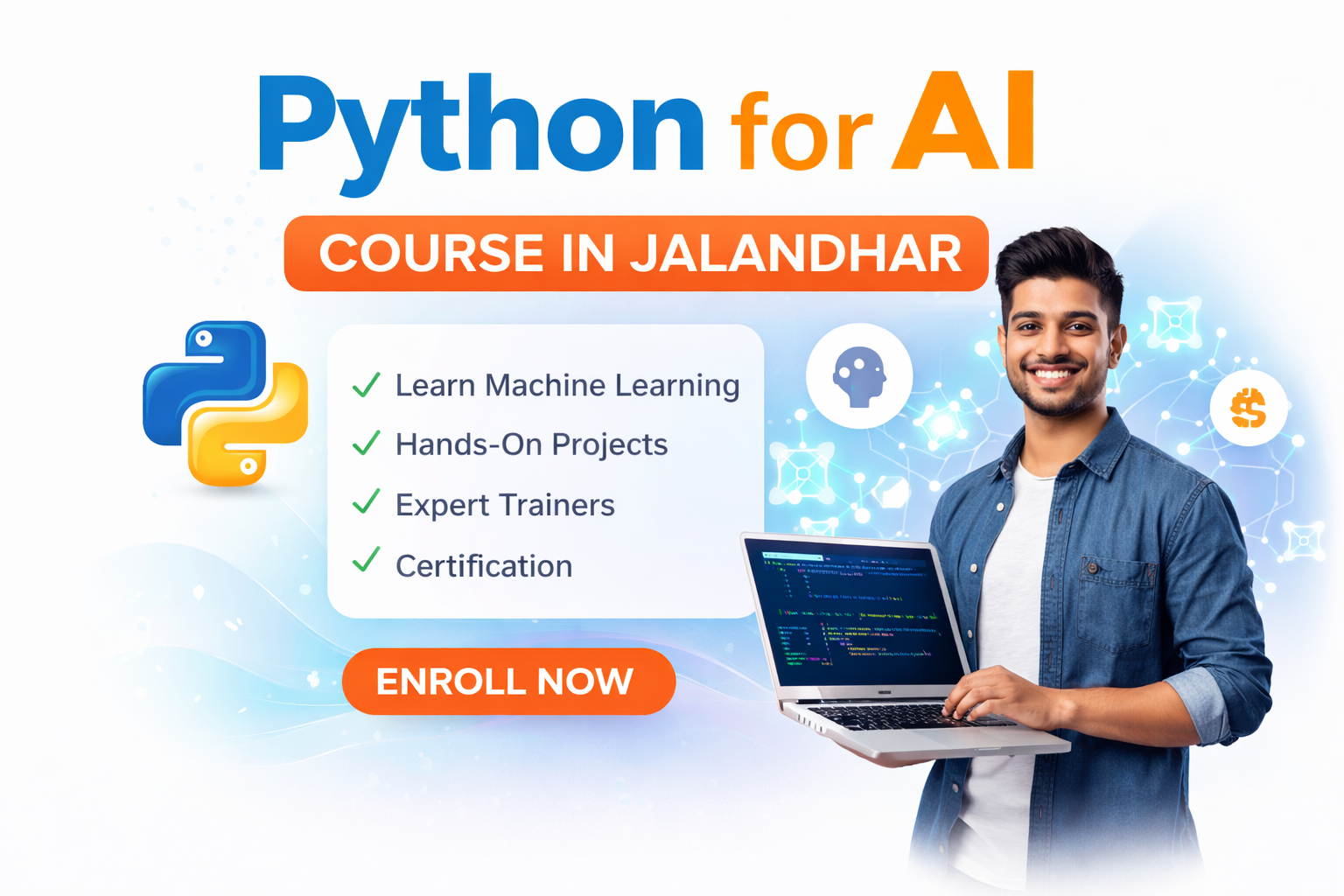
Comprehensive Overview of Python for AI Courses in Jalandhar

Introduction to the AI Education Landscape in Jalandhar

Jalandhar has emerged as a significant hub for technology education in northern India, with Artificial Intelligence (AI) and Machine Learning (ML) courses gaining substantial traction among students and professionals alike. The city boasts several reputable training institutes offering specialized programs that combine Python programming with AI applications, creating a robust ecosystem for aspiring tech professionals.

The demand for AI skills has skyrocketed globally, and Jalandhar has responded by developing comprehensive training programs that cater to diverse learning needs - from fresh graduates seeking entry-level positions to working professionals looking to upskill. These courses are designed to bridge the gap between academic knowledge and industry requirements, with Python serving as the foundational programming language for AI development.

Core Components of Python for AI Courses

Python Fundamentals for Data Science

The cornerstone of any AI course in Jalandhar is comprehensive Python training. Institutes typically begin with Python basics before progressing to specialized libraries essential for AI development. The curriculum covers fundamental concepts including data types, control structures, functions, and object-oriented programming, ensuring students develop strong programming fundamentals before tackling complex AI concepts.

Students learn to work with essential Python libraries such as NumPy for numerical computing, Pandas for data manipulation and analysis, and Matplotlib along with Seaborn for data visualization. These tools form the foundation upon which all advanced AI concepts are built, enabling students to process, analyze, and visualize data effectively.

Machine Learning Algorithms

The machine learning component represents a significant portion of these courses, covering both supervised and unsupervised learning techniques. Students gain hands-on experience with algorithms including Linear Regression for predictive modeling, Decision Trees for classification tasks, and K-Means Clustering for pattern recognition in unlabeled data.

Advanced topics include Support Vector Machines (SVM) for complex classification problems, ensemble methods like Random Forests for improved accuracy, and dimensionality reduction techniques for handling high-dimensional data. The curriculum emphasizes understanding when and how to apply different algorithms based on specific business problems and data characteristics.

Deep Learning and Neural Networks

Deep learning forms an advanced component of Python for AI courses in Jalandhar. Students explore neural network architectures, beginning with perceptrons and progressing to multi-layer networks. The curriculum covers activation functions, backpropagation algorithms, and optimization techniques including Stochastic Gradient Descent (SGD) and Adam optimizers.

Specialized neural network architectures receive detailed attention, including Convolutional Neural Networks (CNNs) for image recognition and computer vision applications, and Recurrent Neural Networks (RNNs) for sequential data processing. Students learn to implement these architectures using frameworks like TensorFlow, Keras, and PyTorch, gaining practical experience in building and training deep learning models.

Popular Institutes Offering Python for AI Courses

TechCADD Computer Education

TechCADD has established itself as a prominent provider of AI and Machine Learning education in Jalandhar. Their Professional Certificate Program in Machine Learning & AI spans 4-6 months, offering comprehensive coverage from Python fundamentals to advanced deep learning concepts. The institute distinguishes itself through industry-aligned curriculum, practical projects using real datasets, and mentorship from experienced data scientists and AI engineers.

The course structure at TechCADD includes modules on Python for data science, supervised and unsupervised learning, deep learning with CNNs and RNNs, Natural Language Processing (NLP), and Generative AI including transformer models and prompt engineering techniques. Students receive placement assistance including resume guidance and interview preparation, making it a career-oriented program.

GTB Computer Education

GTB Institute offers an Artificial Intelligence course with a duration of 4-5 months, focusing on practical training and hands-on experience. Their curriculum covers supervised and unsupervised learning, natural language processing, deep learning, and reinforcement learning. Students gain exposure to industry-standard tools including Python, TensorFlow, and Keras.

The institute emphasizes practical training through real-world projects, enabling students to build portfolios that demonstrate their capabilities to potential employers. The course covers AI applications across domains including image recognition, speech recognition, and robotics, providing a well-rounded understanding of AI's practical implementations.

Gyansetu

Gyansetu provides a Data Analytics course that integrates Python programming with AI applications, offering flexible learning options including weekday (4 months), weekend (6 months), and fast-track (45 days) programs. Their curriculum includes comprehensive Python training covering Pandas, NumPy, Matplotlib, and Scikit-learn libraries.

What sets Gyansetu apart is their integration of Generative AI concepts into the data analytics curriculum. Students learn prompt engineering, AI-based data storytelling, and automation techniques using tools like DALL-E and Midjourney. The course emphasizes practical projects including website analytics, marketing campaign analysis, customer segmentation, and sales performance analysis.

Practical Project Work and Hands-on Experience

Real-World Industry Projects

A distinguishing feature of Python for AI courses in Jalandhar is the emphasis on practical project work. Students work on industry-relevant projects that simulate real business challenges, building portfolios that demonstrate their capabilities to employers. Common projects include customer segmentation using clustering algorithms, sales forecasting using time series analysis, fraud detection using classification models, and sentiment analysis of social media data.

Capstone Projects

Many institutes require students to complete capstone projects that integrate multiple AI concepts learned throughout the course. These projects often involve developing recommender systems for e-commerce platforms, building chatbots using NLP techniques, creating image classification systems for quality control, or developing predictive maintenance models for manufacturing applications.

Tool Mastery and Technical Proficiency

Students gain proficiency in an array of AI development tools beyond Python itself. These include database management systems like MySQL and PostgreSQL for data storage and retrieval, visualization tools including Tableau and Power BI for creating interactive dashboards, cloud platforms such as AWS and Google AI for model deployment, and version control systems like Git for collaborative development.

Career Outcomes and Placement Support

Job Roles and Opportunities

Completing a Python for AI course in Jalandhar opens diverse career paths across industries. Graduates qualify for roles including Machine Learning Engineer, designing and training ML models for real-world applications; Data Scientist, analyzing complex datasets to extract business insights; AI Developer, creating intelligent systems using AI technologies; and NLP Engineer, building systems for text processing and language understanding.

Additional career opportunities include AI Researcher, exploring new AI techniques and algorithms; Robotics Engineer, developing intelligent robots for manufacturing and logistics; AI Consultant, advising organizations on AI adoption strategies; and Business Intelligence Developer, creating AI-powered analytics solutions for decision-making.

Placement Statistics and Support

Institutes in Jalandhar report impressive placement outcomes, with some claiming average salary hikes of 75% and maximum hikes reaching 160% for course completers. Placement support typically includes resume building workshops, mock interview sessions, profile optimization for job portals, and connections with hiring partners across industries.

Industry Demand and Growth Prospects

The demand for AI professionals continues to grow exponentially across sectors. Healthcare organizations seek AI experts for diagnostic systems and personalized medicine; financial institutions require AI skills for fraud detection and algorithmic trading; e-commerce companies need AI for recommendation engines and customer analytics; and manufacturing industries leverage AI for predictive maintenance and quality control.

Curriculum Deep Dive

Module 1: Introduction to AI and Machine Learning

This foundational module covers the history and evolution of AI, key concepts including narrow AI, general AI, and superintelligent AI, real-world applications across industries, and the relationship between AI, machine learning, and deep learning. Students understand the current AI landscape and future trends shaping the field.

Module 2: Python Programming for Data Science

Students master Python programming with emphasis on data manipulation using Pandas for cleaning and transforming data, NumPy for numerical operations on multi-dimensional arrays, Matplotlib and Seaborn for creating publication-quality visualizations, and basic statistics concepts essential for data analysis.

Module 3: Machine Learning Algorithms

This module covers supervised learning algorithms including Linear and Logistic Regression for prediction and classification, Decision Trees and Random Forests for interpretable models, and Support Vector Machines for complex classification boundaries. Unsupervised learning topics include K-Means Clustering for customer segmentation and Principal Component Analysis for dimensionality reduction.

Module 4: Deep Learning and Neural Networks

Students explore neural network fundamentals including perceptrons and multi-layer architectures, activation functions like ReLU and sigmoid, backpropagation for training networks, and optimization algorithms for improving model performance. Advanced topics include Convolutional Neural Networks for image processing and Recurrent Neural Networks for sequence data.

Module 5: Natural Language Processing

The NLP module covers text preprocessing techniques including tokenization and stemming, word embeddings for representing text numerically, sentiment analysis for understanding opinions in text data, and chatbot development for automated customer interactions. Students build practical NLP applications using Python libraries.

Module 6: Generative AI and Advanced Models

This cutting-edge module introduces students to transformer architectures, large language models including ChatGPT, prompt engineering techniques for effective AI interaction, and generative models for creating synthetic data and content.

Module 7: Model Deployment and Production

Students learn to deploy AI models using cloud platforms including AWS and Google AI, create APIs for model serving, implement model monitoring and maintenance strategies, and optimize models for production environments. This module bridges the gap between development and real-world implementation.

Learning Formats and Flexibility

Classroom Training

Traditional classroom-based training remains popular in Jalandhar, offering face-to-face interaction with instructors, peer learning opportunities, structured learning environments with fixed schedules, and immediate doubt resolution during class sessions. Most institutes maintain modern computer labs with necessary software installations.

Online Learning Options

Many institutes now offer online training modes, providing flexibility for working professionals and remote learners. Online programs include live instructor-led sessions, recorded lectures for self-paced learning, virtual labs for hands-on practice, and online doubt-clearing sessions through video conferencing platforms.

Weekend Batches

Weekend batches cater specifically to working professionals and college students who cannot commit to weekday schedules. These programs typically run on Saturdays and Sundays for 4-6 months, covering the same curriculum as weekday batches but with compressed timelines.

Certification and Recognition

Industry-Recognized Certifications

Upon course completion, students receive certifications that hold value in the job market. TechCADD offers a "Professional in Machine Learning & AI" certification, while other institutes provide their own recognized credentials. These certifications typically include unique verification IDs for authenticity and are recognized by employers across India.

Portfolio Development

Beyond certifications, students build comprehensive portfolios showcasing their project work. Portfolios typically include 6-8 real-world projects, code repositories on platforms like GitHub, documentation of project methodologies and results, and visualizations demonstrating analytical capabilities.

Prerequisites and Target Audience

Eligibility Criteria

Most Python for AI courses in Jalandhar require students to have completed 10+2 education, though specific eligibility varies by program. Basic computer literacy is beneficial, but programming experience is not mandatory as courses typically start from fundamentals. Professionals from non-technical backgrounds often successfully transition into AI through these programs.

Target Audience

These courses cater to diverse learner groups including college students seeking technical careers, working professionals looking to upskill or transition into AI roles, entrepreneurs wanting to leverage AI for their businesses, and career changers entering the technology sector.

Ethical Considerations and Responsible AI

AI Ethics Curriculum

Recognizing the importance of responsible AI development, courses in Jalandhar include modules on ethical considerations. Topics covered include bias in AI systems and mitigation strategies, data privacy and security concerns, transparency and explainability in AI decision-making, and fairness considerations in model development.

Legal and Social Implications

Students learn about the broader implications of AI deployment including regulatory compliance requirements, social impact of automation on employment, accountability frameworks for AI systems, and guidelines for responsible AI research and development.

Investment and Return on Investment

Course Fees and Affordability

Python for AI courses in Jalandhar are notably affordable compared to metropolitan cities, making quality AI education accessible. While specific fee structures vary by institute, the relatively lower cost of living and education in Jalandhar provides excellent value for students.

Return on Investment

Given the high demand for AI professionals and the salary premiums commanded by skilled practitioners, the return on investment for these courses is substantial. Graduates typically recoup their educational investment within months of employment, with long-term career growth potential significantly enhanced by AI skills.

Comparison with Other Cities

Jalandhar vs. Metropolitan Tech Hubs

While cities like Bangalore, Hyderabad, and Pune offer similar courses, Jalandhar provides distinct advantages including lower tuition fees compared to metropolitan institutes, reduced living costs during the course duration, smaller class sizes enabling personalized attention, and strong local placement networks.

Quality of Education

The quality of Python for AI education in Jalandhar matches or exceeds that of many metropolitan institutes, with instructors often bringing industry experience and curriculum aligned with current industry requirements.

Future Trends and Continuous Learning

Emerging Technologies

The field of AI evolves rapidly, and courses in Jalandhar incorporate emerging trends including Generative AI applications beyond text and images, edge AI for deploying models on mobile and IoT devices, AutoML for automating model development, and explainable AI for building transparent systems.

Lifelong Learning

Recognizing that AI education doesn't end with course completion, many institutes offer alumni benefits including lifetime access to course materials, free course repeats for skill refreshment, access to updated content as curriculum evolves, and continued career support and networking opportunities.

Practical Tips for Prospective Students

Choosing the Right Institute

When selecting a Python for AI course in Jalandhar, prospective students should consider factors including curriculum comprehensiveness and currency, instructor qualifications and industry experience, project work opportunities and portfolio development, placement track record and support services, batch timings and learning format flexibility, and student reviews and alumni outcomes.

Preparing for the Course

Students can maximize their learning outcomes by refreshing basic mathematics concepts including statistics and linear algebra, practicing Python fundamentals before course commencement, setting clear career goals and learning objectives, and planning time commitments for coursework and project work.

Conclusion

Python for AI courses in Jalandhar represent a significant opportunity for individuals seeking to enter the rapidly growing field of artificial intelligence. With comprehensive curricula covering Python fundamentals through advanced deep learning, hands-on project work, experienced instructors, and strong placement support, these programs provide a solid foundation for AI careers.

The city's institutes have created an ecosystem that balances theoretical knowledge with practical application, ensuring graduates are job-ready upon completion. The affordability of these courses compared to metropolitan alternatives, combined with the quality of education and strong industry connections, makes Jalandhar an attractive destination for AI education.

As AI continues to transform industries and create new career opportunities, the skills acquired through these courses will only grow in value. Whether you're a fresh graduate starting your career, a professional seeking to upskill, or someone transitioning into technology, Python for AI courses in Jalandhar offer a pathway to success in the AI-driven future.

The comprehensive nature of these programs, combined with practical project work and placement support, ensures that graduates are well-positioned to capitalize on the growing demand for AI professionals across healthcare, finance, e-commerce, manufacturing, and countless other sectors

Many computer institutes in Jalandhar continue to teach programming concepts using syllabi that bear little resemblance to what technology companies actually require. The gap between academic instruction and industry needs has become a persistent challenge in technical education across India.

TechCADD addresses this fundamental disconnect through a curriculum that functions as a "living, breathing document" — constantly evolving through direct feedback from industry partners and hiring managers. This approach ensures that what students learn today remains relevant for their job searches tomorrow.

Comprehensive Python and AI Curriculum Structure

The Professional Certificate Program in Machine Learning & AI at TechCADD represents a carefully architected learning journey spanning 4-6 months. The curriculum progresses logically from foundational concepts to advanced applications:

Module 1: Introduction to Artificial Intelligence and Machine Learning - Students begin by understanding the historical context of AI, its current applications across industries, and real-world use cases that demonstrate the transformative potential of these technologies.

Module 2: Python for Data Science and AI - This module focuses on data manipulation using NumPy for numerical computing, Pandas for data wrangling, and Matplotlib for creating publication-quality visualizations. These tools form the technical foundation upon which all advanced AI concepts are built.

Module 3: Supervised and Unsupervised Learning - Students master essential algorithms including Linear Regression for predictive modeling, Decision Trees for classification tasks, K-Means Clustering for pattern discovery, and Support Vector Machines for complex boundary determination.

Module 4: Deep Learning and Neural Networks - This module covers Convolutional Neural Networks for image recognition, Recurrent Neural Networks for sequential data processing, and the mathematical foundations of backpropagation that enable networks to learn from data.

Module 5: Natural Language Processing - Text analytics, sentiment analysis, and chatbot development using NLP techniques prepare students for the growing demand for language-based AI applications.

Module 6: Generative AI and Advanced Models - Students explore ChatGPT, transformer architectures, and prompt engineering techniques — skills that have become increasingly valuable in the current AI landscape.

Module 7: Data Visualization and Predictive Analytics - Training with Power BI, Tableau, and AI-powered interactive dashboards ensures students can communicate insights effectively to both technical and non-technical stakeholders.

Module 8: Deployment and Model Optimization - Students learn to deploy models using AWS, Google AI, and TensorFlow Serving — bridging the critical gap between model development and production implementation.

Module 9: AI Ethics and Responsible AI - Coverage of data privacy, fairness, transparency, and ethical AI practices prepares students to develop technology responsibly.

Module 10: Capstone Projects - Hands-on projects including recommender systems, fraud detection systems, and chatbot development allow students to demonstrate their capabilities through tangible outputs.

Full-Stack Proficiency and Tool-Based Learning

TechCADD distinguishes itself by ensuring students understand both front-end and back-end technologies, making graduates more versatile and valuable candidates. The integration of the most in-demand tools and platforms into training — including TensorFlow for AI, Power BI for visualization, and industry-standard frameworks — ensures skills are immediately applicable in professional environments.

While other institutes may teach students to pass examinations, TechCADD's curriculum is designed to enable graduates to solve real-world business problems from their first day on the job.

Mentorship That Transforms: Learning from Practitioners, Not Just Teachers

The Quality of Instruction as the Great Differentiator

The quality of your instructor ultimately determines the depth of your learning. This represents perhaps the most significant differentiator between TechCADD and other computer institutes in Jalandhar.

TechCADD's trainers are not merely academically qualified — they are seasoned developers, active practitioners, and industry professionals who bring current challenges, best practices, and workflows directly into the classroom. This stands in stark contrast to institutes where instructors may have limited real-world experience or have been out of active practice for years.

Mentorship Beyond Lectures

At TechCADD, students are assigned mentors who guide them throughout their learning journey. These mentors do not simply deliver lectures; they share professional experiences, debug code alongside students, and provide insights that can only come from having worked on actual production systems.

The mentorship model ensures personalized attention, with instructors accessible and dedicated to student success. This commitment to individualized guidance is something that larger, assembly-line institutes simply cannot match.

Evidence of Effective Instruction

Student reviews consistently highlight the quality of instruction at TechCADD. Karan Sharma notes, "I have been studying here from past few months and i would say that this institute is really very good as it provides a friendly environment for students and also the facilities are amazing". Sandeep Chahal adds, "Staff is very cooperated and all classes are well maintained and teacher are so cooperative and provide appropriate knowledge regarding course".

The Learn-by-Doing Philosophy: Projects That Build Portfolios

Theory Without Practice Is Forgotten

TechCADD's pedagogical approach is built around a robust project-based learning model. From the first month of instruction, students work on projects that progressively increase in complexity. Rather than simply learning the concepts of web development or data science, students build and deploy functioning applications and analyze real datasets.

Simulated Work Environments

The learning environment at TechCADD is designed to mirror the conditions students will encounter in professional IT settings. Labs and project scenarios simulate the environment of actual technology companies, with students learning to use version control with Git, collaborate in teams, and meet project deadlines — skills that are as critical as coding proficiency itself.

For students pursuing specialized tracks like ethical hacking, TechCADD provides dedicated, isolated lab environments where penetration testing and vulnerability assessment can be practiced safely without legal concerns.

Real-Time Application in Classroom Settings

The Data Science classes at TechCADD exemplify this hands-on approach. In these sessions, multiple students gather in a single room, working together under the guidance of an experienced instructor. The instructor demonstrates coding and analysis live on a projector while students follow along on their own workstations.

The classroom environment is specifically designed for collaborative learning, with desks and workstations arranged to encourage teamwork, discussion, and peer support during exercises. This setup ensures that all participants, regardless of prior experience, can actively engage in learning and apply concepts in real-time.

Building Portfolio Assets

Each project completed at TechCADD serves as a portfolio asset that students can present to potential employers. The project-based approach means graduates do not merely claim skills — they have tangible proof of their capabilities. As Manish, a successful TechCADD graduate who became a Data Analyst, explains: "By the time I completed the course, I had a robust portfolio: a Power BI dashboard analysing sales performance, a Python project on customer segmentation, and a series of SQL queries I had written for complex data extraction. I wasn't just claiming I had skills; I had proof".

Placement Success: Measurable Outcomes That Matter

A Dedicated Placement Cell

An institute's true value is ultimately measured by the success of its students in the job market. TechCADD maintains a proactive placement cell that continuously engages with a network of hiring partners across Chandigarh, Mohali, Delhi, and beyond.

The placement support extends far beyond simply forwarding resumes to potential employers. TechCADD provides comprehensive career preparation including resume-building workshops, mock interviews with real-time feedback, soft-skills training, and portfolio guidance. This holistic approach ensures students are prepared to excel in interviews, not merely attend them.

Verified Success Stories

Manish's Transformation from B.Sc. Graduate to Data Analyst

Manish's story illustrates the career-changing potential of TechCADD's programs. After completing his B.Sc., Manish faced the common predicament of holding a degree without marketable skills. He was intrigued by the buzz around data and analytics but intimidated by the requirements listed in job postings: SQL, Python, Power BI, Excel, and machine learning.

"I thought these were skills only for engineers or computer science geniuses," Manish admits. After enrolling at TechCADD, he discovered a structured path that built skills from the ground up — from Advanced Excel fundamentals through SQL database management to Python programming and finally Power BI and Tableau visualization.

The result was transformative. Manish received multiple interview calls and successfully secured a position as a data analyst. "The interviewers were impressed with the depth of practical knowledge I had. They specifically mentioned my Tableau dashboard and my understanding of how to use Python for predictive modelling. The starting salary was beyond my expectations".

Salvi's Career Switch from B.Com Graduate to Python Developer

Salvi's journey demonstrates that non-IT backgrounds need not be barriers to technology careers. A B.Com graduate stuck in a monotonous, low-paying back-office job, Salvi wondered whether someone without a computer science degree could become a software developer.

The counsellor at TechCADD outlined a realistic path, explaining why Python serves as an ideal first programming language and how its versatility in web development, data science, and automation makes it a future-proof skill. The Python with Django framework course provided the toolkit Salvi needed to become a full-stack developer.

"Within two months of completing the course, I had three job offers!" Salvi reports. She accepted a position as a Python developer at a software startup with a starting salary double what she had been earning previously. "My team lead was impressed. That feeling of creating something valuable and being recognised for it — that's priceless".

Placement Statistics and Industry Recognition

TechCADD's placement record in Jalandhar speaks for itself, with alumni working as Python Developers, Data Analysts, Software Engineers, and Ethical Hackers in top companies. The institute's placement assistance includes resume preparation, interview preparation, and ongoing support until students secure positions.

The Professional Certificate Program in Machine Learning & AI opens multiple high-paying roles including Machine Learning Engineer, AI Researcher, Data Scientist, NLP Engineer, AI Product Developer, Deep Learning Specialist, AI Consultant, and Business Intelligence Analyst.

Infrastructure and Learning Environment

Strategic Location and Accessibility

TechCADD is centrally located in Jalandhar, easily accessible from all major areas of the city. This strategic positioning saves students hours of commute time, allowing them to focus their energy on learning rather than transportation logistics.

State-of-the-Art Facilities

The institute's computer labs are equipped with high-end systems, licensed software, and high-speed internet, providing a seamless and professional learning experience. The emphasis on learning with the same tools used in professional environments ensures students are not disadvantaged by outdated or inadequate equipment.

The classroom environment is specifically designed to be conducive to learning — spacious, well-equipped, and arranged to encourage collaboration. Desks and workstations are positioned to allow students to discuss ideas, solve problems together, and support each other during exercises.

Future-Proof and Niche Career Specializations

Beyond Generic Courses

While many institutes focus on basic, generic programming courses, TechCADD offers deep, specialized training in high-growth areas including Data Science and Machine Learning, Cyber Security and Ethical Hacking, Full-Stack Web Development (MERN/MEAN Stack), UI/UX Design, and Digital Marketing.

The Data Science Course with AI Modules specifically emphasizes the convergence of these two transformative fields. As the course materials explain, "Data Science with AI moves beyond analysis — it predicts, automates, and optimizes results. This pairing has emerged as a highly sought-after skill in nearly every sector — from medicine to finance, online shopping to advertising".

Career Counselling and Path Guidance

Unsure about which specialization to pursue? TechCADD provides expert career counselling to help students align their interests and strengths with the right career path. This guidance ensures students invest their time and resources in training that genuinely matches their aptitudes and career aspirations.

Flexibility for Diverse Learner Needs

Multiple Learning Formats

TechCADD recognizes that students have varying schedules and learning preferences. The institute offers both online and classroom training modes at their Jalandhar campus, with regular and weekend batches available to accommodate both students and working professionals.

The certification programs typically run for 4-6 months, with flexible options allowing students to choose the pace that works best for their circumstances.

Support for Working Professionals

Weekend and evening batches specifically cater to working professionals who cannot commit to weekday schedules. This flexibility ensures that career changers and upskilling professionals can access quality education without abandoning their current employment.

Affordability and Return on Investment

Value-Based Pricing

TechCADD positions its programs as offering high return on investment through affordable certification with substantial career value. Compared to other institutes in Jalandhar, TechCADD provides competitive pricing without compromising on curriculum quality, instructor expertise, or placement support.

The Economic Case for TechCADD

The relatively low cost of certification combined with the substantial salary increases reported by graduates — with some claiming average salary hikes of 75% and maximum hikes reaching 160% — makes a compelling economic argument for choosing TechCADD.

When Manish secured his data analyst position, his starting salary exceeded his expectations. When Salvi became a Python developer, her starting salary was double her previous earnings. These outcomes demonstrate that the investment in TechCADD training generates returns that far exceed the initial course fees.

Industry-Aligned Tool Mastery

Comprehensive Technology Stack

Students at TechCADD gain proficiency in the complete technology stack required for modern AI and Data Science roles. This includes Python programming with specialized libraries, database management systems including SQL for data extraction, visualization tools such as Power BI and Tableau, cloud platforms including AWS and Google AI, and version control systems like Git for collaborative development.

Hands-On with Industry-Standard Tools

The emphasis on tool-based learning ensures students are comfortable with the exact technologies they will encounter in professional environments. As the Advanced Data Science Course materials state, "You'll be working with Python, TensorFlow, Power BI, Tableau, NumPy, Pandas, and other prominent AI-Data Science platforms".

Recognition and Certification

Globally Recognized Credentials

Upon successful completion of programs, students receive TechCADD-certified credentials including the "Professional in Machine Learning & AI" certification. These certifications are accepted across Jalandhar and beyond, providing students with credentials that validate their expertise to potential employers.

Portfolio as Credential

Beyond formal certification, the project portfolio students build during their training serves as a powerful credential in its own right. As Manish discovered, having tangible proof of capabilities — dashboards, code repositories, and analysis projects — often carries more weight with employers than certificates alone.

Ethical and Responsible AI Education

Comprehensive Ethics Training

Recognizing the importance of responsible AI development, TechCADD includes dedicated modules on AI ethics covering data privacy, fairness in algorithmic decision-making, transparency in AI systems, and responsible AI practices. This preparation ensures graduates are not only technically proficient but also ethically aware.

Value-Based Learning

TechCADD emphasizes "value-based learning" that prepares students for "AI leadership" rather than merely technical execution. This holistic approach produces graduates who understand the broader implications of the technology they develop.

Comparison with Other Institutes in Jalandhar

The Competitive Landscape

Other institutes such as ThinkNEXT Technologies, TCIL-IT Jalandhar, and WebTech Learning also offer AI and ML courses in Jalandhar. However, TechCADD distinguishes itself through expert mentorship, hands-on projects, and comprehensive placement support.

What Sets TechCADD Apart

The key differentiators include:

  • Industry-designed curriculum that evolves based on employer feedback rather than remaining static

  • Practitioner instructors who bring current industry experience rather than purely academic backgrounds

  • Project-based learning that produces portfolio assets rather than just theoretical knowledge

  • Comprehensive placement support that extends beyond resume forwarding to interview preparation and soft-skills training

  • Proven student outcomes documented through detailed success stories rather than vague claims

Student Experience and Community

Collaborative Learning Environment

Students at TechCADD consistently report positive learning experiences characterized by supportive peers and approachable instructors. The classroom environment encourages collaboration, with students working together in small groups to solve exercises, discuss strategies, and share solutions.

This peer-to-peer interaction enhances problem-solving abilities and fosters a sense of teamwork that is essential in real-world data science and development projects.

Verified Student Reviews

The consistently high ratings — 5.00 average based on multiple reviews — reflect genuine student satisfaction. Manmeet Kaur describes TechCADD as "a great place to learn and enhance your technical skills. Nice place to upgrade your skills and upgrade your career in IT sector".

Making an Informed Decision

Questions Prospective Students Should Ask

Before enrolling in any computer institute, TechCADD recommends asking critical questions:

  • Is the curriculum updated for the current year and aligned with actual job descriptions?

  • Who are the trainers and what is their industry experience?

  • What does "placement assistance" actually include? Can I see verified placement records?

  • Will I build a tangible portfolio of projects during the course?

  • Does the institute offer specialized courses for high-demand fields or just generic ones?

When evaluated against this checklist, the reasons to choose TechCADD become clear. The institute is not merely another computer institute but a career accelerator designed to transform students into job-ready professionals.

The TechCADD Commitment

TechCADD's commitment extends beyond course completion to lifelong career support. Alumni benefits include lifetime access to course materials, free course repeats for skill refreshment, access to updated content as curriculum evolves, and continued career support and networking opportunities.

Conclusion: Investing in Your Future

The decision of where to pursue Python and AI training in Jalandhar represents a significant investment of time, money, and effort. TechCADD Computer Education has demonstrated through curriculum design, instructional quality, placement outcomes, and student success stories that it delivers on its promises.

The institute's industry-aligned curriculum ensures students learn relevant, current technologies. Its practitioner instructors bring real-world experience into the classroom. Its project-based approach produces portfolios that demonstrate capabilities to employers. Its placement support helps students translate training into careers. And its documented success stories — from Manish the Data Analyst to Salvi the Python Developer — provide evidence that these claims are matched by outcomes.

For students and professionals in Jalandhar seeking to enter the rapidly growing fields of Python development, Artificial Intelligence, and Data Science, TechCADD represents a choice backed by demonstrated results. The institute has established itself as a trusted name for IT training in Punjab not through marketing claims but through the success of its graduates.

As one student review succinctly states, "I would say that this institute is really very good as it provides a friendly environment for students and also the facilities are amazing". More importantly, TechCADD provides the skills, portfolio, and placement support necessary to launch or advance a career in technology.

The future belongs to those who understand data and can make it intelligent. TechCADD provides the training, mentorship, and support to become one of those professionals — not just with a certificate, but with the practical skills and proven capabilities that employers actually value.




opportunities, industry applications, and long-term career trajectories.


Current Market Demand: Why AI Skills Command Premium Salaries

The Skill Premium for AI Professionals

In 2026, Artificial Intelligence and Machine Learning stand as the highest-paying tech skills in India . Companies across sectors—from startups to Global Capability Centres (GCCs) to product companies—are aggressively hiring AI talent, and they are willing to pay substantial premiums for candidates with demonstrable skills.

The demand-supply gap remains significant. According to a Quess Corp report cited by The Economic Times, specialized GenAI roles are projected to grow 35-40% annually, while the demand-supply gap remains above 50% . This imbalance means that qualified candidates enter a seller's market where their skills command attention and premium compensation.

What Companies Are Actually Looking For

Real-world job postings reveal exactly what employers seek. A recent Machine Learning Engineer position at Naveera Technology LLC, a global engineering partner, lists requirements that align perfectly with comprehensive Python for AI training :

  • Core ML Skills: Python programming, Scikit-learn, XGBoost, PyTorch/TensorFlow

  • Generative AI Expertise: LLMs, RAG pipelines, prompt engineering, vector databases

  • Data Engineering: Spark, Airflow, cloud platforms (Azure, AWS)

  • MLOps: Model deployment, CI/CD pipelines, Docker, API development with FastAPI

Similarly, Infosys—one of India's largest IT employers—actively recruits for Python Generative AI roles requiring expertise in Computer Vision, Natural Language Processing, and Machine Learning . These are not niche, experimental positions; they are core to these companies' digital transformation strategies.

The Agentic AI Frontier

Perhaps the most exciting development in the AI landscape is the emergence of Agentic AI—advanced artificial intelligence focused on autonomous decision-making and action . Unlike traditional AI that merely responds to queries, Agentic AI systems can manage supply chains, write contracts, book logistics, and perform complex workflows independently.

India's Agentic AI market, valued at approximately $276 million in 2024, is projected to reach nearly $3.5 billion by 2030 . This represents a growth trajectory that will create entirely new job categories, many of which didn't exist three years ago:

  • AI Orchestration Engineers

  • Agent Behavior Analysts

  • Agent Safety and Governance Specialists

  • Vector Database Architects

  • Agent Lifecycle Managers

  • Agentic AI Product Managers

For students completing Python for AI courses in Jalandhar today, these roles represent the frontier of their career opportunities.


Career Pathways and Salary Projections

Entry-Level to Senior Roles: The Complete Spectrum

The career progression for AI professionals follows a clear and rewarding trajectory. Based on comprehensive industry data from multiple sources, here is what candidates can expect :


Role Level Position Titles Salary Range (India 2026) Experience Required
Entry-Level AI Engineer, ML Engineer, Data Analyst ₹8-12 LPA 0-2 years
Mid-Level Data Scientist, GenAI Engineer, AI Product Manager ₹15-25 LPA 3-6 years
Senior-Level AI Architect, Research Lead, ML Manager ₹22-40 LPA 7-10 years
Leadership AI Director, Chief Data Scientist, VP of AI ₹40-60+ LPA 10+ years

For context, a Python Generative AI role at Infosys typically offers salaries around ₹10.6 LPA for experienced professionals . Remote ML Engineer positions with global companies can command $30,000 to $60,000 annually (approximately ₹25-50 LPA) .

High-Growth Specializations

Not all AI roles are created equal. Certain specializations are experiencing particularly strong demand and offering premium compensation:

Generative AI Engineer
Focuses on building applications using LLMs, RAG pipelines, and transformer architectures. This role commands salaries at the higher end of the spectrum due to the specialized nature of the skills and the explosion of GenAI applications across industries.

MLOps Engineer
Bridges the gap between model development and production deployment. As companies move from AI pilots to large-scale deployment, MLOps expertise has become critical. The NLB Services report highlights that India has reached a pivotal stage in its GCC 4.0 evolution, where centres are integrating AI across operations rather than merely experimenting with it .

AI Ethics and Governance Specialist
As AI systems become more autonomous and impactful, organizations need professionals who can ensure responsible AI deployment. Roles like AI Ethics Specialist, AI Policy Strategist, and AI Safety and Governance Specialist are emerging as distinct career paths .

Prompt Engineer
This entirely new role focuses on designing and optimizing inputs that guide AI models to produce desired outputs. NITI Aayog's roadmap specifically identifies Prompt Engineers as an emerging job category in the AI economy .

Salary Premiums for Specialized Skills

The Quess Corp report reveals that salary premiums continue to be strongest in senior architecture and safety positions, ranging between 20% and 28% above baseline . This means that professionals who invest in developing expertise in AI safety, governance, and system architecture can command substantially higher compensation than generalist AI practitioners.


The GCC Opportunity: India's Unique Advantage

The Rise of Global Capability Centres

India is home to more than 1,600 Global Capability Centres (GCCs) employing approximately 1.6 million professionals . These centres—operated by multinational corporations for their global operations—are rapidly evolving from back-office support functions to innovation hubs.

The transformation is dramatic. According to an IBEF report citing NLB Services, GCCs are transitioning from AI pilots to large-scale deployment, with workforce projections for 2030 revised upward by 30% , adding an estimated 1.3 million new roles . By 2030, India's GCC workforce is expected to reach 3.46 million.

Emerging Roles Within GCCs

The report identifies several emerging positions within GCCs that reflect the shift toward AI-native, product-centric teams :

  • Cybersecurity and AI Governance Architects

  • Prompt Engineers

  • GenAI Product Owners

  • AI Policy and Risk Strategists

Simultaneously, several legacy roles are being phased out—particularly L1 IT support, legacy application development, manual QA, and on-premises infrastructure management. This transition underscores the importance of upskilling and choosing the right educational path.

From Back Office to Innovation Lab

For Indian tech professionals, this evolution represents a fundamental shift in career potential. As Outlook India notes, the latest disruptions in H-1B visas are also accelerating a reverse brain drain, with highly skilled professionals choosing to stay or return to India . This talent inflow strengthens GCCs, equipping them to move up the value chain faster.

A software tester in Pune who once checked code line by line may now supervise AI systems that validate code automatically, freeing her to focus on design and problem-solving—a shift from repetitive tasks to higher-value creativity.


Geographical Opportunities: Beyond the Metros

The Tier II and Tier III Revolution

One of the most significant developments in India's AI employment landscape is the geographic rebalancing of opportunities. According to the NLB Services report, nearly 39% of GCC employees are expected to operate from non-metro locations by 2030, generating more than 7.15 lakh net new jobs .

Cities such as Coimbatore, Ahmedabad, Jaipur, and Bhubaneswar are emerging as specialised delivery centres. The Quess Corp report specifically notes that Tier II cities including Kochi, Coimbatore, Jaipur, and Ahmedabad now contribute close to 10% of total Agentic AI hiring .

What This Means for Jalandhar Students

For students completing Python for AI courses in Jalandhar, this geographic diversification is excellent news. While Bengaluru and Hyderabad together account for nearly 62% of Agentic AI hiring currently, the expansion into Tier II cities means that opportunities are increasingly available closer to home .

The trend suggests that Jalandhar—with its growing reputation for quality technical education through institutes like TechCADD—could well become part of this distributed workforce model. Students may not need to relocate to metropolitan centres to find quality AI employment; remote work options and expanding GCC footprints in smaller cities are making AI careers accessible from anywhere.

Remote Work: The Great Enabler

The report also reveals that remote roles are projected to account for 15-20% of total advanced AI hiring . This is a game-changer for students in cities like Jalandhar. A Machine Learning Engineer position with a global company can now be performed from Jalandhar, earning salaries competitive with metropolitan markets while enjoying lower living costs.

The Naveera Technology LLC job posting explicitly offers a "Remote (India)" work model, demonstrating that remote AI employment is not theoretical—it is actively being implemented .


Industry-Wide Applications: Where AI Professionals Work

Healthcare

The healthcare sector is undergoing a profound transformation driven by AI. Professionals with Python and AI skills are developing diagnostic systems that can detect diseases from medical imaging, creating personalized treatment recommendation engines, building predictive models for patient outcomes, and developing drug discovery algorithms that dramatically accelerate research timelines.

NITI Aayog's roadmap specifically identifies "AI for Healthcare Specialist" as an emerging role with significant growth potential .

Financial Services

Banking, insurance, and investment firms are among the heaviest adopters of AI technologies. Applications include fraud detection systems that identify suspicious transactions in real-time, algorithmic trading platforms that execute trades at optimal moments, credit risk assessment models that evaluate loan applications, and customer service chatbots that handle routine inquiries.

The insurance sector, in particular, is actively hiring AI professionals for claims anomaly detection, fraud detection, risk scoring, and underwriting support .

E-commerce and Retail

Recommendation engines—the systems that suggest products "customers also bought"—are powered entirely by machine learning algorithms. AI professionals in this sector also work on demand forecasting, inventory optimization, dynamic pricing algorithms, and personalized marketing systems.

Manufacturing and Industry 4.0

The manufacturing sector is embracing AI for predictive maintenance (identifying when equipment will fail before it happens), quality control through computer vision, supply chain optimization, and autonomous robotics. The NITI Aayog roadmap specifically identifies Robotics Engineers and Computer Vision Engineers as roles in high demand .

Agriculture

Even agriculture—which employs about 40% of India's workforce—is being transformed by AI. Generative AI already helps with crop forecasting and pest detection. Agentic AI could orchestrate farm-to-table logistics, reduce wastage, and ensure fairer prices .


The Impact of Generative and Agentic AI

Understanding the Waves of AI Evolution

To appreciate the future scope of AI careers, it's essential to understand the distinction between different types of AI and their respective impacts:

Generative AI (exemplified by ChatGPT) focuses on creating content—text, images, code, music—based on patterns learned from training data. This technology has already redefined content creation and software development .

Agentic AI represents the next wave. These systems don't just answer queries; they act. They can manage supply chains, write contracts, book logistics, and perform complex workflows autonomously .

How These Technologies Transform Work

The impact across sectors will be profound. Accenture projects that companies leading in AI adoption can expect productivity gains of about 20% , underscoring how early movers will strengthen competitiveness .

For Indian professionals, this means:

  • Efficiency gains that allow focusing on higher-value work

  • New tools and platforms that augment rather than replace human capabilities

  • Career acceleration for those who master these technologies early

The Skills That Will Matter Most

The Quess Corp report provides granular insight into the technical skills most in demand for the Agentic AI era :

  • Tool-calling and orchestration appear in 72% of job descriptions

  • Retrieval-Augmented Generation (RAG + Tool) capabilities are required in 63% of roles

  • Framework exposure to LangGraph, AutoGen, and CrewAI has reached 43% of roles

  • Observability appears in 19% of roles

  • Runtime guardrails and safety appear in 8% of roles

For students in Python for AI courses, this data provides a roadmap for continuous learning beyond the core curriculum.


Potential Disruptions and How to Stay Relevant

The Jobs at Risk

While AI creates enormous opportunities, it also disrupts existing roles. NITI Aayog's roadmap warns that routine roles—such as quality assurance engineers and Level 1 support agents—face a high risk of redundancy by 2031 if urgent action is not taken .

The NLB Services report similarly notes that several legacy roles are being phased out, including L1 IT support, legacy application development, manual QA, and on-premises infrastructure management .

The Imperative of Continuous Learning

The key insight from both reports is that the difference between job loss and job creation depends squarely on the choices made today . For individual professionals, this translates to a commitment to lifelong learning and skill development.

A Python for AI course from an institute like TechCADD provides the foundation, but the learning cannot stop at course completion. The field evolves too rapidly. Successful AI professionals dedicate time each week to reading research papers, experimenting with new frameworks, building side projects, and staying connected with the community.

The National Response: AI Literacy and Reskilling

NITI Aayog's roadmap calls for the creation of a National AI Talent Mission to embed AI literacy across education systems, reskill millions of professionals, and retain domestic talent . The mission envisions close coordination between the India AI Talent Mission and the ongoing India AI Mission to position India as a global innovation and talent hub in AI by 2035.

For students, this national focus on AI education and skilling means that government policies, educational initiatives, and industry partnerships will increasingly support their career paths.


Long-Term Projections: Where Will AI Be in 2035?

The Economic Impact

Accenture and Frontier Economics estimate that if India builds the right foundation for AI adoption, AI could add US$2 trillion to the economy by 2035 , raising annual growth by 1.3 percentage points . This is the scale of opportunity at stake—a once-in-a-generation chance to accelerate development.

India's Potential as a Global AI Powerhouse

The vision articulated by policymakers is ambitious but achievable. By 2035, India aims to be the global hub for AI talent and innovation . This would represent a fundamental shift from India's historical position as a provider of cost-effective IT services to a leader in cutting-edge technology development.

For students beginning their AI education today, this timeline aligns perfectly with their career arcs. Those completing Python for AI courses in Jalandhar in 2026 will be entering their prime career years just as India's AI ecosystem reaches maturity.

The Compute and Infrastructure Challenge

It's important to acknowledge challenges. India currently has less than 2% of global computing capacity , and the data centre gap is stark: India generates about 20% of the world's data but hosts only 3% of global capacity . However, the government's India AI Mission and Semiconductor Mission are actively addressing these gaps.


How TechCADD Prepares Students for This Future

Comprehensive, Industry-Aligned Curriculum

TechCADD's Python for AI courses are designed specifically to prepare students for the opportunities described throughout this analysis. The curriculum covers not just Python fundamentals and machine learning algorithms, but also:

  • Generative AI including ChatGPT, transformer architectures, and prompt engineering

  • Deep Learning with CNNs, RNNs, and neural network optimization

  • Natural Language Processing for text analytics and chatbot development

  • Model Deployment using cloud platforms and MLOps practices

  • AI Ethics for responsible development

Hands-On Project Work

Theory without practice is insufficient in AI. TechCADD emphasizes project-based learning where students build portfolios of real applications—recommender systems, fraud detection models, chatbots, and image classification systems. These projects become powerful evidence of capability for job interviews.

Placement Support and Industry Connections

TechCADD's dedicated placement cell connects students with hiring partners across India. The institute's track record includes successful placements of graduates as Python Developers, Data Analysts, and AI Engineers in top companies.


Practical Advice for Prospective Students

Which Skills to Prioritize

Based on current and projected demand, students should prioritize:

  1. Python programming - The lingua franca of AI

  2. Machine learning fundamentals - Supervised and unsupervised learning

  3. Deep learning - Neural networks, CNNs, RNNs

  4. Generative AI - LLMs, RAG, prompt engineering

  5. Data engineering - SQL, data pipelines, ETL

  6. MLOps - Model deployment, monitoring, CI/CD

Building a Portfolio That Stands Out

Employers care far more about what you can do than what certificates you hold. A strong portfolio includes:

  • 4-6 substantial projects demonstrating different AI techniques

  • Code repositories on GitHub with clear documentation

  • Deployed applications that employers can interact with

  • Written explanations of your approach and results

The Value of Hybrid Skills

The most successful AI professionals combine technical expertise with domain knowledge or complementary skills. For example:

  • AI + Cloud (AWS, Azure, GCP) - For deploying and scaling AI systems

  • AI + Data Analytics (Power BI, Tableau) - For communicating insights effectively

  • AI + Full-Stack Development - For building complete AI-powered applications


Conclusion: A Future of Unlimited Potential

The future scope for Python and AI professionals in India is extraordinary. With up to 4 million new jobs projected by 2030, salary premiums that reward specialized skills, expanding opportunities beyond metropolitan centres, and the emergence of entirely new career categories like Agentic AI roles, the field offers unlimited potential for those who prepare properly.

For students in Jalandhar, completing a Python for AI course at a quality institute like TechCADD provides the foundation for accessing these opportunities. The curriculum, project work, and placement support combine to create a launchpad for careers that will only grow in value as India's AI ecosystem matures.

The AI revolution is not coming—it is here. And for those with the right skills, the right training, and the right mindset, the future has never been brighter. The difference between being disrupted by AI and leading with AI is simply the choice to prepare today for the opportunities of tomorrow.

The 4 million jobs projected by NITI Aayog are not guaranteed to everyone—they will go to those who have invested in developing the skills that employers need. For students in Jalandhar who choose to pursue Python for AI training at TechCADD, those jobs are not just possible—they are achievable.