-
Duration: 4–6 months (Regular / Weekend Batches available)
-
Mode: Online & Classroom (Jalandhar Campus)
-
Certification: TechCADD Certified "Professional in Machine Learning & AI"
Complete Curriculum Structure
The curriculum is divided into 10 comprehensive modules that progressively build skills from fundamentals to advanced deployment :
Detailed Breakdown by Module
Phase 1: Foundations (Modules 1-2)
Module 1: Introduction to AI and ML serves as the entry point, covering the historical evolution of artificial intelligence, key concepts, and real-world applications across industries. Students understand how AI powers technologies like Netflix recommendations, ChatGPT, and autonomous vehicles .
Module 2: Python for Data Science focuses on building programming proficiency. Students master:
-
NumPy for numerical computing and array operations
-
Pandas for data manipulation, cleaning, and analysis
-
Matplotlib for creating visualizations and plots
These tools form the technical foundation for all subsequent machine learning work .
Phase 2: Core Machine Learning (Module 3)
Module 3: Supervised and Unsupervised Learning covers the essential algorithms every ML professional must know:
Supervised Learning Algorithms:
-
Linear Regression for predictive modeling and forecasting
-
Decision Trees for classification and regression tasks
-
Support Vector Machines (SVM) for complex classification boundaries
Unsupervised Learning:
Phase 3: Advanced AI (Modules 4-6)
Module 4: Deep Learning and Neural Networks introduces students to:
-
Convolutional Neural Networks (CNNs) for image recognition and computer vision
-
Recurrent Neural Networks (RNNs) for sequential data processing
-
Backpropagation – the mathematical foundation that enables networks to learn from data
Module 5: Natural Language Processing (NLP) covers:
-
Text analytics and preprocessing techniques
-
Sentiment analysis for understanding opinions in text
-
Chatbot development for automated customer interactions
Module 6: Generative AI and Advanced Models addresses the most current AI technologies:
-
ChatGPT and large language models
-
Transformer architectures
-
Prompt engineering techniques for effective AI interaction
Phase 4: Practical Implementation (Modules 7-10)
Module 7: Data Visualization and Predictive Analytics trains students in:
-
Power BI for creating business dashboards
-
Tableau for interactive data visualization
-
AI-powered analytics for predictive insights
Module 8: Deployment and Model Optimization bridges the gap between development and production:
-
Model deployment using AWS cloud platform
-
Google AI services for scalable AI solutions
-
TensorFlow Serving for production model hosting
Module 9: AI Ethics and Responsible AI addresses critical considerations:
-
Data privacy and security concerns
-
Fairness in algorithmic decision-making
-
Transparency and explainability in AI systems
Module 10: Capstone Projects allows students to demonstrate comprehensive skills through:
-
Recommender systems (like those used by e-commerce platforms)
-
Fraud detection systems for financial applications
-
Chatbot development for customer service automation
Tools and Technologies Covered
Students gain proficiency in industry-standard tools throughout the course :
Learning Methodology
Hands-On Classroom Experience
The learning environment at TechCADD emphasizes practical, interactive training :
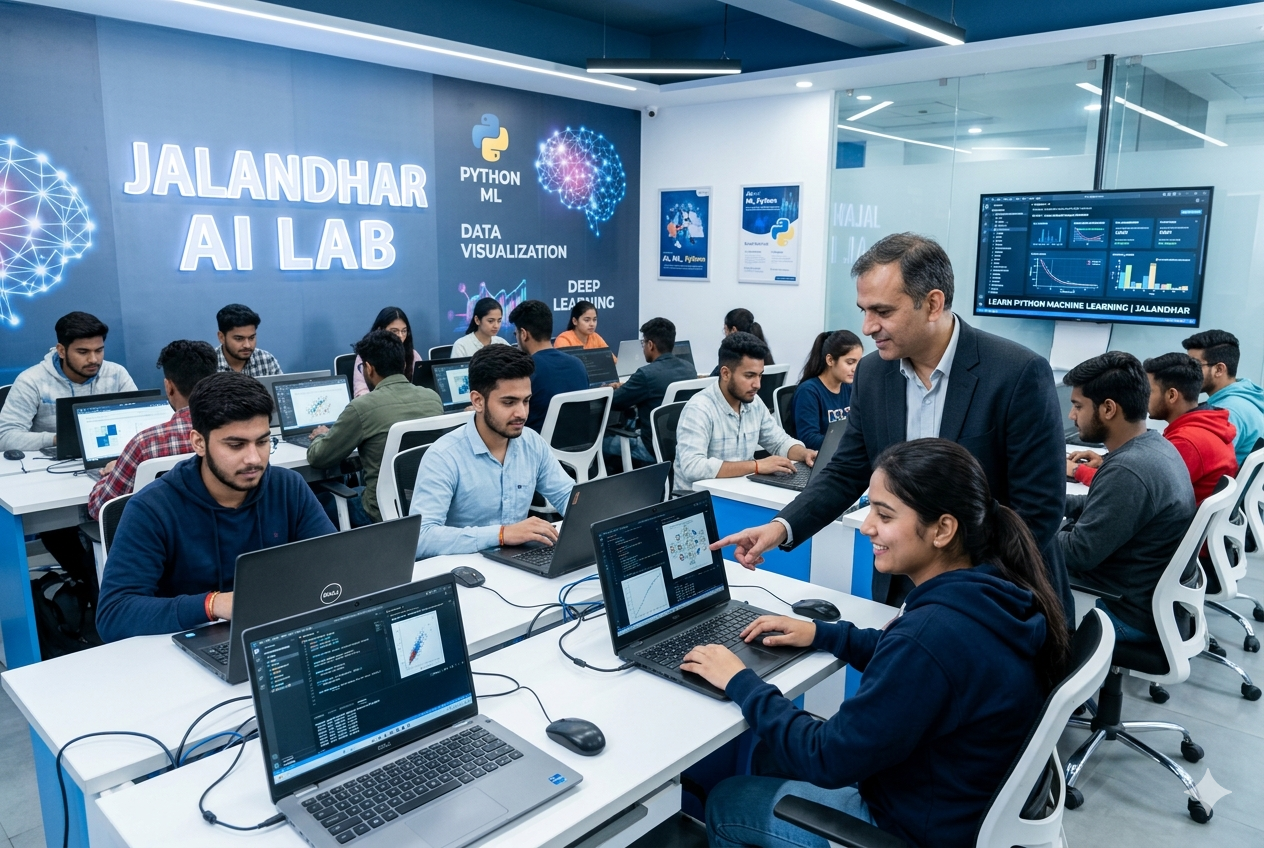
"The instructor demonstrates coding and analysis live on a projector while students follow along in the classroom. Students work on computers while the instructor demonstrates techniques on a projector, covering essential areas such as Data Analysis, Data Visualization, Machine Learning Basics, and Data Cleaning and Preprocessing."
Collaborative Learning
The classroom setup encourages teamwork and peer learning:
-
Students work in small groups to solve exercises and discuss strategies
-
Instructors provide personalized attention, moving around the room to answer questions
-
Each lesson allows immediate practice after demonstration, reinforcing learning
Learning Outcomes
Upon completing the course, students will be able to :
-
Build, train, and deploy AI models for real-world scenarios
-
Work with Python libraries including NumPy, Pandas, and Matplotlib for data science
-
Implement supervised and unsupervised learning algorithms
-
Develop deep learning models using CNNs and RNNs
-
Create NLP applications including chatbots and sentiment analysis systems
-
Deploy models using cloud platforms like AWS and Google AI
-
Apply ethical AI practices in development
Career Paths After Completion
The course prepares students for multiple high-demand roles :
Alternative Program: Data Science with AI Modules
TechCADD also offers a Data Science Course with AI Modules covering :
This program focuses more heavily on the data science workflow while integrating AI modules for predictive and automated analytics .
What Makes This Course Distinctive
Industry-Aligned Curriculum: The content is regularly updated to reflect current AI trends and industry requirements, ensuring graduates have relevant, employable skills .
Practical Focus: Rather than just theory, students work on actual datasets and build deployable models. The emphasis is always on hands-on learning .
Generative AI Integration: Unlike many traditional ML courses, this program includes dedicated modules on ChatGPT, transformer models, and prompt engineering – skills increasingly in demand .
Deployment Training: Many courses teach model development but stop there. This program includes deployment using cloud platforms, bridging the critical gap between development and production .
Ethical AI Coverage: The inclusion of AI ethics, fairness, and responsible AI practices prepares students to develop technology conscientiously .
Frequently Asked Questions
Who can enroll? Students, working professionals, and anyone with basic programming knowledge. Prior AI exposure is not required as basics are taught from scratch .
What tools will I learn? Python, TensorFlow, PyTorch, Power BI, ChatGPT, and more .
Is placement support provided? Yes, with resume help and interview preparation .
Are there flexible batch options? Yes, available in online and offline modes with regular and weekend batches .
Conclusion
The Python Machine Learning course content available in Jalandhar, particularly through TechCADD, offers a comprehensive learning journey from Python fundamentals to advanced AI deployment. The 10-module structure ensures systematic skill development, while the emphasis on hands-on projects and real-world applications prepares students for immediate industry contribution.
The inclusion of both classic machine learning algorithms and cutting-edge topics like Generative AI and deployment strategies makes this program particularly relevant for current job market demands. For anyone seeking to build a career in AI and machine learning, this curriculum provides a solid foundation for professional growth.
Practical Training and Assessment Methods
Beyond the structured curriculum, TechCADD’s Python Machine Learning course in Jalandhar incorporates robust practical training methodologies that ensure skill mastery. Each module includes hands-on coding sessions where students write and execute Python scripts under instructor supervision. The institute provides dedicated lab hours where learners work on real-world datasets sourced from Kaggle, UCI Repository, and industry partners, covering domains like retail, healthcare, and finance.
Assessment Structure:
-
Weekly quizzes to test theoretical understanding of algorithms
-
Bi-weekly coding assignments requiring implementation of ML models from scratch
-
Mid-term project (end of Module 5) – a complete supervised learning solution
-
Final capstone presentation before a panel of industry experts
Students also receive personalized feedback on their code quality, documentation practices, and model optimization techniques. The course includes mock interview sessions focused on technical questions about Python libraries, algorithm selection, and deployment strategies.
Industry Integration: Guest lectures from working Data Scientists and AI Engineers are conducted monthly, sharing real challenges and solutions. Additionally, students gain access to a private GitHub repository containing course materials, supplementary notebooks, and past project examples. This blend of structured learning, continuous assessment, and industry exposure ensures graduates are not just certificate holders but truly job-ready professionals.
This additional focus on practical evaluation and industry connect sets the TechCADD Python ML course apart from conventional theory-heavy programs in Jalandhar.
Why TechCADD: The Definitive Choice for IT Training in Jalandhar
Introduction: Making the Right Career Investment
You have made the most crucial decision: you have decided to invest in your future by learning a high-demand skill. The next step—choosing the right institute in Jalandhar—is where your career path truly takes shape. While many institutes promise jobs and skills, TechCADD delivers a transformative career launchpad that stands apart in the crowded IT training landscape of Punjab.
The technology education sector in Jalandhar has grown significantly, with numerous institutes offering courses in Artificial Intelligence, Data Science, Python development, and Cybersecurity. However, not all institutes are created equal, and the choice you make today will directly impact your career trajectory tomorrow. This comprehensive analysis explores why TechCADD Computer Education has established itself as the premier destination for IT training in Jalandhar, examining everything from curriculum philosophy and instructional quality to placement support and documented student success stories .
The Fundamental Difference: A Curriculum Forged in Industry Experience
Beyond Outdated Syllabi
One of the most significant problems in technical education across India is the persistent gap between what institutes teach and what companies actually need. Many computer institutes in Jalandhar continue to teach programming concepts using syllabi that bear little resemblance to current industry requirements. This disconnect leaves graduates with certificates but without the practical skills employers demand .
TechCADD addresses this fundamental disconnect through a curriculum that functions as a "living, breathing document"—constantly evolving through direct feedback from industry partners and hiring managers. This approach ensures that what students learn today remains relevant for their job searches tomorrow. The institute does not just teach you Python programming; they teach you Python with Django for full-stack web development. They do not just cover data analytics; they immerse you in the complete data pipeline with SQL, Power BI, and Tableau .
Comprehensive Curriculum Architecture
The Professional Certificate Program in Machine Learning & AI at TechCADD represents a carefully architected learning journey spanning 4-6 months. The curriculum progresses logically from foundational concepts to advanced applications through ten comprehensive modules :
Module 1: Introduction to Artificial Intelligence and Machine Learning - Students begin by understanding the historical context of AI, its current applications across industries, and real-world use cases that demonstrate the transformative potential of these technologies. This foundation helps learners appreciate how AI powers everything from Netflix recommendations to ChatGPT responses and autonomous vehicles .
Module 2: Python for Data Science and AI - This module focuses on data manipulation using NumPy for numerical computing, Pandas for data wrangling and analysis, and Matplotlib for creating publication-quality visualizations. These tools form the technical foundation upon which all advanced AI concepts are built .
Module 3: Supervised and Unsupervised Learning - Students master essential algorithms including Linear Regression for predictive modeling, Decision Trees for classification tasks, K-Means Clustering for pattern discovery, and Support Vector Machines for complex boundary determination. Understanding when and how to apply different algorithms based on specific business problems is a key outcome .
Module 4: Deep Learning and Neural Networks - This module covers Convolutional Neural Networks (CNNs) for image recognition and computer vision applications, Recurrent Neural Networks (RNNs) for sequential data processing, and the mathematical foundations of backpropagation that enable networks to learn from data .
Module 5: Natural Language Processing - Text analytics, sentiment analysis, and chatbot development using NLP techniques prepare students for the growing demand for language-based AI applications across customer service and business intelligence .
Module 6: Generative AI and Advanced Models - Students explore ChatGPT, transformer architectures, and prompt engineering techniques—skills that have become increasingly valuable in the current AI landscape where generative AI is transforming content creation and software development .
Module 7: Data Visualization and Predictive Analytics - Training with Power BI, Tableau, and AI-powered interactive dashboards ensures students can communicate insights effectively to both technical and non-technical stakeholders .
Module 8: Deployment and Model Optimization - Students learn to deploy models using AWS, Google AI, and TensorFlow Serving—bridging the critical gap between model development and production implementation that many courses overlook entirely .
Module 9: AI Ethics and Responsible AI - Coverage of data privacy, fairness, transparency, and ethical AI practices prepares students to develop technology responsibly, an increasingly important consideration as AI systems become more prevalent in sensitive applications .
Module 10: Capstone Projects - Hands-on projects including recommender systems, fraud detection systems, and chatbot development allow students to demonstrate their capabilities through tangible outputs that become portfolio assets .
Full-Stack Proficiency and Tool-Based Learning
TechCADD distinguishes itself by ensuring students understand both front-end and back-end technologies, making graduates more versatile and valuable candidates. The integration of the most in-demand tools and platforms into training—including Kali Linux for ethical hacking, TensorFlow for AI, Docker for deployment, and Power BI for visualization—ensures skills are immediately applicable in professional environments .
While other institutes may teach students to pass examinations, TechCADD's curriculum is designed to enable graduates to solve real-world business problems from their first day on the job. The focus is always on hands-on learning, not just theoretical knowledge .
Mentorship That Transforms: Learning from Practitioners, Not Just Teachers
The Quality of Instruction as the Great Differentiator
The quality of your instructor ultimately determines the depth of your learning. This represents perhaps the most significant differentiator between TechCADD and other computer institutes in Jalandhar. TechCADD's trainers are not merely academically qualified—they are seasoned developers, active cybersecurity experts, and lead data scientists who bring current challenges, best practices, and workflows directly into the classroom .
This stands in stark contrast to institutes where instructors may have limited real-world experience or have been out of active practice for years. As the institute's blog emphasizes, "Our trainers are not just academically qualified; they are seasoned developers, active cybersecurity experts, and lead data scientists. They bring current industry challenges, best practices, and workflows directly into the classroom" .
Mentorship Beyond Lectures
At TechCADD, students are assigned mentors who guide them throughout their learning journey. These mentors do not simply deliver lectures; they share professional experiences, debug code alongside students, and provide insights that can only come from having worked on actual production systems. The mentorship model ensures personalized attention, with instructors accessible and dedicated to student success .
This commitment to individualized guidance is something that larger, assembly-line institutes simply cannot match. As the institute states, "Our mentors are approachable and dedicated to your success. They provide personalized attention, ensuring no student is left behind" .
Real-World Industry Recognition
The quality of TechCADD's expertise has been recognized beyond the institute's walls. In April 2025, the Department of Computer Science and Engineering (AI & ML) at Sant Baba Bhag Singh University, Jalandhar, invited TechCADD to conduct a one-day workshop on "Future Trends in IT." The session, led by Mr. Gaurav Sharma from TechCadd Computer Education Pvt. Ltd., covered trending IT domains including Artificial Intelligence, Machine Learning, Cloud Computing, Cybersecurity, Blockchain, Internet of Things, and Data Science .
Over 100 students from B.Tech CSE and related branches actively participated in the workshop, which was highly appreciated for its practical relevance and industry-oriented content. This university partnership demonstrates that TechCADD's expertise is recognized by academic institutions seeking to expose their students to current industry trends .
The Learn-by-Doing Philosophy: Projects That Build Portfolios
Theory Without Practice Is Forgotten
TechCADD's pedagogical approach is built around a robust project-based learning model. From the first month of instruction, students work on projects that progressively increase in complexity. Rather than simply learning the concepts of web development or data science, students build and deploy functioning applications and analyze real datasets .
The institute's Data Science classroom exemplifies this hands-on approach. In these sessions, multiple students gather in a single room, working together under the guidance of an experienced instructor. The instructor demonstrates coding and analysis live on a projector while students follow along on their own workstations. The classroom environment is specifically designed for collaborative learning, with desks and workstations arranged to encourage teamwork, discussion, and peer support during exercises .
Simulated Work Environments
The learning environment at TechCADD is designed to mirror the conditions students will encounter in professional IT settings. Labs and project scenarios simulate the environment of actual technology companies, with students learning to use version control with Git, collaborate in teams, and meet project deadlines—skills that are as critical as coding proficiency itself .
For students pursuing specialized tracks like ethical hacking, TechCADD provides dedicated, isolated lab environments where penetration testing and vulnerability assessment can be practiced safely without legal concerns. This practical exposure is invaluable for building confidence and competence .
Building Portfolio Assets
Each project completed at TechCADD serves as a portfolio asset that students can present to potential employers. The project-based approach means graduates do not merely claim skills—they have tangible proof of their capabilities. This is a critical differentiator in job interviews, where employers increasingly want to see what candidates have built rather than simply what courses they have completed .
Documented Success Stories: Real Transformations, Real Careers
Angelina's Journey: From BCA Graduate to Ethical Hacker
Angelina's story represents one of the most dramatic transformations facilitated by TechCADD. Before her training, she was a BCA graduate who felt her degree had only scratched the surface of real-world IT skills. "I was always the person my family would call when their phone behaved strangely or their Facebook account was acting up. I enjoyed solving these puzzles," Angelina recalls .
Her curiosity about cybersecurity grew as she read about data breaches and hacking incidents. However, the path seemed daunting. Terms like "penetration testing," "network security," and "CEH" seemed like a foreign language. She needed a clear, guided path, not just a list of topics .
The counselling session at TechCADD proved transformative. "The instructor demystified the entire field. He explained that ethical hacking isn't about random guessing; it's a methodological process of vulnerability assessment and penetration testing. The Ethical Hacking and Cyber Security course was mapped out like a journey, starting with the very basics of networking and moving all the way to advanced exploitation techniques" .
The training covered networking fundamentals, Kali Linux mastery, reconnaissance and scanning techniques, vulnerability assessment using Metasploit, web application security focusing on OWASP Top 10 vulnerabilities, wireless hacking, and crucially—professional report writing. "TechCADD didn't just teach us tools; they taught us a mindset. We learnt to think creatively, to look for the unconventional entry point" .
The result was transformative. Angelina received an offer from an IT risk consulting firm as a junior penetration tester. In her first week, she identified a critical SQL injection flaw that the client's own developers had missed. "The feeling of protecting a business from a potential breach was immensely satisfying. I had truly gone from a beginner to a guardian of the digital space" .
Salvi's Career Switch: From B.Com Graduate to Python Developer
Salvi's journey demonstrates that non-IT backgrounds need not be barriers to technology careers. A B.Com graduate stuck in a monotonous, low-paying back-office job, Salvi wondered whether someone without a computer science degree could become a software developer. "The biggest hurdle was my own fear. I thought, 'Can a non-IT background student like me really become a software developer? Where do I even begin?'" .
Her research for software developer courses consistently led her to TechCADD. "What stood out for me were the reviews from other career-switchers. They weren't just from engineering students; there were people from commerce and arts backgrounds who had successfully transitioned into IT. That gave me hope" .
The counsellor at TechCADD outlined a realistic path, explaining why Python serves as an ideal first programming language and how its versatility in web development, data science, and automation makes it a future-proof skill. The Python with Django framework course provided the toolkit Salvi needed to become a full-stack developer .
The training emphasized project-based learning. "We didn't just learn theory. We built things. From simple calculators to complex, database-driven web applications using the Django framework, every module ended with a hands-on project. This project-based approach is crucial for building a strong portfolio" .
"Within two months of completing the course, I had three job offers!" Salvi reports. She accepted a position as a Python developer at a software startup with a starting salary double what she had been earning previously. "My team lead was impressed. That feeling of creating something valuable and being recognized for it—that's priceless" .
Student Reviews and Community Feedback
Beyond these detailed success stories, student reviews consistently highlight the quality of instruction and supportive environment at TechCADD. Karan Sharma notes, "I have been studying here from past few months and I would say that this institute is really very good as it provides a friendly environment for students and also the facilities are amazing" .
Sandeep Chahal adds, "I am doing full stack course there and I feel very glad to join this institute. Staff is very cooperated and all classes are well maintained and teacher are so cooperative and provide appropriate knowledge regarding course" .
Manmeet Kaur describes TechCADD as "a great place to learn and enhance your technical skills. Nice place to upgrade your skills and upgrade your career in IT sector. So you must enroll yourself in this institute" .
Placement Support: Beyond Resume Forwarding
A Dedicated Placement Cell
An institute's true value is ultimately measured by the success of its students in the job market. TechCADD maintains a proactive placement cell that continuously engages with a network of hiring partners across Chandigarh, Mohali, Delhi, and beyond. The placement support extends far beyond simply forwarding resumes to potential employers .
Comprehensive Career Preparation
TechCADD provides comprehensive career preparation including resume-building workshops, mock interviews with real-time feedback, soft-skills training, portfolio guidance, and connections with hiring partners across industries. This holistic approach ensures students are prepared to excel in interviews, not merely attend them .
The career support proved invaluable for both Angelina and Salvi. Angelina notes, "TechCADD's placement cell helped me polish my resume to highlight my practical skills. They conducted mock interviews where I was grilled on technical scenarios, just like in a real job interview for a security analyst role" .
Career Opportunities After Course Completion
The Professional Certificate Program in Machine Learning & AI opens multiple high-paying roles including Machine Learning Engineer, AI Researcher/Scientist, Data Scientist, NLP Engineer, AI Product Developer, Deep Learning Specialist, AI Consultant, and Business Intelligence Analyst .
Similarly, the Advanced Data Science Course prepares students for roles as Data Scientists, Machine Learning Engineers, AI Research Analysts, Business Intelligence Analysts, Data Analysts, Big Data Engineers, Predictive Modelers, and Freelance Data Consultants .
Infrastructure and Learning Environment
State-of-the-Art Facilities
The Data Science classroom at TechCADD exemplifies the institute's commitment to quality infrastructure. The class takes place in a spacious, well-equipped room designed for collaborative learning. Desks and workstations are arranged to encourage teamwork, allowing students to discuss ideas, solve problems together, and support each other during exercises .
The instructor uses a projector to showcase coding examples, data visualization techniques, and machine learning workflows, enabling every student to follow along clearly. This setup ensures that all participants, regardless of their prior experience, can actively engage in learning and apply concepts in real-time .
Hands-On Learning Environment
The combination of live demonstrations and interactive exercises creates an immersive classroom experience that goes beyond traditional lecture-style teaching. Students work on computers while the instructor demonstrates techniques on a projector, covering essential areas such as data analysis, data visualization, machine learning basics, and data cleaning and preprocessing .
Each lesson is designed to allow students to practice immediately after demonstration, reinforcing learning and building confidence in their skills. The instructor moves around the room, providing guidance, answering questions, and helping students overcome challenges during exercises. This personalized attention ensures that every participant can keep up with the lessons .
Strategic Location and Accessibility
TechCADD is centrally located in Jalandhar, easily accessible from all major areas of the city. This strategic positioning saves students hours of commute time, allowing them to focus their energy on learning rather than transportation logistics. The institute's computer labs are equipped with high-end systems, licensed software, and high-speed internet, providing a seamless and professional learning experience .
Institutional Recognition and Partnerships
University Collaboration
The institute's reputation extends beyond student reviews. Innocent Hearts Group of Institutions, Loharan, conducted an industrial visit to TechCADD Computer Education for their Information Technology department students. During this visit, students explored IT services, digital marketing, graphics design, skill development, and animation. They learned about software development, web development, e-commerce solutions, content creation, and digital marketing strategies .
This industrial visit, guided by faculty members Mrs. Rajvinder Kaur and Mrs. Meenu, demonstrates that educational institutions trust TechCADD as a valuable learning destination for their students .
Industry-Academia Bridge
TechCADD serves as a bridge between academic learning and industry requirements. The university workshop on "Future Trends in IT" emphasized the significance of skill development, adaptability to new technologies, and the necessity for continuous learning in today's dynamic IT industry. The session included interactive discussions, real-world use cases, and career guidance for students aiming to align with technological trends .
Future-Proof and Niche Career Specializations
Beyond Generic Courses
While many institutes focus on basic, generic programming courses, TechCADD offers deep, specialized training in high-growth areas including Data Science and Machine Learning, Cyber Security and Ethical Hacking, Full-Stack Web Development (MERN/MEAN Stack), UI/UX Design, and Digital Marketing .
The Advanced Data Science Course specifically emphasizes the convergence of data science and artificial intelligence. As the course materials explain, "Advanced Data Science = Smarter, Predictive, and Automated Decision-Making. Data Science with AI moves beyond analysis—it predicts, automates, and optimizes results. This pairing has emerged as a highly sought-after skill in nearly every sector—from medicine to finance, online shopping to advertising" .
Career Counselling and Path Guidance
Unsure about which specialization to pursue? TechCADD provides expert career counselling to help students align their interests and strengths with the right career path. This guidance ensures students invest their time and resources in training that genuinely matches their aptitudes and career aspirations .
Flexibility for Diverse Learner Needs
Multiple Learning Formats
TechCADD recognizes that students have varying schedules and learning preferences. The institute offers both online and classroom training modes at their Jalandhar campus, with regular and weekend batches available to accommodate both students and working professionals. The certification programs typically run for 4-6 months, with flexible options allowing students to choose the pace that works best for their circumstances .
Support for Working Professionals
Weekend and evening batches specifically cater to working professionals who cannot commit to weekday schedules. This flexibility ensures that career changers and upskilling professionals can access quality education without abandoning their current employment .
Affordability and Return on Investment
Value-Based Pricing
TechCADD positions its programs as offering high return on investment through affordable certification with substantial career value. Compared to other institutes in Jalandhar, TechCADD provides competitive pricing without compromising on curriculum quality, instructor expertise, or placement support .
The Economic Case for TechCADD
The relatively low cost of certification combined with the substantial salary increases reported by graduates makes a compelling economic argument for choosing TechCADD. When Salvi became a Python developer, her starting salary was double her previous earnings. When Angelina secured her penetration testing role, she entered a field with significant growth potential .
The institute emphasizes "High ROI: Low-cost certification with high career value" as a key advantage of their programs .
Ethical and Responsible AI Education
Comprehensive Ethics Training
Recognizing the importance of responsible AI development, TechCADD includes dedicated modules on AI ethics covering data privacy, fairness in algorithmic decision-making, transparency in AI systems, and responsible AI practices. This preparation ensures graduates are not only technically proficient but also ethically aware .
Value-Based Learning
TechCADD emphasizes "value-based learning" that prepares students for "AI leadership" rather than merely technical execution. This holistic approach produces graduates who understand the broader implications of the technology they develop .
Comparison with Other Institutes in Jalandhar
The Competitive Landscape
Other institutes such as ThinkNEXT Technologies, TCIL-IT Jalandhar, and WebTech Learning also offer AI and ML courses in Jalandhar. However, TechCADD distinguishes itself through expert mentorship, hands-on projects, and comprehensive placement support .
What Sets TechCADD Apart
The key differentiators include industry-designed curriculum that evolves based on employer feedback rather than remaining static, practitioner instructors who bring current industry experience rather than purely academic backgrounds, project-based learning that produces portfolio assets rather than just theoretical knowledge, comprehensive placement support that extends beyond resume forwarding to interview preparation and soft-skills training, and proven student outcomes documented through detailed success stories rather than vague claims .
Making an Informed Decision
Questions Prospective Students Should Ask
Before enrolling in any computer institute, TechCADD recommends asking critical questions: Is the curriculum updated for the current year and aligned with actual job descriptions? Who are the trainers and what is their industry experience? What does "placement assistance" actually include? Can I see verified placement records? Will I build a tangible portfolio of projects during the course? Does the institute offer specialized courses for high-demand fields or just generic ones?
When evaluated against this checklist, the reasons to choose TechCADD become clear. The institute is not merely another computer institute but a career accelerator designed to transform students into job-ready professionals.
The TechCADD Commitment
TechCADD's commitment extends beyond course completion to lifelong career support. Alumni benefits include lifetime access to course materials, free course repeats for skill refreshment, access to updated content as curriculum evolves, and continued career support and networking opportunities.
Conclusion: Investing in Your Future
The decision of where to pursue IT training in Jalandhar represents a significant investment of time, money, and effort. TechCADD Computer Education has demonstrated through curriculum design, instructional quality, placement outcomes, and student success stories that it delivers on its promises.
The institute's industry-aligned curriculum ensures students learn relevant, current technologies. Its practitioner instructors bring real-world experience into the classroom. Its project-based approach produces portfolios that demonstrate capabilities to employers. Its placement support helps students translate training into careers. And its documented success stories—from Angelina the Ethical Hacker to Salvi the Python Developer—provide evidence that these claims are matched by outcomes .
For students and professionals in Jalandhar seeking to enter the rapidly growing fields of technology, artificial intelligence, data science, and cybersecurity, TechCADD represents a choice backed by demonstrated results. The institute has established itself as a trusted name for IT training in Punjab not through marketing claims but through the success of its graduates .
As one student review succinctly states, "I would say that this institute is really very good as it provides a friendly environment for students and also the facilities are amazing" . More importantly, TechCADD provides the skills, portfolio, and placement support necessary to launch or advance a career in technology.
Don't just settle for a certificate. Choose an education that commands respect in the industry. Visit TechCADD in Jalandhar for a free, personalized career counselling session and a live demo class. Your transformation from aspirant to professional starts with a single conversation
The Future Scope of Python and AI Careers: A Comprehensive 3200-Word Analysis
Introduction: The Dawn of India's AI Economy
We are standing at a remarkable inflection point in India's economic history. The convergence of artificial intelligence, machine learning, and data science is not merely reshaping the technology sector—it is fundamentally transforming how every industry operates. For students and professionals in Jalandhar who are considering a Python for AI course, understanding the future scope of this career path is essential for making informed decisions about their professional futures.
The numbers paint a picture of unprecedented opportunity. According to NITI Aayog's comprehensive "Roadmap for Job Creation in the AI Economy," while India's tech services sector faces the threat of significant job displacements by 2031, it simultaneously has the opportunity to create up to 4 million new jobs in the next five years. This is not speculative forecasting—it is a data-driven projection based on current adoption rates, industry investments, and the accelerating digital transformation across sectors.
As Shri B.V.R. Subrahmanyam, CEO of NITI Aayog, aptly stated, "India's strength lies in its people. With over 9 million technology and customer experience professionals, and the world's largest pool of young digital talent, we have both the scale and ambition. What we need now is urgency, vision, and coordination".
This comprehensive analysis explores the future scope of Python and AI careers across multiple dimensions: market demand projections, emerging job roles, salary expectations, industry applications, geographical opportunities, and the skills that will matter most in the coming years.
The Macro View: India's IT Sector and AI Demand
A $300 Billion Opportunity
India's IT sector is on a remarkable growth trajectory, projected to hit $300 billion by 2026 with 9.5 million professionals. However, this growth comes with a critical challenge—a widening skills gap that threatens to constrain the sector's potential. The gap between what companies need and what professionals know is growing every day, creating unprecedented opportunities for those who position themselves with the right skills.
The demand for AI and Machine Learning professionals is particularly acute. Industry projections indicate that AI-related roles will cross 1 million positions by 2026, yet India faces a staggering 53% skill deficit in this area. This imbalance means that qualified candidates enter a seller's market where their skills command attention and premium compensation.
The Disruption-Ready Workforce
Ms. Debjani Ghosh, Distinguished Fellow at NITI Aayog, captured the essence of the moment when she said, "The difference between job loss and job creation depends squarely on the choices we make today. This roadmap provides a clear, actionable path to ensure India becomes the global epicentre of AI talent by 2035".
The report highlights that AI disruption is already reshaping jobs in India's $245 billion technology and customer experience sectors. Without swift action, routine roles such as QA engineers and L1 support agents risk rapid redundancy. However, with the right skilling, reskilling, and innovation pathways, India could emerge as a global hub for AI-first roles.
Emerging Job Roles: The AI-First Economy
The New Categories of Work
The AI economy is not just creating more jobs—it is creating entirely new categories of work that didn't exist five years ago. NITI Aayog's roadmap identifies several emerging roles that will define the future of work in India:
Ethical AI Specialists - As AI systems become more autonomous and impactful, organizations need professionals who can ensure responsible AI deployment. These specialists focus on bias detection, fairness in algorithmic decision-making, and compliance with emerging regulations.
AI Trainers - Machine learning models require high-quality training data and continuous refinement. AI Trainers specialize in data annotation, model evaluation, and performance optimization—roles that combine technical understanding with domain expertise.
Sentiment Analysts - As businesses increasingly rely on understanding customer emotions and opinions at scale, Sentiment Analysts use NLP tools to extract insights from social media, customer service interactions, and market feedback.
AI DevOps Engineers - Bridging the gap between model development and production deployment, these professionals ensure that AI systems are scalable, reliable, and continuously integrated into business operations.
Agentic AI and Advanced Roles
The frontier of AI employment is moving toward Agentic AI—advanced systems focused on autonomous decision-making and action. Unlike traditional AI that merely responds to queries, Agentic AI systems can manage complex workflows, make decisions, and execute tasks independently.
Major global companies are already hiring for these advanced roles. Barclays, a leading financial institution, recently posted a position for an AVP - GenAI + ML Engineer requiring experience with "Agentic, GenAI and framework such as LangChain, LangGraph, CrewAI, Langfuse". The role demands deep understanding of "AI Agents, Agentic architecture, Generative AI, LLMs, NLP, and Conversational AI," along with proficiency in Python and the AWS ML ecosystem.
Similarly, Dassault Systèmes is recruiting for a Customer Success - GenAI NLP Developer to work on "shaping an advanced RAG system" and "spearheading the development of next-generation AI applications" using agentic architectures.
The Complete Spectrum of AI Careers
The career progression for AI professionals follows a clear and rewarding trajectory. Based on comprehensive industry data, here is what candidates can expect:
Entry-Level (0-2 years experience) - Positions include AI Engineer, ML Engineer, Data Analyst, and Junior Python Developer. Professionals at this level focus on implementing existing solutions, data preprocessing, and model evaluation under supervision.
Mid-Level (3-6 years experience) - Roles such as Data Scientist, GenAI Engineer, and AI Product Manager become accessible. Professionals at this stage are expected to manage independent modules, optimize model performance, and collaborate with cross-functional teams.
Senior-Level (7-10 years experience) - AI Architect, Research Lead, and ML Manager positions involve system architecture design, code quality review, and end-to-end project delivery management.
Leadership (10+ years experience) - AI Director, Chief Data Scientist, and VP of AI roles focus on organizational strategy, team leadership, and innovation direction.
Technical Skills That Will Matter Most
The Python Imperative
Python has become the undisputed language of AI and data science. According to industry data, Python proficiency is expected to be listed as a requirement in more than 2.5 lakh job postings in India by the end of 2025. The language saw a 7 percentage point increase in adoption from 2024 to 2025, reflecting how industries are re-aligning their talent requirements and how Python has moved from being a preferred language to an essential one.
For recruiters, Python proficiency is becoming a baseline filter, even for roles that aren't strictly programming-heavy. This means that regardless of your specific career path within AI, Python skills are non-negotiable.
The Technical Stack in Demand
Based on real-world job postings from leading companies, here are the technical skills that command premium compensation:
Core AI/ML Skills:
-
Python programming with libraries such as pandas, NumPy, scikit-learn, TensorFlow, and PyTorch
-
Deep understanding of machine learning algorithms and neural networks
-
Experience with statistical analysis, hypothesis testing, and experimental design
Generative AI Expertise:
-
LLMs (Large Language Models) and transformer architectures
-
RAG (Retrieval-Augmented Generation) pipelines
-
Prompt engineering and prompt management
-
Vector databases (e.g., DynamoDB, PGVector, ChromaDB, FAISS)
Agentic AI Skills:
-
Framework exposure to LangGraph, AutoGen, and CrewAI
-
Tool-calling and orchestration capabilities
-
Observability and runtime guardrails
Cloud and MLOps:
-
AWS ML ecosystem (Bedrock, SageMaker, Lambda, API Gateway)
-
CI/CD tools (Jenkins) and cloud-native architectures
-
REST APIs, JSON/XML
The Data Engineering Connection
Data engineering skills are increasingly important for AI professionals. Experience with big data technologies such as Hadoop, Spark, or Hive is considered a significant plus for many roles. The ability to build and maintain data pipelines, data warehouses, and data lakes ensures that data is accurate, accessible, and secure—the foundation upon which all AI systems are built.
Salary Projections and Compensation Trends
Python Developer Salaries in India (2026)
The average Python developer salary in India in 2026 ranges between ₹4.5 LPA and ₹12 LPA, depending on experience, skill set, and company size. Here is the detailed breakdown by experience level:
Source: AmbitionBox, Glassdoor
Specialized AI Role Salaries
For specialized AI roles, the compensation is significantly higher:
City-Wise Salary Comparison (2026)
Location plays a significant role in compensation packages:
Top Companies Hiring Python Developers
Leading companies offering competitive salaries include:
Comparison with Other Tech Roles
Python developers compare favorably with other technology roles in terms of compensation:
Source: AmbitionBox
Industry-Wide Applications: Where AI Professionals Work
Healthcare
The healthcare sector is undergoing a profound transformation driven by AI. Professionals with Python and AI skills are developing diagnostic systems that can detect diseases from medical imaging, creating personalized treatment recommendation engines, building predictive models for patient outcomes, and developing drug discovery algorithms that dramatically accelerate research timelines.
Financial Services
Banking, insurance, and investment firms are among the heaviest adopters of AI technologies. Applications include fraud detection systems that identify suspicious transactions in real-time, algorithmic trading platforms, credit risk assessment models, and customer service chatbots. Barclays' hiring of GenAI ML Engineers demonstrates the financial sector's commitment to AI talent.
E-commerce and Retail
Recommendation engines, demand forecasting, inventory optimization, dynamic pricing algorithms, and personalized marketing systems are all powered by machine learning. Companies like Amazon and Flipkart actively recruit AI professionals for these applications.
Manufacturing and Industry 4.0
The manufacturing sector is embracing AI for predictive maintenance (identifying when equipment will fail before it happens), quality control through computer vision, supply chain optimization, and autonomous robotics.
How Businesses Actually Use Python
What makes Python different from many other skills is its direct line of impact on business outcomes:
-
Retail analytics: Companies like Flipkart and Amazon India use Python-based data models to predict buying patterns and personalize recommendations, boosting conversions.
-
Banking automation: Leading banks deploy Python scripts for fraud detection and to automate compliance checks that would otherwise take hours of manual effort.
-
Healthcare insights: Hospitals and research institutes leverage Python for medical image analysis and patient data processing, enabling faster diagnosis.
-
Manufacturing efficiency: Predictive maintenance systems powered by Python help factories reduce downtime by spotting machine failures before they happen.
In each of these cases, Python is part of the decision-making engine that improves efficiency, accuracy, and profitability.
The GCC Opportunity: India's Unique Advantage
The Rise of Global Capability Centres
India is home to more than 1,600 Global Capability Centres (GCCs) employing approximately 1.6 million professionals. These centres—operated by multinational corporations for their global operations—are rapidly evolving from back-office support functions to innovation hubs.
The transformation is dramatic. GCCs are transitioning from AI pilots to large-scale deployment, with workforce projections for 2030 revised upward significantly. The GCC ecosystem is heading toward a $100 billion valuation by 2030, creating enormous demand for versatile developers and automation experts.
What This Means for Jalandhar Students
For students completing Python for AI courses in Jalandhar, the GCC expansion is excellent news. While Bengaluru, Pune, and Hyderabad remain major tech hubs, the distributed nature of GCC operations means that opportunities are increasingly accessible across India.
The NASSCOM data indicates that 80% of IT providers plan higher hiring in FY 2026. This sustained demand across the industry ensures that qualified candidates will find opportunities regardless of their geographic location.
Government Initiatives and National Support
The National AI Talent Mission
NITI Aayog's roadmap recommends the launch of a National AI Talent Mission, a bold, nationally coordinated effort to transform India into the AI workforce capital of the world. The mission is anchored on three key pillars:
-
Embedding AI across the education system to make AI literacy a foundational skill in schools, universities, and vocational programs
-
Building a national reskilling engine to upskill and reskill millions of technology and CX professionals for higher-value, AI-augmented roles
-
Positioning India as a global AI talent magnet by retaining domestic talent, attracting international experts, and establishing the country as a premier AI skilling destination
Industry-Academia Partnerships
The government is actively collaborating with industry partners to create an enabling ecosystem. The roadmap was developed by NITI Aayog's Frontier Tech Hub in collaboration with NASSCOM and BCG, with guidance from an Expert Council of industry leaders from IBM, Infosys, Tech Mahindra, LTIMindtree, Teleperformance, and others.
Initiatives like the NetApp and Nasscom Foundation partnership are already operational, offering 120 hours of technical training covering Python, data analytics, machine learning, deep learning, Kubernetes, persistent storage, and AI infrastructure, along with 60 hours of soft skills development.
The Future Outlook: Where Will AI Be in 2035?
India's Transformation into a Global AI Hub
The vision articulated by policymakers is ambitious but achievable. By 2035, India aims to be the global hub for AI talent and innovation. This would represent a fundamental shift from India's historical position as a provider of cost-effective IT services to a leader in cutting-edge technology development.
For students beginning their AI education today, this timeline aligns perfectly with their career arcs. Those completing Python for AI courses in Jalandhar in 2026 will be entering their prime career years just as India's AI ecosystem reaches maturity.
The Future of Work in the AI Economy
The AI economy is not about replacing humans—it is about augmenting human capabilities. The most successful professionals will be those who learn to work alongside AI systems, using them as tools to enhance their own productivity and creativity.
NITI Aayog's roadmap emphasizes that the difference between job loss and job creation depends squarely on the choices made today. For individual professionals, this translates to a commitment to lifelong learning and skill development. A Python for AI course provides the foundation, but the learning cannot stop at course completion.
How TechCADD Prepares Students for This Future
Comprehensive, Industry-Aligned Curriculum
TechCADD's Python and AI courses are designed specifically to prepare students for the opportunities described throughout this analysis. The curriculum covers not just Python fundamentals and machine learning algorithms, but also Generative AI including ChatGPT and transformer architectures, Deep Learning with CNNs and RNNs, Natural Language Processing for text analytics and chatbot development, Model Deployment using cloud platforms, and AI Ethics for responsible development.
Real Employer Demand
The relevance of TechCADD's training is validated by real-world hiring needs. TechCADD Computer Education Pvt. Ltd. itself regularly hires Data Scientists, demonstrating that the skills taught are exactly what employers seek. A recent job posting for a Data Scientist at TechCADD required "proficiency in programming languages such as Python, and experience with libraries such as pandas, NumPy, scikit-learn, TensorFlow, or PyTorch," along with "strong analytical and problem-solving skills".
Placement Support and Industry Connections
TechCADD's dedicated placement cell connects students with hiring partners across India. The institute's track record includes successful placements of graduates as Python Developers, Data Analysts, and AI Engineers in top companies.
Practical Advice for Prospective Students
Which Skills to Prioritize
Based on current and projected demand, students should prioritize:
-
Python programming - The lingua franca of AI
-
Machine learning fundamentals - Supervised and unsupervised learning
-
Deep learning - Neural networks, CNNs, RNNs
-
Generative AI - LLMs, RAG, prompt engineering
-
Data engineering - SQL, data pipelines, ETL
-
Cloud platforms - AWS, particularly the ML ecosystem
Building a Portfolio That Stands Out
Employers care far more about what you can do than what certificates you hold. A strong portfolio includes 4-6 substantial projects demonstrating different AI techniques, code repositories on GitHub with clear documentation, deployed applications that employers can interact with, and written explanations of your approach and results.
The Value of Continuous Learning
The field evolves too rapidly for any course to be the end of your education. Successful AI professionals dedicate time each week to reading research papers, experimenting with new frameworks, building side projects, and staying connected with the community. As the NITI Aayog roadmap emphasizes, adaptability and continuous learning are essential for long-term success.
Conclusion: A Future of Unlimited Potential
The future scope for Python and AI professionals in India is extraordinary. With up to 4 million new jobs projected in the next five years, salary premiums that reward specialized skills, expanding opportunities across industries, and the emergence of entirely new career categories, the field offers unlimited potential for those who prepare properly.
The NITI Aayog roadmap sets out India's path to becoming a trusted global AI workforce and innovation partner by 2035. For students in Jalandhar, completing a Python for AI course at a quality institute like TechCADD provides the foundation for accessing these opportunities. The curriculum, project work, and placement support combine to create a launchpad for careers that will only grow in value as India's AI ecosystem matures.
The AI revolution is not coming—it is here. And for those with the right skills, the right training, and the right mindset, the future has never been brighter. The 4 million jobs projected by NITI Aayog are not guaranteed to everyone—they will go to those who have invested in developing the skills that employers need. For students in Jalandhar who choose to pursue Python for AI training, those jobs are not just possible—they are achievable.
As Ms. Debjani Ghosh noted, the difference between job loss and job creation depends squarely on the choices we make today. The choice to invest in AI skills through quality training at an institute like TechCADD is a choice to be part of India's AI-powered future, not left behind by it.