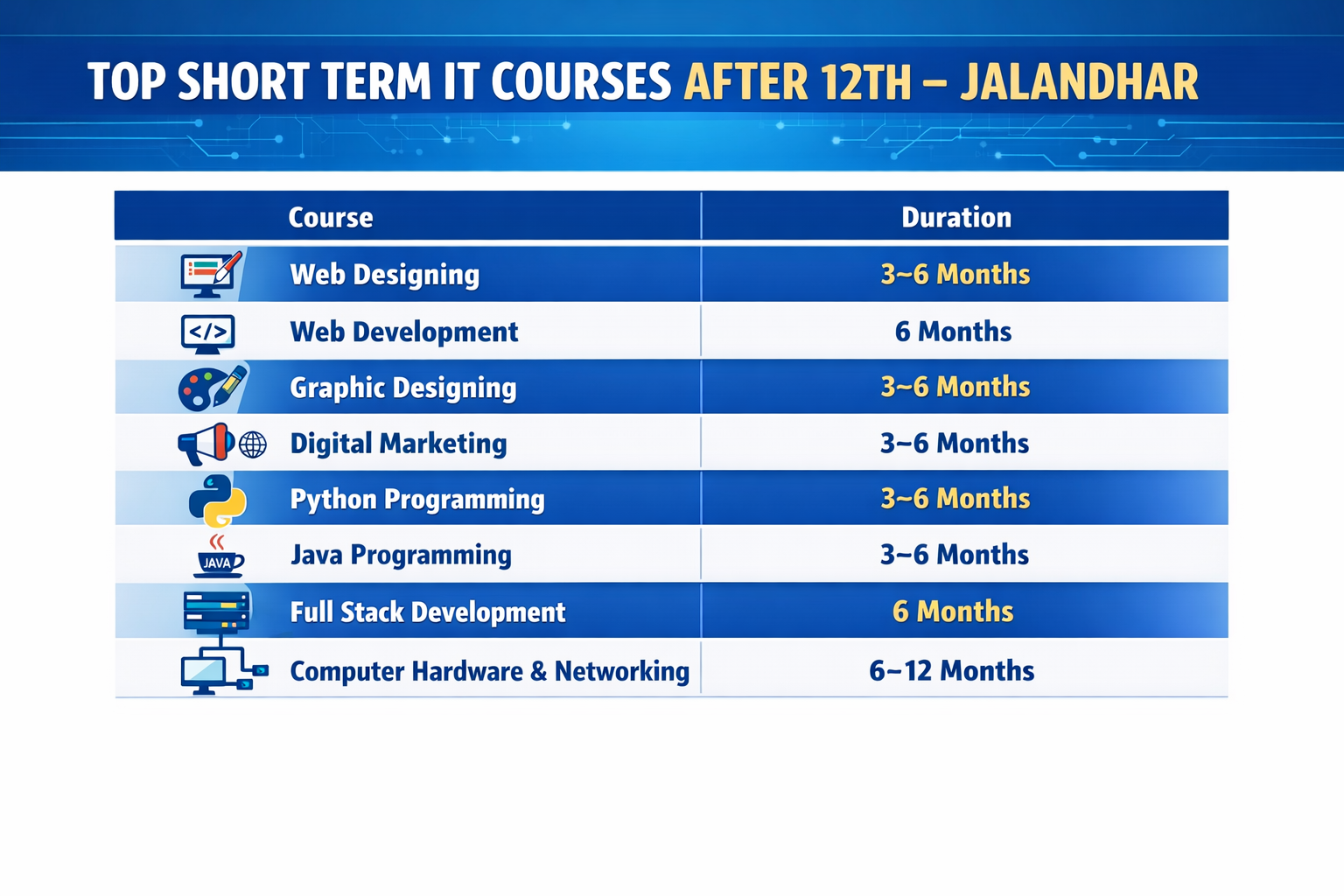
At Techcadd Computer Education, we have meticulously designed our "Short Term IT Courses After 12th in Jalandhar" to cater specifically to the needs of high school graduates. We understand that after 12th, students are eager to build a career, earn an income, and gain practical experience. Our programs are structured to be intensive, practical, and aligned with the current recruitment trends of 2024-2025.
1. Full Stack Web Development (MERN/MEAN Stack) - Extended
Beyond the Basics: The Techcadd Approach
In our Full Stack program, we treat students as future software engineers, not just coders. The first week is dedicated to "Computational Thinking," where students learn to break down complex problems into smaller, manageable algorithms before writing a single line of code. This foundational skill ensures they can adapt to any programming language in the future.
In-Depth Module Breakdown:
-
Front-End Fundamentals (The Art of the Web):
-
HTML5 Semantics: We go beyond simple div tags. Students learn to structure web pages using semantic elements like
-
CSS3 Mastery: This isn't just about coloring text. We dive deep into CSS Grid and Flexbox to create complex, responsive layouts that work flawlessly on desktops, tablets, and mobile phones. Students learn about CSS variables, animations, and transitions to add a layer of interactivity and polish to their designs.
-
Vanilla JavaScript: Before touching frameworks, we ensure students have a rock-solid understanding of core JavaScript concepts: hoisting, closures, prototypal inheritance, the event loop, and asynchronous programming with callbacks, promises, and async/await. This deep knowledge prevents the "framework dependency" trap and makes them better developers overall.
-
Advanced Front-End (Framework Proficiency):
-
React.js (The MERN Path): Students learn the power of component-based architecture. They build single-page applications (SPAs) where the user experience is fluid and fast, without page reloads. We cover:
-
Hooks: useState, useEffect, useContext, useReducer for managing state and side effects.
-
State Management: Introduction to Context API and Redux Toolkit for managing complex application state in large-scale projects.
-
Routing: Implementing dynamic navigation with React Router DOM.
-
Angular (The MEAN Path): For students choosing the MEAN stack, we cover TypeScript, dependency injection, modules, components, services, and reactive forms. They learn the opinionated structure of Angular, which is favored by large enterprises for building scalable and maintainable applications.
-
Back-End Development (The Brain of the Application):
-
Node.js & Express.js: Students learn to create server-side logic. They build RESTful APIs that serve JSON data to the front-end application. Topics include middleware, routing, error handling, and file uploading.
-
Authentication & Authorization: A critical component of modern web apps. Students implement secure user authentication using JWT (JSON Web Tokens) and Passport.js, learning how to manage user sessions and protect routes.
-
Database Management (Storing the Data):
-
MongoDB: As a NoSQL database, MongoDB offers flexibility and scalability. Students learn to design schemas using Mongoose (an ODM library), perform complex queries, and aggregate data. They understand the difference between SQL and NoSQL databases and when to use which.
-
Version Control & Deployment (The Professional Workflow):
-
Git & GitHub: Students learn the professional workflow of collaborative development. They practice branching, merging, pull requests, and resolving merge conflicts. They maintain a portfolio of their code on GitHub, which serves as a live resume for recruiters.
-
Deployment: The final step is making the application live. Students learn to deploy their projects on platforms like Netlify, Vercel, and Heroku, and they get an introduction to cloud services like AWS EC2 and S3 buckets.
Live Project Example (Web Development):
Students build a fully functional E-commerce Platform from scratch. This project includes a product listing page with filters, a shopping cart, a user login/signup system, an admin panel to add/edit products, and a payment gateway integration (like Razorpay or Stripe). This single project covers every aspect of the MERN/MEAN stack and becomes the centerpiece of their job interview discussions.
2. Python Programming & Data Science - Extended
Beyond the Syntax: The Data Storyteller's Journey
Data Science is not just about running algorithms; it's about finding the story hidden within the data. Our course is designed to transform students into data storytellers who can extract insights and drive business decisions.
In-Depth Module Breakdown:
-
Core Python (The Foundation):
-
We start with the absolute basics, assuming no prior coding experience. Students learn about data types, control flow (if/else, loops), functions, and file I/O.
-
Object-Oriented Programming (OOP): A major focus is on OOP concepts—classes, objects, inheritance, and polymorphism. This is essential for writing organized, reusable, and scalable code, especially when working on large data projects.
-
Data Analysis Libraries (The Data Wranglers):
-
NumPy: Students learn to work with multi-dimensional arrays. They perform mathematical operations on entire datasets without writing explicit loops, which is the foundation of efficient data manipulation.
-
Pandas: This is the workhorse of data analysis. Students learn to load data from various sources (CSV, Excel, SQL), clean messy data (handling missing values, removing duplicates), filter, sort, group, and merge dataframes. They become experts at transforming raw, unstructured data into a clean, analysis-ready format.
-
Data Visualization (The Art of Persuasion):
-
Matplotlib: Students learn the grammar of graphics, creating basic plots like line charts, bar charts, and histograms to understand data distributions.
-
Seaborn: Built on top of Matplotlib, Seaborn allows students to create statistically insightful and visually appealing plots with just a few lines of code. They learn to create heatmaps, pair plots, and violin plots to uncover complex relationships in the data.
-
Tableau: We introduce industry-standard BI tools like Tableau, where students learn to create interactive dashboards that communicate insights to non-technical stakeholders effectively.
-
Machine Learning Basics (The Predictive Engine):
-
Scikit-learn: Students are introduced to the exciting world of Machine Learning. They learn the difference between supervised and unsupervised learning.
-
Regression Models: Predicting continuous values (e.g., house prices, sales figures) using Linear Regression.
-
Classification Models: Predicting categories (e.g., spam vs. not spam, customer churn yes/no) using Logistic Regression and Decision Trees.
-
Model Evaluation: Crucially, they learn how to evaluate a model's performance using accuracy scores, confusion matrices, and cross-validation, ensuring they don't just build models, but build good models.
Live Project Example (Data Science):
Students work on a Customer Segmentation project for a retail business. Using a real-world dataset, they clean the data using Pandas, perform exploratory data analysis (EDA) using visualizations, and then apply a K-Means clustering algorithm to segment customers based on their purchasing behavior. They present their findings in a Tableau dashboard, identifying the most valuable customer segments for targeted marketing campaigns.
3. Digital Marketing - Extended
Beyond the Likes: The Growth Hacker's Toolkit
Digital marketing at Techcadd is taught with a performance marketing mindset. It's not about vanity metrics (likes and followers); it's about Return on Investment (ROI), conversions, and business growth.
In-Depth Module Breakdown:
-
SEO (The Art of Being Found):
-
Keyword Research: Students learn to use tools like Google Keyword Planner, Ahrefs, and SEMrush to find the exact terms their target audience is searching for.
-
On-Page SEO: They learn to optimize website content, meta descriptions, title tags, header tags, and image alt text for both users and search engines.
-
Technical SEO: Understanding site architecture, XML sitemaps, robots.txt, and canonical tags to ensure search engines can crawl and index the website effectively.
-
Off-Page SEO & Link Building: Strategies for acquiring high-quality backlinks from authoritative websites, which is a major Google ranking factor.
-
Social Media Marketing (Building Communities):
-
Platform Strategy: Students learn that each platform (Facebook, Instagram, LinkedIn, Twitter, YouTube) has a unique audience and content style. They develop tailored strategies for each.
-
Content Creation: Basic principles of graphic design (using Canva) and video editing for creating engaging social media posts.
-
Community Management: Learning how to engage with followers, respond to comments and messages, and build a loyal community around a brand.
-
Google Ads & Analytics (The Science of Advertising):
-
Google Ads (PPC): Students set up and manage live ad campaigns. They learn about keyword match types, ad copywriting, bid strategies, and quality score. They work with a budget (simulated or real) to maximize clicks and conversions.
-
Google Analytics: This is where data meets marketing. Students learn to navigate Google Analytics, track user behavior (bounce rate, session duration, pages per session), set up goals and conversion tracking, and generate reports to analyze campaign performance. They learn to answer questions like, "Where are my best customers coming from?"
-
Email Marketing & Automation (The Direct Line):
-
Students learn to use platforms like Mailchimp to build email lists, design newsletters, and set up automated email sequences (welcome emails, abandoned cart emails) that nurture leads and drive sales.
Live Project Example (Digital Marketing):
Students are given a hypothetical (or real, local) business, like a new cafe in Jalandhar. Their task is to create a 3-month digital marketing strategy. This includes: an SEO-optimized blog post to drive organic traffic, a social media content calendar for Instagram, a Facebook ad campaign to drive footfall during the weekend, and an email newsletter to announce a new menu. The project is presented to the class and faculty, simulating a pitch to a client.
Choosing an institute for your short term IT courses after 12th in Jalandhar is a decision that will impact your career trajectory for years to come. At Techcadd Computer Education, we don't just take on students; we take on the responsibility of launching careers. Our "Why" is deeply rooted in a philosophy that combines rigorous technical training with holistic personality development. Below, we expand on the core pillars that make Techcadd the preferred destination for tech aspirants in Punjab.
1. The Techcadd Learning Ecosystem: A Culture of Innovation
Beyond the classrooms and labs, Techcadd fosters a unique ecosystem that mimics a real-world tech company environment. We believe that learning is most effective when it happens in a community of passionate, like-minded individuals.
-
Peer-to-Peer Learning: We encourage collaboration over competition. Our batch structure includes group projects where students from different disciplines (e.g., a web developer, a UI/UX designer, and a digital marketer) work together. This simulates a real-world product team, teaching students how to communicate across roles, manage conflicts, and deliver a unified product. This cross-functional experience is highly valued by recruiters looking for team players.
-
The Techcadd Code-Club: We have a vibrant, student-led coding club that organizes weekly hackathons, coding challenges, and tech talks. Here, students solve problems on platforms like HackerRank and LeetCode, sharpening their logical thinking and preparing for the rigorous coding rounds of top tech companies. It’s a space where senior students mentor juniors, creating a supportive lineage of learning.
-
"Brown Bag" Sessions: Once a month, we host lunch-time learning sessions where students present a new technology, a tool they discovered, or a project they are passionate about. This builds presentation skills and confidence, forcing students to articulate their ideas clearly—a skill that pays dividends in job interviews.
8. The Mentor-Student Bond: Beyond the Classroom
The relationship at Techcadd doesn't end when the class is over. Our mentors are invested in your long-term success and act as career guides throughout your journey.
-
1:1 Monthly Mentorship Reviews: Every student is assigned a dedicated mentor who meets with them one-on-one every month. These are not just academic reviews; they are holistic check-ins. The mentor discusses the student's progress, addresses any learning anxieties, helps set short-term career goals, and provides guidance on which technologies to explore next. This personalized attention ensures that no student feels lost or overwhelmed.
-
Life-Long Alumni Support: Your connection to Techcadd doesn't end when you get a job. Our alumni network is an active community. We have a dedicated WhatsApp group for alumni where they share job openings, ask for help with technical challenges at work, and mentor current students. Many of our alumni, now working in Chandigarh, Delhi, and even abroad, return to Techcadd to hire fresh talent from their alma mater.
-
The "Doubt-Not" Policy: We have an open-door policy. If a student is stuck on a concept or a project bug at 9 PM, they can message their trainer. Our faculty is known for going the extra mile, often staying back after hours to help a struggling student or recording extra explanatory videos to clarify complex topics.
9. Placement Preparation: A 360-Degree Approach
Our placement assistance is not an afterthought; it is an integral part of the curriculum from Day 1. We prepare students not just to get a job, but to build a career.
-
The Techcadd Employability Skills Program (ESP): Integrated into the technical curriculum, this program focuses on the soft skills that engineers often lack.
-
Communication Bootcamp: We conduct sessions on spoken English, focusing on eliminating hesitation and building fluency. Students practice introducing themselves, answering HR questions, and participating in group discussions.
-
Resume Engineering: We don't just provide a template. We hold workshops where students learn to write a compelling resume that highlights their projects, skills, and achievements. We teach them how to use action verbs and quantify their impact (e.g., "Built an e-commerce site that handles 100+ products" rather than "Worked on an e-commerce site").
-
LinkedIn Profile Optimization: In today's world, your LinkedIn profile is your digital resume. We teach students how to optimize their profiles, write a compelling headline, build a network, and engage with content to attract recruiters.
-
Rigorous Mock Interview Drives: A week before our placement drives, we put students through a "Grind Week." They face a series of mock interviews:
-
Technical Round 1 (Conceptual): A faculty member grills them on core concepts, data structures, and algorithms.
-
Technical Round 2 (Project-Based): A senior developer from our partner network joins virtually to question them deeply on their live projects, probing their understanding of the code, architecture, and design choices.
-
HR Round: We simulate the final HR interview, tackling questions about salary expectations, strengths/weaknesses, and long-term career goals. This process desensitizes students to interview pressure, making them calm and confident on the actual day.
-
Employer Connect Meets: We regularly invite HR managers and tech leads from companies in Jalandhar, Ludhiana, and Chandigarh for informal "Meet & Greet" sessions. This allows students to network, understand company cultures, and make a personal impression even before the formal interview process begins.
2. Success Stories: The Proof is in the Placements
The best testament to our teaching methodology is the success of our students. Over the years, Techcadd has built a legacy of transforming raw 12th-pass students into confident IT professionals.
-
From Humble Beginnings to Software Engineers: We have countless stories of students from Hindi-medium backgrounds who were initially hesitant to code but, through our structured support and their own hard work, are now working as Full Stack Developers in top MNCs. We celebrate these stories because they embody the Techcadd spirit.
-
The Entrepreneurial Spark: Many of our alumni haven't just taken jobs; they've created them. Several former students have launched their own digital marketing agencies, web development studios, and design consultancies in Jalandhar. They often return to Techcadd to hire interns from our current batches, creating a beautiful cycle of opportunity.
-
Global Footprint: Our students have gone on to work with clients on Upwork and Fiverr, earning in dollars while sitting in Jalandhar. Some have even used the portfolio built at Techcadd to secure admissions for master's programs in Canada, Australia, and the UK.
3. The Techcadd Infrastructure: Designed for Deep Work
Your environment plays a crucial role in your learning effectiveness. We have invested heavily in creating a space that is conducive to focus, creativity, and collaboration.
-
High-Speed Dedicated Bandwidth: In the IT world, lag is the enemy of learning. Our labs are equipped with fiber-optic high-speed internet, ensuring that browsing, streaming tutorials, and using cloud-based tools like Figma or Colab is a seamless experience.
-
Ergonomic Workstations: We understand that you will be spending hours coding or designing. Our workstations are designed with ergonomics in mind—comfortable chairs, large monitors, and a clutter-free environment to prevent fatigue and enhance concentration.
-
The Project Hub: We have a dedicated "Project Hub" room, a space designed for team collaborations. It's equipped with whiteboards, sticky notes, and smart TVs for screen mirroring, allowing project teams to brainstorm ideas, draw architecture diagrams, and review each other's code in a dedicated, professional setting.
4. Financial Accessibility: Investing in Your Future
We firmly believe that financial constraints should never be a barrier to a better future. Techcadd is committed to making high-quality tech education accessible to all.
-
Flexible Payment Plans: We offer customized installment plans that align with your family's financial comfort. Our counselors work with you to create a payment schedule that doesn't strain your resources.
-
Strategic Partnerships with Banks/NBFCs: We have tied up with financial partners to offer education loans at subsidized interest rates for eligible students. This allows you to invest in your future and pay back once you start earning.
-
Scholarship for Girl Students: As part of our commitment to empowering women in tech, we offer special scholarship programs for female students who wish to pursue careers in what has traditionally been a male-dominated field. We believe diversity drives innovation.
5. Staying Ahead of the Curve: Future-Ready Curriculum
The tech industry moves at lightning speed. What is relevant today might be obsolete tomorrow. At Techcadd, our curriculum is a living document.
-
Curriculum Revision Committee: We have a dedicated committee comprising our senior faculty and industry advisors that meets every quarter. They analyze job market trends, study new tool releases, and update the syllabus accordingly. For example, when low-code/no-code platforms started gaining traction, we immediately introduced a module in our web development course on Bubble.io, giving our students an additional, highly-demanded skill set.
-
Elective Modules: After completing the core curriculum, students can choose elective modules to specialize further. A web developer, for instance, can choose between an elective on Progressive Web Apps (PWAs) or one on GraphQL. A digital marketing student can choose between an advanced Facebook Ads elective or an SEO Intensive elective.
-
Workshops on New-Age Tech: We regularly conduct weekend workshops on trending topics that are not yet part of the mainstream curriculum, such as Blockchain basics, Prompt Engineering for AI tools like ChatGPT, or an introduction to AR/VR development. This keeps our students aware of the cutting edge and sparks curiosity.