
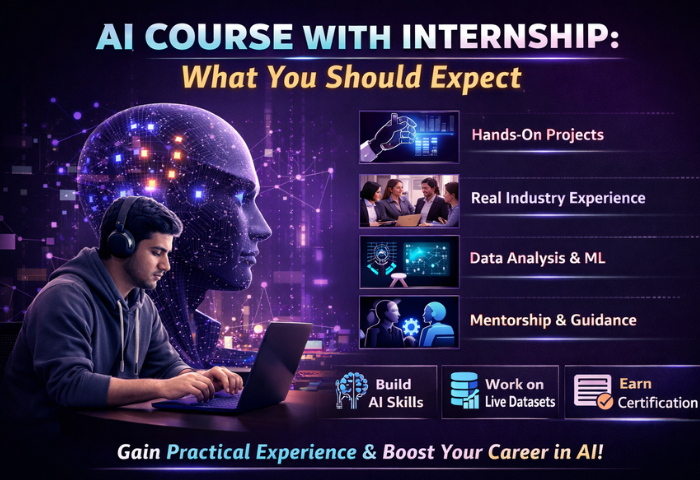
AI Course with Internship: What You Should Expect
Artificial Intelligence is no longer a futuristic concept reserved for tech giants and research laboratories. In 2026, AI has become the driving force behind innovation across industries—from healthcare and finance to e-commerce, manufacturing, and entertainment. As businesses race to integrate AI into their operations, the demand for skilled AI professionals has skyrocketed. However, theoretical knowledge alone is no longer sufficient to land a high-paying AI role. Employers today seek candidates who can demonstrate practical, hands-on experience in building, deploying, and optimizing AI solutions.
This is where an AI Course with Internship becomes a game-changer. Such programs bridge the gap between classroom learning and real-world application, offering students the opportunity to work on live projects, industry tools, and actual business problems. But what should you actually expect when you enroll in an AI course that includes an internship component? This comprehensive guide walks you through every aspect—from curriculum structure and internship experience to career outcomes and long-term benefits.
Why an AI Course with Internship Matters in 2026
The AI landscape in 2026 is characterized by rapid evolution and intense competition. New frameworks, models, and tools emerge constantly, and employers want professionals who can hit the ground running. A traditional degree or certification program that focuses solely on theory often leaves graduates struggling to apply their knowledge in practical settings.
An AI Course with Internship addresses this gap by integrating real-world experience into the learning process. Internships provide exposure to:
-
Live project environments
-
Industry-standard tools and platforms
-
Collaboration with experienced professionals
-
Problem-solving under real constraints
-
Portfolio-building opportunities
According to recent hiring data, candidates with internship experience are 40% more likely to receive job offers and often command starting salaries 20–30% higher than those without practical exposure. This makes understanding What You Should Expect from such a program critical for career planning.
Core Components of an AI Course with Internship
When evaluating an AI program that promises internship opportunities, it is essential to understand its structure. A well-designed AI Course with Internship typically consists of several interconnected phases.
Phase 1: Foundational Learning
The journey begins with building a strong theoretical and technical foundation. This phase ensures that students have the prerequisite knowledge to contribute meaningfully during their internship.
Key Topics Covered:
-
Python Programming: Mastery of Python, including data structures, functions, object-oriented programming, and essential libraries like NumPy, Pandas, and Matplotlib.
-
Mathematics for AI: Linear algebra, calculus, probability, and statistics—the mathematical backbone of machine learning algorithms.
-
Data Handling and Preprocessing: Cleaning, transforming, and visualizing data to prepare it for modeling.
-
Introduction to Machine Learning: Supervised and unsupervised learning algorithms, model evaluation, and feature engineering.
This phase typically lasts 2–3 months and includes hands-on assignments, quizzes, and mini-projects to reinforce learning.
Phase 2: Core AI and Machine Learning
Once the foundation is solid, students dive deeper into AI and machine learning concepts. This phase focuses on building, training, and optimizing models.
Key Topics Covered:
-
Supervised Learning Algorithms: Linear regression, logistic regression, decision trees, random forests, support vector machines, and gradient boosting.
-
Unsupervised Learning: Clustering techniques, dimensionality reduction, and anomaly detection.
-
Deep Learning: Neural networks, convolutional neural networks (CNNs) for computer vision, recurrent neural networks (RNNs) for sequence data, and transformers for NLP.
-
Model Evaluation and Optimization: Cross-validation, hyperparameter tuning, regularization, and performance metrics.
-
Frameworks and Libraries: TensorFlow, PyTorch, Keras, and Scikit-learn.
Students work on multiple projects during this phase, building a portfolio that demonstrates their technical capabilities.
Phase 3: Specialization and Advanced Topics
To stand out in the competitive AI job market, specialization is key. This phase allows students to choose advanced topics based on their career interests.
Specialization Options:
-
Natural Language Processing (NLP): Text preprocessing, sentiment analysis, language models, transformers, and large language models (LLMs).
-
Computer Vision: Image classification, object detection, image segmentation, and generative models.
-
Generative AI: GANs, VAEs, diffusion models, and prompt engineering.
-
Reinforcement Learning: Game AI, robotics, and optimization problems.
-
AI for Specific Domains: Finance, healthcare, e-commerce, or manufacturing applications.
This phase also introduces students to deployment concepts, preparing them to take models from development to production.
Phase 4: Internship Preparation
Before the internship begins, students undergo preparation sessions that cover:
-
Resume and Portfolio Building: Showcasing projects effectively
-
Technical Interview Preparation: Common AI interview questions and coding challenges
-
Soft Skills: Communication, teamwork, and professional etiquette
-
Industry Orientation: Understanding how AI teams function in real organizations
Phase 5: The Internship Experience
The internship is the centerpiece of the program. Lasting anywhere from 2 to 6 months, it provides students with immersive, real-world experience.
What You Should Expect During the Internship:
1. Real Projects, Not Busy Work
A quality internship ensures that students work on meaningful projects that contribute to the organization's goals. This could involve building predictive models, developing chatbots, automating processes, or analyzing customer data.
2. Mentorship and Guidance
Interns are paired with experienced mentors who provide guidance, review code, offer feedback, and help navigate challenges. Regular check-ins ensure continuous learning and progress.
3. Exposure to Industry Tools
Interns gain hands-on experience with tools and platforms used in professional settings, such as cloud services (AWS, GCP, Azure), MLOps frameworks, version control (Git), and collaboration tools.
4. Collaboration and Teamwork
Working alongside data scientists, engineers, and product managers, interns learn how AI projects are executed in cross-functional teams. This exposure is invaluable for understanding workplace dynamics.
5. Problem-Solving Under Constraints
Real-world projects come with constraints—limited data, computational resources, tight deadlines, and business requirements. Interns learn to navigate these challenges and deliver results.
6. Performance Evaluation
Most internships include formal evaluations at the midpoint and end. Constructive feedback helps interns identify strengths and areas for improvement.
7. Networking Opportunities
Interns interact with professionals across the organization, building relationships that can lead to future job opportunities and references.
What Makes a Great AI Internship?
Not all internships are created equal. When evaluating an AI Course with Internship, consider the following factors that distinguish high-quality programs:
1. Project Relevance
The internship should involve projects aligned with current industry needs—generative AI, LLMs, computer vision applications, or predictive analytics. Avoid programs where interns are assigned administrative or unrelated tasks.
2. Mentor Quality
Experienced mentors with industry backgrounds make a significant difference. They provide insights that go beyond technical skills, including best practices, career advice, and professional networking.
3. Company Reputation
Internships with reputable companies add credibility to your resume. Even if the company is a startup, its focus on AI and innovation matters.
4. Duration and Intensity
A meaningful internship typically requires at least 2–3 months of full-time or significant part-time engagement. Short, superficial programs may not provide sufficient depth.
5. Compensation and Benefits
While unpaid internships exist, paid internships are a sign that your contributions are valued. Stipends or salaries also help cover living expenses during the internship period.
6. Post-Internship Opportunities
Some internships lead to full-time job offers. Programs with strong placement records or direct hiring pipelines add significant value.
Benefits of Completing an AI Course with Internship
Understanding What You Should Expect from such a program also involves recognizing the long-term benefits.
1. Job-Ready Skills
Graduates emerge with practical experience that makes them attractive to employers. They understand not just how to build models, but how to deploy, monitor, and maintain them in production.
2. Strong Professional Network
Internships introduce students to professionals in the field, creating connections that can lead to referrals, collaborations, and job opportunities.
3. Enhanced Resume and Portfolio
Real-world projects and internship experience stand out on resumes and during interviews. They provide concrete evidence of your capabilities.
4. Higher Earning Potential
As noted earlier, candidates with internship experience often command higher salaries. Employers value the reduced training time and immediate contribution that experienced interns bring.
5. Clarity on Career Path
Internships help students understand which areas of AI they enjoy most—whether research, engineering, analytics, or product management—guiding future career decisions.
6. Confidence and Professionalism
Working in a real organization builds confidence, communication skills, and professional maturity—attributes that cannot be taught in classrooms.
Challenges You Might Face
While the benefits are substantial, it is also important to be aware of potential challenges during an AI Course with Internship.
1. Workload Management
Balancing coursework, projects, and internship responsibilities can be demanding. Time management and prioritization become essential skills.
2. Steep Learning Curve
Real-world AI work often involves technologies and problems not covered in courses. Interns must be prepared to learn continuously and adapt quickly.
3. Imposter Syndrome
Working alongside experienced professionals can sometimes lead to self-doubt. Remember that internships are learning experiences, and asking questions is expected.
4. Uncertainty and Ambiguity
Unlike structured assignments, real projects may have unclear requirements or evolving goals. Flexibility and problem-solving attitude are key.
5. Competition
Internship positions, especially with top companies, are highly competitive. Strong performance during the coursework phase is essential to secure quality internships.
How to Choose the Right AI Course with Internship
With numerous options available, selecting the right program requires careful evaluation.
Checklist for Choosing a Program:
-
Curriculum Relevance: Does it cover current AI technologies and trends?
-
Internship Placement Record: What percentage of students get internships? With which companies?
-
Mentor Experience: Are instructors and mentors industry professionals?
-
Hands-on Projects: How many projects will you complete before the internship?
-
Tools and Technologies: Will you learn industry-standard frameworks and platforms?
-
Placement Support: Does the program offer job placement assistance after the internship?
-
Alumni Success: What are past students doing now?
-
Cost and Duration: Is the program affordable and appropriately paced?
Researching reviews, talking to alumni, and attending informational sessions can provide valuable insights.
Career Paths After an AI Course with Internship
Completing such a program opens doors to multiple career trajectories.
Entry-Level Roles
-
AI Engineer: Building and deploying AI models
-
Machine Learning Engineer: Developing ML systems and pipelines
-
Data Scientist: Analyzing data and building predictive models
-
NLP Engineer: Working on language-based AI applications
-
Computer Vision Engineer: Developing image and video analysis systems
Mid-Level and Senior Roles
With experience, professionals can progress to:
-
Lead AI Engineer
-
AI Architect
-
Machine Learning Manager
-
AI Research Scientist
-
Head of AI / AI Director
Alternative Paths
-
AI Consultant: Advising businesses on AI strategy and implementation
-
Freelance AI Developer: Working on projects independently
-
AI Entrepreneur: Building AI-powered products or startups
-
AI Educator: Teaching and training the next generation of AI professionals
Industry Trends Shaping AI Internships in 2026
Understanding the broader context helps set realistic expectations for your AI Course with Internship.
1. Generative AI Dominance
Companies are racing to integrate generative AI into their products and operations. Interns with skills in LLMs, prompt engineering, and RAG pipelines are in high demand.
2. MLOps and Deployment Focus
Building models is only half the battle. Employers want professionals who can deploy, monitor, and maintain models in production. Internships increasingly include exposure to MLOps practices.
3. Ethical AI and Responsible Development
As AI becomes more powerful, concerns around bias, fairness, and transparency grow. Interns may work on projects related to model interpretability, fairness audits, and responsible AI implementation.
4. Cross-Disciplinary Applications
AI is being applied in diverse domains—healthcare, finance, agriculture, education, and more. Interns with domain knowledge alongside technical skills have a competitive edge.
5. Remote and Hybrid Internships
The shift toward remote work continues. Many internships now offer remote or hybrid options, expanding access to opportunities across geographic boundaries.
Success Stories: From Internship to Career
Hearing about real-world outcomes can illustrate What You Should Expect from an AI Course with Internship.
Case Study 1: From Student to AI Engineer
Riya, a graduate of a 6-month AI program with a 3-month internship, joined a fintech startup as an intern. During her internship, she built a credit risk prediction model that improved the company's approval accuracy by 15%. She received a full-time offer before her internship ended and now works as an AI Engineer, earning ₹12 LPA.
Case Study 2: Specialization Pays Off
Arjun focused on computer vision during his coursework and internship. His project on automated quality inspection for a manufacturing client led to a patent filing. He now works as a Computer Vision Specialist at a leading automation company.
Case Study 3: Entrepreneurial Journey
Priya used her internship experience to identify a gap in AI-powered customer support for small businesses. She launched her own startup, secured initial funding, and now provides AI chatbot solutions to over 50 clients.
These stories highlight the transformative potential of combining structured learning with practical experience.
Preparing for Your AI Internship: Tips for Success
To make the most of your AI Course with Internship, consider these preparation strategies:
Before the Internship
-
Build a Strong Portfolio: Showcase your best projects on GitHub
-
Practice Coding: Solve problems on LeetCode, HackerRank, or Kaggle
-
Learn Industry Tools: Familiarize yourself with Git, Docker, and cloud platforms
-
Research the Company: Understand their products, industry, and AI initiatives
-
Set Learning Goals: Identify what you want to achieve during the internship
During the Internship
-
Be Proactive: Ask questions, seek feedback, and volunteer for tasks
-
Document Your Work: Maintain notes on projects, tools, and learnings
-
Network Actively: Connect with colleagues across teams
-
Communicate Regularly: Keep mentors informed of progress and challenges
-
Focus on Impact: Understand how your work contributes to business goals
After the Internship
-
Update Your Resume: Add internship projects and achievements
-
Stay in Touch: Maintain connections with mentors and colleagues
-
Seek Recommendations: Request LinkedIn recommendations or reference letters
-
Reflect on Learnings: Identify skills to develop further
Common Questions About AI Courses with Internship
How Long Does a Typical AI Course with Internship Last?
Most programs range from 6 to 12 months, including 2–6 months of internship. Duration depends on course intensity, internship format, and individual pacing.
Are These Programs Expensive?
Costs vary widely based on institution, curriculum, internship quality, and location. However, the return on investment is generally high given the salary premiums for experienced candidates.
Can I Do an Internship Remotely?
Yes, many companies now offer remote internships. Ensure the program provides support for remote work arrangements and access to necessary tools.
What If I Don't Get an Internship?
Reputable programs guarantee internship placements or offer alternative project experience. Research placement records before enrolling.
Is Prior Programming Experience Required?
Most programs expect basic programming knowledge, though some offer foundational modules for beginners. Check prerequisites before applying.
The Future of AI Education: Integrated Learning Models
The success of AI Courses with Internship reflects a broader shift in education toward integrated learning models. Traditional degrees are being complemented—and in some cases replaced—by programs that combine rigorous academics with practical experience.
Trends to Watch:
-
University-Industry Partnerships: More collaborations between educational institutions and companies to create internship pipelines
-
Micro-credentials and Stackable Certifications: Bite-sized learning modules that can be combined into comprehensive qualifications
-
Lifelong Learning Platforms: Continuous upskilling opportunities for professionals at all career stages
-
AI-Powered Learning: Personalized education paths adapted to individual progress and goals
These trends suggest that integrated, practical training will become the norm rather than the exception in AI education.
Conclusion: What You Should Expect and Why It Matters
An AI Course with Internship represents one of the most effective pathways to a successful career in artificial intelligence. By combining structured learning with real-world experience, such programs prepare students not just to understand AI concepts, but to apply them in ways that create tangible value for organizations.
What You Should Expect from these programs includes:
-
Comprehensive foundational training in Python, mathematics, and machine learning
-
Deep dives into advanced topics and specializations aligned with industry demand
-
Hands-on projects that build a portfolio of demonstrable skills
-
A meaningful internship experience with real projects, mentorship, and professional exposure
-
Career support that helps translate internship experience into job opportunities
-
Long-term benefits including higher earning potential, stronger networks, and career clarity
However, success requires active participation. Students must engage fully with coursework, seek out learning opportunities during internships, and continuously develop both technical and professional skills.
In 2026, the AI job market offers unprecedented opportunities for skilled professionals. Those who invest in comprehensive, practical training—including a quality internship—position themselves at the forefront of this transformative field. Whether you aspire to be an AI engineer, data scientist, researcher, entrepreneur, or consultant, an AI Course with Internship provides the foundation, experience, and confidence to turn those aspirations into reality.
The future belongs to those who can not only understand AI but also build, deploy, and optimize it in real-world contexts. By choosing a program that delivers on its promise of practical experience, you take a decisive step toward becoming one of them.

Comments
No comments yet. Be the first to share your thoughts!
Leave a Comment