
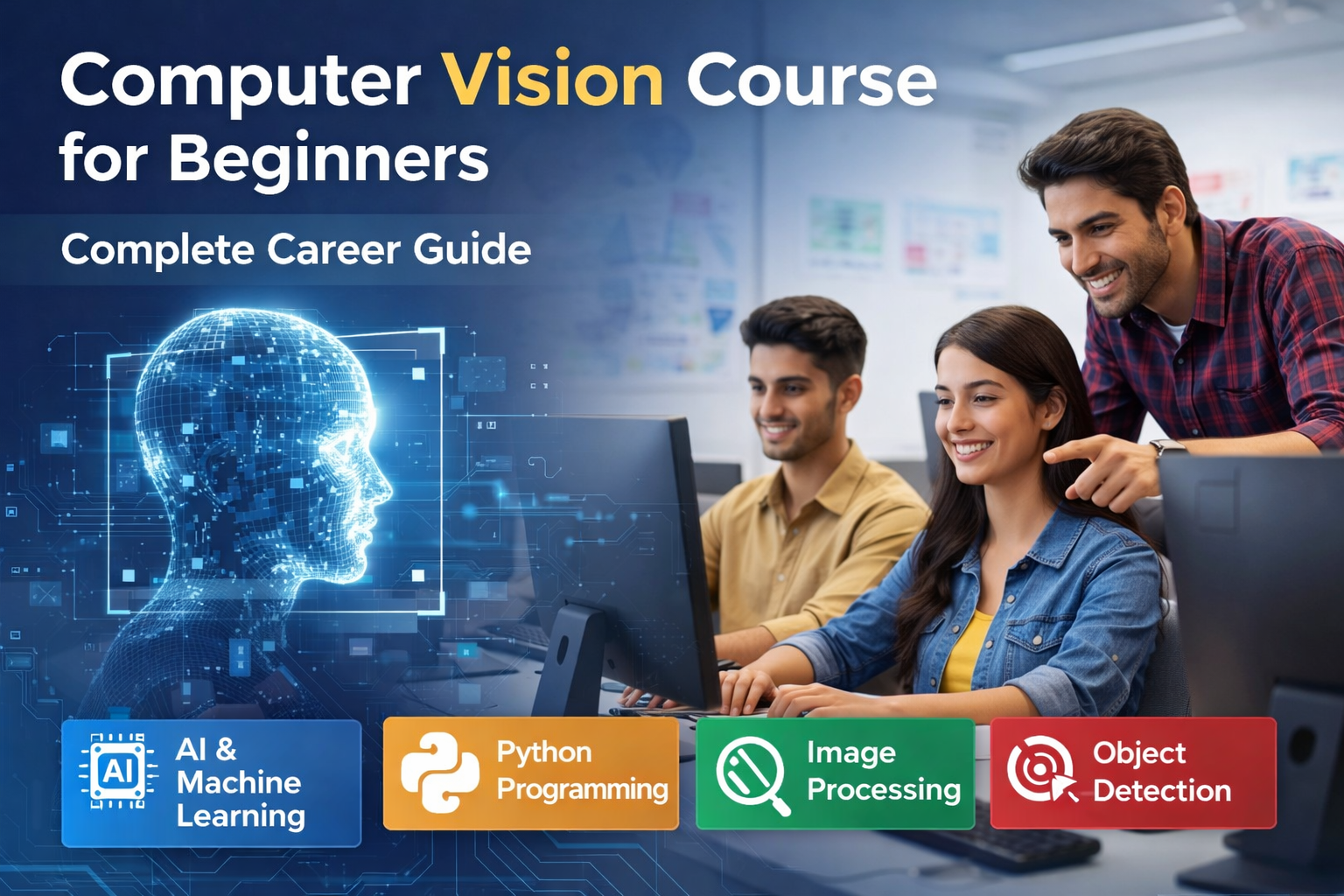
Computer Vision Course for Beginners
Computer Vision is a rapidly growing field within Artificial Intelligence that focuses on enabling machines to interpret and understand visual information from the world. Images and videos contain massive amounts of data, and computer vision technologies allow computers to analyze this visual data in ways similar to human perception. A Computer Vision Course for Beginners is designed to introduce learners to the principles, techniques, and tools used to build systems that can detect, recognize, and interpret visual content.
The course begins with the basic understanding of what digital images are and how computers process them. Every digital image is made up of pixels, and each pixel contains numerical information representing colors and brightness. Students learn how images are represented using different color models such as RGB, grayscale, and HSV. Understanding how images are stored and manipulated digitally is the foundation for all computer vision techniques.
Once students understand image representation, the course introduces the concept of image processing, which is the first step in computer vision. Image processing involves applying mathematical and computational methods to modify or analyze images. These techniques help enhance images, remove noise, detect edges, and extract useful features. Image processing is widely used in fields such as medical imaging, satellite imagery analysis, and security systems.
A beginner computer vision course usually teaches students how to perform common image processing tasks using programming languages like Python. Python is one of the most widely used languages in artificial intelligence because of its simplicity and powerful ecosystem of libraries. Students learn how to use libraries such as OpenCV, NumPy, and Matplotlib to read images, manipulate pixels, display images, and perform basic transformations.
Another fundamental topic covered in the course is feature detection and extraction. In computer vision, features are patterns or structures within images that can be used to identify objects or shapes. Features can include edges, corners, textures, or key points in an image. Detecting these features helps computer vision systems understand the structure of images.
Students learn various feature detection algorithms such as edge detection methods like Sobel and Canny edge detectors. These techniques highlight boundaries in images, making it easier to identify objects. Feature detection is essential for applications like facial recognition, gesture recognition, and motion tracking.
As the course progresses, learners are introduced to object detection and recognition. This is one of the most exciting and practical aspects of computer vision. Object detection involves identifying and locating objects within images or video frames. For example, a computer vision system may detect cars on a road, faces in a crowd, or products on a store shelf.
Students learn how computer vision systems analyze images to locate objects using various techniques such as bounding boxes and region proposals. Object recognition takes this process further by identifying what the detected object actually is. For example, the system might recognize that an object in an image is a dog, a person, or a traffic sign.
The course also explores image classification, which is a process where a machine learning model assigns a label to an entire image. For example, an image classification model might determine whether an image contains a cat, a dog, or a human face. Image classification is widely used in fields such as social media image tagging, medical diagnosis systems, and wildlife monitoring.
A major component of modern computer vision is deep learning, and many beginner courses introduce students to this topic. Deep learning uses artificial neural networks to automatically learn patterns from large datasets. In computer vision, a specialized type of neural network called a Convolutional Neural Network (CNN) is commonly used.
CNNs are designed to process image data efficiently by analyzing local patterns such as edges, shapes, and textures. Through multiple layers of processing, CNNs can learn to recognize complex patterns and objects in images. Students learn the basic architecture of CNNs and how they are used in applications such as image recognition and object detection.
Another important topic covered in the course is video analysis. While image processing focuses on individual images, video analysis deals with sequences of frames. Computer vision systems can analyze videos to detect motion, track objects, and recognize activities. For example, video analysis is used in surveillance systems, sports analytics, and autonomous driving technologies.
Students learn techniques such as motion detection and object tracking, which allow computer vision systems to follow moving objects across video frames. This technology is used in applications such as pedestrian tracking, traffic monitoring, and gesture-based interaction systems.
Practical learning is a key component of a computer vision course. Students work on projects that help them apply theoretical concepts to real-world problems. These projects allow learners to build applications that demonstrate their understanding of computer vision techniques.
Some common beginner projects include:
• Face detection systems
• Image classification models
• Object detection applications
• Real-time camera vision programs
• License plate detection systems
These projects help students develop confidence in applying computer vision concepts and working with real datasets.
The course also introduces students to data preparation and dataset handling, which is essential in machine learning and computer vision. Machine learning models require large amounts of labeled data to learn patterns effectively. Students learn how to collect, clean, and preprocess image datasets before training models.
Another important aspect of computer vision education is learning how to evaluate model performance. Students learn about metrics such as accuracy, precision, recall, and confusion matrices. These evaluation techniques help determine how well a computer vision model performs on unseen data.
The tools used in computer vision are also covered in the course. Some of the most popular tools and frameworks include:
• OpenCV – A powerful library for image and video processing
• TensorFlow – A machine learning framework developed by Google
• PyTorch – A popular deep learning framework used for research and production
• NumPy – A library for numerical computing in Python
• Matplotlib – A visualization library for displaying images and data
By learning these tools, students gain hands-on experience with technologies that are widely used in industry and research.
Another important part of the course focuses on real-world applications of computer vision. Computer vision technologies are used in a wide range of industries, and understanding these applications helps students see the practical value of what they are learning.
Some major applications of computer vision include:
Autonomous Vehicles
Self-driving cars use computer vision systems to detect lanes, recognize traffic signs, and avoid obstacles.
Healthcare
Computer vision helps doctors analyze medical images such as X-rays, MRIs, and CT scans to detect diseases.
Security and Surveillance
Facial recognition and motion detection systems help improve security in public spaces.
Retail and E-commerce
Computer vision is used for automated checkout systems, inventory management, and product recognition.
Agriculture
Farmers use computer vision to monitor crops, detect diseases, and analyze soil conditions.
Manufacturing
Factories use vision systems to inspect products and detect defects in production lines.
Understanding these real-world applications helps students appreciate how computer vision technology impacts everyday life.
A beginner computer vision course also introduces learners to career pathways in the field. As demand for AI technologies continues to grow, computer vision specialists are becoming highly sought after in industries such as technology, robotics, healthcare, and automotive engineering.
Common job roles related to computer vision include:
Computer Vision Engineer
Machine Learning Engineer
AI Researcher
Robotics Engineer
Data Scientist
AI Software Developer
These roles involve designing, developing, and deploying intelligent systems that can analyze visual information.
The course typically concludes by helping students understand how to continue their learning journey. Computer vision is a vast field, and beginners are encouraged to explore advanced topics such as deep learning optimization, 3D vision, augmented reality, and robotics vision systems.
Students may also be encouraged to participate in open-source projects, AI competitions, and research initiatives to further strengthen their skills.
By the end of a Computer Vision Course for Beginners, students develop a solid understanding of how machines interpret images and videos. They gain practical experience with programming tools, learn how to build basic vision systems, and develop the foundation needed to pursue advanced studies in artificial intelligence.
For individuals interested in the future of technology, computer vision provides an exciting pathway into one of the most innovative areas of artificial intelligence. With industries increasingly relying on intelligent visual systems, learning computer vision can open doors to numerous career opportunities and technological innovations.
A Computer Vision Course for Beginners is designed to help students understand how machines analyze and interpret visual data. The course combines theoretical concepts with hands-on projects so learners can develop both knowledge and practical skills.
The course typically begins with the fundamentals of digital images and how computers represent visual data. Students learn how images are stored as pixels and how different color models such as RGB and grayscale are used in image processing.
After understanding the basics, students move on to image processing techniques. These techniques allow computers to manipulate and enhance images to extract useful information. Common topics include image filtering, edge detection, thresholding, and feature extraction.
One of the most exciting parts of computer vision is object detection and recognition. In this stage, students learn how machines identify objects inside images or videos. This technology powers applications like face detection, license plate recognition, and automated security systems.
The course also introduces machine learning and deep learning for computer vision. Students learn how neural networks and convolutional neural networks (CNNs) are used to train models that recognize patterns in visual data.
Practical projects are an important part of the learning experience. Students may build applications such as:
-
Face detection systems
-
Image classification models
-
Object detection programs
-
Real-time video processing applications
These projects help students understand how computer vision is applied in real-world scenarios.
Most beginner computer vision courses use Python programming along with popular libraries like:
-
OpenCV
-
TensorFlow
-
PyTorch
-
NumPy
-
Matplotlib
By the end of the course, students gain the ability to build basic computer vision applications and understand how AI systems analyze visual data.
This knowledge provides a strong foundation for advanced studies in Artificial Intelligence, Deep Learning, Robotics, and Data Science.

Comments
No comments yet. Be the first to share your thoughts!
Leave a Comment