
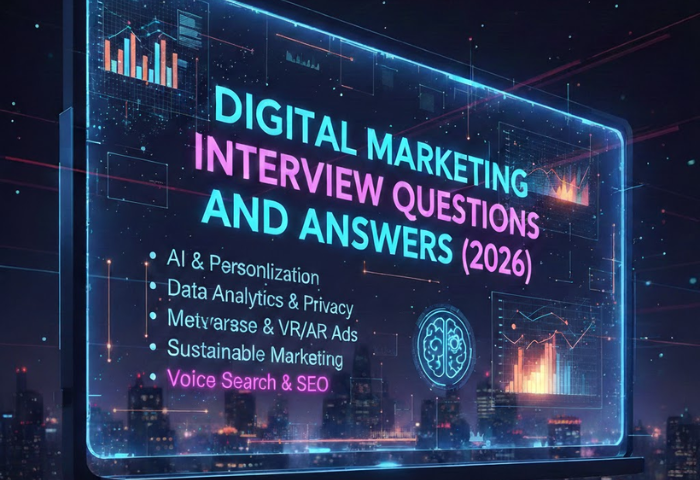
In 2026, Digital Marketing interviews are no longer basic or predictable. Companies now look for candidates who not only understand theory but can also explain real-world strategies, tools, data interpretation, and performance optimization. Whether you are a fresher, student after 12th, career switcher, or experienced professional, preparing the right interview questions and answers is the key to cracking top digital marketing jobs.
At Techcadd Jalandhar, we train students according to current industry hiring patterns, making sure they are confident, skilled, and job-ready. This blog is a 2026-updated, in-depth Digital Marketing Interview Guide designed by industry experts.
Digital marketing today encompasses several domains, including SEO, Social Media Marketing, Pay-Per-Click Advertising (PPC), Content Marketing, Email Marketing, Web Analytics, and Conversion Rate Optimization (CRO), and interviewers expect candidates to demonstrate proficiency in all these areas. Understanding the basics of SEO is fundamental, as it forms the backbone of online visibility; candidates should be able to explain concepts such as on-page SEO, off-page SEO, technical SEO, keyword research, backlinking, Core Web Vitals, and E-E-A-T (Experience, Expertise, Authoritativeness, and Trustworthiness) while providing examples of how they have applied these techniques to improve search rankings.
Why Digital Marketing Interviews Are Different in 2026
Digital marketing has evolved beyond posting ads or ranking websites. Today’s interviewers evaluate:
-
Strategic thinking
-
Data analysis skills
-
Platform knowledge
-
Creativity + automation
-
ROI-focused execution
Employers expect candidates to understand how marketing decisions impact business growth, not just definitions.
Basic Digital Marketing Interview Questions (Freshers – 2026)
1. What is Digital Marketing?
Digital Marketing is the promotion of products or services using online platforms such as search engines, social media, websites, email, and mobile apps to reach targeted audiences and generate measurable results.
Similarly, knowledge of Social Media Marketing is indispensable, with an emphasis on platform selection, organic versus paid strategies, engagement metrics, content calendars, and targeting the right audience for measurable outcomes. Interviewers in 2026 are particularly interested in candidates who can combine creativity with data, demonstrating an understanding of social media algorithms, audience insights, performance metrics, CTR, and conversion tracking, and who can use this knowledge to drive brand growth effectively.
Another crucial area is PPC and Performance Marketing, where candidates must show proficiency in Google Ads, Quality Score, remarketing campaigns, conversion tracking, budget optimization, and reducing cost-per-click, as businesses increasingly rely on paid campaigns to generate leads and drive ROI.
2. Why is Digital Marketing important in 2026?
In 2026, customers research, compare, and purchase products online. Digital marketing allows businesses to:
-
Reach the right audience
-
Track real-time performance
-
Optimize campaigns instantly
-
Achieve higher ROI compared to traditional marketing
3. What are the major components of Digital Marketing?
Key components include:
-
Search Engine Optimization (SEO)
-
Social Media Marketing (SMM)
-
Pay-Per-Click Advertising (PPC)
-
Content Marketing
-
Email Marketing
-
Affiliate Marketing
-
Web Analytics
-
Conversion Rate Optimization (CRO)
4. What is the difference between traditional and digital marketing?
Traditional marketing is one-way communication with limited tracking, while digital marketing enables two-way interaction, precise targeting, and complete performance measurement.
5. What skills are required to become a Digital Marketer?
A successful digital marketer in 2026 needs:
-
Analytical thinking
-
Creativity
-
Communication skills
-
Technical understanding
-
Data interpretation
-
Marketing psychology
SEO Interview Questions and Answers (2026 Updated)
6. What is SEO?
SEO (Search Engine Optimization) is the process of improving a website’s visibility on search engines like Google to increase organic traffic.
Content Marketing questions are also prominent, with interviewers seeking candidates who understand content strategy, content funnels, interactive content, long-form blogs, case studies, and video marketing, as well as the ability to measure success using metrics like page views, engagement, and lead generation. Email Marketing remains a powerful tool, so candidates should be familiar with segmentation, personalized campaigns, open rates, CTR, automated workflows, and drip campaigns, demonstrating how they have used email to nurture leads and retain customers. Web Analytics and data interpretation are equally critical, as modern digital marketing relies on metrics-driven decisions; candidates must understand Google Analytics, bounce rate, session duration, conversion rate optimization, traffic sources, and user behavior analysis, showing their ability to optimize campaigns for maximum impact. Advanced questions often focus on digital marketing strategy, AI integration, marketing automation, predictive analytics, and ROI measurement, reflecting the growing importance of technology and data-driven approaches in shaping campaigns.
7. What are the types of SEO?
-
On-Page SEO – Content, keywords, meta tags
-
Off-Page SEO – Backlinks, brand mentions
-
Technical SEO – Website speed, indexing, mobile optimization
8. What is keyword intent?
Keyword intent refers to the purpose behind a search query, such as informational, navigational, commercial, or transactional intent.
9. What are Core Web Vitals?
Core Web Vitals measure user experience through:
-
Loading speed
-
Interactivity
-
Visual stability
10. What is E-E-A-T in SEO?
E-E-A-T stands for Experience, Expertise, Authoritativeness, and Trustworthiness, which helps search engines evaluate content quality.
Social Media Marketing Interview Questions (2026)
11. What is Social Media Marketing?
Social Media Marketing is the use of platforms like Meta properties to build brand awareness, engage audiences, and drive conversions.
12. How do you choose the right social media platform?
Platform selection depends on:
-
Target audience
-
Business type
-
Content format
-
Marketing goals
13. What is organic vs paid social media?
Organic social media focuses on free reach and engagement, while paid social media involves running targeted ads for faster results.
14. What metrics matter in social media marketing?
Important metrics include:
-
Reach
-
Engagement rate
-
Click-through rate (CTR)
-
Conversion rate
15. How often should a brand post on social media?
Consistency matters more than frequency. Posting 3–5 times per week with quality content is ideal.
PPC & Performance Marketing Interview Questions
16. What is PPC?
Pay-Per-Click (PPC) is an advertising model where advertisers pay only when users click on their ads.
17. What is Quality Score?
Quality Score measures the relevance of keywords, ads, and landing pages to improve ad rankings and reduce cost-per-click.
18. What is conversion tracking?
Conversion tracking measures actions such as purchases, sign-ups, or calls generated through ads.
19. What is remarketing?
Remarketing targets users who have previously interacted with your website or ads but didn’t convert.
20. How do you reduce ad costs?
Ad costs can be reduced by improving:
-
Quality Score
-
Ad relevance
-
Landing page experience
-
Audience targeting
Content Marketing Interview Questions (2026)
21. What is content marketing?
Content marketing involves creating valuable, relevant, and consistent content to attract and retain a targeted audience.
22. What types of content perform best in 2026?
-
Long-form blogs
-
Short videos
-
Case studies
-
Interactive content
-
AI-assisted personalized content
23. What is a content funnel?
A content funnel guides users from awareness to conversion through different content stages.
24. How do you measure content success?
Using metrics like:
-
Page views
-
Time on page
-
Engagement
-
Lead generation
-
Conversion rate
Email Marketing Interview Questions
25. What is email marketing?
Email marketing is a direct communication channel used to nurture leads and retain customers.
26. What is open rate?
Open rate shows the percentage of recipients who opened an email.
27. What is segmentation?
Segmentation divides email lists into specific groups based on behavior or demographics.
28. What makes a good email subject line?
A good subject line is:
-
Short
-
Personalized
-
Action-oriented
-
Curiosity-driven
Web Analytics Interview Questions
29. What is web analytics?
Web analytics involves collecting and analyzing website data to understand user behavior and improve performance.
Beyond technical knowledge, HR interviewers assess candidates’ communication skills, problem-solving abilities, creativity, and adaptability, often asking why they chose digital marketing as a career, how they differentiate themselves from other candidates, or where they see themselves in five years. Preparing for these questions requires both practice and insight into industry trends. By using this Digital Marketing Interview Questions and Answers (2026) guide, aspirants can confidently navigate interviews, understand what employers expect, and demonstrate not only knowledge but also practical application of digital marketing strategies.
Learning from an institute like Techcadd Jalandhar ensures hands-on experience with live projects, mock interviews, resume building, and placement assistance, bridging the gap between academic learning and real-world application. This approach empowers students to tackle questions related to SEO, social media campaigns, PPC optimization, content strategy, email outreach, analytics, and advanced digital marketing tools, while also preparing them for behavioral and HR discussions that evaluate personality, attitude, and problem-solving mindset.
30. What is bounce rate?
Bounce rate indicates the percentage of visitors who leave a website without interaction.
31. What is conversion rate optimization (CRO)?
CRO focuses on improving website elements to increase conversions.
Advanced Digital Marketing Interview Questions (Experienced Candidates)
32. How do you build a digital marketing strategy?
A strong strategy includes:
-
Market research
-
Goal setting
-
Channel selection
-
Budget allocation
-
Performance tracking
33. What role does AI play in digital marketing?
AI helps in:
-
Predictive analytics
-
Chatbots
-
Personalized marketing
-
Automation
-
Audience targeting
34. How do you measure ROI in digital marketing?
ROI is measured by comparing campaign costs with generated revenue or business outcomes.
35. What are marketing automation tools?
Marketing automation tools streamline repetitive tasks like email workflows, lead scoring, and campaign tracking.
Common HR Digital Marketing Interview Questions
36. Why did you choose digital marketing as a career?
Digital marketing offers creativity, growth, flexibility, and global opportunities with measurable impact.
37. What makes you different from other candidates?
Practical skills, real project experience, and result-oriented thinking set candidates apart.
38. Where do you see yourself in 5 years?
A confident digital marketer managing strategies, teams, and performance-driven campaigns.
Why Learn Digital Marketing from Techcadd Jalandhar?
At Techcadd Jalandhar, we focus on:
-
Live projects
-
Industry-relevant curriculum
-
Interview preparation
-
Resume building
-
Placement assistance
-
One-on-one mentoring
Our training prepares students for real interviews, not just exams.
Whether you are preparing for a fresher role or an advanced position, this guide ensures that you are equipped with the latest interview questions, model answers, real-world examples, and performance-driven insights, making you a highly desirable candidate in the competitive digital marketing job market of 2026.
Final Thoughts
Digital Marketing interviews in 2026 are skill-focused, data-driven, and performance-oriented. Preparing with outdated questions is no longer enough. You must understand why strategies work, how tools are used, and how results are measured.
This guide by Techcadd Jalandhar is designed to help you confidently face interviews and secure high-paying digital marketing roles.
If you are serious about building a successful digital marketing career, start with the right training, right mindset, and right preparation.
In 2026, preparing for Digital Marketing Interview Questions and Answers has become a critical step for anyone aiming to build a successful career in the digital marketing industry, whether you are a fresher, a student after 12th, or an experienced professional looking to advance your skills.
As the digital landscape evolves rapidly, companies now look for candidates who not only understand theoretical concepts but also possess practical knowledge, analytical skills, and the ability to implement performance-driven strategies across multiple platforms. At Techcadd Jalandhar, we focus on equipping students with industry-ready skills that meet current hiring trends, and this comprehensive guide is designed to help aspirants confidently face interviews while showcasing their expertise.
Comments
No comments yet. Be the first to share your thoughts!
Leave a Comment