
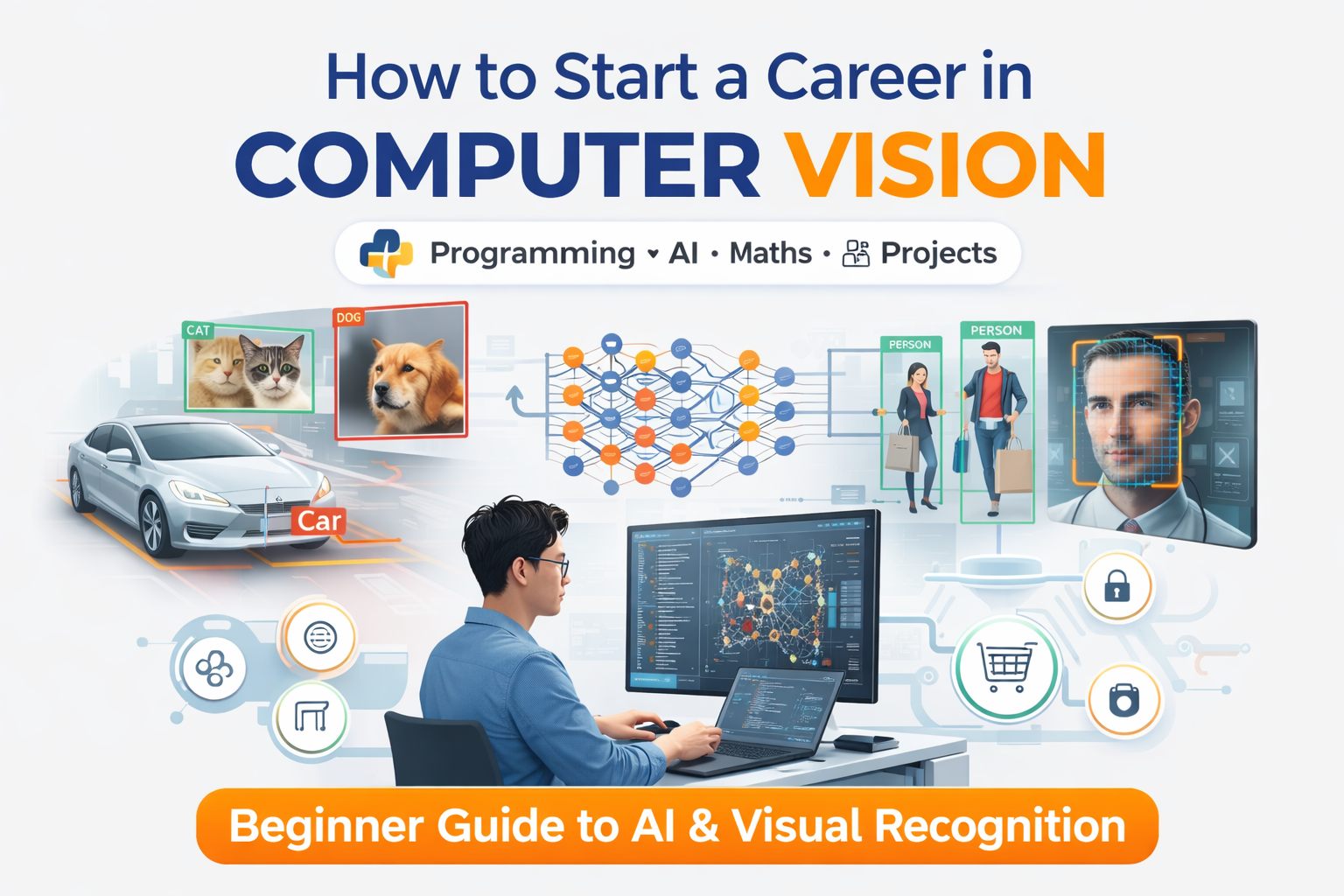
How to Start a Career in Computer Vision
How to Start a Career in Computer Vision
Computer Vision is one of the fastest-growing fields in Artificial Intelligence (AI). It focuses on enabling machines to interpret and understand visual information such as images and videos. Technologies like facial recognition, autonomous vehicles, medical imaging analysis, augmented reality, and security surveillance all rely heavily on computer vision. As industries continue to adopt intelligent systems, the demand for skilled computer vision professionals is increasing rapidly.
Starting a career in computer vision may seem complex at first, but with the right roadmap and consistent learning, anyone with an interest in technology can build expertise in this exciting field. This course overview explains the key steps, skills, and learning stages required to begin a successful career in computer vision.
Understanding Computer Vision
Computer Vision is a subfield of Artificial Intelligence and Machine Learning that enables computers to process and analyze visual data. Unlike traditional software programs that operate using structured data, computer vision systems work with unstructured data such as images, video streams, and visual patterns.
The main goal of computer vision is to train machines to identify objects, recognize patterns, and interpret scenes in a way similar to how humans perceive the world.
Some common applications of computer vision include:
-
Face recognition systems used in smartphones and security systems
-
Self-driving vehicles detecting pedestrians and road signs
-
Medical image analysis for disease detection
-
Object detection in surveillance systems
-
Augmented reality filters in social media applications
-
Automated manufacturing inspection systems
Because of these widespread applications, computer vision has become a highly valuable skill in the modern technology industry.
Step 1: Building a Strong Programming Foundation
The first step toward a career in computer vision is learning programming. Since most computer vision tools and frameworks rely on programming languages, understanding how to write efficient code is essential.
Python is the most commonly used programming language in computer vision because it provides a large ecosystem of machine learning and image processing libraries. Beginners should start by learning the fundamentals of Python programming.
Important programming topics include:
-
Variables and data types
-
Conditional statements and loops
-
Functions and modular programming
-
Object-oriented programming concepts
-
File handling and data processing
-
Working with external libraries
Once you are comfortable with programming basics, you can begin exploring libraries that are commonly used for computer vision development.
Step 2: Learning the Mathematics Behind Computer Vision
Mathematics plays a crucial role in understanding how computer vision algorithms work. Many beginners overlook this aspect, but having a solid mathematical foundation makes it much easier to understand machine learning models and neural networks.
Key mathematical concepts required for computer vision include:
Linear Algebra
Linear algebra is essential because images are represented as matrices of pixel values. Concepts such as vectors, matrices, eigenvalues, and matrix multiplication are widely used in computer vision algorithms.
Probability and Statistics
Machine learning models rely on probability to make predictions. Understanding probability distributions, statistical inference, and data analysis helps in building reliable models.
Calculus
Calculus is important for optimization techniques used in training neural networks. Gradient descent and backpropagation, which are fundamental to deep learning, are based on calculus.
A good understanding of these mathematical topics helps developers understand the internal working of computer vision models rather than simply using them as black-box tools.
Step 3: Understanding Machine Learning Fundamentals
Machine Learning is the backbone of modern computer vision systems. Before diving into advanced computer vision techniques, it is important to understand how machine learning algorithms learn patterns from data.
Machine learning focuses on building models that can make predictions or decisions without being explicitly programmed.
Common machine learning concepts include:
-
Supervised learning
-
Unsupervised learning
-
Classification and regression
-
Feature extraction and selection
-
Model evaluation and validation
Some traditional machine learning algorithms used in computer vision include:
-
Support Vector Machines (SVM)
-
Decision Trees
-
Random Forest
-
K-Nearest Neighbors (KNN)
These algorithms were widely used for early computer vision tasks such as image classification and pattern recognition.
Step 4: Exploring Deep Learning
While traditional machine learning methods are useful, modern computer vision applications rely heavily on deep learning. Deep learning uses artificial neural networks to learn complex patterns from large datasets.
Convolutional Neural Networks (CNNs) are the most widely used deep learning architecture in computer vision. They are specifically designed to analyze visual data by automatically learning features such as edges, textures, and shapes.
Important deep learning topics for computer vision include:
-
Artificial neural networks
-
Convolutional neural networks (CNNs)
-
Activation functions
-
Backpropagation
-
Optimization techniques
-
Transfer learning
Deep learning frameworks commonly used in computer vision development include:
-
TensorFlow
-
PyTorch
-
Keras
These frameworks provide tools for building and training complex neural networks efficiently.
Step 5: Learning Core Computer Vision Techniques
Once the fundamentals of machine learning and deep learning are understood, students can begin studying core computer vision techniques.
Computer vision involves various image processing and pattern recognition methods that help machines interpret visual data.
Important techniques include:
Image Processing
Image processing involves preparing images before they are analyzed by machine learning models. Techniques such as image filtering, resizing, noise reduction, and contrast enhancement improve data quality.
Edge Detection
Edge detection algorithms identify boundaries within images. These boundaries help machines recognize shapes and objects.
Object Detection
Object detection involves identifying and locating objects within images or video frames. Popular algorithms include YOLO (You Only Look Once) and Faster R-CNN.
Image Segmentation
Image segmentation divides an image into multiple regions so that different objects can be analyzed separately.
Feature Extraction
Feature extraction identifies important visual characteristics within images, allowing machine learning models to recognize patterns more effectively.
Libraries such as OpenCV provide powerful tools for implementing these techniques.
Step 6: Working With Computer Vision Libraries
To build real-world computer vision applications, developers rely on specialized libraries and frameworks that simplify image processing and machine learning tasks.
Some widely used computer vision libraries include:
OpenCV
OpenCV (Open Source Computer Vision Library) is one of the most popular libraries for image and video processing. It provides tools for object detection, face recognition, image filtering, and motion tracking.
NumPy
NumPy is used for numerical computing and matrix operations. Since images are stored as matrices, NumPy is essential for processing image data.
Matplotlib
Matplotlib helps visualize images, graphs, and model outputs during development.
PyTorch and TensorFlow
These deep learning frameworks allow developers to build neural networks for tasks such as image classification and object detection.
Learning how to use these tools effectively is an important step toward becoming a computer vision professional.
Step 7: Building Practical Projects
Practical experience is one of the most important aspects of learning computer vision. Working on projects helps students understand how theoretical concepts apply to real-world problems.
Beginner-level projects may include:
-
Face detection using a webcam
-
Image classification models
-
Hand gesture recognition systems
-
Object detection in images
Intermediate projects may include:
-
Mask detection systems
-
Traffic sign recognition
-
Lane detection for autonomous driving
Advanced projects may include:
-
Real-time object tracking
-
Medical image diagnosis systems
-
Autonomous drone vision systems
Projects not only improve technical skills but also help build a portfolio that can attract potential employers.
Step 8: Learning to Work With Datasets
Computer vision models require large datasets for training. Learning how to collect, clean, and prepare image datasets is an essential skill.
Popular computer vision datasets include:
-
ImageNet
-
COCO dataset
-
MNIST dataset
-
Open Images dataset
Students must also understand techniques such as:
-
Data augmentation
-
Data labeling
-
Dataset preprocessing
These techniques help improve model performance and accuracy.
Step 9: Creating a Portfolio
Employers in AI and computer vision fields often look for practical experience rather than just academic qualifications. Building a portfolio is an effective way to showcase your skills.
A strong portfolio may include:
-
GitHub repositories with computer vision projects
-
Documentation explaining project objectives and results
-
Demonstration videos of working models
-
Blog posts explaining technical concepts
Platforms such as GitHub, Kaggle, and personal portfolio websites are excellent places to present your work.
Step 10: Exploring Career Opportunities
Once you develop strong computer vision skills, many career opportunities become available. Computer vision specialists work in various industries including robotics, healthcare, automotive technology, and security systems.
Common career roles include:
-
Computer Vision Engineer
-
Machine Learning Engineer
-
AI Researcher
-
Robotics Vision Engineer
-
Autonomous Systems Engineer
Many companies are actively seeking professionals who can design intelligent systems capable of interpreting visual data.
Step 11: Participating in the Computer Vision Community
Another important step in building a career in computer vision is becoming part of the global AI and computer vision community. Technology evolves rapidly, and staying connected with professionals, researchers, and developers helps you remain updated with the latest trends and innovations.
Participating in communities allows students and professionals to learn new techniques, discover emerging tools, and solve technical problems through collaboration.
Some useful platforms include:
-
GitHub – for sharing projects and collaborating on open-source software
-
Kaggle – for participating in machine learning and computer vision competitions
-
Stack Overflow – for troubleshooting programming issues
-
Reddit AI communities – for discussions and knowledge sharing
-
LinkedIn AI groups – for networking with industry professionals
By actively participating in these communities, learners can gain valuable insights from experienced developers and researchers. It also helps them stay informed about new research papers, frameworks, and technological advancements.
Step 12: Reading Research Papers and Industry Blogs
Computer vision is a research-driven field. Many breakthroughs come from academic research labs and technology companies. Reading research papers and technical blogs helps learners understand how new algorithms and models are developed.
Some important sources for computer vision research include:
-
arXiv.org – a repository of AI and machine learning research papers
-
Google AI Blog – updates about research and innovations in artificial intelligence
-
OpenAI Blog – insights into advanced AI developments
-
Towards Data Science – practical articles about machine learning and computer vision
Understanding research papers may seem difficult at first, but over time it helps learners develop a deeper understanding of advanced techniques and methodologies used in computer vision systems.
Step 13: Learning Deployment and Real-World Implementation
Building a model is only part of the process. Real-world computer vision applications require deployment so that models can be integrated into real systems.
Deployment skills include:
-
Creating APIs to serve machine learning models
-
Integrating models into web or mobile applications
-
Using cloud platforms such as AWS, Google Cloud, or Azure
-
Optimizing models for real-time performance
For example, a face recognition system might need to run in real time on a security camera, while a medical imaging system may process thousands of images in a hospital database.
Learning deployment techniques ensures that computer vision solutions can function efficiently in real-world environments.
Step 14: Continuous Learning and Skill Development
Technology changes rapidly, especially in fields like artificial intelligence and computer vision. Professionals who succeed in this industry are those who continuously learn new tools, frameworks, and algorithms.
Some emerging trends in computer vision include:
-
Vision Transformers (ViT)
-
Self-supervised learning
-
3D computer vision
-
Edge AI and real-time inference
-
AI-powered augmented reality
Keeping up with these advancements ensures that professionals remain competitive and capable of working on cutting-edge technology projects.
Continuous learning may include:
-
Taking advanced online courses
-
Attending AI conferences and workshops
-
Reading new research papers
-
Experimenting with emerging tools and frameworks

Comments
No comments yet. Be the first to share your thoughts!
Leave a Comment