On this page
- By Harrachneet Kaur Sandhu
- A Vision Born from a Real Industry Gap
- From Computer Education to a Technology Ecosystem
- Our Mission: Bridging Education and Industry
- Skills Must Lead to Capability
- Building Confidence Alongside Competence
- A Mission That Extends Beyond the Classroom
- The Future We Want to Build
- Carrying the Vision Forward
- — Harrachneet Kaur Sandhu
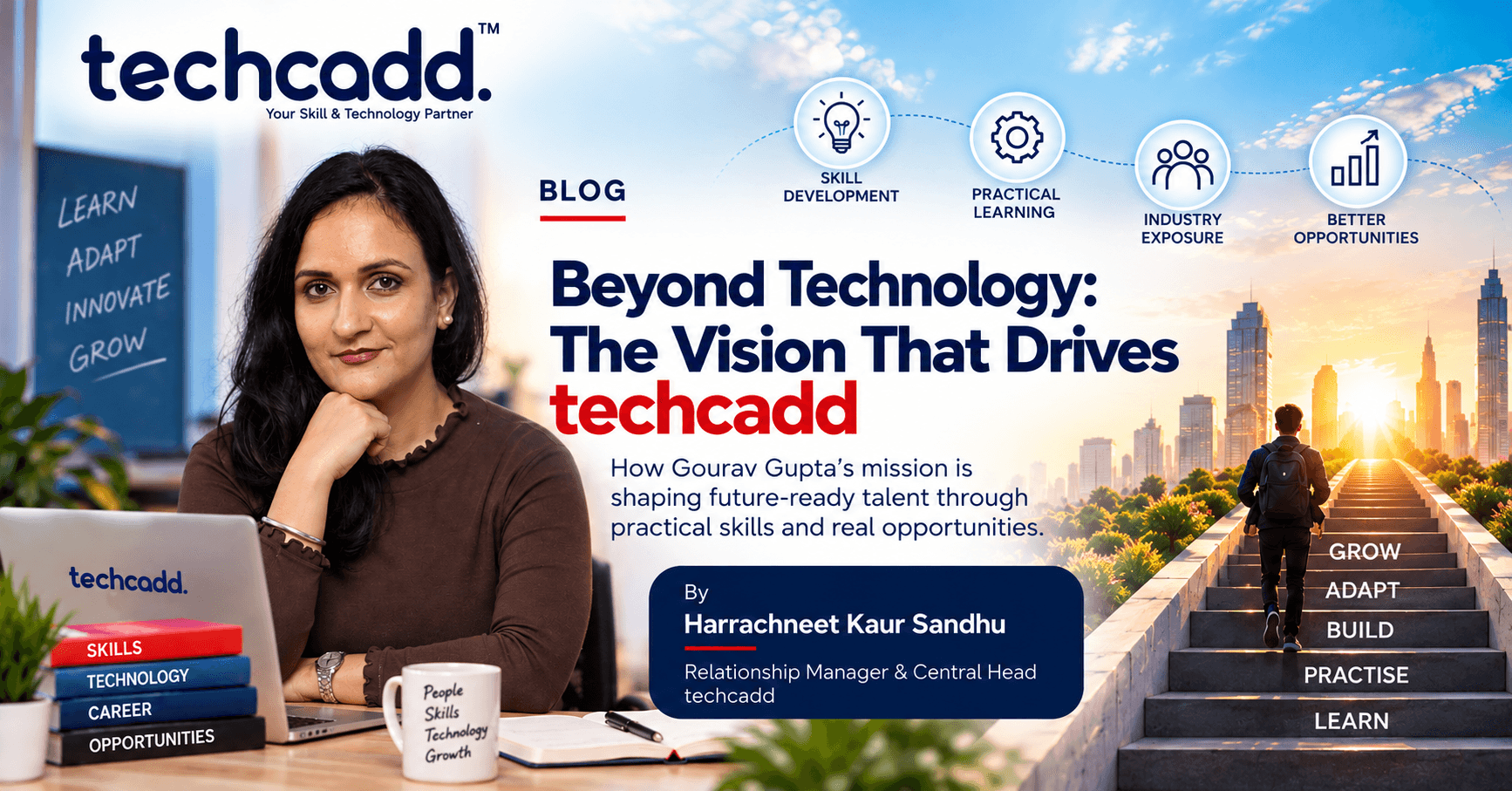
Beyond Technology: The Vision That Drives techcadd
By Harrachneet Kaur Sandhu
Relationship Manager & Central Head, techcadd
When people ask me what techcadd stands for, my answer goes beyond courses, classrooms, or even technology.
For me, techcadd represents a vision, the vision to make technology meaningful, practical, and accessible, and to help young people develop the skills and confidence required to build their place in an increasingly technology-driven world.
As the Relationship Manager and Central Head of techcadd, I have had the opportunity to work closely with our teams, students, educational institutions and industry partners. Through these interactions, I have seen how one clear vision can shape not only an organisation, but also the aspirations and career journeys of thousands of learners.
That vision belongs to our Founder & CEO, Mr. Gourav Gupta, or as we fondly call him, Gourav Sir.
A Vision Born from a Real Industry Gap
techcadd was founded in Jalandhar in 2016 around a fundamental challenge: the gap between what students learn academically and what industry expects them to be able to do. Its founding philosophy was therefore built around practical, future-ready skills rather than theoretical knowledge alone.
Gourav Sir's vision has always been clear: young people should not simply know technology; they should have the confidence and practical capability to use it.
That distinction is important.
Technology changes continuously. A tool that is relevant today may evolve tomorrow. Job roles change, business requirements change, and new technologies create entirely new possibilities. Therefore, preparing a learner for the future cannot simply mean teaching a fixed syllabus.
It means developing the ability to learn, practise, adapt, solve problems, and keep upgrading one's skills.
This philosophy continues to shape techcadd's direction.
From Computer Education to a Technology Ecosystem
Over the years, techcadd has expanded beyond conventional computer education into areas such as Artificial Intelligence, cloud technologies, cybersecurity, automation, data, and modern software development, while retaining its emphasis on practical and project-based learning.
This evolution reflects something Gourav Sir has consistently understood: technology education cannot remain static when technology itself is moving so quickly.
For us, innovation does not mean adding a fashionable technology name to a course catalogue. It means understanding how technologies are changing industries and then creating learning opportunities that help students engage with those changes practically.
Our responsibility is not merely to tell students what AI, cybersecurity, cloud computing, or data science are. It is to help them understand where these technologies are being applied, what skills are required to work with them, and how they can begin building those capabilities themselves.
Our Mission: Bridging Education and Industry
One of the strongest pillars of Gourav Sir's mission is bridging the gap between academia and industry.
This is particularly close to my own role at techcadd.
Relationships between technology organisations and educational institutions should not exist only on paper. A meaningful industry-academia partnership should create tangible learning opportunities for students.
That is why techcadd's engagement with colleges and universities extends into technology seminars, workshops, industry interactions, industrial training, and placement initiatives. Its recent institutional activities have focused on exposing students to emerging technologies, practical applications, and evolving industry expectations beyond conventional classroom learning.
For me, every such interaction has a larger purpose.
When a student attends a technology workshop, asks an industry expert a question, works on a practical project, experiences an internship, or participates in a placement drive, the distance between education and profession becomes a little smaller.
That is where collaboration creates real value.
Skills Must Lead to Capability
One principle I strongly associate with Gourav Sir's leadership is the emphasis on doing rather than merely knowing.
A certificate can document that someone completed a programme. But a learner's real professional strength comes from what they can actually create, analyse, solve, or implement.
That is why techcadd's stated approach emphasises hands-on work, projects and industry engagement rather than theory alone. Career counselling and placement support are also positioned as parts of the learning journey rather than disconnected activities at the end.
This distinction will become even more important as AI makes information increasingly accessible.
When information itself is available within seconds, the differentiator will increasingly be the ability to ask the right questions, think critically, apply knowledge, use technology responsibly, and solve real problems.
That is the kind of capability we want our learners to develop.
Building Confidence Alongside Competence
Skill development is often discussed purely in technical terms.
I believe there is another dimension that deserves equal attention: confidence.
I have interacted with students who have potential but lack clarity. Some are overwhelmed by the number of career options available. Others have theoretical knowledge but hesitate when asked to apply it. Many simply need the right guidance to recognise where their strengths can take them.
This is why career counselling, mentorship and industry exposure matter.
Our role is not to decide a student's future for them. It is to help them understand the possibilities, identify their interests, recognise the skills required, and make better-informed decisions about their own journey.
That human connection is an important part of what techcadd seeks to build.
A Mission That Extends Beyond the Classroom
Gourav Sir's vision for techcadd has never been confined to what happens inside a training centre.
It is about creating a broader ecosystem connecting technology, students, educators, institutions and industry.
Today, techcadd's activities include university engagement, technology workshops, industrial training and placement-related initiatives, alongside its growing focus on emerging technologies.
As Relationship Manager and Central Head, I see my responsibility within this ecosystem as building and strengthening those connections: between our organisation and institutions, between opportunities and students, and between the vision of our leadership and its execution on the ground.
Because relationships become valuable when they lead to opportunities.
The Future We Want to Build
The next decade will bring changes that none of us can predict completely.
Artificial Intelligence will continue to reshape professions. Automation will transform workflows. Cybersecurity will become increasingly critical. Cloud and data technologies will continue to influence how organisations operate, while new technologies and career roles will emerge.
We cannot prepare young people for that future by teaching them only what is relevant today.
We have to prepare them to keep learning tomorrow.
That, to me, is the deeper meaning behind Gourav Sir's vision for techcadd.
It is not simply about producing more technology professionals.
It is about developing people who are curious enough to learn, capable enough to apply, confident enough to create and adaptable enough to grow with technology.
Carrying the Vision Forward
Having been part of the techcadd journey, I believe an organisation's true identity is defined not merely by what it says, but by what it consistently works towards.
Our mission remains to bring education closer to industry, technology closer to learners, and skills closer to real opportunities.
Every student we guide, every institution we collaborate with, every workshop we conduct, every industry interaction we facilitate, and every new technology we introduce into our learning ecosystem is another step towards that mission.
Gourav Sir started techcadd with the vision of making young people more capable and confident with technology.
As we move forward, our responsibility is to take that vision further, to keep learning, keep innovating, keep building meaningful partnerships, and continue creating pathways through which technology can become an opportunity for people to grow.
Because ultimately, the future of technology is not only about the technology we build.
It is about the people we prepare to build with it.
— Harrachneet Kaur Sandhu
Relationship Manager & Central Head, techcadd
Filed under
Keep reading
- The Future Belongs to Those Who Keep LearningTechnology is evolving rapidly, changing the skills businesses need and how professionals work. Gourav Gupta, Founder & CEO of techcadd, shares why continuous learning, practical experience and upskilling are essential for building future-ready careers.
- What Is RAG? A Beginner's Guide to Retrieval-Augmented Generation New to AI? Learn what RAG (Retrieval-Augmented Generation) means, how it works, and why it matters for students in Jalandhar starting their AI and data science journey with techcadd.
- Top 5 Digital Marketing Institutes in Jalandhar for Automation & Ads (2026 Guide)Looking for the best digital marketing institute in Jalandhar? Explore top 5 options known for hands-on training in automation tools and paid ads, perfect for students and career switchers.
Comments
Loading…