On this page
From Excel Nightmares to Python Automation
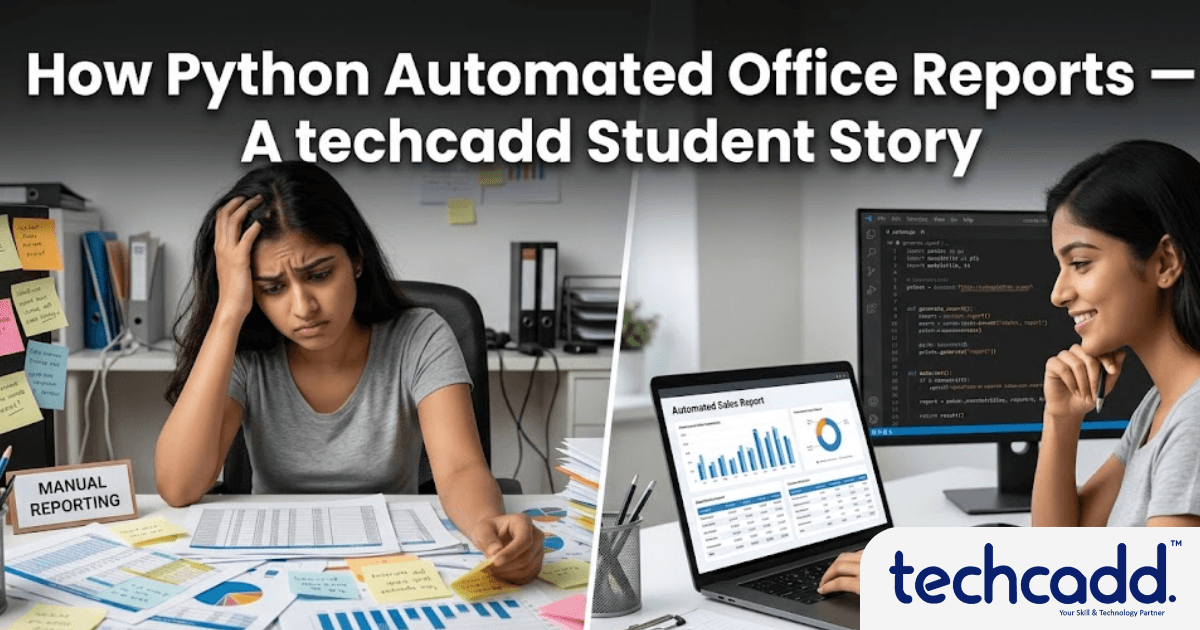
Riya was in her final year of college when she got an internship at a small trading company in Jalandhar. Her job sounded simple on paper — compile daily sales data into a report and send it to her manager every evening. In reality, it meant three hours of copy-pasting numbers between Excel sheets, fixing formulas that broke every other day, and double-checking totals because one wrong click meant redoing everything.
She wasn't lazy. She was just tired of doing the same repetitive task by hand, day after day, when she knew — somewhere in the back of her mind — that there had to be a smarter way.
That's when a friend mentioned Python. Not in a vague "Python is powerful" way, but in a specific one: "You can literally tell it to open your Excel file, clean the data, and generate the report for you. Every single day. Automatically."
Riya was skeptical at first. She had never written a line of code in her life. Her background was commerce, not computer science. So her first question, quite naturally, was:
"Is Python actually possible for someone like me, with zero coding background?"
The answer, as she found out at techcadd, is yes — and this is where a lot of students get the wrong idea. People assume data analytics with Python requires you to already understand programming logic, algorithms, or advanced math. It doesn't. What it actually requires is curiosity and consistency. Python's syntax is close to plain English, which is exactly why it has become the go-to language for people from non-tech backgrounds who want to work with data.
Within her first few classes, Riya wasn't writing complex programs. She was learning how to read a spreadsheet using a library called pandas, filter rows based on conditions, and calculate totals — the exact tasks she was doing manually every evening at her internship.
Turning Classroom Learning Into a Real Office Tool
By the third week, Riya had built something that felt almost unreal to her — a script that opened her daily sales file, cleaned out blank rows and duplicate entries, calculated totals by product category, and saved a neatly formatted summary. What used to take her three hours now took eleven seconds.
She still remembers running it for the first time and just staring at the screen, waiting for something to go wrong. Nothing did.
This is usually where a common doubt shows up for students learning data analytics:
"Okay, I can clean data and make a report. But is this actually useful in a real job, or just a classroom exercise?"
It's a fair question, and the honest answer is that this exact skill — automating repetitive reporting — is one of the most requested skills in analytics job postings, whether it's for a data analyst, a business analyst, or even an operations executive role. Companies don't always need someone who can build fancy machine learning models on day one. Often, they need someone who can save the team hours every week by removing manual, error-prone work. Riya's script did precisely that.
Her mentor at techcadd pushed her a step further. Instead of just cleaning data, she learned to visualize it — turning rows of numbers into simple bar charts and trend lines using matplotlib, so her manager could glance at a graph instead of scrolling through a spreadsheet. She also picked up basic Excel automation using Python, so the final report didn't just sit as raw data but looked like something a client could actually be handed.
A common beginner mistake Riya noticed in herself, and later in her classmates, was jumping straight into complicated codes copied from the internet without understanding what each line actually did. Slowing down and understanding the "why" behind every function made everything after that stage far easier.
Where This Skill Took Her Next
By the time Riya's internship ended, her manager asked her to stay on — not for the original reporting job, but for a broader role helping the team track inventory trends and customer buying patterns. That shift happened because of one small script she built to save herself time.
This is the part students often underestimate. They think of Python and data analytics as something you learn for a "future job" — some distant goal after graduation. Riya's experience showed something different: the moment you can automate even one small, boring task, you become noticeably more valuable in whatever role you're already in, internship or otherwise.
For students wondering, "What should I actually learn first if I want to reach this stage?" — the honest path looks like this: start with Python basics and get comfortable with how loops and conditions work, move into pandas for handling real data, then add basic visualization once you're confident reading and cleaning datasets. Trying to learn everything at once, including advanced statistics or machine learning right away, usually backfires and leads to burnout before the fundamentals even settle in.
Riya still isn't a "coder" in the traditional sense. She doesn't build software applications, and she probably never will. But she understood something most companies genuinely care about — using data to make decisions faster and cutting out repetitive manual work. That single realization changed how she approached her final year, her internship, and eventually her job offers.
For any student in Jalandhar sitting where Riya once sat — unsure if a commerce or non-tech background is "enough" to learn data analytics — her story is proof that the starting point matters far less than the willingness to build something real with what you learn.
Filed under
Keep reading
- How a Jalandhar Student Used SQL to Land Her First Data JobA Jalandhar student's real journey from zero coding background to landing her first data job — how she learned SQL step by step and turned it into a career breakthrough with techcadd.
- Digital Marketing in 2026: How techcadd Jalandhar Helps Students Build Industry-Ready SkillsDigital marketing is evolving rapidly in 2026. Discover how techcadd Jalandhar helps students build practical, AI-aware, and industry-ready skills in SEO, social media, content marketing, analytics, and digital strategy.
- From Classroom to Campaigns: How techcaddJalandhar Makes Digital Marketing PracticalDiscover how techcadd in Jalandhar turns digital marketing theory into real campaign experience, helping students build skills that actually work in the job market.
Comments
Loading…