On this page
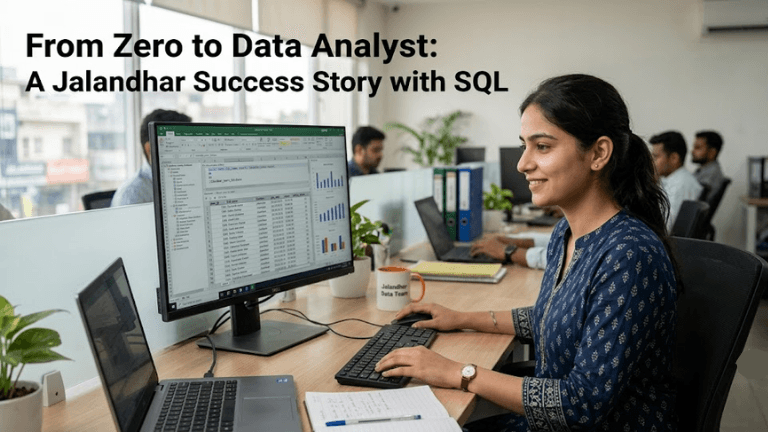
From Confusion to Confidence: Meet Payal
Payal was like most third-year B.Com students in Jalandhar — decent marks, no clear direction, and a nagging feeling that a plain degree wasn't going to be enough. She'd scroll through LinkedIn late at night, watching people her age post about "data analyst" roles and salary packages that felt like a different universe. The question that kept bothering her wasn't "what should I do" — it was "where do I even start?"
She didn't come from an engineering background. No coding classes in college, no cousin working in tech to guide her, no clue what SQL even stood for. Honestly, when a friend first mentioned it, she thought it was some kind of software you install and forget about, like most college "computer subjects" turn out to be.
What changed things was a casual conversation. A senior from her college, who had recently joined a company as a junior data analyst, said something that stuck with her: "You don't need to be a coder. You just need to be comfortable asking questions to data — SQL is basically that, in a language computers understand."
That one sentence reframed everything for Payal. She stopped thinking of SQL as "programming" and started thinking of it as a skill — like learning to use Excel properly, except more powerful. That mental shift mattered more than people realize, because a lot of students quit before they even start, simply because they've convinced themselves it's "too technical" for someone from a non-tech background.
She enrolled in a structured SQL course in Jalandhar, and unlike her fears, the first class wasn't about memorizing syntax. It was about understanding how companies in Jalandhar and beyond actually store and use information — customer records, sales numbers, inventory — the stuff businesses run on every single day.
The Learning Curve: What Actually Happened Week by Week
The first two weeks were the hardest — not because SQL was impossibly difficult, but because Payal kept comparing her pace to random people online who claimed to have "mastered SQL in 15 days." She didn't. And that's normal.
Her actual routine looked less glamorous: an hour after college, writing basic SELECT statements, messing up WHERE clauses, forgetting semicolons, and occasionally just staring at an error message wondering what she'd done wrong. One of the biggest lessons she learned early was that beginners almost always make the same mistake — trying to jump straight into complex queries without getting comfortable with the basics like filtering, sorting, and grouping data first.
By week three, something clicked. JOINs — which sound intimidating on paper — started making sense once she stopped thinking of tables as abstract boxes and started picturing them as real things: one table of customers, another of their orders, and JOIN simply being the bridge connecting "who bought what."
She began practicing with mock datasets that resembled real business scenarios — a local retail store's sales data, a college's student database, things she could actually relate to instead of generic textbook examples. That relatability made a huge difference. Instead of memorizing syntax, she was solving small problems: "Which products sold the most last month?" "Which students scored above average?" Real questions, real answers.
Around this time, she also realized SQL wasn't a standalone island. It connected naturally to how businesses make decisions — which is exactly what recruiters mean when they say they want candidates with "practical, job-ready skills," not just certificates.
By the end of month one, she wasn't fluent, but she was functional. And functional is exactly where most beginners need to get to before confidence starts building on its own.
The Interview, The Offer, and What She'd Tell You
Payal's first interview didn't go the way she expected. She'd prepared for theory questions — normalization, database concepts, textbook definitions. Instead, the interviewer opened a laptop, showed her a messy spreadsheet of sales data, and said, "Write a query to find our top 5 customers by revenue this quarter."
No pressure to recite definitions. Just a practical task. And because she'd spent weeks practicing on real-feeling datasets instead of just theory, she didn't freeze. She talked through her thinking out loud, wrote the query, fixed a small mistake herself without being told, and got it right on the second try. That moment — being able to self-correct instead of panicking — was what actually impressed the interviewer, not perfection.
She didn't get an offer from that first company. But she got specific feedback on what to improve, which she used to sharpen her query-writing speed and her ability to explain her logic clearly. Three interviews later, she landed a junior data analyst role at a growing firm — her first real job, built almost entirely on a skill she'd started learning from scratch less than a year earlier.
If you asked Payal today what she'd tell a Jalandhar student sitting exactly where she once sat, she wouldn't say "just learn SQL." She'd say this: learn it with real data, not just theory, and don't wait to feel "ready" before you start applying.
For students in Jalandhar wondering if a skill like SQL can genuinely open doors without an engineering degree or years of coding experience — Payal's story is proof that it can. Structured learning, consistent practice, and a willingness to sit with confusion instead of running from it made the real difference, not natural talent.
Filed under
Keep reading
- Python for Data Analytics: How One Student Automated Her Office Reports | techcadd JalandharHow a techcadd student in Jalandhar used Python to automate boring Excel reports and land a data analytics role. Real story, real skills, real results.
- The Jalandhar Student Who Built Her First ML Model in 30 DaysHow a Jalandhar student went from zero coding experience to building her first machine learning model in just 30 days — her journey, struggles, and what she learned along the way.
- From Zero Coding Knowledge to Machine Learning: A techcadd Student's Journey in JalandharEver wondered if you can learn Machine Learning with zero coding background? Read how a techcadd student in Jalandhar went from complete beginner to building real ML projects, step by step.
Comments
Loading…