Month 01
Python for AI
Learn Python from the beginning, with no prior coding experience needed.
- Python
- Jupyter Notebook
- Google Colab
Project: First Python programs

After 12th · 3-month trackStarter
You build software that learns from data, such as prediction models, text classifiers and chatbots, and learn the skills behind the AI tools people use every day.
4.9 on Google750+ reviews
Program
Artificial Intelligence
3months
One subject, one term, one live project.
AI is taught from the fundamentals, so you do not need to be a programmer to start. You begin with Python and the essential maths, then move into machine learning, deep learning, natural language processing and generative AI. Every concept is tied to a hands-on task, and you get feedback on your practice work as you go. By the end you can build, test and explain working AI solutions and have a portfolio of projects to show.
The 3-month program is the quickest way to find out whether Artificial Intelligence is the right career for you. You finish the foundations, build three guided projects and leave with a certificate — and every class counts if you later move up to the 6 or 9-month track.
Your 3 months at a glance
By the end of the artificial intelligence program you can do each of these on your own.
You can write small, reusable Python programs that work with data and files.
You can clean a messy dataset with pandas and describe it with basic statistics.
You can explore a dataset, chart what you find and pull the data you need with basic SQL.
Month 01
Learn Python from the beginning, with no prior coding experience needed.
Project: First Python programs
Month 02
Work with data in Python and learn the maths that models rely on, explained in simple terms.
Project: Data cleaning notebook
Month 03
Explore datasets, find patterns and present the results with charts.
Project: Data analysis report
Pick a month to see exactly what is taught, which tools you use and what you ship.
Month 1 of 3
Learn Python from the beginning, with no prior coding experience needed.
Tools this month
You ship
First Python programs
Write a set of Python programs that read a file, process the data and print clear results.
Month 2 of 3
Work with data in Python and learn the maths that models rely on, explained in simple terms.
Tools this month
You ship
Data cleaning notebook
Clean a messy dataset with pandas and summarise it with basic statistics.
Month 3 of 3
Explore datasets, find patterns and present the results with charts.
Tools this month
You ship
Data analysis report
Explore a dataset and present its main patterns with Matplotlib and Seaborn charts.
8 tools across 3 months — introduced only when a project needs them.
Everything is installed in our labs. On your own laptop, a mentor helps you set it up in the first week.
Arts, commerce, medical or non-medical — start Artificial Intelligence from zero, before or alongside your degree.
BCA, B.Tech, B.Sc or B.Com students who want real project work next to their syllabus.
Finished a degree in another field? Build job-ready Artificial Intelligence skills with a portfolio to prove them.
Learn enough Artificial Intelligence to take paid work or bring the skill into your own business.
Most learners stop at: Knowing the AI vocabulary
You get to: Having the skills behind the applications
Most learners stop at: Watching how AI is built
You get to: Building and training models yourself
Most learners stop at: A certificate alone
You get to: A portfolio of working projects
Most learners stop at: Trusting whatever a model outputs
You get to: Understanding bias, privacy and model limits
Ten minutes on a call is enough to know whether 3 months of AI fits your stream, your college plans and your goal.
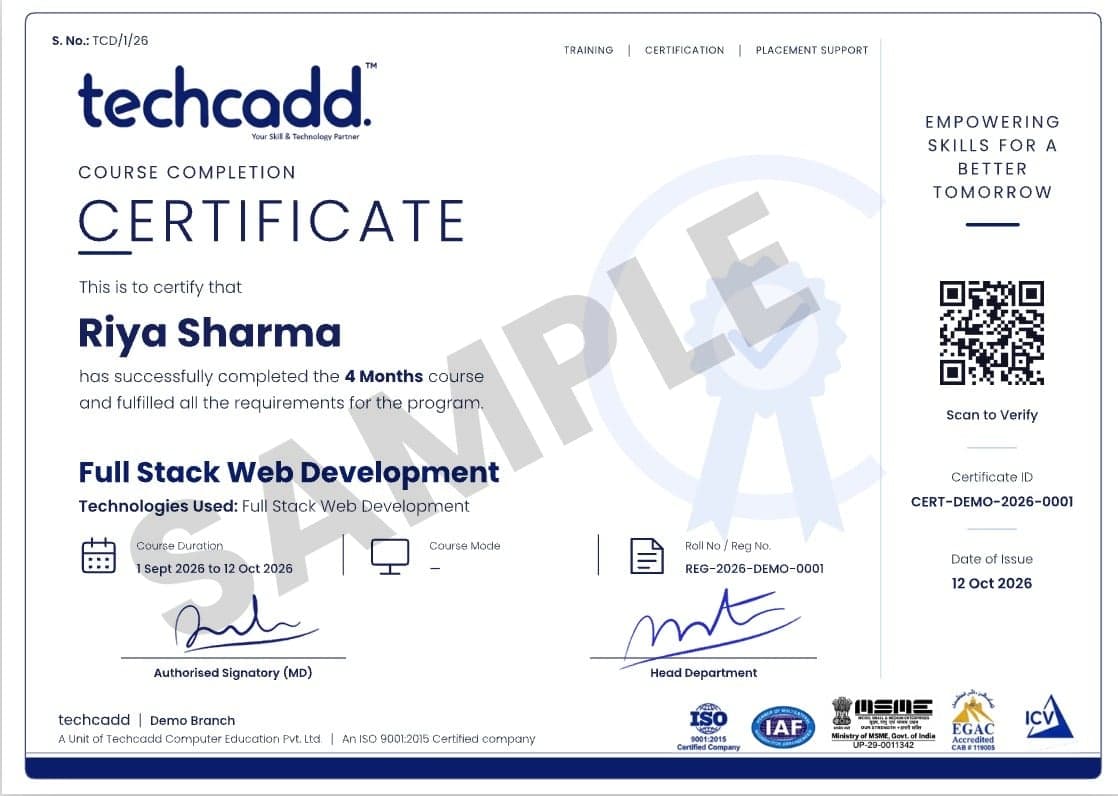
3 reviewed projects
You finish the artificial intelligence program with proof of what you built — not only a piece of paper.
Online-verifiable certificate that lists your modules, projects and grade.
Issued for live-project work on the longer tracks and accepted for college credit.
One reviewed project per month that you can walk an interviewer through.
Resume review, mock interviews and referrals to our hiring partners.
Four roles AI learners grow into — each one builds on the last.
Role 1 of 4
Helps build, train and test machine learning models on a team.
Role 2 of 4
Analyses data and builds models that support business decisions.
Role 3 of 4
Writes Python software that uses data and AI models.
Role 4 of 4
Uses generative AI tools and prompts to automate everyday tasks.
Every topic in every month runs through the same three steps.
Step 1
A short concept class with a worked example — you see why before you see how.
Step 2
You build it yourself in the lab while a mentor reviews your work and unblocks you.
Step 3
You demo the result and answer questions — practice for every interview to come.
A first course after 12th should leave you with skills you can show, not notes you can't use.
You move on when your project is reviewed and working — not when the month ends.
The same tools, devices and accounts that working teams use every day.
Mentors who deliver client projects, so what you learn is what is used.
Start with 3 months and continue to 6 or 9 without repeating a single class.
AI has moved from research labs into everyday business. Banks use it to detect fraud, hospitals use it to read scans, retailers use it to predict demand, and small businesses use it to answer customers around the clock. This course is built to give you the skills behind these applications, not just the vocabulary.
01
Every concept is tied to a hands-on task. You write Python code, train machine learning models, work with real datasets and build projects such as a prediction model, a text classifier and a generative AI-based assistant. By the end, you have a portfolio you can show to employers or clients, which often matters more than a certificate alone.
02
The program covers the full path from foundations to modern applications: Python, data handling, machine learning, deep learning, natural language processing and generative AI. It also introduces responsible AI, so you understand bias, privacy and the limits of what models can do. The tools taught are the ones working teams rely on, including Python libraries, Jupyter notebooks and current generative AI platforms.
03
AI skills are valuable well beyond one job title. Depending on your background, you can aim for roles such as:
Entry-level salaries for these roles vary widely by city, company and skill level. As an approximate guide, freshers in India often start in the range of ₹3 to ₹6 lakh per year, and experienced professionals who add AI to their existing expertise can move into higher bands. Treat these numbers as indicative, since the market changes quickly.
04
Many learners are already employed or running a business, so the course supports both live online classes and in-person learning. You can fit sessions around your schedule, revisit concepts through practice tasks, and ask questions directly instead of studying alone.
05
Because AI work can be done remotely, your location matters less than your skills. Learners can apply for roles in Bengaluru, Hyderabad, Pune and Mumbai, take on remote projects, or build services for international clients, all while staying close to home.
06
This course suits you if you want practical, job-focused AI skills and are ready to practise regularly. It may not be the best fit if you are looking only for a quick overview or a theory-heavy academic programme. If you are unsure, a free demo class is a good way to see the teaching style before you decide.
Because live online classes are available, you can join from wherever you are. Here is how the course fits learners in different regions:
Manufacturers, exporters and agri-tech businesses in cities like Ludhiana are using AI for demand forecasting and quality checks. Anyone looking for an artificial intelligence course in Punjab can learn these applications, and Mohali's growing IT sector is another strong destination for skilled freshers.
Gurugram's MNCs and the e-commerce and logistics companies around Faridabad hire for analytics and automation roles, so learners aiming for corporate jobs can build the right skills here. Those searching for an artificial intelligence course in Haryana can follow the same route online.
Hotels, tourism businesses and horticulture units in places like Shimla can use AI chatbots and smart booking tools. Learners seeking an artificial intelligence course in Himachal Pradesh can also build remote-work and freelancing careers without leaving the hills.
The city's IT, BPO and startup ecosystem, along with Panchkula nearby, values people who can apply AI tools to real workflows. Learners can explore an artificial intelligence course in Chandigarh to move from support roles to technical ones.
With agencies, fintech firms and the country's largest fresher job market, Delhi and Noida reward learners who bring portfolio projects. An artificial intelligence course in Delhi helps freshers stand out among many applicants.
Online sellers, handicraft businesses and tourism operators in Jammu and Srinagar can use AI for product descriptions, customer support and market analysis. Learners can join an artificial intelligence course in Jammu and Kashmir entirely online.
Hospitality, tourism and the pharma units around Haridwar and SIDCUL are adopting automation, and Dehradun's education sector is doing the same. This makes an artificial intelligence course in Uttarakhand useful for both job seekers and local entrepreneurs.
Jaipur's tourism, jewellery and textile businesses can use AI for recommendations, design trends and customer insights. An artificial intelligence course in Rajasthan helps both employees and business owners in these sectors.
IT, electronics and retail are expanding in Lucknow and Meerut, and government digital projects need data-skilled people. Learners can take an artificial intelligence course in Uttar Pradesh online and aim for these growing opportunities.
24 questions
3 months, with one module and one reviewed project per month. Classes are practical first: most of every session is spent building.
They share one roadmap. 3 months covers the foundations with guided projects, 6 months reaches portfolio level with an industry certificate and placement support, and 9 months adds specialisation, an internship-style capstone and placement preparation.
Yes. The course starts with Python and the fundamentals, and the early modules teach logic, Python and data handling in plain language before moving to machine learning and generative AI.
Basic school-level maths, such as percentages and simple algebra, is enough to begin. The statistics, probability and linear algebra that models rely on are explained in simple terms.
Yes. Project work runs through every module and ends with a capstone project. You can build items such as a prediction model, a text classifier or a chatbot.
Program certificate, a portfolio of 3 reviewed projects and guidance on what to learn next.
Yes. You can move up to the 6-month certificate program or the 9-month diploma program and carry on from where you stopped — no class is repeated.
Yes. The program starts from zero and is open to arts, commerce, medical and non-medical students. You only need basic computer skills.
Yes. Morning, evening and weekend batches are available, and live online classes come with recordings for revision.
No institute can honestly guarantee a job. We give placement support — resume and portfolio reviews, mock interviews and referrals — and keep helping until you are placed.
Book a free counselling session or message us on WhatsApp. A counsellor will share the current fee, instalment options and scholarships for your chosen program.
Graduates, postgraduates, working professionals, job switchers, freelancers, business owners and 12th-pass students can join. No computer science degree is required, as the course starts with Python and fundamentals.
Yes, beginners can learn AI here. The early modules teach logic, Python and data handling in plain language before moving to machine learning and generative AI.
The syllabus covers Python, data handling and statistics, machine learning, deep learning, computer vision, natural language processing, generative AI, AI automation and a capstone project. Each module includes practical work.
You will work with Python, SQL, NumPy, pandas, scikit-learn, TensorFlow or PyTorch, OpenCV, Hugging Face, LangChain, Jupyter or Google Colab, Git and Streamlit. The toolset is updated as the industry changes.
Yes, you receive a Techcadd course completion certificate after finishing the program.
Both options are available. You can attend live online classes from anywhere in India or join in person at the Jalandhar centre in Punjab.
Common roles include AI/ML engineer, data analyst, junior data scientist, NLP or prompt engineer, AI automation specialist and computer vision engineer. Many learners also apply the skills in marketing, operations or their own business. Outcomes depend on your effort, portfolio and the job market, and jobs are not guaranteed.
Yes, freelancing is a realistic path. You can offer services such as chatbot development, data analysis, content and workflow automation and AI-assisted marketing, using the projects from your portfolio as proof of skill.
Yes, project work runs through every module and ends with a capstone project. You can build items like a prediction model, an image recognition tool, a chatbot or an automation workflow.
Yes, students from Himachal Pradesh can join fully online through live classes. This works well for learners in Shimla, Dharamshala and Solan who want to study without relocating.
In Punjab, opportunities are growing in Mohali's IT and startup cluster and in manufacturing and export units that use automation and forecasting. In Haryana, Gurugram and Faridabad offer analytics and automation roles in MNCs, logistics, automobile and e-commerce companies.
Yes, working professionals in Delhi NCR, Noida, Ghaziabad, Lucknow and Meerut can attend live online sessions with flexible timings. Evening and weekend batches suit those who work full time.
Yes, learners from Jammu & Kashmir, Uttarakhand and Rajasthan can study online with live classes, doubt support and project guidance, with no need to travel to Jalandhar.
Tell us your stream and goal — we will suggest the right duration, share fee details and book your free demo.
2nd Floor, Crystal Plaza, SCS 78, Opposite PIMS Hospital, Jalandhar, Punjab 144001Mon – Sat: 9:00 AM – 7:00 PM
Sit in a free demo class first. If AI is not for you, a counsellor will help you find what is.