Best Cloud Computing Certificate Program in Jalandhar
Learn deploying and running infrastructure on AWS and Azure instead of a server in the office, taught on live client work at techcadd Jalandhar rather than from slides.
- Live client projects
- Practitioner trainers
- Placement support
- Certificate + internship
- Duration
- 3, 6 or 9 Months
- Mode
- Classroom, Weekend & 1-on-1
- Eligibility
- 12th Pass Onward
- Includes
- Internship Letter
- Students trained
- 25,000+Students trainedsince 2007
- Google rating
- 4.9★Google rating556+ reviews
- Practical training
- 100%Practical traininglive client work
Course overview
Cloud computing turns infrastructure into a service. Instead of buying and maintaining every server, storage system and network device yourself, you provision computing resources on demand, scale them when workloads change, secure them through policy, automate them as code, and pay only for what you use. Four properties define it: on-demand provisioning, scalability up and down with demand, pay-as-you-go pricing, and high availability built on distributed infrastructure with backups and redundancy.
The work runs on a loop — plan the workload, provision the cloud resources, deploy the applications, then monitor and improve — and four capabilities make a cloud engineer: compute (EC2, containers and scalable workloads), network (VPC, subnets, routing and security), storage (S3, EBS, EFS and databases) and automation (Terraform, CI/CD and monitoring). The most important skill is knowing which service and architecture a problem actually needs. Not every application requires Kubernetes, multiple servers or a complex architecture; a simple one may need only a virtual machine, storage, a database and proper networking. Traditional infrastructure still wins where you need complete control over dedicated hardware, have predictable workloads or face specific compliance requirements.
The syllabus is 25 modules in a single numbered ladder with exit points at three, six and nine months, taught in Jalandhar. Module 01 begins with Linux administration, and Bash scripting, networking and Git follow from the ground up, so no coding background is assumed; from Module 05 onward every session runs on live AWS. Stage 1 covers IAM, VPC design, EC2 compute, storage and databases, scaling and high availability, ending in a complete multi-tier AWS capstone. Stage 2 adds serverless and event-driven AWS, security engineering and disaster recovery, AI and generative-AI services on AWS, Docker, Kubernetes, Jenkins, Terraform, observability and AI model deployment. Stage 3 is a structured twelve-week extension that deepens the same domains: architecture and resilience engineering, security and compliance, production AI service engineering, Kubernetes operations at scale, GitOps automation, site reliability with cost optimisation, and MLOps with a final expert capstone.
Cloud teams need people who can move from Linux, scripting and networking fundamentals through AWS infrastructure, deployment, security, containers, automation, monitoring and production troubleshooting — and prove it with work they have actually built. That is why labs, projects, practical assessments, documentation, interview preparation and the final certification are built into every stage: a learner leaves each track with artefacts that can be opened and defended, not only a certificate.
techcadd's Cloud Computing Certificate Program in Jalandhar is built for graduates, system administrators and developers moving into infrastructure work. It opens with cloud models, regions and how pricing actually works, then goes deep on the AWS core services: EC2, S3, VPC and IAM. Azure fundamentals are covered alongside, so you can read either platform. Linux administration gets its own module, since it sits under nearly everything else here. You then move into Docker containers and images, the basics of Kubernetes orchestration, and building CI/CD pipelines with Jenkins and Git. Terraform introduces infrastructure as code, and the final modules cover monitoring, logging and cost control, which is what separates someone who can launch a server from someone a company will trust with an account. Labs run on real cloud accounts under trainer supervision. You finish with deployed infrastructure you can walk through, CV preparation and interview practice.
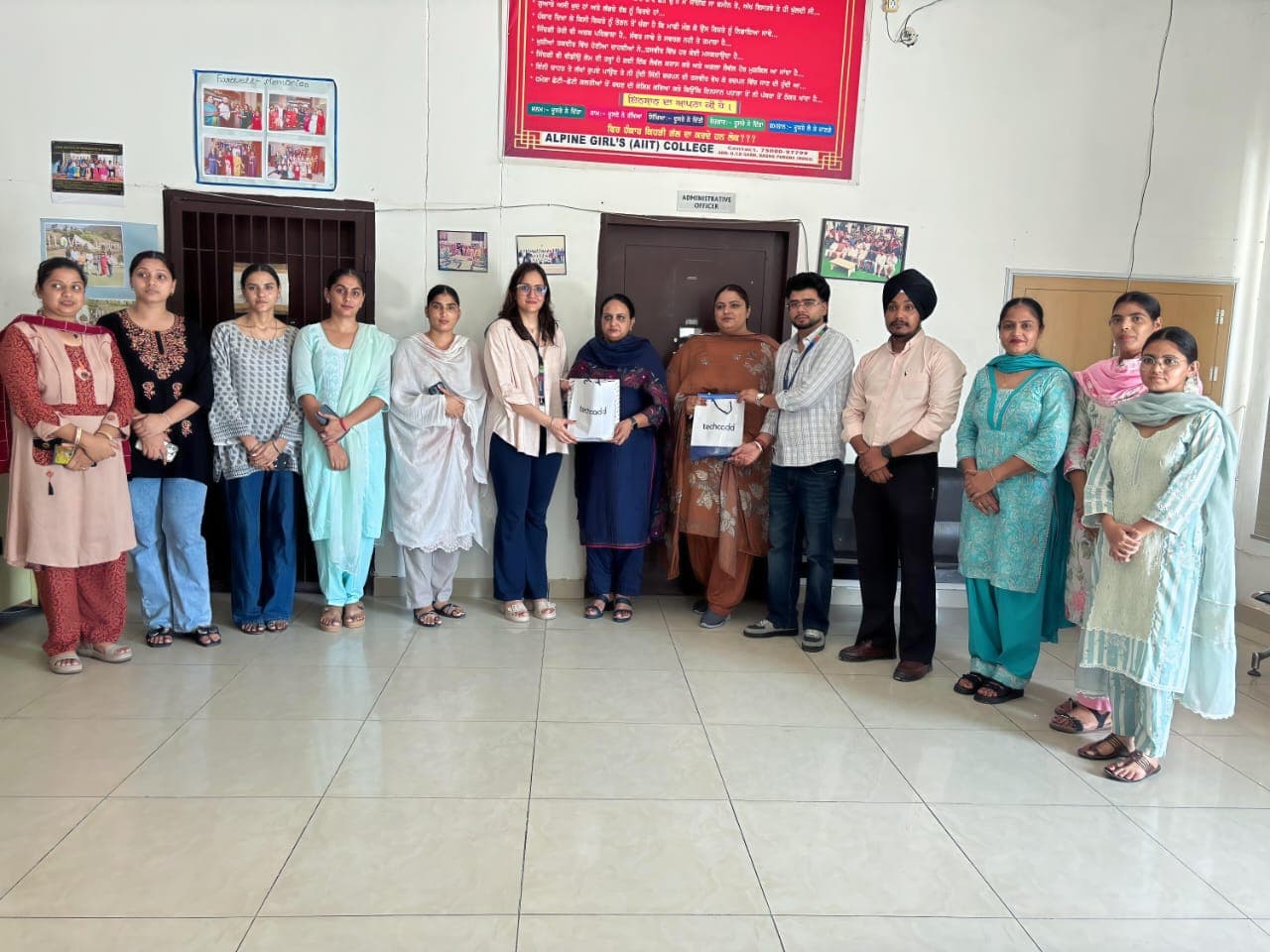
Industry-Ready Training in Cloud Computing
- 100% practical, project-based learning
- AI tools integrated into every module
- Live client projects under trainer supervision
- Internship letter and placement support
- Small batches with daily doubt clearing
Who can dothis course
The Cloud Computing programme is built for people at six different starting points, and the batch is deliberately mixed. What matters far more than your background is turning up consistently and finishing what each module asks you to build.
Students after 12th
Join from any stream. You start from fundamentals with no assumed knowledge, and most students run the programme alongside a degree at a Jalandhar college using the weekday or weekend batch.
Graduates and final-year students
If you are finishing a BA, BBA, B.Com, BCA or B.Tech, this is the shortest route from degree to salary. Enter placement season with project work in hand instead of a blank CV.
Working professionals
The weekend batch exists for people already earning. Career switchers typically become interview-ready for Cloud Engineer roles within five to six months without leaving their current job.
Business owners and freelancers
Owners take this programme to stop outsourcing work they cannot judge. Freelancers take it to bill clients beyond Punjab, since location does not limit remote work in this field.
Career restarters
A gap on the CV counts for less than work you can point at. The programme starts at zero and finishes with a portfolio and a documented internship letter, which is what an interviewer asks about after a break.
Self-taught learners
If free videos left you with notes but nothing built, what changes here is a trainer who reviews what you produced this week and a deadline attached to every module.
Why this programmeis worth your year
Cloud and DevOps skills are the clearest salary jump available to a working IT professional in Punjab. That gap is the whole argument for this programme: there is local demand, there are budgets, and there are very few trained people to hand the work to.
What separates this from a playlist of tutorials is supervision on real work. From the second half of the programme you build on live client projects with a trainer beside you, make decisions that have consequences, and correct them the following week. That loop is the skill. No employer in Jalandhar will take your word for it without work they can inspect.
Be realistic about the money. A fresher who finishes with a working portfolio typically starts around ₹22,000 – ₹40,000 a month locally, and moves up quickly with experience. Roles include Cloud Engineer, DevOps Engineer, System Administrator, Cloud Support Associate. The ceiling is high, but it is earned. Nobody pays a beginner well for a certificate alone.
The alternative is what most people try first: free videos, a cheap online course, six months of drifting, and knowledge you cannot demonstrate. A structured programme with live projects, a mentor who corrects you, an internship letter and a placement cell that actually calls employers is the difference between knowing the subject and being hired to do it.
Students reach the Jalandhar centre from Model Town, Urban Estate, Adarsh Nagar, Basti Bawa Khel and Rama Mandi, with weekend students travelling in from Phagwara, Kapurthala, Nakodar, Hoshiarpur and Adampur. Whether you have just finished 12th, are completing a degree at a local college, or are switching from a non-technical job, the programme starts at zero, which is why weekday, evening, weekend and 1-on-1 timings all exist rather than a single fixed slot, with every class running two hours.
Cloud Computing Is Powering the Next Generation of Industry Leaders
- Live client work from week one, supervised by a trainer, not slides, not simulations.
- Cloud Engineer roles in Punjab start around ₹22,000 – ₹40,000 a month for a fresher with a working portfolio.
Reviewed by mentors. Built for interviews.What you will
actually build
The syllabus runs as a single ladder of 25 topics with three exit points: the six-month Professional track continues exactly where the three-month Practitioner track ends, and the nine-month Expert track continues where the Professional track ends. Month 1 begins with Linux administration, Bash scripting, networking and Git from the ground up, so no coding background is assumed; from topic 05 onward every session runs on live AWS. Every topic is specified the same way — the subject matter, the named tool stack used in labs, the production problem the skill solves, and a practical artefact for your portfolio — and you advance when a deliverable passes review rather than when the calendar says so.
Foundation: Linux, Networking, Git & Core AWS (Topics 1–10)
- Linux Administration & File Systems
- Bash Scripting & Server Automation
- Computer Networking & Protocols
- Git, GitHub & Version Control Workflow
- Cloud Fundamentals & AWS Global Infrastructure
- AWS IAM & Account Security
- VPC, Subnetting & Cloud Network Design
- EC2 Compute & Web Server Hosting
- Storage, Databases & the Data Layer
- Scaling, Architecture & AWS Capstone
One course.A mesh of real tools.
Everything below is installed on the lab machines and used on live client work, not shown once in a slide and forgotten.
 GitHub
Get Certified in
Cloud Computing
Complete the course with a portfolio of live projects and receive an industry-recognised certificate, plus a documented internship letter accepted by Punjab universities.
 Computer Education · JalandharCertificateof Project ExcellenceThis is to certify thatStudent Name
has designed, built and deployed a live capstone project in Cloud Computing, reviewed and graded under industry mentorship.
Computer Education · JalandharCertificateof Course CompletionThis is to certify thatStudent Namehas successfully completed the professional training programme in Cloud Computing with a grade of A+.
Two certificates on completion — the course certificate and a separate capstone project certificate.
Where this coursetakes you
The roles this opens, what they pay in Punjab and beyond, and who is hiring for them — the same figures our free Salary Estimator publishes, not a brochure number.
Cloud / DevOps Engineer
Manages cloud infrastructure, CI/CD pipelines, and container orchestration.
- Starting package
- ₹2.8–5LPA
- After 2 years
- ₹5.5–10LPA
Indicative ranges for Cloud / DevOps Engineer roles, compiled from public job-market listings and drawn on the same scale in every market. Actual offers vary by employer, skillset and interview performance — Punjab pay typically reaches 2× the fresher ceiling within two years of delivery experience.
Open the salary estimatorWhere Cloud / DevOps Engineer graduates get hired
- Cloud service providers and partners
- IT services companies with cloud practices
- Startup infrastructure and platform teams
- Remote DevOps and SRE contracts
What does a Cloud Support Engineer or trainee interview test?
The entry-level role Stage 1 prepares you for, at three months. It tests whether you can administer Linux, script routine tasks, reason about networks and configure AWS IAM, VPC and EC2. What you show them: the Linux and Bash toolkit, the networking practical and your first AWS deployment.
What does a Cloud Engineer interview test?
The early-career role reached between three and six months. It tests whether you can deploy AWS workloads with storage, databases, scaling, monitoring and a secure multi-tier architecture. What you show them: the EC2, S3 and RDS application, the ALB and Auto Scaling build, and CloudWatch dashboards.
What does a DevOps Engineer interview test?
The early-career DevOps route, reached at six months. It tests whether you can containerise applications and automate delivery with Jenkins, Docker, Kubernetes and Terraform. What you show them: the CI/CD pipeline, the Kubernetes application and the infrastructure-as-code repository.
What does a Cloud Automation Engineer interview test?
The advanced role reached between six and nine months. It tests whether you can combine infrastructure automation, monitoring, security and operational workflow into one repeatable delivery system. What you show them: the modular Terraform estate, the CI/CD pipeline, the observability stack and the security report.
What does an AWS or Cloud DevOps Engineer interview test at senior level?
The expert-track role at nine months. It tests whether you can review architectures, harden AWS estates, run production Kubernetes, control cost and lead a full MLOps capstone. What you show them: the architecture review pack, the MLOps deployment and the expert capstone.
What job roles open up after Cloud Computing?
Graduates move into Cloud Engineer, DevOps Engineer, System Administrator, Cloud Support Associate and similar roles. Cloud and DevOps skills are the clearest salary jump available to a working IT professional in Punjab.
What can I earn, and how fast does it grow?
A fresher with a working portfolio starts around ₹22,000 – ₹40,000 a month in the Jalandhar market. With two years of delivery experience that typically doubles, and specialists who keep learning move well beyond it.
Can I freelance or work remotely with this skill?
Yes. A Jalandhar address costs you nothing on a remote brief. Students bill clients in Delhi, Dubai and Canada. The programme covers client handling, proposals and reporting so you can price and defend your work, not just do it.
Which industries hire for this in Punjab?
Beyond IT companies, the export houses, sports goods and hand tool manufacturers, immigration consultancies, hospitals, schools and real estate firms across Jalandhar all now hire for these skills directly.
Can I continue to higher studies or a specialisation later?
The certificate and portfolio stand on their own, and they stack. Most students move on to an adjacent techcadd track. The tools overlap, so the second programme is faster than the first.
Hands-on projectsyou will ship
Linux & Bash Automation Toolkit
Backup, log-parsing and health-check scripts scheduled with cron and version-controlled in Git.
Secure AWS Network
A multi-AZ VPC with public and private subnets, NAT gateway, bastion access and flow logs.
AWS Web Application
An EC2, VPC, S3 and RDS deployment with Route 53 DNS and CloudWatch monitoring.
Scalable Cloud Architecture
A multi-tier architecture using ALB, Auto Scaling, private subnets and security controls.
Event-Driven Serverless Workflow
Lambda, EventBridge, SNS and SQS defined and deployed through CloudFormation.
AI Cloud Chatbot
An AI-powered chatbot built on Amazon Bedrock with Python, Streamlit and S3 storage.
Containerized Application
A Dockerised application packaged with Compose and deployed onto Kubernetes with Helm.
Automated CI/CD Pipeline
A GitHub-to-Jenkins pipeline with quality gates, image scanning and Kubernetes deployment.
Infrastructure as Code
A reusable Terraform configuration for AWS infrastructure with remote state and locking.
Cloud Operations Platform
An observable environment with SLO dashboards, log aggregation, alert routing and a postmortem.
Security & Recovery Review
A hardened AWS estate with least-privilege policies, an audit trail and a tested recovery runbook.
MLOps Deployment
A containerised AI service released through CI/CD with a model registry and drift monitoring.
Learn it. Build it. Make it yours.
Every project moves through the same loop: understand the brief, build with guidance, then explain the decisions behind your work.
Understand
Break a real requirement into a clear plan and the right tools.
Linux & Bash Automation ToolkitBuild
Work hands-on with trainer feedback while the decisions are still easy to change.
Secure AWS NetworkPresent
Turn the finished work into a portfolio story you can defend in an interview.
AWS Web ApplicationWhy students choosetechcadd
There are many places to learn this in Jalandhar and the brochure syllabus looks similar at all of them. What differs is who teaches, whether you ever touch real work, and whether anyone picks up the phone after you have paid. techcadd has trained students across Punjab since 2007 on the same model: small batches, working practitioners as trainers, client projects as coursework.
Trainers who still do the work
Your trainer is not a full-time lecturer. They deliver client projects for techcadd's services arm, so examples in class are current rather than a case study from five years ago.
Live projects, real consequences
You work on genuine client requirements under supervision. This is where a portfolio comes from, and it is the first thing an interviewer asks to see.
Small batches and open lab hours
Batches stay small enough that a trainer sees your screen daily. Lab time runs outside class hours and doubt sessions continue until the concept lands.
Internship letter and certificate
Every student finishes with an industry-recognised certificate and a documented internship on real work, accepted for university industrial training requirements.
A placement cell that persists
Mock interviews, CV reviews and drives with hiring partners across Jalandhar and Ludhiana, repeated after a rejection, not abandoned.
Since 2007, 25,000+ students
Nearly two decades of hiring relationships in Punjab is why a call from our placement cell gets answered and why local employers know what our certificate means.
How techcaddcompares
Cloud courses are easy to advertise and hard to deliver, because they cost the provider money to run. These are the eight things worth asking before you pay any institute, including this one.
| Feature | techcadd | Other institutes |
|---|---|---|
| Curriculum | Industry-aligned, updated regularly | Often outdated or generic |
| Learning style | 100% hands-on, project-based | Mostly theory-heavy |
| Trainers | Industry-experienced mentors who still deliver client work | Mixed experience levels |
| Real projects | Multiple real-world projects plus a capstone | Limited or simulated projects |
| Cloud accounts | You provision real AWS and Azure resources in your own account, with billing guardrails set up on day one | Screenshots and simulator walkthroughs |
| Placement support | Dedicated career and interview preparation | Often limited or absent |
| Batch flexibility | Weekday, evening, weekend and 1-on-1 options | Fixed schedules |
| Doubt support | Ongoing mentor and community support | Limited post-class support |
| Certification | Industry-recognised certificate plus a documented internship letter | Varies |
The right-hand column describes what is commonly offered in the market, not any particular institute. Ask any institute you are considering — this one included — to show you the work its students actually produced.
What you are reallybeing taught
Services get renamed and consoles get redesigned. These ideas do not — they are what you are really being taught, and what a strong candidate can articulate under questioning.
Build from fundamentals
Linux, scripting, networking and cloud concepts make every AWS service easier to reason about. The console is a shortcut over things you should already understand.
Automate repeatable work
Bash, GitHub Actions, Jenkins, Ansible and Terraform turn manual steps into controlled, reviewable workflows. Anything done twice by hand is a script that has not been written yet.
Design for failure
High availability, Auto Scaling, monitoring, backups and disaster recovery belong in the architecture, not in the postmortem.
Secure by default
IAM, MFA, least privilege, encryption, KMS, WAF and secrets management are part of engineering, not an afterthought bolted on before an audit.
Observe what you operate
Prometheus, Grafana, Loki, ELK, CloudWatch and Alertmanager make system behaviour visible before users report it.
Prove the result
Projects, practical labs, documentation, viva, mock interviews and final presentations turn learning into evidence somebody else can check.
What our studentsin Jalandhar say
- Google
techcadd's placement cell kept calling me for drives until I was placed. That persistence mattered more than the certificate for Cloud Computing.
Rohit SharmaJunior Analyst · Phagwara GoogleI was switching careers and worried I would be behind. Half the Cloud Computing batch were doing the same thing, and nobody made me feel slow.
Simranjeet SinghFreelancer · Kapurthala GoogleI joined the Cloud Computing batch with almost no background and finished with a project I could actually show. The trainers correct your work daily rather than just moving to the next slide.
Anjali VermaCareer Switcher · Jalandhar Cantt Googletechcadd's placement cell kept calling me for drives until I was placed. That persistence mattered more than the certificate for Cloud Computing.
Rohit SharmaJunior Analyst · Phagwara GoogleI was switching careers and worried I would be behind. Half the Cloud Computing batch were doing the same thing, and nobody made me feel slow.
Simranjeet SinghFreelancer · Kapurthala GoogleI joined the Cloud Computing batch with almost no background and finished with a project I could actually show. The trainers correct your work daily rather than just moving to the next slide.
Anjali VermaCareer Switcher · Jalandhar Cantt
- Google
What made Cloud Computing click for me was the lab time. You can sit after class and someone will still explain it until you get it.
Gurpreet DhillonWorking Professional · Nakodar GoogleThe Cloud Computing programme got me interview-ready faster than I expected. My interviewer asked to see my project and that was the whole conversation.
Manpreet KaurFinal-Year Student · Hoshiarpur GoogleI travelled in for the weekend Cloud Computing batch and it was worth every trip. Small batch, real work, no time wasted on theory nobody uses.
Vikas ChopraWeekend Batch · Ludhiana GoogleWhat made Cloud Computing click for me was the lab time. You can sit after class and someone will still explain it until you get it.
Gurpreet DhillonWorking Professional · Nakodar GoogleThe Cloud Computing programme got me interview-ready faster than I expected. My interviewer asked to see my project and that was the whole conversation.
Manpreet KaurFinal-Year Student · Hoshiarpur GoogleI travelled in for the weekend Cloud Computing batch and it was worth every trip. Small batch, real work, no time wasted on theory nobody uses.
Vikas ChopraWeekend Batch · Ludhiana
Frequently Asked Questions
Cloud computing turns infrastructure into a service. Instead of buying and maintaining every server, storage system and network device yourself, you provision computing resources on demand, scale them when workloads change, secure them through policy, automate them as code, and pay only for what you use. Four properties define it: on-demand provisioning, scalability up and down with demand, pay-as-you-go pricing, and high availability built on distributed infrastructure.
With traditional infrastructure you manage the hardware: you buy servers, configure, deploy and maintain them, capacity is fixed, the investment is up front, and scaling means purchasing more machines. In the cloud you manage the resources: services are provisioned within minutes, scale to demand, are billed on usage, and arrive with availability and redundancy options built in. Traditional infrastructure is the better answer when you need complete control over dedicated hardware, have predictable workloads or face specific compliance requirements; the cloud wins when you need flexibility, rapid deployment and the ability to adapt as requirements change.
There are three exit points on one 25-module ladder: 3 months (Practitioner, Modules 1–10), 6 months (Professional, Modules 11–18) and 9 months (Expert, Modules 19–25). They are nested rather than parallel — the six-month track is those first ten modules plus eight professional ones covering DevOps, AI and automation, and the nine-month track is all eighteen plus a seven-module expert extension that deepens the same domains rather than replacing them.
No. Module 01 begins with Linux administration, and Bash scripting, networking and Git follow, all taught from the ground up, so the programme is open to career changers and graduates with no coding background. From Module 05 onward every session runs on live AWS.
Linux, Bash, Git and GitHub for the foundation; AWS IAM, VPC, EC2, S3, EBS, EFS, RDS, DynamoDB, ALB, Auto Scaling, Route 53 and CloudWatch for core infrastructure; Lambda, API Gateway, EventBridge, SNS, SQS, Step Functions and CloudFormation for serverless; KMS, Secrets Manager, ACM, WAF, Shield, GuardDuty and Security Hub for security; Docker, Amazon ECR, Kubernetes, EKS and Helm for containers; Jenkins, GitHub Actions, SonarQube, Trivy and Terraform for delivery; Prometheus, Grafana, Alertmanager, Loki and ELK for observability; and Amazon Bedrock, SageMaker, Rekognition, Textract, Comprehend, Polly, Transcribe, Lex and boto3 for AI services.
Twelve portfolio projects across the three stages. Stage 1 produces a Linux and Bash automation toolkit, a secure multi-AZ AWS network, an EC2-RDS-S3 web application and a scalable multi-tier architecture. Stage 2 adds an event-driven serverless workflow, an AI cloud chatbot on Bedrock, a containerised application on Kubernetes, an automated CI/CD pipeline and a Terraform infrastructure repository. Stage 3 adds a cloud operations platform with SLO dashboards, a security and recovery review, and an MLOps deployment.
Stage 1 prepares you for Cloud Support Engineer, AWS Cloud Trainee, Junior Cloud Engineer and Cloud Operations Associate. Stage 2 prepares you for Cloud Engineer, AWS Cloud Engineer, DevOps Engineer and Cloud/DevOps Associate. Stage 3 prepares you for Senior Cloud/DevOps Engineer, Cloud Automation Engineer, AWS DevOps Engineer and Cloud Solutions Architect Associate. Every one of those interviews asks for work you have actually built, which is why each module ends in a graded artefact.
Cloud teams need people who can move from Linux, scripting and networking fundamentals through AWS infrastructure, deployment, security, containers, automation, monitoring and production troubleshooting — and prove it with work they have actually built. The most valuable skill in the field is knowing which service and architecture a problem actually needs: not every application requires Kubernetes, multiple servers or a complex architecture, and a simple application may only need a virtual machine, storage, a database and proper networking.
techcadd runs Cloud Computing over 3 to 6 months depending on the track you choose. Weekday, evening and weekend batches cover the same syllabus, and 1-on-1 training is available if you would rather set your own pace. Every class runs for 2 hours, whichever format you choose.
In Jalandhar, shorter 2–3 month courses typically cost ₹8,000 to ₹15,000, while comprehensive 4–6 month programmes with live projects, an internship and placement support run roughly ₹18,000 to ₹40,000. techcadd counsellors share the current fee sheet and EMI options on request, and a demo class is free.
Students after 12th, graduates and final-year students, working professionals switching careers, and business owners all join this programme. You start from fundamentals, so a technical background helps but is not required.
Graduates typically move into roles such as Cloud Engineer, DevOps Engineer, System Administrator or Cloud Support Associate. Cloud and DevOps skills are the clearest salary jump available to a working IT professional in Punjab.
A fresher with a working portfolio typically starts around ₹22,000 – ₹40,000 per month in the Jalandhar market, rising substantially within two years of experience. Freelancers handling multiple clients often earn more, since remote work is not limited by location.
No training provider can honestly guarantee a job, and you should be cautious of anyone in Jalandhar who claims one. techcadd guarantees placement support: CV reviews, mock interviews, portfolio preparation and repeated drives with hiring partners across Jalandhar and Ludhiana.
You will work hands-on with AWS, Azure, Docker, Kubernetes, Terraform, Jenkins and the supporting toolchain used on live projects. All practice happens in the lab on licensed software, not on demo screenshots.
Yes. Every student receives an industry-recognised certificate on completion plus a documented internship letter based on live client work. The internship satisfies the industrial training requirement at most Punjab universities.
Every module ends with something you built. This programme finishes with a live project drawn from techcadd's own client delivery work, supervised by a trainer, which becomes the portfolio you take to interviews.
Yes. techcadd Jalandhar runs weekday, evening and weekend batches in parallel so working professionals and college students can both attend, and 1-on-1 training is available for a fully personal schedule. Every class (batch or 1-on-1) runs for 2 hours; book a free demo class to see the lab and meet the trainer before enrolling.
Choose the right duration for you
Start with the time you can commit consistently. Every track begins with practical foundations, then adds depth as your goals grow.
Practitioner
Build the operating-system, networking, version-control and AWS foundation needed to deploy real workloads. Prepares you for Cloud Support Engineer, AWS Cloud Trainee, Junior Cloud Engineer and Cloud Operations Associate roles.
Professional
Continue into serverless AWS, cloud security, AI services, containers, Kubernetes, CI/CD, Terraform, monitoring and MLOps. Prepares you for Cloud Engineer, AWS Cloud Engineer, DevOps Engineer and Cloud/DevOps Associate roles.
Expert
Deepen the same cloud, AWS, DevOps and AI domains into architecture, security, automation, reliability and operational mastery. Prepares you for Senior Cloud/DevOps Engineer, Cloud Automation Engineer, AWS DevOps Engineer and Cloud Solutions Architect Associate roles.
Choose the rightduration for you
Modules are numbered 01 to 25 in a single sequence, and progression is capability-gated: you advance when a deliverable passes review, not when the calendar says so. Every module is specified the same way — the topics in teaching order, the named platforms and tools used in labs, the production problem the skill solves, and a practical artefact for your portfolio.
Practitioner
Modules 1 – 10
Build the operating-system, networking, version-control and AWS foundation needed to deploy real workloads. Prepares you for Cloud Support Engineer, AWS Cloud Trainee, Junior Cloud Engineer and Cloud Operations Associate roles.
Professional
Modules 11 – 18
Continue into serverless AWS, cloud security, AI services, containers, Kubernetes, CI/CD, Terraform, monitoring and MLOps. Prepares you for Cloud Engineer, AWS Cloud Engineer, DevOps Engineer and Cloud/DevOps Associate roles.
Expert
Modules 19 – 25
Deepen the same cloud, AWS, DevOps and AI domains into architecture, security, automation, reliability and operational mastery. Prepares you for Senior Cloud/DevOps Engineer, Cloud Automation Engineer, AWS DevOps Engineer and Cloud Solutions Architect Associate roles.
| Module | 3 Months | 6 Months | 9 Months |
|---|---|---|---|
| 01Linux Administration & File SystemsLinux architecture, kernel, shell and user space; distributions and release models; installation on virtual machines and cloud instances; the file system hierarchy, links and inodes; core commands for navigation, search, archiving and compression; redirection, pipes and filters with grep, awk and sed; users, groups, ownership, permissions, umask, sudo and access control lists; package management with apt, yum and dnf; processes, services and unit files under systemd; disks, partitions, mounting, /etc/fstab and swap; SSH key-based authentication; cron and scheduled jobs; log locations, journalctl and first-line troubleshooting. Tools: Linux (Ubuntu / Amazon Linux), Bash, SSH, systemd, cron. Deliverable: a Linux administration lab covering users, permissions, services, mounts and SSH, plus a personal command reference sheet. | Included | Included | Included |
| 02Bash Scripting & Server AutomationShell scripting fundamentals; the shebang, execution permissions and PATH; variables, quoting, expansion and command substitution; positional parameters and argument parsing; standard input, output and error; exit codes; conditionals and loops; functions, scope and return values; arrays; text-processing pipelines for log analysis; here-documents; error handling with set -euo pipefail and trap; debugging with set -x; backup, log-rotation, user-provisioning and health-check scripts; scheduling with cron and systemd timers. Tools: Bash, cron, rsync, tar, grep/awk/sed, Git. Deliverable: a Bash automation project — backup script, log parser and server health-check suite — with usage documentation. | Included | Included | Included |
| 03Computer Networking & ProtocolsLAN, WAN, MAN and PAN; topologies; routers, switches, firewalls and gateways; the OSI and TCP/IP models layer by layer; encapsulation and framing; IPv4 and IPv6 addressing, CIDR notation and hands-on subnetting; MAC addressing and ARP; DNS hierarchy, resolution and record types; DHCP; NAT and port address translation; static and dynamic routing; TCP versus UDP, the three-way handshake and common service ports; HTTP, HTTPS and TLS basics; VPN types; troubleshooting with ping, traceroute, dig, netstat, ss, curl and tcpdump. Tools: ip/ifconfig, ping, traceroute, dig, curl, tcpdump, Wireshark. Deliverable: a networking practical, a subnetting exercise set and a documented connectivity troubleshooting report. | Included | Included | Included |
| 04Git, GitHub & Version Control WorkflowVersion control concepts and why infrastructure belongs in it; repositories, the staging area and the commit graph; inspecting history with log, diff and blame; branching, merging, rebasing and conflict resolution; .gitignore and repository hygiene; tags and releases; stashing and reverting; remotes; GitHub issues, pull requests and code review; branching strategies — feature branch, Git Flow and trunk-based; protected branches; GitHub Actions basics, workflow files, triggers and runners. Tools: Git, GitHub, GitHub Actions. Deliverable: a team repository with a documented branching strategy, reviewed pull requests and a first GitHub Actions workflow. | Included | Included | Included |
| 05Cloud Fundamentals & AWS Global InfrastructureThe history and economics of cloud computing; on-premises versus cloud cost models; capital versus operational expenditure; the essential characteristics — on-demand self-service, elasticity, pooling and measured service; deployment models; IaaS, PaaS and SaaS with real examples; lock-in and common misconceptions; the AWS shared responsibility model; regions, availability zones, edge locations and local zones; region selection criteria; the Console, CLI and SDKs; account creation, root-account protection, billing dashboard, budgets, Cost Explorer and the free tier. Tools: AWS Management Console, AWS CLI, AWS Billing, Budgets and Cost Explorer. Deliverable: an AWS account setup lab, a region and service-model comparison note, and a billing alarm and budget configuration. | Included | Included | Included |
| 06AWS IAM & Account SecurityIdentity and access management concepts; root user versus IAM users; groups, roles and temporary credentials through STS; JSON policy structure — version, effect, action, resource and condition; managed, customer-managed and inline policies; policy evaluation logic and explicit deny; least-privilege design; permission boundaries; multi-factor authentication and enforcement; access keys, rotation and secure storage; IAM roles for EC2 and service-to-service access; cross-account basics; credential reports and IAM Access Analyzer; CloudTrail as the audit record; AWS Organizations and multi-account concepts. Tools: AWS IAM, STS, IAM Policy Simulator, AWS CLI, CloudTrail. Deliverable: an IAM baseline with groups, roles, MFA and a password policy, plus a custom least-privilege policy and a credential audit report. | Included | Included | Included |
| 07VPC, Subnetting & Cloud Network DesignVPC concepts and CIDR planning for growth; public and private subnets across availability zones; route tables and route propagation; internet gateway; NAT gateway versus NAT instance trade-offs; security groups versus network ACLs and stateful versus stateless filtering; Elastic IPs and elastic network interfaces; VPC peering and transit gateway; gateway and interface endpoints; DNS resolution inside a VPC; bastion and jump-box patterns; VPC flow logs. Tools: Amazon VPC, Security Groups, NACLs, NAT Gateway, VPC Endpoints, VPC Flow Logs. Deliverable: a multi-AZ VPC build with public and private subnets, NAT, bastion access, flow logs and a documented routing diagram. | Included | Included | Included |
| 08EC2 Compute & Web Server HostingInstance families, generations and right-sizing; Amazon Machine Images and building custom AMIs; instance lifecycle, key pairs and SSH access; user data and bootstrapping; launch templates and versions; EBS volume types, IOPS and throughput, snapshots, resizing and encryption; instance store; Elastic IP association; placement groups; purchasing options — on-demand, reserved, savings plans and spot; installing and configuring Nginx or Apache; deploying a web application; connecting through a bastion host; the instance metadata service; EC2 status checks and CloudWatch basics. Tools: Amazon EC2, EBS, AMI, Launch Templates, Nginx/Apache, SSH, CloudWatch. Deliverable: a hosted web application on EC2 with a custom AMI, launch template, encrypted EBS and a documented bootstrap script. | Included | Included | Included |
| 09Storage, Databases & the Data LayerObject, block and file storage compared; S3 buckets, objects, keys and prefixes; storage classes and intelligent tiering; lifecycle policies and archival to Glacier; versioning, replication and object lock; static website hosting; presigned URLs; bucket policies, ACLs, encryption and public-access blocking; EFS shared file systems and mount targets; storage cost comparison; relational versus non-relational data models; Amazon RDS engines, multi-AZ deployments, read replicas, backups and snapshots; securely connecting an application to RDS; DynamoDB tables, partition and sort keys, capacity modes, secondary indexes and TTL. Tools: Amazon S3, EBS, EFS, Amazon RDS, DynamoDB, AWS Backup. Deliverable: an S3 static site with a lifecycle policy, an RDS-backed application with secure connectivity, and a DynamoDB table design note. | Included | Included | Included |
| 10Scaling, Architecture & AWS CapstoneVertical versus horizontal scaling; Elastic Load Balancing with Application and Network Load Balancers, listeners, rules, target groups and health checks; Auto Scaling groups, launch templates, dynamic, scheduled and predictive policies, cooldowns and lifecycle hooks; high availability and fault tolerance across availability zones; Route 53 hosted zones, record types and routing policies; CloudWatch metrics, custom metrics, alarms, logs and dashboards; the AWS Well-Architected Framework; multi-tier reference architecture; cost optimisation fundamentals; load testing, troubleshooting and architecture review. Tools: ALB, Auto Scaling, Route 53, CloudWatch, EC2, VPC, S3, RDS. Deliverable: a complete AWS capstone — multi-tier, load-balanced and auto-scaled — with an architecture diagram, documentation and a mock interview. | Included | Included | Included |
| 11Advanced AWS & Serverless ArchitectureCloudWatch log groups, metric filters, composite alarms, Logs Insights and dashboards; CloudTrail trails, event history, log-file validation and multi-region trails; AWS Config rules and resource timelines; CloudFormation templates, stacks, parameters, mappings, conditions, outputs, nested stacks, change sets and drift detection; Route 53 advanced routing — weighted, latency, failover and geolocation with health checks; Lambda runtimes, handlers, layers, environment variables, memory and timeout tuning, concurrency and cold starts; API Gateway REST and HTTP APIs; EventBridge buses, rules and schedules; SNS topics and filtering; SQS standard and FIFO queues, visibility timeout and dead-letter queues; Step Functions state machines. Tools: Lambda, API Gateway, EventBridge, SNS, SQS, Step Functions, CloudFormation, CloudWatch, CloudTrail, Route 53. Deliverable: a CloudFormation infrastructure-as-code stack, an event-driven serverless workflow, and a CloudWatch dashboard with alarms. | Not included | Included | Included |
| 12Cloud Security, Encryption & Disaster RecoverySecurity under the shared responsibility model; IAM hardening and least privilege at scale; encryption at rest and in transit; KMS customer-managed keys, key policies, grants, rotation and envelope encryption; Secrets Manager and Systems Manager Parameter Store; certificate issuance and renewal with ACM; WAF rules, managed rule groups and rate limiting; Shield and DDoS resilience; GuardDuty findings and Security Hub standards; VPC security review and least-exposure design; backup strategy with AWS Backup, snapshots, retention and vault lock; recovery point and recovery time objectives; disaster-recovery patterns — backup and restore, pilot light, warm standby and multi-site; recovery testing and written runbooks. Tools: IAM, KMS, Secrets Manager, Parameter Store, ACM, WAF, Shield, GuardDuty, AWS Backup. Deliverable: a security hardening checklist applied to a live environment, an encryption and secrets implementation, and a tested DR runbook. | Not included | Included | Included |
| 13AI, Machine Learning & Generative AI FoundationsArtificial intelligence, machine learning and deep learning distinguished; supervised, unsupervised and reinforcement learning; the model lifecycle from data and features through training and validation to inference; neural networks, layers, weights, activation functions and backpropagation in concept; overfitting, bias-variance and evaluation metrics; generative AI and foundation models; large language models, tokens, context windows, temperature and embeddings; vector databases and retrieval-augmented generation; prompt-engineering patterns; popular model families and how to choose between them; responsible AI, bias, hallucination, privacy and data governance; AI security concerns including prompt injection; the infrastructure demands of AI workloads. Tools: Python, Jupyter/Colab, NumPy and pandas basics, prompt tooling, vector-store concepts. Deliverable: an AI concepts assessment, a prompt-engineering workbook, and a short written model-selection and evaluation note. | Not included | Included | Included |
| 14AWS AI Services & Bedrock ApplicationsThe AWS AI and machine-learning service stack; Amazon Bedrock — model access, invocation parameters, streaming, knowledge bases and guardrails; Rekognition for image and video analysis; Textract for document and form extraction; Comprehend for entity, sentiment and key-phrase analysis; Polly for speech synthesis; Transcribe for speech-to-text; Translate for language conversion; Lex for conversational interfaces; a SageMaker overview covering notebooks, training jobs and hosted endpoints; calling AI services from Python with boto3; building an interface with Streamlit; storing prompts, documents and artefacts in S3; IAM permissions for AI services; quota, latency and cost considerations. Tools: Amazon Bedrock, Rekognition, Textract, Comprehend, Polly, Translate, Transcribe, Lex, SageMaker, Python (boto3), Streamlit, S3. Deliverable: an AI-powered cloud chatbot built on Bedrock, Python, Streamlit and S3, with documented prompts, guardrails and cost notes. | Not included | Included | Included |
| 15Docker & ContainerizationContainers versus virtual machines; Docker architecture — daemon, client and registry; images, layers and the union file system; writing Dockerfiles with FROM, RUN, COPY, ENV, ARG, EXPOSE, ENTRYPOINT and CMD; build context, layer caching and .dockerignore; multi-stage builds and minimal base images; tagging, versioning and image promotion; running, inspecting, exec-ing into and debugging containers; port publishing; volumes and bind mounts; Docker networks; environment variables and secret handling; Docker Compose for multi-container stacks with dependencies and healthchecks; registries with Docker Hub and Amazon ECR; image size reduction and vulnerability scanning; container logging and resource limits. Tools: Docker, Dockerfile, Docker Compose, Docker Hub, Amazon ECR, Trivy. Deliverable: a containerised multi-service application with an optimised multi-stage Dockerfile, a Compose stack and a published image. | Not included | Included | Included |
| 16Kubernetes Orchestration & HelmWhy orchestration is needed; Kubernetes architecture — API server, etcd, scheduler, controller manager, kubelet and kube-proxy; clusters, nodes and the declarative model; Pods, ReplicaSets and Deployments; rolling updates, revision history and rollbacks; Services (ClusterIP, NodePort, LoadBalancer) and Ingress controllers; ConfigMaps and Secrets; namespaces, labels, selectors and annotations; resource requests, limits and quality of service; liveness, readiness and startup probes; persistent volumes, claims and storage classes; StatefulSets, DaemonSets and Jobs; the Horizontal Pod Autoscaler; Helm charts, templates, values, dependencies and releases; managed Kubernetes on AWS (EKS); a kubectl troubleshooting workflow. Tools: Kubernetes, kubectl, Minikube/kind, Amazon EKS, Helm. Deliverable: a Kubernetes deployment with services, ingress, config, secrets and autoscaling, packaged as a versioned Helm chart. | Not included | Included | Included |
| 17CI/CD Pipelines & Infrastructure as CodeContinuous integration, delivery and deployment distinguished; Jenkins installation, plugins, credentials, agents and shared libraries; freestyle versus pipeline jobs; declarative Jenkinsfile syntax — stages, steps, environment, parallel and post conditions; GitHub integration, webhooks and multibranch pipelines; automated testing inside the pipeline; static code analysis and quality gates with SonarQube; container image scanning with Trivy; building, tagging and pushing Docker images; deploying to Kubernetes from a pipeline; approval gates, artefact promotion and rollback; GitHub Actions as an alternative runner; Terraform fundamentals — providers, resources, variables, locals, outputs and data sources; the init-plan-apply workflow; state files, remote state on S3 and DynamoDB locking; modules, reuse and versioning; workspaces; drift management. Tools: Jenkins, GitHub, GitHub Actions, SonarQube, Trivy, Docker, Kubernetes, Terraform. Deliverable: an end-to-end CI/CD pipeline from commit to Kubernetes deployment, plus a Terraform-managed AWS environment with remote state. | Not included | Included | Included |
| 18Monitoring, Observability & MLOps DeploymentMonitoring versus observability; the three signals — metrics, logs and traces; Prometheus architecture, scrape configuration, exporters and PromQL; Node Exporter and application instrumentation; Grafana data sources, dashboards, panels, variables and annotations; Alertmanager routing, grouping, inhibition and notification channels; log aggregation with Loki and with the ELK stack; CloudWatch integration and cross-source dashboards; designing alerts that are actionable; the MLOps lifecycle; experiment tracking, model registry and versioning; packaging a model behind FastAPI; building interfaces with Streamlit; dockerising AI applications; deploying models to EC2; CI/CD for AI applications; model performance monitoring and drift detection. Tools: Prometheus, Node Exporter, Grafana, Alertmanager, Loki, ELK, FastAPI, Streamlit, Docker, AWS EC2, Jenkins, GitHub Actions. Deliverable: an end-to-end AI cloud project with monitoring dashboards, alert routing, CI/CD and a final industry presentation. | Not included | Included | Included |
| 19Cloud Architecture & Resilience EngineeringArchitecting from stated requirements — availability, latency, durability, security and cost targets; applying the Well-Architected Framework as a review discipline; multi-AZ and multi-region patterns; active-active versus active-passive; stateless application design and session handling; caching layers with CloudFront and ElastiCache; decoupling with queues, topics and events; database scaling patterns — read replicas, caching, partitioning and connection pooling; failure-mode and effects analysis; blast-radius reduction and bulkheads; chaos experiments and game-day exercises; capacity planning and load modelling; writing reference architectures and architecture decision records. Tools: AWS VPC, ALB, Auto Scaling, Route 53, CloudFront, ElastiCache, CloudWatch, Well-Architected Tool. Deliverable: a reference architecture pack, a failure-mode analysis, a game-day exercise report and a set of architecture decision records. | Not included | Not included | Included |
| 20AWS Security Engineering & ComplianceIdentity federation and single sign-on; multi-account strategy with AWS Organizations, organisational units and service control policies; least-privilege policy authoring, review and testing; permission boundaries and role chaining; KMS key hierarchy, grants, cross-account and cross-region encryption; Secrets Manager rotation functions; certificate lifecycle management; WAF rule tuning, rate limits and bot control; Shield Advanced concepts; GuardDuty finding triage and automated response; Security Hub standards and CIS benchmark scoring; VPC flow log analysis; CloudTrail-based investigation and timeline reconstruction; incident-response runbooks and escalation; backup validation, restore drills and cross-region recovery; producing compliance evidence and audit trails. Tools: IAM, AWS Organizations, KMS, Secrets Manager, WAF, Shield, GuardDuty, Security Hub, CloudTrail, AWS Backup. Deliverable: a security hardening report, a CloudTrail investigation exercise and a tested cross-region recovery runbook. | Not included | Not included | Included |
| 21Cloud AI Services EngineeringDesigning applications around managed AI services; Bedrock integration patterns, model selection and parameter tuning; prompt templates, system prompts, guardrails and output validation; embeddings, vector stores and retrieval-augmented generation on AWS; knowledge bases and document ingestion pipelines with Textract and S3; Rekognition and Comprehend inside processing pipelines; Polly, Transcribe and Translate in media workflows; Lex conversational flows and fulfilment with Lambda; SageMaker endpoints, batch transform and inference options; cost, latency, throttling and quota management; evaluation harnesses, regression tests and human review for AI features; privacy, data residency and responsible-AI controls. Tools: Amazon Bedrock, SageMaker, Rekognition, Textract, Comprehend, Polly, Translate, Transcribe, Lex, Lambda, Python (boto3), S3. Deliverable: a production-style AI service integration with documented architecture, evaluation test cases and a cost analysis. | Not included | Not included | Included |
| 22Production Containers & Kubernetes OperationsContainer image strategy, base-image selection and hardening; multi-stage build optimisation and scanning inside the pipeline; registry lifecycle and immutability policies; Kubernetes cluster operations on EKS — node groups, IAM roles for service accounts and cluster upgrades; namespace and RBAC design; resource quotas and limit ranges; probes, PodDisruptionBudgets and graceful shutdown; horizontal pod and cluster autoscaling; ingress controllers, TLS termination and DNS integration; external secrets integration; rolling, blue-green and canary deployment strategies; troubleshooting CrashLoopBackOff, ImagePullBackOff, OOMKills, pending pods and service networking failures. Tools: Docker, Amazon ECR, Kubernetes, Amazon EKS, Helm, kubectl, Trivy. Deliverable: a hardened Kubernetes application with RBAC, quotas, a canary rollout and a documented troubleshooting playbook. | Not included | Not included | Included |
| 23Infrastructure Automation & GitOps DeliveryTerraform at scale — module design, composition, versioning and private registries; environment separation with workspaces and directory layouts; remote state, locking, imports and state manipulation; data sources, dynamic blocks, for_each and lifecycle rules; policy as code and automated plan review; handling secrets safely in infrastructure code; Ansible fundamentals for configuration management; designing pipelines for infrastructure change with plan, review and approval stages; GitOps principles and pull-request-driven delivery; drift detection and reconciliation; rollback and change-management procedure; documenting an estate for handover. Tools: Terraform, Terraform modules, Ansible, Git/GitHub, Jenkins, GitHub Actions. Deliverable: a modular multi-environment Terraform repository, an infrastructure CI/CD pipeline and a documented rollback procedure. | Not included | Not included | Included |
| 24Site Reliability, Observability & Cost OptimisationSite reliability engineering principles; service level indicators, objectives, agreements and error budgets; toil identification and reduction; instrumenting applications for metrics and structured logs; distributed tracing concepts; Prometheus at scale with recording rules, relabelling and federation; Grafana dashboard design for operators rather than for screenshots; Alertmanager routing, silencing, escalation and on-call rotation; runbooks, incident command and communication; blameless postmortems and follow-up tracking; load and performance testing; right-sizing compute and storage; savings plans, reserved capacity and spot strategy; storage lifecycle and data-transfer cost control; tagging, cost allocation and budgets; FinOps reporting to non-technical stakeholders. Tools: Prometheus, Grafana, Alertmanager, Loki, ELK, CloudWatch, AWS Cost Explorer, AWS Budgets, Compute Optimizer. Deliverable: an observability stack with SLO dashboards and alert routing, an incident postmortem, and a cost-optimisation report with measured savings. | Not included | Not included | Included |
| 25MLOps at Scale & Expert CapstoneProduction MLOps architecture; data and feature pipelines; experiment tracking, model registry and lineage; packaging models with FastAPI and containers; deployment strategies for models — batch, real-time and serverless inference; shadow deployment and A/B evaluation; automated retraining triggers; model monitoring, data quality and drift detection; CI/CD for AI applications including dependency and image scanning; expert capstone planning and scoping; integrating infrastructure, application, AI, security, automation and observability into one coherent system; architecture presentation and defence; project documentation, technical viva and final evaluation. Tools: FastAPI, Streamlit, Docker, Kubernetes, Terraform, Jenkins, Prometheus, Grafana, AWS (EC2, S3, ECR, SageMaker). Deliverable: the expert capstone with dashboards, CI/CD evidence, an architecture presentation, a technical viva and final evaluation. | Not included | Not included | Included |
Nested, not parallel. Three months is ten foundation modules ending in a multi-tier AWS capstone; six months is those same ten plus eight professional modules covering DevOps, AI and automation; nine months is all eighteen plus a seven-module expert extension that deepens the existing domains rather than replacing them. Nothing is removed when a learner extends.
Not sure if Cloud Computing is the right fit?
One call with a counsellor is usually enough to find out. Book a free demo class and see the lab before you decide.
Ask aboutCloud Computing
Send your question and a counsellor will call you back about batch timings, fees, EMI options, placement record, or whether this course fits your degree.
- Free counselling and demo class
- Weekday, evening, weekend or 1-on-1, all 2-hour classes
- Internship letter and placement support