Month 01
Mobile app basics & Dart fundamentals
Understand how mobile apps are made, where Flutter fits, and write your first Dart programs.
- Flutter SDK
- Dart
- Visual Studio Code
Project: Dart practice programs

After 12th · 6-month trackMost chosen
You learn to build modern mobile apps with Flutter and the Dart language, working from one shared codebase.
4.9 on Google750+ reviews
Certificate Program
Flutter App Development
6months
Half a year, finishing with a portfolio.
Flutter is taught progressively: you begin with programming and Dart, then learn widgets and layouts, followed by navigation, state management, APIs, data handling and debugging. Each concept is practised by building, because Flutter is best understood through applications rather than syntax alone. No earlier coding experience is assumed, but regular hands-on practice is expected. As the months go on, small interface exercises grow into more complete application projects that you can keep in a personal portfolio.
The 6-month certificate program takes you from zero to a portfolio. You move forward when a project is finished and reviewed, not when the calendar says so — by the end you have six projects, an industry certificate and placement support for entry-level Flutter App Development roles.
Your 6 months at a glance
By the end of the flutter app development certificate program you can do each of these on your own.
You understand how a Flutter application is structured and can create and arrange basic application screens.
You can build an application with several screens, forms and meaningful user interactions.
You understand how application state works and how to keep it organised as an app becomes more complex.
You understand how a Flutter application communicates with external services and works with structured data.
Month 01
Understand how mobile apps are made, where Flutter fits, and write your first Dart programs.
Project: Dart practice programs
Month 02
Go further with Dart so you can apply real programming logic inside Flutter applications.
Project: Student records program
Month 03
Start working in Flutter itself and arrange visual elements into structured, responsive screens.
Project: Profile and catalogue screens
Month 04
Turn single screens into a multi-screen app that responds to what the user does.
Project: Multi-screen registration app
Month 05
Learn how changing data is handled as an application becomes larger.
Project: Task list app
Month 06
Connect an app to external services and show live, structured data on screen.
Project: Live data listing app
Pick a month to see exactly what is taught, which tools you use and what you ship.
Month 1 of 6
Understand how mobile apps are made, where Flutter fits, and write your first Dart programs.
Tools this month
You ship
Dart practice programs
Write a set of small Dart programs, such as a marks calculator and a number game, using conditions, loops and functions.
Month 2 of 6
Go further with Dart so you can apply real programming logic inside Flutter applications.
Tools this month
You ship
Student records program
Build a Dart program that stores, searches and updates a list of records using classes, collections and error handling.
Month 3 of 6
Start working in Flutter itself and arrange visual elements into structured, responsive screens.
Tools this month
You ship
Profile and catalogue screens
Build a set of static app screens with lists, cards, images and buttons that adapt to different screen sizes.
Month 4 of 6
Turn single screens into a multi-screen app that responds to what the user does.
Tools this month
You ship
Multi-screen registration app
Build an app with a validated sign-up form that passes the entered details through to a summary screen.
Month 5 of 6
Learn how changing data is handled as an application becomes larger.
Tools this month
You ship
Task list app
Build a task app where items can be added, completed and removed, with the screen updating correctly each time.
Month 6 of 6
Connect an app to external services and show live, structured data on screen.
Tools this month
You ship
Live data listing app
Build an app that fetches data from an API and displays it in a list, with proper loading and error screens.
8 tools across 6 months — introduced only when a project needs them.
Everything is installed in our labs. On your own laptop, a mentor helps you set it up in the first week.
Arts, commerce, medical or non-medical — start Flutter App Development from zero, before or alongside your degree.
BCA, B.Tech, B.Sc or B.Com students who want real project work next to their syllabus.
Finished a degree in another field? Build job-ready Flutter App Development skills with a portfolio to prove them.
Learn enough Flutter App Development to take paid work or bring the skill into your own business.
Most learners stop at: Watches tutorials without practising
You get to: Builds apps through consistent hands-on practice
Most learners stop at: Knows mobile development only in theory
You get to: Creates interfaces, navigation and user interactions
Most learners stop at: Fixes errors by trial and error
You get to: Debugs and troubleshoots problems methodically
Most learners stop at: Has only course completion to show
You get to: Has a portfolio of genuine projects
Ten minutes on a call is enough to know whether 6 months of Flutter fits your stream, your college plans and your goal.
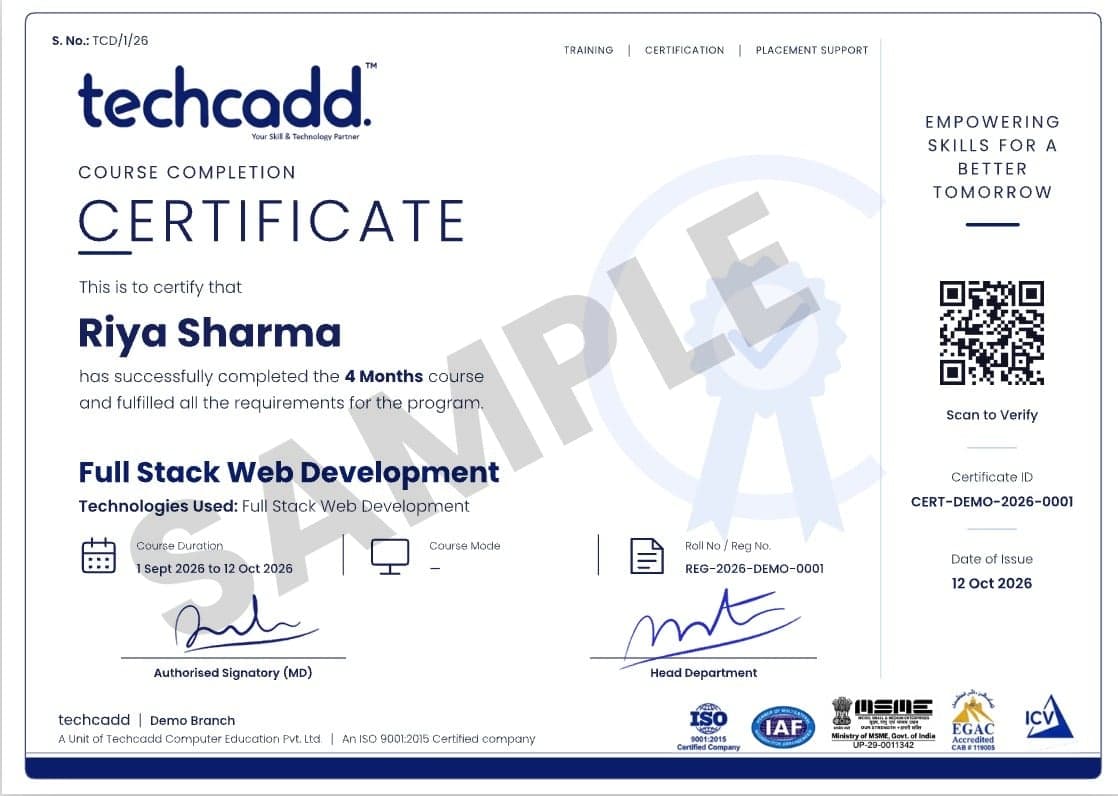
6 reviewed projects
You finish the flutter app development certificate program with proof of what you built — not only a piece of paper.
Online-verifiable certificate that lists your modules, projects and grade.
Issued for live-project work on the longer tracks and accepted for college credit.
One reviewed project per month that you can walk an interviewer through.
Resume review, mock interviews and referrals to our hiring partners.
Four roles Flutter learners grow into — each one builds on the last.
Role 1 of 4
Builds and maintains mobile applications using Flutter and Dart.
Role 2 of 4
Develops application screens, features and logic for mobile apps and keeps them working as requirements change.
Role 3 of 4
Works on applications intended for more than one platform from a shared codebase.
Role 4 of 4
Builds application features as part of a wider software team, where Flutter is one part of the technology stack.
Every topic in every month runs through the same three steps.
Step 1
A short concept class with a worked example — you see why before you see how.
Step 2
You build it yourself in the lab while a mentor reviews your work and unblocks you.
Step 3
You demo the result and answer questions — practice for every interview to come.
A first course after 12th should leave you with skills you can show, not notes you can't use.
You move on when your project is reviewed and working — not when the month ends.
The same tools, devices and accounts that working teams use every day.
Mentors who deliver client projects, so what you learn is what is used.
Start with 3 months and continue to 6 or 9 without repeating a single class.
01
Learning Flutter can help learners move beyond theoretical programming concepts and understand how mobile applications are structured and developed. Instead of studying mobile development only at a conceptual level, learners can practise creating interfaces, handling user interactions, navigating between screens, and connecting applications to external data.
02
One important reason to study Flutter is its cross-platform development model. Flutter allows developers to work toward applications for multiple platforms using a shared development approach. Understanding this workflow can be useful for learners who want to explore modern application development. However, cross-platform development does not eliminate the need to understand platform-specific behaviour, testing, performance, deployment, and application requirements.
03
Flutter development involves more than designing screens. Learners need to understand Dart programming, variables, functions, classes, conditions, collections, asynchronous operations, application logic, and debugging. These fundamentals can strengthen broader software-development abilities and provide a foundation for solving development problems.
04
Projects provide a way to apply individual concepts together. A learner might progress from small UI exercises to applications involving navigation, forms, APIs, local data, authentication, or other practical functionality. A portfolio containing genuine projects can help learners demonstrate what they can actually build rather than relying only on a course completion statement.
05
Flutter skills can be relevant to roles such as: Flutter Developer, Mobile App Developer, Cross-Platform App Developer, Junior Application Developer, Software Developer, where Flutter is part of the technology stack. Actual job requirements vary between employers. Many development positions also expect knowledge of Git, APIs, databases, software-development practices, problem-solving, and programming fundamentals.
06
Mobile applications continue to be an important interface for many digital products and services. Learning a framework such as Flutter can therefore give learners exposure to a practical area of software development. The technology ecosystem will continue to evolve, so learners should treat the course as a foundation and continue updating their knowledge as Flutter, Dart, development practices, and platform requirements change.
07
For someone moving toward software development, Flutter provides a focused area in which to develop programming, UI, API, debugging, and project skills. It can form part of a larger career-switching plan that includes programming fundamentals, Git, databases, backend concepts, problem-solving, projects, and interview preparation.
Learners from Punjab can use Flutter skills to explore application development in software services, startups, freelance work, and technology-oriented businesses. Learners closer to Jalandhar can consider the available offline option, while students elsewhere in Punjab can explore online learning.
For learners from Haryana, Flutter can complement the technology ecosystem around IT services, e-commerce, automobile-related businesses, logistics, and other digital businesses. Working professionals and graduates can use online learning to develop application-development skills alongside their existing commitments.
Learners from Himachal Pradesh may find online Flutter learning particularly useful when looking for flexible access to technology education. Flutter skills can also be relevant to freelancers and professionals interested in developing applications for tourism, hospitality, local businesses, and digital services.
For learners in Chandigarh and the surrounding Tricity area, Flutter Development can be a practical skill for students, graduates, startup-oriented learners, and working professionals interested in software and mobile application development.
Learners from Delhi NCR can explore Flutter as part of a broader software-development career pathway. The region's IT services, agencies, e-commerce, fintech, media, and startup ecosystem can provide varied contexts in which application-development skills may be relevant.
Students from Jammu and Kashmir can use online learning to develop Flutter skills without needing to relocate for every stage of their learning. Application development can also be relevant to digital services, tourism-related businesses, e-commerce, and emerging technology work.
For learners from Uttarakhand, Flutter can be explored as a development skill alongside education, hospitality, tourism, pharmaceuticals, and other digitally enabled sectors. Online learning can be useful for students and professionals seeking flexibility.
Learners from Rajasthan can explore Flutter for software development, freelance work, and applications serving areas such as tourism, retail, handicrafts, jewellery, and other digitally growing businesses. Jaipur can provide a relevant local technology and business context.
Learners from Uttar Pradesh can consider Flutter as part of a broader software-development skill set. The technology can be relevant to digital businesses, IT services, electronics, retail, and startup environments, while online learning can support students from different parts of the state.
32 questions
6 months, with one module and one reviewed project per month. Classes are practical first: most of every session is spent building.
They share one roadmap. 3 months covers the foundations with guided projects, 6 months reaches portfolio level with an industry certificate and placement support, and 9 months adds specialisation, an internship-style capstone and placement preparation.
Yes. Flutter can suit beginners who are willing to learn programming from the fundamentals. Expect to spend time on Dart basics such as variables, conditions, functions and object-oriented concepts before larger applications feel comfortable, and practise regularly.
No. Flutter lets you work towards applications for multiple platforms from a shared codebase, but you still need to understand platform-specific behaviour, testing, performance and deployment requirements.
Flutter skills are relevant to roles such as Flutter Developer, Mobile App Developer and Cross-Platform App Developer, and to freelance application work. Requirements vary between employers, and many roles also expect Git, APIs, databases and strong programming fundamentals.
Industry certificate, a portfolio of 6 reviewed projects and placement support with resume review, mock interviews and referrals.
Yes. You can move up to the 9-month diploma program and carry on from where you stopped — no class is repeated.
Yes. The program starts from zero and is open to arts, commerce, medical and non-medical students. You only need basic computer skills.
Yes. Morning, evening and weekend batches are available, and live online classes come with recordings for revision.
No institute can honestly guarantee a job. We give placement support — resume and portfolio reviews, mock interviews and referrals — and keep helping until you are placed.
Book a free counselling session or message us on WhatsApp. A counsellor will share the current fee, instalment options and scholarships for your chosen program.
A Flutter Development Course teaches learners how to build mobile applications using Flutter and the Dart programming language. It can cover programming fundamentals, widgets, UI development, navigation, state management, APIs, data handling, debugging and application projects.
Graduates, postgraduates, students, working professionals, career changers, aspiring developers and beginners can explore a Flutter Development Course. Basic computer familiarity is useful, while learners without programming experience should be prepared to learn programming fundamentals first.
Yes, Flutter Development can be suitable for beginners who are willing to learn programming fundamentals and practise regularly. Beginners can start with Dart and basic programming concepts before progressing to Flutter application development.
A Flutter syllabus can include Dart programming, Flutter fundamentals, widgets, layouts, navigation, forms, state management, API integration, data handling, debugging, Git and practical application projects. The exact syllabus should be confirmed against the current course structure.
Flutter primarily uses Dart as its programming language. Learners therefore need to understand Dart programming concepts as they progress into Flutter application development.
The time required to learn Flutter depends on the learner's previous programming experience, learning schedule and amount of practice. Beginners generally need additional time to develop programming fundamentals before becoming comfortable with complete applications.
Yes, Flutter Development can be learned online, provided the learning format offers appropriate instruction, practice and project work. Online learning can be particularly useful for students and professionals who are not located near the Techcadd centre in Jalandhar.
Techcadd's learning model includes Online + Offline options, with the physical centre located in Jalandhar, Punjab. Learners should confirm the current batch schedule and availability before enrolling.
Common Flutter development tools include the Flutter SDK, Dart, Android Studio or Visual Studio Code, Git, GitHub, Android emulators and Flutter development/debugging tools. The exact tools used during training should be confirmed with the current course setup.
Flutter skills can be relevant to roles such as Flutter Developer, Junior Flutter Developer, Mobile App Developer, Cross-Platform App Developer and application-development roles where Flutter is part of the technology stack. Employers may also expect knowledge of programming, Git, APIs, databases and software-development practices.
Yes, Flutter skills can be useful for freelance work involving mobile applications, prototypes, UI development, feature implementation and application maintenance. Freelancing success depends on technical ability, portfolio quality, communication, project management and client requirements.
Yes, a non-IT graduate can learn Flutter, although they may need additional time to understand programming fundamentals. Starting with Dart and basic programming before moving into larger Flutter projects can make the learning progression easier.
Yes, working professionals can learn Flutter Development, particularly through a flexible online learning format. Flutter can be useful for professionals who want to add mobile application development to their existing technical skills or explore a career transition.
No, completing a Flutter course does not guarantee a job. Employment depends on programming skills, project experience, portfolio quality, problem-solving ability, interview performance and individual employer requirements.
A course certificate can document completion of training, but practical development ability is important when pursuing Flutter-related opportunities. Employers and clients may also evaluate programming knowledge, application projects, Git usage, API integration and problem-solving skills.
Yes, students from Punjab can learn Flutter online. Learners who are near the Techcadd centre in Jalandhar can also explore the available offline option, subject to the current course schedule.
Yes, learners from Haryana can explore online Flutter Development training. This can be convenient for graduates and working professionals who want to develop mobile application skills without relocating.
Yes, students from Himachal Pradesh can learn Flutter online. Online learning can be especially useful for learners who want flexible access to application-development training while continuing their education or work.
Yes, Flutter Development can be suitable for students from Rajasthan who are interested in programming and mobile applications. Learners can use projects to develop practical skills and explore software-development or freelance pathways.
Yes, learners from Uttar Pradesh can explore online Flutter Development learning. The course can be relevant to graduates, working professionals, career changers and aspiring developers interested in mobile application development.
Flutter Development can provide a pathway into mobile and cross-platform application development. Learners can explore developer roles, freelance projects and broader software-development opportunities, while continuing to build skills in programming, APIs, databases, Git, testing and deployment.
Tell us your stream and goal — we will suggest the right duration, share fee details and book your free demo.
2nd Floor, Crystal Plaza, SCS 78, Opposite PIMS Hospital, Jalandhar, Punjab 144001Mon – Sat: 9:00 AM – 7:00 PM
Sit in a free demo class first. If Flutter is not for you, a counsellor will help you find what is.