Responsive Business Website
A multi-page marketing site with contact form and mobile-first layout.
- HTML5
- Tailwind CSS
- JavaScript


Programming · Intermediate
Learn front-end and back-end web development with HTML, CSS, JavaScript, React, Node.js and databases, and deploy full working applications.
Eligibility: 12th pass or above; basic computer skills
4.9/5 from 750+ Google reviews
A Web Development Course helps learners understand how websites and web applications are planned, designed, developed, tested and maintained. It is relevant for students, graduates, working professionals and career changers who want to build practical programming and web technology skills.
The field covers the technologies used to create the visible parts of websites as well as the programming and server-side logic that can power more functional web applications. Depending on the learning path, students can work with areas such as HTML, CSS, JavaScript, databases, server-side programming, APIs and modern development workflows.
For learners in Punjab, web development can be particularly relevant to the growing digital needs of businesses, startups, agencies and technology-oriented organizations. Students who prefer classroom learning can explore the learning environment at the Jalandhar centre, while learners from other locations can use online learning options.
The course is designed to help learners progress from foundational concepts toward practical development work, problem-solving and project creation. It can also provide a foundation for further specialization in frontend development, backend development or full-stack web development.
Why learn it now
Open any module to see exactly what you will learn. Every module ends with hands-on practice reviewed by your mentor.
Concepts become skills only when you use them. Each week follows the same three steps.
Short concept sessions with live demos — every idea is shown before it is practised.
Hands-on labs and a project at the end of every module, reviewed by your mentor.
Explain your work in weekly demos — the same way you will in interviews.
You practise on the same tools teams use every day — the ones interviewers ask about.
6 guided projects — each one reviewed by your mentor and ready to show in interviews.
Web development is a relatively accessible technology field because learners can begin with foundational concepts before progressing toward more advanced programming and application development. The course can therefore suit people with different educational and professional backgrounds, provided they are willing to practice regularly.
Graduates from computer science, information technology, engineering, mathematics, commerce or other disciplines can use web development training to build practical technical skills alongside their academic qualification. For someone looking to enter the technology sector, learning how websites and web applications are developed can provide a practical direction for building projects and demonstrating technical ability.
Postgraduate learners may use web development as an additional technical skill or as a way to strengthen their existing specialization. Someone with a non-development background can also use structured learning to understand programming and web technologies before exploring more specialized roles.
Professionals already working in IT, digital marketing, design, content, business operations or related areas may benefit from understanding how websites and web applications are built. Web development knowledge can also make communication easier when working with developers, designers, agencies or technology teams. For professionals considering a technical career transition, a structured course can provide a more organized path than trying to learn unrelated technologies independently.
People planning a career change can consider web development if they enjoy technology, logical problem-solving and building digital products. The learning process can begin with fundamental web technologies and gradually move toward more practical projects. The important consideration is not simply completing a course but developing enough understanding to create and explain working projects.
Web development can also be relevant to learners interested in freelance work. Businesses frequently need websites, landing pages, web interfaces, maintenance and other digital development services. A learner who develops strong technical and communication skills can eventually explore independent project work. Freelancers should also understand requirements gathering, project estimation, version control, testing and client communication alongside technical development.
Business owners and entrepreneurs can benefit from understanding web development even if they do not intend to become full-time developers. Technical knowledge can help them communicate requirements more effectively when planning a website, web application or online business. It can also provide a better understanding of what is involved in maintaining and improving a digital product.
Someone moving from a non-technical career does not necessarily need an advanced programming background to start learning web development. The important foundations are logical thinking, consistency and willingness to practice. A structured progression from basic markup and styling to programming, databases and application development can make the transition easier to manage.
Beginners can start with fundamental concepts such as how webpages work, HTML structure, CSS styling and basic JavaScript before moving into more complex development concepts. They do not need to understand every web technology before beginning.
Students who have completed Class 12 and are interested in technology can also consider web development, particularly if they are comfortable with computers and want to explore programming. They should view the course as a skill-building pathway rather than assuming that completing training alone guarantees employment. Regular coding practice, project work and continued learning remain important.
What you need: What matters is learning concepts in the correct sequence and applying them through small practical exercises and projects.
Check My EligibilityLearners from Punjab can use online web development training to build skills relevant to local businesses, startups, digital agencies and technology-oriented organizations. Students who are close to Jalandhar can also consider available offline learning options.
For learners in Haryana, web development can complement the technology ecosystem around Gurugram, Faridabad and other commercial centres. Online learning can be useful for professionals who want to build technical skills alongside their existing work.
Learners from Himachal Pradesh may find online training particularly practical because it allows them to develop technology skills without depending entirely on local classroom availability. Web development can also support remote work and freelance-oriented career exploration.
Students and professionals in Chandigarh and the wider Tricity area can use web development skills in technology, BPO, startup, education and digital-service environments. Online learning provides flexibility for learners managing studies or employment.
Delhi NCR offers a broad digital and technology ecosystem, making web development relevant to learners interested in agencies, IT services, e-commerce, media and technology businesses. Online training can also fit the schedules of working professionals.
Learners from Jammu and Kashmir can access web development training online and develop skills that can be applied to websites, digital businesses, e-commerce and remote technology work. This can be useful for learners looking beyond locally available technology roles.
For students and professionals in Uttarakhand, web development can provide a practical digital skill that complements education, business and remote-work opportunities. Online learning can make structured training accessible alongside existing commitments.
Learners from Rajasthan, particularly around Jaipur, can explore web development as a technical skill relevant to digital businesses, agencies, tourism-related businesses, e-commerce and other organizations that depend on an online presence.
Learners from Uttar Pradesh can use web development training to prepare for opportunities connected with IT, digital services, e-commerce and technology businesses. Online learning is particularly useful for students outside major technology centres.
Web development can support several career directions depending on the depth of skills developed.
Learners can also explore related areas such as: E-commerce development, Digital agency work, Software services, Startup technology teams, Website maintenance, Freelance web development, Independent website projects. With additional learning, developers can move toward more specialized areas involving modern frameworks, APIs, cloud platforms, databases, application security and scalable web applications.
Web development can be relevant to freelance services such as website creation, landing pages, frontend development, website maintenance, feature development and custom web applications. However, successful freelancing requires more than technical knowledge. Learners also need communication skills, requirement understanding, project planning, pricing awareness and the ability to maintain client relationships.
Web development salaries in India vary significantly according to experience, technical specialization, location, organization, project complexity and portfolio strength. Entry-level roles generally differ considerably from experienced development positions, so salary should be treated as an approximate market-dependent outcome rather than a guaranteed result of completing a course.
Punjab learners can explore web development opportunities connected with IT services, startups, digital agencies, e-commerce and businesses increasingly dependent on websites and online platforms. The skill can also complement existing knowledge in areas such as digital marketing or business operations.
Haryana offers a strong technology and business ecosystem, particularly around Gurugram and other commercial centres. Web development can be relevant to software services, e-commerce, logistics, automobile-related businesses and digital organizations.
The Chandigarh-Tricity ecosystem includes IT services, BPO, education, startups and digital businesses. Web development can therefore be useful for learners seeking technical roles or looking to combine development with another digital skill.
Delhi NCR provides exposure to a wide range of technology-oriented businesses, agencies, media companies, e-commerce organizations and startups. Learners can use web development as a foundation for pursuing frontend, backend or broader software-development paths.
Cities such as Noida have a significant technology and services ecosystem, while Lucknow and other urban centres also provide opportunities connected with digital services and businesses. Web development skills can be applied across company websites, software products, e-commerce and web applications.
Every batch is led by a senior mentor and supported by teaching assistants, so doubts are cleared the same day.
Senior Full-Stack Mentor
Has built web platforms for startups and export businesses across Punjab. Teaches with live coding and code reviews, so students learn how real teams write, test and ship software.
Web development is not limited to understanding programming theory. Learners work toward understanding how individual technologies combine to create functioning websites and web applications. This makes the subject suitable for people who prefer learning by building and experimenting.
A structured program can help learners understand the relationship between webpage structure, visual presentation, programming logic, server-side processing and data. This broader understanding is useful when progressing from simple webpages to more interactive applications.
Web development introduces learners to programming concepts such as variables, conditions, functions, data handling and logical problem-solving. These skills can also create a foundation for learning other programming technologies later.
One of the practical advantages of web development is the ability to demonstrate skills through projects. A learner can build webpages, interactive interfaces, websites or web applications and use suitable projects as evidence of their development ability. A portfolio can be especially useful for beginners who do not yet have extensive professional experience.
Web development can lead toward different technical paths rather than a single job role. Depending on the skills developed, learners can explore frontend development, backend development or full-stack development. They can later specialize in particular frameworks, programming languages, databases or development workflows.
For someone moving from a non-technical field, web development provides a structured way to begin learning technology. Instead of trying to study every programming concept at once, learners can progress from basic webpage development toward more complex applications. The transition still requires practice and continued learning, but structured training can provide a clearer starting point.
Web development skills can also be relevant for freelance projects. Small businesses, professionals, startups and organizations may require websites, landing pages, updates or custom web functionality. Learners interested in freelancing need more than coding skills, however. Client communication, requirement analysis, deadlines, testing and project management are also important.
Websites and web applications are used across industries including education, retail, e-commerce, finance, hospitality, media, healthcare, manufacturing and professional services. This broad application makes web development a transferable technical skill rather than one limited to a single business sector.
Web development can serve as a foundation for exploring more advanced areas such as full-stack development, cloud deployment, APIs, databases, web security and modern application frameworks. Learners do not need to master all of these areas at the beginning. A strong foundation allows them to decide which direction best matches their interests and career goals.
Web development can be started without an advanced technical background. Beginners can first understand how webpages are structured and styled before gradually moving into programming and application development. The key is consistent practice. Writing code, debugging errors, completing projects and understanding why a solution works are more valuable than simply memorizing syntax.
Businesses across India increasingly depend on websites and web-based systems for communication, customer interaction, marketing, commerce and internal operations. This creates continued relevance for people who understand web technologies. For learners researching a Web Development Course as a career option, the most useful approach is to focus on practical skills, project experience and a clear development pathway rather than relying only on a course certificate. Ultimately, web development can be a useful choice for learners who enjoy technology, problem-solving and creating digital products. The skills developed through the course can provide a foundation for employment, freelancing, further specialization and continued growth in the web technology field.
North India's first AI-powered and Robotics learning centre For a Web Development learner, exposure to a technology-focused learning environment can help connect programming concepts with the wider world of modern technology. While web development has its own tools and workflows, understanding how software interacts with emerging technologies can broaden a learner's perspective and encourage practical experimentation. Learners from Punjab, Haryana, Himachal Pradesh, Chandigarh, Delhi NCR, Jammu & Kashmir, Uttarakhand, Rajasthan and Uttar Pradesh can access the program through the available online learning format, while learners who can attend in person can explore the Jalandhar learning environment.
Web development becomes easier to understand when concepts are applied rather than studied only theoretically. A practical learning approach can involve writing code, creating webpages, working with interactive elements, debugging problems and gradually developing complete web projects. This helps learners understand not only what a technology does, but also how different components work together in a real development workflow.
Web development includes many technologies, and beginners can easily become overwhelmed when trying to learn everything simultaneously. A structured course can provide a logical progression from foundational web concepts to programming, data handling and application development. Starting with fundamentals before moving toward more advanced concepts can make the learning process easier to follow and gives learners a stronger base for later specialization.
Web development is a broad field rather than a single technology. Depending on the curriculum and the learner's interests, the skills developed can support progression toward frontend, backend or full-stack development. This gives learners the flexibility to continue developing in the direction that best matches their interests, existing knowledge and career plans.
A well-structured Web Development Course can accommodate learners starting from the basics as well as people who already have some programming or technology experience. Beginners can focus on understanding core concepts and development fundamentals, while existing learners can use structured training to strengthen gaps in their knowledge and improve how they approach projects.
Learners have different schedules and circumstances, so flexibility matters. The program supports Online + Offline learning, allowing learners to choose the format that fits their situation. For learners outside Punjab, online learning provides a way to access structured web development education without requiring a physical Techcadd centre in their city. Learners near Jalandhar can consider the available offline learning option.
The purpose of learning web development should extend beyond memorizing HTML tags or programming syntax. Learners should gradually develop the ability to understand requirements, write code, troubleshoot issues and create functional digital experiences. These practical abilities can support future preparation for development roles, freelance work, internships or further technical specialization.
Web development can become a starting point for learning additional technologies such as APIs, databases, cloud deployment, web security, development frameworks and other modern software practices. Building strong fundamentals first can make it easier to understand these advanced areas later rather than attempting to learn them without a clear foundation.
Learn Web Development as a certificate course, as university industrial training, or as a longer job-ready diploma.
| Feature | Certificate Course | Industrial TrainingMost chosen | Job-Ready Diploma |
|---|---|---|---|
| Typical duration | 5–6 Months | 6 weeks – 6 months | 9 – 12 months |
| Full course curriculum | |||
| Module projects | |||
| Live industry project | Not included | ||
| University training report & letter | Not included | ||
| Advanced specialisation modules | Not included | Not included | |
| Placement assistance | |||
| Internship with experience letter | Not included | Not included |
Weekday Morning
Mon – Fri · 9:00 – 11:00 AM
ClassroomWeekday Evening
Mon – Fri · 5:00 – 7:00 PM
ClassroomWeekend
Sat – Sun · 10:00 AM – 1:00 PM
Classroom + LiveLive Online
Mon – Fri · 8:00 – 9:30 PM
Live onlineNot sure which track or batch suits you? A counsellor will help you decide.Ask a Counsellor
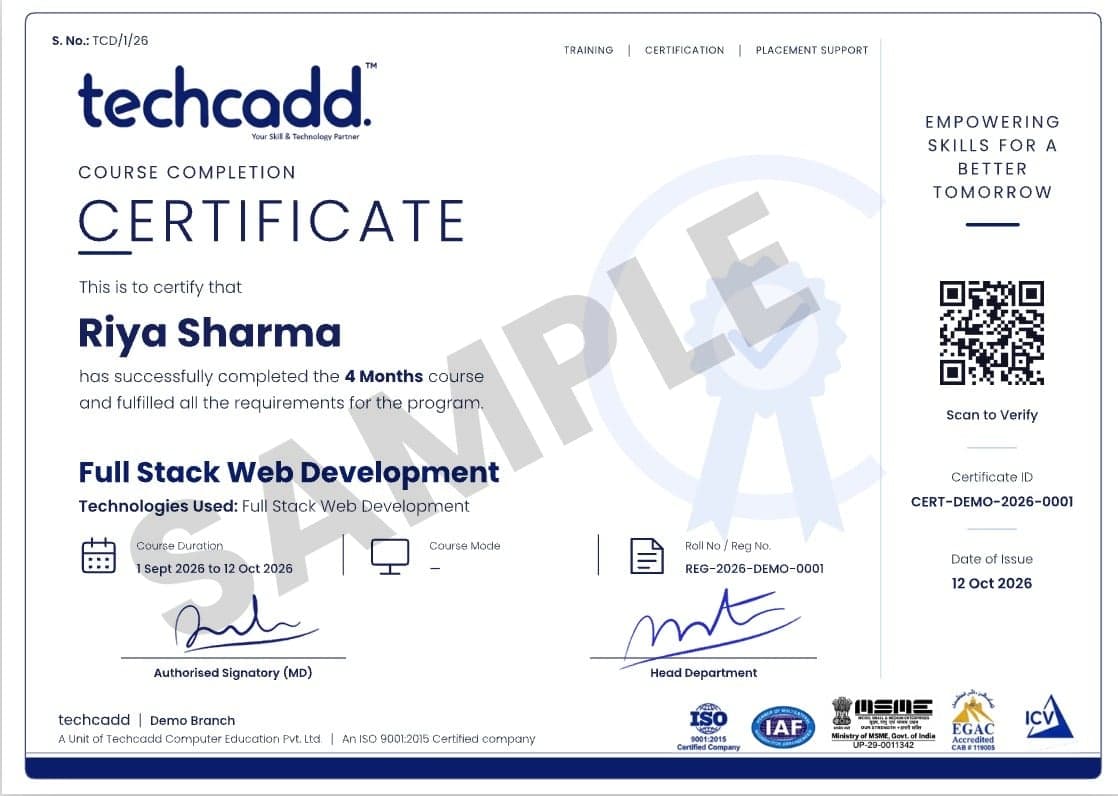
Your certificate lists your modules and projects, and our placement team works with you until you land the role.
Rated 4.9/5 by 750+ students on Google.
Straight answers on eligibility, batches, certification and placements.
Still have a question?
Counsellors are available Mon – Sat: 9:00 AM – 7:00 PM.
A Web Development Course teaches the concepts and technologies used to create websites and web applications, including areas such as HTML, CSS, JavaScript and other relevant development technologies.
Yes, web development can be suitable for beginners because the fundamentals can be learned progressively, starting with webpage structure and styling before moving into programming and more advanced development concepts.
A typical syllabus can include HTML, CSS, responsive design, JavaScript, frontend development, backend concepts, databases, APIs, development tools and practical projects, although the exact syllabus should be confirmed with the current course curriculum.
The duration depends on the curriculum, learning depth, class schedule and learner's pace. For the current course duration and batch schedule, learners should confirm the latest details with Techcadd.
Web development course fees can vary according to the curriculum, duration, learning format and other course-specific factors. The current fee structure should be confirmed directly with Techcadd rather than relying on an outdated figure.
Yes, web development can be learned online because coding, development tools and project work can be practiced using a computer and suitable development environment. Online learning can also make structured training accessible to learners outside Jalandhar.
Yes, Techcadd offers an Online + Offline learning format, with the physical centre located in Jalandhar, Punjab. Learners should confirm current classroom schedules and availability before enrolling.
Web development skills can support career paths such as Web Developer, Frontend Developer, Backend Developer and, with broader skills, Full-Stack Developer. Actual job opportunities depend on technical ability, projects, experience and employer requirements.
Web developer salaries in India vary according to experience, location, technical skills, specialization, organization and role. A course itself does not guarantee a particular salary, so salary expectations should be based on the wider job market and the learner's actual skills.
Yes, web development can be used for freelance services such as website creation, landing pages, frontend work, maintenance and custom web functionality. Freelancing also requires client communication, project planning, requirement analysis and business skills.
Common web development tools include code editors such as Visual Studio Code, web browsers and browser developer tools. Depending on the curriculum, learners may also work with Git, GitHub, JavaScript environments, frameworks, databases and API tools.
Yes, beginners can start web development without prior programming experience because foundational concepts can be introduced gradually. Consistent coding practice is important as learners move from HTML and CSS toward JavaScript and application development.
Web development can be a useful career direction for people who enjoy programming, problem-solving and creating digital products. Its applications span websites, e-commerce, software products, agencies and web-based business systems.
Yes, working professionals can learn web development through a structured program and flexible learning format. Online classes can be particularly useful for professionals who need to balance training with existing work commitments.
Yes, students from Punjab can join web development training through available online or offline learning options. Learners near Jalandhar can explore the physical centre, while online learning can provide access from other parts of the state.
Yes, students from Himachal Pradesh can learn web development online and practice development projects from their own location. This can be useful for learners in areas where regular classroom-based technology training may be less convenient.
Haryana's technology and business ecosystem, particularly around Gurugram, creates relevance for web development in IT services, e-commerce, logistics, digital businesses and other technology-driven organizations. Learners should evaluate opportunities based on their actual skills and experience.
Yes, students from Rajasthan can learn web development online and build projects remotely. Learners can use the training as a foundation for exploring software development, digital agencies, e-commerce and freelance web development.
Yes, students from Uttar Pradesh can join online web development training and practice the same core development concepts from their location. This can be useful for learners in cities such as Noida, Lucknow and other parts of the state.
Yes, web development can provide useful software and programming foundations for exploring advanced areas later. However, moving into AI, machine learning or other specialized fields requires additional subject-specific learning beyond web development fundamentals.
Turn your interest in websites and programming into practical web development skills. Learn through a structured approach covering core web technologies, programming concepts and project-based development, with flexible learning options for students and professionals.