Business Landing Page
A responsive one-page website for a local business, such as a Jalandhar sports-goods exporter, with clear calls to action.
- HTML5
- CSS3
- Responsive


Programming · Beginner
Design responsive, accessible websites with HTML5, CSS3, Tailwind CSS, Figma and JavaScript basics, and build a portfolio of live pages.
Eligibility: 12th pass or above; no coding background needed
4.9/5 from 750+ Google reviews
A Web Designing Course focuses on the skills and concepts used to create attractive, functional, responsive, and user-friendly websites. The course generally introduces learners to website structure, visual layout, responsive design, typography, colours, navigation, user interface principles, and the technologies used to build web pages.
It can be useful for graduates, postgraduates, working professionals, freelancers, career changers, beginners, and people interested in building websites for businesses or personal projects. Depending on the curriculum, learners may work with technologies such as HTML, CSS, JavaScript, responsive design frameworks, image-editing tools, and web development environments.
For learners in Punjab, web designing can be relevant to IT services, digital agencies, e-commerce businesses, startups, education, hospitality, and other sectors that require an online presence. Techcadd's physical learning centre is located in Jalandhar, Punjab, while learners from other locations can explore online learning options.
The course is particularly useful for people who want to develop practical website-design skills and understand how a website moves from a visual concept to a usable web page.
Why learn it now
Open any module to see exactly what you will learn. Every module ends with hands-on practice reviewed by your mentor.
Outcome: Learners should be able to understand the basic components involved when a website is accessed and identify the different parts of a web project.
Outcome: Learners should be able to create structured web pages and organise content logically.
Outcome: Learners should be able to transform a basic HTML structure into a visually organised webpage.
Outcome: Learners should be able to create layouts that work more effectively across desktop, tablet, and mobile screens.
Outcome: Learners should be able to add basic interactive functionality to web pages.
Outcome: Learners should be able to make design decisions with usability and visitor experience in mind.
Outcome: Learners should understand how pre-built responsive components and layout systems can speed up website design.
Outcome: Learners should be able to organise their work into presentable projects that demonstrate their web-design capabilities.
Concepts become skills only when you use them. Each week follows the same three steps.
Short concept sessions with live demos — every idea is shown before it is practised.
Hands-on labs and a project at the end of every module, reviewed by your mentor.
Explain your work in weekly demos — the same way you will in interviews.
You practise on the same tools teams use every day — the ones interviewers ask about.
6 guided projects — each one reviewed by your mentor and ready to show in interviews.
A Web Designing Course can be suitable for people from different educational and professional backgrounds. Prior advanced programming knowledge is generally not necessary for beginners because web design can be approached progressively, starting with basic website structure and visual concepts.
Graduates from computer science, IT, commerce, management, arts, or other disciplines can consider web designing when they want to add a practical digital skill to their existing qualification. The skill can complement areas such as digital marketing, business, content creation, graphic design, or entrepreneurship.
Postgraduates who want to broaden their technical profile can use web designing as an additional skill. Understanding how websites are structured can also be useful for people working around digital projects, online businesses, marketing, or technology teams.
Professionals can explore web designing when their current work increasingly involves websites, digital communication, online campaigns, or business websites. Learning website structure and responsive design can help them communicate more effectively with developers and digital teams.
People planning a move toward the digital or IT sector can use web designing as an entry point. It provides exposure to website layouts, frontend technologies, usability, and practical website creation before moving into more advanced areas.
Freelancers can develop web-design skills for services such as creating business websites, landing pages, portfolio websites, basic e-commerce interfaces, or website redesigns. Actual freelance opportunities depend on skill level, portfolio quality, client requirements, and ability to deliver projects professionally.
Business owners can benefit from understanding web designing because a website is often an important part of an online presence. Even when development work is outsourced, basic design knowledge can help business owners communicate requirements and evaluate website layouts, navigation, and user experience.
Someone moving from a non-technical field into digital work can consider web designing because the learning path can begin with fundamentals rather than immediately requiring advanced programming concepts.
Beginners can start with fundamentals such as HTML, CSS, page structure, layouts, responsive design, and basic JavaScript concepts.
12th-pass students can also consider web designing if they are interested in websites and digital technology. However, the course can be equally relevant to graduates and working professionals looking to add a practical skill.
What you need: Consistent practice is important because web designing is a practical skill.
Check My EligibilityLearners from Jalandhar, Ludhiana, Amritsar, Mohali, Patiala, and other parts of Punjab can use web designing skills for opportunities connected with IT services, startups, digital agencies, e-commerce, and local businesses. Online learning can provide an option for learners who are not located near the Jalandhar centre.
Learners from Gurugram, Faridabad, Panchkula, Ambala, and Karnal can explore web designing in the context of IT services, MNCs, e-commerce, logistics, and business websites. Online learning can make the course accessible without relocating.
Learners from Shimla, Dharamshala, and Solan can connect web-design skills with tourism, hospitality, local businesses, and remote digital work. Online learning can be particularly useful when access to specialised training nearby is limited.
Learners in Chandigarh can develop web-design skills relevant to IT, BPO, education, government-related digital services, startups, and local businesses that require professional websites.
Delhi, Noida, and Ghaziabad offer exposure to agencies, media, e-commerce, IT companies, and other digital businesses. Online web-design learning can suit learners who want to build skills alongside studies or employment.
Learners from Jammu and Srinagar can explore website design for tourism, handicrafts, horticulture businesses, e-commerce, and other organisations that increasingly use digital platforms.
Learners from Dehradun and Haridwar can apply web-design skills to tourism, education, hospitality, pharma, and businesses operating in the region. Online learning can provide flexibility for learners managing other commitments.
Learners from Jaipur and surrounding areas can find relevant applications in tourism, handicrafts, jewellery, textiles, e-commerce, and service businesses that need strong online presentation.
Learners from Lucknow, Meerut, Noida, and other cities can explore web designing in IT, retail, electronics, education, and digital-business environments while studying online from their location.
After developing sufficient practical skills, learners can explore roles such as Web Designer, Junior Web Designer, UI Designer, Website Designer, Junior Frontend Developer, WordPress Designer, or related entry-level digital roles. The responsibilities and requirements vary by employer.
Web-design skills can be useful across IT services, digital agencies, e-commerce, media, education, hospitality, startups, retail, and businesses that depend on an online presence. There is also a freelance dimension. Individuals with a strong portfolio may offer services such as website design, landing-page creation, website redesign, responsive-page development, and ongoing design updates. Freelancing income is not fixed and depends on expertise, project complexity, client acquisition, communication, and portfolio quality. Career progression can move from basic web design toward frontend development, UI/UX, JavaScript development, WordPress development, or other specialised areas. Additional skills in SEO, digital marketing, graphic design, accessibility, performance, or backend technologies can further broaden career options. Salary also varies considerably according to location, experience, technical ability, portfolio, employer, and role. Therefore, salary figures should be treated as approximate rather than guaranteed outcomes.
Punjab offers opportunities connected with IT services, digital agencies, startups, e-commerce, education, and local businesses. Web designers can work on websites and digital interfaces for organisations that need a professional online presence.
Gurugram and other major business locations provide exposure to IT services, MNCs, e-commerce, logistics, and digital businesses. Web-design skills can complement roles involving websites, marketing interfaces, and digital products.
Tourism, hospitality, local businesses, and remote digital work create relevant applications for web-design skills. Website presentation can be particularly important for businesses that attract customers through online channels.
The Chandigarh–Tricity region has IT, BPO, education, startups, and service businesses where website and digital-interface skills can be relevant. Learners can also combine web designing with digital marketing or UI/UX skills.
Delhi, Noida, and Ghaziabad have a broad digital-business ecosystem involving agencies, media, e-commerce, IT services, and technology companies. This creates multiple environments where web-design and frontend skills can be applied.
Cities such as Noida and Lucknow have growing IT, electronics, retail, education, and digital-business activity. Web designing can support both employment-oriented development and freelance website services in these markets.
Every batch is led by a senior mentor and supported by teaching assistants, so doubts are cleared the same day.
Senior Full-Stack Mentor
Has built web platforms for startups and export businesses across Punjab. Teaches with live coding and code reviews, so students learn how real teams write, test and ship software.
Web designing is a practical discipline where concepts can be applied directly by creating web pages and interfaces. Instead of learning only theory, learners can work toward producing visible website layouts and projects.
Understanding HTML and page structure helps learners see how website content is organised. CSS introduces styling and layout, while other frontend technologies can add interaction and dynamic behaviour.
Modern websites need to work across desktops, tablets, and smartphones. Learning responsive layouts helps learners understand how website elements can adapt to different screen sizes.
A website is not only about appearance. Navigation, readability, spacing, hierarchy, consistency, and usability influence how visitors interact with a page. Web designing introduces these important principles.
Web-design projects can become part of a portfolio. Examples may include business websites, landing pages, portfolio sites, informational websites, or redesign concepts. A strong portfolio can demonstrate practical ability more effectively than a list of skills alone.
Depending on skill level and additional expertise, web-design knowledge can support paths such as Web Designer, UI Designer, Junior Frontend Developer, Website Designer, WordPress Designer, and Web Design Assistant. Actual responsibilities vary between organisations.
Web design can also support freelance services. Small businesses, professionals, startups, and organisations may require websites, landing pages, redesigns, or ongoing design changes. Freelancers need more than technical skills, including communication, pricing, project management, revisions, and client handling.
For someone moving toward the digital sector, web designing can provide an accessible starting point. Learners can gradually progress from basic page creation to responsive layouts, JavaScript, frontend frameworks, UI/UX principles, and more advanced web technologies.
Web designing can complement digital marketing, SEO, graphic design, content creation, e-commerce, and social media. For example, someone working in digital marketing can benefit from understanding landing-page structure and website usability.
Businesses, organisations, creators, and professionals continue to use websites as part of their digital presence. As design expectations change, web professionals need to keep developing their knowledge of responsive interfaces, accessibility, performance, usability, and modern frontend practices. For learners who want a practical digital skill with applications across employment, freelancing, business, and further technical development, web designing provides a flexible foundation.
“North India's first AI-powered and Robotics learning centre” Techcadd provides a technology-focused learning environment where learners can gain exposure to modern digital concepts alongside their core training. For Web Designing, this environment can support a broader understanding of how websites and digital experiences fit into today's technology ecosystem. Learners from Punjab, Haryana, Himachal Pradesh, Chandigarh, Delhi NCR, Jammu & Kashmir, Uttarakhand, Rajasthan, and Uttar Pradesh can access the learning program online, while learners who prefer in-person learning can attend the Jalandhar centre.
Web designing is best understood through practical application. The learning approach can focus on creating page structures, applying styling, building responsive layouts, and developing website projects rather than relying only on theoretical explanations.
The curriculum can cover commonly used web technologies and concepts such as HTML, CSS, JavaScript, responsive design, frontend fundamentals, and website usability. This gives learners a structured foundation for working with modern websites.
Web designing involves several connected concepts. Starting with website structure and gradually moving toward styling, responsive layouts, interaction, and more advanced frontend concepts can make the learning process easier to follow, particularly for beginners.
Learners can choose an appropriate learning mode based on their location and circumstances. The physical centre is in Jalandhar, Punjab, while learners from other states can access the course online without needing to relocate.
Practical website assignments can provide opportunities to create work that demonstrates actual design and implementation skills. Projects such as business websites, landing pages, portfolio pages, or responsive layouts can contribute to a professional portfolio.
Web designing can serve different objectives. A learner may want to pursue a web-design role, develop freelance services, strengthen digital-marketing skills, build websites for a business, or eventually move toward frontend development. The foundational skills can support several of these directions.
Web designing can be approached progressively without assuming advanced technical knowledge at the beginning. Learners can first understand how websites work before moving into more detailed frontend technologies and development concepts.
Learn Web Designing as a certificate course, as university industrial training, or as a longer job-ready diploma.
| Feature | Certificate Course | Industrial TrainingMost chosen | Job-Ready Diploma |
|---|---|---|---|
| Typical duration | 3–4 Months | 6 weeks – 6 months | 9 – 12 months |
| Full course curriculum | |||
| Module projects | |||
| Live industry project | Not included | ||
| University training report & letter | Not included | ||
| Advanced specialisation modules | Not included | Not included | |
| Placement assistance | |||
| Internship with experience letter | Not included | Not included |
Weekday Morning
Mon – Fri · 9:00 – 11:00 AM
ClassroomWeekday Evening
Mon – Fri · 5:00 – 7:00 PM
ClassroomWeekend
Sat – Sun · 10:00 AM – 1:00 PM
Classroom + LiveLive Online
Mon – Fri · 8:00 – 9:30 PM
Live onlineNot sure which track or batch suits you? A counsellor will help you decide.Ask a Counsellor
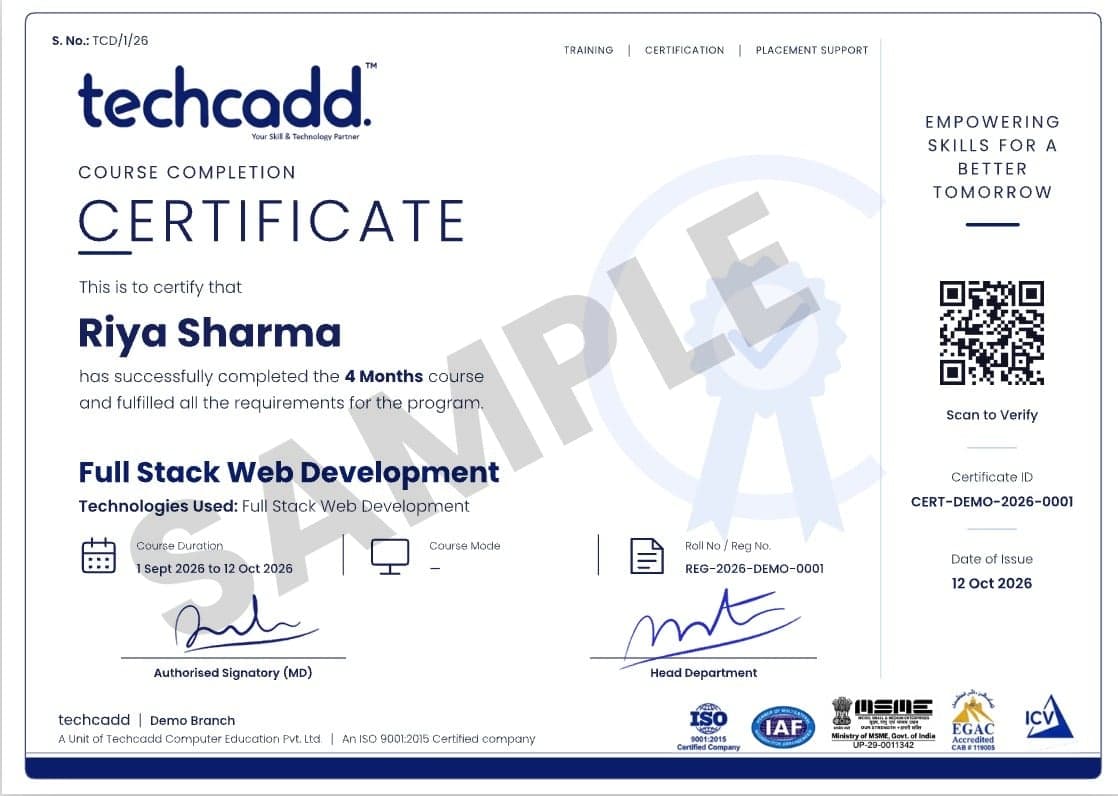
Your certificate lists your modules and projects, and our placement team works with you until you land the role.
Rated 4.9/5 by 750+ students on Google.
Straight answers on eligibility, batches, certification and placements.
Still have a question?
Counsellors are available Mon – Sat: 9:00 AM – 7:00 PM.
A Web Designing Course can be joined by graduates, postgraduates, working professionals, career changers, freelancers, business owners, beginners, and interested 12th-pass learners.
Yes, a Web Designing Course can be suitable for beginners because the fundamentals can be introduced progressively, starting with website structure, HTML, CSS, and basic design concepts.
A typical syllabus can include web fundamentals, HTML, CSS, responsive design, JavaScript basics, UI/UX principles, layouts, frontend concepts, browser tools, and practical website projects.
The duration depends on the specific course structure, curriculum depth, and learning schedule, so the current duration should be confirmed with the institute.
Web Designing Course fees depend on the curriculum, duration, learning mode, and institute, so the current fee structure should be confirmed before enrolment.
Yes, web designing can be learned online, including through live online learning where available. Online learning can allow learners from different cities and states to study without relocating.
Yes, offline learning is available at the Techcadd centre in Jalandhar, Punjab.
Common technologies include HTML5, CSS3, JavaScript, responsive-design techniques, Bootstrap, browser developer tools, code editors such as Visual Studio Code, and other tools depending on the curriculum.
Depending on your skills and experience, possible roles include Web Designer, Junior Web Designer, UI Designer, Website Designer, Junior Frontend Developer, and WordPress Designer.
Web-design salaries vary according to role, location, experience, employer, technical skills, and portfolio quality. A course does not guarantee a particular salary.
Yes, web designing can support freelance services such as business websites, landing pages, website redesigns, portfolio websites, and responsive-page development, provided the freelancer has the required skills and portfolio.
Yes, beginners without advanced coding experience can start with web-design fundamentals such as HTML and CSS before progressing toward JavaScript and other frontend concepts.
Web designing can lead toward website design, UI design, frontend development, WordPress, freelance services, and related digital roles. Additional skills can broaden the available career paths.
Yes, learners from Punjab can join online learning options and study web designing without needing to travel to the Jalandhar centre.
Yes, learners from Himachal Pradesh, including areas such as Shimla and Solan, can use online learning to study web designing remotely.
Haryana has opportunities connected with IT services, MNCs, e-commerce, logistics, and digital businesses, where website and frontend skills can be relevant.
Yes, learners from Rajasthan can study web designing online, making the course accessible to people who are not located near the Jalandhar centre.
Yes, Web Designing can be suitable for learners from Uttar Pradesh who want to develop digital skills applicable to IT, retail, education, electronics, e-commerce, and freelance work.
Yes, working professionals can learn web designing to add a digital skill, understand website projects better, explore a career transition, or develop capabilities useful for freelance work.
No, completing a Web Designing Course does not guarantee a job. Employment depends on practical skills, portfolio quality, experience, interview performance, and the requirements of individual employers.
Learn the fundamentals of website design, responsive layouts, frontend technologies, user-friendly interfaces, and practical website creation through a structured Web Designing Course. Whether you are a beginner, graduate, working professional, freelancer, business owner, or career changer, the program can help you develop practical skills for creating and working with modern websites.