Full Stack E-commerce Platform
Product catalogue, cart, order management, admin dashboard and sandbox payment integration.
- React
- Node.js
- MongoDB

Programming · Intermediate
Become a full stack JavaScript developer with MongoDB, Express, React and Node.js, building and deploying production-style applications.
Eligibility: Basic HTML/CSS knowledge or completion of Web Designing; graduates and final-year students welcome
4.9/5 from 750+ Google reviews
A MERN Stack Course provides structured training in modern full-stack web development using MongoDB, Express.js, React, and Node.js. Together, these technologies allow developers to work across the frontend and backend of web applications while using JavaScript across much of the development process.
The course can be useful for graduates, postgraduate students, working professionals, aspiring developers, freelancers, job switchers, and beginners who want to build practical web-development skills. Learners can expect to understand how websites and web applications are designed, how user interfaces communicate with backend services, how data is stored and managed, and how different application components work together.
A practical learning approach can also help learners develop projects that demonstrate their understanding of frontend, backend, databases, APIs, and application workflows.
For learners in Punjab, online learning can provide access to MERN Stack training from different cities, while those seeking offline learning can explore the Techcadd centre in Jalandhar. The exact course duration and current curriculum should be confirmed before enrolment.
Why learn it now
Open any module to see exactly what you will learn. Every module ends with hands-on practice reviewed by your mentor.
Outcome: Learners should be able to understand and write basic JavaScript code and recognize how frontend technologies are used to create web interfaces.
Outcome: Learners should be able to use JavaScript more effectively when creating interactive web applications and working with data and APIs.
Outcome: Learners should be able to create interactive frontend interfaces using React and understand how different components communicate within an application.
Outcome: Learners should be able to structure a frontend application and connect it with backend services.
Outcome: Learners should understand the role of Node.js in backend development and be able to create the foundations of a server-side application.
Outcome: Learners should be able to create backend routes and understand how a frontend application communicates with server-side functionality.
Outcome: Learners should understand how to design and work with application data using a document-oriented database.
Outcome: Learners should understand the complete flow of information from a React interface through a Node.js/Express backend to a database and back to the user.
Outcome: Learners should understand how authenticated application workflows operate and why secure development practices matter.
Outcome: Learners should be able to demonstrate how frontend, backend, database, APIs, and application logic work together.
Concepts become skills only when you use them. Each week follows the same three steps.
Short concept sessions with live demos — every idea is shown before it is practised.
Hands-on labs and a project at the end of every module, reviewed by your mentor.
Explain your work in weekly demos — the same way you will in interviews.
| Tool | What it is used for |
|---|---|
| MongoDB | Database technology |
| Express.js | Backend web framework |
| React | Frontend library |
| Node.js | JavaScript runtime |
| JavaScript | Core programming language |
| HTML & CSS | Web-interface fundamentals |
| REST APIs | Application communication |
| JSON | Common data-exchange format |
| Git | Version control |
| GitHub | Code repository and collaboration platform |
| Code editor/IDE | Writing and managing source code |
| Browser developer tools | Inspecting and debugging web applications |
| Package managers such as npm | Managing JavaScript dependencies |
6 guided projects — each one reviewed by your mentor and ready to show in interviews.
A MERN Stack course can suit people with different educational and professional backgrounds. The most important requirement is an interest in programming, web development, and learning how different parts of a web application work together. Prior professional experience is not necessarily required for beginners if the learning path starts with programming and web-development fundamentals.
Graduates from computer science, information technology, engineering, mathematics, or related backgrounds may find MERN Stack training useful for developing practical development skills alongside their academic knowledge. It can help bridge the gap between learning programming concepts and applying them to complete web applications. Graduates from other disciplines can also consider the course if they are interested in moving toward technology. They may need additional time to become comfortable with programming fundamentals, but a structured learning path can make the transition more manageable.
Postgraduate learners who want to strengthen their development profile can use MERN Stack training to build practical knowledge around frontend development, backend programming, databases, APIs, and application architecture. For learners who already know programming, the course can provide an opportunity to organize those skills around full-stack application development.
Working professionals can consider MERN Stack when they want to add web-development capabilities to their existing technical profile or explore a transition toward software development. For example, someone working with basic web technologies may use MERN Stack to understand how frontend interfaces connect with server-side applications and databases.
MERN Stack can be relevant for professionals planning a move toward web-development roles. A job switcher should focus not only on learning individual technologies but also on building projects that demonstrate the ability to solve practical development problems. A portfolio containing functional applications can be useful when discussing development skills with prospective employers or clients.
Freelancers can explore MERN Stack because full-stack development can allow them to work on different parts of a web project rather than being limited to a single layer. Potential freelance work may include business websites with application functionality, dashboards, custom web applications, API integrations, or modifications to existing applications, depending on the freelancer's skills and client requirements.
Business owners and entrepreneurs may benefit from understanding MERN Stack even if they do not intend to become full-time developers. Basic knowledge of frontend, backend, databases, and APIs can help them communicate more effectively with development teams and understand the technical requirements of a web application. Those who want to build prototypes or manage their own smaller digital products may also find the technical foundation useful.
People moving into technology from another career can consider MERN Stack as one possible route into web development. The transition is easier when learners first develop fundamentals such as HTML, CSS, JavaScript, programming logic, Git, and basic web concepts before moving deeper into the MERN ecosystem. Career changers should also expect consistent practice because full-stack development involves several interconnected technologies.
Beginners can learn MERN Stack, but starting directly with advanced full-stack concepts may be overwhelming without programming fundamentals.
12th-pass students interested in technology can consider MERN Stack as a development skill pathway, particularly if they are planning a technology-focused education or career. They should be prepared to spend sufficient time developing programming fundamentals rather than focusing only on frameworks.
What you need: A beginner-friendly pathway should gradually introduce JavaScript and web-development concepts before moving into React, Node.js, Express.js, databases, APIs, authentication, and application projects.
Check My EligibilityLearners from Punjab can use online MERN Stack training to develop web-development skills without needing to relocate. The combination of IT, startups, manufacturing businesses, exports, and digitally growing local businesses creates different contexts where websites, dashboards, e-commerce systems, and business applications can be relevant. Learners near Jalandhar, Ludhiana, Amritsar, Mohali, Patiala, and Phagwara can choose online learning according to their requirements, while offline learning is available at the Jalandhar centre.
For learners in Haryana, MERN Stack can be particularly relevant to people interested in technology and software opportunities around areas such as Gurugram and Faridabad. The state's presence of MNCs, IT services, e-commerce, automobile, and logistics businesses provides useful industry contexts for understanding web applications, business platforms, dashboards, and internal tools.
Learners from Himachal Pradesh may be interested in MERN Stack for both employment-oriented development skills and remote work or freelancing possibilities. Students and professionals in cities such as Shimla, Dharamshala, and Solan can use online learning to build development skills that are not necessarily dependent on being physically located in a major technology hub. Web applications can also have relevance to tourism, hospitality, education, and local businesses.
Chandigarh and the wider Tricity region have a strong connection with education, IT/BPO services, startups, and professional services. MERN Stack can therefore be relevant for learners who want to build modern web-development skills while studying or working in the region. Online learning also allows learners to continue training alongside college or employment.
Delhi NCR offers a broad technology and business environment involving IT services, agencies, media, fintech, e-commerce, and startups. Learners from Delhi, Noida, and Ghaziabad can use MERN Stack training to build skills applicable to frontend development, backend development, web applications, dashboards, and digital products. A strong project portfolio can be particularly valuable when competing for entry-level development opportunities.
Learners from Jammu and Srinagar can use online MERN Stack learning to develop technology skills while remaining in the region. Web development can support applications and digital services connected with tourism, e-commerce, handicrafts, local businesses, and other sectors. Freelancing and remote development can also be considered as longer-term possibilities for learners who build strong technical and communication skills.
Students and professionals from Dehradun and Haridwar can explore MERN Stack as a route into web development while remaining connected to sectors such as education, tourism, hospitality, pharmaceuticals, and other businesses. Online training can be useful for learners who want to combine technical learning with college, work, or other commitments.
Learners from Jaipur and other parts of Rajasthan can explore MERN Stack for software development, freelance projects, and digital business applications. Industries such as tourism, handicrafts, jewellery, and textiles increasingly interact with online platforms and digital services, giving developers opportunities to understand how technology can support different business requirements.
Learners from Uttar Pradesh can consider MERN Stack for software-development and technology-oriented career pathways. Noida is an important technology and business environment within the state, while Lucknow and Meerut also provide different professional and commercial contexts. Online learning can allow students and working professionals to build development skills regardless of their specific city.
MERN Stack skills can support several development-oriented career pathways, depending on the learner's practical ability and experience.
Learners should remember that completing a course alone does not guarantee a particular job. Employers may also evaluate coding ability, projects, problem-solving, Git knowledge, communication, testing practices, and interview performance.
MERN Stack skills can be relevant across: IT services, Software development, Startups, E-commerce, Digital platforms, Fintech, Media and content platforms, Education technology, Business software, SaaS products, Web development agencies.
A learner may begin by developing foundational frontend or backend skills and later move toward broader full-stack responsibilities. With experience, additional areas such as TypeScript, cloud services, DevOps, testing, system design, application security, performance optimization, and software architecture can expand the available career pathway. The long-term value of MERN Stack learning depends on continued practice and the ability to adapt as JavaScript frameworks, development tools, cloud platforms, and software-development practices evolve.
MERN Stack can also support freelance development work. Depending on experience, freelancers may work on custom web applications, dashboards, business systems, API integrations, frontend interfaces, database-backed applications, or improvements to existing projects. Freelancing requires more than technical knowledge. Client communication, requirement analysis, estimation, documentation, project management, testing, and ongoing support are also important skills.
MERN Stack can be relevant to developers working with startups, IT services, e-commerce businesses, exporters, and digitally growing local businesses. Learners can explore web applications, business dashboards, customer-facing platforms, and freelance development.
Haryana's MNC, IT services, e-commerce, automobile, and logistics ecosystem can create different use cases for web-based business applications. Learners around Gurugram and other technology-oriented areas can develop skills relevant to software and application-development pathways.
Delhi NCR provides a broad environment across IT, fintech, e-commerce, media, agencies, and startups. MERN Stack learners can target development roles involving web applications, dashboards, APIs, and digital products, while building a project portfolio suited to entry-level opportunities.
The region's IT/BPO, education, startup, and professional-services environment provides contexts where web applications and digital platforms are useful. MERN Stack can be relevant for learners seeking development skills while studying or working in the Tricity region.
Noida's technology and business ecosystem can be particularly relevant for software-development learners, while Lucknow and Meerut provide additional commercial and professional contexts. MERN Stack learners can build skills for web development, software services, startups, and freelance projects.
For learners in Himachal Pradesh, MERN Stack can support both employment-oriented development learning and remote/freelance possibilities. Web applications can be applied to sectors such as tourism, hospitality, education, and local digital businesses, depending on individual opportunities.
Every batch is led by a senior mentor and supported by teaching assistants, so doubts are cleared the same day.
Senior Full-Stack Mentor
Has built web platforms for startups and export businesses across Punjab. Teaches with live coding and code reviews, so students learn how real teams write, test and ship software.
Learning MERN Stack can provide a practical pathway for people who want to understand how complete web applications are developed rather than focusing only on one part of a website.
One of the main advantages of the MERN approach is that learners can study both frontend and backend development within one technology ecosystem. React focuses on building user interfaces, while Node.js and Express.js support server-side development and APIs, and MongoDB provides a database layer. Understanding how these components interact gives learners a broader view of application development.
JavaScript is central to the MERN ecosystem. Building skills around JavaScript can help learners understand programming logic, asynchronous operations, APIs, browser interaction, and application development before applying those concepts through frontend and backend technologies.
Full-stack development involves more than writing code. Developers need to understand requirements, design application flows, identify errors, work with data, connect APIs, and troubleshoot unexpected behaviour. Working on progressively more complex projects can help learners develop this practical problem-solving mindset.
Projects are an important part of demonstrating development ability. A learner can use MERN Stack projects to show knowledge of interfaces, components, databases, APIs, authentication, data handling, and application workflows. A portfolio should focus on genuine work and clearly explain what the learner built and which technologies were used.
MERN Stack skills can support exploration of roles such as frontend developer, backend developer, full-stack developer, React developer, Node.js developer, and junior software developer, depending on the learner's depth of knowledge and broader skill set. Learning the stack does not automatically qualify someone for every role; practical ability, projects, communication, problem-solving, and interview preparation also matter.
People moving from another technical or non-technical career can use full-stack development as one possible technology pathway. MERN Stack offers a structured ecosystem through which learners can progressively develop programming and application-building skills. A career switch should be approached as a skill-building process rather than simply completing a course.
Full-stack skills can be useful for freelancers who want to develop custom web applications for clients. Depending on their expertise, freelancers may work on dashboards, business applications, API-based systems, e-commerce functionality, or other web products. Successful freelancing also requires communication, requirement gathering, project management, pricing, and client-handling skills in addition to coding.
MERN Stack technologies are associated with web application development and provide learners with exposure to frontend interfaces, backend services, APIs, databases, and application deployment concepts. The technology landscape continues to evolve, so learners should treat the course as a foundation and continue updating their skills as frameworks, libraries, development practices, and tooling change.
MERN Stack can also serve as a foundation for exploring areas such as cloud deployment, DevOps, testing, application security, TypeScript, system design, mobile development, or other software-development technologies. This makes the learning journey broader than simply mastering four technologies.
The same foundation can be adapted for different goals. A student may focus on projects and internships, a graduate may emphasize job preparation, a working professional may build development skills for a transition, and a freelancer may focus on client-oriented application development. The most valuable outcome is not simply knowing the names of MERN technologies, but being able to use them together to understand and build functional web applications.
North India's first AI-powered and Robotics learning centre For MERN Stack learners, a modern technology-oriented learning environment can provide useful exposure beyond basic programming concepts. Learners can focus on building web applications while developing an understanding of how software development fits into a broader technology ecosystem. This can be relevant for learners from Punjab, Haryana, Himachal Pradesh, Chandigarh, Delhi NCR, Jammu & Kashmir, Uttarakhand, Rajasthan, and Uttar Pradesh through available learning options.
MERN Stack is best understood through implementation rather than theory alone. A practical learning approach can help learners work with frontend interfaces, backend services, databases, APIs, and application logic while gradually connecting these components into functional projects.
The MERN ecosystem has four core technologies: MongoDB, Express.js, React, and Node.js. A focused curriculum can help learners understand the role of each technology and, more importantly, how they work together in a complete web application.
Web development involves debugging, handling user input, managing application data, connecting APIs, and solving unexpected technical issues. Learning through coding exercises and projects can help students develop the problem-solving habits required for development work.
MERN Stack can be approached by beginners as well as learners who already have programming experience. Beginners can build their foundation progressively, while learners with existing JavaScript or web-development knowledge can focus more deeply on application architecture and full-stack development.
Learners can choose an online or offline learning format according to their location and circumstances. Online learning can make MERN Stack training accessible to students and professionals across North Indian states, while learners who prefer classroom learning can explore the Jalandhar, Punjab centre.
MERN Stack learning can provide a base for exploring related areas such as Git, testing, cloud deployment, DevOps, TypeScript, application security, databases, and system design. Learners can continue expanding their skills after understanding the fundamentals of full-stack development.
The course can help learners develop practical capabilities relevant to frontend, backend, and full-stack development pathways. Instead of focusing only on terminology, learners can work toward understanding how real applications are structured, developed, tested, and improved.
Learn MERN Stack as a certificate course, as university industrial training, or as a longer job-ready diploma.
| Feature | Certificate Course | Industrial TrainingMost chosen | Job-Ready Diploma |
|---|---|---|---|
| Typical duration | 5–6 Months | 6 weeks – 6 months | 9 – 12 months |
| Full course curriculum | |||
| Module projects | |||
| Live industry project | Not included | ||
| University training report & letter | Not included | ||
| Advanced specialisation modules | Not included | Not included | |
| Placement assistance | |||
| Internship with experience letter | Not included | Not included |
Weekday Morning
Mon – Fri · 9:00 – 11:00 AM
ClassroomWeekday Evening
Mon – Fri · 5:00 – 7:00 PM
ClassroomWeekend
Sat – Sun · 10:00 AM – 1:00 PM
Classroom + LiveLive Online
Mon – Fri · 8:00 – 9:30 PM
Live onlineNot sure which track or batch suits you? A counsellor will help you decide.Ask a Counsellor
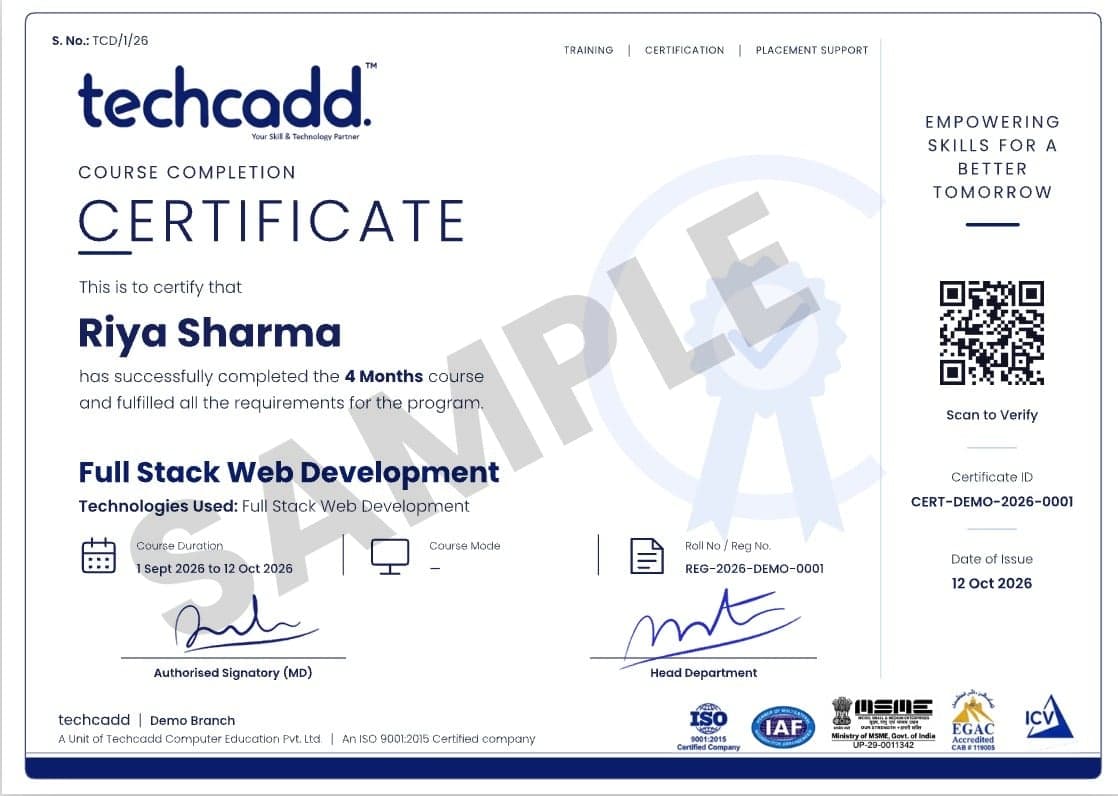
Your certificate lists your modules and projects, and our placement team works with you until you land the role.
Rated 4.9/5 by 750+ students on Google.
Straight answers on eligibility, batches, certification and placements.
Still have a question?
Counsellors are available Mon – Sat: 9:00 AM – 7:00 PM.
A MERN Stack course is a web-development program that teaches MongoDB, Express.js, React, and Node.js for building full-stack web applications.
Yes, MERN Stack can be learned by beginners when the learning path starts with programming and web-development fundamentals before moving into advanced concepts.
You can learn JavaScript, React, Node.js, Express.js, MongoDB, APIs, frontend development, backend development, database concepts, authentication basics, Git, and full-stack project development.
No, prior professional programming experience is not necessarily required, although basic computer skills and an interest in programming can make the learning process easier.
A typical syllabus can cover JavaScript fundamentals, React, Node.js, Express.js, MongoDB, REST APIs, frontend-backend integration, authentication concepts, Git, and practical projects; the exact Techcadd syllabus should be confirmed before enrolment.
The learning time varies according to the course structure, prior programming knowledge, practice time, and individual learning pace, so the current Techcadd course duration should be confirmed directly.
MERN Stack course fees vary between institutes and course formats, so the current Techcadd fee structure should be confirmed before enrolment rather than relying on a fixed figure.
Yes, MERN Stack can be learned online through structured instruction and hands-on coding practice, making it accessible to learners across different Indian states.
Yes, offline learning can be explored at the Techcadd centre in Jalandhar, Punjab, subject to current batch availability.
Depending on your practical skills and experience, possible roles include frontend developer, React developer, backend developer, Node.js developer, full-stack developer, web application developer, and junior software developer.
There is no single salary for MERN Stack learners because compensation depends on experience, location, technical ability, projects, employer, and role; salary figures should therefore be treated as approximate rather than guaranteed.
Yes, MERN Stack can support freelance work involving web applications, dashboards, APIs, business systems, frontend interfaces, and database-backed applications, depending on the freelancer's capabilities and client requirements.
The core technologies are MongoDB, Express.js, React, and Node.js, while supporting tools can include JavaScript, HTML, CSS, Git, GitHub, code editors, browser developer tools, REST APIs, JSON, and npm.
Yes, MERN Stack can provide a foundation for web-development careers by covering frontend, backend, database, API, and full-stack application concepts.
Yes, working professionals can learn MERN Stack through online or offline training depending on their schedule and location, although consistent coding practice is important.
Yes, students from Punjab can learn MERN Stack online, allowing learners from cities such as Amritsar, Ludhiana, Mohali, Patiala, and Phagwara to study without relocating.
Yes, learners from Haryana can join online MERN Stack training and build web-development skills while continuing their education or professional work.
Yes, students and professionals from Himachal Pradesh can learn MERN Stack online and develop skills relevant to software development, remote work, and freelancing pathways.
Yes, students from Rajasthan can learn MERN Stack through online training and use projects to develop practical skills for software development or freelance work.
Yes, MERN Stack can be suitable for learners from Uttar Pradesh who are interested in web development, software services, startups, or freelance application development.
Certificate availability and the applicable conditions should be confirmed with Techcadd because the exact certification arrangements are not established by the course title alone.
MERN Stack specifically refers to a combination of MongoDB, Express.js, React, and Node.js, whereas “web development” is a broader field that can involve many different programming languages, frameworks, databases, and technologies.
After building a strong MERN foundation, learners can consider areas such as TypeScript, testing, cloud deployment, DevOps, application security, system design, performance optimization, or other software-development technologies depending on their career goals.
Take the next step toward learning modern full-stack web development with structured training covering frontend, backend, databases, APIs, and practical application development. Enquire to understand the current syllabus, batch details, learning format, and course duration before making your decision.