Employee Management Portal
Role-based portal for departments, attendance and leave requests with reactive forms and dashboards.
- Angular
- RBAC
- MongoDB

Programming · Intermediate
Build enterprise-style web applications with MongoDB, Express, Angular and Node.js, using TypeScript, RxJS and modern deployment practices.
Eligibility: Basic HTML/CSS/JavaScript knowledge; graduates and final-year students welcome
4.9/5 from 750+ Google reviews
A MEAN Stack Course is designed to introduce learners to full-stack web application development using MongoDB, Express.js, Angular, and Node.js. Together, these technologies cover major parts of a modern web application, including the frontend, server-side application logic, APIs, and database management. (CSC India Learning)
The course can be useful for graduates, postgraduates, working professionals, career changers, aspiring developers, and learners interested in building web applications. Depending on the curriculum, learners can expect to work with JavaScript, Angular-based interfaces, Node.js and Express.js backend development, MongoDB databases, APIs, authentication, debugging, and application deployment.
MEAN Stack learning is particularly relevant for people who want to understand how different parts of a web application communicate rather than learning frontend or backend development in isolation.
For learners in Punjab, classroom learning can be explored at the Techcadd Jalandhar centre, while learners from other regions can consider the online learning option.
Why learn it now
Open any module to see exactly what you will learn. Every module ends with hands-on practice reviewed by your mentor.
Concepts become skills only when you use them. Each week follows the same three steps.
Short concept sessions with live demos — every idea is shown before it is practised.
Hands-on labs and a project at the end of every module, reviewed by your mentor.
Explain your work in weekly demos — the same way you will in interviews.
You practise on the same tools teams use every day — the ones interviewers ask about.
6 guided projects — each one reviewed by your mentor and ready to show in interviews.
A MEAN Stack Course can suit learners who want to move into full-stack web development and are willing to spend regular time practising programming concepts. Because the stack combines frontend, backend, database, and API development, learners should be prepared for hands-on coding rather than treating the course as purely theoretical training.
Graduates from computer science, IT, engineering, mathematics, business, or other backgrounds can consider MEAN Stack training if they want to develop software and web-development skills. A technical background can make some concepts easier to approach, but the more important factor is the learner's willingness to practise programming consistently.
Postgraduates who want to add a development skill to their existing qualification can use MEAN Stack training to move toward web-development roles. Learners from management or non-technical backgrounds may need additional time for programming fundamentals before progressing into the complete stack.
Working professionals in IT, software support, web services, digital products, or related areas can use MEAN Stack training for upskilling. Someone already familiar with programming may be able to connect the different technologies more quickly and apply them to existing technical responsibilities.
Professionals planning a move into software development can explore MEAN Stack as a structured pathway into full-stack development. A career switch should be approached realistically: completing a course is only one part of becoming job-ready, while coding practice, projects, debugging ability, Git usage, and interview preparation also matter.
MEAN Stack skills can be useful for freelancers who want to develop customized web applications rather than only managing basic websites. Freelance opportunities can involve frontend development, API development, database-backed applications, dashboards, authentication systems, and maintenance. However, freelance success depends on technical ability, portfolio quality, communication, project management, and finding suitable clients.
Entrepreneurs and business owners who want to understand the technology behind their digital products can benefit from learning full-stack concepts. MEAN Stack knowledge can help them communicate more effectively with developers and understand how application interfaces, servers, APIs, and databases work together.
People moving from another professional field can consider MEAN Stack if they are genuinely interested in programming. Unlike simpler digital tools, full-stack development requires consistent coding practice, logical thinking, debugging, and problem-solving.
Beginners can learn MEAN Stack, but they should understand that it is more technically demanding than basic website-building courses.
12th-pass students who have a strong interest in programming can explore the field, particularly if they plan to continue their formal education alongside skill development. The course should complement rather than replace a broader educational pathway for students at this stage.
What you need: A learner may need to first become comfortable with HTML, CSS, JavaScript, programming logic, and web fundamentals before moving deeply into Angular, Node.js, Express.js, and MongoDB.
Check My EligibilityPunjab learners can explore MEAN Stack development alongside the state's growing IT, startup, business, manufacturing, and digital-services ecosystem. Students from Jalandhar, Ludhiana, Amritsar, Mohali, and other areas can use online learning when attending a physical class is not practical.
Haryana has a strong concentration of corporate, IT, automobile, e-commerce, and logistics activity. Learners from Gurugram, Faridabad, Panchkula, and other cities can develop MEAN Stack skills with the aim of pursuing software-development or technology-oriented career paths.
For learners in Shimla, Dharamshala, and Solan, online MEAN Stack learning can provide access to a technical skill without requiring relocation. The ability to work remotely can also make web-development skills relevant for learners interested in remote employment or freelance projects.
Chandigarh's IT, BPO, education, startup, and professional-services environment can provide a useful context for learners developing software skills. MEAN Stack can complement learners who want to move toward application development rather than focusing only on digital content or marketing.
Delhi, Noida, and Ghaziabad offer exposure to IT services, software companies, agencies, e-commerce, fintech, media, and startups. Learners in this region can use MEAN Stack training as part of a broader software-development career strategy.
Students from Jammu and Srinagar can consider online MEAN Stack learning if they want to develop technical skills while remaining in their home region. Web applications can serve businesses and organizations across tourism, handicrafts, retail, e-commerce, and other sectors.
Learners from Dehradun and Haridwar can explore MEAN Stack as a technical skill alongside opportunities connected with education, tourism, hospitality, pharma, and digital services. Online learning can also support learners who are balancing education or employment.
Learners from Jaipur and surrounding areas can develop MEAN Stack skills for software and web-development opportunities while also exploring applications for tourism, retail, jewellery, handicrafts, and other digital businesses.
Learners from Lucknow, Meerut, Noida, and other parts of Uttar Pradesh can consider MEAN Stack for software development and technology careers. The skill can also be useful for learners who want to build applications for businesses, startups, or freelance clients.
MEAN Stack skills can support different web-development career directions, depending on a learner's programming ability, projects and practical experience.
The skills can also be relevant across industries such as IT services, SaaS, e-commerce, education, healthcare, logistics, travel, media, fintech and startups. For freelancers and independent developers, MEAN Stack knowledge can be useful for developing business websites, dashboards, customer portals, database-driven applications and custom web solutions.
Web applications continue to require people who understand more than one layer of development. Learning frontend, backend, APIs and databases together can therefore provide a broader technical foundation than focusing on only one development area. For a beginner, the goal should not simply be to learn the names of four technologies. The stronger objective is to understand how a complete web application is planned, developed, connected, tested and improved using the MEAN ecosystem.
Learners in Jalandhar, Ludhiana, Amritsar, Mohali, Patiala and Phagwara can build MEAN Stack skills for local IT companies, software services, startups and freelance web-development opportunities.
Cities such as Gurugram, Faridabad, Panchkula, Ambala and Karnal have strong connections with IT services, e-commerce, corporate businesses and technology-driven organisations, making full-stack development a relevant skill area.
Learners in Chandigarh can explore web-development opportunities connected with IT services, startups, education, BPO and technology-focused businesses.
For learners from Delhi, Noida and Ghaziabad, MEAN Stack skills can be relevant to software companies, digital businesses, SaaS companies, agencies, e-commerce and technology startups.
Learners from Shimla, Dharamshala and Solan can use online learning to build development skills without depending entirely on local classroom availability, while also exploring remote work and freelance opportunities.
Students from Jammu and Srinagar can use online MEAN Stack learning to develop technology skills that can support remote employment, freelance projects and broader software-development opportunities.
Learners from Dehradun, Haridwar, Jaipur, Lucknow and Meerut can similarly use online training to build full-stack development capabilities while remaining connected to opportunities beyond their immediate city.
Every batch is led by a senior mentor and supported by teaching assistants, so doubts are cleared the same day.
Senior Full-Stack Mentor
Has built web platforms for startups and export businesses across Punjab. Teaches with live coding and code reviews, so students learn how real teams write, test and ship software.
One of the main advantages of learning MEAN Stack is that learners can understand how the frontend, backend, APIs, and database interact within a web application. The stack brings MongoDB, Express.js, Angular, and Node.js into one development workflow. (CSC India Learning)
Angular gives learners a structured framework for building web interfaces. Learning components, routing, forms, services, and application logic can help learners understand how more complex frontend applications are organized.
Node.js allows JavaScript to be used on the server side. Learners can explore server-side programming, application logic, APIs, request handling, and communication between the frontend and backend.
Express.js is commonly used with Node.js to structure server-side applications and APIs. Understanding API development helps learners see how frontend applications communicate with backend services.
A full-stack application often needs a database to store and retrieve information. MongoDB gives learners experience with document-oriented database concepts and CRUD operations.
MEAN Stack becomes more meaningful when learners connect its individual technologies into working applications. Projects can help them practise frontend development, backend logic, database operations, API integration, authentication, and debugging together.
A portfolio can demonstrate what a learner can actually build. Full-stack projects can showcase skills such as responsive interfaces, APIs, database integration, authentication, application logic, and deployment.
Depending on experience and additional skills, learners may explore roles such as: Full-Stack Developer, Angular Developer, Node.js Developer, JavaScript Developer, Web Application Developer, Backend Developer, Frontend Developer. A course does not automatically qualify someone for every role; practical proficiency and project experience remain important.
MEAN Stack skills can be useful for freelancers who want to work on customized web applications, dashboards, business tools, APIs, database-driven applications, or ongoing development projects.
Learning the MEAN ecosystem can give learners a structured understanding of frontend and backend development. They can later expand into areas such as TypeScript, testing, cloud deployment, DevOps, advanced databases, system design, or other development frameworks.
For professionals moving toward software development, MEAN Stack can provide a focused technology pathway. However, successful career switching requires consistent coding practice and should include projects, Git/version control, debugging, problem-solving, and interview preparation alongside the course.
Web applications are used across sectors such as e-commerce, education, finance, healthcare, logistics, SaaS, media, travel, and professional services. This gives full-stack development skills relevance beyond a single industry.
The value of MEAN Stack learning is not limited to memorizing four technologies. Learners can develop broader abilities in programming logic, application architecture, API communication, databases, debugging, version control, and software-development workflows. Overall, the MEAN Stack Course can be a suitable pathway for learners who want to move beyond basic website creation and develop the technical ability to build database-driven, interactive web applications.
Techcadd is “North India's first AI-powered and Robotics learning centre”. For MEAN Stack learners, exposure to a technology-focused learning environment can help connect web development skills with the wider direction of modern technology.
MEAN Stack development becomes easier to understand when learners actually build applications rather than only studying concepts. Practical exercises can cover frontend interfaces, backend APIs, database operations, authentication and complete web applications.
The learning path can focus on the four core technologies of MEAN Stack—MongoDB, Express.js, Angular and Node.js—along with supporting development skills such as JavaScript, TypeScript, REST APIs and version control.
MEAN Stack can appear complex to beginners because frontend, backend and database concepts are connected. Structured guidance can help learners gradually move from basic programming concepts to building and understanding full-stack applications.
Learners can choose the learning format that suits their circumstances. Offline learning is available at the Jalandhar centre, while online learning can make the course accessible to students and professionals from other North Indian locations.
Building practical applications gives learners something more meaningful to discuss during interviews or freelance discussions. Depending on the curriculum, projects may involve dashboards, business websites, API-driven applications, authentication systems or database-based web solutions.
MEAN Stack knowledge can support several web-development pathways, including frontend, backend and full-stack roles. Learners can gradually strengthen their programming, API development, database and application-development abilities according to their career goals.
Online learning can make MEAN Stack training accessible to learners from Punjab, Haryana, Himachal Pradesh, Chandigarh, Delhi NCR, Jammu & Kashmir, Uttarakhand, Rajasthan and Uttar Pradesh, without requiring everyone to relocate to Jalandhar.
Learn MEAN Stack as a certificate course, as university industrial training, or as a longer job-ready diploma.
| Feature | Certificate Course | Industrial TrainingMost chosen | Job-Ready Diploma |
|---|---|---|---|
| Typical duration | 5–6 Months | 6 weeks – 6 months | 9 – 12 months |
| Full course curriculum | |||
| Module projects | |||
| Live industry project | Not included | ||
| University training report & letter | Not included | ||
| Advanced specialisation modules | Not included | Not included | |
| Placement assistance | |||
| Internship with experience letter | Not included | Not included |
Weekday Morning
Mon – Fri · 9:00 – 11:00 AM
ClassroomWeekday Evening
Mon – Fri · 5:00 – 7:00 PM
ClassroomWeekend
Sat – Sun · 10:00 AM – 1:00 PM
Classroom + LiveLive Online
Mon – Fri · 8:00 – 9:30 PM
Live onlineNot sure which track or batch suits you? A counsellor will help you decide.Ask a Counsellor
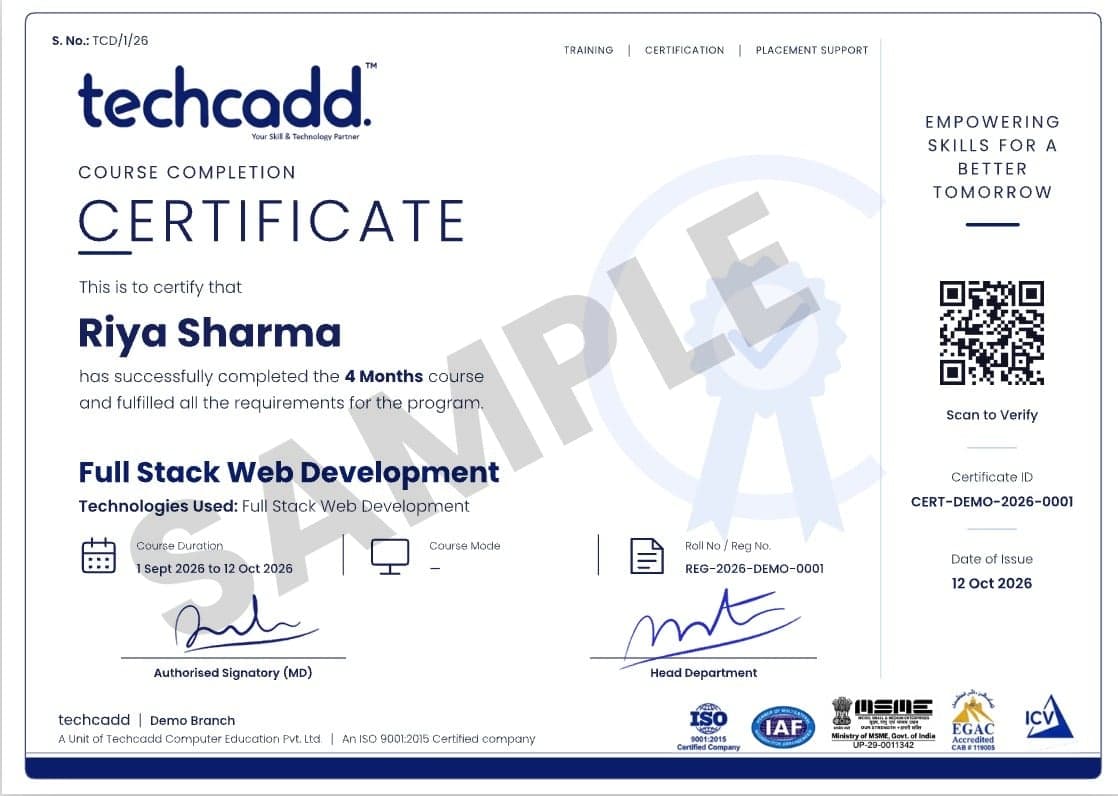
Your certificate lists your modules and projects, and our placement team works with you until you land the role.
Rated 4.9/5 by 750+ students on Google.
Straight answers on eligibility, batches, certification and placements.
Still have a question?
Counsellors are available Mon – Sat: 9:00 AM – 7:00 PM.
A MEAN Stack Course teaches full-stack web development using MongoDB, Express.js, Angular and Node.js, along with supporting programming and development tools.
Graduates, postgraduates, students, working professionals, career changers and beginners interested in web development can consider the course.
Yes, beginners can learn MEAN Stack by starting with programming and web-development fundamentals before progressing to Angular, Node.js, Express.js and MongoDB.
The four core technologies are MongoDB, Express.js, Angular and Node.js.
Yes. Both are JavaScript-based full-stack technologies, but MEAN uses Angular, whereas MERN uses React as its frontend technology.
JavaScript is central to MEAN Stack, while TypeScript is commonly used for Angular development.
Depending on the curriculum, learners may work with Angular, Node.js, Express.js, MongoDB, Mongoose, REST APIs, Git, GitHub, npm, Postman and Visual Studio Code.
Yes. Online learning can allow students and working professionals to study MEAN Stack without attending a physical classroom.
Techcadd offers Online + Offline learning, with its physical centre located in Jalandhar, Punjab.
Possible career directions include Full Stack Developer, Angular Developer, Node.js Developer, JavaScript Developer, Frontend Developer, Backend Developer and Web Application Developer.
Yes. Full-stack skills can be useful for freelance projects involving websites, dashboards, APIs, business applications and database-driven web solutions.
Yes. Working professionals can use online learning to develop or upgrade their web-development skills alongside their existing work, subject to their available time.
It can be useful for career changers who want to move towards software and web development, particularly when they combine course learning with programming practice and projects.
Depending on the curriculum and learner's skill level, projects can include dashboards, customer portals, management applications, authentication systems, API-driven applications and database-based web applications.
No certificate alone can guarantee employment. Employers may also consider programming ability, practical projects, problem-solving skills, technical understanding and interview performance.
Yes. Learners in Punjab can explore opportunities in IT services, software companies, startups, e-commerce businesses and freelance development, depending on their skills and experience.
Yes. Learners from Gurugram, Faridabad, Delhi, Noida and Ghaziabad can use MEAN Stack skills for exploring software, SaaS, e-commerce, IT services and technology-sector opportunities.
Yes. Students from Shimla, Dharamshala and Solan can use online learning to develop full-stack skills while remaining in their home location.
Yes. Learners from Jammu and Srinagar can use online learning to access MEAN Stack training and develop skills relevant to remote work, freelancing and software-development careers.
After building a strong MEAN foundation, learners can deepen their knowledge through advanced Angular, backend architecture, API development, authentication, testing, deployment, cloud technologies and larger real-world projects.
Book a free demo class, meet your mentor and get a personalised learning plan — no commitment.