12th-pass students & beginners
Start with HTML, CSS and programming logic; basic computer use is enough to begin.

Learn how complete web applications are built — from the frontend interface to backend logic, databases, APIs and the fundamentals of deployment — by building real projects.
Program snapshot
Full Stack Development · All Levels
Same trainers and live projects on every track. Pick the length that fits your semester or career plan — a counsellor shares fees and scholarships.
3months
Core skills and guided projects for students on a short timeline or professionals upskilling.
6months
University-approved industrial training with a live project, training report and internship letter.
9months
Everything in the 6-month track plus advanced modules and an internship on real client work.
This training shows how modern web applications are created, from the frontend interface to the backend systems that process data and business logic. Instead of focusing on one part of web development, it brings together frontend development, backend programming, databases, APIs and the fundamentals of deploying web applications.
You progress from web-development fundamentals — HTML, CSS, responsive design and JavaScript — towards building complete applications and understanding how the layers work together. The learning is practice-oriented: you write code, connect application components, work with data, debug problems and build a portfolio of genuine project work.
Included on every track.
Who can join: 10+2 or any graduate; B.Tech/BCA/MCA/diploma students welcome.
3 phases, each ending in work you can show. Tap a phase or use the arrow keys to explore.
Phase 1 of 3
Understand how websites work, then structure and style responsive pages yourself.
By the end: You can build a structured, responsive web page without relying on a template.
Phase 2 of 3
Add programming logic to your pages, then learn how the server side processes requests.
By the end: You can add interactive behaviour to pages and explain how the server side handles a request.
Phase 3 of 3
Store and retrieve data, connect the layers through APIs and manage your code like a developer.
By the end: You can connect a front end, a back end and a database into one working application.
Full stack skills cover both the client and server side of an application, which supports several software and web development paths and builds transferable abilities such as debugging, version control, API integration and database handling.
10+2 or any graduate; B.Tech/BCA/MCA/diploma students welcome.
Start with HTML, CSS and programming logic; basic computer use is enough to begin.
Add practical development skills to a technical or non-technical degree.
Move beyond a single technology and understand front end, back end and databases together.
Understand what goes into websites, portals and digital products, and communicate better with technical teams.
A structured route into programming and web development, backed by projects and a portfolio.
Handle client projects that need functionality, APIs and databases, not only page design.
You install, configure and ship with every one of these in the lab — the stack employers expect on day one.
Page structure and semantics
Styling, Flexbox, Grid and responsive layouts
Programming logic and interactivity
Code editor
Inspecting and debugging pages
Version control
Hosting code and portfolio projects
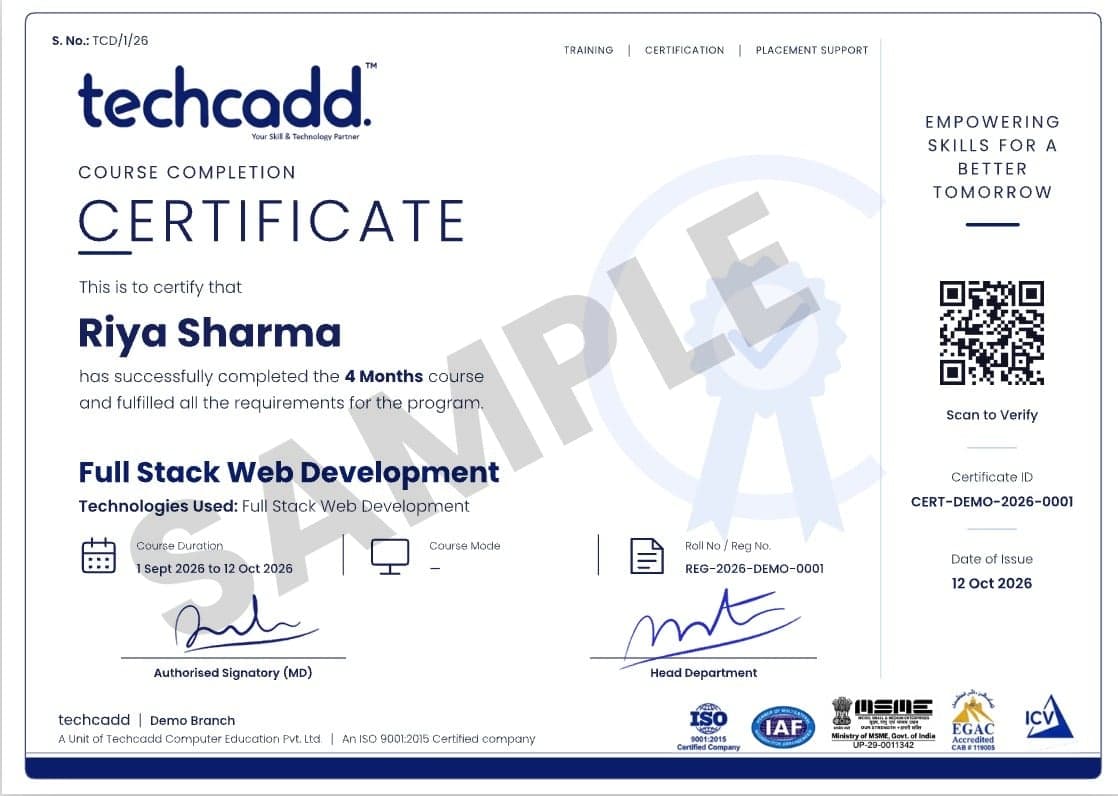
Industry recognised
QR-verifiable certificate with your course, duration, registration number and certificate ID.
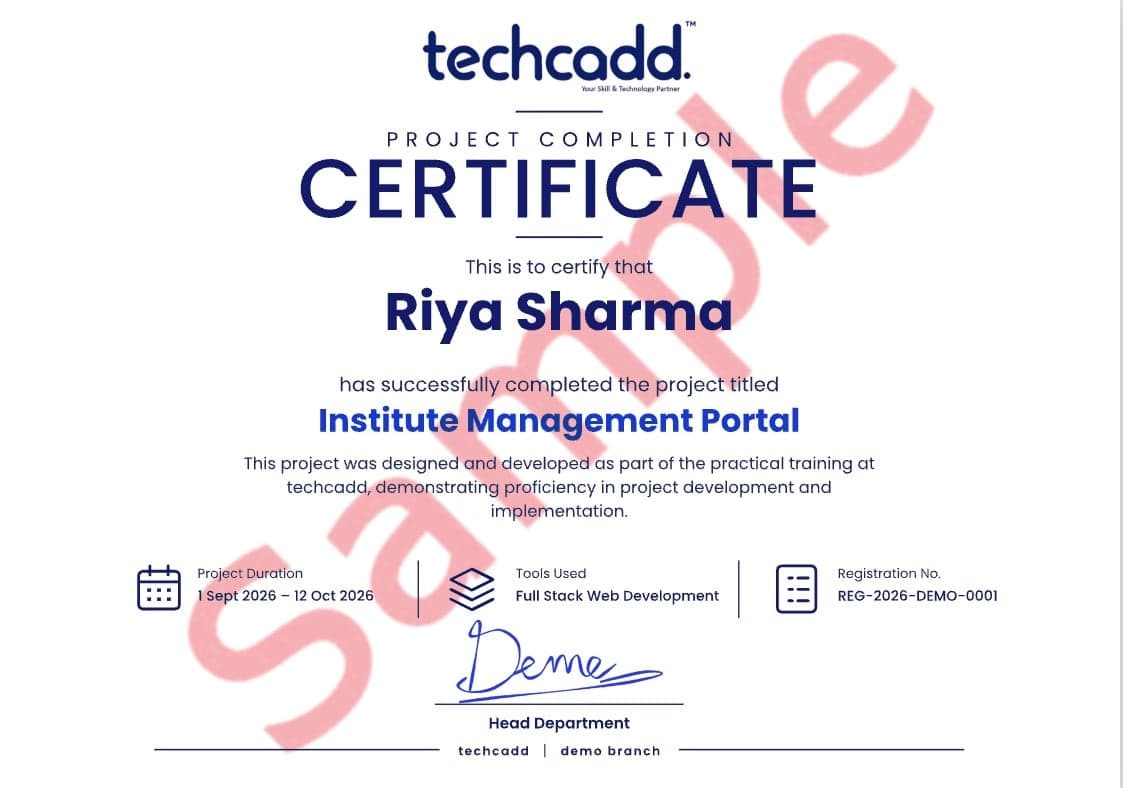
Live project
Names the live project you built, its tools and dates — issued with your internship letter for university training credit.
Every certificate has a unique number that anyone can verify on techcaddjalandhar.com.
Online-verifiable certificate listing your modules, projects and grade.
Experience letter for your live-project internship, accepted for university credit.
Four reviewed projects on GitHub or Behance that you can walk an interviewer through.
Resume and portfolio review, mock interviews and referrals until you are hired.
Straight answers to the career questions students ask us most.
Depending on your additional knowledge and experience, you can explore roles such as Full Stack Developer, Web Developer, Frontend Developer, Backend Developer, Software Developer, Junior Software Engineer and Application Developer. Job requirements vary between employers, so programming fundamentals and practical projects count alongside course completion.
After the core skills, developers typically specialise in frontend engineering, backend development, databases, cloud technologies, DevOps or application architecture as their experience grows.
It can be. Client websites, dashboards, APIs and other digital products are common freelance work. Success also depends on communication, project estimation, portfolio quality, reliability and understanding client requirements.
IT services companies, startups, digital agencies, e-commerce and other digital businesses across Punjab, Chandigarh Tricity, Haryana and Delhi NCR, where websites, customer portals and internal applications are part of everyday operations. Remote development work is also an option.
Choose a direction to specialise in: frontend engineering, backend development, cloud technologies, DevOps, databases or application architecture. Our MERN Stack and Cloud Computing programs are natural next steps.
Each project is reviewed by a trainer and published to your portfolio before you move on.
Build a multi-page site with semantic HTML, a mobile-first layout and a working contact form.
Add JavaScript logic, DOM updates and form validation to build an app that manages tasks in the browser.
Build a portal from a client-style brief with server-side routing, authentication and records stored in a database.
Plan and build an application that connects a front end, an API and a database, with the code and a write-up of your contribution on GitHub.
Repeated for every module, so the job feels familiar before you get it.
Every task starts like a real job: a brief, a deadline and a clear definition of done.
You build it yourself in the lab while a mentor reviews your work and unblocks you.
Demo your work and answer questions — practice for interviews and client calls.
Mentors who still ship real projects for clients.
Real briefs, not copy-paste sample projects.
Personal attention and same-day doubt clearing.
Longer tracks include an internship and experience letter.
Resume, mock interviews and referrals to 500+ partners.
Nearly two decades of training students across North India.
What changes when training is built around live work.
| What matters | TechCADD | Typical institute |
|---|---|---|
| Training style | Hands-on labs every class | Mostly theory & slides |
| Projects | Live client briefs & capstone | Sample projects only |
| Batch size | Small batches | Large classrooms |
| Trainer background | Working industry professionals | Full-time trainers only |
| Internship | Included in longer tracks | Rarely offered |
| Placement support | Resume, mock interviews & referrals | Job list on request |
| Doubt clearing | Same day, 1:1 if needed | Weekly, if at all |
| Certification | Verifiable certificate + internship letter | Paper certificate |
01
One of the main advantages of full stack learning is that it connects different parts of web development. Instead of understanding only how a webpage looks, learners can explore how the frontend communicates with backend services, how information is stored and how application logic works.
02
Full Stack Development is strongly practice-oriented. Learners can work toward building websites and web applications rather than limiting their learning to programming theory. Practical development also provides opportunities to identify errors, debug code and improve an application over time.
03
A full stack developer needs to understand both client-side and server-side development. Learning these areas together can give students a broader technical perspective and help them understand how different components of an application interact.
04
Projects can be an important part of demonstrating development ability. A learner can use completed websites, applications and other practical work as evidence of their skills when applying for jobs, internships or freelance opportunities. A portfolio should show genuine work and explain what the learner contributed rather than simply listing technologies.
05
Full stack skills can support several technology career pathways. Depending on additional knowledge and experience, learners may explore roles such as: Full Stack Developer, Web Developer, Frontend Developer, Backend Developer, Software Developer, Junior Software Engineer, Application Developer. Actual job requirements vary between employers, so learners should develop programming fundamentals and practical experience alongside course completion.
06
For someone moving into technology from another field, Full Stack Development can provide exposure to several areas of software development within one learning path. It can help a career changer determine whether programming, frontend development, backend development or application development is a suitable direction.
07
Websites and web applications are common areas of freelance development. A learner with practical full stack capabilities may be able to work on client websites, dashboards, APIs or other digital products. However, freelancing requires more than technical knowledge. Communication, project estimation, portfolio development, reliability and understanding client requirements are equally important.
08
Businesses increasingly rely on websites, online services, customer portals and internal applications. Understanding full stack development can help learners contribute to the technical side of these digital products. It can also be valuable for business owners who want enough technical understanding to communicate with developers and evaluate digital-product requirements.
09
Full stack learning involves more than individual programming languages. Learners can develop transferable abilities such as logical thinking, debugging, version control, API integration, database handling and understanding application architecture. These skills can remain useful even when specific technologies change.
10
Full Stack Development can act as a foundation for deeper areas of technology. After developing core skills, learners can choose to specialise in frontend engineering, backend development, cloud technologies, DevOps, databases, application architecture or other software-development areas. For beginners, the strongest approach is to first build solid programming and web-development fundamentals before moving into increasingly advanced technologies.
11
Yes, it can be suitable for beginners when the learning path starts with fundamentals and progresses gradually. Beginners should understand that becoming comfortable with full stack development takes practice. Completing lessons is only the beginning; building projects, debugging applications and repeatedly applying concepts are important parts of developing real-world ability. The value of the program therefore comes from combining structured learning with consistent practice, project work and continued skill development.
Learners from Jalandhar, Ludhiana, Amritsar, Mohali and other parts of Punjab can use full stack training to develop skills relevant to IT services, startups, digital businesses and technology-oriented roles. Classroom learning is available through the Jalandhar centre, subject to current course availability.
Learners from Gurugram, Faridabad, Panchkula and other areas can explore Full Stack Development alongside the state's IT-services, e-commerce, automobile and logistics ecosystem. Online learning can be useful for students who are not near Jalandhar.
Students from Shimla, Dharamshala, Solan and other areas may find online full stack learning useful because it provides access to technical training without requiring relocation. Remote work and freelancing can also make web-development skills relevant to learners in the state.
Learners in Chandigarh and the Tricity can consider Full Stack Development for technology, BPO, startup and digital-business pathways. The skill set can be particularly useful for learners who want to understand complete web applications rather than only frontend design.
Students and professionals from Delhi, Noida and Ghaziabad can explore full stack skills in the context of the region's large IT, media, fintech, e-commerce and digital-services ecosystem. Online learning can provide flexibility alongside work or studies.
Learners from Jammu and Srinagar can use online training to develop web-development capabilities without depending on a local physical training centre. Full stack skills can also support remote-development and freelance-oriented career exploration.
Students from Dehradun, Haridwar and other parts of Uttarakhand can learn Full Stack Development online and apply those skills to technology-enabled businesses, education, hospitality and remote-work opportunities.
Learners from Jaipur and other areas can explore full stack development as a practical technology skill alongside the state's tourism, retail, handicrafts and growing digital-business environment.
Students and professionals from Lucknow, Meerut and other parts of Uttar Pradesh can consider Full Stack Development for IT, electronics, retail and digital-business opportunities. Online learning can make the program accessible beyond cities with dedicated technology-training options.
4.9750+ Google reviews
Switch modes if your schedule changes — your projects and progress move with you.
Lab-based batches at our North India branches.
Interactive live sessions with recordings for revision.
Saturday–Sunday batches for college students and working people.
Personal mentoring at your pace and schedule.
26 questions
No. Basic computer use is helpful, and prior development experience is not essential. Beginners should expect to spend significant time practising HTML, CSS and programming logic before tackling more complex applications.
HTML, CSS and JavaScript form the core, followed by backend programming, databases, APIs and version control with Git. The specific backend language, framework and database follow the current curriculum, so confirm them before you enrol.
The front end is what users see and interact with; the back end handles server-side processing, application logic and data. Full stack learning covers both, so you understand how the parts of an application communicate.
Yes. Completed websites and applications are evidence of your skills when applying for jobs, internships or freelance work. A portfolio should show genuine work and explain what you contributed, not just list technologies.
Both formats exist: classroom learning at the Jalandhar centre and online learning for those further away. Confirm current batch schedules and delivery format before enrolling.
A Full Stack Development Course teaches the frontend, backend, database and application-development concepts required to understand and build complete web applications.
Graduates, postgraduates, students, working professionals, beginners, freelancers and career changers can consider a Full Stack Development Course if they are willing to learn programming and practise regularly.
Yes, Full Stack Development can be suitable for beginners when the course starts with programming and web-development fundamentals before progressing to more advanced topics.
A typical syllabus can cover HTML, CSS, JavaScript, frontend development, backend programming, databases, APIs, Git and application development, although the exact Techcadd syllabus should be confirmed before enrolment.
The duration depends on the specific course structure, learning schedule and depth of coverage, so the current Techcadd course duration should be confirmed directly rather than assuming a fixed timeframe.
Yes, Full Stack Development can be learned online, and online learning can make the program accessible to students who are outside Jalandhar or prefer remote learning.
Classroom learning can be explored at the Techcadd centre in Jalandhar, Punjab, subject to current course and batch availability.
Common technologies include HTML, CSS, JavaScript, frontend frameworks, backend technologies, databases, REST APIs, Git and GitHub, but the exact tools included in the Techcadd course should be confirmed from its current syllabus.
Depending on your skills and experience, Full Stack Development can support roles such as Full Stack Developer, Web Developer, Frontend Developer, Backend Developer, Software Developer and Junior Software Engineer.
Yes, Full Stack Development can support freelance work involving websites, web applications, APIs and other digital products, although successful freelancing also requires a portfolio, communication skills and the ability to manage client requirements.
The career scope includes frontend, backend, full stack and broader software-development pathways across industries such as IT services, e-commerce, fintech, digital agencies, media and other technology-driven businesses.
No, a computer science degree is not necessarily required to start learning Full Stack Development, although learners from non-technical backgrounds may need additional time to build programming fundamentals.
Yes, students from different parts of Punjab can explore online Full Stack Development learning, while classroom learning can be explored through the Jalandhar centre.
Yes, learners from Haryana can consider online training, which can be useful for students and working professionals who want to learn without relocating.
Yes, online learning can provide students in Himachal Pradesh with access to Full Stack Development training and can complement remote-work or freelance-oriented career plans.
Yes, students from Uttar Pradesh can consider Full Stack Development as a pathway toward web and software-development skills, particularly when combined with practical projects and programming fundamentals.
Yes, learners from Rajasthan can use online learning to develop full stack skills while building projects that demonstrate their practical abilities.
No, certification alone is not enough to guarantee a job; employers may also evaluate programming ability, projects, problem-solving, technical knowledge and practical development experience.
No institute can honestly guarantee a job. We provide placement assistance — resume and portfolio reviews, mock interviews and referrals to 500+ hiring partners — and keep supporting you until you are placed.
Book a free counselling session or message us on WhatsApp. A counsellor will share the current fee, EMI options and scholarships for your chosen track.
Yes. Book a free demo using the form on this page or call us. You can attend at any branch or join a live online class.
Sit in a free demo class or talk to a counsellor about your background and goals — no obligation.
Tell us a little about yourself — we'll suggest the right track, share fee and scholarship details and book your free demo.
2nd Floor, Crystal Plaza, SCS 78, Opposite PIMS Hospital, Jalandhar, Punjab 144001Mon – Sat: 9:00 AM – 7:00 PM