Month 01
Digital marketing fundamentals
Understand how businesses find customers online and how the channels work together.
- WordPress
- Canva
- Google Search Console
Project: Marketing plan for a local business

After 12th · 4-month trackExtended starter
You learn to bring customers, leads and sales to a business through search, ads, social media, content and email, and to measure what worked.
4.9 on Google750+ reviews
Program
Digital Marketing
4months
One subject, one term, one live project.
Digital marketing is taught hands-on: instead of only theory, you build keyword and content plans, set up ad accounts, work on campaign exercises and learn to read performance data. The curriculum moves from fundamentals to advanced practice, and each module ends with a task you complete yourself. It starts from the basics and builds step by step, so beginners can follow without earlier experience. By the end you have a set of completed exercises and a live project that you can show as a portfolio.
The 4-month program adds one more month to the starter track, so you practise on a live campaign before you finish. You leave with four projects and a certificate — and every class counts if you later move up to the 6 or 9-month track.
Your 4 months at a glance
By the end of the digital marketing program (4 months) you can do each of these on your own.
You can explain how the channels work together and draft a simple marketing plan for a business.
You can audit a website, build a keyword map and suggest practical fixes.
You can set up and review a Google Ads campaign and judge whether the spend is working.
You can plan a monthly content calendar and run a basic paid social campaign.
Month 01
Understand how businesses find customers online and how the channels work together.
Project: Marketing plan for a local business
Month 02
Learn how to help a website get found on search engines.
Project: SEO audit and keyword map
Month 03
Set up and review search advertising and judge whether the spend is working.
Project: Search campaign setup
Month 04
Plan content and run paid campaigns on the platforms people use every day.
Project: Monthly content calendar
Pick a month to see exactly what is taught, which tools you use and what you ship.
Month 1 of 4
Understand how businesses find customers online and how the channels work together.
Tools this month
You ship
Marketing plan for a local business
Draft a simple digital strategy and website structure for a practice brand, mapped to its customer journey.
Month 2 of 4
Learn how to help a website get found on search engines.
Tools this month
You ship
SEO audit and keyword map
Audit a website, build a keyword map for it and list the practical fixes you would make first.
Month 3 of 4
Set up and review search advertising and judge whether the spend is working.
Tools this month
You ship
Search campaign setup
Structure a Google Ads search campaign for a practice business, with ad copy, a budget and conversion tracking.
Month 4 of 4
Plan content and run paid campaigns on the platforms people use every day.
Tools this month
You ship
Monthly content calendar
Plan a month of social media content for a practice brand and set up a basic paid campaign with a defined audience.
10 tools across 4 months — introduced only when a project needs them.
Everything is installed in our labs. On your own laptop, a mentor helps you set it up in the first week.
Arts, commerce, medical or non-medical — start Digital Marketing from zero, before or alongside your degree.
BCA, B.Tech, B.Sc or B.Com students who want real project work next to their syllabus.
Finished a degree in another field? Build job-ready Digital Marketing skills with a portfolio to prove them.
Learn enough Digital Marketing to take paid work or bring the skill into your own business.
Most learners stop at: Collects scattered tips from tutorials
You get to: Completes a hands-on task in every module
Most learners stop at: Posts content and hopes for results
You get to: Measures clicks, leads and sales in numbers
Most learners stop at: Depends fully on an agency
You get to: Plans budgets and runs own campaigns
Most learners stop at: Has only a certificate to show
You get to: Has a portfolio of campaign work
Ten minutes on a call is enough to know whether 4 months of Digital Marketing fits your stream, your college plans and your goal.
4 reviewed projects
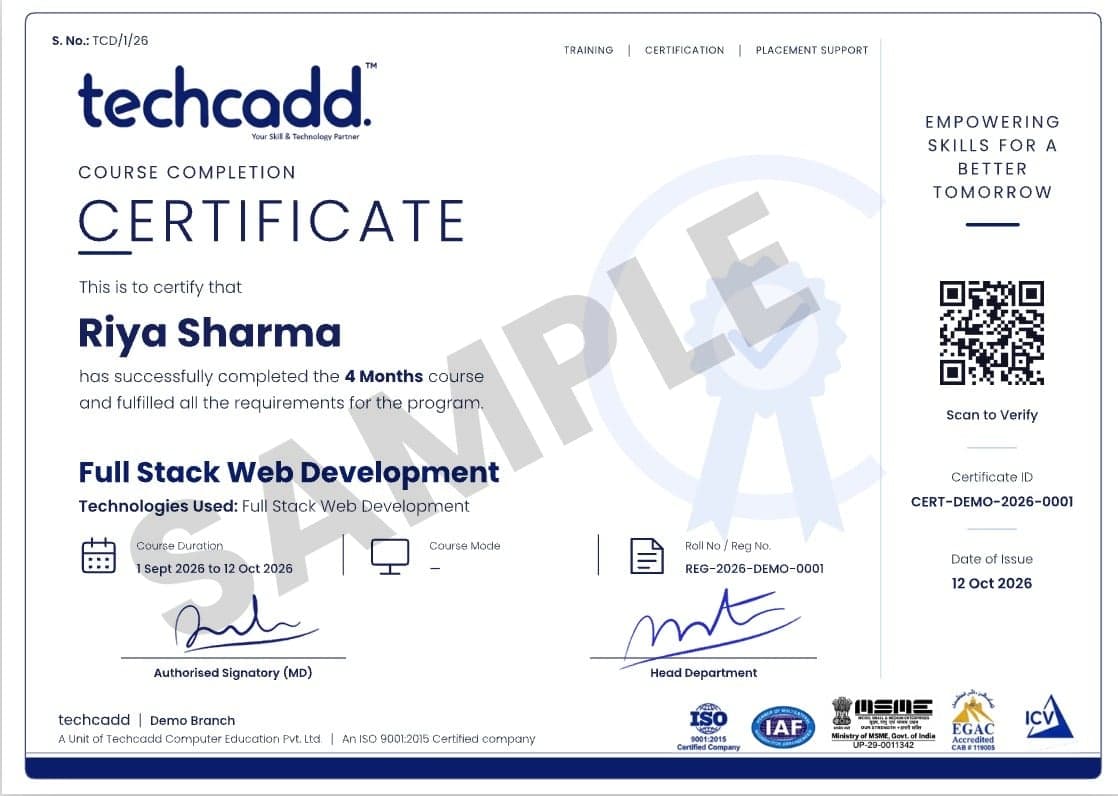
You finish the digital marketing program (4 months) with proof of what you built — not only a piece of paper.
Online-verifiable certificate that lists your modules, projects and grade.
Issued for live-project work on the longer tracks and accepted for college credit.
One reviewed project per month that you can walk an interviewer through.
Resume review, mock interviews and referrals to our hiring partners.
Four roles Digital Marketing learners grow into — each one builds on the last.
Role 1 of 4
Plans and runs day-to-day marketing activity across search, social media, content and email.
Role 2 of 4
Improves how a website is found on search engines through keyword research, on-page work and audits.
Role 3 of 4
Sets up, tracks and optimises paid search and paid social campaigns against a budget.
Role 4 of 4
Plans content calendars, manages brand pages and communities, and reviews how posts and campaigns perform.
Every topic in every month runs through the same three steps.
Step 1
A short concept class with a worked example — you see why before you see how.
Step 2
You build it yourself in the lab while a mentor reviews your work and unblocks you.
Step 3
You demo the result and answer questions — practice for every interview to come.
A first course after 12th should leave you with skills you can show, not notes you can't use.
You move on when your project is reviewed and working — not when the month ends.
The same tools, devices and accounts that working teams use every day.
Mentors who deliver client projects, so what you learn is what is used.
Start with 3 months and continue to 6 or 9 without repeating a single class.
Digital marketing is one of the few career skills where you can see your results in numbers. A well-run ad campaign shows clicks, leads and sales. A strong SEO plan shows rankings and traffic. This program is built around that idea: you learn by doing, and you measure what you do.
01
Almost every business now needs customers online, from a clothing brand to a coaching centre to a manufacturer looking for export enquiries. That demand creates roles in SEO, performance marketing, social media, content, email and analytics, and it also creates steady freelance and consulting work.
02
You do not just watch tutorials. You research keywords, plan content calendars, set up Google Ads and Meta Ads accounts, build email sequences and review GA4 reports. By the end, you have real exercises and a portfolio you can show to employers or clients.
03
The same training can lead to a job as an SEO executive, social media manager, PPC specialist, content marketer or analytics associate. It can also lead to freelancing, running your own agency or growing your family business online.
04
Marketing keeps changing, and so does the toolset. You learn how to use today's platforms along with AI tools for research, content drafts, ad copy ideas and reporting, while keeping human judgment and quality control in charge.
05
Live online classes make the course accessible whether you are a working professional in Panchkula, a freelancer in Dehradun or a student in Jaipur. Recorded revision support and weekly practice tasks help you keep pace if you miss a session.
06
If you run a business, you can apply each module directly to your own brand and see the impact. If you want a job, the same exercises become case studies for interviews.
techcadd's live online classes let you learn from wherever you are. The local business context shapes how you apply the skills, so here is how learners from each region typically use them.
A digital marketing course in Punjab suits exporters, hosiery and sports goods makers, and small manufacturers who want to sell and generate enquiries online instead of relying only on dealers.
Learners looking at a digital marketing course in Haryana often aim for performance marketing, e-commerce and logistics roles with the companies around Gurugram and Faridabad.
A digital marketing course in Himachal Pradesh helps hotel and homestay owners in Shimla, apple growers and remote freelancers who want to reach customers beyond the hills.
For a digital marketing course in Chandigarh, the main draw is the tricity's IT, BPO and startup ecosystem, where content, social media and analytics roles are common.
Students choosing a digital marketing course in Delhi often target agencies, fintech and media firms, including those in Noida, since this is India's largest fresher job market.
A digital marketing course in Jammu and Kashmir is useful for handicraft sellers, tourism operators and horticulture businesses in Srinagar who want to sell on marketplaces and social platforms.
Learners seeking a digital marketing course in Uttarakhand often come from tourism, hospitality and education in Dehradun, where online bookings and reviews drive growth.
A digital marketing course in Rajasthan fits jewellery, textile and handicraft sellers in Jaipur who want to reach buyers across India and abroad.
For a digital marketing course in Uttar Pradesh, retail, electronics and government-linked roles in Lucknow and Meerut create steady demand for local SEO and social media skills.
Wherever you are starting from, the course is designed so you can begin as a beginner and finish with practical, portfolio-ready experience.
25 questions
4 months, with one module and one reviewed project per month. Classes are practical first: most of every session is spent building.
They share one roadmap. 3 months covers the foundations with guided projects, 6 months reaches portfolio level with an industry certificate and placement support, and 9 months adds specialisation, an internship-style capstone and placement preparation.
Anyone with basic computer and internet knowledge can join, including 12th-pass students. No technical or marketing background is required, and a willingness to practise every week matters more than your starting level.
No. You do not need a technical or design background to start. If you can use a smartphone, browse the internet and are curious about how brands find customers online, you can learn this skill.
Yes. Many learners offer services such as SEO, social media management, content writing or ad setup as freelancers. The program covers portfolio building, client communication and proposals, but finding your first clients takes consistent effort.
Program certificate, a portfolio of 4 reviewed projects and guidance on what to learn next.
Yes. You can move up to the 6-month certificate program or the 9-month diploma program and carry on from where you stopped — no class is repeated.
Yes. The program starts from zero and is open to arts, commerce, medical and non-medical students. You only need basic computer skills.
Yes. Morning, evening and weekend batches are available, and live online classes come with recordings for revision.
No institute can honestly guarantee a job. We give placement support — resume and portfolio reviews, mock interviews and referrals — and keep helping until you are placed.
Book a free counselling session or message us on WhatsApp. A counsellor will share the current fee, instalment options and scholarships for your chosen program.
Anyone with basic computer and internet knowledge can join, including graduates, postgraduates, working professionals, job switchers, freelancers, business owners and 12th-pass students. No technical or marketing background is required.
The program is structured module by module, and batch speed (regular, weekend or fast-track) can change the total timeline. Confirm the current duration at your free demo class.
The syllabus covers digital marketing fundamentals, SEO, Google Ads, social media marketing and Meta Ads, content and email marketing, video marketing and YouTube SEO, GA4 analytics, and a Generative AI module. WordPress basics and affiliate marketing are also included, with a live project at the end.
Yes, learners receive a techcadd course completion certificate after finishing the program requirements. A certificate helps your profile, but employers mainly judge your portfolio and practical skills.
You can learn fully online through live classes, or choose offline sessions at the techcadd centre if you live nearby. Online learners get live interaction with the trainer, assignments and recorded revision support.
Yes, the course starts from the basics and builds step by step, so beginners can follow it without prior experience. Regular weekly practice matters more than your starting level.
You can apply for roles such as SEO executive, PPC specialist, social media manager, content marketer, email marketer and analytics associate. techcadd supports you with resume and interview preparation, but it cannot guarantee a job, since results depend on your skills and effort.
Yes, many learners offer services such as SEO, social media management, content writing or ad setup as freelancers. The course covers portfolio building, client communication and proposals, but it takes consistent effort to find your first clients.
You will work with Google Ads, Meta Ads Manager, Google Analytics 4, Google Search Console, Semrush, WordPress, Canva and AI tools such as ChatGPT. Tool lists are updated as platforms change.
Yes, owners can apply each module directly to their own brand, from local SEO and Google Business Profile to Meta Ads and email campaigns. This helps you plan budgets and measure results instead of depending fully on an agency.
Yes, students from Himachal Pradesh can join live online classes from any city or town, including hill areas, as long as they have a stable internet connection. Recorded sessions help if connectivity drops during a class.
Punjab offers openings with manufacturers, exporters, startups and IT firms around Mohali, while Haryana has strong demand in e-commerce, logistics and MNC marketing teams near Gurugram. Both states also support freelancing for local businesses that are moving online.
Yes, learners from both regions can study online and apply the skills to local sectors. In Jammu and Kashmir that often means handicrafts and tourism, and in Uttarakhand it usually means hospitality, tourism and education.
Yes, Delhi NCR has the largest mix of agencies, fintech and e-commerce employers, while Rajasthan offers opportunities in tourism, jewellery and textile brands that sell across India. Online learners in both regions can build a portfolio without relocating.
Tell us your stream and goal — we will suggest the right duration, share fee details and book your free demo.
2nd Floor, Crystal Plaza, SCS 78, Opposite PIMS Hospital, Jalandhar, Punjab 144001Mon – Sat: 9:00 AM – 7:00 PM
Sit in a free demo class first. If Digital Marketing is not for you, a counsellor will help you find what is.