Month 01
Web & programming foundations
Understand how modern websites work and write your first JavaScript.
- HTML & CSS
- JavaScript
- VS Code
Project: Simple interactive web page

After 12th · 9-month trackJob-ready
You learn to build complete web applications with MongoDB, Express.js, React and Node.js, from the screens people see to the server and database behind them.
4.9 on Google750+ reviews
Diploma Program
MERN Stack
9months
The longest track, with placement preparation.
MERN is taught in a beginner-friendly order: web and JavaScript fundamentals first, then React for the frontend, then Node.js and Express.js for the backend, and MongoDB for the data. It is learned through implementation rather than theory alone, so coding exercises and projects run alongside every topic. Once each layer is clear, you connect them through APIs and add authentication. The final stage is full-stack project work, where the aim is to understand the complete development process instead of copying an existing project.
The 9-month diploma is the complete route. After the certificate-level modules you specialise, work on an internship-style capstone and spend the final weeks on interview and placement preparation — you leave with nine projects, a diploma and an internship letter in MERN Stack.
Your 9 months at a glance
By the end of the mern stack diploma program you can do each of these on your own.
You understand how to design and work with application data using a document-oriented database.
You understand the complete flow of information from a React interface through the backend to the database and back to the user.
You understand how authenticated application workflows operate and why secure development practices matter.
You can show how frontend, backend, database, APIs and application logic work together in an application you built.
Month 01
Understand how modern websites work and write your first JavaScript.
Project: Simple interactive web page
Month 02
Move from basic syntax to the JavaScript that makes pages interactive and data-driven.
Project: Interactive task manager
Month 03
Build interfaces from reusable components with the frontend library of the MERN stack.
Project: Component-based product page
Month 04
Go from isolated exercises to React applications with several screens and connected features.
Project: Multi-screen React app
Month 05
Move to the server side and build the backend that a frontend talks to.
Project: Backend for a task app
Month 06
Learn how application data is designed, stored and retrieved in the database of the MERN stack.
Project: Database-backed backend
Month 07
Connect the frontend, backend and database into one working flow.
Project: Connected full-stack app
Month 08
Add user accounts and treat security as part of development, not an afterthought.
Project: App with login and protected pages
Month 09
Bring every technology together in complete projects and get ready to explain your work.
Project: Full-stack capstone application
Pick a month to see exactly what is taught, which tools you use and what you ship.
Month 1 of 9
Understand how modern websites work and write your first JavaScript.
Tools this month
You ship
Simple interactive web page
Build a small web page with HTML and CSS and add basic JavaScript logic, such as a calculator or a quiz.
Month 2 of 9
Move from basic syntax to the JavaScript that makes pages interactive and data-driven.
Tools this month
You ship
Interactive task manager
Build a to-do application in plain JavaScript that responds to user actions and loads data from an external source.
Month 3 of 9
Build interfaces from reusable components with the frontend library of the MERN stack.
Tools this month
You ship
Component-based product page
Build a product listing interface in React with reusable components, a filter and a working form.
Month 4 of 9
Go from isolated exercises to React applications with several screens and connected features.
Tools this month
You ship
Multi-screen React app
Build a React application with routing, validated forms and data loaded through an API.
Month 5 of 9
Move to the server side and build the backend that a frontend talks to.
Tools this month
You ship
Backend for a task app
Build a Node.js and Express.js server with organised routes, middleware and proper error handling.
Month 6 of 9
Learn how application data is designed, stored and retrieved in the database of the MERN stack.
Tools this month
You ship
Database-backed backend
Design a data model for a small application and connect your backend to MongoDB with full create, read, update and delete operations.
Month 7 of 9
Connect the frontend, backend and database into one working flow.
Tools this month
You ship
Connected full-stack app
Join a React frontend to your Node.js, Express.js and MongoDB backend so that every screen reads and saves real data.
Month 8 of 9
Add user accounts and treat security as part of development, not an afterthought.
Tools this month
You ship
App with login and protected pages
Add registration, login and protected routes to your full-stack application, with careful password handling.
Month 9 of 9
Bring every technology together in complete projects and get ready to explain your work.
Tools this month
You ship
Full-stack capstone application
Build an original application, such as a dashboard, task-management platform or e-commerce-style app, and explain what you built and which technologies you used.
13 tools across 9 months — introduced only when a project needs them.
Everything is installed in our labs. On your own laptop, a mentor helps you set it up in the first week.
Arts, commerce, medical or non-medical — start MERN Stack from zero, before or alongside your degree.
BCA, B.Tech, B.Sc or B.Com students who want real project work next to their syllabus.
Finished a degree in another field? Build job-ready MERN Stack skills with a portfolio to prove them.
Learn enough MERN Stack to take paid work or bring the skill into your own business.
Most learners stop at: Knows the names of the four technologies
You get to: Uses them together in a working application
Most learners stop at: Understands only one part of a website
You get to: Works across frontend, backend and database
Most learners stop at: Copies an existing project
You get to: Understands the complete development process
Most learners stop at: Has only course completion to show
You get to: Explains genuine portfolio projects
Ten minutes on a call is enough to know whether 9 months of MERN fits your stream, your college plans and your goal.
9 reviewed projects
You finish the mern stack diploma program with proof of what you built — not only a piece of paper.
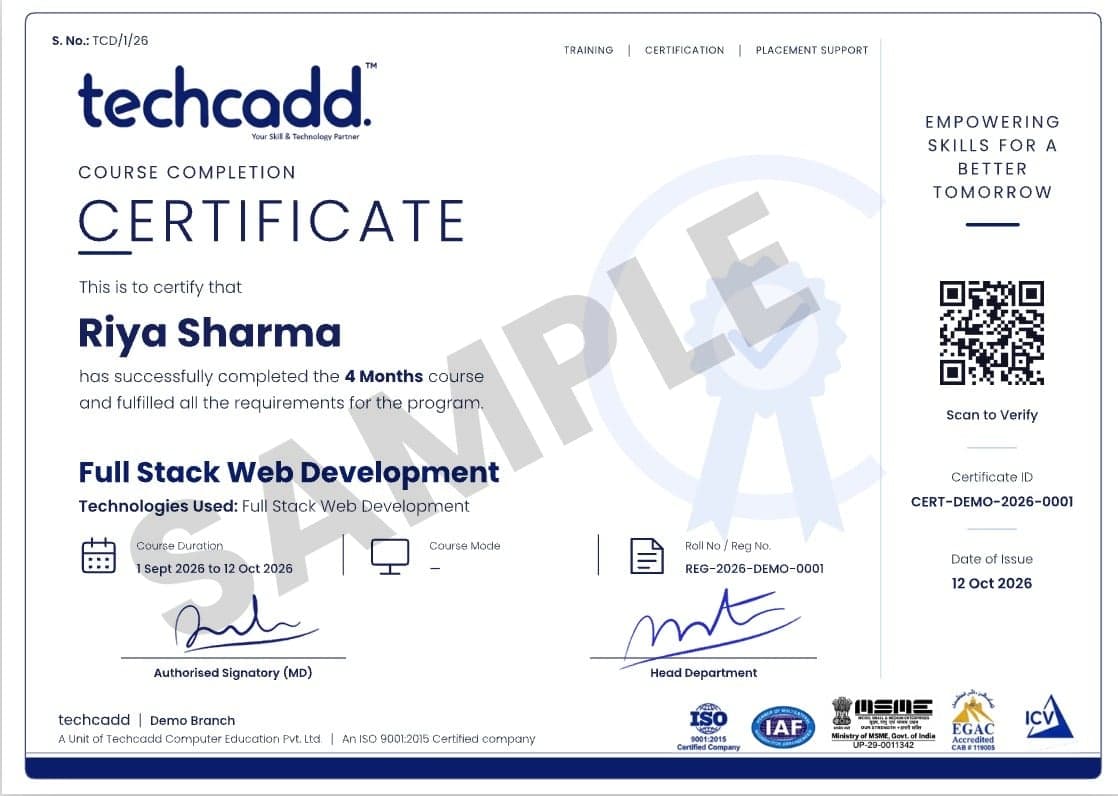
Online-verifiable certificate that lists your modules, projects and grade.
Issued for live-project work on the longer tracks and accepted for college credit.
One reviewed project per month that you can walk an interviewer through.
Resume review, mock interviews and referrals to our hiring partners.
Four roles MERN learners grow into — each one builds on the last.
Role 1 of 4
Builds the screens and interactions users see, using React, JavaScript, HTML and CSS.
Role 2 of 4
Builds the server-side routes, APIs and database logic that web applications depend on.
Role 3 of 4
Works across frontend, backend and database to deliver complete application features.
Role 4 of 4
Specialises in building and maintaining component-based interfaces with React.
Every topic in every month runs through the same three steps.
Step 1
A short concept class with a worked example — you see why before you see how.
Step 2
You build it yourself in the lab while a mentor reviews your work and unblocks you.
Step 3
You demo the result and answer questions — practice for every interview to come.
A first course after 12th should leave you with skills you can show, not notes you can't use.
You move on when your project is reviewed and working — not when the month ends.
The same tools, devices and accounts that working teams use every day.
Mentors who deliver client projects, so what you learn is what is used.
Start with 3 months and continue to 6 or 9 without repeating a single class.
Learning MERN Stack can provide a practical pathway for people who want to understand how complete web applications are developed rather than focusing only on one part of a website.
01
One of the main advantages of the MERN approach is that learners can study both frontend and backend development within one technology ecosystem. React focuses on building user interfaces, while Node.js and Express.js support server-side development and APIs, and MongoDB provides a database layer. Understanding how these components interact gives learners a broader view of application development.
02
JavaScript is central to the MERN ecosystem. Building skills around JavaScript can help learners understand programming logic, asynchronous operations, APIs, browser interaction, and application development before applying those concepts through frontend and backend technologies.
03
Full-stack development involves more than writing code. Developers need to understand requirements, design application flows, identify errors, work with data, connect APIs, and troubleshoot unexpected behaviour. Working on progressively more complex projects can help learners develop this practical problem-solving mindset.
04
Projects are an important part of demonstrating development ability. A learner can use MERN Stack projects to show knowledge of interfaces, components, databases, APIs, authentication, data handling, and application workflows. A portfolio should focus on genuine work and clearly explain what the learner built and which technologies were used.
05
MERN Stack skills can support exploration of roles such as frontend developer, backend developer, full-stack developer, React developer, Node.js developer, and junior software developer, depending on the learner's depth of knowledge and broader skill set. Learning the stack does not automatically qualify someone for every role; practical ability, projects, communication, problem-solving, and interview preparation also matter.
06
People moving from another technical or non-technical career can use full-stack development as one possible technology pathway. MERN Stack offers a structured ecosystem through which learners can progressively develop programming and application-building skills. A career switch should be approached as a skill-building process rather than simply completing a course.
07
MERN Stack technologies are associated with web application development and provide learners with exposure to frontend interfaces, backend services, APIs, databases, and application deployment concepts. The technology landscape continues to evolve, so learners should treat the course as a foundation and continue updating their skills as frameworks, libraries, development practices, and tooling change.
08
MERN Stack can also serve as a foundation for exploring areas such as cloud deployment, DevOps, testing, application security, TypeScript, system design, mobile development, or other software-development technologies. This makes the learning journey broader than simply mastering four technologies.
09
The same foundation can be adapted for different goals. A student may focus on projects and internships, a graduate may emphasize job preparation, a working professional may build development skills for a transition, and a freelancer may focus on client-oriented application development. The most valuable outcome is not simply knowing the names of MERN technologies, but being able to use them together to understand and build functional web applications.
Learners from Punjab can use online MERN Stack training to develop web-development skills without needing to relocate. The combination of IT, startups, manufacturing businesses, exports, and digitally growing local businesses creates different contexts where websites, dashboards, e-commerce systems, and business applications can be relevant. Learners near Jalandhar, Ludhiana, Amritsar, Mohali, Patiala, and Phagwara can choose online learning according to their requirements, while offline learning is available at the Jalandhar centre.
For learners in Haryana, MERN Stack can be particularly relevant to people interested in technology and software opportunities around areas such as Gurugram and Faridabad. The state's presence of MNCs, IT services, e-commerce, automobile, and logistics businesses provides useful industry contexts for understanding web applications, business platforms, dashboards, and internal tools.
Learners from Himachal Pradesh may be interested in MERN Stack for both employment-oriented development skills and remote work or freelancing possibilities. Students and professionals in cities such as Shimla, Dharamshala, and Solan can use online learning to build development skills that are not necessarily dependent on being physically located in a major technology hub. Web applications can also have relevance to tourism, hospitality, education, and local businesses.
Chandigarh and the wider Tricity region have a strong connection with education, IT/BPO services, startups, and professional services. MERN Stack can therefore be relevant for learners who want to build modern web-development skills while studying or working in the region. Online learning also allows learners to continue training alongside college or employment.
Delhi NCR offers a broad technology and business environment involving IT services, agencies, media, fintech, e-commerce, and startups. Learners from Delhi, Noida, and Ghaziabad can use MERN Stack training to build skills applicable to frontend development, backend development, web applications, dashboards, and digital products. A strong project portfolio can be particularly valuable when competing for entry-level development opportunities.
Learners from Jammu and Srinagar can use online MERN Stack learning to develop technology skills while remaining in the region. Web development can support applications and digital services connected with tourism, e-commerce, handicrafts, local businesses, and other sectors. Freelancing and remote development can also be considered as longer-term possibilities for learners who build strong technical and communication skills.
Students and professionals from Dehradun and Haridwar can explore MERN Stack as a route into web development while remaining connected to sectors such as education, tourism, hospitality, pharmaceuticals, and other businesses. Online training can be useful for learners who want to combine technical learning with college, work, or other commitments.
Learners from Jaipur and other parts of Rajasthan can explore MERN Stack for software development, freelance projects, and digital business applications. Industries such as tourism, handicrafts, jewellery, and textiles increasingly interact with online platforms and digital services, giving developers opportunities to understand how technology can support different business requirements.
Learners from Uttar Pradesh can consider MERN Stack for software-development and technology-oriented career pathways. Noida is an important technology and business environment within the state, while Lucknow and Meerut also provide different professional and commercial contexts. Online learning can allow students and working professionals to build development skills regardless of their specific city.
31 questions
9 months, with one module and one reviewed project per month. Classes are practical first: most of every session is spent building.
They share one roadmap. 3 months covers the foundations with guided projects, 6 months reaches portfolio level with an industry certificate and placement support, and 9 months adds specialisation, an internship-style capstone and placement preparation.
Yes. MERN can be learned by beginners when the path starts with programming and web-development fundamentals before moving into advanced concepts, which is how this roadmap is ordered. Basic computer skills and an interest in programming make it easier.
You learn JavaScript, React, Node.js, Express.js and MongoDB, along with APIs, frontend and backend development, database concepts, authentication basics, Git and full-stack project development.
Once your MERN foundation is strong, you can explore areas such as TypeScript, testing, cloud deployment, DevOps, application security, system design or performance optimisation, depending on your career goals.
Diploma + internship letter, a portfolio of 9 reviewed projects and placement support with resume review, mock interviews and referrals.
Yes. The program starts from zero and is open to arts, commerce, medical and non-medical students. You only need basic computer skills.
Yes. Morning, evening and weekend batches are available, and live online classes come with recordings for revision.
No institute can honestly guarantee a job. We give placement support — resume and portfolio reviews, mock interviews and referrals — and keep helping until you are placed.
Book a free counselling session or message us on WhatsApp. A counsellor will share the current fee, instalment options and scholarships for your chosen program.
A MERN Stack course is a web-development program that teaches MongoDB, Express.js, React, and Node.js for building full-stack web applications.
Yes, MERN Stack can be learned by beginners when the learning path starts with programming and web-development fundamentals before moving into advanced concepts.
You can learn JavaScript, React, Node.js, Express.js, MongoDB, APIs, frontend development, backend development, database concepts, authentication basics, Git, and full-stack project development.
No, prior professional programming experience is not necessarily required, although basic computer skills and an interest in programming can make the learning process easier.
A typical syllabus can cover JavaScript fundamentals, React, Node.js, Express.js, MongoDB, REST APIs, frontend-backend integration, authentication concepts, Git, and practical projects; the exact Techcadd syllabus should be confirmed before enrolment.
The learning time varies according to the course structure, prior programming knowledge, practice time, and individual learning pace, so the current Techcadd course duration should be confirmed directly.
Yes, MERN Stack can be learned online through structured instruction and hands-on coding practice, making it accessible to learners across different Indian states.
Yes, offline learning can be explored at the Techcadd centre in Jalandhar, Punjab, subject to current batch availability.
Depending on your practical skills and experience, possible roles include frontend developer, React developer, backend developer, Node.js developer, full-stack developer, web application developer, and junior software developer.
Yes, MERN Stack can support freelance work involving web applications, dashboards, APIs, business systems, frontend interfaces, and database-backed applications, depending on the freelancer's capabilities and client requirements.
The core technologies are MongoDB, Express.js, React, and Node.js, while supporting tools can include JavaScript, HTML, CSS, Git, GitHub, code editors, browser developer tools, REST APIs, JSON, and npm.
Yes, MERN Stack can provide a foundation for web-development careers by covering frontend, backend, database, API, and full-stack application concepts.
Yes, working professionals can learn MERN Stack through online or offline training depending on their schedule and location, although consistent coding practice is important.
Yes, students from Punjab can learn MERN Stack online, allowing learners from cities such as Amritsar, Ludhiana, Mohali, Patiala, and Phagwara to study without relocating.
Yes, learners from Haryana can join online MERN Stack training and build web-development skills while continuing their education or professional work.
Yes, students and professionals from Himachal Pradesh can learn MERN Stack online and develop skills relevant to software development, remote work, and freelancing pathways.
Yes, students from Rajasthan can learn MERN Stack through online training and use projects to develop practical skills for software development or freelance work.
Yes, MERN Stack can be suitable for learners from Uttar Pradesh who are interested in web development, software services, startups, or freelance application development.
Certificate availability and the applicable conditions should be confirmed with Techcadd because the exact certification arrangements are not established by the course title alone.
MERN Stack specifically refers to a combination of MongoDB, Express.js, React, and Node.js, whereas “web development” is a broader field that can involve many different programming languages, frameworks, databases, and technologies.
After building a strong MERN foundation, learners can consider areas such as TypeScript, testing, cloud deployment, DevOps, application security, system design, performance optimization, or other software-development technologies depending on their career goals.
Tell us your stream and goal — we will suggest the right duration, share fee details and book your free demo.
2nd Floor, Crystal Plaza, SCS 78, Opposite PIMS Hospital, Jalandhar, Punjab 144001Mon – Sat: 9:00 AM – 7:00 PM
Sit in a free demo class first. If MERN is not for you, a counsellor will help you find what is.